

The One Request Before The Clock Ran Out
The wall clock outside Rhett Hollis’s cell ticked toward six in the morning with the stubborn patience of something that had never been questioned, and when the first set of keys scraped along the bars, the sound moved through him the way winter air slips under a door, because he had spent five years learning just how loud silence could be in a place built for waiting.
He had filed motions, requested hearings, written appeals in handwriting that trembled on bad days, repeating the same sentence until it felt carved into him, and still the system gave nothing back, because paperwork does not blink when you insist you are telling the truth, and it does not soften when you say a child is growing up without you.
That morning, his voice came out rough anyway, not dramatic, not loud, just worn down like a coin passed through too many hands.
“I need to see my daughter.”
The younger guard hesitated in a way that looked almost human, while the older one made a quiet sound of disgust and stared at the floor, as if the request itself had dirtied the air.
“You don’t get requests,” the older one said, because he had decided long ago that mercy had no place in the job.
Rhett swallowed, because begging was a taste you never got used to, and he forced the words out carefully, as if calm might keep them from being denied.
“She’s eight. I haven’t seen her in three years. I’m asking for one visit, that’s all.”
The Warden Who Didn’t Believe In Coincidence
The request should have ended in that hallway the way most did, swallowed by routine and indifference, but it reached Warden Everett Callahan, a man close to retirement who had seen too many men break and too many others pretend they hadn’t, and when he reopened the Hollis file, the same unease returned, because the evidence was neat in the way staged rooms are neat, where everything looks right and still something feels off.
There were prints on a weapon, stained clothes, a neighbor who eventually claimed he saw Rhett leaving the house that night, and a case praised for its speed and “clarity,” but Callahan had spent decades learning that clarity can be constructed, while a certain kind of fear cannot.
Rhett’s eyes in the intake photo had stayed with him, not because they looked innocent in any sentimental way, but because they were stubborn, angry, almost offended by the idea that truth could be ignored.
Callahan picked up the phone and kept his tone flat, as if he were requesting something routine.
“Bring the child in.”
The Girl With The Quiet Walk
A white county vehicle pulled up hours later, and a social worker stepped out holding the hand of a small girl whose blond hair had been neatly brushed, though her expression remained serious, the way children look when they’ve learned early that crying doesn’t change outcomes.
Her name was Elowen Hollis, and she was eight years old, but her eyes carried something older than that, something like a locked drawer no one had found the key to, and as she walked through the corridor, she didn’t shrink from the noise, didn’t flinch at the voices, and didn’t ask where her father would sit, because she already knew.
Men behind doors went quiet as she passed, not because of rules, but because of that instinct adults sometimes feel when a child looks too composed, because composure in a child often means someone taught them how to hide.
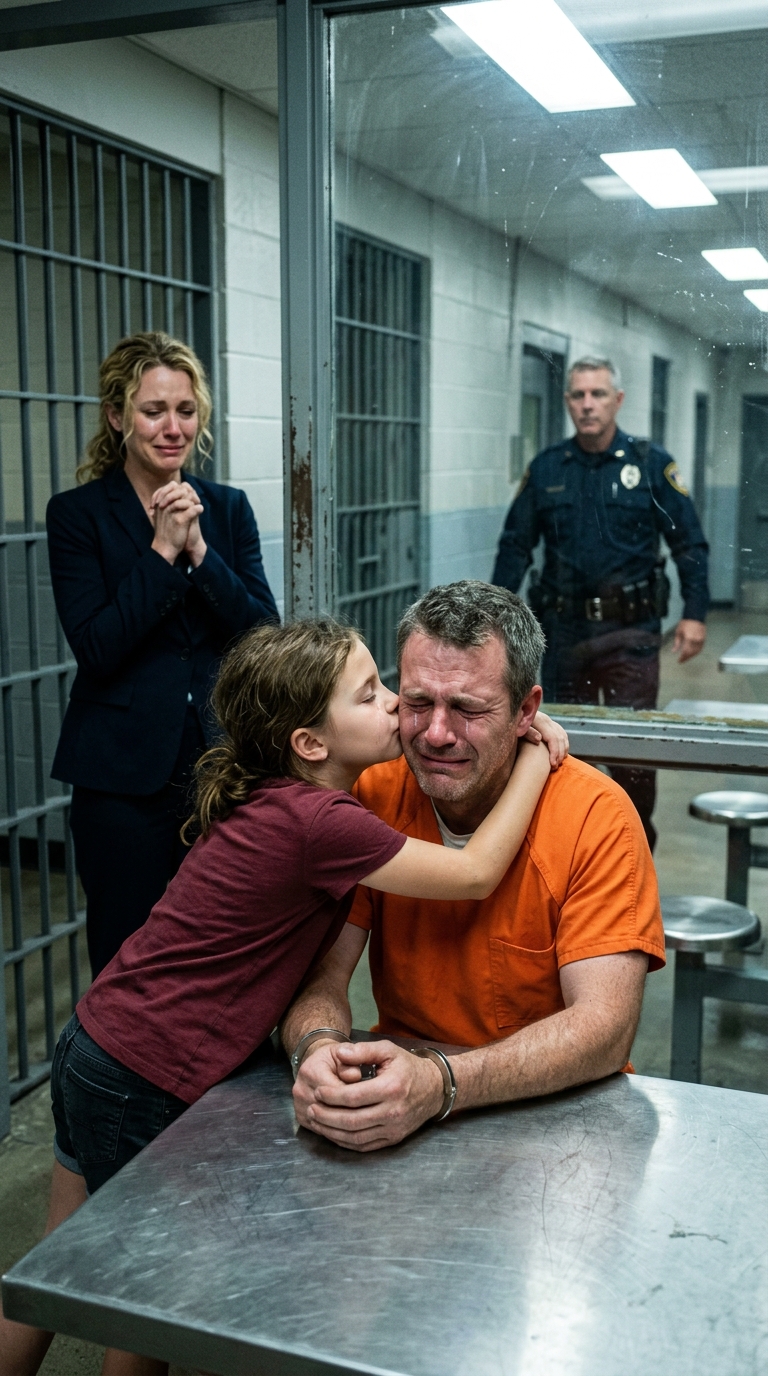
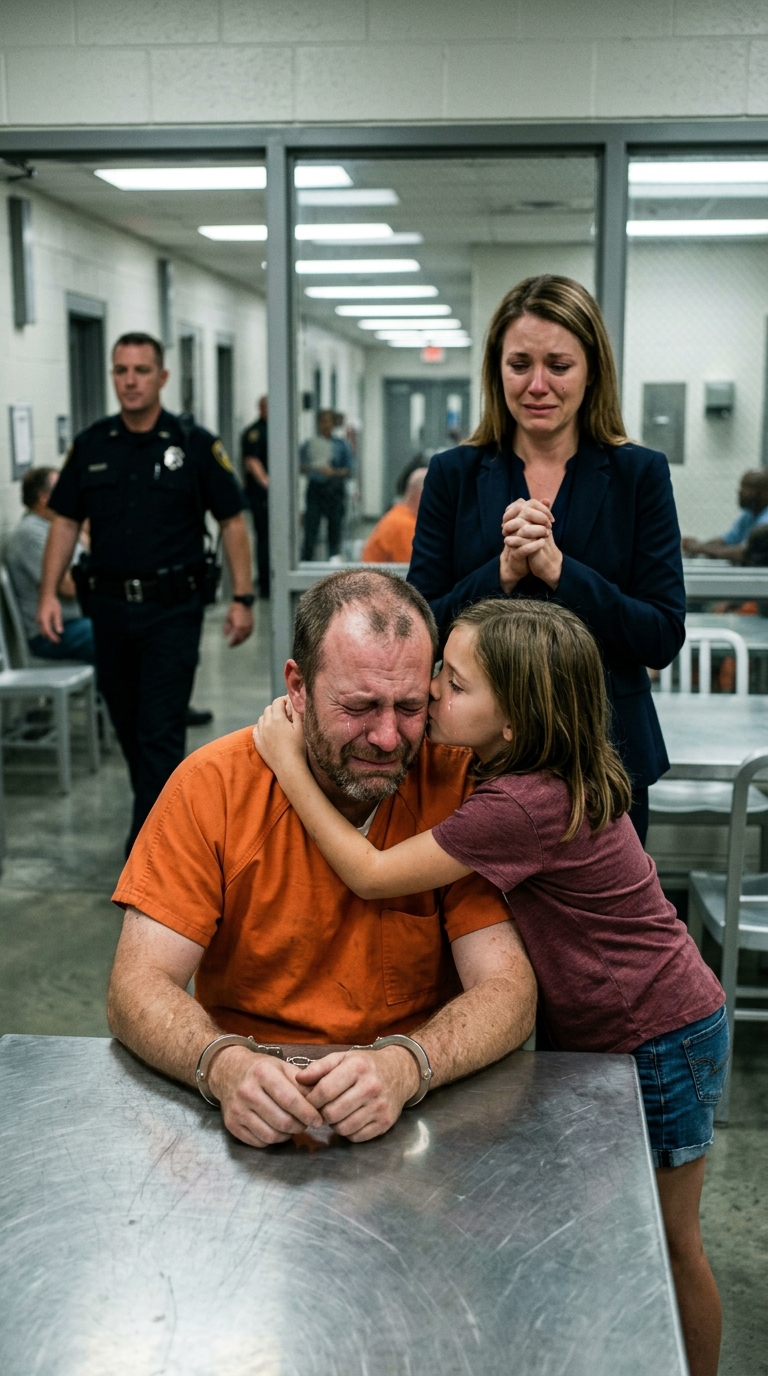
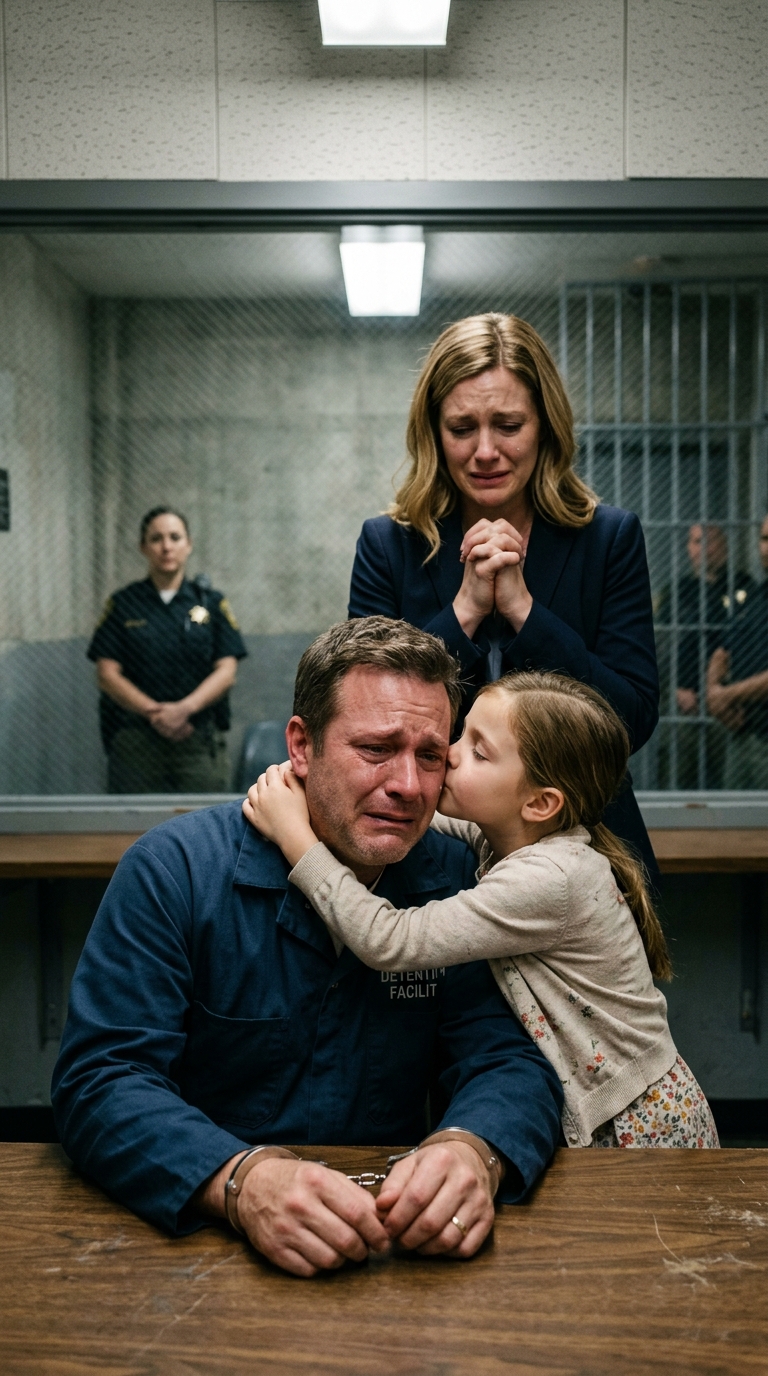
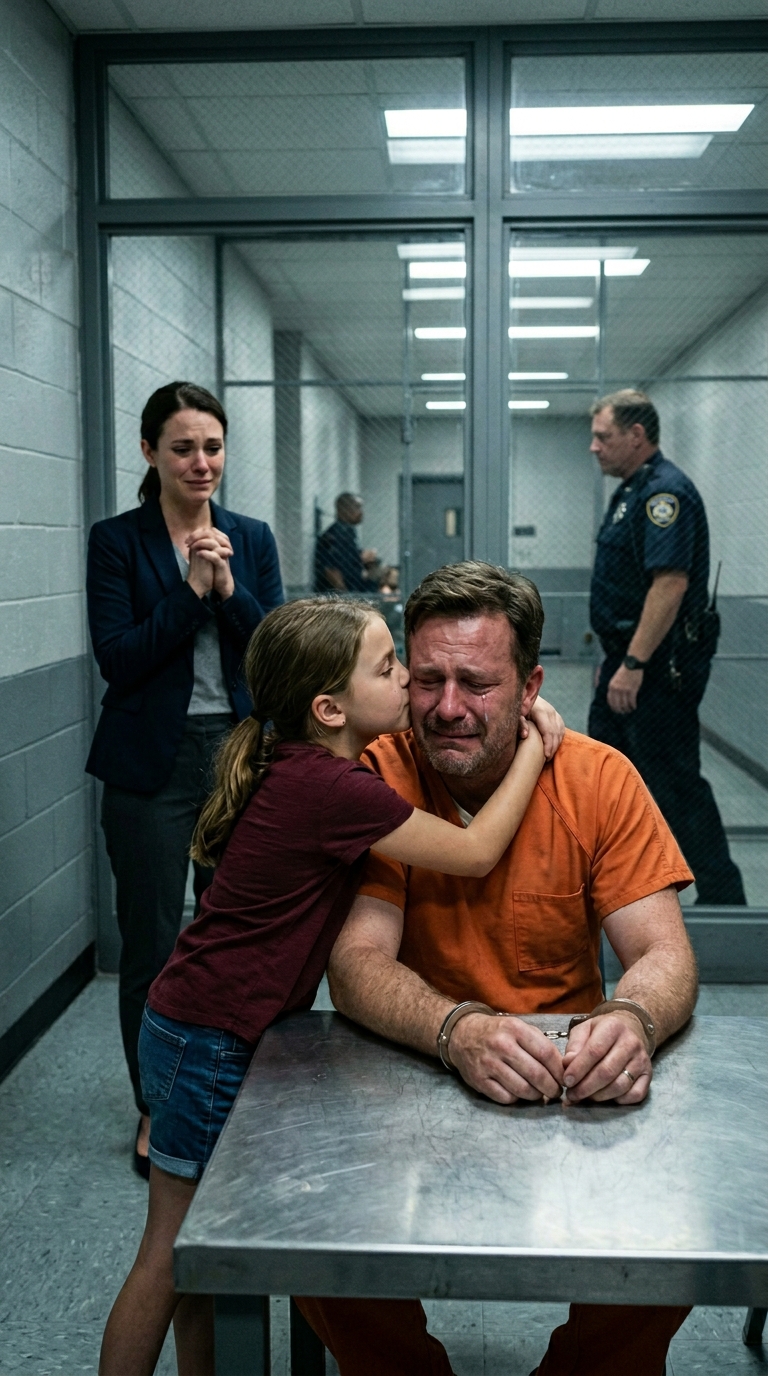
In the visitation room, Rhett sat cuffed to a metal table in a faded orange uniform that hung loosely on his shoulders, and when he saw her, his face changed in a way that made the guards look away, because nothing in that room could match the rawness of a parent seeing a child who had continued growing without him.
His voice broke anyway, despite his effort to hold it steady.
“Ellie.”
Elowen let go of the social worker’s hand and walked toward him without running, as if she needed to arrive with control, and Rhett lifted his hands as far as the chain allowed, because he had rehearsed this moment in the dark so many times that his body moved before his thoughts could catch up.
She stepped close and wrapped her arms around him, and for a full minute neither of them spoke, because sometimes the first language needed is simply presence.
Then Elowen leaned up, placed her mouth near his ear, and whispered.
The Whisper That Made The Room Tilt
No one else heard the words, but everyone saw what they did.
Rhett went pale, as if the air had been pulled from his chest, and his shoulders began to shake in waves he couldn’t control, while tears that had been held back for years broke loose into something rawer, something that made the chain at his wrists clink with every tremor.
He pulled back just enough to look at her, and his eyes held two things at once—horror and hope—a combination that made him look suddenly younger.
“Are you sure?” he asked, his voice breaking.
Elowen nodded once, small and certain, as if she had already decided she wouldn’t take the words back.
Rhett stood so quickly the chair scraped and fell, and the guards moved in, hands ready, but he wasn’t rushing the door—he was pointing at himself, like a man trying to prove he still existed.
“I didn’t do it,” he shouted, because the sentence finally carried weight. “I’ve said it for years, and now I can prove it.”
A guard reached for Elowen to pull her away, but she tightened her arms around her father with a strength that didn’t match her size, and her voice came out clear, not loud, just steady.
“It’s time people heard the truth.”
Seventy-Two Hours Bought With Instinct
Behind the observation glass, Warden Callahan watched the security footage replay, because the camera didn’t care about reputation and didn’t soften details, and the sequence was simple—a hug, a whisper, a man changing in a single breath, and a child repeating a sentence that sounded older than her years.
Callahan dialed a number he avoided unless necessary, because it came with consequences.
“I need a seventy-two-hour hold,” he said to the state official on the other end, skipping formalities the way people do when something urgent is already burning.
There was a pause that lingered long enough to feel like a challenge.
“That procedure is scheduled,” the official replied, clipped and impatient. “Everything is set.”
Callahan stared at the frozen image of Elowen’s face on the monitor and felt that same instinct press against his chest.
“There’s potential new evidence,” he said. “I won’t move forward until it’s checked.”
The silence returned, heavier now, before the answer came like a reluctant door opening.
“Seventy-two hours,” the official said. “Not a minute more, and if you’re wrong, your career goes with it.”
Callahan hung up and watched the screen again, because what stayed with him wasn’t Rhett’s shouting—it was the way a child had walked in like someone carrying a truth that had finally become too heavy to hold alone.
A Retired Lawyer Who Still Heard Old Mistakes
Two hundred miles away, in a modest home where the furniture had been chosen for comfort rather than display, Marjorie Keene ate a quiet dinner in front of the evening news, because retirement had not given her peace so much as it had given her time to remember.
She had once been the kind of defense attorney judges spoke about with a mix of admiration and irritation, because she didn’t fold easily, and because she could sense a manufactured story the way some people smell smoke, but three years earlier a serious medical scare had forced her to step back, and everyone around her had called it “rest,” as if the mind understood that word.
On the screen, a reporter described an incarcerated man’s final request to see his child, then mentioned the sudden hold, the unusual reaction, the rumor that the child had said something that shifted the entire case.
Marjorie’s fork paused halfway to her mouth when Rhett Hollis’s booking photo appeared, because she recognized that look—not the face, but the look—the furious disbelief of a man watching the system close in on him.
Thirty years earlier, she had seen another man with that same expression lose everything while the court congratulated itself, and the regret had followed her into every quiet room she had ever entered.
She reached for her phone.
“Perry,” she said when her former investigator answered, her voice already moving faster than her body liked. “I need everything on the Hollis case, and I need it tonight.”
The Home Where Children Kept Secrets
The next day, Marjorie drove to a county-run youth residence outside a small Kansas town, a place surrounded by old trees and a kind of silence that felt intentional, and she showed a badge that was no longer valid with the confidence of someone who had learned that most doors open if you act like you belong.
The director, Nadine Voss, was in her seventies, sharp-eyed, tired in the way caregivers become tired, and she didn’t offer warmth easily.
“That child is protected,” Nadine said. “No unauthorized visits.”
Marjorie kept her voice steady, because urgency could make people defensive.
“I’m not here to frighten her,” she said. “I’m here to understand how she ended up here, and what happened after she saw her father.”
Nadine studied her for a long moment, then exhaled like someone choosing to risk being wrong.
“She arrived six months ago,” Nadine said. “Brought in by her uncle, Spencer Hollis, who claimed he couldn’t manage her and that she needed structure.”
Marjorie’s focus sharpened at the name, because family members who arrive with neat explanations often carry hidden motives.
“Was she okay?” Marjorie asked.
Nadine’s mouth tightened.
“She had bruises on her arms,” she said quietly. “Nothing extreme, but enough to raise questions, and she barely spoke, barely slept, and woke up shaking from dreams like she was running from something she couldn’t explain.”
Marjorie felt something cold settle behind her ribs.
“And after the prison visit?”
Nadine looked down at her hands.
“She stopped talking entirely,” she said. “Doctors found nothing physical, so it’s like she closed a door inside herself, like she said what she came to say and then locked everything else away.”
Through the window, Elowen sat alone with a box of crayons, drawing with the focus of someone mapping something only she could see.
The Night Everyone Thought They Understood
Marjorie spent the evening with the Hollis file spread across her dining table, because the case had been presented as straightforward, and yet the details kept catching like thread on a nail.
The neighbor witness, Brock Delaney, initially reported seeing “a man” leaving the house near eleven, and only later became certain it was Rhett, which Marjorie had learned was the kind of certainty that could be shaped under pressure, while the forensic work had been completed with suspicious speed, arriving just in time to seal the arrest.
The lead prosecutor at the time, Julian Pruitt, had built his reputation on efficiency, and three years after the conviction he had risen to a judgeship, the kind of career path often built on a single celebrated case.
Marjorie checked public records the way she once checked alibis, and her stomach tightened when she found business filings linking Judge Pruitt to Spencer Hollis through a shared development company, the kind that moved property quietly while public attention stayed elsewhere.
She called Perry again, her voice low and firm.
“Find out what Spencer bought after Rhett’s conviction,” she said. “Every parcel, every transfer, every partner, and tell me what Rhett’s wife was looking into before that night.”
The Uncle Who Wore Good Manners Like Armor
Spencer Hollis arrived at the youth residence two days later in a black luxury SUV, dressed in a tailored suit and a composed smile that looked practiced, the kind men wear when they expect doors to open because they’re used to paying for hinges.
“I’m here for my niece,” he said to Nadine without greeting, sliding paperwork across the desk. “I’m her legal guardian, and with everything happening, she should be with family.”
Nadine didn’t touch the papers, because she had spent enough years around children to know that “family” can be a threat just as easily as it can be a refuge.
“You gave up that role when you left her here,” Nadine said evenly. “She’s under state protection.”
Spencer’s smile cooled slightly.
“Circumstances changed,” he said, leaning in just enough to crowd the space. “Her father is out of time, and she needs someone who can provide for her.”
Nadine met his eyes without blinking.
“She needs safety,” she said. “And she arrived with bruises no one explained.”
For a brief second, Spencer’s mask slipped, something hard flashing behind his gaze, before the smile returned like a curtain drawn back into place.
“Be careful what you imply,” he said. “I know people. I can make this place very uncomfortable for you.”
Nadine’s hand moved under the desk toward a small button, because she had already decided that if he threatened her, she wanted it recorded, and when she spoke again, her voice remained calm.
“You’re welcome to leave,” she said. “And if you return with threats, I’ll use what I have.”
Spencer’s smile sharpened.
“This isn’t over,” he said softly, and he left with the kind of confidence that comes from believing consequences are for other people.
The Truth Rhett Could Finally Say Out Loud
Marjorie met Rhett in a cold visitation room where the air carried the faint scent of bleach, and she studied him the way she had always studied clients—not for tears, not for charm, but for consistency, because truth tends to hold the same shape no matter how many times you return to it.
“Tell me what happened that night,” she said, not pretending this would be easy.
Rhett’s hands tightened around the edge of the metal table.
“I lost my job that week,” he said, his voice steady but worn, as if the memory had been repeated until it lost its edges. “I drank too much, passed out on the couch, and woke up to sirens and confusion and my wife on the floor, and everyone filled in the rest like it had already been decided.”
Marjorie leaned forward, eyes steady.
“And your daughter?”
Rhett swallowed.
“She was there,” he said. “She told me she saw someone come in after I passed out—someone she recognized, someone wearing a blue shirt, moving like he owned the place.”
Marjorie’s mind moved instantly to Spencer, but her face didn’t change.
“Did she name him?”
Rhett’s voice dropped for the first time.
“She said it was my brother.”
The Man Who Didn’t Disappear, He Hid
Perry returned with documents that made the pattern impossible to ignore, because Spencer’s purchases began right after Rhett’s conviction, and several of them tied back to property once connected to the Hollis family, while Judge Pruitt’s name appeared quietly in the background—approving filings, smoothing transactions, making everything look legitimate.
Then Nadine called Marjorie late that night, her voice unsteady.
“She’s drawing again,” Nadine said. “But this time she wrote something, and I don’t know what to do with it.”
Marjorie sat upright, her pulse quickening.
“What did she write?”
Nadine hesitated.
“She drew three people holding hands under a bright sun,” she said. “Then she wrote one word beneath it, and she spelled it carefully, like it mattered.”
Marjorie’s grip tightened around her phone.
“What word?”
Nadine’s voice dropped.
“Mom.”
Marjorie went still, because the entire case had been built on the assumption that the mother was gone, and children don’t write a word like that without meaning.
Before Marjorie could respond, Perry sent a message that made her breath catch—a name, a location, and a note that someone connected to the Hollis home, a maintenance worker named Cory Latham, had disappeared days after the incident, leaving behind a worried mother in rural Oklahoma whose reports had gone nowhere.
Marjorie stared at the message until the letters blurred.
The Meeting In The Small House Off The Highway
Marjorie drove through the night to a forgotten town outside Tulsa, because her body was tired and her doctor would have objected, but guilt has a way of pushing people forward, and she arrived at a small house where an elderly woman waited on the porch like she had been counting headlights.
Inside, Cory Latham stood from a worn chair, thinner than he should have been, his eyes cautious, his hands still.
“Ma’am,” he said quietly, “I didn’t want to pull you into this, but that man in there doesn’t have time.”
Marjorie’s throat felt dry.
“If you’re alive, why did you stay hidden?” she asked.
Cory glanced toward the back room.
“Because the people who did this don’t lose often,” he said. “And because the person you need to hear from had to decide she was ready.”
The door opened, and a woman stepped into the room—short hair, a face marked by years she shouldn’t have had to carry, but her eyes were unmistakable, because Marjorie had studied them in photographs until she knew them.
Her name had changed, her posture more guarded, but she was Rhett’s wife, Hannah Hollis.
“I’m Hannah,” she said, her voice rough. “And I’ve been waiting to bring this into the light the right way.”
Marjorie sat down because her body demanded it.
“You let him sit in there for five years,” Marjorie said, not accusing, just stunned.
Hannah’s eyes filled, but her voice didn’t break.
“I let him live,” she said. “Because if I stepped forward too soon, Spencer would have finished what he started, and Elowen would have paid for it.”
The Recording That Didn’t Care About Power
Hannah pulled out an old phone, the kind people keep long after they’ve replaced it, and her fingers only shook slightly as she pressed play.
A man’s voice filled the room—controlled at first, then sharper—and Marjorie felt her skin tighten as she recognized the tone of entitlement.
“You really thought you could ruin me,” the voice said, followed by Hannah’s voice from years ago, pleading but unyielding.
Hannah stopped the recording before it went too far and met Marjorie’s gaze.
“There’s more,” she said. “There’s a second recording where he calls Judge Pruitt, and they talk like this is just business.”
Cory’s jaw tightened.
“That night I went back for tools,” he said, staring at the floor like he still saw it there. “I saw Spencer inside. I saw him set things up to frame Rhett. I got Hannah out through the kitchen window while he was busy making sure the story looked clean.”
Marjorie steadied her breathing, because emotion was loud, but the court needed structure.
“We go to a judge who can’t be bought,” she said, her voice sharpening into the one she used to carry into courtrooms. “And we do it now.”
The Judge Who Still Believed The Job Meant Something
Marjorie called Judge Lillian Sutter, a woman known for being relentlessly fair in a way that made dishonest people uneasy, and within the hour they were in a private courtroom with security posted, because if the wrong people caught wind of this, the evidence could disappear as easily as it had been arranged.
Judge Sutter listened without interruption as Marjorie laid out the timeline, the property connections, the missing witness, the child’s drawings, and then Hannah’s recording, which filled the room with the cold clarity of people speaking when they believe no one can stop them.
When it ended, the judge’s expression didn’t soften, but her eyes sharpened.
“If this is authenticated,” she said quietly, “this isn’t just a wrongful conviction—it’s a coordinated abuse of the system.”
Marjorie held her gaze.
“Then let’s stop the state from making an irreversible mistake,” she said.
Judge Sutter picked up her phone and gave orders in a tone that made everyone move faster.
“Immediate hold,” she said. “Bring me officials not tied to Judge Pruitt, seal this hearing, and prepare a warrant.”
Elowen’s Sentence, Finally Spoken
Back at the youth residence, Nadine sat beside Elowen with a fresh sheet of paper, and the girl drew three figures again—the same bright sun, the same joined hands—then she paused, as if listening for permission only she could hear.
Nadine kept her voice gentle.
“You’re safe here,” she said. “You can tell me what you need to tell me.”
Elowen’s lips parted, and when she spoke, it was small but clear, the first sound in days that came from her own choice.
“My mom told me to stay quiet,” she whispered. “She said the moment would come, and I would know.”
Nadine felt tears rise without warning.
“Is that what you told your dad?” she asked.
Elowen nodded once.
“I told him she’s here,” she said. “I told him she didn’t forget us.”
The Gate That Opened Under Daylight
By midafternoon, Warden Callahan received the order, read it twice, and exhaled with a mix of relief and anger, because relief meant someone might be saved, and anger meant the system had nearly done something it could never undo.
Rhett Hollis was brought out, cleaned up, handed a small bag with his few belongings, including an old photo of Elowen as a toddler, and when he stepped toward the final gate, sunlight hit his face in a way that made him squint, because he had spent years under lighting that made every day look the same.
Callahan walked beside him to the threshold.

“I should’ve pushed harder sooner,” Callahan said quietly.
Rhett shook his head.
“You listened when it mattered,” he said. “That counts.”
Outside, Hannah stood near a worn car, with Cory a few steps behind her, while Elowen stayed close to Nadine—until the moment she saw her father.
Then she ran.
She collided with him like she belonged there, arms wrapped tight, her voice close to his ear, warm and certain.
“I told you,” she said. “I told you it was time.”
Rhett held her as if the world might try to take her again, then lifted his eyes to Hannah, who stood very still, hands clasped, eyes shining, because she had spent five years balancing between survival and hope.
The first words that came weren’t polished.
“You’re real,” he whispered.
Hannah stepped closer, her voice trembling but steady.
“I’m here,” she said. “And we’re done letting Spencer decide our lives.”
Rhett nodded, breath unsteady, because the story finally made sense—the missing pieces locking into place, the betrayal no longer a blur but a name, a face, a pattern.
He lowered himself to Elowen’s level, cupping her cheeks carefully, as if she were something fragile and priceless.
“Thank you,” he said, his voice thick. “Thank you for being brave when grown-ups weren’t.”
Elowen smiled—a small, real smile that hadn’t been there in a long time.
“We can go home now,” she said.
Hannah reached out and touched Rhett’s arm—not gripping, just grounding—and the three of them stood in the afternoon light like a family slowly stitched back together, one careful thread at a time.
Marjorie watched from a short distance beside Nadine, finally letting herself breathe, because some victories don’t come with applause, and still they are the reason you keep going.
Nadine wiped at her eyes and gave Marjorie a look with a trace of tired humor.
“Stubborn women,” she murmured.
Marjorie’s lips curved slightly.
“It’s a tradition,” she said, and for once, the word felt like a gift instead of a burden.
