

THE NIGHT THE SNOW WOULDN’T STAY QUIET
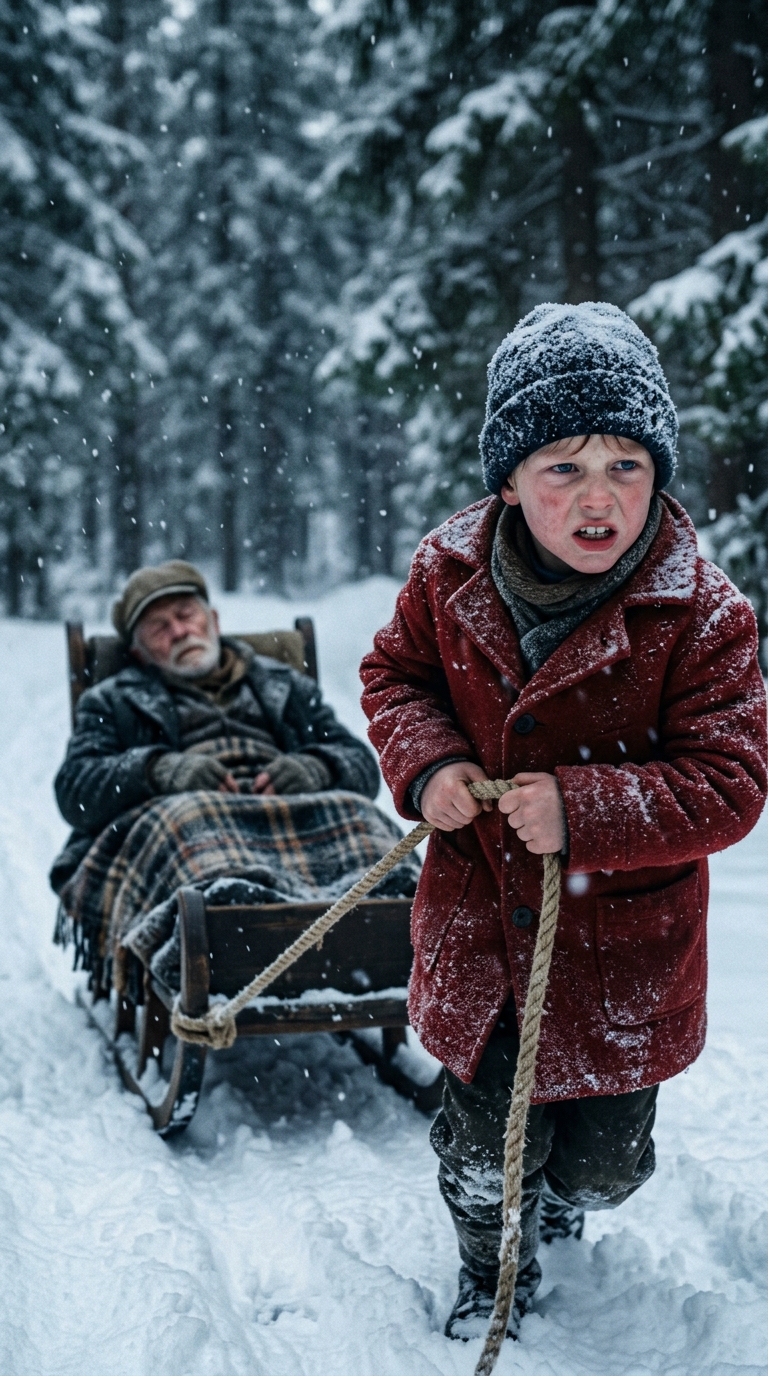
By the time the storm had finished locking the world in place, it felt like the land itself had decided to stop answering to anyone, and along a forgotten stretch of asphalt once called Route 19, where evergreens bent under layers of ice like weary elders, a small figure pushed forward through the white with the quiet determination of someone who had learned early that hesitation could cost more than effort ever would.
Mara Bell was eleven, though hunger and long nights had a way of stretching time until age felt uncertain, and she dragged a wooden sled behind her, its runners groaning at every step as if even the tools she relied on wanted to give up and wait for morning. Snow climbed into her boots, soaking through seams that had long since lost their fight with water, and the wind circled her head—not roaring, but whispering insistently, like it believed she might still listen.
Her coat had once belonged to someone bigger, stronger, warmer, and now it hung from her frame like a promise meant for the wrong person, sleeves folded again and again until they knocked against her wrists. Her hands, wrapped in mismatched socks tied with fraying cord, pulsed between burning pain and numb emptiness in a rhythm she recognized as dangerous.
Stopping wasn’t an option, because stopping brought thoughts, and thoughts brought memories, and memories froze harder than snow ever could.
WHAT THE HOUSE LEFT BEHIND
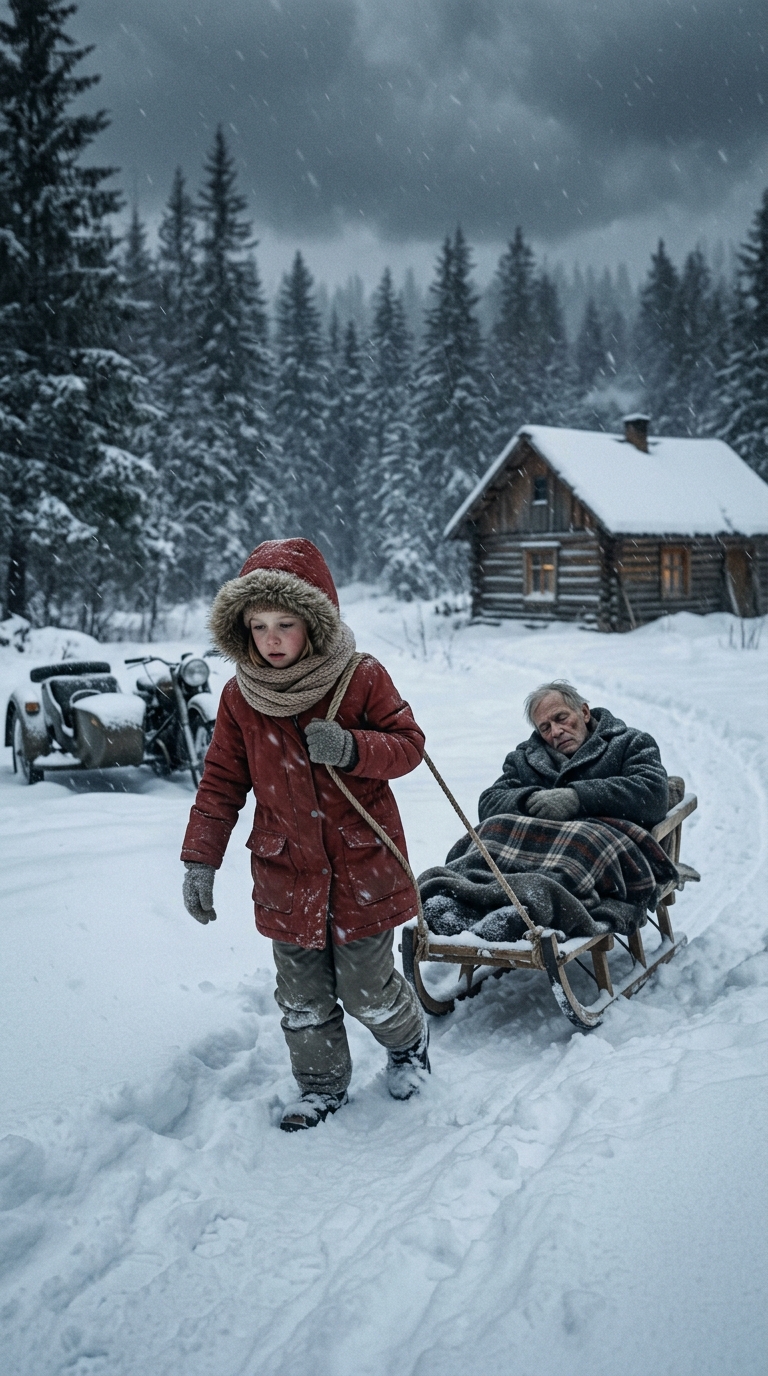
Two nights earlier, Mara had slipped away from Ashwick Youth Residence without ceremony, without goodbyes, and without the kind of dramatic anger people like to imagine when children run. She had simply waited until the arguments downstairs softened into exhausted silence, then eased the door open, letting the cold rush in like it had been waiting patiently.
Earlier that day, she had listened from the narrow space behind a broken supply closet as the administrator, Ms. Caldera, spoke calmly to a visiting inspector about balanced meals, working heaters, and spare beds that didn’t exist. Mara knew the truth the way you learn the layout of a dark room—by memory. Which floorboards creaked. Which corners held the deepest cold. Which younger children cried themselves quiet because noise drew the wrong kind of attention.
When the storm warning came, and Ms. Caldera packed her car with luggage and promises that never returned, Mara understood something with a clarity so sharp it almost felt like relief: no one was coming to fix this.
She left before food became leverage, before fear made people careless, and headed toward a closed maintenance depot she remembered from a previous placement that had ended without explanation. It wouldn’t be warm, but it would be solid—and sometimes solid was enough.
THE SHAPE BENEATH THE SNOW
She noticed the metal because it caught the light differently, a curved edge refusing to disappear into the white like everything else, and at first she told herself it was just debris—the remains of something abandoned—which would have made it easier to ignore.
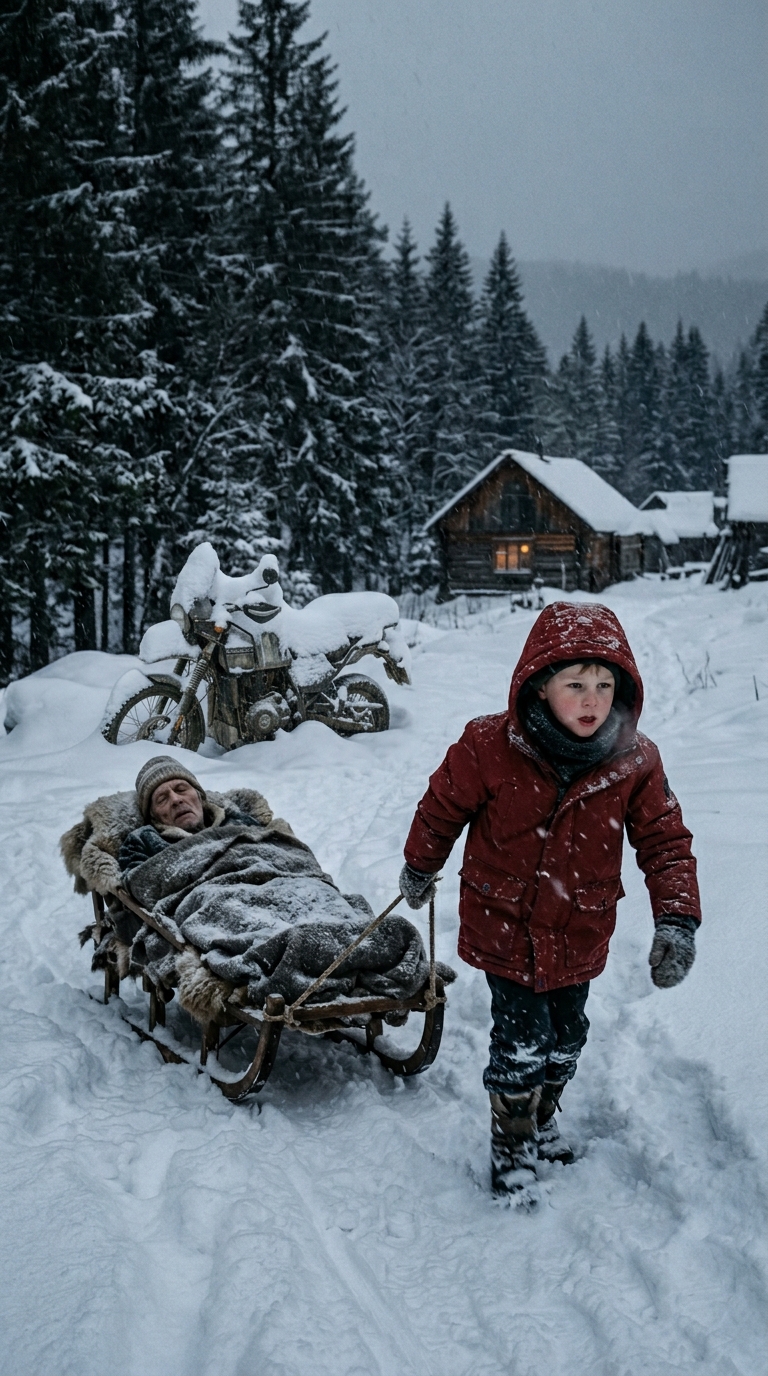
But curiosity pulls in its own way, and as she dragged the sled closer, legs trembling, breath cutting sharply in her throat, she uncovered the side of a motorcycle tipped awkwardly into the drift, its weight pressing deep into the ground as if it had tried to hide.
Beside it lay a man.
He was large in a way that made the snow around him seem cautious, his leather jacket stiff with ice, one arm stretched forward as if reaching for something already gone. For a moment, Mara felt that old instinct rise—the one that warned her that grown men meant questions, and questions meant uniforms, and uniforms meant files that followed you like shadows.
She stepped back.
Then his hand moved. Just slightly—enough to disturb the thin crust of snow covering his fingers.
The wind sharpened, as if irritated by her hesitation, and before she could argue with herself, Mara dropped the rope and knelt beside him, brushing snow from his face until she saw the dark mark along his temple—evidence of a story she didn’t yet understand.
She leaned closer, searching for proof, and when his lips parted and released a thin, uneven breath that barely fogged the air, something inside her decided before fear could catch up.
“Stay,” she whispered, her voice trembling more than she liked, “just stay.”
STRENGTH THAT WASN’T MUSCLE
He didn’t wake—not fully—but when she shook his shoulder, gently at first and then with urgency growing in her hands, his eyes flickered and a sound escaped him that wasn’t quite words, but close enough to hope.
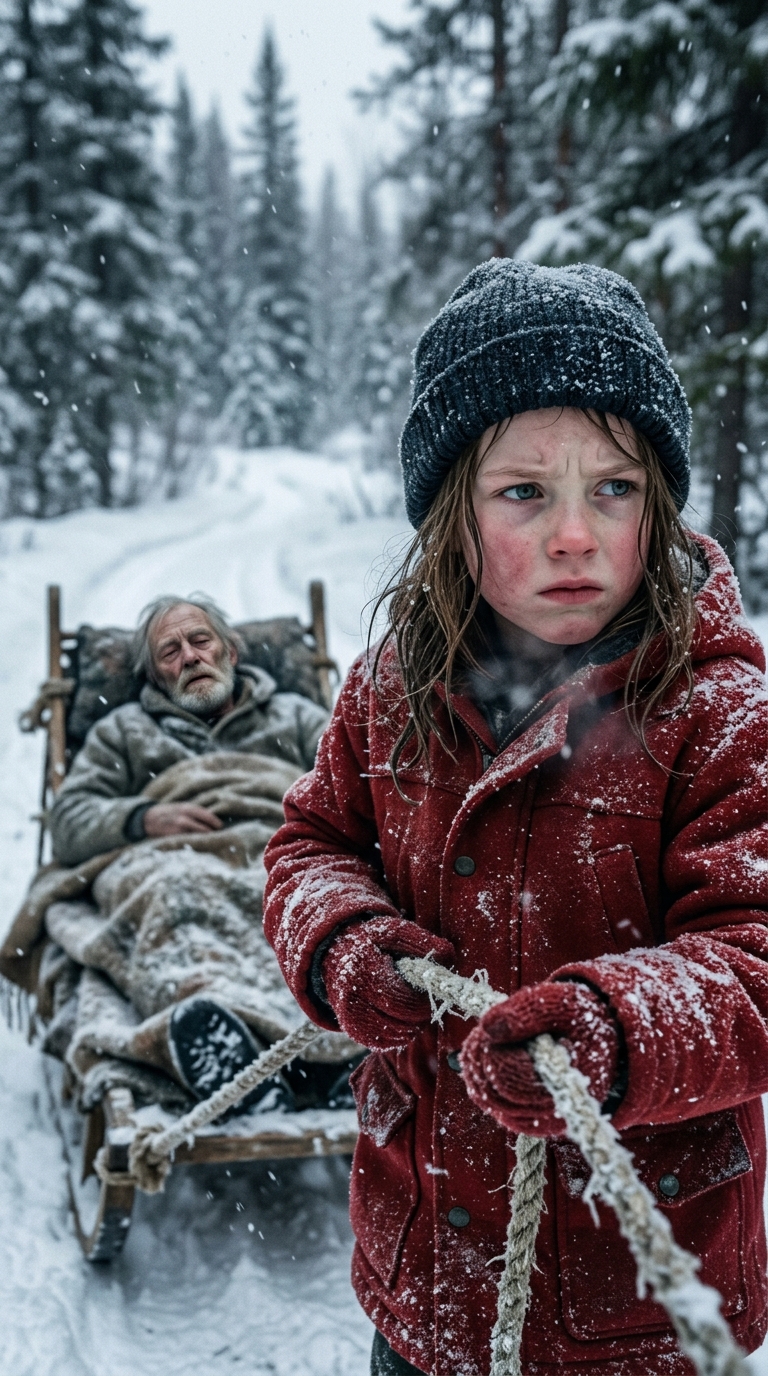
Mara was small, and she knew exactly how small, because the world never let her forget—but desperation changes the rules of strength. She slid her arms beneath his shoulders, leaned back until her heels dug into the ice, and pulled.
The snow resisted like it had something to prove, refusing to release him, but she didn’t stop. Inch by inch, she dragged him toward the faint outline of the depot, barely visible through the storm like a rumor. Her lungs burned, her vision blurred, and her thoughts reduced to a single command she repeated until it felt carved into her bones: keep moving.
When she finally forced the warped door open and pulled him inside, darkness swallowed them both. She collapsed for a brief second beside him, then forced herself back up, because she had learned that rest only comes after necessity is met.
A FIRE BUILT FROM WHAT REMAINED
She built the fire from whatever she could find—crumpled paper, broken wood, a lighter she had taken long ago from a place where adults didn’t notice small things going missing—and she coaxed the flame carefully, shielding it with her body until warmth slowly pushed back against the cold clinging to everything.
She worked his jacket open with careful hands, easing away the wet layers until she could cover him with the dry pieces she carried, murmuring reassurances she wasn’t even sure were meant only for him. Scars crossed his skin in quiet lines—evidence of a life lived in ways she couldn’t yet understand—and she looked away, focusing instead on the steady rise and fall of his chest.
Time stretched, marked only by the low crackle of the fire and the wind pressing insistently against the walls, until his eyes snapped open and his hand shot out, gripping her wrist with sudden strength.
“Promise me,” he said, voice raw and uneven, “you have to find her.”
Mara froze, her heart racing.
“Who?” she asked, barely louder than the fire.
“The girl,” he murmured, his gaze unfocused, “Mara. I said I would.”
The room seemed to tilt.
No one used that name.
THE NAME SHE NEVER GAVE
When his grip loosened, she pulled back and pressed herself against the wall, watching him with a mix of fear and disbelief, because that name was something she kept hidden deep inside, something she abandoned each time she moved, each time she became someone easier to place.
He slipped into restless sleep again, his breathing uneven, and when he woke later, steadier but still weak, he asked for water and offered a name of his own.
“Call me Hale,” he said, after a pause that suggested other names had been left behind. “Most people don’t use the one I started with.”
She told him it sounded made up, and he gave a faint smile, one that cost him more than he let on.
“Real names,” he said, “tend to complicate things.”
He spoke around the pain in his ribs, avoided questions about how he ended up there, and when he thought she wasn’t watching, tension tightened his face in a way that told her he was holding himself together by sheer will.
WHAT THE JACKET HELD
While he slept, Mara kept the fire alive and arranged their small space, and that was when she found the pouch hidden inside his jacket—sealed against the elements, tucked close as if it mattered more than comfort.
Inside were photographs that made her hands shake, because the woman smiling back at her, dressed in a uniform and holding a toddler with familiar eyes, was someone she recognized from dreams she had taught herself not to trust.
Her mother.
The letter beneath the photos changed everything Mara thought she knew, written in a careful hand that felt close despite the distance of time. It explained that she had not left—that she had uncovered something tangled and wrong within systems meant to protect, and that she had hidden what she learned inside songs and stories, trusting her child would remember when the moment came.
Mara sat still, listening to the fire breathe, realizing slowly that memory itself could be a kind of shelter.
ENGINES IN THE SNOW
They heard it before they saw it—a distant hum cutting through the storm with purpose—and Hale’s eyes sharpened the moment the sound reached him, his body tensing despite everything.
“That’s not rescue,” he said quietly, forcing himself upright. “That’s retrieval.”
Fear returned, fast and sharp—but now it carried direction. And when the door burst open and figures moved through the snow with an intent that felt anything but kind, Mara ran, her heart pounding, clutching the truth she had been trusted with.
What followed wasn’t just pursuit—it was revelation. Loyalties fractured. Voices rose. Men who once stood together found themselves on opposite sides of something far larger than any single promise or patch.
The storm finally began to break under the sound of engines climbing the ridge, riders arriving like an answer made real, and when authorities followed—drawn by numbers and names hidden in childhood rhymes—the night loosened its hold at last.
MORNING WITHOUT RUNNING
When morning came, pale and cautious, it found Mara standing beside Hale beneath a sky washed clean, a marker placed where silence had once lived—her mother’s name carved where it could no longer be lost.
For the first time, Mara didn’t feel the need to keep moving.
She had been seen.
She had been chosen.
And in the quiet that followed, she understood something new—that courage doesn’t always arrive loudly. Sometimes it wears borrowed coats and walks into storms simply because no one else is left to do it.
