

PART 1: The Boy Inside the Doghouse
I arrived home from a trucking assignment six days earlier than expected and discovered my eight-year-old son curled inside our dog’s wooden shelter in the freezing cold. When I demanded an explanation, my wife showed almost no concern. “He wet the bed again,” she said. “If he can’t behave like a child, he can sleep where the dog sleeps.” My name is Julian Salcedo. I’m forty-two, and I haul refrigerated freight across the United States. Our home is outside Springfield, Missouri, where winter nights can turn dangerously cold. I had spent twenty-three days driving through several states, convinced those long stretches away were helping me give my family a better life.
Matthew was four when cancer took his mother, Elena. After her death, he grew particularly close to Thunder, our elderly German shepherd. Thunder had been Elena’s dog before she and I married, and somehow he always seemed to recognize when Matthew needed comfort. Two years ago, I married Lorraine. In the beginning, she appeared caring and patient with my son. She brought him coloring books, cooked the food he liked, and assured him she wasn’t trying to take his mother’s place. I trusted that kindness. I thought I had found someone who could help us build a family again. At 5:40 on a bitter December morning, that belief fell apart.
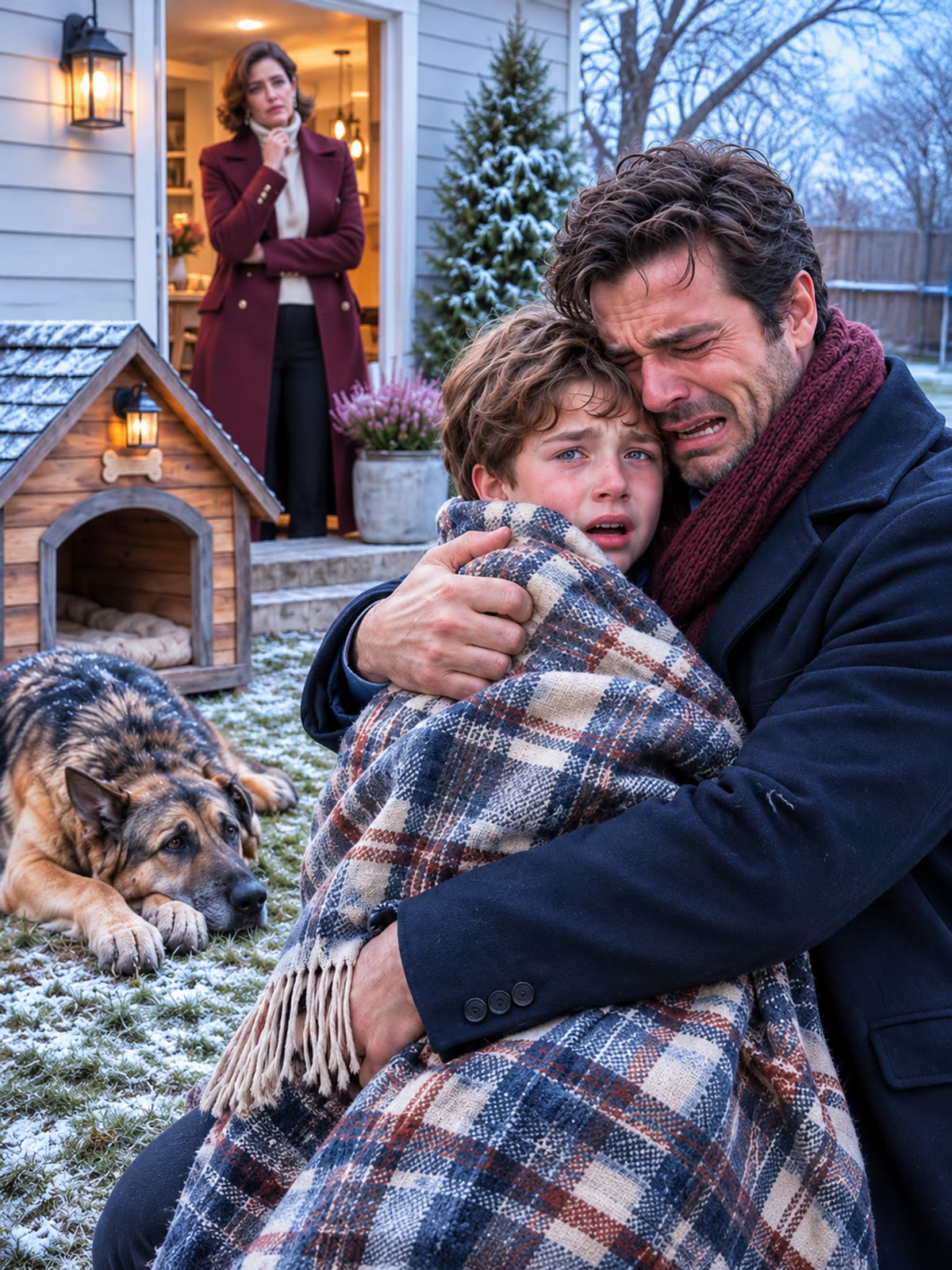
I parked my truck and slipped through the side gate, hoping to surprise Matthew before he left for school. Before my assignment, I had promised we would go fishing when I returned. Coming home early meant we finally had the time, and I was eager to tell him. Then Thunder started barking in the backyard. There was something desperate about the sound. I followed it toward the wooden doghouse near our old oak tree. Thunder lay stretched across the opening, frost dampening his coat. When he saw me, he shifted out of the way. Behind him, beneath an old blanket, a small body was curled tightly against the cold.
It was Matthew. He had on thin pajamas, and his feet were bare. His hands were tucked deep into Thunder’s fur, searching for warmth. “Matthew? Buddy, wake up.” His eyes opened, but before recognition reached them, he flinched. “I’m sorry, Daddy,” he whispered. “I tried to get to the bathroom.” I gathered him into my arms. His feet were icy, and his whole body shook against me. Carrying him to the kitchen entrance, I knocked until Lorraine opened the door. “Julian? You’re home early.” I could barely take my eyes off the child trembling in my arms. “Why was Matthew sleeping outside?”
Lorraine let out a sigh. “He wet his sheets again. Three times this week. I’m tired of cleaning up after him.” I stared at her. “He’s eight years old, Lorraine. It’s below freezing!” Her reply came without hesitation. “Then maybe he’ll finally learn.” Matthew pressed his face into my shoulder. I wanted to shout, but he needed warmth and a doctor more than he needed to hear another frightening argument. I told Lorraine to step aside. Inside, I warmed him carefully, put him into clean clothes, and wrapped blankets around him. I made oatmeal and hot chocolate. After his shaking began to settle, I arranged for him to be examined that morning. Lorraine went into our bedroom and slammed the door.
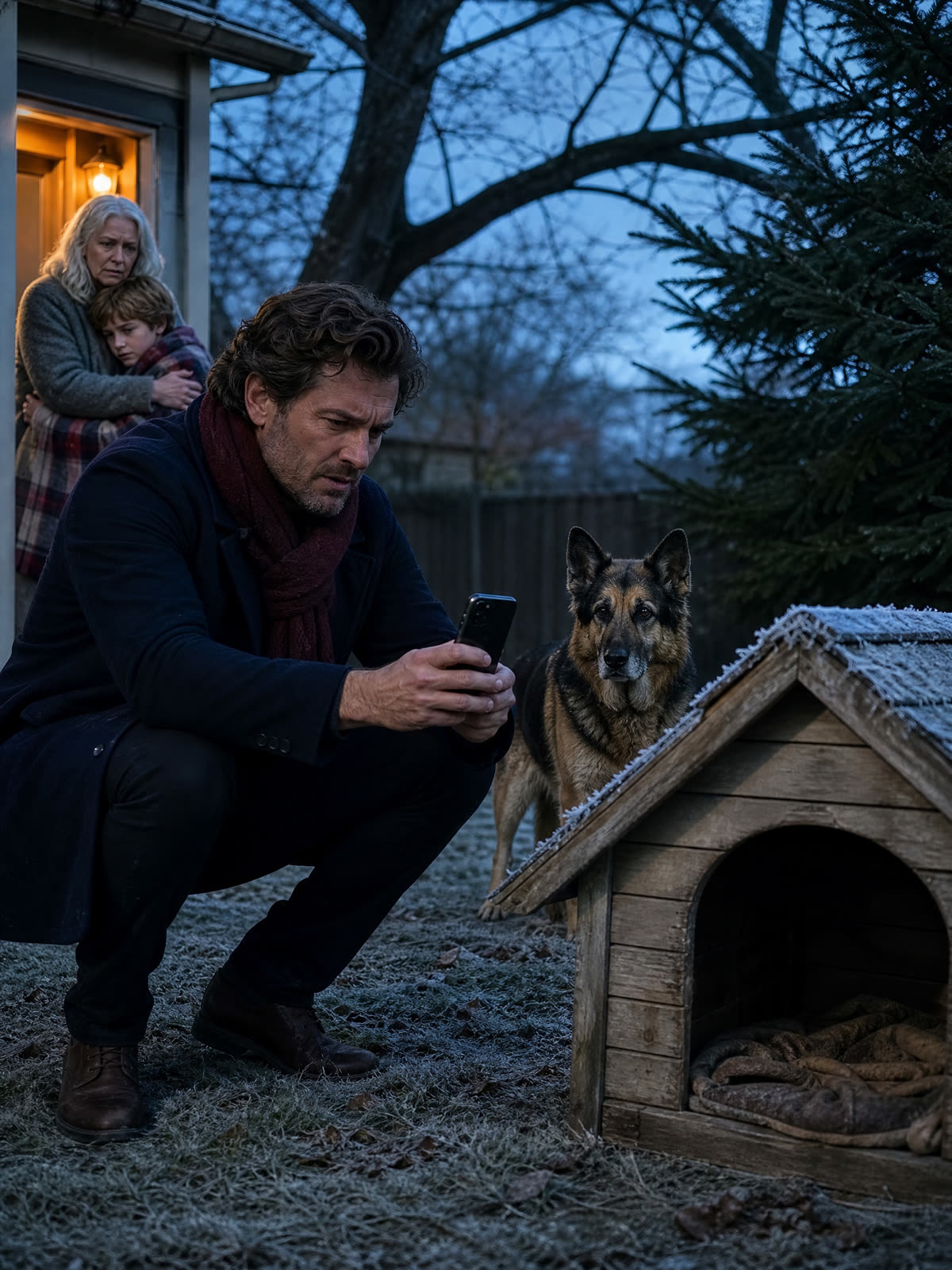
While Matthew rested, I remembered the camera. Months before, after discovering animal tracks along the backyard fence, I had fastened a motion-activated trail camera to the oak tree. Its lens pointed toward Thunder’s shelter. Lorraine had never shown much interest in it. I stepped outside, took out the memory card, and loaded the files onto my laptop. The first image showed Matthew walking across the dark yard with his small pillow. In another, he was folding himself into the doghouse beside Thunder. Several photographs showed the old shepherd stretched across the opening, his body between my son and the wind. I began checking the dates.
The earliest image had been recorded twenty-two days before, shortly after I left for work. There were photographs from twenty-two different nights. This hadn’t happened once after a difficult evening. My son had been sleeping in that shelter almost every night of my assignment. Then I opened a picture of Lorraine in the doorway. Her arm was raised, pointing toward the doghouse. Matthew stood in front of her holding his pillow. I stared at the screen and struggled to draw a breath. Behind me, quiet footsteps crossed the hall. Matthew had gotten up. He looked from the photographs to my face, and what he asked next made the pictures even worse.
“Daddy, are you going to tell Lorraine you know?” I lowered myself beside him. “Why are you afraid of that, sweetheart?” His fingers closed around my wrist. “She said if I told you, she’d send me to the same place Mommy went.” His next words were almost too quiet to hear. “And next time, Thunder wouldn’t be allowed to come with me.” My eight-year-old son thought telling his father might mean disappearing forever. I held his hands. “Matthew, nobody is sending you away. You haven’t done anything wrong.” His gaze moved toward the bedroom. “Will Lorraine be mad?” I answered him as clearly as I could. “You’re not going to be alone with her again. I promise.”
I called my mother, Rose, who lived twenty minutes away. Once she heard what I had discovered, she came immediately. I took Matthew to the doctor, where the examination found irritation on his feet and evidence of extended exposure to cold. Fortunately, he didn’t need to be hospitalized. When the doctor asked how long he had been wetting the bed, I had no answer. Matthew explained softly that Lorraine sometimes locked the back door after putting him outside. On other nights, she sent him out as soon as she found the wet bedding. Thunder always went after him. The doctor advised further medical care and counseling to help him recover.
Mom was waiting when we returned, and Matthew hurried into her arms. She didn’t press him with questions. She simply held him while I began documenting what had happened. I photographed the shelter, saved the original camera files, and made copies that preserved their dates and times. Then I called Missouri’s child protection authorities and the sheriff’s office. I described the repeated nights outside, the freezing temperatures, and the threats that had kept Matthew silent. An investigator told me to protect the evidence and avoid questioning my son over and over. I wanted to understand everything, but making him repeat those nights to every worried adult would not help him feel safe.
Lorraine started calling while we were away. Her first message sounded almost pleasant. “Where are you? Is Matthew okay?” Then the tone changed. “Don’t turn this into a big scandal.” Another followed: “Your son exaggerates everything.” Then: “You’re going to ruin this family over a little discipline.” I kept every message. That afternoon, I contacted Matthew’s teacher. She said he had been falling asleep in class and had come to school wearing damp shoes more than once. She had sent Lorraine several messages because Lorraine was his listed emergency contact whenever I traveled. Lorraine had blamed allergies and told the teacher I already knew. The teacher still had their exchanges. I asked her to save them.
That evening, I opened our household financial records. After Elena’s death, Matthew had qualified for survivor benefits based on her employment history. The payments went into a separate account I managed for his needs. I had allowed Lorraine access so she could buy his clothes, cover school supplies, and handle medical expenses while I was away. I believed she was spending that money on him. Now the statements showed transfers I couldn’t account for. During the previous six months, six payments of $600 had gone to an account belonging to Nadia, Lorraine’s sister. Their descriptions included “therapy” and “school expenses.” Matthew went to public school. I had never authorized private therapy matching those payments.
Altogether, $3,600 had left my son’s account. I remembered Nadia purchasing a used ATV a few months earlier. Lorraine had said her sister’s boyfriend bought it for her. The timing didn’t establish that Matthew’s money paid for the vehicle, and I knew suspicion wasn’t proof. But the transfers still needed explaining. I called the bank, requested the full transaction history, and removed Lorraine’s access. Before doing anything further, I also arranged to consult an attorney. The records were troubling on their own. Combined with the photographs, the medical visit, and the messages from school, they made it impossible to keep accepting Lorraine’s version of anything without checking it.
When I went back to the house for more documents, Lorraine was sitting in front of my laptop. One of the trail-camera photographs remained open on the screen. “So you’re reporting me for teaching him discipline?” she demanded. “I’m reporting what happened to Matthew. And I want to know why his money was sent to Nadia.” Her expression shifted. Instead of answering, she raised her phone and showed me an image of a text I had sent months before. “Do whatever you need to do to make him listen.” I remembered the message. Lorraine had been complaining that Matthew would not finish his homework. Now she was holding those words between us as though they excused everything.
She smiled. “You told me to handle him, Julian. If you accuse me of anything, I’ll show the police this message.” I looked at the screenshot. The words were mine, but the way she presented them made a complaint about homework look like permission for something entirely different. Lorraine leaned toward me. “And then we’ll see whether they believe you’re such a wonderful father.”
PART 2: The Message She Had Cut Away
Lorraine kept her phone raised, displaying the sentence she expected to use against me. “Do whatever you need to do to make him listen.” I recognized it immediately. Three months earlier, I had been unloading freight in Oklahoma when she complained that Matthew refused to finish his homework. But I remembered something else, too: that wasn’t the end of what I had told her. I took out my own phone, opened our messages, and went back to that date. Directly below the sentence in her screenshot was another message. “No yelling or harsh punishments, please. I’ll talk to him when I get home.” She had cropped it out.
“Show the investigators the entire conversation,” I told her. “I’ll give them my phone too.” Her arm dropped. “You’re really going to destroy our marriage over a child who doesn’t know how to behave?” For two years, I had believed she loved Matthew. Now she talked about him as if he were an unwanted burden rather than an eight-year-old who had already lost his mother. I looked at her and made the boundary plain. “Matthew isn’t coming back here while you’re staying in this house.” She responded with a bitter laugh. “And where will you be, Julian? Driving across the country while your mother raises him?”
I wanted to push back, but there was something in that accusation I could not ignore. For twenty-three days, I had sent money home and accepted a handful of cheerful photographs as reassurance that everything was fine. His calls had grown shorter. Lorraine always seemed to have a reason when he couldn’t talk. I had failed to recognize what those changes might mean. Her treatment of him was not something I had approved, but my absence had helped her conceal it. “You’re right about one thing,” I said. “I’ve been away too much. That’s going to change.” Saying it was simple. Working out how to make it true would require more.
That afternoon, I spoke with a family attorney. Although I had owned the house before marrying Lorraine, my attorney advised against trying to throw her out or resolve property questions in the middle of an argument. We began taking the proper steps toward separation and seeking protections for Matthew. That night, my son and I stayed with Mom. Thunder came, too. Matthew wanted the old shepherd beside his bed, so I carried the dog’s cushion into the room. After he had settled beneath a warm blanket, he looked up at me. “Daddy, if I wet the bed here, do I have to go outside?” My chest tightened. “No, buddy. Never. We’ll change the sheets, and you’ll go back to sleep.”
He nodded, though I could see he didn’t fully believe it yet. The following morning, I went through the camera files again. They showed twenty-two separate nights, starting shortly after I left on my assignment. In some, Matthew approached the shelter carrying his pillow. In others, Thunder lay across the opening while my son slept inside. The pictures did not tell us precisely how many hours he spent outdoors on each occasion. I would not claim they established something they couldn’t show. What they did document was a repeated pattern. This was not a single punishment Lorraine could explain away as one terrible decision on one difficult night.
I turned over the original photographs, the medical records, and Lorraine’s messages to investigators. Later, Matthew spoke with a child protection professional trained to question children without making them repeatedly revisit distressing experiences. I waited outside. When the interview ended, he asked for apple juice and sat quietly with my mother. I did not ask him to repeat what he had said. His counselor explained that stress can be associated with bedwetting and recommended continued medical evaluation along with emotional support. There was no reason to treat his wet sheets as defiance. He needed care, and I needed to learn how to give him the reassurance that fear had taken away.
At school, I met with his teacher and reviewed the messages she had sent Lorraine. More than once, she had reported that Matthew looked exhausted. She had also mentioned his wet shoes. Lorraine’s responses claimed we were following medical advice. I asked that the school list me as the primary contact from then on and call me directly whenever there was a concern. I no longer wanted information about my son filtered through another person. The messages were another record of what had been happening while I believed things at home were under control. His teacher had noticed changes. Lorraine had supplied explanations. I had not been there to ask further questions.
Meanwhile, my attorney helped assemble the records of the six $600 payments from Matthew’s survivor-benefit account. Each transfer had gone to Nadia under a description suggesting therapy or educational costs. We had no documentation supporting those descriptions. The authorities were reviewing the transactions separately from the allegations concerning Matthew’s treatment. I understood that neither matter would necessarily be resolved quickly. It could take months. I wasn’t expecting an immediate arrest or some sudden confession in a courtroom. My priorities were preserving what could be proved and keeping my son safe while the appropriate people examined it. Anger alone would not accomplish either of those things.
Several days later, Lorraine agreed to meet at my attorney’s office. She brought a folder and the cropped screenshot. Once again, she accused me of approving the punishments. I set my phone on the table and showed the full conversation, including the message she had removed. Then my attorney asked for receipts corresponding to the therapy payments from Matthew’s account. Lorraine looked down at her folder. For the first time since I had returned, she appeared to have no explanation ready. Spread across the table were six transfers of six hundred dollars each. Every one had come from my son’s benefits. Every one had gone to her sister.
My attorney indicated the descriptions beside the payments. “Can you provide receipts for the therapy and educational expenses listed here?” Lorraine shifted in her seat. “Nadia needed some financial help. I was going to put the money back.” I looked at her. “That money belongs to Matthew.” She answered, “I know that, Julian.” I asked the question she still hadn’t addressed. “Then why didn’t you ask me?” Her gaze moved away. “Because you would’ve said no.” For several seconds, the room was silent. Her answer left no confusion about whether she had known I would object. She had used the account anyway, describing the payments as expenses for my son.
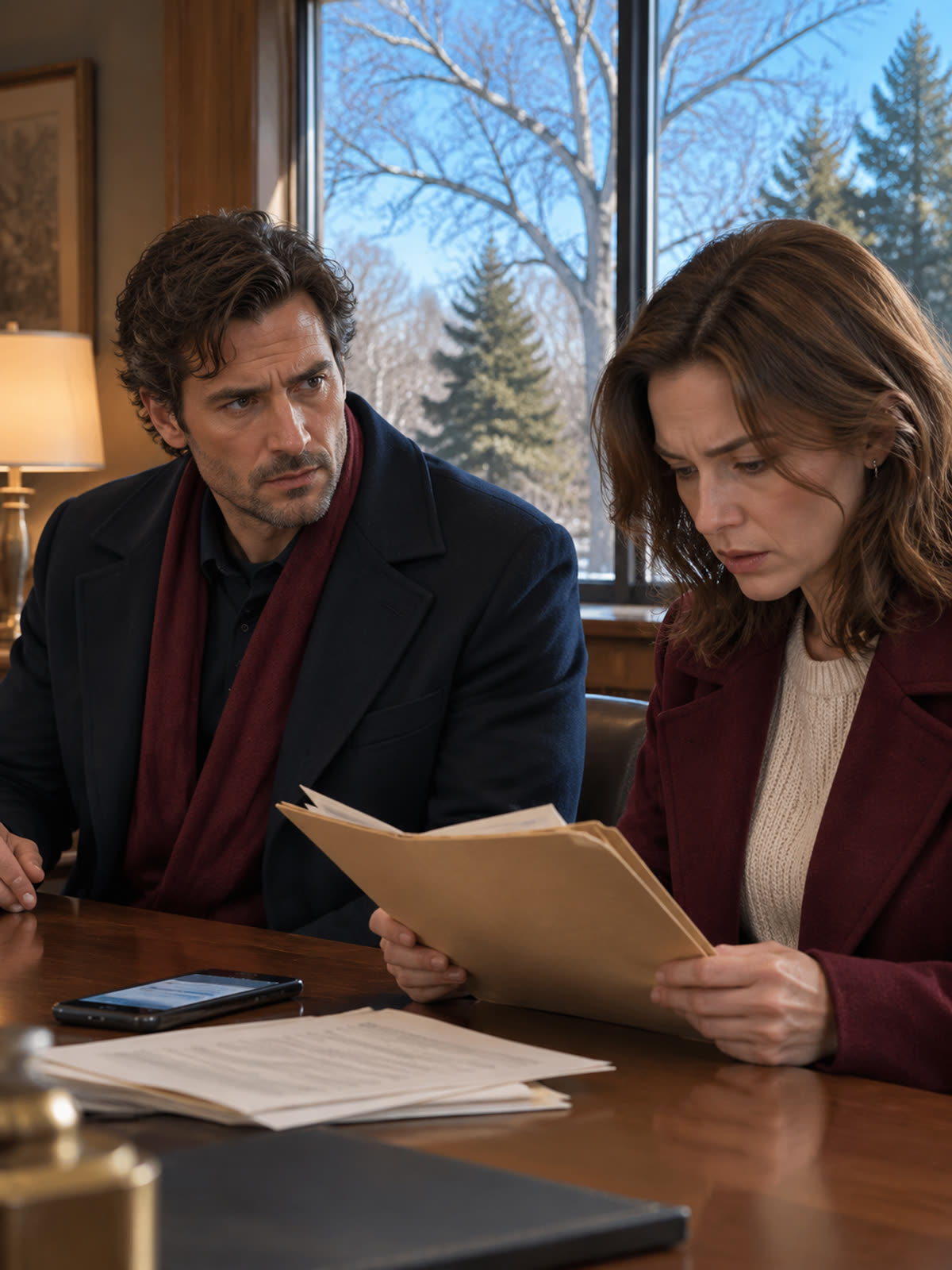
Lorraine eventually said Nadia had been struggling financially. According to her, the transfers were only temporary loans, and she intended to replace the money after my next work bonus arrived. But no one had agreed to lend Matthew’s benefits to her sister. My attorney requested that any further explanation, together with supporting records, be submitted in writing. We then returned to the photographs. Lorraine maintained that sending Matthew outside had been discipline rather than mistreatment. Again, she insisted I had told her to do whatever was needed to make him obey. I displayed the complete exchange once more. “Yes, I wrote that first sentence,” I said. “I should’ve asked more questions. But I also told you not to use harsh punishments.”
She crossed her arms. “You weren’t here. I cooked for him, washed his clothes, took him to school. You have no idea how exhausting it was.” I did not pretend that caring for a child was effortless. But Matthew was eight, and his mother was dead. Difficulty did not justify putting him outside in freezing weather. “If you couldn’t manage, you should’ve told me,” I replied. “You could’ve called my mother. You could’ve asked me to come home.” Lorraine shook her head. “You always choose him over me.” I looked at the photographs between us. “He’s my son. He needed someone to protect him.”
The meeting finished without an apology. My attorney asked that further communication pass through our legal representatives. We continued the divorce process and sought suitable arrangements to prevent Lorraine from being alone with Matthew while the authorities assessed his safety. The investigation into his treatment stayed open. The financial issue remained under separate review, and Lorraine later agreed through her attorney to repay the $3,600 in installments. None of that undid what had happened. A written agreement could address the missing money. It could not erase the nights in the yard or make Matthew immediately believe that a wet bed would never send him outside again.
He was still struggling. Sometimes a slamming door woke him. Some mornings, he pushed his wet pajamas beneath the bed because he feared I would be angry. When I found them, I sat beside him. “Buddy, you don’t have to hide anything.” He would answer, “But I made a mess.” I kept my response simple. “Then we’ll clean it together. That’s all.” He studied my face as though a punishment might still follow. His counselor reminded me that trust returns slowly. Predictable days, patience, and repeated reassurance mattered more than one speech about being safe. I followed that advice, knowing he would need to see my promises kept again and again.
Yet one part of my promise remained unsettled. My work still took me away for weeks. Mom could help, but if I kept driving the same routes, I could not honestly tell Matthew I would be home every night. I contacted my employer and learned that a local delivery job had opened, carrying supplies between Springfield and surrounding communities. It paid less, and I would lose the bonuses attached to long-distance assignments. The position offered the chance to return home most afternoons before six. It also meant making our budget work on substantially less money. I had told my son things would change. Now I had to decide what I was willing to give up to make that promise real.
PART 3: The Promise That Had to Become a Life
For two evenings, Mom and I worked through the household budget. We eliminated expenses we did not need and adjusted our payments. Then I accepted the local delivery position. The lower salary was real, as were the bonuses I would no longer receive, but the new schedule gave me something my old routes could not: the ability to be home most afternoons before six. I started picking Matthew up from school, taking him to appointments, and sitting with him over his homework. I learned his classmates’ names. Instead of relying on someone else’s report about his day, I could ask him myself and be there to hear the answer.
Mom continued to help when we needed her, but I did not want her to become another person filling the space I kept leaving. I wanted my son to know his father would be present. Several weeks after I began the new job, I came home one afternoon and found Matthew on the living room floor with Thunder. He was brushing the old dog’s fur with careful strokes. When he saw me, he smiled. “Daddy, you’re home before dinner again.” I lowered myself beside him. “That’s the plan, buddy.” He leaned into my shoulder, then asked the question that told me he was still counting time differently than I was. “Are you going away for twenty-three days anymore?”
I shook my head. “No. Not for that long.” Matthew put his arms around me and held on without another word. That night, for the first time since I had found him in the shelter, he went to sleep without asking whether I would still be home in the morning. When I looked in later, Thunder was resting beside the bed. The old shepherd no longer had to put his body between my son and freezing air. It was a quiet change, one that would have been easy to overlook before. Now it mattered enormously. Matthew had gone to sleep without needing one more assurance that I would not disappear before he woke.
Eight months after that December morning, much had changed, though nothing had been resolved with the speed or simplicity I might once have imagined. Lorraine had moved out. Our divorce was moving forward, and the authorities were still handling the investigation into my son’s treatment. There had been no abrupt courtroom victory and no dramatic confession that tied everything into a neat conclusion. Investigators had reviewed the camera images, medical records, school messages, and statements obtained during the child protection process. My attorney continued following the separate financial matter as well. The work was careful and ongoing. Meanwhile, Matthew’s life could not be put on hold until every legal question had an answer.
Lorraine had agreed to return the $3,600 in installments, and the first payments had arrived. Recovering the money did not restore the twenty-two nights Matthew had spent outdoors. It did not immediately repair his trust, either. For weeks after we came home, he had nightmares. Sometimes he woke crying because he had dreamed Lorraine was outside his bedroom. On other mornings, he tried to carry wet bedding quietly to the laundry room, certain I would be disappointed. Whenever I saw him doing that, I stopped what I was doing. “Matthew, sweetheart, you don’t need to hide those.” He would lower his head. “I’m sorry, Daddy.”
My answer stayed the same. “There’s nothing to apologize for. We’ll wash them together.” We had that conversation many times. His doctor continued investigating the bedwetting, while his counselor helped him understand that the treatment he had endured was not his fault. Slowly, the nightmares came less often. More nights passed without him waking, although some mornings remained hard. He began asking classmates to visit again. His teacher said he was taking part in lessons and no longer falling asleep at his desk. Those ordinary signs of recovery meant more to me than the money I had once earned by staying on the road for weeks.
The delivery job paid considerably less, but most evenings I was home before dinner. I helped with assignments, attended school meetings, and began recognizing when something was troubling him. For years, I had treated providing for my family as a matter of working every hour I could. Now I understood how much he also needed my attention. Mom remained an important part of our lives, but she no longer had to manage things while I vanished on another long assignment. I could not change how much I had missed before. I could change how often I was there now, and how carefully I listened when Matthew spoke.
Even Thunder appeared happier. His hips had begun troubling him more, so the veterinarian adjusted his treatment and suggested a softer sleeping place. I bought an insulated doghouse for the yard, though he seldom used it. Most nights, he chose the thick cushion beside Matthew’s bed. Before switching off the light, my son covered him with a small blanket. One evening, he explained the arrangement to me. “Thunder kept me warm, Daddy,” he told me. “Now I keep him warm.” I sat beside them for a long time. The dog who had sheltered my child from the cold was growing older, and Matthew had found his own gentle way to care for him.
On a Sunday morning in early summer, I finally kept the promise I had made before my last long-distance assignment. I took Matthew fishing at a quiet lake outside Springfield. We brought sandwiches and a borrowed fishing rod, and Thunder rested comfortably in the shade. Matthew wore a blue baseball cap and talked with excitement about landing the biggest fish in Missouri. For more than an hour, his line gave him no reason to celebrate. He kept checking it, convinced the fish were hiding. Then the rod bent sharply. His shout broke across the stillness. “DADDY! SOMETHING’S PULLING!” I hurried to his side.
“Keep the rod steady, buddy. You’ve got it.” He worked the reel with a look of fierce concentration. I guided his hands while leaving most of the effort to him. A moment later, a small catfish broke the surface. Matthew cried out with excitement. “I CAUGHT ONE!” We looked at the fish for a little while before releasing it carefully. He laughed so loudly that Thunder raised his head from the grass. “Did you see me, Daddy? I did it!” I answered him with the simple truth. “I saw everything, buddy.” This time I had been beside him, watching as it happened, instead of hearing about the moment after it was already gone.

On the drive home, Matthew fell asleep in the passenger seat. At a stop, I looked over at him and remembered the frightened boy curled against Thunder in the frozen yard. I could not undo those nights. I could not pretend my long absence had played no part in allowing Lorraine to conceal them. But there was something I could do from then on: make sure he never had to wonder whether I would listen when he needed me. That required more than feeling ashamed of what I had missed. It required being present often enough to notice, and making room for the things he might find difficult to say.
After dinner that evening, I helped him get ready for bed. Thunder lowered himself onto his cushion while Matthew climbed beneath the blanket. I was reaching toward the light when he called to me. “Daddy?” I stopped. “Yeah, buddy?” He looked at me and asked, “Was it good that I told you about Lorraine?” I sat on the mattress beside him. “It was absolutely the right thing to do.” His gaze fell to his hands. “But she said you’d be mad.” I wanted him to hear the answer without any uncertainty. “I’m glad you told me. You can always tell me when someone hurts you or makes you afraid, even if it’s someone I love.”
He considered that for a moment. Then he asked, “What if you trust a bad person again?” I did not answer right away. I could have promised never to make another mistake, but it would not have been an honest promise. He deserved something stronger than words I could not guarantee. “Then I’ll listen to you,” I said. “And if I don’t know what to do, I’ll ask someone who can help us.” He nodded, but there was still something he needed to know. “You won’t go away?” I answered carefully. “I’ll be here, Matthew. And when I have to leave for work, you’ll know where I’m going and when I’m coming home.”
Matthew reached down and stroked Thunder’s coat. “Okay, Daddy.” I turned off the lamp and remained in the doorway until his breathing settled into the slow rhythm of sleep. For twenty-three days, he had waited for me while an aging dog protected him from the cold. Those days were beyond my power to return. What I could offer was the father he had needed all along: someone present, someone who listened, someone who believed him. Since then, when he wakes and calls for me, he no longer waits twenty-three days to hear an answer. But his question had put the promise into its clearest form. The next time he needed to tell me something difficult, would my actions have made him certain he could?
Disclaimer: This story is a work of fiction inspired by real-life themes. Names, characters, places and events are fictionalized, and any resemblance to real persons is purely coincidental. It does not represent any person or organization and does not encourage inappropriate behavior. Images are for illustration purposes only.
