

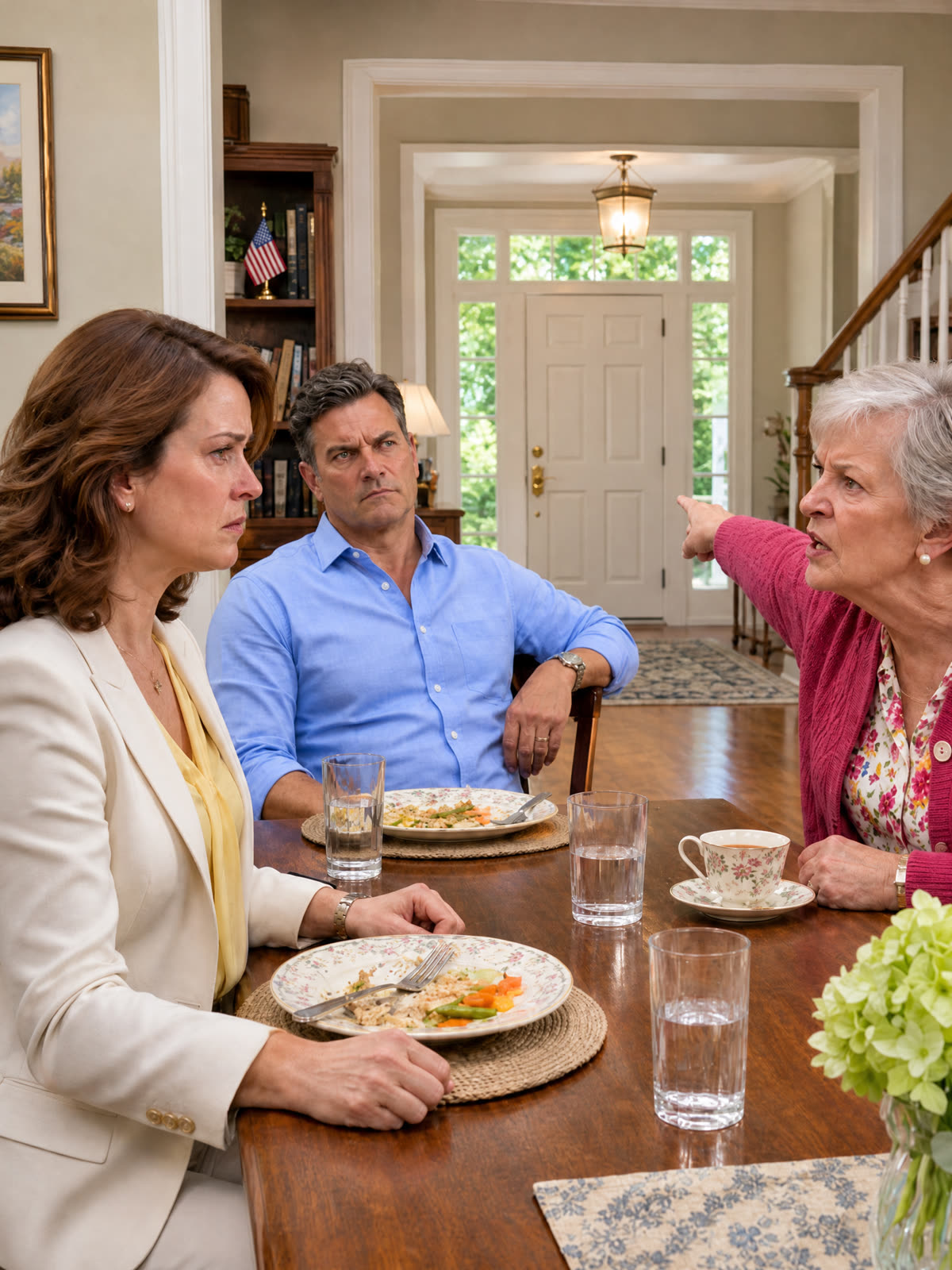
PART 1 — The Ultimatum He Expected Me to Obey
“If you refuse to quit your job by the end of this month, I’m filing for divorce. And you’ll need to find somewhere else to live.” My husband, Marcus, announced this across the dinner table with the casual certainty he might have used to discuss a routine household bill. Beside him, his mother, Teresa, nodded her agreement. “Your husband has made himself clear, Natalie. If you can’t respect his decisions, you should pack your belongings and leave.” Neither of them seemed to imagine there could be anything left for me to say.
I was forty-nine, and Marcus and I had been married for twenty-four years. Threats like these had become familiar enough that I knew the pattern before the conversation finished. He would demand something, I would resist, and eventually divorce would enter the discussion as though it were his final, unquestionable argument. Usually, I tried to find a way around the confrontation. This time, however, what he wanted was something I could not give up without surrendering a part of the life I had spent years building.
For fifteen years, I had advanced through a regional food logistics company near Chicago until I became senior operations director. Eighteen employees reported to me. My work involved real responsibilities, and my income paid a substantial share of our household expenses. Marcus wanted me to leave that career behind and become Teresa’s full-time caregiver. “I’m not quitting,” I replied. “We can hire a part-time home health aide and share the remaining responsibilities.” I was offering an arrangement that addressed her needs without requiring my entire working life to disappear.
Teresa lowered her teacup. “A woman at my church has a daughter-in-law who stays home and takes care of everything. That’s how a proper family works.” I had heard enough comparisons to understand what she expected me to take from that one. “That’s their arrangement,” I said. “It doesn’t have to be ours.” Marcus responded by pointing toward the front door. “Then rent yourself an apartment. Let’s see how well you manage without me.” Once again, disagreement had become a threat to my marriage and the place where I lived.
My gaze moved toward the hallway, where the marks recording our children’s heights still remained on the wall. Daniel had learned to ride his bicycle in our driveway. Chloe had filled countless afternoons playing in the backyard. This house held the ordinary milestones of our family, and Marcus had referred to it as his house for years. I seldom corrected him. His words had become so habitual that I had allowed them to stand, even though there was an important difference between what he called the property and what the ownership records actually said.
My parents had given me the colonial home in Glenview, Illinois, before Marcus and I married. Before that, it had belonged to my grandparents. The warranty deed had been recorded in my name alone. None of this was information Marcus had been denied or a secret I had kept from him. He had known the circumstances from the beginning. Yet after so many years of hearing him claim the house whenever we argued, I had become accustomed to responding to his certainty rather than considering the documents behind it.
Teresa had moved into our main-floor guest suite four years earlier, after Marcus’s father died. I arranged bathroom safety bars, managed her medications, prepared meals, and drove her to medical appointments. At first, these were things I did to help someone living through a difficult change. Over time, they became duties everyone seemed to assume belonged to me. Dinner running late brought complaints. Asking Marcus to handle an appointment brought accusations that I was neglecting his mother. My help was no longer treated as something I offered; it was treated as something I owed.
Whenever I challenged those expectations, Marcus returned to the same threat. In the earlier years, I argued with him. Later, I often apologized simply to bring the household back to peace. I had become practiced at setting aside whatever had upset me if doing so would end the tension. But after that dinner, I went upstairs without making the promise he wanted. I had not agreed to resign, and I had not agreed to leave. For once, I let the disagreement remain unresolved rather than making myself responsible for smoothing it away.
In our bedroom, I opened the folder holding our property records. The papers were not new, but looking at them felt different now that Marcus had again spoken as though he could decide whether I remained under this roof. There was the deed, dated before our wedding, with my name plainly identifying the owner. I studied the record of a gift my parents had made before there was a marriage to preserve. The house had not begun as something Marcus provided for me, no matter how often his threats suggested otherwise.
Holding that deed, I remembered what my father had said when he transferred the property. “A woman should never have to depend on a man’s mood to know whether she has a roof over her head.” His words returned with a force I had not fully understood when he first spoke them. Downstairs, my husband had treated housing as something he could withdraw if I disappointed him. Upstairs, the document in my hands reminded me that my father had wanted me to have a choice that did not depend on anyone’s approval.

The next morning, Marcus asked whether I had reconsidered. “I’m thinking about it,” I answered. He smiled, apparently hearing the beginning of my usual retreat. I let him believe what he wanted to believe. At work, instead of preparing to abandon my position, I contacted Amanda Ross, a family-law attorney in downtown Chicago. Over the following days, I assembled title records, bank statements, tax documents, and renovation receipts. Before making any decision, I wanted to understand my position through something more reliable than the claims made during an argument.
Amanda reviewed everything carefully. “The house was transferred to you before the marriage,” she explained. “Based on these records, it is your non-marital property. We still need to account for marital funds used for improvements, but Marcus cannot simply declare himself the owner.” The relief I felt was enormous. She also cautioned me not to change locks or try to remove anyone without following the proper legal process. I was not seeking revenge or permission to repeat Marcus’s behavior. I needed to know whether his threats could actually leave me homeless.
For the first time in our marriage, I could think about what I wanted without immediately imagining the loss of my home. Still, I did not rush back to confront him. I needed a clearer picture of our finances, so at work I built a spreadsheet covering property taxes, insurance, groceries, utilities, tuition, and the renovations completed over the years. Looking at those expenses together was different from paying them as they arrived. The pattern emerged plainly, without anyone’s voice rising over mine or telling me what I should believe.
My salary covered most of the property taxes, insurance, groceries, and maintenance, along with a substantial part of Chloe’s college expenses and Teresa’s medical costs. Marcus contributed too, particularly toward certain renovations, but the records did not support his repeated claim that he carried the entire household. He also maintained a country-club membership, leased an expensive pickup, and regularly put money into a personal investment account. I was not financially dependent on him in the way his warnings implied. In several important respects, the household he controlled depended on me.
A week later, he raised my resignation at dinner while Daniel was visiting from his apartment and Chloe was home from Northwestern University for the weekend. “Have you spoken to human resources yet?” Marcus asked. “No.” He frowned. “Why not?” “Because I’m keeping my job.” Teresa immediately lowered her fork. “You’re willing to destroy your marriage over a career?” “I’ve offered to hire professional help,” I replied. “Nobody has to sacrifice anything.” I had already offered a practical alternative, but neither of them was treating the conversation as a problem we could solve together.
Marcus turned toward our children. “This is between your mother and me.” Chloe looked at him. “Dad, are you seriously threatening divorce because Mom won’t resign?” “Stay out of adult matters.” “I am an adult,” she answered. “And I’ve been hearing you threaten Mom since I was in middle school.” Silence settled over the table. Marcus’s face hardened. “You don’t understand marriage.” Then Daniel spoke. “We understand what happens in this house, Dad. Everyone checks your mood before saying anything.” Their words left me staring at the children I had believed I was protecting.
For years, I had told myself that yielding and apologizing kept our arguments from hurting them. Instead, they had been watching the pattern and adjusting themselves around it. Marcus pushed back his chair and walked away without finishing his meal. Afterward, Chloe took my hand. “Mom, you don’t have to keep accepting this.” I could not give her a simple answer or pretend I had everything settled. “I’m trying to figure out what happens next,” I admitted. Knowing I had choices was not the same as knowing exactly how to use them.
Two weeks later, my seventy-three-year-old mother, Evelyn, came from Ohio for an early cardiology appointment at Northwestern Memorial Hospital. I prepared the upstairs guest room so she would not have to travel before sunrise. When Marcus returned and saw her overnight bag, his expression changed. “What’s going on here?” “Mom has a medical appointment tomorrow,” I explained. “She’s staying tonight.” He looked straight at her. “Are we running a hotel now?” My mother immediately reached for her purse. “I can find somewhere else, Marcus. I don’t want to cause trouble.”
“You’re not going anywhere, Mom,” I told her. Teresa watched from her armchair. “A respectful wife asks the head of the household before inviting guests.” I looked at the woman who had lived with us rent-free for four years. “Your mother has stayed here for years,” I told Marcus. “Mine needs one night.” “That was my decision,” he replied. “And this is mine.” He struck the kitchen island with his fist hard enough to rattle the mugs. “This is my house! If you don’t like my rules, pack your bags and leave tonight. We’re getting divorced.”
My mother flinched. Chloe covered her mouth. Teresa stayed in her chair, apparently waiting for the apology that usually followed. My heart pounded, but I remembered the records Amanda had examined. I knew whose name was on the deed. Beyond that, I understood that Marcus would keep using divorce against me for as long as the threat made me surrender. “Okay,” I said. Marcus blinked. “What?” “I accept. Let’s get divorced.” His certainty slipped. “You’ll change your mind when you realize what you’re losing.” I looked at my mother, still holding her purse. “No, Marcus. I know exactly what I’m doing.”
He went upstairs, still convinced I would eventually plead with him to reconsider. The following afternoon, however, I came home from my attorney’s office carrying a thick binder containing our financial records, the divorce petition, and a certified document he had not expected me to produce. In the den, Marcus glanced at it and smirked. “What’s that? Your resignation paperwork?” I put it on the coffee table. “No. It’s our divorce petition.” He opened the binder and turned to the next document. When his eyes reached the name on the certified deed, the confidence vanished from his face.
PART 2 — The Name He Could No Longer Ignore
Marcus stared at the certified deed before looking back at me as though the document had somehow arrived from another household. “What is this supposed to prove?” “That the house was given to me before we got married,” I replied. “My name has been on the title for twenty-four years.” Nothing about the history had changed. What had changed was that I was no longer allowing his version of ownership to determine the conversation. The paper between us stated something he had known long before he started pointing me toward the front door.
Teresa leaned closer and adjusted her glasses. “My son has lived here all that time. He’s paid for this house.” “He’s contributed to our home,” I answered. “But that doesn’t change who received the property before the marriage.” I was not denying the years we had lived together or pretending Marcus had never contributed financially. Those contributions were part of what the attorneys would need to address. But they did not make the original gift disappear, and they did not turn his repeated claims into the legal history of the property.
Marcus worked through the binder. Following the deed were property-tax records, a title search, and a detailed account of the renovations. “You can’t pretend I never paid for anything,” he snapped. “I helped remodel the kitchen. I paid for the deck.” “I’m not pretending otherwise.” I showed him the section listing improvements made since 2002. Some had been paid from his income, some from mine, and many from joint accounts. The point of gathering those records was to recognize what had actually happened, not to replace his exaggerations with my own.
“Amanda explained that documented marital contributions may need to be reimbursed,” I said. “I’m prepared to handle that fairly.” He pushed the binder away. “So you’re throwing me and my mother onto the street?” “No. My attorney prepared a proposed sixty-day transition arrangement. You both have time to find somewhere else to live.” I explained that I would not change the locks or remove their belongings. If we could not agree about occupancy, Amanda would ask the court to decide. There would be a process, not another demand delivered across a table.
Teresa shook her head. “After everything Marcus has done for you, this is how you repay him?” I looked directly at her. “For four years, I’ve helped with your appointments, medications, meals, and daily needs. I never asked you to leave. But yesterday, you watched your son order my seventy-three-year-old mother out because she needed one night before a hospital appointment.” Teresa looked away. I had spent so much time explaining what I could do for everyone else that simply stating what had happened felt unfamiliar. Yet there was nothing exaggerated about it.
Marcus folded his arms. “You planned this behind my back.” “I sought legal advice after you threatened to divorce me and make me homeless.” He seemed to object not only to my decision but to the fact that I had checked whether he could carry out his threat. “You sound like one of those people from your office.” “No, Marcus. I sound like someone who’s finally allowed to make her own decisions.” My work had given me responsibilities he wanted me to abandon. It had not created the need to have a voice in my own home.
By then, Daniel and Chloe had come into the den. Marcus immediately looked to them. “Tell your mother she’s being unreasonable. She’s forcing her husband out after twenty-four years.” Daniel sighed. “Dad, you’ve threatened to throw Mom out for years. You can’t act surprised that she finally took you seriously.” “I’m your father.” “I know. I love you. But that doesn’t mean you’re right.” Our son was not denying their relationship. He was refusing to let that relationship erase what he had seen, just as he had done at the dinner table.
Chloe moved beside me. “I support Mom having a home where nobody threatens her whenever she disagrees.” Teresa changed her approach. “People say things they don’t mean during arguments. Surely one disagreement isn’t worth ending a family.” “It wasn’t one disagreement,” I replied. That was what I needed them to understand. This was not a single evening that had somehow overturned an otherwise equal marriage. It was the accumulated weight of a pattern, one that had continued because I kept trying to preserve our life by making my own needs smaller.
I reminded Teresa about the canceled trips to Ohio, the disputes over Marcus’s spending, and the evenings when I apologized because I had worked late. The details differed, but the condition underneath them did not. Whenever I resisted, Marcus threatened divorce. Remaining married had come to depend on my willingness to obey. He picked up the financial summary again. “So you’re ending everything because I asked you to take care of my mother?” “No. I’m ending it because you demanded that I abandon my career and threatened to take away my home when I refused.”
For several moments, Marcus said nothing. Daniel and Chloe had heard my answer, and the binder remained between us with the records neither anger nor accusation could change. Finally, Marcus closed it. “I’m hiring my own attorney.” “You should,” I replied. “I want everything handled properly.” I meant that. I did not need him to be left without advice, and I did not need the children to stop loving him. I needed our future to be settled through a fair process rather than through the force of whichever threat he used next.

That night, Marcus shut himself in our bedroom, and I slept in the guest room near my mother. Evelyn found me beside the bed, folding a blanket. “Your father would be proud of you,” she said. I tried to smile, but instead I began to cry. “I should have done this years ago.” She held me while I cried. Standing firm in front of Marcus had not removed the grief underneath my decision. I could understand why leaving the pattern was necessary and still feel the loss of all the years I had spent inside it.
The following weeks were difficult. Marcus retained a divorce attorney, and both lawyers examined the title history, renovation costs, retirement accounts, and the other marital assets. He continued arguing that decades of living in the house should give him ownership. After reviewing the records, his own attorney confirmed what Amanda had explained: the house was my non-marital property, while documented marital contributions could be addressed financially. The answer did not dismiss everything Marcus had paid. It separated those contributions from the claim that he could decide whether I was allowed to stay.
Marcus stopped pointing at the front door. For the first time in years, he no longer spoke as though my place in the house depended on his permission. That change did not repair the marriage, but it made the old imbalance impossible to overlook. The doorway itself had not changed, nor had the rooms around it. What had changed was his ability to use them as leverage. Once the ownership records had been acknowledged by both attorneys, the familiar threat no longer carried the power he had relied on.
Negotiations continued until our attorneys developed a settlement covering our shared finances. Marcus would keep his leased luxury pickup along with its remaining obligations. Our joint liquid savings would be split equally, and he would retain a larger portion of his executive pension in exchange for the agreed reimbursement connected with improvements to the house. Neither of us received everything we wanted. The agreement was not a punishment; it was an effort to divide what we had built together without pretending the house had ever been his to grant or take away.
As the terms came closer to completion, I realized that protecting the property was not the hardest part. The harder thing was accepting that the marriage I had spent twenty-four years trying to save was actually ending. Records could show when a house had been transferred and where money had gone. They could not make the emotional weight of those years disappear. Marcus and I communicated mostly through our attorneys while they finalized the division of savings, retirement accounts, and documented contributions. The practical work continued alongside a grief I could not settle with a signature.
Our children struggled too. Daniel helped his father look for somewhere to live, and I sometimes noticed how exhausted he seemed afterward. Chloe was angrier. She wanted Marcus to acknowledge every threat he had made through the years. “You don’t have to fight him for me,” I told her. “But he spent years making you think you had nowhere to go.” “I know, sweetheart. But you can still love your father without defending what he did.” I wanted both children to know that loving each parent did not require pretending that everything either parent did was right.
Eventually, on a Tuesday afternoon, we appeared before a Cook County judge. The courtroom was smaller than I had imagined. The judge reviewed the settlement, confirmed that we understood it, and entered the divorce decree. After twenty-four years, our marriage ended with signatures and a formal ruling. Outside, Marcus stood near the elevators with his attorney. For a moment, he looked as though he expected me to come over and ask for another chance. Instead, I adjusted my coat. “Take care, Marcus.” He gave me no answer.
Several weeks later, moving day arrived beneath steady rain in Glenview. Daniel helped Marcus load boxes and furniture into a rented truck while Chloe carefully wrapped Teresa’s china figurines and family photographs. I made coffee and put a box of doughnuts on the kitchen counter for everyone who was helping. I was not trying to make the day pleasant enough to undo our decisions. I simply wanted the separation to happen without another argument. There had been enough of those, and nothing about carrying belongings outside required us to repeat them.
Teresa stood in the doorway of the guest suite that had been hers for four years. “I never imagined I’d leave this house in a moving truck,” she murmured. “I never imagined I’d have to prove I had the right to stay here,” I replied. She lowered her eyes. “I suppose I should have spoken up when Marcus treated your mother that way.” “Yes,” I said quietly. “You should have.” Her acknowledgment did not undo that evening, but for once I did not soften my answer simply to protect her from discomfort.
I did not list every appointment I had arranged or every meal I had prepared. I no longer needed Teresa’s gratitude to establish that I had helped her. Those years had happened whether she recognized them or not, just as the ownership of the house had been real before Marcus finally accepted it. When Daniel carried her last suitcase outside, she followed him. Her belongings were leaving the guest suite, and the practical work of moving continued. I had no wish to turn her departure into another account that needed to be argued and proved.
Marcus remained in the foyer, beside the same front door he had pointed toward whenever he threatened to make me leave. Looking at him there, I could not separate the man from all the years we had shared, but neither could I separate that doorway from the threats. The house around us held both kinds of memories. Then he spoke in a voice quieter than I had expected. “Are you really not going to ask me to stay?”
PART 3 — The Question He Still Couldn’t Answer
I looked at the man I had married when I was twenty-five. I remembered him holding our newborn son, making coffee on Sunday mornings, and helping our daughter learn to ride her bicycle. Those moments were real, and I did not need to deny them to understand why our marriage had ended. The threats were real too. Remembering the happiness did not erase what had followed, any more than remembering the pain meant there had never been love. Both belonged to the history standing between us in the foyer.
“I asked you to stay for years, Marcus.” He frowned. “When?” “Every time you threatened divorce and I gave up something important to keep our marriage together. Every canceled trip, every apology, every decision I accepted just to avoid another argument.” He looked away. “You never explained it like that.” “I shouldn’t have needed to beg for our marriage whenever we disagreed.” I had spent years responding to the possibility of losing him. What he had not recognized was how often that response required me to give up something of myself.
For several seconds, he looked toward the staircase. “I never thought you’d actually do this.” I understood. He had counted on the fear of losing my marriage to outweigh everything else, because for so long it had. He had expected another apology, another abandoned plan, another decision quietly reversed. This time, the fear was no longer making the choice for me. Marcus picked up his last bag and went outside, where Daniel waited beside the truck. I watched them leave and then closed the front door. The lock clicked softly behind them.
For the first time in twenty-four years, Marcus could no longer use that doorway to threaten me. Chloe came downstairs and found me still standing in the foyer. “Mom, are you okay?” I turned toward her. “Not completely.” She put her arms around me. “But I think I will be,” I whispered. There was no need to pretend the ending felt easy simply because I knew it was necessary. I could feel the hurt of what was gone while beginning to understand what it meant to remain without waiting for the next demand.
The house was quiet that evening. Teresa’s television was no longer playing in the guest suite. Marcus’s keys were absent from the kitchen counter. Nobody was waiting to ask why I had made a decision without permission. I walked past the children’s height marks and into the kitchen we had remodeled together. The rooms still held our shared history, but I did not have to prepare an explanation for occupying them. When I switched off the kitchen lights, I understood that keeping the property was only part of what I had recovered.
The first weeks after the move felt stranger than I expected. At about five-thirty each evening, I still caught myself checking the clock at work. For years, getting home late had meant questions about where I had been and why my career mattered more than my family. Nobody was waiting to interrogate me now, but the habit did not disappear simply because the reason for it had left. My working day could end without becoming an accusation, and yet I still had to become accustomed to that freedom rather than merely know it existed.
Sometimes I woke expecting to hear Marcus getting ready in the bathroom or Teresa watching television downstairs. I missed parts of our family routines, even though I did not miss the arguments surrounding them. Twenty-four years could not be erased by the finality of a decree. Remaining in the house meant living among familiar spaces while learning a different way to inhabit them. I was beginning to recover myself, but that did not happen all at once. The unfamiliar quiet brought relief, and it also reminded me how much of my life had been arranged around other people.
I stayed in the colonial home my parents had given me. Eventually, I redecorated the upstairs guest room so Evelyn would always have somewhere comfortable to sleep when she came from Ohio. Her visits no longer needed to be weighed against Marcus’s mood or defended as an exception to rules he made. Preparing the room was not about revisiting the confrontation that had happened before her appointment. It was simply about knowing my mother could stay. Something that ordinary should never have required an argument about who was permitted to make decisions.
Daniel continued watching football with his father on Sundays, and Chloe sometimes met Marcus for lunch between her college classes. I encouraged both relationships. I had not wanted a divorce to become a demand that our children stop loving him. What mattered was that they could maintain those relationships without abandoning their own judgment. They had already shown me that they understood the difference between love and agreement. Now, as our family adjusted, that distinction mattered for their lives as much as it had mattered when they stood beside me.
When Marcus pressured Daniel to leave environmental engineering for investment banking, our son calmly refused. Later, Chloe decided to study abroad in Spain. Marcus objected and tried to forbid her from going. She listened, bought her ticket with her own savings, and went anyway. Neither child stopped loving their father. They simply stopped treating his disapproval as a command. Watching that change, I could see that refusing an unreasonable demand did not have to mean ending a relationship. It meant recognizing that love did not give someone else ownership of every choice.

A few months after the move, Teresa called. “Natalie, my arthritis has been getting worse. I have an orthopedic appointment next week. Could you drive me?” For four years, I had arranged her medical visits without stopping to question whether I had the time. My first impulse was to agree, just as it had always been. The request was familiar enough that the old response was already there before I considered it. But our circumstances had changed, and I paused instead of letting habit make another decision for me.
“For a scheduled appointment, you’ll need to ask Marcus or Daniel,” I replied. “If it’s an emergency, I can help you contact emergency services.” Teresa sounded surprised. “But you always handled my doctors.” “We don’t live together anymore, Teresa.” After a long silence, she ended the call. Daniel eventually took her to the appointment, and she received the care she needed. Nothing about my answer had prevented that. I simply was not the person responsible for arranging everything anymore, even when everyone had once assumed I always would be.
That distinction mattered. I had not needed to become uncaring in order to stop being permanently available. Teresa’s needs could still be met without my schedule and working life automatically being set aside. For so long, I had treated the ability to help as though it created an obligation to handle every detail. Now I was learning to separate those things. Saying no to the appointment did not erase the four years I had helped her. Nor did those four years require me to continue the same arrangement after we no longer shared a home.
Six months after the divorce became final, Marcus called on a Sunday evening. “Natalie, I’ve been thinking about us.” I waited. “Maybe we ended things too quickly. I know I could be harsh sometimes. Perhaps we should try marriage counseling.” For years, I had wished he would suggest counseling instead of bringing divorce into every disagreement. Hearing those words now still hurt. They were words I had once wanted badly, but wanting them in the past did not tell me what he understood in the present.
“What do you mean when you say you were harsh?” I asked. “I had a temper. Sometimes I said things because I was frustrated.” His answer described anger, but I needed to know whether he understood what the anger had been used to demand. “Do you understand why I refused to quit my job?” “I understand your career was important to you.” “That isn’t what I’m asking.” There was a difference between acknowledging that I cared about something and recognizing that I had the right to decide whether to keep it.
He sighed. “I’m trying here, Natalie.” I asked the question more plainly. “Do you understand that I had the right to work, invite my mother to stay for one night, and have an equal voice in our marriage?” Those were not special privileges I had wanted him to grant. They were the ordinary choices that had repeatedly become arguments about obedience. I waited through a long silence. I had once listened for any opening that might allow me to end a disagreement. This time, I listened for whether he understood why the disagreement had mattered.
Then he said, “You didn’t have to destroy our whole life over it.” His answer told me what I needed to know. He missed the life we used to have, but he still believed my refusal to obey him was what had destroyed it. The threats themselves remained in the background of his explanation, while my decision to stop surrendering stood at the center. He could acknowledge having a temper without acknowledging that my choices had been mine to make. That was not the understanding I had been listening for.
I asked one final question. “Marcus, if the house had been in your name that night, would you really have let me stay after ordering me out?” He did not answer. I waited, hoping he might finally acknowledge what he had done and what the threat had meant. The silence continued. There was nothing for me to soften or explain differently. I had asked about the very power he had claimed, and he would not say what he would have done with it. “Goodbye, Marcus.” I ended the call.
I still live in the colonial house my parents gave me before my wedding. The front door is painted bright red now. My mother’s guest room is ready whenever she visits, and Daniel and Chloe come over without first worrying about anyone’s mood. The house remains full of memories, but those memories no longer dictate the terms of my life. I do not need to erase the years we lived here together in order to live here differently. I only need to remember that being at home should not depend on keeping someone else pleased.
I continue working as senior operations director, making decisions that matter to my employees and enjoying the career I nearly surrendered to preserve my marriage. At work, I had long been trusted to manage responsibilities and make judgments. At home, I had gradually accepted the idea that exercising the same judgment could put everything at risk. Keeping my job was never simply about holding on to a title. It was about retaining a life and a voice that were mine, rather than giving them up because someone had made disagreement feel dangerous to the marriage.
I do not celebrate the divorce. Marcus and I raised two children, and many of our happy years were genuinely happy. Those memories remain part of my life, and I do not need to turn all of them into something false to justify leaving. But I also remember how often I apologized when I had done nothing wrong, canceled plans to avoid a confrontation, or stayed silent because I feared another threat. Remembering the good honestly means remembering the rest honestly too. Neither version is complete if it requires pretending the other never happened.
My father understood something important when he put the house in my name before the wedding. He was not trying to protect me from marriage itself. He wanted me to have a choice. For twenty-four years, Marcus believed threatening divorce would make me surrender whatever he demanded. He expected the thought of losing my husband and my home to frighten me into obedience. The document my father arranged did not make the emotional decision easy. It meant that fear of having nowhere to live did not have to make that decision for me.
On the night Marcus ordered me to pack my belongings, I finally understood that keeping my dignity and having a roof over my head did not have to be opposing choices. I could have both. Answering his ultimatum with that simple “Okay,” was not a rejection of our children or the real happiness our family had known. It was the end of a pattern that had taught everyone in our home to mistake fear for love. I had stopped letting the threat decide what I would surrender. For the first time, the choice of what came next was mine—and I had not yet discovered everything that would mean.
Disclaimer: This story is a work of fiction inspired by real-life themes. Names, characters, places and events are fictionalized, and any resemblance to real persons is purely coincidental. Images are for illustration purposes only.
