

PART 1 — The Voice on the Line
Autumn had settled quietly over Cedar Falls, Michigan, when a call reached veteran emergency dispatcher Dorothy Webb that felt different almost immediately. She had just reached toward her coffee when her headset came alive. She delivered the familiar greeting she had spoken countless times, then listened for an answer. “911, what’s your emergency?” Nothing followed. There was no explanation, no frantic adult voice, only the faint sound of someone breathing on the other end.
Dorothy waited. The breathing belonged to a child. Rather than let the silence become frightening, she made her voice gentler and asked again whether the caller could explain what had happened. This time, a little girl answered. “My legs hurt. I can’t close them.” The words sharpened Dorothy’s attention at once. She understood that any alarm in her own voice might frighten the child further, so she kept it steady while asking the girl’s name and age.
“Sadie. I’m six.” Dorothy began locating the call without letting their conversation break. She asked whether an adult was in the house. Sadie explained that her mother had gone to work. Before leaving, her mother had told her not to open the door to anyone. Dorothy kept listening, allowing the girl time to answer rather than hurrying her through questions. There was fear in that small voice, and pain beneath it.
“You’re doing great, Sadie. Can you tell me what your house looks like?” Sadie’s reply came in hesitant pieces. “It’s white… but the paint is peeling. There’s a broken mailbox.” Together with the location information from the call, those details gave emergency services what they needed. Dorothy sent an ambulance immediately. Then she stayed on the line, listening to cartoons somewhere near Sadie and to the small pauses when the girl struggled not to cry.
“Help is coming. Just stay with me.” Dorothy continued reassuring her while the ambulance traveled toward the house. There was nothing she could do from the dispatch center to ease the pain directly, but she could make certain Sadie did not have to wait alone. Several minutes passed before the sound of sirens finally reached the telephone. Dorothy heard them through her headset and asked, “Do you hear them?”
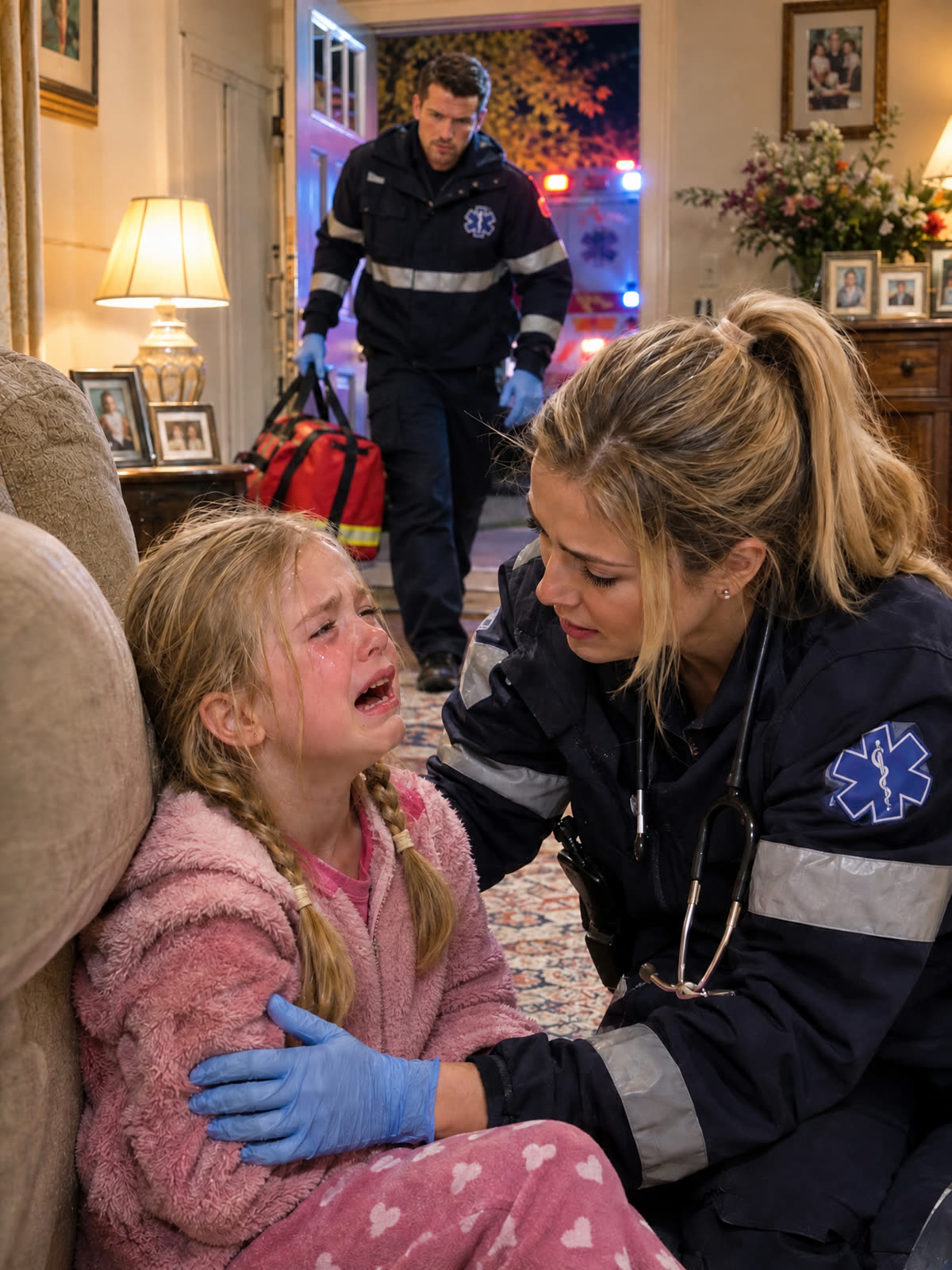
“Yes… will they make it stop hurting?” Sadie asked. “They will, sweetheart. They’re almost there.” Outside the weathered white house, paramedics Gideon Frost and Rhonda Pike found the front door locked. They called to Sadie from the other side. Her weak voice answered, telling them about a spare key beneath a flowerpot. She had remembered her mother’s warning. Instead of opening the door herself, she explained how they could get inside.
Once they entered, Gideon noticed the stale air and a chemical odor that did not belong unnoticed in a house with a child. The paramedics followed Sadie’s voice toward a small bedroom. She was lying beside her bed, her knees bent into an awkward position. Every effort to move sent pain through her hips. She was frightened of trying again, frightened of making it worse, and waiting for them to tell her what would happen next.
Rhonda lowered herself beside the girl rather than immediately lifting or moving her. She gave Sadie a chance to see her and hear her before beginning the examination. Gideon looked around the room while his partner focused on their patient. There was no obvious injury that explained why a six-year-old could barely move. That absence troubled him. Something was wrong, but its cause was not plainly visible.
The chemical smell seemed to come from a strong cleaning product spilled near the laundry area. Gideon considered it while Rhonda worked, but Sadie’s breathing and other vital signs did not suggest a serious inhalation exposure. The odor needed an explanation, yet it did not account for the pain in her hips and legs. Whatever had brought her to the floor beside her bed appeared to have another cause.
Rhonda kept her attention on Sadie. “Sadie, my name is Rhonda. I’m going to help you, but I need you to tell me if anything hurts when I touch it.” Sadie nodded. Rhonda examined her as carefully as she could, keeping her movements gentle and giving the girl the chance to respond. Gideon remained nearby. Together they worked to stabilize her without causing any more pain than necessary.
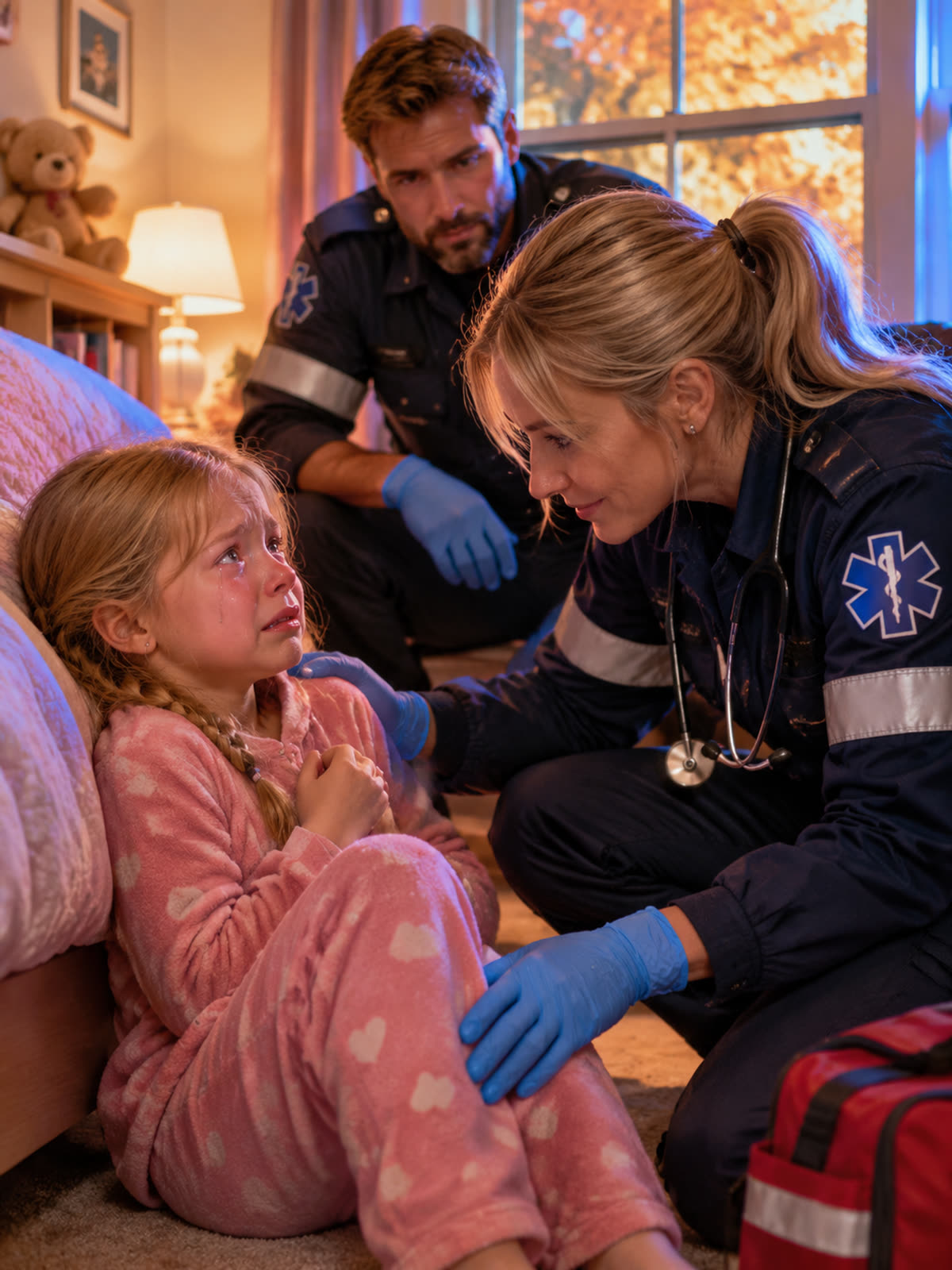
When they were ready, the paramedics carried Sadie outside. As her stretcher approached the ambulance, she caught hold of Rhonda’s sleeve. “Don’t call him.” Rhonda paused rather than brushing past the words. “Call who, sweetheart?” Sadie turned her eyes away. “I want my mom.” Rhonda did not press her to explain. The girl was already frightened and hurting; another demand was not what she needed.
Still, Rhonda did not dismiss what she had heard. She repeated Sadie’s words to Gideon, and he quietly relayed them to the emergency department before their arrival. At the hospital, the initial examination brought questions rather than an immediate answer. Sadie did not have a fever high enough to explain the severity of her pain. Routine blood tests offered no clear explanation either. Moving her hips still made her cry, so the attending physician requested imaging.
Sadie’s mother reached the hospital before the scans had been reviewed. She hurried inside in her work uniform, breathless and shaking. “I left her for less than two hours,” she told the nurse. “She was asleep when I left. She knows how to call me. I don’t understand.” Her daughter had been asleep when she walked out of the house. Now Sadie was in a hospital bed, and nobody could yet tell her why.
The doctor asked who generally cared for Sadie when her mother worked longer shifts. Her mother hesitated before answering. “My boyfriend, Wesley. But he’s out of town today.” Across the room, Sadie heard the name. Her expression changed completely. The child who had managed to describe her house, explain the hidden key, and answer the paramedics’ questions suddenly stopped responding. She would not answer any more questions.
Then the radiologist asked to speak with the attending physician in the hallway. Several minutes passed before the doctor returned with a tablet containing the images. He did not begin by sitting beside Sadie. Instead, he asked her mother to accompany him into a consultation room. “I need you to look at something,” he said. The scans showed injuries around Sadie’s hips and upper legs. They did not all appear to be from the same incident. One was recent. Others were already healing. Her mother stared at the screen.
PART 2 — What the Records Revealed
“That’s impossible.” Sadie’s mother stared at the images while the doctor remained composed. “Has Sadie had any serious falls recently?” he asked. “No.” He tried another possibility. “Any sports injuries?” Her mother answered with disbelief. “She’s six,” her mother said. “She doesn’t play sports. She watches cartoons and colors.” The ordinary things her daughter did offered no explanation for what the scans showed.
The physician, Dr. Raymond Hale, lowered the tablet while keeping his attention on her. “Then I have to ask about the explanations you’ve been given for her pain. Has she complained before?” She hesitated before answering. “She had a fall in the bathtub. That was a few weeks ago.” Dr. Hale asked, “Who told you that?” Her reply was immediate. “Wesley. He said she slipped getting out.”
“Did Sadie tell you herself?” That question stopped her. She started to speak, then closed her mouth and looked down at her hands. The explanation she remembered had come from Wesley, not from her daughter. “I don’t think I asked her,” she said quietly. Dr. Hale allowed the silence to remain for a moment. He did not rush to fill it or make the question easier to set aside.
“I’m going to bring in people whose job is to help families in this situation. A hospital social worker, and someone from child protective services. That is standard when a child has injuries that don’t match a single event. It is not an accusation against you.” Her mother asked, “Is it against Wesley?” The doctor answered carefully. “The medical findings will be reviewed by people trained to do that. My job is to document what I see and make sure Sadie is safe while they do.”
Dr. Hale contacted a hospital social worker, Lorraine Beck, and notified the police as required by law. Elsewhere, at the dispatch center, Dorothy completed her account of the call. She recorded the time, 8:07, and preserved Sadie’s exact words as she had been trained to do twenty years before. My legs hurt. I can’t close them. Don’t call him. The child’s statements remained separate from the explanations supplied by adults.
If the case went further, Dorothy wanted the earliest record to reflect what Sadie herself had said. That afternoon, Detective Ana Ortiz came to the hospital and asked Dorothy to bring the recording. In a small conference room, they listened to it from beginning to end. Ortiz did not interrupt. When it finished, she said only, “She told you where the key was before anyone asked.”
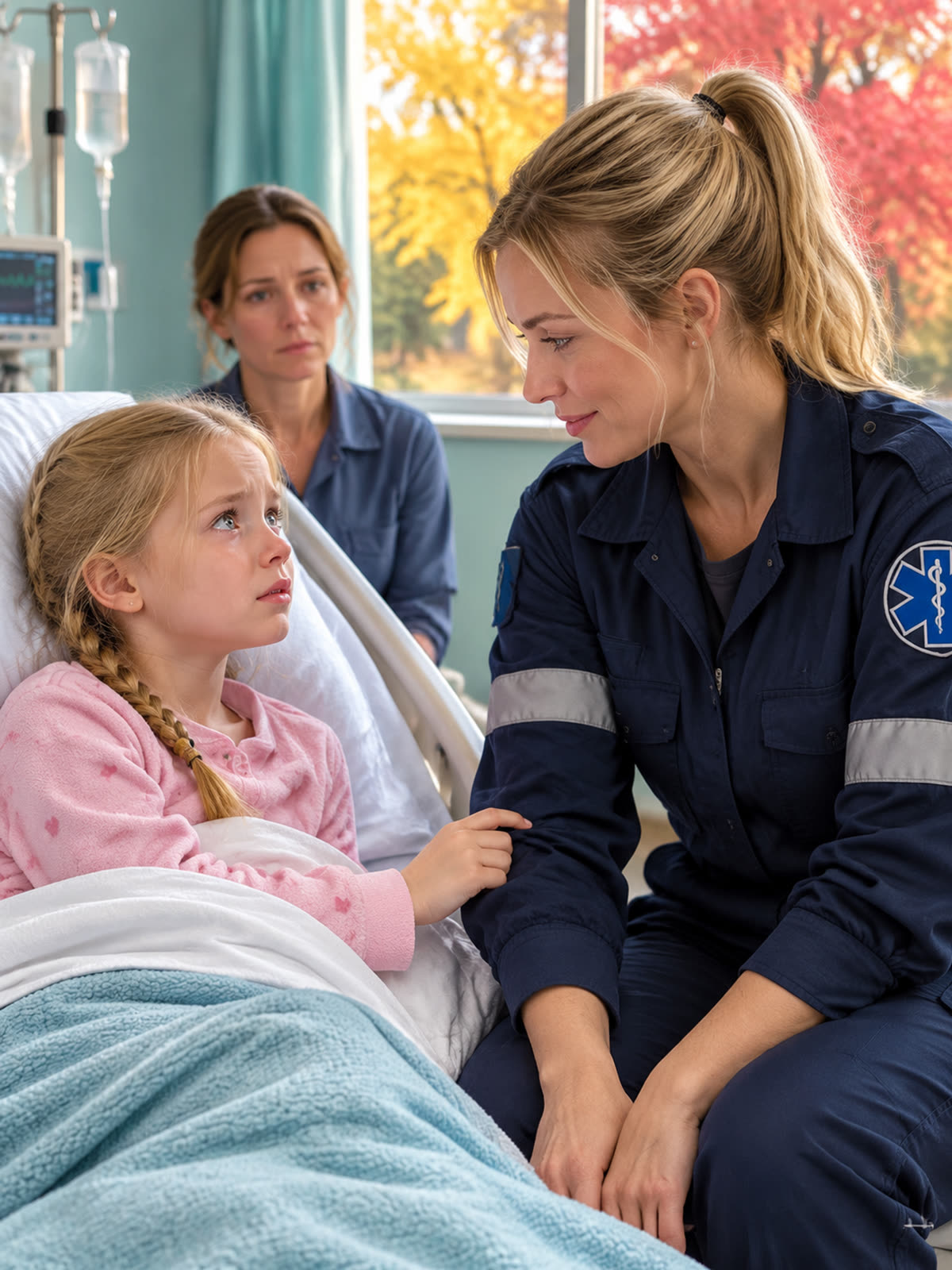
“She was trying to help us help her,” Dorothy replied. “That’s what a lot of these kids do.” The detective’s answer was brief. Meanwhile, Rhonda had remained beside Sadie’s hospital bed. She sat with her hands resting on her knees while the girl held the cuff of her uniform between two fingers. Sadie had not released her sleeve since the ambulance ride. The familiar fabric was still caught in her small hand.
A trained child forensic interviewer would speak with Sadie the following morning. The conversation would take place in a quiet room arranged for that purpose, with someone who knew how to listen without making the child repeat her account again and again. Until then, Lorraine made the rule unmistakable: nobody was to question her. Nurses, the detective, and everyone else involved were expected to respect it.
“She isn’t a witness tonight,” Lorraine said. “She’s a six-year-old who needs a blanket and a snack.” Her words returned the room’s attention to the child in the bed rather than the questions surrounding her. There would be an investigation, and people trained for it would do their work. For that evening, Sadie needed care. Her mother remained nearby, although she said very little.
Rhonda looked at the little girl still holding her sleeve. “Do you want me to stay?” Sadie nodded. “Then I’ll stay.” Rhonda did not ask her to explain why she wanted company, or what she feared might happen if that familiar person left. She simply stayed beside the bed. Sadie could keep hold of the cuff without having to trade an answer for the comfort of someone remaining with her.
When Lorraine asked Sadie’s mother about Wesley, the answers came in short sentences. He had moved in the previous winter. He contributed toward the rent. On days when her shifts ran long, he collected Sadie from school. She had believed he was good with her daughter. These were the arrangements she had depended on, and she described them now while the investigation began around her.
“Where did he say he was going this week?” Detective Ortiz asked. “A work trip. Chicago.” The detective followed with another practical question. “Do you have a number for his employer?” Sadie’s mother took out her phone to find it. Before she could, a notification caught her attention. Wesley had sent a message at 8:14 that morning, only seven minutes after Sadie called for help.
Everything okay at the house? Don’t forget what we talked about. Her mother stared at the words. “I didn’t tell him anything was wrong.” Ortiz told her not to answer and not to erase anything. Then the detective asked a question that drained the color from her face. “Did he know Sadie was home alone this morning?” Her mother answered in a whisper. “He knew my schedule. He always knows my schedule.”
The following morning, Sadie sat in a room furnished with soft chairs and a box of crayons. Across from her was Dr. Yolanda Reyes, who spoke slowly and never raised her voice. A detective, the social worker, and a prosecutor watched from behind a one-way mirror. Sadie’s mother waited outside in the hallway with Rhonda. She held a cup of coffee, but she did not drink it.
Dorothy would not repeat what Sadie said in that room. Those words belonged to Sadie and to the people responsible for protecting her. The girl spoke for a long time. Dr. Reyes let her speak without interrupting. Afterward, Detective Ortiz came into the hallway, paused to draw a breath, and addressed Sadie’s mother. “She told us everything we needed to know. She was very brave.”
Her mother set down the untouched coffee and covered her face. “I should have asked her,” she said. “I should have asked her first.” Lorraine answered gently, without taking away the truth of what she had said. “Yes,” Lorraine said gently. “And now you will.” There was no way to ask the earlier questions again at the right time. There was only the chance to listen differently now.
Specialists reviewed the medical findings and agreed with Dr. Hale’s reading of the first scans. The injuries were at different stages of healing and did not fit the explanations given for them. The emergency recording, the paramedics’ observations, Wesley’s message, and Sadie’s interview became part of the case file. Under a court order, investigators examined his phone, his messages, and his supposed business trip. They found there had been no trip to Chicago. His car had been parked two blocks from the white house all morning.
PART 3 — The People Who Stayed
Wesley was arrested that afternoon. Dorothy was not there, and she was glad she had not been. Detective Ortiz later told her that he had offered no resistance. He requested a lawyer, then asked whether Sadie’s mother had been “told the whole story.” Ortiz said she told him that the story had already been told—by the child he had spent a year teaching to keep silent.
The legal proceedings lasted many months. Hearings, motions, and delays followed, handled by the people trained for that work. Sadie was not required to testify in an open courtroom. Her recorded interview and the supporting evidence carried the case. When it ended, Wesley was convicted and received a long prison sentence. The judge observed that Sadie had ultimately been protected because a child asked for help and adults listened.
The conviction did not make every difficulty disappear. That winter, Sadie’s mother lost her job because she had missed shifts. Without Wesley’s contribution toward rent, she lost the apartment as well. For several weeks, she and Sadie stayed at a county-supported family shelter. Lorraine pursued the forms, referrals, and signatures they needed, fighting through each piece of paperwork rather than allowing it to become another closed door.
A local church supplied furniture. A hospital volunteer helped find a daycare opening and a job at a medical billing office. The supervisor there did not demand explanations and allowed Sadie’s mother to take Thursdays for her daughter’s therapy. Those arrangements gave them practical support while they worked through what had happened. The work of helping Sadie continued well beyond the hospital and the end of the court case.
Her mother began therapy too. During her first session, she told the counselor, “I believed him because he always sounded so sure.” The counselor’s answer was simple. “Certainty isn’t evidence.” Sadie’s mother wrote the words inside the front cover of her notebook. It was something she could return to, in her own handwriting, rather than another confident explanation accepted without a question.
Sadie recovered in the uneven way children sometimes do. Good weeks were followed by terrible nights. She needed the hallway light left on when she slept. Certain voices still made her flinch. Healing did not move neatly forward, and the passage of time did not mean every fear had gone. Yet she began coloring in her own room again. She asked for juice. She learned that she could refuse things she did not want.
Her counselor introduced a game in which Sadie could be in charge of the toys. Given that authority, she was naturally strict. Alongside the difficult nights, there were moments like that: an ordinary child’s game, a request spoken aloud, a choice she was allowed to make. Those moments belonged to her recovery too. They did not erase what she had experienced, but neither did what had happened take every ordinary thing from her.
One spring morning, the hospital liaison contacted Dorothy. Sadie and her mother wanted to visit the dispatch center, if she was willing. Dorothy was more than willing. Before their arrival, she cleaned her desk twice. She had heard Sadie’s frightened voice through a headset and preserved her words in a record. Now the girl wanted to come in person.
They arrived on a Saturday. Although there was no rain, Sadie wore a yellow raincoat and held her mother’s hand. To Dorothy, she seemed smaller than she remembered and, somehow, taller at the same time. “Are you the lady on the phone?” Sadie asked. “I am.” The girl looked at her and said, “You had a nice voice.” Dorothy answered, “So did you.”
Sadie considered that before continuing. “I told you about the mailbox.” Dorothy nodded to the details she remembered. “You did. And the flowerpot. You were very good at details.” Sadie replied, “Mom says details are important.” “She’s right.” They stood together at the dispatch desk, speaking now about the things Sadie had managed to describe while she was frightened and waiting for help.

Dorothy showed her the headset and allowed her to try it on. Sadie tapped the microphone. “Hello?” she said in a small, solemn voice. Then she held it against her ear and listened, as though someone might respond. After a moment she asked, “What do you do when somebody doesn’t say anything?” It was a question Dorothy knew how to answer, although answering calls never made every silence the same.
“I wait,” Dorothy said. “I keep the line open. Sometimes people need time before they can say it.” Sadie nodded slowly. “You waited.” “I did.” The girl removed the headset and offered it back with both hands, carefully, as if it were something precious. “Thank you for waiting,” she said. Dorothy did not think she managed an answer. She nodded and looked toward the clock, as she did when her eyes would not behave.
Before they left, Sadie’s mother handed Dorothy a plain white envelope. Inside was a drawing of a white house with peeling paint, a broken mailbox, and a blue flowerpot. A bright yellow sun shone above two figures standing together: a woman and a little girl holding hands. Across the bottom, in careful, uneven letters, Sadie had written: Mom stayed. Dorothy waited.
Dorothy placed the picture in the drawer beneath her desk. Beside it lay her old folded dispatch checklist, its creases worn soft. On that paper, in her own handwriting, she had recorded the time and the importance of keeping the child’s account intact: 8:07 a.m. Child’s original words preserved. The drawing and the checklist stayed together in the drawer.
Rhonda visited the following week. She had been promoted to supervisor. Perched on the edge of Dorothy’s desk, she complained about a coffee that had cost $2.25, because some traditions were not going to change. Then their conversation returned to Sadie. “Think about it,” Rhonda said. “She was six. She didn’t have a plan. She just called.”
“She had a plan,” Dorothy said. “She remembered what her mom told her. And she called anyway.” Rhonda remembered another detail. “She didn’t open the door.” “No. She told us where the key was instead.” Rhonda gave a soft laugh, then fell quiet. The small practical decision had allowed them inside without Sadie abandoning the instruction she had been given.
“Do you ever think about the ones who don’t call?” Rhonda asked. “Every day,” Dorothy said. “That’s why I keep the line open.” There was no easy ending to that question. Sadie had reached them. Other children remained in the thoughts behind the work, and Dorothy returned to her headset knowing that an unanswered greeting did not necessarily mean there was nobody who needed her.
On the anniversary of Sadie’s call, a quiet Tuesday in late September, Dorothy looked at the clock at 8:07. She remembered a small voice describing pain and a white house with a broken mailbox. She thought of Gideon bending to lift a flowerpot, and of Rhonda on a bedroom floor with her sleeve caught in a child’s fist. She remembered Dr. Hale asking the question that had not been asked before, and Detective Ortiz listening to the recording without interrupting.
She thought, too, of an ordinary phone setting, an ordinary message, and an adult’s ordinary explanation—things that might have remained unquestioned if a little girl had never picked up a phone. Then her headset lit up. “911, what’s your emergency?” A pause followed. Then a faint breath. Dorothy picked up her pen and waited.
Disclaimer: This story is a work of fiction inspired by real-life themes. Names, characters, places and events are fictionalized, and any resemblance to real persons is purely coincidental. Images are for illustration purposes only.
