

PART 1 — The Name on the Receipt
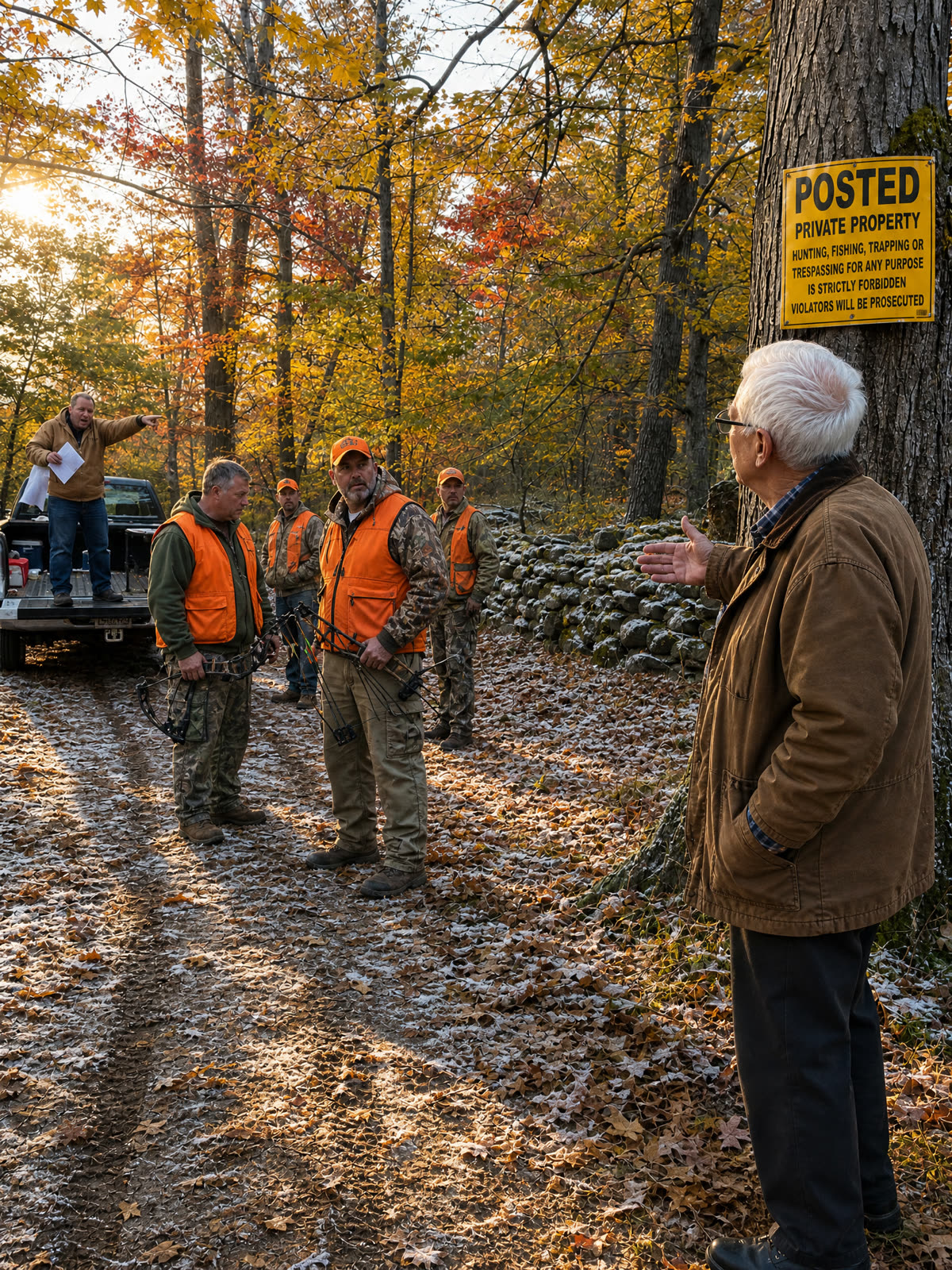
“These men paid me four hundred dollars each to hunt here, so get off my land, old man!” Silas Dalton stood on his pickup’s tailgate in my back field, flourishing a handful of receipts above eleven men wearing blaze-orange vests. The sheets snapped in the cold breeze. Beyond the trucks, the morning sun edged over the eastern ridge, lifting steam from the frost. It was an October Saturday in Haldane Corners, Connecticut, the first weekend of archery season on private land. Silas had arrived with eleven strangers, their compound bows, and permission to hunt woods he did not own.
The forty acres behind my house had been in my family since 1871. My great-great-grandfather purchased the oak, maple, and hickory woodland from a veteran of Gettysburg; the original deed still hung in my front hall. Along the northern boundary stood a dry-stone wall built in 1790 by Josiah Haldane, whose family had given the village its name. Three feet high, two feet thick, and a quarter mile long, it had endured two hundred and thirty-five years without mortar. When I walked my dog beside it the previous evening, not a section had been disturbed.
Now a fifteen-foot opening split it apart. Fieldstones lay on either side, several broken, and tractor tracks crossed the breach toward the parked trucks. “Silas,” I said. “You need to take these men home.” He laughed, striking the receipts against his hand. “They paid for the privilege,” he said. “Four hundred dollars apiece.” “Not to me.” “Because you’re not the one handling the lease!” “There is no lease,” I said. One hunter moved forward: a stocky fellow around forty, with a gray goatee and a bow in his left hand. Beside an old white oak, he stopped to examine my yellow POSTED sign.
His gaze went from the sign to me. “Sir,” he asked, “is this your property?” “Every acre you’re standing on,” I said. Silas stepped off the tailgate. At forty-seven, he was a large man, six foot two, with a heavy jaw and his late father’s way of crowding people during a conversation. “Don’t listen to him,” he told the hunters. “He’s a retired nobody with too much time on his hands.” I left my hands at my sides. At seventy-two, I had witnessed enough shouting in courtrooms to know how little it improved an argument.
“Your name isn’t on my deed, Silas,” I said. “And mine isn’t on those receipts.” “Signs are just paper!” he snapped. He grabbed the sign and wrenched it from the oak, the nails shrieking free. Then he snapped its wooden backing over his knee and tossed the pieces among the leaves. Nobody laughed. Beyond him, muddy tractor ruts cut through the fern bed my wife had planted twenty years earlier. Nell had wheeled every ostrich fern, cinnamon fern, and lady fern up from the southern swamp herself after retiring from teaching. Their October fronds were brown, but their roots had still been alive.
Eleven bows, eleven orange vests, and eleven men who might honestly have believed Silas could rent them this ground. “Did you tell them they had my permission?” I asked. “They don’t need your permission,” Silas said. “They paid me.” A thin hunter in his sixties, wearing wire-rimmed glasses and holding his bow by the riser, lifted a hand. “Silas,” he said. “You said the owner passed away.” Heads turned. Silas tightened his jaw. “I said there wouldn’t be a problem.” “You told us he was dead,” the man insisted. “Back in September. At the diner. I asked you straight out before I handed you the cash. You said the old man died in the spring, and you were handling things for the estate.”
Silas pointed at me. “He’s the problem,” he said. “I’m calling conservation. They’ll throw him out.” “Please do,” I said. He pressed his phone against his ear and reported a trespasser interfering with licensed hunters on leased property at the end of Weller Road. The trespasser, he explained, was an elderly man who refused to leave. Once he finished, he smiled as though making the call had established ownership. What he had forgotten, or never understood, was that I had spent thirty-one years bringing wildlife and trespass cases before Connecticut judges.
Twenty minutes later, a green pickup bearing a light bar and Connecticut’s state seal eased up my lane and stopped beside the ruined wall. It belonged to the Department of Energy and Environmental Protection’s Environmental Conservation Police—EnCon, as people around the hills called them. The officer was a compact, square-shouldered woman around forty in a green uniform and brown campaign hat. CRUZ appeared on her name tag. Before speaking, she studied the opening, displaced stones, shattered sign, damaged ferns, and uneasy gathering of hunters. Silas hurried toward her with his receipts raised.
“Officer!” he called. “Arrest that man. I’ve got eleven paid hunting passes right here. He’s interfering with lawful hunters.” She made no move to take them. “Mr. Dalton,” she said. “Who owns this parcel?” “I control it,” Silas said. “Same thing.” After looking at him a moment, she turned to me. “Sir,” she said. “Your name?” “Franklin Weller.” Recognition flickered across her face. “Franklin Weller,” she repeated carefully. “The prosecutor?” “Retired,” I said. “I was the State’s Attorney for the Litchfield Judicial District until six years ago. Before that, assistant state’s attorney for twenty-five years.” She nodded. “I read your opinion on the Fiske case at the academy,” she said. “The jacklighting case. In 2009.” “That was the judge’s opinion,” I said. “I only wrote the brief.”
The field fell quiet. “Mr. Dalton,” she said, holding out her palm. “Let me see exactly what you sold them.” Silas surrendered a receipt. A clip-art deer decorated its corner; above a paragraph granting October-through-December bow-hunting rights on my forty acres, the heading read WELLER WOODS HUNTING LEASE, 2025 ARCHERY SEASON. It acknowledged four hundred dollars cash, paid in full. Cruz stopped at the signatures, read them again, and glanced toward me in my old barn coat, my dog beside my feet. Michael Ferreira had signed as Hunter. Above him, on the Landowner line, someone had carefully written Franklin J. Weller, followed by S. Dalton, Executor of the Estate. “Mr. Weller,” Officer Cruz said quietly. “Did you sign this?” “No, ma’am,” I said. “Is this your signature?” “It’s my name,” I said. “It isn’t my hand. But it’s close.” I looked at Silas. “Somebody practiced.” Cruz extended her other hand. “All of them, please,” she said. “Every receipt.”
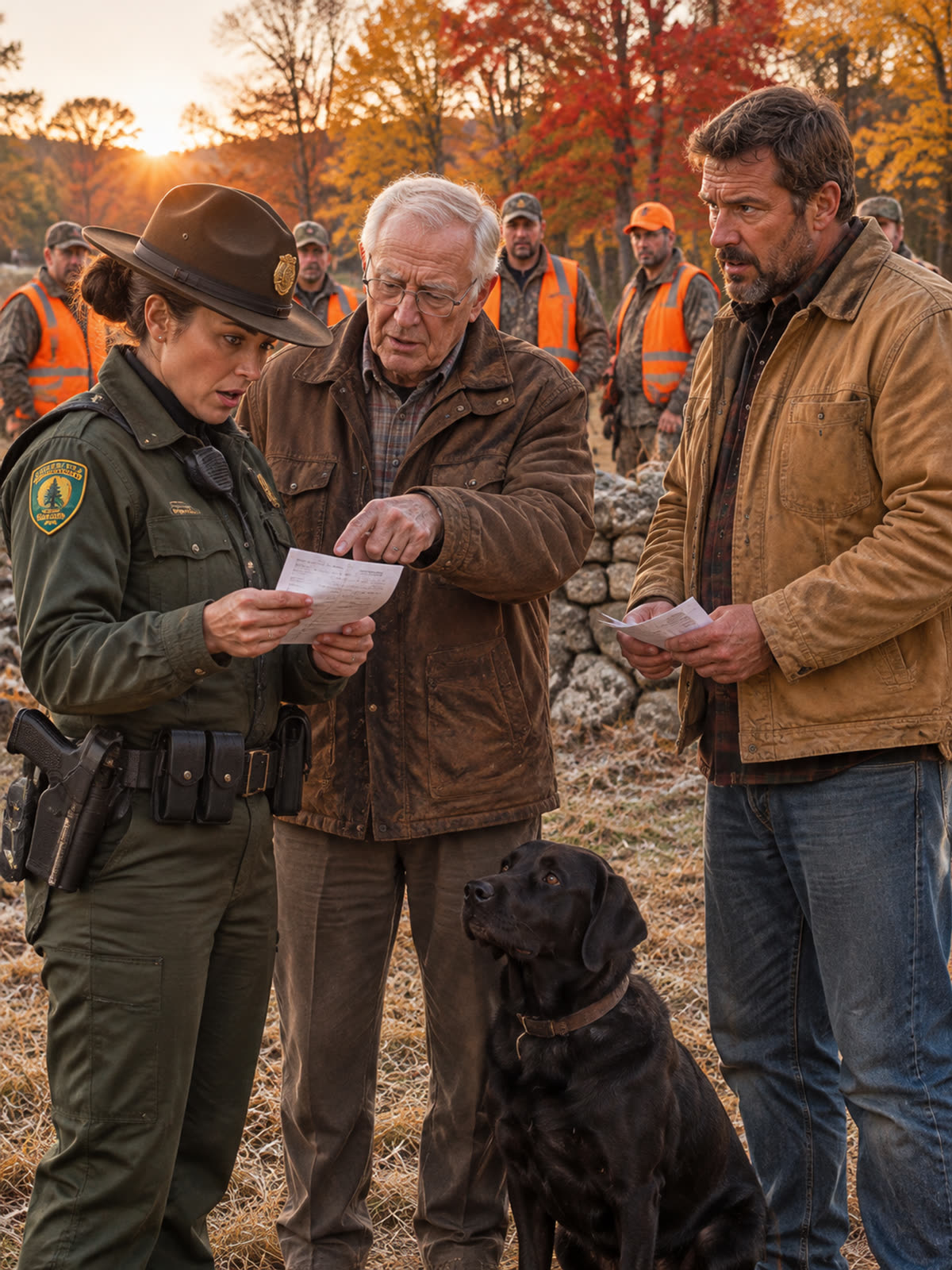
All eleven carried the same deer, wording, and forged signature. Eleven cash payments of four hundred dollars: forty-four hundred altogether. Instead of questioning Silas first, Cruz approached the hunters. “Gentlemen,” she said. “Connecticut law requires anybody hunting on private land to carry written permission from the landowner. You all know that. It’s in the hunting guide. It’s on your license.” She raised the receipts. “Each of you thought this was that permission. It isn’t. The landowner is standing right there. He’s alive. He didn’t sign these.” The men exchanged looks. “I’m not going to write any of you up,” she said. “I don’t believe any of you knew. But I need you to unstring your bows, put them in your vehicles, and leave this property now. And I’m going to need each of your names and phone numbers, because you’re all going to be witnesses.”
They quietly followed her instructions. Before leaving, the hunter with the gray goatee offered his hand. “Mike Ferreira,” he said. “From Torrington. I’m sorry, Mr. Weller. I should’ve known. When we drove in through that hole in the wall, I thought, who knocks down a wall to get onto land he’s leasing? I should’ve turned around right then.” I shook his hand. “You asked the right question, Mr. Ferreira,” I said. “Before you started hunting. Most men wouldn’t have.” The thin man approached next. He was Arthur Bell, a retired Winsted machinist who had taken the four hundred dollars from his Social Security.
“He told me you died in April,” Arthur Bell said. “Heart attack. He said the estate was tied up in probate, and the heirs were out of state, and he was handling the property. He said it like he’d been to your funeral.” He shook his head. “I said I was sorry for his loss. He thanked me.” I had no answer. When the final truck disappeared down the lane, only Cruz, Silas, and I remained. Duke, my old black Labrador, sat at my feet watching Silas.
“Mr. Dalton,” she said. “You took four thousand four hundred dollars from eleven men by telling them the owner of this land was dead and you had authority to lease it. You signed his name to eleven documents. You damaged a stone wall that’s on the state’s list of historic agricultural walls. You tore down a posted sign and broke it in front of a witness. And you called me out here to report the actual owner as a trespasser.” Silas’s face had faded from red to gray. “I’m going to ask you to come down to the barracks in Harwinton with me,” she said. “You’re not under arrest yet. I want to give you the chance to explain.”
He gave me a long, peculiar look. Under his anger lay something older, something I recognized from a skinny eighteen-year-old in the back row of Litchfield Superior Court twenty-nine years earlier. “You don’t remember me,” Silas said quietly. “Do you, Mr. Weller.” “I remember you, Silas,” I said. “I remember your father.” After they drove away, Duke followed me to the breach. I surveyed the gray, brown, and rust-colored fieldstones, some weighing two hundred pounds, that a farmer and his oxen had hauled from the earth when these hills were cleared for pasture.
Nell had walked that wall with me every evening. Eleanor, formally, though almost everyone called her Nell. For thirty-four years she taught fourth grade at Haldane Corners Elementary, and she knew the story of every old wall, cellar hole, and mill dam nearby. Sometimes she rested her palm on these stones and said, “Somebody’s grandfather carried these, Frank. Every one of them. One at a time.” Breast cancer had taken her three years earlier, after forty-four years of marriage. Our son in Seattle and daughter in Baltimore called each Sunday and kept asking when I would sell and find somewhere smaller. My answer remained not yet.
The tractor had crushed the ostrich fern crowns deepest into the mud. A few might return in spring; most probably would not. My knees protested as I lowered myself beside a stone of perhaps forty pounds. I tried lifting it onto the wall and could not raise it far enough. I settled it back among the leaves and remained kneeling, my hand spread over it as Nell’s used to be. Duke lay beside me and rested his chin on my knee. Twenty-nine years before, I had prosecuted Silas Dalton’s father. Now, with Nell’s ruined garden behind me, that winter was waiting for me again.
PART 2 — What Nell Asked Me to Do
In the winter of 1996, Earl Dalton farmed the land north of mine, beyond the stone wall. Like his father and grandfather, he kept dairy cows—sixty of them—in a deteriorating barn, carrying more debt than a man should have to bear. Milk prices collapsed that year, and half the dairies in Litchfield County failed. One January night, at two in the morning, a game warden found Earl in my woods with a spotlight, a .30-30, and a dead doe in his truck. Jacklighting meant freezing a deer in a beam of light before shooting it. It was illegal everywhere in the country. It was not hunting; it was killing.
The warden testified that Earl had done it six times that winter, taking six deer from my property. Earl said venison had fed his wife and two children since November because he could no longer afford groceries. Silas was the older child. I was forty-three, an ambitious assistant state’s attorney certain of my principles. Many poachers I prosecuted were poor, desperate rural men, and I believed that making hunger an exception would destroy the rule. I requested the maximum. Earl received thirty days in the county jail, a two-thousand-dollar fine, and a ten-year hunting-license revocation. Eighteen months later he lost his farm. In 2001, he drank himself to death in a rented Torrington trailer.
The evening before sentencing, Nell stood in my study doorway wearing her bathrobe. “Frank, he was feeding his kids.” “He was breaking the law, Nell,” I said. “His boy Silas is in my old class,” she said. “He was in fourth grade with me. He’s eighteen now. He’s going to sit in that courtroom and watch you put his father in jail for feeding him.” She looked at me. “Ask for the fine. Ask for probation. Let him keep his license. He’s going to lose that farm either way. Don’t make the boy watch you do it.” I refused to listen. I told her the law did not care whose children they were.
She attended sentencing anyway. In the back row, beside an eighteen-year-old wearing a borrowed sport coat, she placed her hand on his arm when the judge announced thirty days. That boy was Silas. Only after Nell died did I find her letter to the judge among her papers, asking mercy for Earl. His reply said he had considered it, but the State’s Attorney’s request for the maximum had persuaded him to impose it. For three years, scarcely a day had passed without my thinking about that letter.
Cruz called around seven that evening. I sat at the kitchen table with untouched soup while Duke slept beside the woodstove. “Mr. Weller,” she said. “I wanted to let you know where things stand.” At the Harwinton barracks, with a public defender present, Silas had talked for two hours and admitted everything. He had copied my signature from a culvert letter filed at town hall, practicing for a week. He acknowledged the forged receipts and his claim that I was dead. Of the forty-four hundred dollars collected at a Route 4 diner in September, twenty-one hundred remained. “On what?” I asked about the money already spent.
After a pause, Cruz answered. “His property taxes, sir,” Officer Cruz said. “He’s three years behind with the Town of Haldane Corners. The town’s put a lien on his house, and they’re scheduled to sell it at a tax sale in December. He owes eleven thousand eight hundred dollars.” She fell quiet briefly. “He said he thought if he could get enough money from the hunters, he could stop the sale. He said he didn’t know what else to do.” I listened without speaking.
“The State’s Attorney in Litchfield will decide on charges,” she said. “But I can tell you what I put in my report. Forgery in the second degree, eleven counts. That’s a class D felony each. Larceny in the third degree, for the four thousand four hundred. Criminal mischief for the wall, and the sign. Criminal trespass. And making a false report to a police officer, for calling me out there.” She paused. “Mr. Weller, you know better than I do what that adds up to,” she said. “He could be looking at real prison time. Years.” “I know,” I said.
“I’m calling because the State’s Attorney’s office is going to want to talk to you,” she said. “As the victim. They’ll want your input before they decide how to proceed.” Then she added, “He told me something else. At the end. He said to tell you he was sorry about the ferns.” I remained at the table, the phone against my ear. “He said your wife planted them,” Officer Cruz said. “He said she was his fourth grade teacher. He said she sat with him in court when he was eighteen.”
The following afternoon I drove to Silas’s house. Even retired prosecutors know better than to visit defendants, but I was no longer a prosecutor, and I could not forget Nell’s hand on his arm. The bank had sold the old farm in 1998 to a New Yorker who converted it into a horse property. Silas occupied two remaining acres, in a small Cape Cod his grandfather built for a hired man in 1952. Blue tarps patched the roof; the siding needed paint. A yellow tax-sale notice covered part of the front door. His wife, a small, tired-eyed woman in a nurse’s aide uniform, answered. Behind her, a teenage girl did homework while a younger boy watched television. “Mr. Weller,” she said. “He’s out back.”
He sat on an overturned bucket in the hip-roofed shed beside the tractor that had wrecked my wall, elbows on knees, face buried in his hands. He looked up but stayed seated. “Come to see the criminal?” he said. “I came to see Earl Dalton’s son,” I said. His laugh was short and ugly. “You remember him, then.” “I remember him every day, Silas.” He studied me, then lowered his eyes to the dirt. “You know why I told them you were dead?” he said. “Because Nell Weller died. Three years ago. I went to her funeral. I sat in the back. You didn’t see me.” He swallowed. “And I thought, the good one’s dead. The one who sat with me. And the one who put my father in jail is still up there on that hill with his forty acres. Like nothing ever happened.”
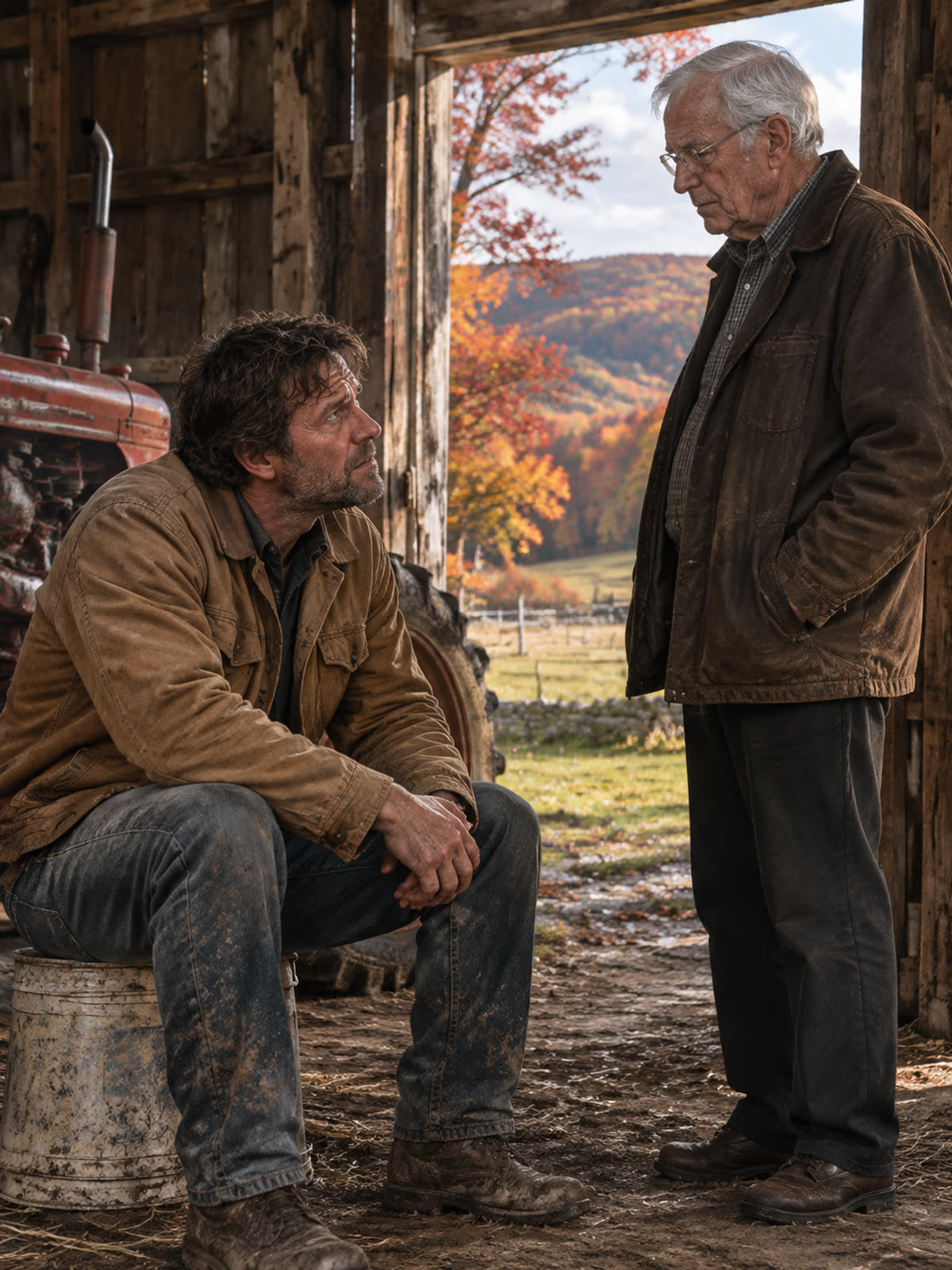
I let him continue. “I lost my job at the paper mill in Winsted two years ago when they closed it,” he said. “Twenty-four years. Gone. I’ve been driving a delivery truck for twelve dollars an hour. My wife works double shifts at the nursing home in Torrington. My daughter wants to go to UConn. And the town’s going to sell my house in December for eleven thousand eight hundred dollars.” He met my eyes. “The house my grandfather built. The last piece of Dalton land.” “So you sold mine,” I said quietly. “So I sold yours,” he said. “And I told myself it was justice. My father fed his family off your deer, and you took everything from him. So I’d feed mine off your woods, and you’d never even know.”
His next laugh was bitter. “Except I couldn’t even do that right. I knocked down your wall because I was too lazy to go around through the gate. I tore up your wife’s ferns. I lied to eleven good men and told them you were dead.” He covered his face again. “I’m my father’s son. That’s all.” For a long while I stood in the doorway. “No,” I said finally. “You’re not your father’s son. Not entirely.” He raised his head. “You’re Nell’s student too. She sat with you. And thirty years later, the first thing you told that officer was that you were sorry about her ferns.”
Catherine Breen, now State’s Attorney for the Litchfield Judicial District, called Monday and asked me in. Twenty years earlier she had clerked in my office, a sharp Waterbury woman who challenged me frequently and was usually right. Tuesday found me in my former office overlooking the Naugatuck River. Her furniture was different; the bookshelves remained. “Frank,” she said. “This is the strangest case I’ve had in a year. A man forges your signature on eleven hunting leases, tells the hunters you’re dead, and then calls the conservation police on you.” She shook her head. “The forgeries alone, eleven counts, class D felonies. I could ask for five years. Easily.” “I know,” I said.
“His lawyer’s going to argue it’s a first offense,” she said. “No record. Steady job until the mill closed. Wife and kids. He’ll want me to offer him accelerated rehabilitation.” Connecticut’s program allowed certain first offenders probation for up to two years under specified conditions. Successful completion meant dismissal and erasure of the charges. Serious crimes were excluded, but forgery and larceny could qualify. “I’m inclined to oppose it,” Catherine said. “The forgery’s too deliberate. He practiced your signature for a week. And there are eleven victims.” She regarded me across the desk. “But I want your view first. You’re the victim. And you’re you.”
For a while I watched the river. “Catherine,” I said finally. “In 1996, I prosecuted his father for jacklighting deer in my woods. Earl Dalton. Do you remember?” “Before my time.” “I asked for the maximum,” I said. “Thirty days, a two thousand dollar fine, and ten years without a license. He was feeding his kids. My wife begged me to ask for probation. I told her the law was the law.” I stared at my hands. “He lost his farm. He drank himself to death. And his son grew up hating me.” Catherine said nothing.
“I want you to support his application for accelerated rehabilitation,” I said. “With conditions.” She stared. “Frank…” “I know what I’m asking,” I said. “I sat in that chair for six years. I know exactly what I’m asking.” Leaning forward, I continued. “Here are my conditions. Full restitution to all eleven hunters, four thousand four hundred dollars, paid within six months. He rebuilds the stone wall himself, every stone, by hand, under the supervision of a mason I’ll choose. He replants the ferns. Two hundred hours of community service. And he writes a letter to each of the eleven men, in his own hand, telling them the truth.”
She considered me across my old desk. “Why?” she asked. “Because twenty-nine years ago,” I said, “my wife asked me to show a Dalton some mercy. And I didn’t. And she sat in the back row of a courtroom with her hand on an eighteen-year-old boy’s arm while I ruined his father.” I swallowed. “This is the only chance I’ll ever get to do what she asked.”
The hearing took place in November’s second week, in Courtroom B of Litchfield Superior Court in Torrington—the courtroom where I had prosecuted Earl in 1996, with the same pews and tall, rippled-glass windows. I took a seat in the back. Silas wore an ill-fitting borrowed sport coat beside Kevin Sorrell, his tired young public defender. His wife and their seventeen-year-old daughter sat behind him. The girl had her father’s heavy jaw. Mike, Arthur, four other hunters, and Officer Cruz were there. Catherine informed Judge Harlan Sweeney that the State would not oppose rehabilitation, then described the conditions I had requested.
The gray-haired judge, twenty-two years on the bench, studied me over his reading glasses. “Mr. Weller,” he said. “You prosecuted in this courtroom for thirty-one years. I don’t think I ever once heard you ask for accelerated rehabilitation for anybody.” “No, Your Honor,” I said. “You didn’t.” “Would you like to address the court?” I rose, steadying myself on the pew ahead as my knees ached. “Your Honor,” I said. “Twenty-nine years ago, I stood at that table and asked this court for the maximum sentence for this man’s father. His name was Earl Dalton. He jacklighted six deer in my woods to feed his family in a bad winter. The court gave me what I asked for.” Silas turned toward me. “My wife sat right here, in this row, beside this man, who was eighteen years old. She’d taught him in fourth grade. She asked me to show mercy. I didn’t.”
Silence filled the room. “I’ve spent three years since she died wondering what would’ve happened if I had,” I said. “I don’t know. Maybe nothing. Maybe Earl Dalton would’ve lost his farm anyway, and drunk himself to death anyway.” I swallowed. “But I know what happened because I didn’t. His son grew up thinking the law was just something the man up on the hill used to take things from people like him. And thirty years later, he tried to take something back.” I looked directly at Silas. “He did something wrong,” I said. “Badly wrong. He lied to eleven men, and he forged my name, and he tore down a wall that stood for two hundred and thirty-five years. He has to answer for that. But I’d like him to answer for it with his own two hands, on my land, putting back what he broke. Not in a cell.” I sat. “That’s what my wife would have asked for. I’m asking for her.”
Judge Sweeney watched me over his glasses for another long moment. Then his attention shifted to the defense table. “Mr. Dalton,” he said. “Stand up.” Silas rose, his hands trembling.
PART 3 — What Our Hands Could Repair
“I’m granting your application,” the judge said. “Two years of supervised probation. Full restitution within six months. Two hundred hours of community service. You’ll rebuild the stone wall on Mr. Weller’s property, by hand, under the supervision of a mason of his choosing, by June first. You’ll replant the ferns. And you’ll write those letters.” He removed his glasses. “If you complete every condition, these charges will be dismissed and erased, and you’ll walk out of this with no record. If you miss one, you’ll be back in front of me, and I won’t be nearly as understanding as Mr. Weller.”
The gavel fell. Silas sank into his chair and covered his face. His wife leaned across the rail and rested her hand on his shoulder. In the back row, alone with my hands folded, I occupied the place Nell had taken in 1996. There, Nell, I thought. There. Silas began rebuilding the Saturday after Thanksgiving. To supervise him, I hired Ezra Pike of Cornwall, a seventy-eight-year-old dry-stone mason who had spent fifty years restoring Litchfield County’s old farm walls.
Ezra arrived at seven in a canvas coat and wool cap, with enormous hands and a voice that sounded like gravel. For half an hour he examined the damaged section without speaking. Then he faced Silas. “You knocked this down with a tractor,” he said. “Yes, sir,” Silas said. “You’re going to put it back with your hands,” Ezra Pike said. “One stone at a time. The way the man who built it did. And you’re going to learn something about that man while you do it.”
Every Saturday through winter, they worked in snow, sleet, and bitter cold. Ezra taught Silas to read each stone, distinguishing its face from its bed and setting it with an inward lean so its own weight secured it. He demonstrated how to pack the center with small hearting stones that prevented movement, and how broad capstones shed rain. The wall was more than a pile of rock; rebuilding it required understanding the weight and place of every piece. Silas learned with his hands what the tractor had allowed him to ignore.
I carried out coffee at ten and lunch at noon. Initially, I left everything on Ezra’s tailgate and retreated indoors. The second week I lingered. By the third, I sat on an overturned bucket beside the opening, passing along hearting stones because my knees would permit little more. On the fourth Saturday, Mike Ferreira’s pickup came up the lane at eight. He climbed out carrying leather gloves and walked over to us. “Figured you could use another back,” he said.
Silas stared. “You don’t have to do this. I took your money.” “You gave it back,” Mike said. By the end of December, Silas had repaid every hunter, combining the remaining twenty-one hundred dollars with a loan from his brother-in-law in Danbury. “And you wrote me a letter. Two pages. In pencil.” Mike pulled on his gloves. “Nobody ever wrote me a letter like that in my life.” He had come back to the woods without a bow, offering his labor to the man who had deceived him.
By January, four hunters were spending Saturdays with us: Mike, Arthur Bell, and the two Duffy brothers from New Hartford. They worked alongside Silas and Ezra, and at noon we perched on tailgates in the cold. I made chili in a large pot on the woodstove and brought it out for everyone. We talked about deer, old walls, and the Red Sox. The same ground that had held eleven uneasy strangers in October now held men eating together beside a slowly closing gap.
One February Saturday, Ezra stopped midway through the morning. Kneeling beside the wall’s base, he lifted a flat gray fieldstone from the frozen leaves. It was about the size of a dinner plate. “Look at this,” he said. He turned it over. Beneath it, so weathered that the cuts were barely visible, someone had chiseled two letters and a date: J.H. Underneath them, 1790. “Josiah Haldane,” I said quietly.
“He signed it,” Ezra said. “The man who built this wall. He put his initials on the bottom of one stone, where nobody’d ever see it.” He offered it to Silas. “You want to know something about the man who built this? He was proud of it. Proud enough to sign it.” Silas accepted the stone in both hands and looked at it for a long time. The marks had survived beneath the wall through all the years that the stones above them stood undisturbed.
Silas lowered the fieldstone into the bottom course. He placed the initials downward, restoring it to the position where it had rested for two hundred and thirty-five years. Around him lay the winter woods, and beside him stood the men helping rebuild what he had destroyed. Josiah’s signature disappeared into the wall again, unseen but back where it belonged.
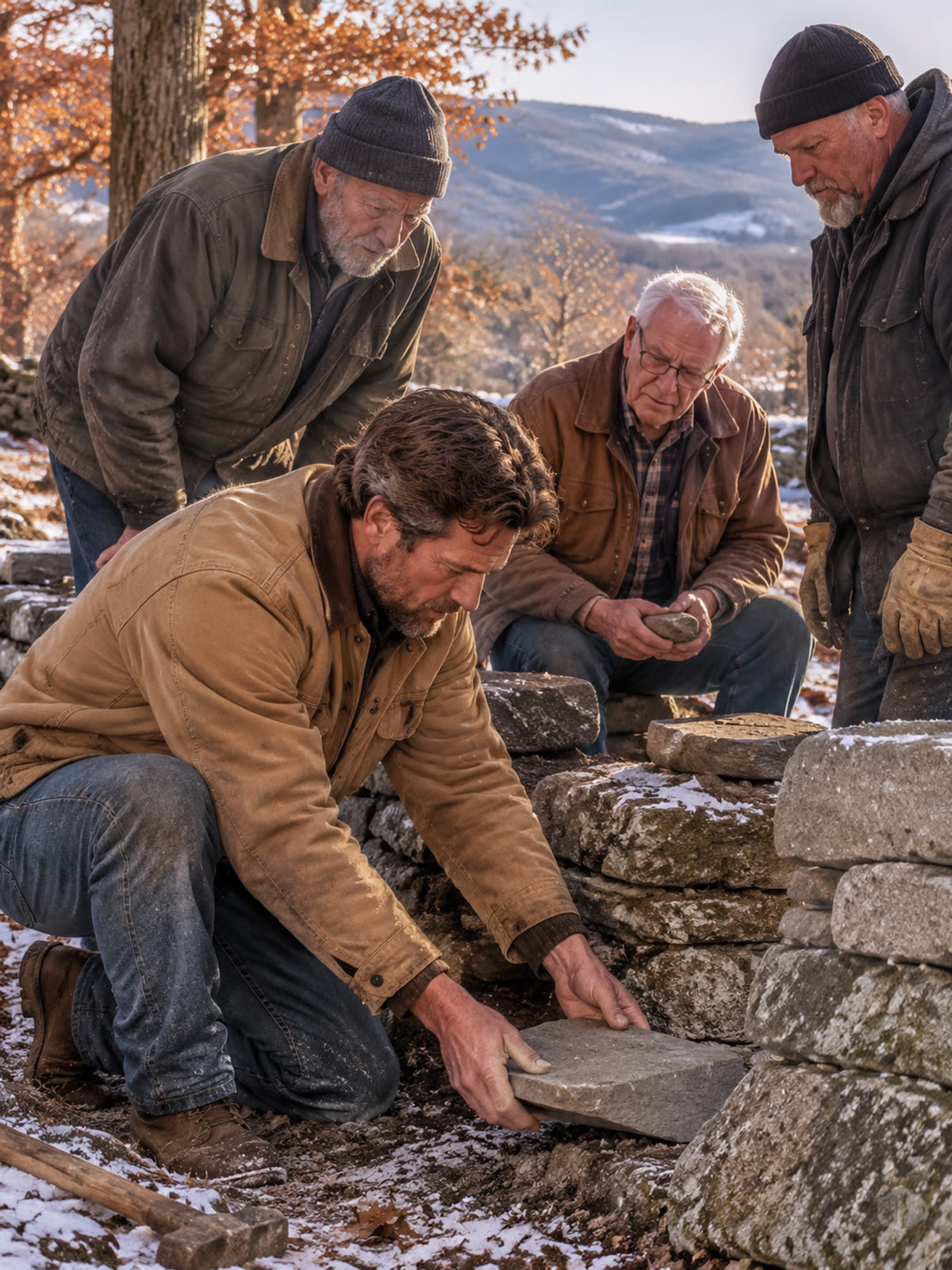
They completed the repair in April, with peepers calling from the swamp and the earliest green showing in the maples. The final capstone was a three-foot slab of gray schist. Ezra, Silas, Mike, and both Duffy brothers lifted it together and settled it above the old breach. Ezra stepped back, then inspected the entire repaired stretch. “You can’t tell,” he said finally. “A hundred years from now, nobody’ll know it was ever broken.”
Then came the ferns. Each Saturday afternoon in March, after finishing work on the wall, Silas had gone to the southern swamp where Nell once dug hers. He gathered ostrich ferns, cinnamon ferns, and lady ferns, their tightly furled fiddleheads emerging from the mud. Using Nell’s old wheelbarrow from my barn, he brought them to the woodland edge. One at a time he set them into his tractor tracks, watered their roots, and covered the soil with leaf mulch. I watched from the edge of the trees.
After the last plant, he stood and wiped his palms against his jeans, surveying the surviving ferns and their replacements. “Mrs. Weller made us plant a garden,” he said. “In fourth grade. Behind the school. She gave every kid one plant to take care of.” He nearly smiled. “Mine was a fern. I killed it in two weeks. She gave me another one.” I could not speak. “I never forgot that,” Silas said. “She gave me another one.” He looked at his hands. “And then she sat with me in court. And then she died. And I tore up her ferns with a tractor.” “And then you planted them back,” I said.
That afternoon I invited him inside for the first time. In his muddy work clothes, he sat at Nell’s kitchen table, looking at her blue willow plates on the shelf and cookbooks along the windowsill. I made coffee and laid two pages before him. A Litchfield lawyer I had known for forty years had prepared them. This was a hunting lease, but unlike the papers Cruz had collected, it was real.
For five years, Silas would hold the exclusive right to manage archery hunting on my property. He could choose up to eight hunters each season and charge a fee he considered fair. Every hunter would carry written permission signed personally by me. I would receive twenty-five percent of the fees; he would keep the rest. In return, he would maintain the trails, posted signs, and walls around all forty acres, and patrol the woods weekly during hunting season. Insurance and liability clauses were included. Another clause ended the arrangement immediately if he ever forged another signature.
He read the document twice. “Why?” he asked. “Because your property taxes are eleven thousand eight hundred dollars,” I said. “And the tax sale got postponed until August because your lawyer asked the town for a payment plan. And eight hunters at four hundred dollars a season, minus my share, is twenty-four hundred dollars a year.” I sat opposite him. “That’s not enough to save your house. But it’s a start. And it’s honest.” He stared down at the lease. “My father would’ve given anything to hunt these woods legal,” he said finally. “I know,” I said. “I’m sorry I never let him.”
Silas took the pen and wrote Silas E. Dalton on the Manager line, in his own handwriting. Then he passed the pages across the table. On the Landowner line, I signed Franklin J. Weller, in mine. The following October, at dawn on the first Saturday of archery season, I walked toward the north wall. Duke followed more slowly now, his muzzle grayer. Frost covered the grass, sunlight rose beyond the eastern ridge, and red and gold filled the trees. Nell’s ferns had grown thick through summer and were turning bronze.
Silas’s pickup stood at the gate—not beside the wall. Since April, he had used that entrance every time. Eight hunters waited with their bows: Mike, Arthur, the Duffy brothers, and four friends who had contacted Silas in August. Each carried my written permission in his jacket. I had signed every sheet at the kitchen table in September with Silas sitting opposite me. Wearing a blaze-orange vest, he checked licenses against a clipboard. “Morning, Mr. Weller,” he said when he saw me. “Morning, Silas.”
He handed over the clipboard. It listed every hunter’s name, license number, telephone number, and assigned stand, each location marked on a hand-drawn woodland map. Above the list, in his blocky handwriting, were the words Weller Woods. Honest Hunting. Est. 1871. I studied them. “I hope you don’t mind,” Silas said. “Mike’s daughter made us a sign for the gate. I wanted to ask you first.” On his tailgate leaned a hand-painted white-oak board. Its deer was considerably better than the clip-art animal on those old receipts. Below the same heading appeared smaller lettering: Permission of the Landowner.
“Hang it,” I said. With the hunters watching, he fastened the sign to the gatepost. Then he opened the gate and admitted them individually. Each nodded as he passed. Mike shook my hand, and Arthur tipped his cap. After the last hunter entered the woods, Silas closed the gate. We listened to their footsteps fading through the leaves toward their stands, quiet as good hunters should be.
“I made the August payment,” he said, after a while. “To the town. They took the house off the tax sale list. I’ve got a payment plan for the rest. Two years.” He looked toward the gate. “This helps. More than you know.” “Good,” I said. For a while longer we stood in the cold sunrise. Then he reached inside his orange vest and offered me a small, flat fieldstone, roughly the size of my palm.
Letters had been carefully chiseled into its underside: S.D., then F.W., and beneath them, 2026. “Ezra showed me how,” Silas said. “I put one just like it in the wall. Bottom course, next to Josiah’s. Facing down, so nobody sees it.” He held out the second stone. “This one’s for you. So you know it’s there.” I accepted it. Cold, rough, and surprisingly heavy, it rested in my hand at the gate to woods where I had once caught his father taking deer.
I thought of Nell’s palm against the wall each evening, then against an eighteen-year-old boy’s arm in a courtroom. I thought of the fern she had given him and the second one she offered after the first died. “Thank you, Silas,” I said. He nodded, tucked his hands into his vest pockets, and looked across the stones toward the trees. Then he said, quietly, “She’d have liked this. Mrs. Weller.” “Yes,” I said. “She would.”
Duke followed as we walked the wall together that morning, past the invisible repair and the tall bronze ferns silvered with frost. At the north corner, where Josiah Haldane’s wall met the old Dalton line, Silas’s stone lay face down beside the one dated 1790. I rested my palm on the capstones as Nell used to do. Somebody’s grandfather had carried them there, one at a time. Now somebody’s son had carried them back. The wall was whole again. But beyond it stood the last piece of Dalton land, and Silas still had two years of payments ahead.
Disclaimer: This story is a work of fiction inspired by real-life themes. Names, characters, places and events are fictionalized, and any resemblance to real persons is purely coincidental. Images are for illustration purposes only.
