

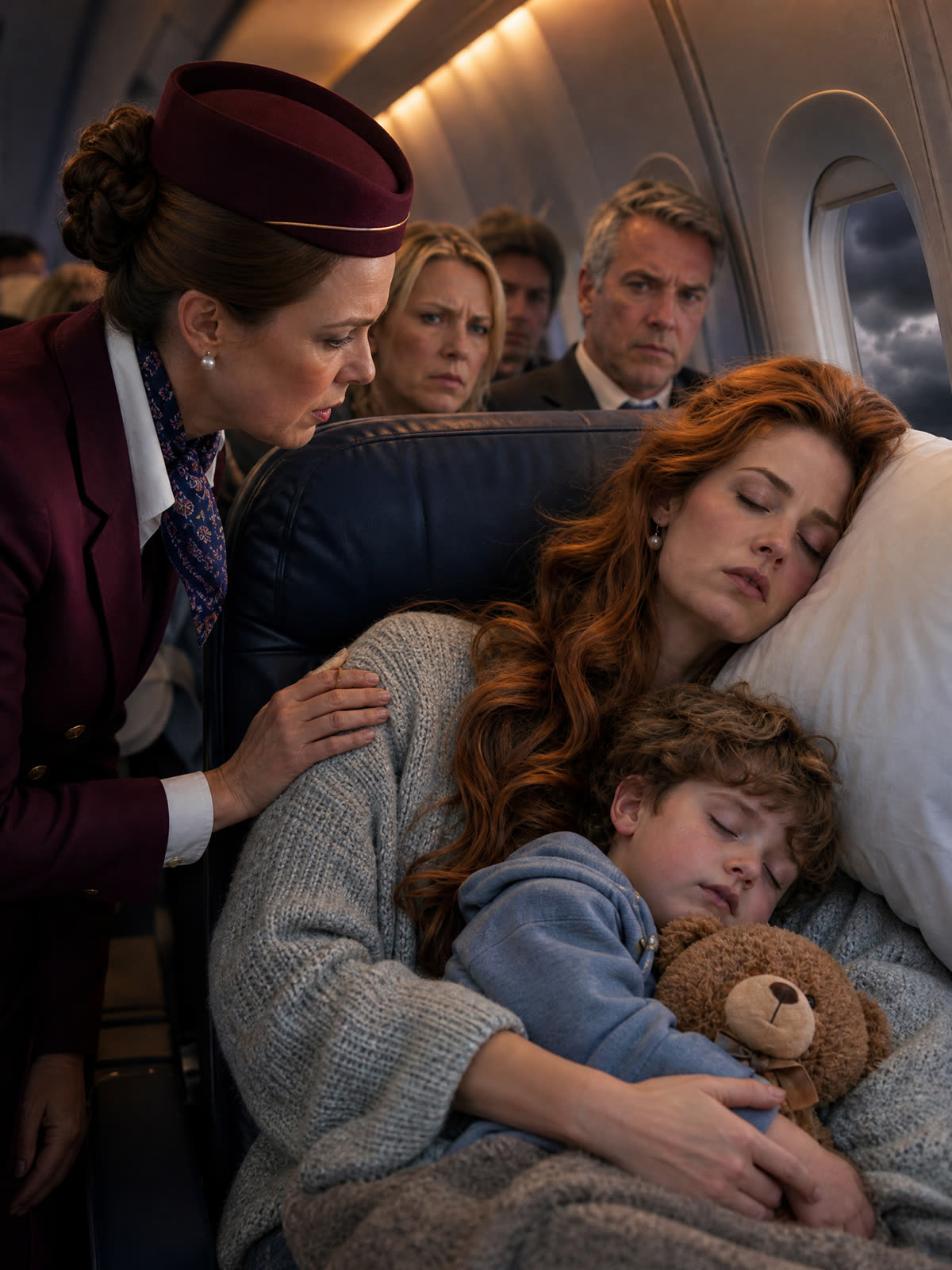
PART 1 — The Woman in Seat 11A
The passenger jet had spent two uneventful hours crossing the Atlantic when an urgent message from the captain shattered the cabin’s stillness. “If there is a fighter pilot on board, please identify yourself to our cabin crew immediately,” the speakers announced with sharp clarity. Almost three hundred travelers fell silent, none realizing that their survival might depend on the exhausted mother sitting in seat 11A. Beside her, six-year-old Sammy slept with his curly head resting against her arm as dark clouds passed beyond the window.
To everyone sharing the overnight journey from Baltimore to Lisbon, she looked like an ordinary woman wrapped in an oversized gray cardigan. Her name was Dr. Rachel Cole. Once a tactical aviator, she had willingly exchanged combat equipment for peaceful mornings and stories at bedtime. She had chosen the window seats in row eleven so Sammy could watch the runway lights disappear without drink carts disturbing him. Earlier, she had turned down the warm dinner rather than interrupt his much-needed sleep.
Nothing about her quiet appearance suggested that she had once guided supersonic strike fighters through hostile airspace under the callsign Falcon. Her military years had brought distinguished medals, demanding maneuvers, and a devastating accident that finally drove her from the cockpit. Afterward, she had promised herself she would never take the controls again. Keeping her son safe had become the only mission she wanted. Rachel closed her eyes, pressed her cheek against his hair, and hoped the announcement meant less than it seemed.
“Ladies and gentlemen, this is Captain Brian Walsh speaking once again from the flight deck,” the public address system chimed a second time. “We are handling an unexpected technical issue, so if anyone among our passengers has military flight training, please make yourself known right away.” Across the aisle, a young mother drew her infant closer. Anxious whispers spread between the rows while passengers searched the surrounding faces for a uniformed officer or an off-duty pilot willing to stand.
Rachel opened her eyes and slowly exhaled. Beneath the captain’s controlled delivery, she recognized a particular kind of fear: the tension that came just before mechanical trouble became catastrophe. A single misunderstood instrument reading could erase the narrow space between recovery and disaster. Karen, a senior flight attendant, hurried along the aisle, studying passengers with strained eyes. Her trembling hands made it clear that the situation beyond the reinforced cockpit door was worse than the announcement admitted.
Looking down, Rachel brushed a loose curl from Sammy’s forehead while her heart hammered against her ribs. She had vowed to put her family first, but remaining silent would not protect him if the jet fell into the freezing Atlantic. Karen stopped beside their row. “Excuse me, ma’am,” Karen whispered as she came to a halt right beside their seats. “Do you happen to know if any passengers around you have military flight background, because our flight crew is running out of time. “
“I am a pilot,” Rachel replied firmly, sitting up straight in her seat. Karen blinked and stepped back in surprise. “You fly airplanes?” Rachel released the buckle of her seatbelt. “I was an active combat aviator with the armed forces for over a decade,” Rachel explained as she unclicked her metal seatbelt. “I logged thousands of hours flying high-performance jet fighters before I resigned my commission eighteen months ago.” The quiet mother who had scarcely moved all evening suddenly held the attention of everyone nearby.
The passenger in seat 11C let his magazine fall and stared at her. “You are telling us that you can handle this gigantic passenger jet?” Rachel did not turn toward him. “I can handle flight emergencies under pressure,” Rachel answered calmly without glancing back at him. She then addressed the elderly woman across the aisle, whose worried gaze had followed their exchange. “Excuse me, ma’am, but my little boy is sleeping deeply, so would you mind keeping a protective eye on him until I return?”
“Of course I will watch over him, sweetie, so please go help our pilots,” the older woman promised while placing a gentle hand over Sammy’s blanket. Rachel bent over her son, straightened the wool covering around him, and kissed his warm cheek. “Mommy has to step away for just a little while, but I will be right back to hold your hand, Sammy.” Leaving him went against everything she wanted, yet protecting him now meant walking toward the trouble rather than remaining at his side.
Karen motioned urgently toward the front of the aircraft. “Please follow me straight to the cockpit right now, captain.” Rachel rose and followed her into the aisle. The exhaustion that had weighed on her moments earlier gave way to the exacting discipline of her military training. Behind her, Sammy remained asleep beneath the elderly woman’s watchful gaze. Ahead waited a crisis Rachel had mistaken for a technical failure, unaware that someone familiar with her painful past had deliberately arranged the danger.
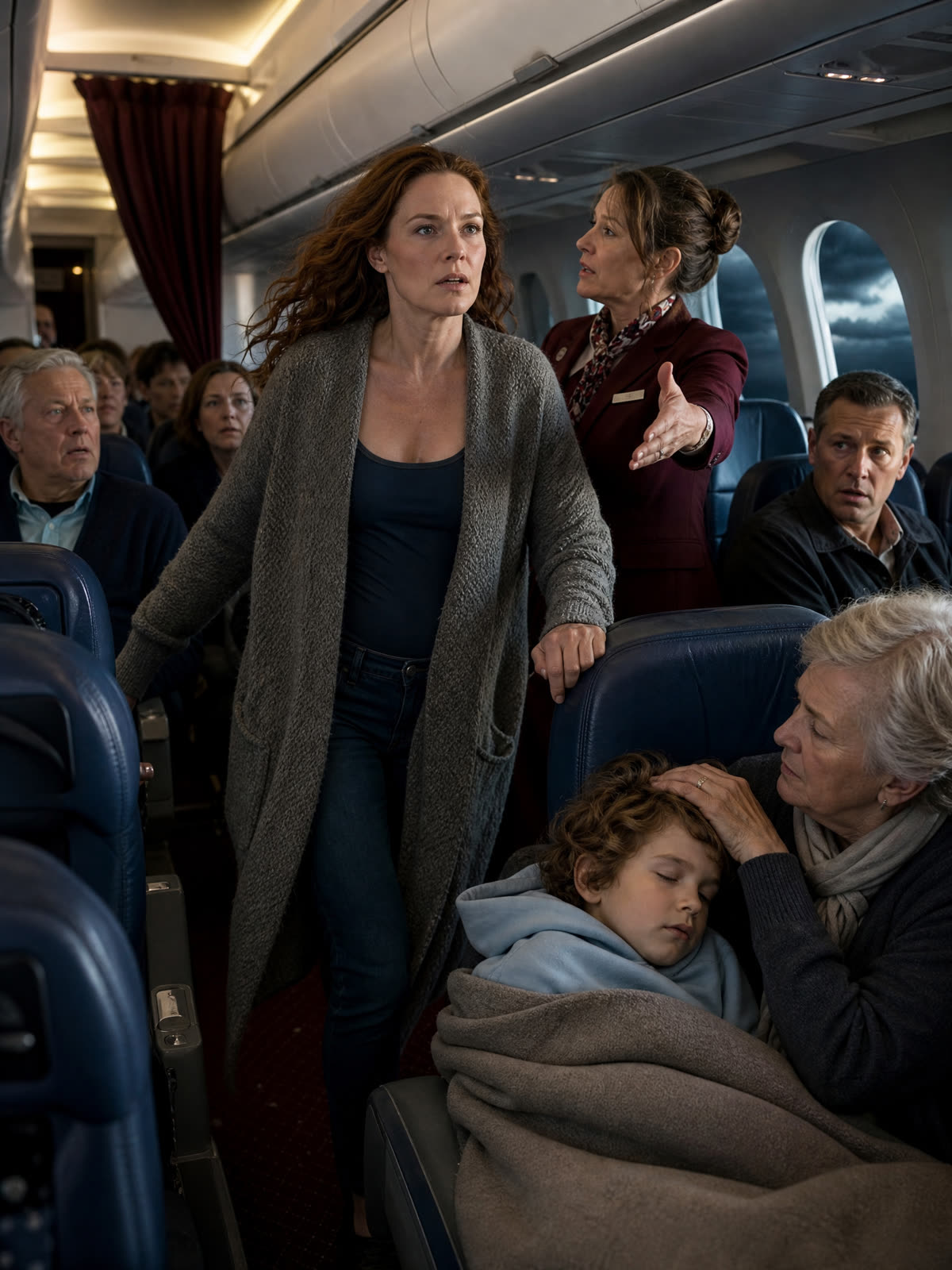
When the security door opened, the cockpit smelled of burnt wire insulation and bitter coffee. Captain Brian Walsh leaned over the control wheel, sweat running down his temple as warnings crowded the instrument displays. In the other seat, the first officer lay unconscious, his eyes rolled back behind a clear oxygen mask. “Are you the person who answered our call for military flight help?” Brian asked without turning his head from the artificial horizon. “I am Rachel Cole,” she stated as she stepped across the threshold.
“What airframe did you fly before leaving the service?” Brian asked through clenched teeth. “I flew frontline tactical fighters,” Rachel responded evenly. He glanced back, doubt showing through his fatigue. “When was the last time you handled an aircraft during real flight operations?” Rachel met his eyes. “It has been eighteen months since my last flight,” Rachel answered without looking away from his gaze. Brian pulled against the yoke. “I need someone with sharp reflexes and current hours, not just distant memories from flight school,” Brian muttered as he pulled back on the yoke.
Before she could answer, a hard, repeating vibration traveled through the cockpit floor. Unlike the uneven jolts of turbulence, its rigid rhythm suggested aerodynamic flutter tied to trouble within the primary hydraulic actuators. Rachel moved toward the center pedestal. “How many minutes has that control column been shaking back and forth like that?” Rachel asked as she stepped closer to the center pedestal. “It started about ten minutes ago and keeps getting worse,” Brian groaned while struggling to keep the heavy wings level.
“Talk me through every single event from the moment things went wrong,” Rachel commanded in a crisp, authoritative tone. Brian answered quickly. “The primary autopilot tripped off without any master warning chime,” Brian explained rapidly. “A few seconds later, the flight management computer began spewing contradictory trim codes, and my copilot complained of sudden numbness in his fingers right before collapsing.” Rachel examined the unconscious man’s shallow breathing and enlarged pupils. “Did he share the standard crew meals with you tonight?”
“No, he did not touch the catering cart because he brought his own private metal flask from the terminal,” Brian answered. Rachel swept her gaze across the consoles. “Has anyone else working in the cabin reported dizziness or muscle spasms?” “Nobody else is feeling sick, just him,” Brian said, his voice tightening. Without warning, the jet rolled sharply right despite the captain’s inputs. Brian strained against the yoke, his knuckles whitening as the aircraft threatened to enter a spiraling descent.
“Stop fighting the yoke right now,” Rachel warned in a sharp voice. “If I let go of the controls, this airplane will roll over and tear its wings off,” Brian yelled over the sound of screaming wind. Rachel raised her voice over him. “You are fighting a corrupted digital override signal,” Rachel shouted back. “Your computer is deliberately opposing your physical inputs, which will overstress the elevator assemblies if you keep wrestling with it.” Brian looked at her in disbelief. “How could you possibly know what our computer is doing?”
“Because I watched a corrupted flight computer tear my wingman’s jet out of the sky,” Rachel said in a cold, steady voice. Brian hesitated only a heartbeat before trusting her. Following her direction, he lifted the safety guard on the overhead panel and isolated the secondary electronic control channel. A heavy shudder passed through the airframe, then the flutter stopped. The yoke steadied in his hands. “You were completely right about the control channels.” Rachel remained focused. “Do not celebrate yet, captain,” Rachel warned, her thoughts turning back to the young boy waiting in row eleven. “We have an angry storm front ahead, our fuel reserves are burning fast, and your copilot needs emergency medical care.”
A physician traveling aboard the aircraft appeared in the cockpit doorway, his expression grave. “Captain, I have completed a full physical assessment of your first officer, and this is not a stroke or a sudden cardiac arrest.” Brian kept his hands near the throttles. “What is wrong with him, doctor?” Dr. Simon Hayes delivered the finding that changed the emergency completely. “His symptoms indicate acute organophosphate toxicity, which means he was deliberately poisoned with a fast-acting nerve agent,” Dr. Hayes explained gravely.
PART 2 — The Descent Through the Storm
The doctor’s words seemed to chill the confined cockpit. Rachel turned toward the cup holder between the pilots. “Where is the metal flask he was drinking from earlier?” Karen searched around the entrance, confusion tightening her pale face. “It was sitting right beside his flight bag ten minutes ago, but now it is completely gone.” The missing flask made the first officer’s collapse more than a medical emergency. Whatever had happened to him was connected to the failing aircraft, and the evidence had vanished while everyone struggled to keep it airborne.
Rachel moved forward with the certainty of command. “Lock the cockpit security deadbolt immediately,” Rachel ordered, stepping forward into command mode. Brian’s eyes widened. “Do you really believe someone on this plane caused this on purpose?” Rachel answered without hesitation. “Someone gave your first officer a lethal chemical so that nobody would be left to counter the sabotaged computer code,” Rachel stated firmly. Outside the flight deck, the passengers still knew only that their journey had become frightening. Inside, the crew now faced the possibility of deliberate mass murder.
Brian changed the throttle settings and began an emergency descent toward an international airport near Portugal’s northern coast. As the nose lowered, another alarm rang overhead. Hydraulic pressure in the right landing gear system dropped to zero. They had escaped the violent control flutter, but the aircraft was still presenting them with failures faster than they could resolve them. Then the security panel beside the cockpit entrance glowed red. Someone outside was trying to enter the access code.
Brian checked the overhead security monitor. “That is Warren Vance outside the door.” Rachel studied the rigid figure on the small screen. “Who is Warren Vance?” Brian lowered his voice. “He is the senior vice president of fleet operations for our airline, and he was flying as a VIP guest in the first-class cabin tonight,” Brian whispered. The man outside was not simply an impatient traveler. His position gave him familiarity with the airline, its aircraft, and the people responsible for operating them.
Karen’s voice came through the wall interphone. “Captain, do not open that door under any circumstances because Mr. Vance is screaming that his corporate title gives him absolute authority over this flight!” In Rachel’s mind, the separate pieces joined: corrupted navigation software, a poisoned first officer, and the disappearance of the flask. Vance’s demand to enter the cockpit no longer seemed unrelated to the damage. The locked door was now as important to their survival as the controls beneath Brian’s hands.
The interphone sounded again. “Captain, the doctor found a discarded plastic seal and an empty syringe cap hidden under the copilot’s floor mat.” Below the descending aircraft, the clouds opened enough to expose runway lights shining through the rain. Brian looked toward them. “We are running out of sky,” Brian declared as the dark ocean clouds parted to reveal the rain-soaked runway lights below. There was no time left to settle who had done what. First, they had to bring the passengers to the ground.
Rachel lowered herself into the first officer’s seat and fastened the four-point harness across her chest. “Let us land this bird first and settle with Vance once our wheels are on solid concrete.” Rain swept across the windscreen in blinding sheets as strong crosswinds shoved against the wings. Brian moved the landing gear lever. Only two green indicators appeared. The right main gear remained unconfirmed, leaving them uncertain whether it would support the jet when they touched down.
Brian wiped sweat from his brow. “If that right landing gear collapses when our tires hit the ground, we are going to cartwheel across the runway.” Rachel closed her hands around the auxiliary thrust levers. Her pulse settled into the measured rhythm she remembered from emergencies in another life. “I will manage the differential engine power while you control the rudder pedals.” Each pilot would have to trust the other completely, with little room for hesitation and none for a struggle over control.
Brian’s voice shook beneath the pressure. “You have never landed an airliner this heavy in your entire life,” Brian said, his voice shaking slightly under the pressure. Rachel kept her eyes on the runway threshold shining through the downpour. “No, I have not,” Rachel replied while keeping her eyes locked onto the glowing threshold lights through the driving rain. “However, my son is waiting for me in row eleven, and I am bringing him home alive tonight.”
The tires struck the soaked runway with a deafening rush of friction and steam. For one terrifying second, the right wing dropped toward the asphalt as the unsecured gear threatened to fold. Rachel opened the left thrust reverser while easing the right engine, producing enough uneven force to hold the fuselage level. Then a metallic clunk rang through the floor. The mechanical lock had engaged. Beneath the aircraft’s immense weight, the right landing gear finally held firm against the pavement.
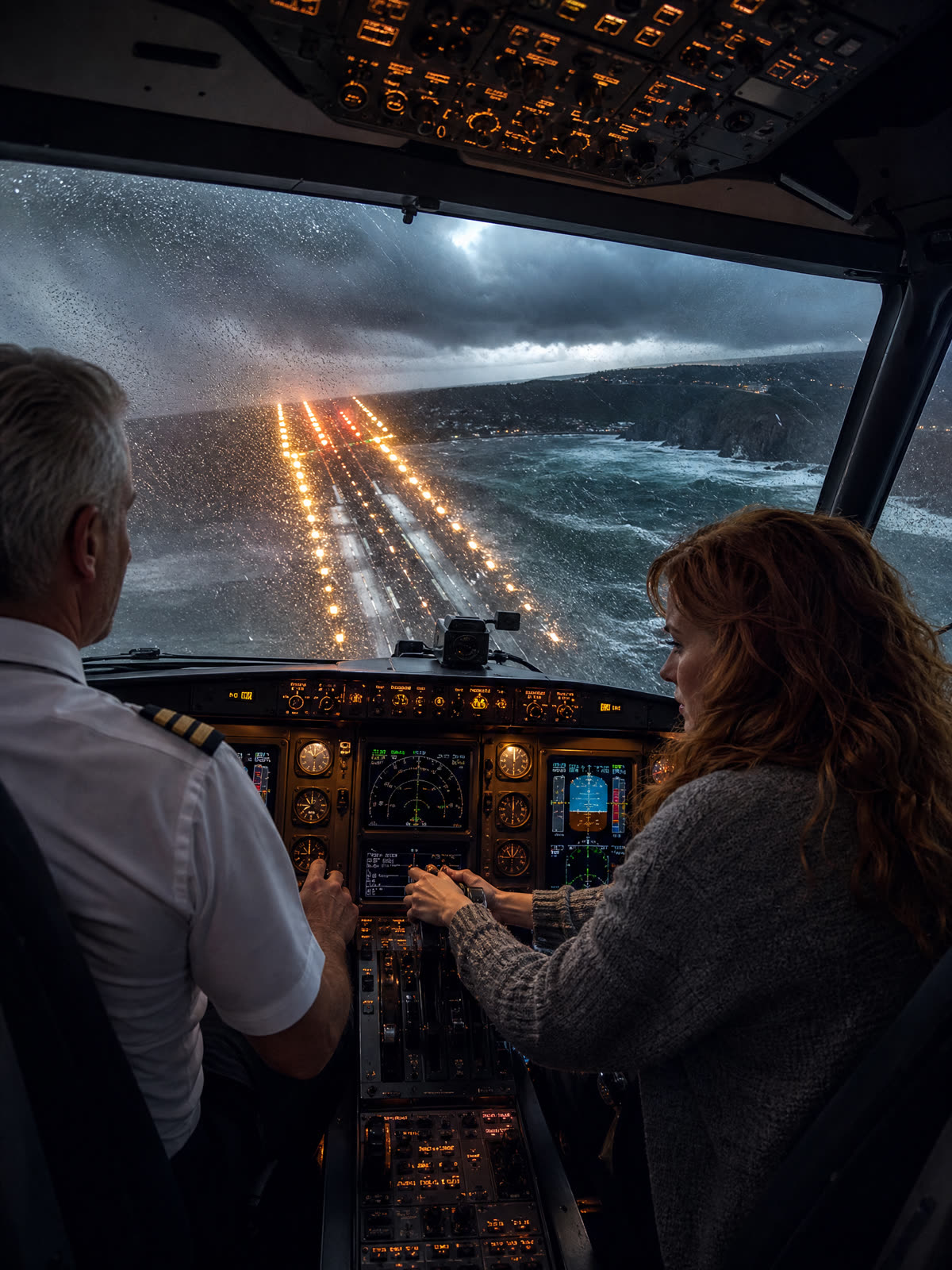
The jet decelerated along the center line, turned onto the taxiway, and came to a gentle stop. Throughout the cabin, almost three hundred people rose into applause, many crying with relief. Rachel did not remain in the cockpit to receive their gratitude. As soon as the engines shut down, she released her harness and hurried toward row eleven. The only face she needed to see was waiting among the passengers she had helped bring safely through the storm.
Sammy was awake now, sitting up and rubbing his eyes. He looked around at the crying travelers without understanding what had happened. When Rachel reached him, he stretched out his arms. “Mommy, where did you go?” Sammy asked, extending his small arms toward her. She gathered him tightly against her chest, and the tears she had held back finally escaped. “I was right here taking care of our flight, and everything is completely safe now.” She held him close while relief swept through the cabin around them.
Outside, flashing blue emergency lights reflected across the rain-darkened Portuguese airfield. Tactical police boarded the grounded aircraft while mobile stairways were positioned at its exits. Passengers began descending to the tarmac as armed federal officers entered the forward cabin. The dangerous flight was over, but the investigation had already begun. The same aircraft that had carried frightened families across the ocean now stood surrounded by emergency crews and officers searching for the person responsible.
Warren Vance was forced against the jetway wall. His expensive suit creased as officers closed metal handcuffs around his wrists. During the escort toward the stairs, he noticed Rachel passing with Sammy’s hand held securely in hers. He stopped on the wet steps, his mouth twisting into a cruel smile. “Dr. Rachel Cole, what an astonishing surprise to find you sitting in economy class.” Rachel froze. Her grip tightened around her son’s small hand as an icy feeling moved through her.
Brian caught up with them on the wet pavement. He looked from the handcuffed executive to the woman who had helped save his aircraft. “Do you actually know this criminal, Rachel?” Before Rachel could respond, Warren supplied an answer of his own. “I know every single thing about her military past,” Warren hissed before the police officers pushed him into the back of a waiting squad car.
PART 3 — The Truth She Had Carried for Eighteen Months
Over the following forty-eight hours, investigators uncovered a sprawling corporate conspiracy that reached across several continents. Warren Vance had spent years diverting millions of dollars through counterfeit aircraft components and falsified government maintenance documents. His authority over fleet operations had allowed the deception to spread throughout the airline. What had looked like a sudden emergency above the Atlantic was the final act of a much older fraud.
An unexpected federal audit had threatened to expose his scheme. To prevent investigators from following the digital records, Warren had altered the aircraft’s software, intending to send the flight into the deep ocean and destroy the evidence with it. Nearly three hundred passengers had been placed in the path of that plan. Their deaths would have concealed the thefts and counterfeit parts behind the wreckage of a catastrophic crash.
Investigators also established how the first officer had been incapacitated. Before departure, in the airport lounge, Warren had poisoned the drink the man carried in his personal flask. The chemical was meant to leave the captain alone when the sabotaged systems began to fail. Without another pilot capable of helping him understand and counter the corrupted controls, Brian was supposed to become overwhelmed. Rachel’s presence in row eleven had prevented the plan from unfolding as intended.
For Rachel, however, the investigation’s most devastating discovery reached beyond the airline. Warren’s knowledge of her military history had not been an empty threat. Long before taking his place on the airline’s executive board, he had worked as chief operating director for an aerospace supplier called Vanguard Defense Logistics. That earlier position connected the man arrested in Portugal to the squadron Rachel had left eighteen months before.
Vanguard had secretly supplied fraudulent flight components to her tactical unit. Those components caused the midair mechanical failure that killed her wingman, Captain Daniel Ward. The loss that had broken Rachel’s confidence was linked to the same man who had nearly destroyed the airliner carrying her son. The two disasters she had regarded as separate parts of her life now led back to the same concealed wrongdoing.
For a year and a half, Rachel had held herself responsible for Daniel’s death. She believed an error in her flying had doomed her closest friend during their training exercise. That relentless guilt had driven her away from military aviation, away from the cockpit, and into the quiet civilian life she had built around Sammy. She had left believing she was escaping the consequences of her own failure, never knowing that defective equipment had caused the loss.
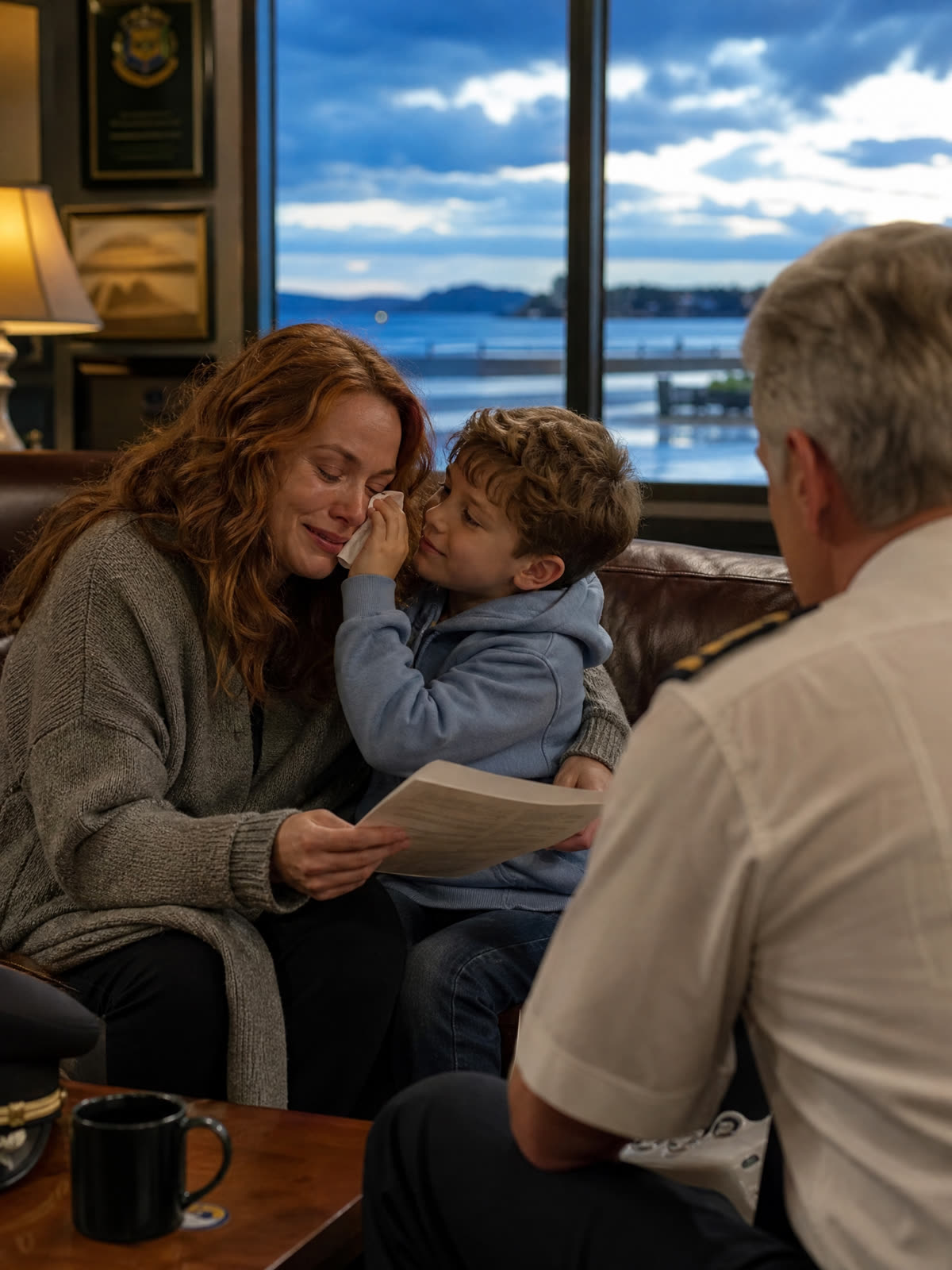
In a quiet briefing room at airport police headquarters, an international investigator placed a newly decrypted military transcript in her hands. It came from the day Daniel’s aircraft had gone down over the Nevada desert. Rachel looked at the yellowed document, confronting a record of the moments she had replayed in her mind for eighteen months. This time, there were words she had never been able to hear.
Daniel’s final radio transmission appeared on the page: “Tell Rachel that this was never her fault. My hydraulic lines completely severed, and she executed every protocol perfectly.” She read the black lettering while tears slipped down her face. The message did not change the fact that he was gone, but it overturned the blame she had carried since the crash. In his final moments, Daniel had known she had done everything correctly.
Rachel had spent eighteen months trapped inside her grief, convinced that the friend who trusted her had died because she failed him. Yet his last words showed that his trust had never broken. Until the end, he had understood what happened to his aircraft. The guilt that had shaped every decision since his death had rested on a mistake, while the truth had waited inside a military record she had never seen.
Sammy leaned against her on the worn leather couch and raised a small tissue to her wet cheek. “Please do not cry, Mommy, because you were the bravest person in the whole sky today.” Rachel folded her arms around him and held him close. Across from them, Brian sat in an armchair and offered a quiet nod of respect. She remained tearful, but she no longer had to carry the memory of Daniel’s death as proof that she had failed him.
Several weeks afterward, Warren Vance stood convicted in a federal courtroom. The charges included attempted murder, industrial sabotage, and corporate fraud. He received a mandatory life sentence without the possibility of parole. The man whose decisions had killed Daniel and endangered everyone aboard the Atlantic flight would no longer hide behind an executive title or falsified records. The investigation had brought the truth into the open, both for the passengers and for Rachel.
Rachel knew she would not return to combat aviation. She also understood that her love of flight had survived Daniel’s death, even while guilt had kept it out of reach. She accepted a position as chief instructor at a respected civil aviation academy near Albuquerque. There, she could train young pilots and still return to her own bed each evening. Flying no longer had to mean choosing between the work she loved and the child she wanted to raise.
On her first morning at the academy, Rachel entered the lecture hall carrying her old combat flight helmet and placed it on the front desk. Sammy sat proudly at the back with his colored pencils, watching his mother take command of the room. At the whiteboard, she picked up a black marker and wrote one sentence: The sky does not care who you used to be.
She faced the waiting students. “Your previous awards will not help you fly an airplane during a true emergency, and your personal pride will only blind you to dangerous mistakes.” Silence settled over the room as the young pilots leaned forward. Rachel continued with a confident smile. “All that truly matters when disaster strikes is your ability to stay calm, see the raw truth of your instruments, and place your complete trust in the partner sitting beside you,” Rachel finished with a confident smile.
In the years afterward, thousands of commercial travelers read accounts of the woman in seat 11A who had saved their loved ones. Rachel never thought of herself as an exceptional hero. To her, she had been a trained pilot doing what duty required to protect the people depending on her. The attention did not change the way she understood that night: her son had been aboard an aircraft in danger, and she had possessed the experience to help.
One sunny afternoon, a handwritten letter reached her office from a small Maryland town. The note said: “Dear Captain Cole, I was the girl sitting in row nine on that flight to Portugal with my mother. When everyone else started screaming, you looked back at us with kind eyes and gave us a reassuring nod before walking through the cockpit door. That simple look made me believe that we were going to survive, and tomorrow morning I am taking my very first flying lesson.”
Rachel smiled and carefully folded the letter. She placed it in a wooden memory box with Daniel’s framed photograph and Sammy’s airplane drawings. Painful memories had not disappeared, and she understood that they never entirely would. But they no longer had the power to imprison her. The past could remain part of her life without deciding how much of the future she was allowed to enjoy.
Later, she walked toward the flight line with Sammy’s hand in hers. Above them, a twin-engine training aircraft climbed through the clear blue New Mexico sky. The shadows that had followed her through the clouds had finally given way to the promise of another day. Sammy watched the rising airplane, then looked up at her with a bright smile. “Are you going to teach me how to touch the clouds one day, Mom?”
Rachel knelt on the tarmac and drew him into her arms, laughing with joy. “I would love nothing more in this world, Sammy, because we are finally home.”
Disclaimer: This story is a work of fiction inspired by real-life themes. Names, characters, places and events are fictionalized, and any resemblance to real persons is purely coincidental. Images are for illustration purposes only.
