


Part One: The Woman in Room 312
At Eleanor’s funeral, her daughter stepped close to me beside the coffee urn and murmured, softly enough that no one else could catch it, “I hope she was worth it. I hope you got everything you came for.”
Then she smiled at the minister and walked back to her seat in the front row. I stood there gripping a paper cup of coffee I didn’t even want, watching my hand tremble so hard that it slopped over onto my shoes.
I’m twenty-two. Eleanor was sixty-nine. I was a care assistant on her floor at Willowbrook, and I married her in June. She died in September. I know exactly how that sounds. If I read it in the paper, I’d think what everyone in this town thinks: a young guy, an old dying woman with a house and savings and a pension. Do the math.
So I’m going to tell you what really happened. All of it, even the parts that make me look foolish. Because a week after the funeral my phone rang, and the man on the line said Eleanor had left me something after all. Something that wasn’t in the will. Something he wouldn’t discuss over the phone. And he said I would need to come and collect it immediately.
My name is Owen Carter. I’m a nursing student at the community college in Harlan, Ohio. Last year I was finishing my clinical placement, and to cover rent I worked thirty hours a week at Willowbrook Senior Living, a long brick building on the edge of town with a parking lot that floods every spring. The background matters, so I’ll be quick.
I grew up in foster care. Five homes between the ages of six and eighteen. My mother had problems I won’t go into, and my father was just a name on a form. The longest I stayed anywhere was three years, with an older couple named the Pruitts, who were kind and worn out and moved to Florida when I was fifteen.
All my life people told me I was old for my age. Teachers said it as praise, foster parents said it with relief, and at school it meant I had no friends. I read too much and talked about things the other kids didn’t care about. I’d rather sit in the library at lunch with a paperback than stand in the parking lot pretending to like whatever everyone else liked. When I was sixteen, a social worker wrote in my file that I was “emotionally self-sufficient.” I read it upside down on her desk. I think she meant it kindly. What it really meant was that nobody had ever needed to worry about me, so nobody ever did.
I went into nursing because of Mrs. Pruitt, who had been a nurse for thirty years. When I had the flu at thirteen, she sat on the edge of my bed at two in the morning with a cold washcloth and talked about Jane Eyre until I fell asleep. It was the first time I remember anyone staying up with me, and I decided right then that whatever she was, I wanted to be that. So that’s who I was when I started on the third floor at Willowbrook: twenty-one, quiet, good with my hands, bad at small talk, and left with eleven dollars in my checking account most weeks after rent.
Room 312 sat at the end of the hall by the window that looked out over the parking lot. Eleanor Whitlock had been there about eight months when I started. Stage four ovarian cancer. She’d done chemo twice and decided against a third round. She was sixty-eight then, with short white hair, very sharp gray eyes, and reading glasses hanging from a beaded chain around her neck. She’d taught high school English for thirty-four years at Harlan High, so half the town had been her student, and most of them were a little afraid of her. The staff called her “difficult.” That was the word in the shift notes: Room 312, difficult. Refuses activities. Refuses group dining. Short with staff.
My first week I carried in her lunch tray and set it on her table, and she looked at me over her glasses and said, “You’re new.” I answered, “Yes, ma’am.” She asked, “Do you read?” It wasn’t the question I’d expected, but I said, “Yes, ma’am.” “What are you reading now?” I was in the middle of East of Eden, which I’d found on a free cart outside the library, and I told her. She took off her glasses and looked at me properly for the first time. “What do you think of Cathy?” she said. “I think Steinbeck didn’t know what to do with her,” I said. “I think he wanted her to be evil because he couldn’t figure out how else to explain a woman who didn’t want what everybody told her to want.” Eleanor Whitlock stared at me for about five seconds. Then she said, “Sit down.”
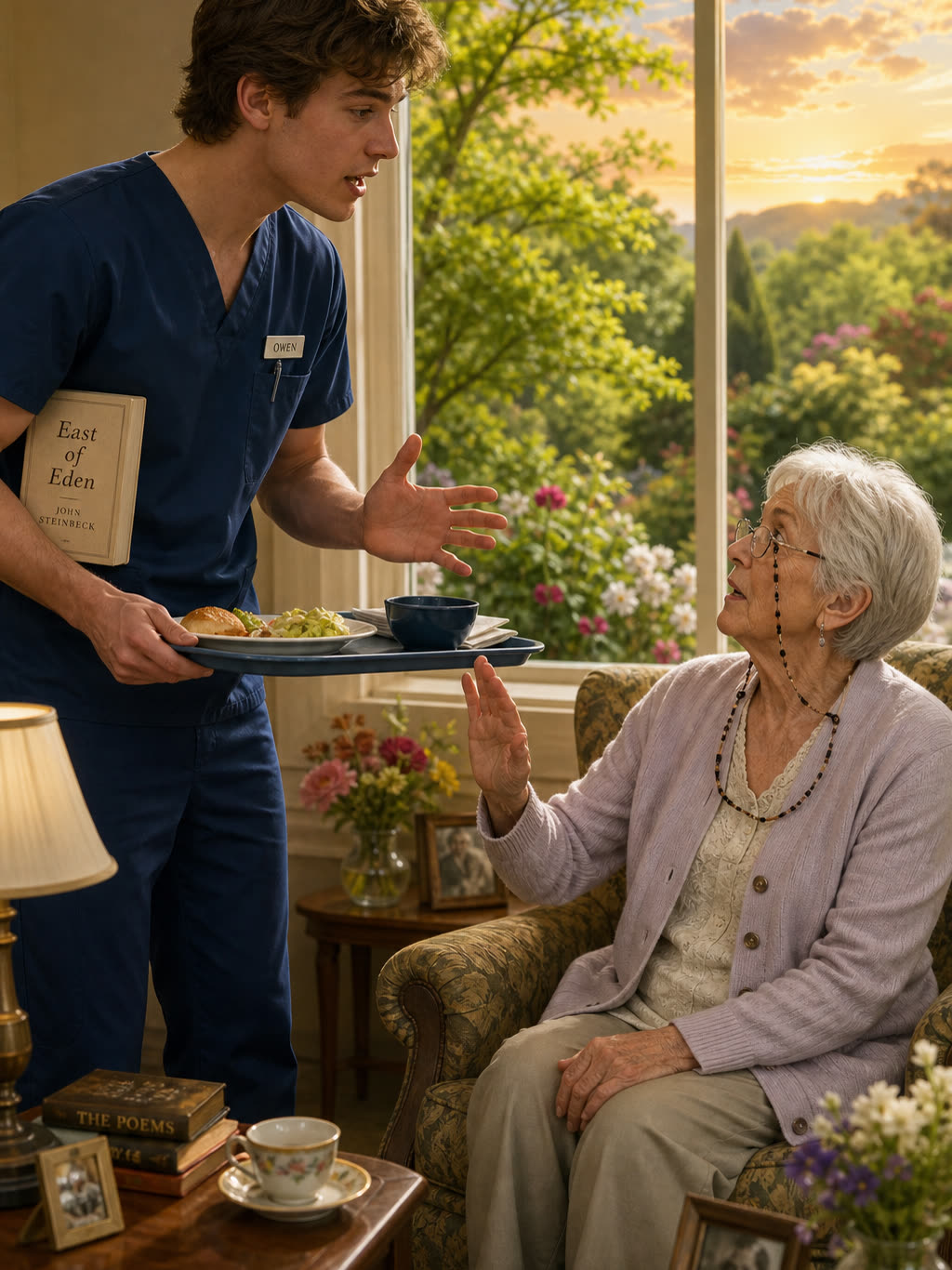
“I have eleven more trays, ma’am.” “Then come back when you’re done,” she said. “And stop calling me ma’am. I taught for thirty-four years. I know when people are being polite because they’re afraid of me.” I came back after my shift and sat in the chair by her window for an hour, and we argued about Cathy Ames.
Eleanor had two children. Philip was forty-one and sold commercial real estate in Columbus. Gwendolyn, whom everyone called Gwen, was thirty-eight and lived in Cincinnati with a husband who did something in finance and two kids in private school. They’d moved their mother into Willowbrook after her second round of chemo, when she could no longer manage the stairs in her house. That was the official reason.
The unofficial reason, which I learned later from a nurse named Dolores who had worked the third floor for twenty years and missed nothing, was that neither of them wanted her living with them. Philip said his condo was too small. Gwen said her kids were too young to be around “all that.” They found Willowbrook online, toured it once, and signed the papers.
In the fourteen months Eleanor lived there, her children visited twice, and I was working both times. The first was in May, my second week. Philip came alone in a gray suit, carrying a leather folder, and stayed forty minutes. I was changing linens in the next room and could hear him through the wall. He wanted her to sign a power of attorney. He wanted her to sign papers to list her house, which he said was sitting empty and losing value. He called it the responsible thing to do. Eleanor said, very clearly, “I’m not dead yet, Philip. Ask me again when I am.” He left with the folder still full.
The second time was in October. They came together on a Sunday afternoon, Philip and Gwen, and they brought a lawyer, a young man with a briefcase who stood awkwardly by the door. They brought grocery-store flowers still in the plastic sleeve with the price sticker on it. They stayed an hour and a half. More paperwork: her accounts, her investments, her house again, a plan for “managing her affairs.”
I walked in halfway through with her afternoon medications. Nobody looked at me. Gwen sat on the edge of the bed holding out a pen, and Philip stood at the window with his arms folded. Eleanor looked at me over their heads. “Owen,” she said. “What’s the name of that book we talked about yesterday? The one where the children wait for their father to die so they can sell the farm?” There is no such book. We’d talked about Middlemarch the day before. But I understood what she was doing. “I don’t remember, Mrs. Whitlock,” I said. “But I know how it ends.” “How does it end?” “Badly,” I said. “For the children.”
Philip turned from the window and looked at me as though he’d spotted a stain on the carpet. “Who is this?” he said to his mother. “He’s the only person in this building who reads,” said Eleanor. “Sit down, Owen. My children were just leaving.” They left. The lawyer looked relieved. Gwen forgot the flowers, and I put them in water anyway.
After that, I started reading to her. It began because her eyes were failing; the cancer had spread, and the medications blurred her vision. One night she tried to read a paperback, kept losing her place, and hurled it across the room, where it struck the wall above my head while I was emptying her water pitcher. “Sorry,” she said. “That wasn’t aimed at you.” “I know.” I picked it up. Persuasion, by Jane Austen. “Do you want me to read it to you?” She studied me for a long time. “You don’t have to do that.” “I know I don’t.” So I read to her, twenty minutes after my shift, then forty, then most of an hour, most nights, in the chair by the window while the parking lot lights came on.
And I kept doing it. Not because I had to. Because she was the first person in my life who talked to me as if I were a whole person. She listened, and not the way adults usually listen to young people, nodding and waiting for their turn. She asked questions. She disagreed with me. She’d stop me mid-chapter and say, “No. Read that again. What does she mean by that?” and then wait for my answer as if it mattered. And she remembered. That was what got me. She would recall something I’d said three weeks before, some small throwaway remark.
“You said once that you don’t trust happy endings,” she said one night in December. “Why?” I didn’t remember saying it. “I don’t know. Because they’re not real, I guess.” “Says who?” “Everybody. Life.” “You’re twenty-one,” she said. “You haven’t had enough life to know what’s real. You’ve only had enough to know what’s been real so far.” She closed her eyes. “There’s a difference. Read me the next chapter.”
Nobody had ever taken me seriously before. Not a teacher, not a foster parent, not a social worker, not a girlfriend. I’d had two girlfriends, briefly, and both told me I was “too intense.” Eleanor didn’t think I was too intense. Eleanor thought I wasn’t intense enough. “You hide,” she told me in January. “You walk around this building like you’re apologizing for taking up air. Stop it. You’ve got a good mind. Use it out loud.” So I did. I started speaking up in my nursing classes. I politely argued with my clinical instructor twice when I thought she was wrong, and she wrote on my evaluation that I showed “strong critical thinking and confidence.” I had never had confidence on any evaluation in my life. Eleanor read it twice when I brought it in, then handed it back without a word. But she was smiling.
She told me about her own life too. She grew up in Harlan, a pharmacist’s daughter, and went to Ohio State on a scholarship in 1975, which was rare for a small-town girl. She married Robert Whitlock, who taught chemistry at the same high school. They were married thirty-one years, until he died of a stroke in 2010. “He was a good man,” she said. “And a terrible husband.” “What do you mean?” “He was kind. He was faithful. He never raised his voice. And he never once asked me what I thought about anything.” She looked out at the parking lot. “Thirty-one years. Not once. He’d come home and tell me about his day and his students and his experiments, and I’d listen, and then he’d go read the newspaper. I could have been a lamp.” “Why did you stay?” “Because that’s what you did,” she said. “And because he was kind. And because I had the children. And because I thought maybe that was all there was.” She was quiet. “I taught a hundred books about women who wanted more than they had. And I went home every night and made pot roast.”
She turned and looked at me. “Do you know you’re the first person since my father who’s ever asked me a question and waited for the answer?” I didn’t know what to say, so I said nothing and opened Middlemarch where we’d left off. But I couldn’t stop thinking about it, all night and all the next day. You’re the first person.
I told her how I felt in March. I hadn’t planned to. It was a Tuesday night, raining, the parking lot lights all smeared across the window. I’d just finished chapter forty-two of Middlemarch, the one where Dorothea’s husband dies, and Eleanor had her eyes closed. I thought she was asleep. I shut the book, and before I could stop myself, I said out loud: “I think I’m in love with you.” Her eyes opened. She looked at me. And then she began to laugh.
Part Two: A Gummy Ring and a Promise
It wasn’t a mean laugh or a polite one. It was a real laugh, the biggest I’d ever heard from her. She laughed so hard she had to hold her side where the tumor was and wince, wiping her eyes and shaking her head. Then she looked at my face, and she stopped. Completely. She saw I meant it.
The room went very quiet, the rain ticking against the window. “Owen,” she said, her voice lower now. “I’m sixty-nine years old.” “I know.”
“I’ve got cancer in my ovaries and my liver and my lymph nodes. I wear adult diapers. You change them.” “I know.” “I have gray hair in places you don’t want to think about.” “I don’t care.”
She looked at me for a long time. “I’m dying,” she said finally. “You know that, don’t you?” “I know,” I said. “Months. Maybe six, if I’m lucky. Maybe less.” “I know, Eleanor.”
She turned to the rain and said nothing for so long that I thought she might ask me to leave, or have the charge nurse take me off her floor, or report me. I had broken every rule in the employee handbook. “Do you know what you’re saying?” she said at last, quietly, not to me but to the window. “Yes.” “You’re twenty-one.” “I’ll be twenty-two in May.”
She turned back, her gray eyes wet. “God help me,” she said. “So do I.”
I’m not going to tell you everything about the following month. Some of it is private, and some I don’t have words for. Nothing happened that would embarrass either of us in front of a judge or a nurse or her children. People assume the worst; I know they do. Mostly I kept coming to her room every night after my shift. We kept reading and arguing. We held hands. I’d sit on the edge of her bed and she’d rest her head on my shoulder while I read, and sometimes she fell asleep that way and I sat perfectly still for an hour so I wouldn’t wake her. She told me things she’d never told anyone, and I told her things I’d never told anyone: my mother, the five houses, the night I was eleven and slept in a bus station because my foster father locked me out for being late. She held my face in both hands when I told her that and said nothing at all.
I proposed in April. People have made a lot of jokes about the ring, so let me explain. I was a student on placement with eleven dollars in my checking account. I’d looked at rings in the mall jewelry store, and the cheapest was two hundred and forty dollars. I could have put it on a credit card or borrowed from someone. But I didn’t want to pretend to be somebody I wasn’t, not with her. Eleanor hated pretending more than anything. She used to say dishonesty was the only sin she couldn’t forgive in a student: lie about your homework and you get a C, lie about yourself and you get nothing. So I went to the Dollar General on Route 9 and bought a bag of Haribo gummy rings, the kind with a little jewel on top. I picked the best one, red with a green gem, and drove to Willowbrook.
That night, after chapter fifty-five of Middlemarch, I put the book down and got on one knee on the linoleum beside her bed. My knees cracked. She raised her eyebrows. I held up the gummy ring. “Eleanor Whitlock,” I said. “I have eleven dollars. I’m not going to pretend I have more. This is what I can afford. I’d give you a real one if I could. But I’d rather give you a true one.”
She gazed at the ring for a long time, then held out her left hand. I slipped it onto her finger. It was too big and hung there loose, red and shiny, with its little green jewel. She turned her hand in the light. “It’s the most honest ring anybody’s ever given me,” she said. “Is that a yes?” She looked at me, and then she nodded.
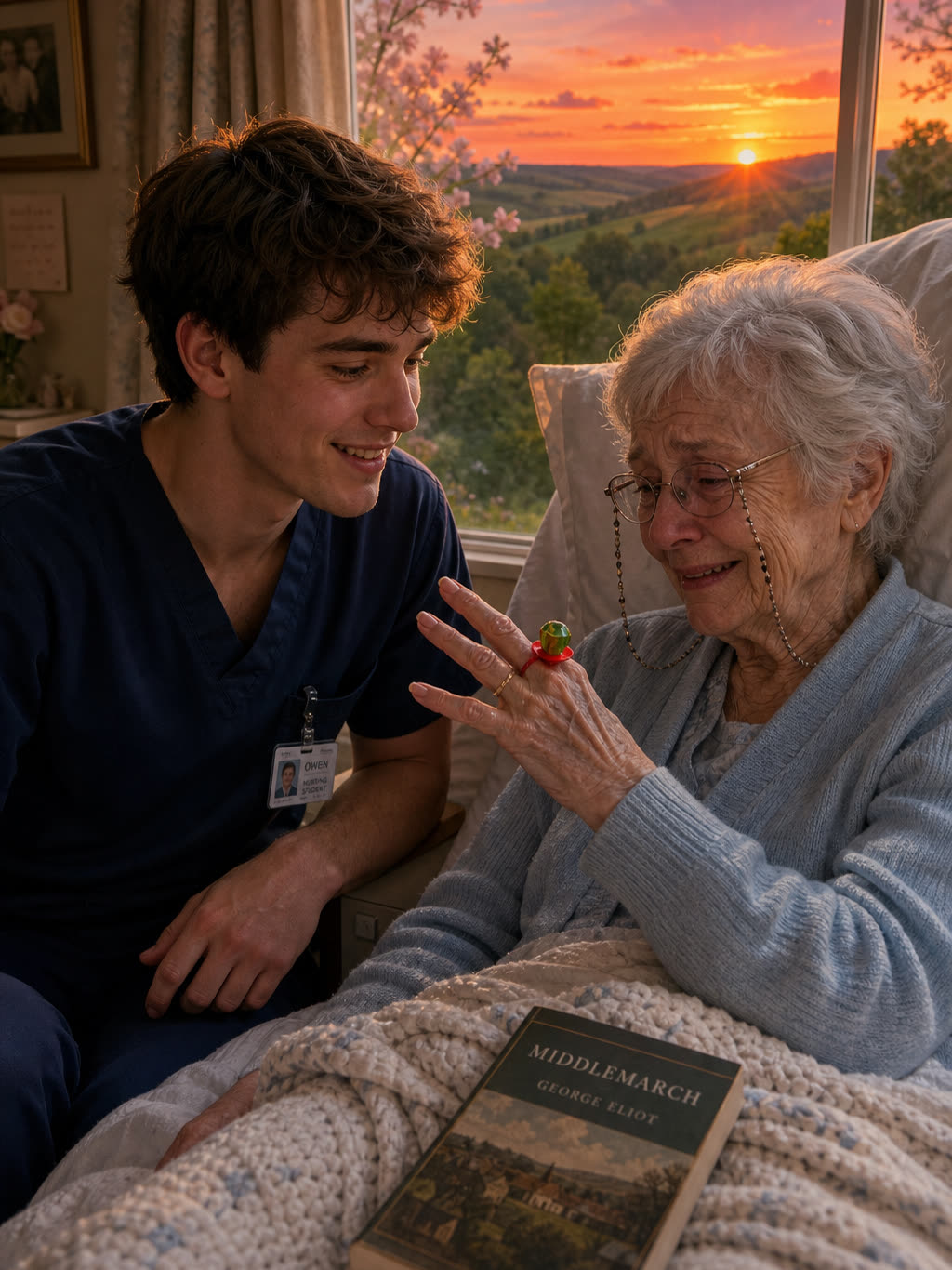
She wore it every single day, until it went hard as glass and lost its color. The nurses laughed at first, then they stopped. Dolores, the twenty-year nurse who missed nothing, came in the next morning, saw it on her finger, and stood there a long moment. “Well,” Dolores said at last. “It’s about time somebody gave you something you actually wanted.” Then she went and fetched a fresh water pitcher and never said another word about it.
The night I proposed, Eleanor said the thing we would argue about more than anything. She was still looking at the ring. “If you’re doing this for the money…” I stared at her. “How can you even think that? I’m here because I like being around you. I don’t want your money. I’ve never wanted anything from you.”
She gave me a long look over her glasses, her teacher look, the one that made sixteen-year-olds confess to plagiarism. Then she said it straight. “You’re not getting a cent from me. Not one. I want you to understand that. Not now. Not when I’m gone. Not a dollar, not a book, not a teaspoon. I’ll be dead and people will say exactly what they’re going to say regardless. So there’s no point giving them a reason.” I told her that was fine. “Are you sure?” “I’m sure, Eleanor. I don’t want anything.” She studied my face. “I know,” she said finally. “That’s why.” I didn’t understand what she meant. Not for a long time.
We were married on the eighteenth of June in the little first-floor chapel at Willowbrook, by a retired judge named Harold Mbeki, one of Eleanor’s students in 1981. She arranged all of it herself, and I want people to know that. In May, before she let me file a single paper, she asked her oncologist, Dr. Ruth Feldman, to bring in a psychiatrist from Dayton, Dr. Patricia Lowe, for a full capacity evaluation. “Why?” I asked. “You’re the sharpest person I’ve ever met.” “Because my children will say I’m not,” she said. “The minute they find out. They’ll say I’m confused. They’ll say I’m on too much morphine. They’ll say you tricked me. So I’m going to make it impossible for them to say it truthfully.”
Dr. Lowe spent three hours with her, asking about the date, the president, her medications, her finances, her children, me, and what marriage meant legally. Afterward she sat beside me in the hallway. “Mr. Carter. I’ve done about four hundred of these evaluations. That woman is more competent than I am. She corrected my grammar twice. She also asked me to write in my report that she proposed to you.” “She didn’t. I proposed to her. With a gummy ring.” “She told me that too,” said Dr. Lowe. “She said, write down that he proposed, and I said yes, and that I’d have proposed to him myself if I’d had any idea he was that brave.”
The wedding was small. Dolores was Eleanor’s witness and my clinical instructor, Ms. Abernathy, was mine. Three nurses came, two residents wheeled themselves in at the back, and Mr. Kowalski from room 308, ninety-four and deaf, kept asking “What? What did she say?” all through the ceremony. Eleanor sat in her wheelchair in a pale blue dress Dolores bought at Kohl’s, wearing the Haribo ring, already going cloudy. When Judge Mbeki said, “You may kiss the bride,” Mr. Kowalski shouted, “WHAT?” and everybody laughed, including Eleanor, who laughed so hard she had to hold her side again. It was the happiest day of my life. I’m not ashamed to say it.
Her children found out three weeks later. Maybe someone from town told them, maybe the county clerk; in Harlan everyone knows everyone’s business by Thursday. They came on a Saturday in July, Philip and Gwen, no flowers, no lawyer, walking onto the third floor as if storming a building. I was in the hallway with a medication cart. Philip reached me first, a head taller than I was, in a polo and khakis. “You,” he said. “You little parasite.” “Mr. Whitlock…” “Do you think we’re stupid? Do you think we don’t know what you’re doing?” I could smell his coffee. “She’s sixty-nine years old. She’s dying. She’s on morphine. She doesn’t know what she’s doing. And you crawl in here and marry her so you can get your hands on everything she’s got.” “I don’t want anything she’s got.” “Bull,” said Philip, loudly. A resident down the hall turned to look. Gwen stood behind him with her arms wrapped around herself, looking at me as if I were something she’d stepped in.
Dolores came out of the nurses’ station. “Mr. Whitlock. Lower your voice, please. There are sick people on this floor.” “Don’t tell me what to do. This is my mother.” “It’s your mother’s floor,” said Dolores. “And your mother’s asking for you. Go in. Or go home. But stop yelling at my staff.” They went in. I stood at the door with my cart and listened; I couldn’t help it. I heard Philip shouting, Gwen crying. I heard “morphine” and “confused” and “annulment” and “lawyer.” I heard Gwen say, “How could you embarrass us like this? Everyone in Harlan is talking.”
Then I heard Eleanor, in her classroom voice, the one that silenced rooms of thirty teenagers. “Sit down. Both of you. I’m going to say this once. I married Owen Carter because I love him. Because he reads to me. Because he talks to me. Because in fourteen months in this building, he is the only person who has ever asked me what I think. You came here twice. Both times with paperwork.” “Mother…” “I’m not finished, Philip. My will has not changed. It’s with Leonard Price. It was written two years ago and it says exactly what it said then. Owen isn’t in it. He never will be. I told him that the day he proposed, and he said that was fine. He meant it.” Silence. “Then why marry him?” Gwen asked in a small voice. “Because I wanted to be married to someone who loved me,” Eleanor said. “Just once. Before I died. I wanted to know what that felt like. Your father was a kind man. But he never once asked me what I thought. Owen asks me every single day.” Philip walked out past me without a word. Gwen stopped in the hallway and looked at me, and for a second I thought she would say something real. Then she looked away and followed her brother to the elevator.
The following Monday Willowbrook moved me off the third floor. The director, Ms. Haskins, was apologetic; she had read Dr. Lowe’s report and talked to Dolores. But Philip had called corporate and threatened to sue over an employee exploiting a vulnerable resident. “You can visit her as her husband, anytime,” she said. “But you can’t be her aide anymore.” So I worked the first floor, and every night I rode up to 312 and read to my wife. It was a strange, hot, short summer. She weakened every week. We finished Middlemarch on the twenty-ninth of August, and I read the last line twice because she asked. “That’s the truest thing ever written,” she said, eyes closed. “About people who live quiet lives and do good things nobody notices. Most of the good in the world is done by people nobody will ever write a book about.” She opened her eyes. “Like you.” We started Persuasion again, the one she’d thrown at the wall. We didn’t finish it.
She died on September fourteenth, at four twenty in the morning. I’d been sleeping in the chair by the window for six nights, Dolores’s blanket over me, and I woke because her breathing had changed. I know that sound from placement. I sat on the bed and took her hand, the one with the ring. She opened her eyes once, for just a second, and looked at me. She didn’t say anything. She didn’t need to. Fifteen minutes later she was gone, and I sat holding her hand until the sun came up over the parking lot.
Her children had a lawyer at Willowbrook before the funeral home did. The funeral at First Presbyterian was enormous, thirty-four years of former students telling stories about rewriting essays six times. Philip gave the eulogy and never mentioned me. Then came the coffee urn, and Gwen’s whisper, and my shaking hand. Over the next weeks Philip and Gwen told half of Harlan what I was: a predator, a gold digger. A woman moved her cart to another checkout line when I got behind her. My landlord asked if there was “anything he should know.” Then came the lawsuit, an annulment petition for undue influence and lack of capacity, and a letter to the Ohio Board of Nursing. Ms. Abernathy told me, looking sick, that an inquiry had opened. “I can’t be a nurse,” I said. She didn’t answer.
At a free legal clinic in Dayton, a young lawyer named Priya explained why they fought so hard: in Ohio a surviving spouse can elect against the will and take a share of an estate worth about one point four million. “That’s why they want the marriage annulled. If there’s no marriage, there’s no spouse.” “I don’t want it,” I said. “I told her I didn’t want it. I promised her.” I signed a waiver the next morning. Philip’s lawyer said the family would still proceed “to clear their mother’s name.” The hearing was set for October twentieth. And then, last week, my phone rang. “Mr. Carter? This is Leonard Price. I was Eleanor Whitlock’s attorney.” He said it wasn’t about the waiver, though it was a fine thing I’d done. “Eleanor left you something. It’s not in the will. It’s not part of the estate. And I can’t discuss it over the phone.” “She told me she wasn’t leaving me anything. Not a cent.” “Not a cent,” he agreed. “There’s no money involved. But you’ll have to come collect it immediately.”
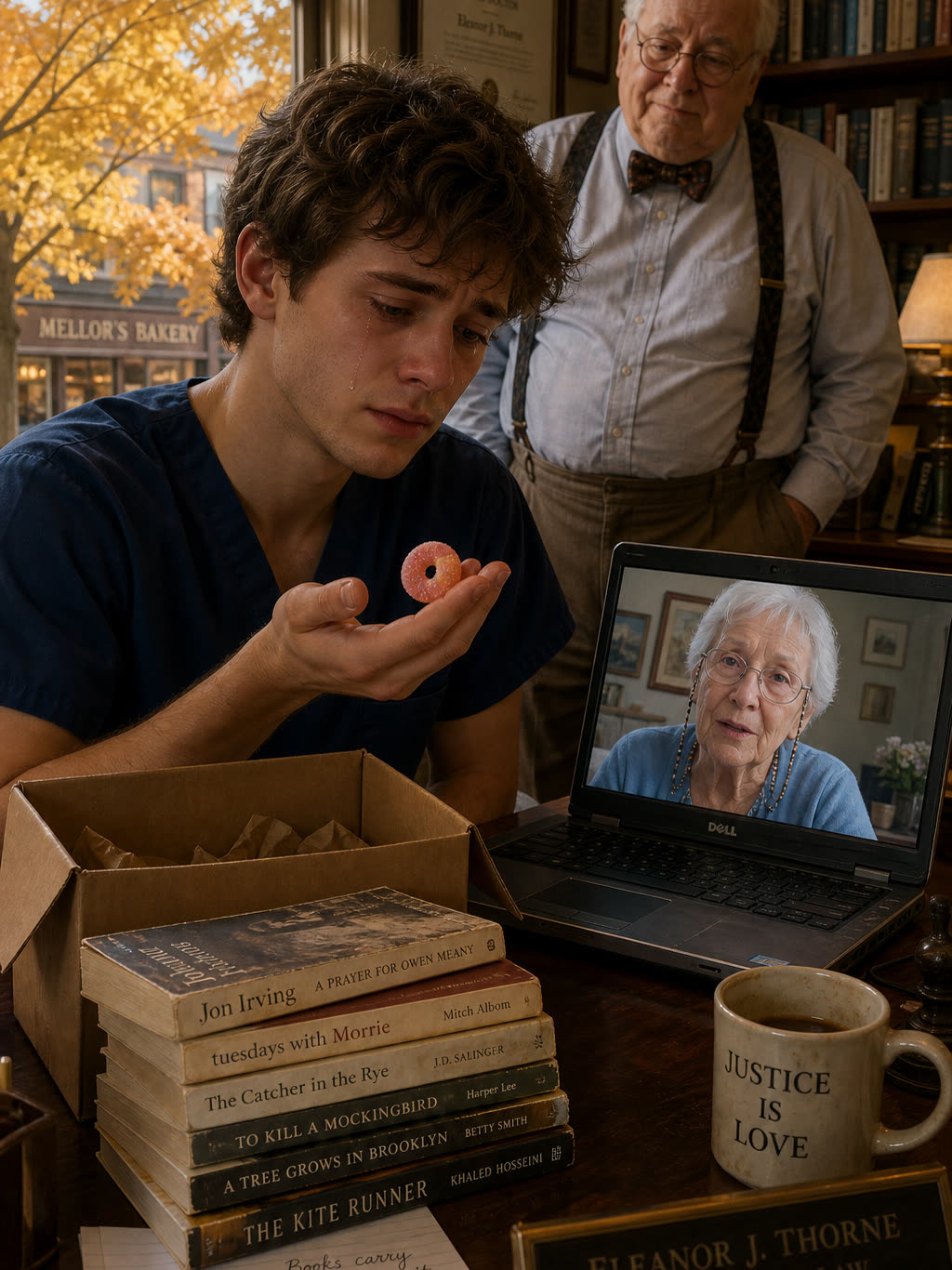
His office was two small rooms up a narrow staircase above the bakery. He was short and round, in suspenders and a bow tie, with a framed tenth-grade English paper on the wall bearing a big red F and, in Eleanor’s handwriting: You can do better. I know you can. See me. He pulled an old copy-paper box from under his desk. On the lid, in black marker, in handwriting I knew better than my own, it read: OWEN. NOT PART OF THE ESTATE. DO NOT LET MY CHILDREN TOUCH THIS. And Leonard said, “Before we open it, there’s a letter I’m supposed to read you first.”
Part Three: What She Left Behind
Leonard put on his reading glasses and cleared his throat. “Leonard,” he read. “If you’re reading this to Owen, it means I’m dead and my children are behaving exactly as I predicted. Do not let him argue with you. He’ll try to give everything back. He’s like that. Tell him these things are not money and are not part of my estate, because I gave them to him while I was alive and of sound mind, as gifts, which Dr. Lowe will confirm. Tell him that if he tries to refuse any of it, I will haunt him. I mean it. I taught tenth grade for thirty-four years. I know how to haunt people.”
He took off his glasses, smiling. “Then she wrote, ‘Start with the envelope. Then the DVD. Then the books. Then go get Dickens. Do not wait. Mildred’s moving on Friday.’” “Who’s Dickens?” “You’ll see,” said Leonard. “Envelope first.” Inside the manila envelope was a four-page letter in shaky blue ink, written in May when her hands were still mostly steady. I won’t share all of it. I’ll share the beginning and the end.
“Owen, you’re angry with me right now. I can feel it from wherever I am. You’re thinking, she promised. She said not a cent. Well, I kept my promise. Not a cent. But I never said I wouldn’t leave you anything. I told you I wouldn’t leave you money because money is what my children understand, and money is what they’d use against you. They’d look at a twenty-two-year-old boy and a dying old woman and they’d see a transaction, because that’s all they’ve ever seen when they looked at me. So I gave them nothing to see. But I’m not going to leave you with nothing. I’m going to leave you with the truth. Which is the only thing I ever really had to give anyone.”
There were pages more, about Robert, about her father, about the first time she heard me argue about Cathy Ames and thought, oh, there you are. I’ve been waiting for you for sixty-eight years. At the end: “You told me once you don’t trust happy endings. I’ve had enough life now. Most of it was quiet and dutiful and lonely. And then, at the very end, I got six months of being loved by someone who wanted nothing from me except my company. That’s a happy ending, Owen. Don’t you dare let anyone tell you it wasn’t. Go get Dickens. He’s waiting. All my love, and I mean all of it, Eleanor. P.S. The ring is in the small envelope. Don’t eat it. It’s hard as a rock. I wanted you to know I wore it until the end. It’s the only piece of jewelry I’ve ever owned that I was proud of.”
I tipped the small envelope into my palm, and the Haribo ring fell out, red gone pale and cloudy, the green jewel faded to the color of sea glass, hard as glass. I closed my hand around it. Leonard sat very still and looked out the window for a long time while I cried.
When I could breathe again, he slid a DVD into an old laptop. “She recorded this in May, in her room at Willowbrook. Dr. Lowe was there. Dr. Feldman. Dolores. And me. She said you should watch it before the hearing. And she said her children should watch it at the hearing.” There was Room 312, the chair by the window, the parking lot outside. Eleanor sat up in bed in a blue cardigan, her glasses on their beaded chain, the gummy ring on her finger. Thinner than I remembered, and very calm.
She looked straight into the camera. “My name is Eleanor Ruth Whitlock. Today is May the twelfth. I’m sixty-nine years old. I’m making this recording because I know my children, and I know what they’re going to do after I die. I’m going to marry Owen Carter in June. Nobody has pressured me. Owen proposed to me with a ring made out of candy, and I said yes, and if I’d had any sense, I’d have proposed to him first.” In the background, Dolores laughed. “I’ve told Owen that I’m leaving him nothing in my will. He agreed before I’d even finished the sentence. I believed him then and I believe him now. In fourteen months in this building, my children have visited me twice. Both times they brought legal paperwork. Owen has visited me every night for eleven months. He’s never brought me anything except books.”
She looked up again, with her teacher’s look. “Philip. Gwendolyn. I know you’re watching this. I know you’ve told people he’s a con man. I know you’ve said I was confused. I know, because I raised you. I’m not angry with you. I’m sad. I’m sad that you never visited. I’m sad that you only ever wanted to talk about my house. I’m sad that I’ll die without knowing you as grown people, because you never let me.” Her voice shook a little. “But I’m not angry. You’re getting everything. The house. The investments. Your father’s pension. All of it. Split down the middle, the way it’s always been. So here’s the only thing I’m going to ask of you. Leave that boy alone. He’s twenty-two. He has nothing. He grew up in five foster homes. He’s going to be a nurse, a very good one, and he’s the kindest person I’ve ever known. If you take that from him to protect your pride, I’ll know. I don’t care where I am. I’ll know. That’s all. Leonard, turn it off.” The screen went dark.
I couldn’t speak. “Dr. Lowe’s full report is in the box,” Leonard said quietly, “signed and notarized. So are Dr. Feldman’s statement, Dolores’s, and Judge Mbeki’s, who says he spent twenty minutes alone with Eleanor before the ceremony and she was, quote, sharper than any attorney who’s ever stood in my courtroom. I’ll file it all with the probate court tomorrow, and with the Board of Nursing.” “She planned all of it,” I said. “Before we were even married.” “She knew exactly what they’d do,” Leonard said. “So she made sure you’d have the truth. In writing. On video. That’s what she left you. Not money. The truth, so nobody could ever take it away from you.” Then he took out six old paperbacks with broken spines, Middlemarch, Persuasion, East of Eden, Jane Eyre, The Great Gatsby, Their Eyes Were Watching God, each inscribed: Given to Owen Carter, May 12. A gift during my lifetime. Not part of my estate. —E.R.W.
In the margins of Middlemarch were fifty years of pencil notes, from when she was nineteen, from when she was thirty and teaching it for the first time, from when she was sixty-nine and listening to me read it. Under the last line she had written, very shakily: O. read this to me Aug. 29. I cried. He pretended not to notice. He always pretends not to notice. It’s the kindest thing about him. I held the book against my chest. “And now,” said Leonard, taking his coat from the hook, “we have to go get Dickens. Mildred’s moving to her daughter’s in Indiana on Friday.” “Who’s Dickens?” “Dickens is a tortoise. A Russian tortoise. Eleanor’s father bought him in 1957, the day she was born. He’s almost seventy-four years old. Philip wanted to take him to the county animal shelter. Mildred wouldn’t let him.”
Mildred Pruett, ninety-one and five feet tall, lived in a yellow house on Elm Street next to a gray one with a FOR SALE sign in the yard. Eleanor’s house. I stood on the sidewalk and looked at it for a long time. “You’re Owen,” Mildred said, opening her door. “She said you’d be skinny. She was right.” In her warm sunroom, in a wooden box lined with hay under a heat lamp, sat a brown-and-gold tortoise the size of a dinner plate, eating lettuce very slowly. He looked up at me with small dark eyes and a face like a very old, very patient man. “That’s Dickens,” said Mildred. “Ellie named him herself when she was six. She said he looked like he had a lot of stories. She used to read to him out on the back porch. I’d hear her through the fence. Reading Jane Austen to a tortoise.”
When I lowered my hand into the box, Dickens stretched out his wrinkled neck and sniffed my fingers. “He likes you,” said Mildred. “He bit Philip.” I laughed, the first time in a month. She gave me an index card in Eleanor’s shaky writing with his diet and, at the bottom: He likes being read to. He prefers Austen. Don’t let anybody tell you that’s silly. I carried him to my car in a box that said BANANAS. On her step, Mildred held my hand in both of hers. “The last time I visited her in August, she was happier than I’d ever seen her. In forty-one years, Owen. Whatever people in this town are saying about you, I want you to know that. She was happy.”
The hearing was on October twentieth, in a small wood-paneled room of the Harlan County Probate Court. I wore my only suit, too big in the shoulders, bought at a thrift store for my foster brother’s funeral. Priya came, and Leonard in his bow tie, and Dolores, and Dr. Lowe, and retired Judge Mbeki in the back row with his cane. Philip and Gwen sat at the other table with a slick lawyer from Columbus, who used the words I’d been hearing for a month: vulnerable, terminal, morphine, exploitation, predator. Then Leonard handed Judge Constance Beale a stack of documents and asked the court to view a recording Eleanor made before the marriage. “I’ll allow it,” she said.
They rolled in a television, and there was Eleanor in her blue cardigan, the gummy ring on her finger. I watched Philip’s face go from angry to pale to something I can’t describe. Gwen put her hand over her mouth from the first sentence. When Eleanor said, my children have visited me twice, Gwen made a sound like she’d been hit. When she said, leave that boy alone, Gwen began to cry hard, shoulders shaking, and shook off her lawyer’s hand. When the screen went dark, no one spoke for a long time. Judge Beale folded her glasses very carefully. “Mr. Whitlock. Mrs. Lindqvist. Do you wish to proceed with your petition?” Philip opened his mouth. Gwen stood. “No, Your Honor. We withdraw it. Phil. We’re withdrawing it.” “Gwen…” “She said leave him alone. She asked us for one thing, Phil. In fourteen months. She never asked us for anything.”
Philip looked at the dark screen, then at me, really looking for the first time, and I didn’t look away. “We withdraw the petition,” he said finally, flatly. “And the complaint to the nursing board.” Judge Beale nodded. “The petition is dismissed with prejudice. And Mr. Whitlock, I knew your mother. I was in her American Literature class in 1979. She made me rewrite my paper on The Scarlet Letter four times. I’d recommend you go home and watch that recording again. By yourself. Several times.”
In the hallway Gwen stopped me, mascara running. “I said a terrible thing to you at the funeral. By the coffee. I’m sorry. I didn’t want to know. If you were real, then it meant we’d left her alone for nothing, and that somebody else had been there instead. A kid. A stranger.” “I know,” I said. “Was she happy? Really?” I thought of Mildred on her step, of Mr. Kowalski shouting WHAT? at the wedding, of Eleanor holding her side. “Yes. She was really happy.” Gwen wiped her face. “She used to read to us when we were little. Every night, Phil and me on the couch on either side of her. She did all the voices. I’d forgotten.” “She read to a tortoise too,” I said. Gwen laughed, wet and surprised. “Dickens. Is he alive?” “He’s in my apartment. Eating romaine. She left him to me.” “Of course she did,” she said.
That was eight months ago. The Ohio Board of Nursing closed its inquiry in November, finding “no evidence of misconduct.” I graduated in May, passed my boards in June, and start next month on the oncology unit at the hospital in Dayton. Dr. Feldman’s recommendation said: He reads to his patients. I’ve never seen anyone else do that. Hire him. Some people in Harlan still talk, but others, mostly Eleanor’s former students, come up to tell me she failed them in tenth grade and it was the best thing that ever happened to them. Philip hasn’t spoken to me. Leonard says he watched the video four more times before he sold the house. Gwen writes real letters, with stamps. Her daughter is reading Jane Eyre, and Gwen reads it with her at night, out loud, doing the voices.
In April Gwen drove up with her kids to meet Dickens. Her ten-year-old sat on my floor for an hour with the tortoise in her lap, stroking his shell. “He’s really seventy-four?” “Almost seventy-five.” “Did he know her? Like, really know her?” “Since the day she was born. She used to read to him.” The girl thought a long while. “Can I read to him? Is that weird?” Gwen made a small sound by the window, and I knew she was crying. “It’s not weird,” I said. “He prefers Austen.”
Dickens hibernated from November to March in a box in my closet, then woke slow and grumpy and ate an entire butternut squash in two days. On warm evenings now I carry him to the patch of grass behind the hardware store, where he walks slowly through the clover while I sit on an upturned bucket and read. We started Persuasion again, the one Eleanor threw at the wall. Last night I finished it, the chapter where they get their second chance, and read the last line aloud to a seventy-five-year-old tortoise with the sun going down orange over the parking lot. Dickens lifted his wrinkled head and looked at me as if he understood every word.
I took the Haribo ring from my shirt pocket, where I carry it every day, hard as glass, pale pink, the green jewel the color of sea glass. It will probably outlast everybody, like the tortoise. Eleanor once said I didn’t trust happy endings because I hadn’t had enough life to know what was real. She was right. I know now. Some people leave you money. Some people leave you a house. Eleanor left me a tortoise, six paperbacks, a candy ring, and the truth, signed and notarized, so that nobody could ever take it away. And she left me something else she never put in writing: the knowledge that I was worth loving, by someone who had waited sixty-eight years for someone to ask what she thought, and when I finally did, decided I was worth her last six months. Not a cent. Exactly like she promised.
I put the ring back in my pocket, picked up Dickens, who complained about it, and carried him upstairs. Then I opened Middlemarch to the first page. Her pencil notes were all there in the margins, waiting. I started reading.
Disclaimer: This story is a work of fiction inspired by real-life themes. Names, characters, places and events are fictionalized, and any resemblance to real persons is purely coincidental. Images are for illustration purposes only.
