

PART 1 — THE EMPTY GLASS
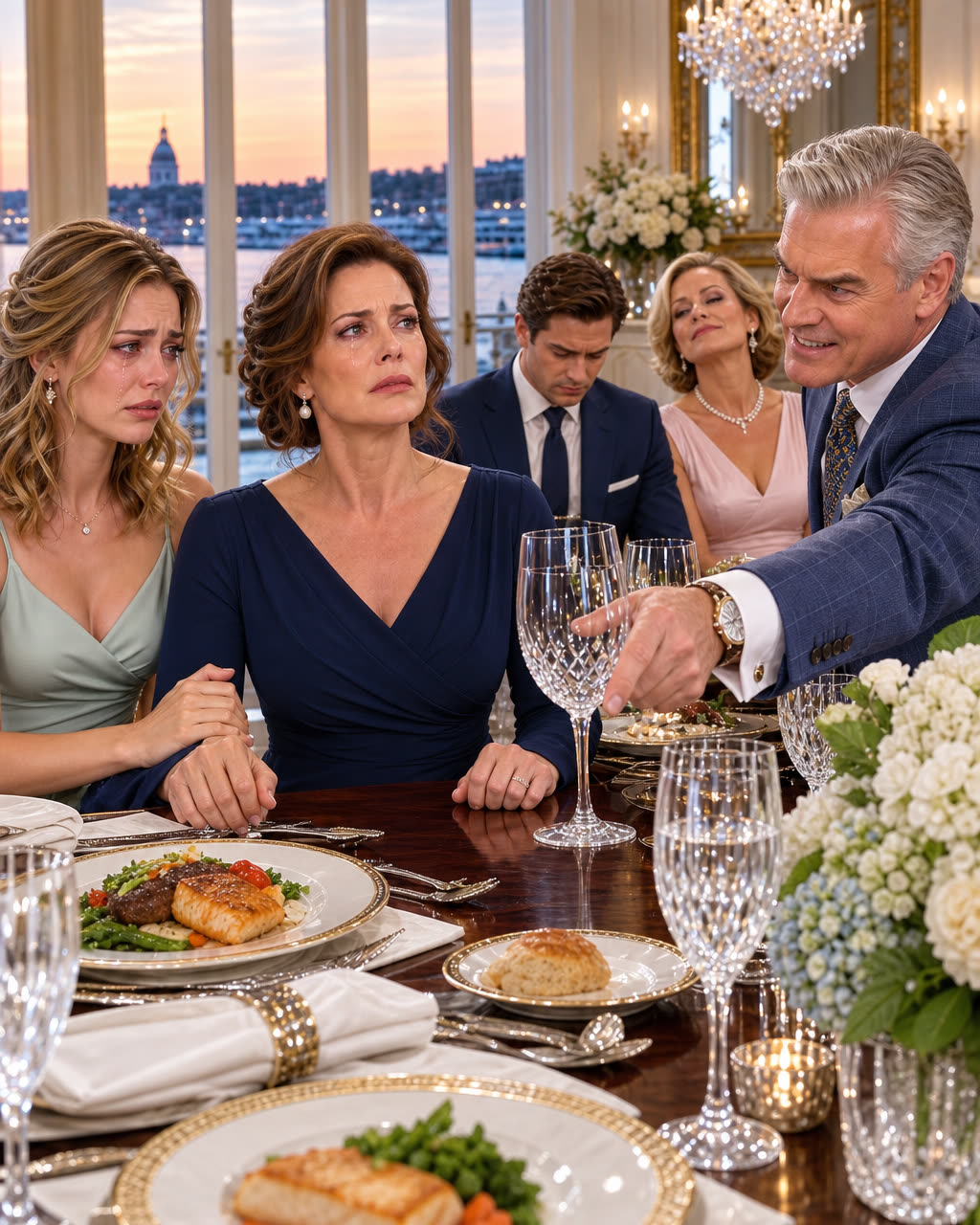
At dinner with my daughter’s fiancé’s family, his father, a Navy captain, nudged his empty glass across the table toward me. “Make yourself useful. Pour the wine.” He laughed, and then he added, “A single mother? No wonder your daughter doesn’t know what a real family looks like.” Tears gathered in my daughter’s eyes. I rose from my chair, took her hand, and walked out of that house. The man had no idea that I was an Army general, and by Monday, that ignorance would leave him stunned.
Everything that followed happened within a few heartbeats, yet I can still recall every detail of it. The empty crystal glass sat on the polished table, catching the glow of the chandelier overhead. My daughter’s fingers trembled inside my hand beneath the tablecloth. Across from us, a man who believed he had already taken my measure leaned back in his seat, thoroughly pleased with himself. He thought he had found someone with no power to answer him. He could not have been more wrong, and the proof was already waiting on his calendar for Monday morning.
Captain Richard Whitmore had no idea he had just insulted a woman who commanded more troops than he could imagine. He wore the smile of a man addressing hired help, certain of his place and certain of mine. On Monday morning he would face me again, and nothing about that meeting would resemble the evening he was enjoying so much.
My name is General Victoria Hayes. I am fifty-three years old, a three-star United States Army general, and the mother of twenty-six-year-old Olivia. I had spent three decades earning the stars on my shoulders, through long nights, hard postings, and a thousand decisions that other people would never see. Yet when I thought about who I was, the title was never the first thing that came to mind. The first thing was always my daughter, the person I had raised and the reason I had learned to be both firm and gentle.
Olivia had been engaged to Ethan Whitmore for several months, and she glowed whenever she spoke about him. She told me he was kind, that he listened, and that he wanted a quiet life built on honesty. When the time came to meet his parents, she was nervous in the way young people are when two halves of their world are about to touch for the first time. I told her not to worry. I told her I only wanted to meet the people who had raised the man she loved, and I meant every word.
That Friday, however, I wore no uniform. I thought about it for a long time before deciding, because a uniform can change a room the instant you walk into it. People stand straighter, speak more carefully, and smile at you in ways they otherwise would not. I did not want that. I wanted her fiancé’s relatives to meet her mother, not a high-ranking officer, and I wanted to see how they behaved when there was nothing to be gained from impressing me.
So I chose a plain navy dress, understated pearls, and the comfortable heels Olivia had given me at Christmas. I looked in the mirror and saw an ordinary woman heading to an ordinary family dinner, and that was exactly the point. I had no way of knowing then that this simple choice would nearly end my daughter’s engagement before the night was over.
The Whitmores’ sprawling waterfront home stood outside Annapolis, Maryland, behind a long drive lined with trimmed hedges. Richard, his wife Patricia, and their son Ethan welcomed us in the entrance hall beneath a chandelier that cost more than my first home. Everything about the house announced money and standing, from the gleaming floors to the framed photographs of men in dress uniforms along the walls. Olivia squeezed my hand once before we stepped inside, and I squeezed back.
Richard looked me over from head to toe, slowly, the way a man inspects something he is considering buying and expects to find lacking. “So,” he said, “you’re the famous single mother.” “Just Victoria,” I answered. He laughed. “Of course.” Over dinner he asked about my income, my education, and whether I had raised Olivia respectably, each question wrapped in a polite tone that did nothing to hide its edge. “What exactly do you do?” he asked. “I work for the federal government.” “Administrative work?” “Something like that.” He smirked. Patricia leaned toward him with an air of generosity. “Richard, darling, don’t embarrass her. Government clerks are important too.”
Under the table, Olivia clasped my hand, and I felt how tightly she held on. I kept my face calm, as I have learned to do in far harder rooms than this one. Then Richard lifted his empty wineglass and shoved it across the table until it stopped in front of me. “Pour the wine.” I studied the glass, then looked up at him. “Excuse me?” “You heard me.” He chuckled. “A single mother? No wonder your daughter doesn’t know what a real family looks like.”
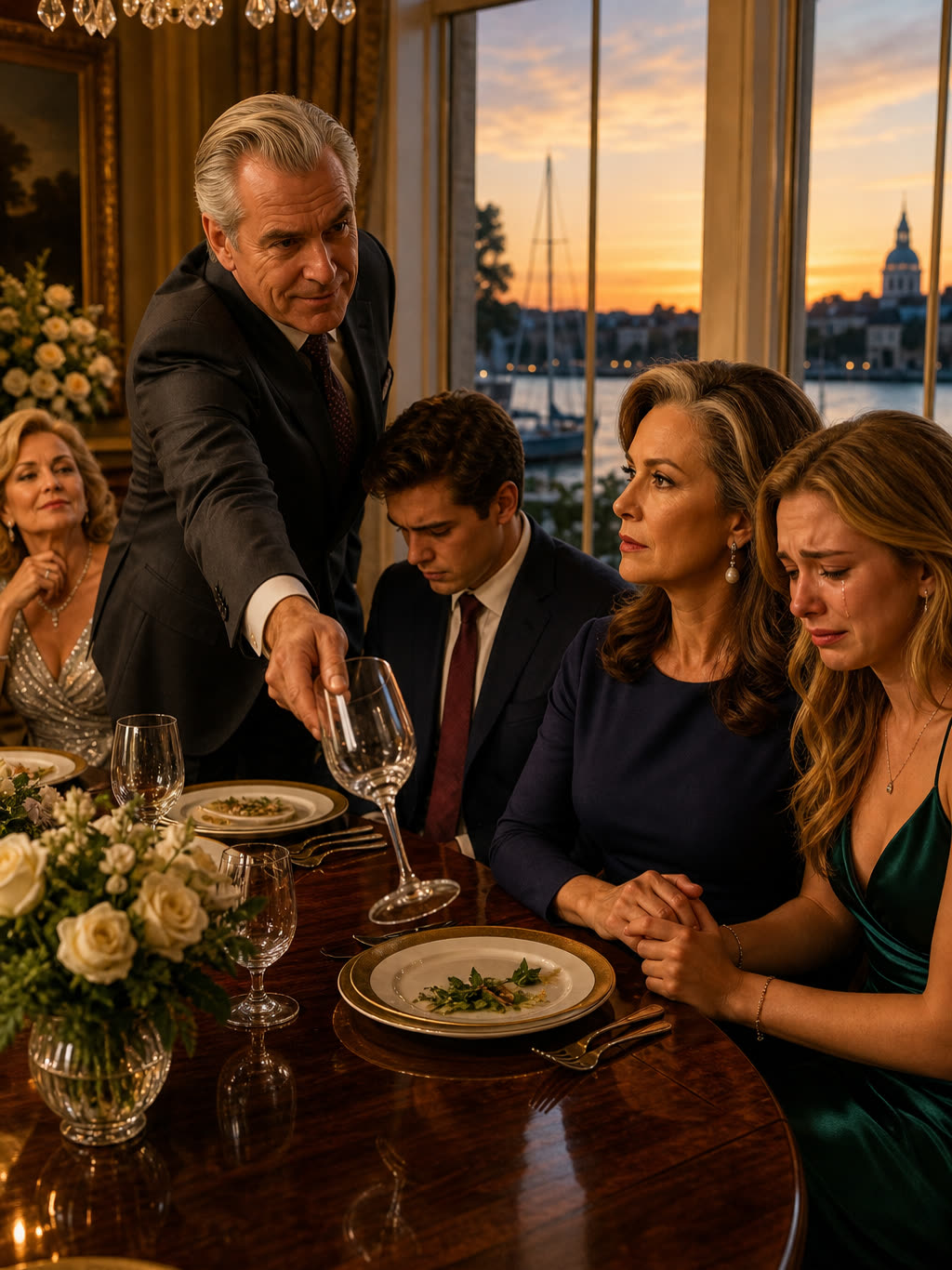
The dining room fell silent. I could hear the faint tick of a clock somewhere behind us and the soft hiss of the candles. Olivia’s eyes filled with tears, and she did not try to hide them. Ethan fixed his gaze on his plate and would not lift it. I waited, and I will admit that I waited with real hope, for him to defend the woman he had promised to marry. He remained mute, and his silence landed on my daughter harder than his father’s insult had.
Richard reclined in his chair, pleased with himself, as if he had just delivered a lesson the whole table needed to hear. “Don’t look so offended,” he said. “In this family, we respect tradition.” Patricia gave a small, approving nod. Nobody else moved. In that moment I understood everything I had come to this house to learn, and I understood it more completely than any conversation could have taught me.
I set my napkin beside my plate, folded and neat. “Olivia,” I said softly, “get your coat.” Richard scowled. “We’re not finished.” “Yes,” I replied, standing. “We are.” Olivia rose beside me, her hand still locked in mine, and I felt her draw a steadying breath. Together we turned away from the long table, the empty glass, and the faces that would not meet ours.
As we reached the exit, Richard called after us, his voice ringing off the polished floors. “Your daughter should learn that marrying into a military family requires discipline!” I stopped and turned around. For the first time all night, I smiled. “Captain Whitmore, I understand military discipline considerably better than you think.” He laughed again, loudly, convinced he had won. I left without answering.
Behind us, I heard Patricia whisper, “What an arrogant little woman.” The front door closed on her words, and the cool evening air met us on the steps. Olivia was shaking, and I wrapped my arm around her shoulders as we walked down toward the car. I did not look back at the house. There was nothing in it I needed to see again.
They knew nothing of my position. Olivia knew nothing of Monday’s paperwork. And as I guided the car down that long drive, away from the lights and the chandelier, I had no idea how quickly Richard Whitmore would make his next mistake, or how much it would cost him.
PART 2 — THE GENERAL THEY NEVER SAW COMING
Halfway home, Olivia began crying. It was not the quiet crying she had tried to contain at the table. It came out of her in rough, helpless breaths now that the doors were closed and nobody was watching. “I’m sorry, Mom.” The words were barely audible, and they cut through me more sharply than anything Richard had said.
My hands tightened around the wheel until my knuckles ached. I kept my eyes on the dark road and my voice level, because I knew that what she needed from me was steadiness. “You have nothing to apologize for.” I said it slowly so that she would hear each word and understand that I meant it entirely.
“Ethan promised they’d be respectful,” she said, wiping her face with the back of her hand. “He said his father was strict, but honorable.” I could hear how much she wanted that to still be true. She had trusted the man she loved, and she had believed what he told her about his family. Watching her realize how thin that trust had been was one of the hardest things I have ever sat through.
I glanced across at her. “Honor isn’t something you announce at dinner, sweetheart. It’s something you demonstrate when nobody important is watching.” She turned the words over in her mind, and I saw her shoulders ease just slightly. I had learned that lesson the hard way, through years of watching how people behave toward those they believe cannot help them, and I wanted her to learn it without the same cost.
She dried her cheeks and stared out through the windshield for a while. The headlights swept across the road ahead, and neither of us spoke. Finally she asked the question I had been expecting. “Why didn’t you tell them who you were?” It was not an accusation. She was searching for the reason behind a choice she did not yet understand.
“Because I wanted to know how they treated people they believed couldn’t help them.” She said nothing, but I could see her absorbing it. I had not set out to test them cruelly, and I had hoped, truly hoped, that the test would be passed. Instead it had shown me exactly who they were, and it had shown my daughter too, however painful that was.
We drove on through the dark, past the quiet stretches of road, and for a long time the car was filled only with the low hum of the engine. I thought about the years of early mornings, packed lunches, school plays, and promotions I had missed or fought to keep. I thought about how often people had assumed my life must have been smaller because I raised my child alone. None of that had ever mattered to me, until I watched it used as a weapon against her.
Twenty minutes later, Ethan called. Olivia stared at the screen for a moment before she answered, and the call came through the car speakers, filling the space between us. “Olivia, my father expects an apology.” His voice was flat and rehearsed, and I nearly laughed at the audacity of it. “For what?” she demanded, and I heard steel in her voice that had not been there an hour earlier.
“For disrespecting him in his own home.” “And what about what he said to my mother?” Ethan paused. The silence stretched, and I could picture him choosing between two uncomfortable truths. “Look, you know how Dad is. He’s a captain. He’s used to being respected.” Olivia’s breath caught, and I knew exactly what she was feeling. It was the moment when someone she loved had chosen the easier side.
I turned into our driveway, and the headlights washed over the front of our house. The last light of the evening still lingered on the horizon, painting the sky in deep orange and violet. I put the car in park and spoke calmly toward the dashboard. “Then he should know how to show respect.” Olivia disconnected the call. She sat very still, and I watched the hurt in her eyes slowly begin to harden into determination.

The next morning, an encrypted alert arrived from my chief of staff, Colonel Daniel Brooks. It concerned Monday’s interservice readiness assessment at a joint defense facility, a meeting I had been preparing for over several weeks. I opened the message at my kitchen table with a cup of coffee going cold beside me. I expected routine scheduling details. I did not expect what I found.
One name caught my attention immediately: Captain Richard Whitmore. I read it twice to be sure my eyes were not playing tricks after a sleepless night. There it was, in black and white, on the list of officers whose organizations would face examination on Monday.
He commanded a Navy logistics unit facing an official assessment of readiness, purchasing safeguards, and command accountability. I had been appointed weeks earlier to lead the joint panel, which would assess four organizations, including his. At the time, his name had meant nothing to me. Now it sat on the page like a stone dropped into still water.
More troubling was an attached inspector general referral. A preliminary independent inquiry had identified unusually costly maintenance contracts, missing supplies, and questionable spending approvals. Civilian employees had also complained of retaliation for questioning transactions. Nothing had yet been established as fact, and I reminded myself of that again and again as I read each line.
I read everything twice, set the pages down, and called Brooks. He answered on the second ring. “Daniel, I need a conflict-of-interest consultation immediately.” “Ma’am?” His voice carried surprise, because in all the years we had served together, I had never made such a request.
“I had a personal encounter with one of the officers under review. I want legal counsel to determine whether I should recuse myself from any decisions concerning him.” He paused, and I could almost hear him piecing it together. “Understood, General.” That was all he said, and it was exactly what I needed from him.
I wouldn’t ruin an officer’s career because he’d insulted me; doing so would make me resemble the man he thought he was entitled to be. Nor would I shield him from an independent inquiry. Those were the two lines I would not cross, and I held them firmly in my mind through the long hours of that Saturday. What happened to Richard had to be decided by evidence and process, never by my wounded pride.
By Sunday afternoon, military counsel advised that I could deliver the scheduled general briefing if I disclosed our encounter, took no substantive decisions about Richard, and left his command’s findings to an independent panel. I readily agreed. It was a relief to have a clear path that protected the integrity of the entire process and allowed me to do my duty without compromising anyone.
Richard then compounded his mistake by messaging Olivia. The words appeared on her phone as she sat beside me on the sofa: My son deserves a bride from a respectable family. Your mother’s attitude proves my concerns were justified. Her hand went to her mouth as she read it aloud, and I could see the anger rising in her face.
He attached a photograph of me beside Friday’s dinner table, taken without my knowledge, and added another line beneath it: Some people forget their place. Olivia showed me the screen, her fingers trembling with fury rather than sorrow this time. “Mom, he thinks he can humiliate you whenever he wants.” I examined the image carefully. “He can think whatever he likes.”
“What are you going to do?” I put down her phone and met her eyes. “Absolutely nothing personal.” She appeared baffled, so I continued. “But on Monday, he’ll discover something important.” “What?” “That rank doesn’t excuse bad character.” She searched my face, and for a long moment neither of us spoke. Then my own phone vibrated against the table. Brooks again.
“The briefing room is confirmed, General. Captain Whitmore’s unit will attend. The independent review team has also secured additional procurement records.” “Good,” I said. “Anything else, ma’am?” I glanced toward my dress uniform hanging in the closet, pressed and waiting, the silver stars catching the light from the window. “Yes, Colonel.” After a pause, I instructed him: “Make sure every officer follows the established protocol. No exceptions.”
PART 3 — MONDAY MORNING, 0800 HOURS
At exactly eight Monday morning, Richard arrived at the joint command briefing room in immaculate Navy service dress, smiling. Every button gleamed and every ribbon sat perfectly aligned. He walked in like a man who had never once doubted his own importance, and he took his seat at the table as though it had been reserved in his honor.
Brooks later told me Richard had spent ten minutes boasting about influential contacts and assuring junior officers the assessment was just a formality. He spoke loudly enough for the entire room to hear, perfectly relaxed, perfectly sure. “Washington knows my record,” he announced. “Nobody is going to question my leadership.”
The junior officers around him listened politely, some nodding, some exchanging quick glances they thought he could not see. They had worked under men like him before, and they knew when to stay quiet. Richard took their silence for agreement, and it only fed his confidence further.
Representatives from the other three organizations being assessed settled into their seats, shuffling folders and checking notes. The room carried the usual hum of a formal review, with low voices, rustling paper, and the clink of coffee cups. Richard leaned back, one arm draped over the chair beside him, as though the entire event had been arranged for his benefit.
Meanwhile, I stood in the corridor outside with Brooks at my side, listening to the muffled sounds through the closed doors. I thought of Olivia’s tears, of the empty glass, and of Ethan staring down at his plate. I let those memories pass through me and then set them aside, because they did not belong in that room. What belonged there was the procedure, and nothing else.
I had promised myself that I would carry out my duty without a trace of vengeance. Everything I did that morning had to withstand scrutiny, and it had to be right regardless of who sat at that table. My feelings were real, and I did not pretend otherwise. But feelings were not evidence, and I had no intention of letting them stand in for it.
Brooks glanced at his watch and then at me. “It’s time, General.” I straightened my jacket, adjusted my cuffs, and drew a slow breath. Thirty years of service stood behind me in that moment, and I felt the full weight of every one of them settle calmly on my shoulders.
Then the doors opened. “Attention on deck!” All the officers rose at once, chairs scraping, boots sounding against the floor. The room snapped to order with a speed that only comes from long discipline. I stepped through the doorway and walked forward, my steps measured and even.
I entered in my Army Service Uniform, three silver stars shining on each shoulder. Brooks introduced me in a clear, formal voice. “Ladies and gentlemen, Lieutenant General Victoria Hayes, chair of the Joint Readiness Assessment Panel.” The words hung in the air for a heartbeat before anyone moved.
Richard’s smile vanished. His eyes widened, jaw falling open as though the floor had disappeared beneath him. The color drained from his face in a single wave, and he stood frozen, his hand still resting on the back of his chair. He looked at the stars, then at my face, then at the stars again, as if one of them might correct the other.
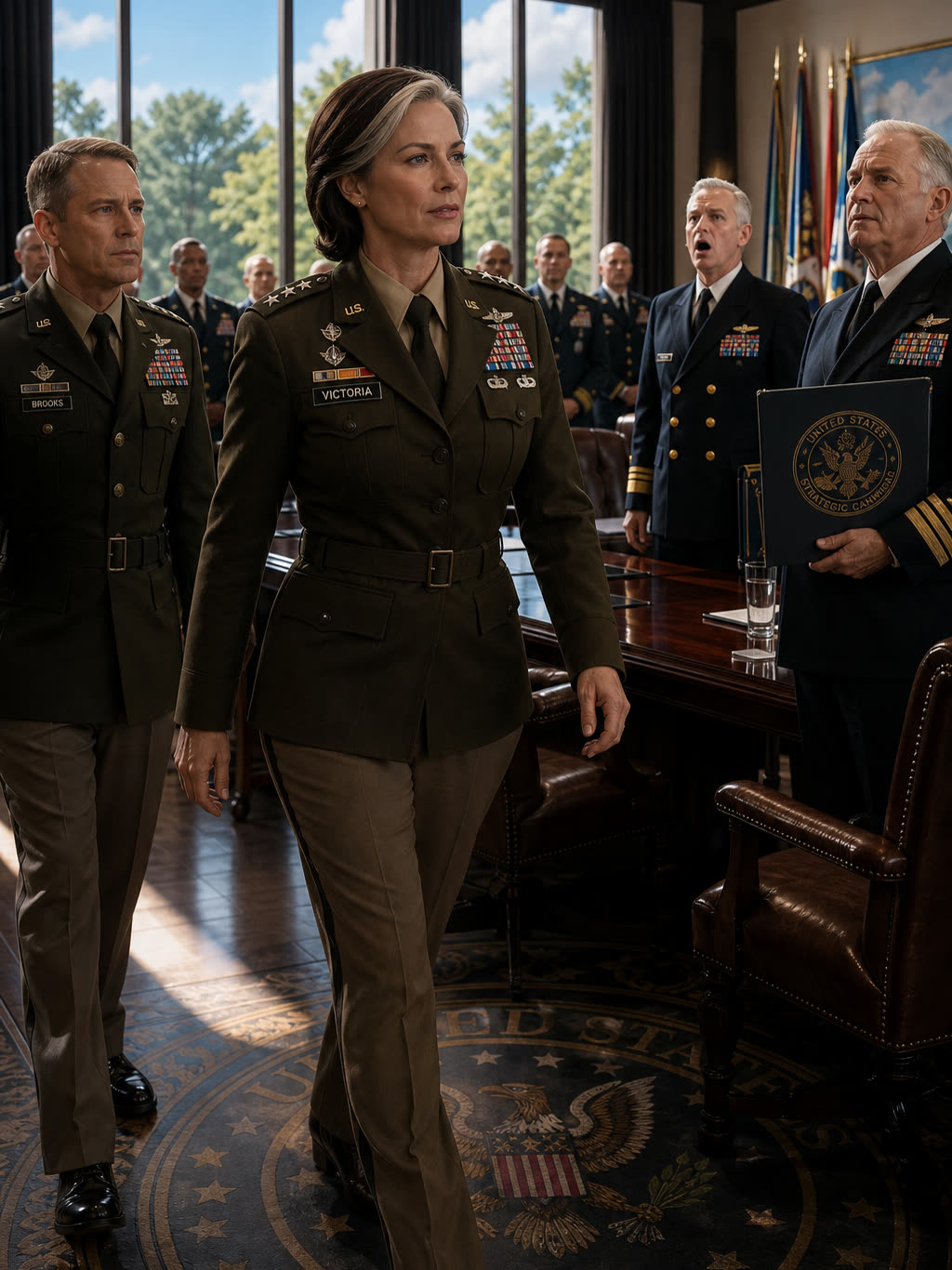
I approached the head of the table, my eyes sweeping across the assembled officers. “Good morning, everyone. Please be seated.” Everyone settled with a rustle of fabric and a scrape of chairs, everyone except Richard, who remained standing as though his legs had forgotten how to bend.
“General… Hayes?” His voice cracked on the second word. I met his eyes. “Captain Whitmore.” His face reddened, the shock giving way to something between panic and shame. “Ma’am, I… I didn’t realize—” “I know.” He swallowed hard, and I watched his throat work.
“I believe we’ve met.” “Yes, Captain. We have.” After a silence that felt much longer than it was, I spoke to the room. “For transparency, Captain Whitmore and I had a personal encounter this weekend. I have disclosed that interaction to legal counsel and will not participate in findings or disciplinary recommendations concerning his command.”
Richard exhaled with fleeting relief, his shoulders dropping a fraction. He assumed I was protecting him, that some kindness remained beneath the rank. I was safeguarding the procedure. “Rear Admiral Sullivan,” I continued, “will oversee the independent review of Captain Whitmore’s unit.” A gray-haired officer rose from his seat. “Thank you, General.”
Opening a thick folder, he addressed Richard directly. “Captain Whitmore, our examination has identified serious discrepancies requiring formal investigation. These include unsupported procurement approvals, inventory shortages, and evidence of possible retaliation against civilian employees.” Richard went rigid. “Those accusations are ridiculous!”
Sullivan stayed composed, his voice unhurried. “Several witnesses provided contemporaneous records. The financial documents have been independently authenticated.” Sweat appeared on Richard’s forehead, and he glanced around the room as if looking for an ally. He found only lowered eyes and quiet faces. “This is because of Friday night!”
I faced him squarely. “No, Captain. Friday night is why I’m not deciding your case.” The words landed in the stillness, and I saw the truth of them reach him, slowly and completely. Sullivan shut the folder with a soft, final sound. “Pending further proceedings, you’ve been temporarily relieved of command. Your access to certain procurement systems is suspended, and the matter has been referred to the appropriate investigative authorities.”
Richard seized the table edge, his knuckles whitening. “You can’t do this!” Sullivan’s face hardened. “The decision has already been reviewed through the proper chain of command.” Richard turned to me, and for the first time since I had known him, he looked small. “Victoria, please. My son is marrying your daughter.”
I remembered Olivia crying, his empty glass, and Ethan staring down at his plate. I let the memory settle and answered him quietly. “Captain,” I said, “you told me my daughter didn’t know what a real family looked like.” He dropped his gaze. “I’m sorry.”
I shook my head. “You’re apologizing to a general because you’re afraid of the consequences. You should have respected her mother when you believed she was nobody.” The room stayed silent. No one coughed, no one shifted. I turned to Sullivan. “Please proceed according to established procedures.” Then I walked out.
Six months later, investigators substantiated multiple violations of financial controls and retaliation complaints. Richard faced administrative sanctions and proceedings to separate him from service, while procurement concerns went for additional legal review. The man who had been so certain of his place now had no place left to stand.
Patricia no longer held her lavish military charity dinners. Olivia returned Ethan’s engagement ring. “I need a husband who stands beside me,” she told him, “not someone who hides behind his father.” She said it without anger, with the calm of a woman who had made her peace with a difficult decision.
Three months afterward, Olivia received a promotion at her engineering company and bought her first house. On moving day, she set a framed photograph of the two of us on the mantel and stepped back to look at it. Smiling at it, she said: “You know what, Mom? We were always a real family.” I embraced her. “Yes, sweetheart. We were.”
Evening sunlight spread across her garden. I had worked thirty years for the stars on my shoulders, but watching Olivia build a life beyond people who judged others by titles taught me what Richard never understood. Respect starts with character, not rank. My greatest professional victory wasn’t seeing a cruel officer lose command. It was seeing my daughter realize she’d never needed his approval.
Disclaimer: This story is a work of fiction inspired by real-life themes. Names, characters, places and events are fictionalized, and any resemblance to real persons is purely coincidental. Images are for illustration purposes only.
