

PART 1
The wedding took place at Briarwood Estate, a white-columned venue just outside Charleston. Manicured lawns rolled out in every direction, a still lake shimmered behind the ceremony arch, and two hundred guests filled the grounds, all of them dressed as if they had stepped out of a glossy magazine spread.
My son Daniel stood beside his bride, Vanessa, with the smile of a man who believed he had just won everything he had ever wanted. I stood a few steps away and watched him, and for a moment I let myself feel only the old, simple pride of a father seeing his boy at the altar.
In the front row sat my wife, Margaret. Tears shone in her eyes and a folded handkerchief rested in both of her hands, held the way she always held things at moments she wanted to keep carefully. She sat that way at graduations, at funerals, and at every hour of our lives that mattered.
I should explain something about those hands. For months, Margaret had tried to love Vanessa, and she had tried with everything she had.
She helped choose the flowers. She sat at our kitchen table and addressed the invitations one by one in her careful, looping script, pausing over each name as if the envelope itself were a blessing. And she gave Vanessa the pearl bracelet her own mother had worn on her wedding day, pressing it into the younger woman’s palms with the tenderness of someone offering a thing that can never be replaced.
Vanessa accepted it with a bright smile. Later, she told one of her bridesmaids, loudly enough for Margaret to hear, that it was vintage, she supposed, and that maybe she would wear it to the rehearsal but certainly not to the actual wedding.
Margaret said nothing.
That was her way. She absorbed small cruelties the way soil absorbs rain, quietly, without complaint, and with no one the wiser except me.
The ceremony itself ended beautifully. The vows were spoken, the kiss was given, the guests applauded, and champagne began to flow. The band slid into a soft jazz number, and the whole crowd drifted toward the garden reception, two hundred people crossing the manicured grass toward white-draped tables and strings of lights, wrapped in the warm and particular happiness of a celebration that believes it is going well.
Then it happened.
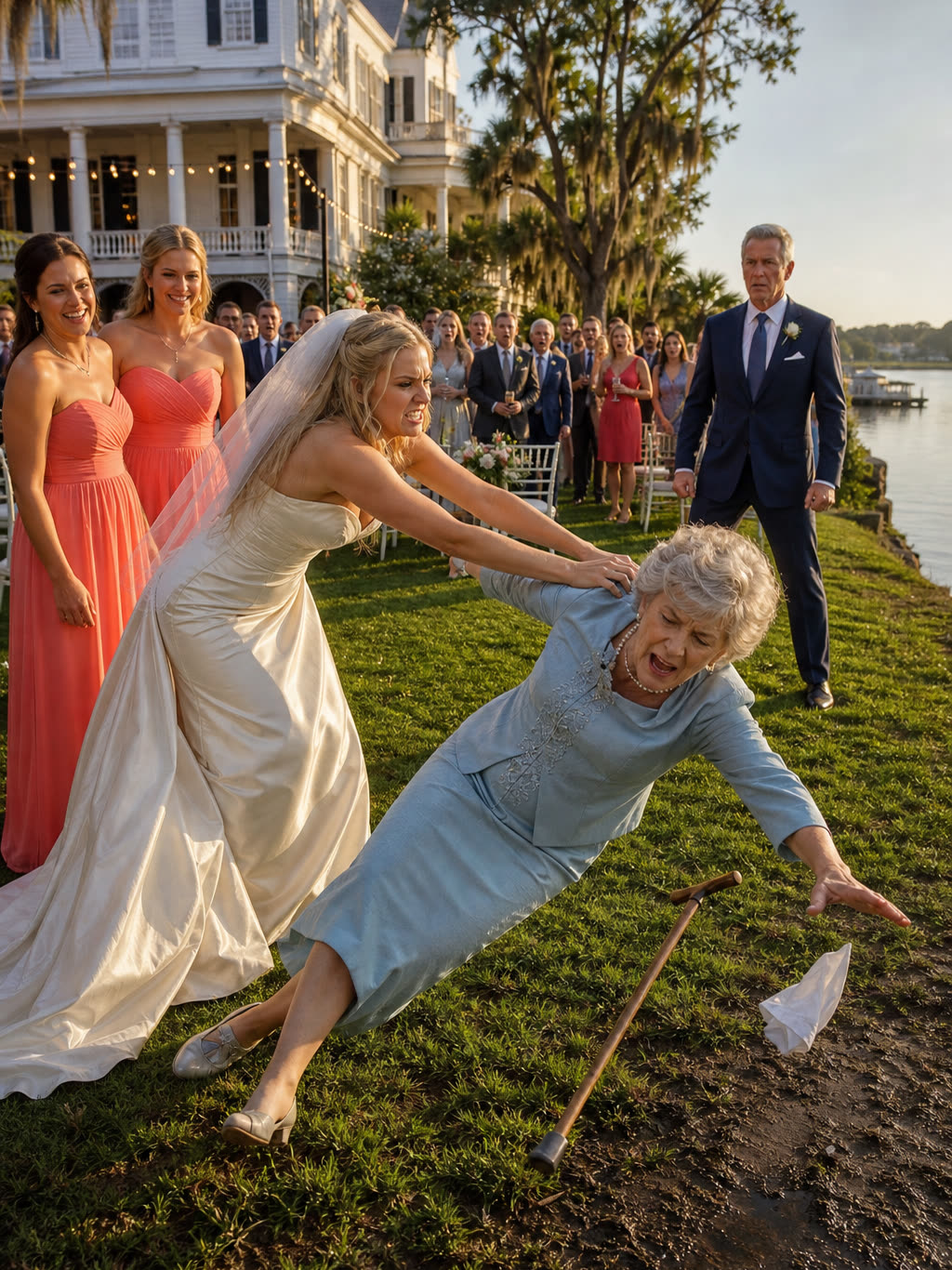
Near the edge of the lawn, the rain from the night before had left the ground soft and treacherous. Margaret walked carefully, one hand on her cane, moving with the deliberate dignity of a woman whose body asks for patience and who has learned to give it. Behind her, Vanessa approached with two bridesmaids at her side. Something passed between the three of them, some private little amusement, and I watched it from across the lawn without yet understanding what I was seeing.
I saw Vanessa lean close and say something. Margaret turned, confused.
Then Vanessa placed both hands on my wife’s shoulders and shoved.
Margaret fell sideways into the mud.
Her pale blue dress, the one she had saved for months to buy for this very day, was ruined in an instant. Her handkerchief landed in a puddle. Her cane skittered away across the grass. For one terrible second, the entire wedding fell silent, the way only two hundred people can go silent all at once, a total suspension of everything.
Then Vanessa laughed.
It was not a nervous laugh. It was not the startled sound of someone who has just made a terrible mistake. She laughed like a person who had finally done the thing she had been waiting to do, and who found it every bit as satisfying as she had imagined.
Daniel stepped toward her. I watched from across the lawn and I expected him to go to his mother. I expected him to kneel in the mud, lift her up, and turn to his wife with something real and furious on his face.
Instead, my son slipped his arm around Vanessa’s waist, leaned close to her ear, and whispered something.
Vanessa laughed harder.
Something inside me became very calm.
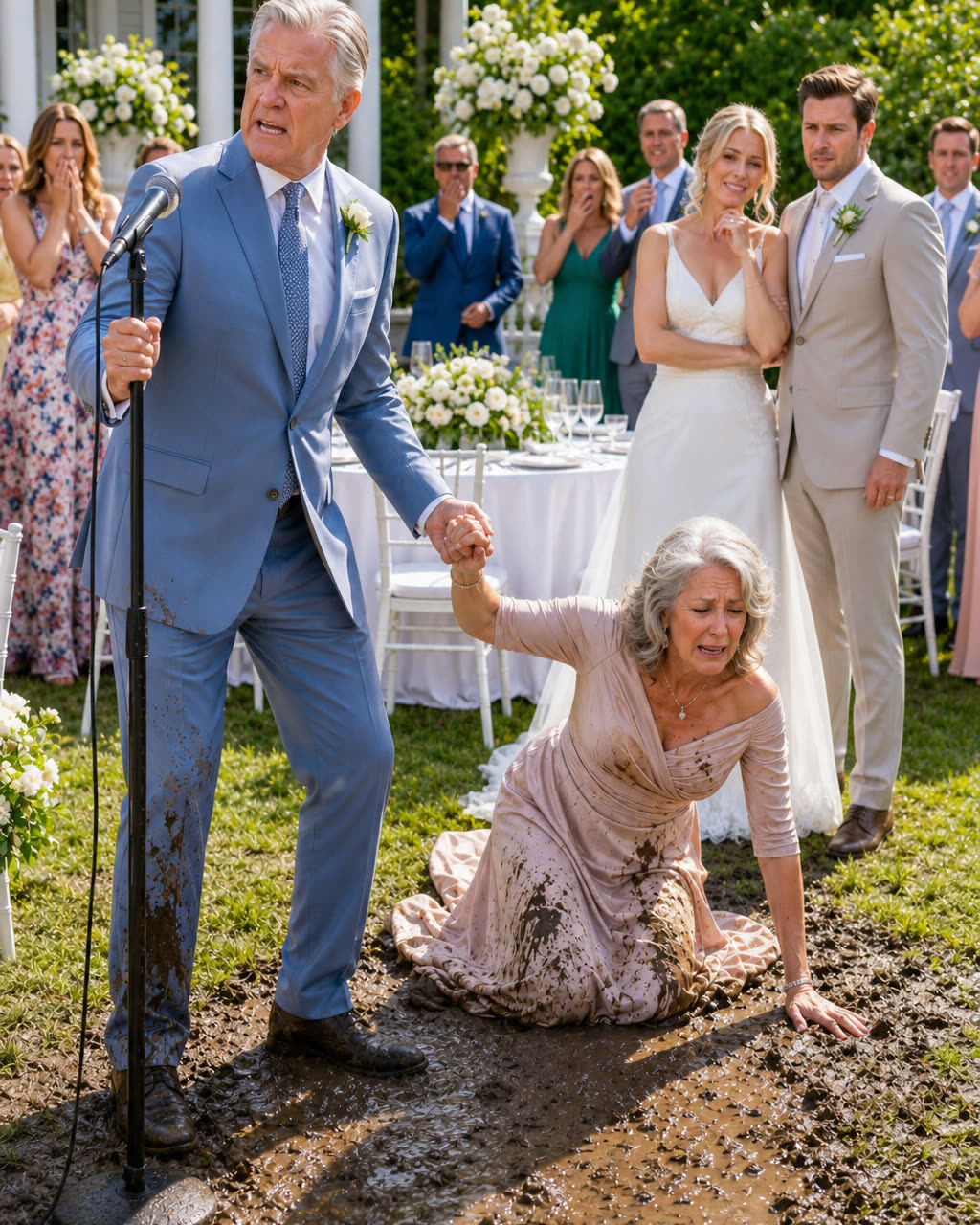
It was not the hot calm of rage held in check. It was the cold calm of a man who has just understood something completely and is now deciding what to do with that understanding. I walked across the lawn at an even pace. I bent and picked Margaret’s cane out of the grass. I helped her to her feet. I took off my jacket and wrapped it around her.
Her hands were trembling, but her face was steady, the way a face goes steady when dignity has been stripped away in public and the only thing left is deciding who you will be in the next sixty seconds.
“Thomas,” she whispered. “Don’t.”
But I was already walking toward the microphone near the bandstand.
The band kept playing until I tapped the microphone once.
The sound cracked across the garden like a branch snapping in a quiet forest.
Every face turned.
Vanessa’s father, Richard Caldwell, set down his champagne glass.
The band stopped.
Daniel’s smile disappeared.
I looked at my son first. Then I looked at his bride. Then I looked at the two hundred people who had just watched my wife shoved into the mud at her own son’s wedding, and not one of whom had moved to help her.
I had spent thirty years building a name, a business, and a family that people respected. In that moment I understood that respect and courage are not the same thing, and that the room in front of me held plenty of the first and almost none of the second.
I leaned toward the microphone. My voice came out level, and it carried across the lake.
“Ladies and gentlemen,” I said, “before the first dance, I believe everyone here deserves to understand why this wedding will not be paid for by the Whitmore family.”
For three seconds, no one moved. No one breathed. And then, from somewhere behind the white tent, I heard the first sound of something that had begun to come apart.
PART 2
The string lights swayed above the garden in the evening breeze. Somewhere behind the tent, a caterer dropped a tray, and the clatter of silverware sounded louder than thunder in the silence that surrounded it.
Vanessa’s mouth fell open.
Daniel took one step toward me. “Dad. Stop.”
I did not look at him.
I kept my eyes on the guests, many of whom had known Margaret and me for thirty years. Former neighbors. Business partners. Friends from church. Daniel’s college classmates. Every one of them had just watched my wife fall, and every one of them was now watching me.
“I had planned,” I said, “to stand here tonight and welcome Vanessa into our family. I had planned to speak about love, patience, and the joy of seeing your child build a life with someone.”
Vanessa folded her arms across her ivory gown. “This is insane.”
Her father said her name, sharp and low.
She ignored him.
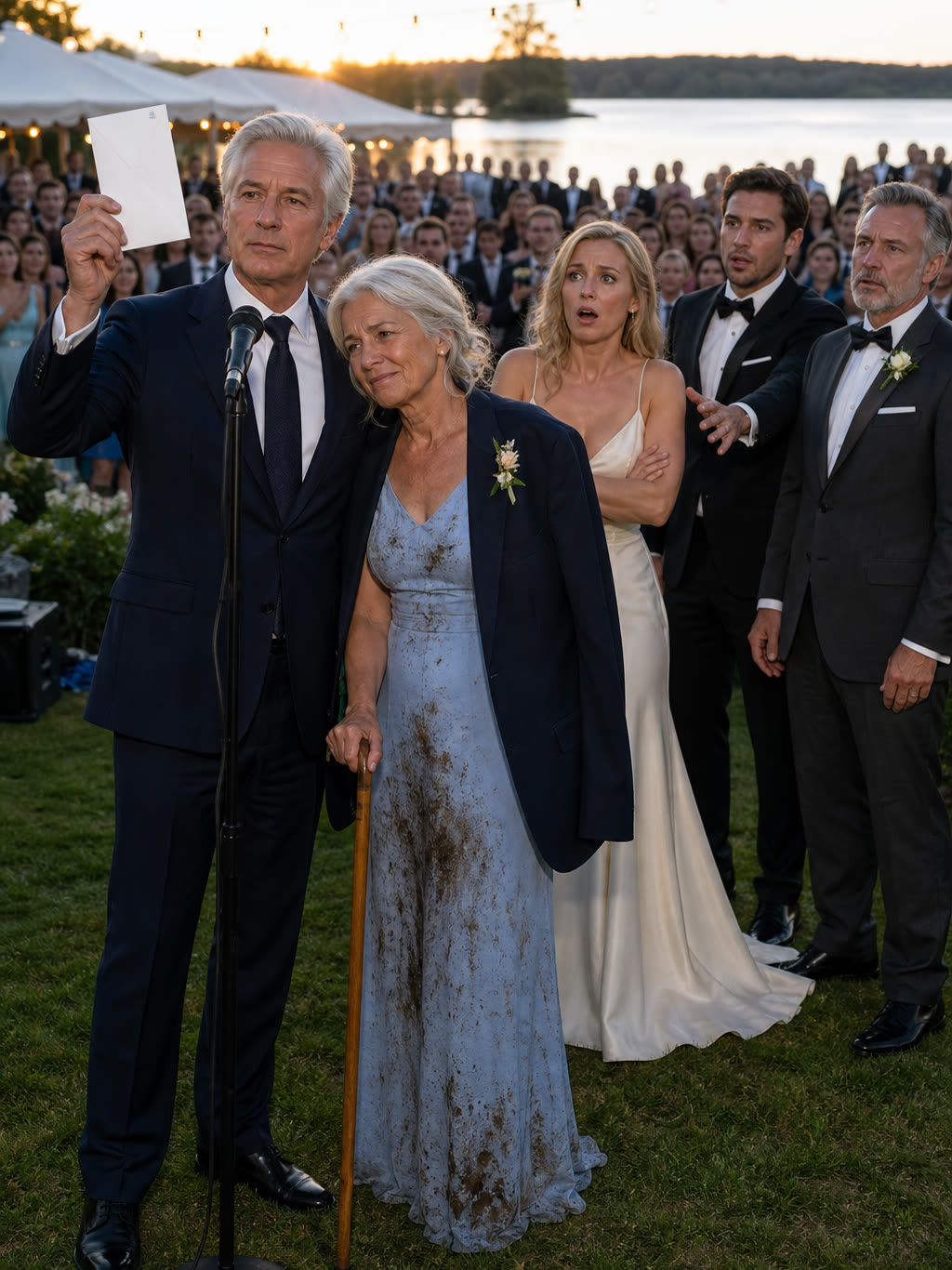
I reached into my suit and drew out an envelope. I had carried it with me all afternoon, not expecting disaster, simply holding the final payment for the reception as arranged. Eighty-four thousand dollars. The venue, the catering, the band, the flowers, the photography, the open bar, and the accommodations for out-of-town guests.
Daniel knew I was paying.
Vanessa knew better than anyone.
“Three months ago,” I said, “Vanessa asked my wife whether we could increase the flower budget. Margaret said we would think about it. Vanessa replied that if we were going to act poor, we should not have offered to host the wedding.”
A murmur rolled through the crowd, low and uneasy, like wind moving through tall grass.
“That is not true,” Daniel said.
Margaret, standing at the edge of the lawn in my jacket, looked down at the ground.
I turned to my son. “Your mother cried in the laundry room that night. You were upstairs. You heard her. You did nothing.”
His face tightened, but he said nothing.
I held up the envelope so that the whole garden could see it.
“This contains a cashier’s check for the remaining balance. It was meant to go to the venue manager after dinner. It will not.”
Vanessa’s expression changed for the first time. The smugness drained away, and something rawer showed through underneath.
“You can’t do that,” she said.
“I can,” I replied. “And I have.”
Richard Caldwell stepped forward slowly. “Thomas, are you saying the vendors have not been paid?”
“The deposits are paid,” I said. “By me. The final balances were to be paid tonight. Also by me.”
The venue manager, Elaine Porter, had appeared near the tent entrance, pale and silent, her hands pressed together in front of her.
I turned toward her. “Mrs. Porter, I apologize for the disruption. You will receive full payment for services already rendered tonight. But no additional upgrades, no extended bar, no late-night catering, no extra vehicle service, and no honeymoon transfer will be covered by my family.”
Vanessa stared at me as though I had slapped her, a particular kind of irony that I suspect was not lost on anyone with a clear view of the lawn.
Daniel’s voice dropped. “Dad. You’re embarrassing us.”
I looked at my son. Really looked at him. This was the boy who had once carried injured birds into the garage and begged me to help them. The boy who had wept when his mother broke her wrist, because he thought he should have caught her. That boy was still somewhere inside this man in the tailored tuxedo. I could see the edges of him, pressed flat under ambition and the need to keep his world smooth.
“No,” I said. “You did that when you chose laughter over your mother.”
Vanessa recovered first. She turned to Elaine Porter. “This is a private family matter. Continue the reception.”
Elaine looked from Vanessa to me, and then to Richard Caldwell. “Mrs. Whitmore has been injured on the grounds. I think we should pause service until we understand what is happening.”
“Mrs. Whitmore?” Vanessa repeated, her voice going high and brittle. “That’s me now.”
“No,” Margaret said.
It was the first time all evening she had spoken loudly enough for the crowd to hear.
Every head turned toward her.
She stood in the grass with mud staining her dress from shoulder to knee, my jacket hanging loose around her shoulders, her silver hair come undone on one side. She looked like exactly what she was, a woman who had been hurt. But her voice did not waver.
“You are not me,” she said.
Vanessa blinked, more offended than ashamed.
Daniel moved toward his mother. “Mom, Vanessa was joking. She barely touched you. You slipped.”
The lie was so immediate, so well rehearsed, that it seemed to drain the last warmth from the evening air.
A man near the back said, “I filmed it.”
Another guest said, “So did I.”
Daniel stopped moving.
Vanessa’s bridesmaids went quiet, and one of them took a small step away from her.
Richard Caldwell turned slowly toward his daughter. He was a man in his early sixties, polished and controlled, the kind of man who knew the price of every room he entered. Until that moment, he had looked embarrassed. Now he looked furious.
“Vanessa. Tell me you did not push that woman.”
Vanessa’s face tightened. “Dad, please don’t start.”
“Tell me.”
She looked around at the guests, then at Daniel, waiting for him to rescue her.
Daniel swallowed and looked at the ground.
That was all Richard needed.
He walked to a nearby table, picked up a linen napkin, and wiped his hands with slow, deliberate care.
“I warned you,” he said to Daniel.
Daniel looked up. “Mr. Caldwell—”
“No. I warned you both. I told you that humiliation is not humor. I told you that cruelty in private becomes cruelty in public. You both smiled and told me I was old-fashioned.”
Vanessa said he was not doing this here.
“I am doing exactly this here,” Richard said.
The guests shifted where they stood. Some looked away. Others watched with the fixed attention of people witnessing the exact moment a beautiful event becomes a permanent memory for all the wrong reasons.
Margaret reached for my hand. I took it, and her fingers were cold and still shaking.
Daniel saw the gesture, and something in his face began, finally, to shift. He looked at his mother’s mud-covered dress and did not look away quickly this time. His mouth trembled.
“Mom,” he said.
Margaret held up one hand.
“Not here,” she said. “Not because people are watching. Not because the money stopped. Not because your bride’s father is angry. When you are ready to tell the truth without needing an audience, you know where we live.”
She turned to me. “Thomas. Take me home.”
I lifted the microphone from its stand and set it down carefully on the table beside it. There was nothing more to announce.
Vanessa said we couldn’t just leave, that we would ruin everything.
Margaret looked back at her with the quiet of someone who has finally stopped pretending.
“No, dear,” she said. “You already did.”
A path opened through the guests. No one applauded. That would have been theatrical, and this was not theatrical. It was heavier than that. People stepped aside with lowered eyes, and some whispered apologies to Margaret as we passed.
At the edge of the tent, Richard Caldwell caught up with us.
“Margaret,” he said, his voice rough. “I am truly sorry.”
She nodded. “Thank you, Richard.”
He turned to me. “Thomas, I will make sure the staff are paid tonight. Send me what you covered. I’ll reimburse you.”
I shook my head. “The deposits are gone. Let them stand as the cost of a lesson.”
Richard looked back toward his daughter, who was now arguing with Daniel beside the cake table. “Some lessons cost more than money.”
We left through the side garden, and the sounds of the reception faded behind us, one voice at a time.
I walked Margaret to the car with my arm around her. She did not speak. When I opened the door, she lowered herself into the seat with great care, as if she were made of glass.
I thought that was the end of the night. I was wrong. As I started the engine, my phone buzzed in my pocket, and the name on the screen made my blood run cold.
PART 3
In the car, Margaret sat very still. I started the engine but did not pull away. Through the windshield, we could see the glowing tent, the expensive flowers, the guests standing in confused clusters, and our son in the middle of it all, caught between two families who no longer trusted the celebration they had come to witness.
Margaret’s hands rested in her lap, one of them still smudged with dried mud.
“I should have said something sooner,” she whispered.
“So should I.”
She looked out the window. “Do you think we lost him?”
I did not answer right away. Parenting teaches you many things. It does not teach you how to measure loss when the person you love is still alive and within reach, yet choosing distance.
“I think,” I said finally, “he has to decide whether he wants to be found.”
We drove home in silence. The headlights swept over dark fields and quiet roads, and the only sound was the small, steady rhythm of the engine.
By noon the following day, a video of the shove had traveled through half the guest list. By evening, Vanessa’s version of events had collapsed under the weight of too many phones and too many years of small cruelties finally taking public shape.
Three days later, Daniel came to our house alone.
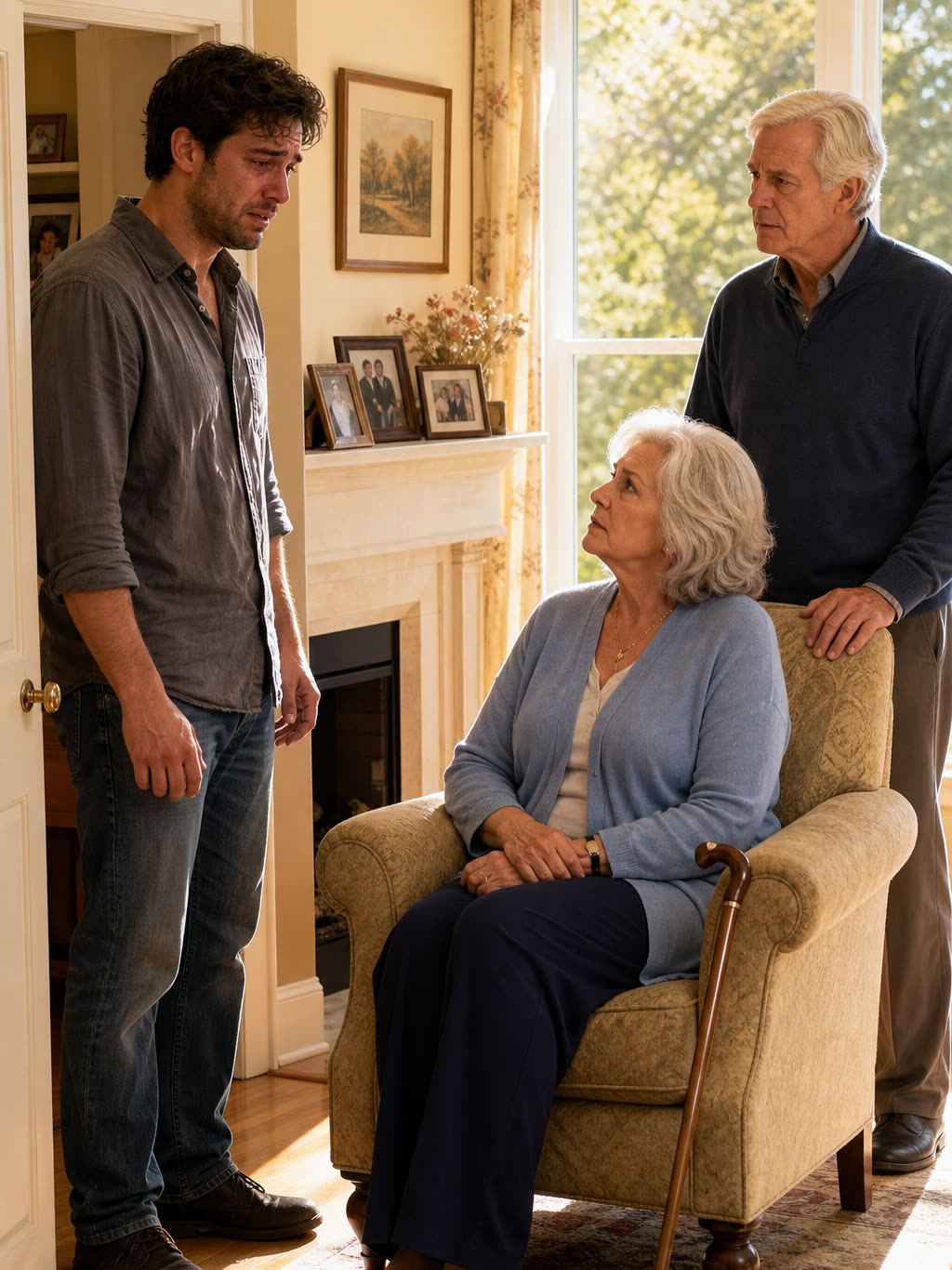
He looked exhausted. He wore jeans and a wrinkled shirt, and his face was that of a man who had spent several nights meeting himself.
Margaret opened the door but did not step aside.
“Is she with you?”
“No.”
“Are you here because she sent you?”
“No.”
“Are you here because your father stopped payment?”
Daniel swallowed. “No.”
Only then did she let him in.
He stood in our living room, the same room where he had opened Christmas presents, studied for exams, and called us on the night he passed the bar. He looked at the family photographs on the mantel. In most of them, Margaret stood beside him, smiling with the quiet pride of a mother who had never required acknowledgment for her devotion.
“I lied,” Daniel said.
Neither of us spoke.
“I saw her push you,” he continued, his voice breaking. “I knew exactly what happened. And I tried to make it into an accident because I didn’t want the wedding to fall apart.”
Margaret sat down in the armchair by the window. “Did you think I fell apart instead?”
Daniel covered his face.
“Yes,” he whispered.
That was the first honest word.
Margaret looked at him for a long time. The clock on the mantel ticked, and the afternoon light moved slowly across the carpet.
“Then begin with what does not happen next,” she said. “You do not bring contempt into this house. You do not ask your father for money while pretending respect is optional. And you do not call me when you need comfort if you cannot call me when I am humiliated.”
Daniel nodded. Tears ran down his face.
“I’m sorry, Mom.”
Margaret’s eyes filled, but she did not rush. Easy forgiveness would have taught him nothing except that pain could be erased with the right words.
“I hear you,” she said. “Now live differently.”
The marriage license had been signed, so the wedding was legal, but the reception had ended early. Half the guests left before dinner. The band packed up by nine. The cake was never cut. Richard Caldwell paid the staff and took his wife home. Vanessa stayed at a hotel that night and posted nothing online, which, for her, was nearly an admission.
By autumn, Daniel filed for separation.
He came by every Sunday after that. Not for money, and not for help, but to repair what he could. Sometimes Margaret let him cook dinner with her. Sometimes she kept the visits short. Trust returned unevenly, the way grass grows back over damaged ground, in patches, slowly, and never quite in the same pattern as before.
I watched it happen from my chair, saying little. Some healing cannot be hurried by a father’s hand, and the wisest thing I did all that year was to stay out of its way.
One year after the wedding, Daniel arrived carrying a garment bag. Inside was Margaret’s blue dress, professionally cleaned and restored as far as it could be. A faint shadow lingered near the hem where the worst of the mud had been, but the dress was wearable again.
“I know it doesn’t fix it,” he said.
Margaret touched the fabric.
“No,” she said. “But it tells me you remember.”
That evening, the three of us ate dinner on the back porch. Nothing dramatic happened. There were no grand speeches and no perfect ending. There was only grilled chicken, summer corn, and iced tea, and a son helping his mother carry plates to the kitchen without being asked.
Sometimes justice is not loud.
Sometimes it is a microphone, a stopped band, a room full of witnesses, and one sentence that finally says what silence has protected for too long.
And sometimes the real ending comes later, quietly, on a back porch in the fading light, when the people who were hurt discover they no longer have to pay for peace with their own dignity.
And that, in the end, is worth more than eighty-four thousand dollars.
It is worth everything.
Disclaimer: This story is a work of fiction inspired by real-life themes. Names, characters, places and events are fictionalized, and any resemblance to real persons is purely coincidental. Images are for illustration purposes only.
