

PART 1
My name is Laura Hartley, and thirteen years had passed since I last stood in the same room as Michael.
I spotted him at the registration desk.
Rebecca stood beside him, perfectly composed, their son in a blazer from an expensive private school.
Michael saw me.
“Laura?”
For one brief second he looked stunned.
Then his face went cold.
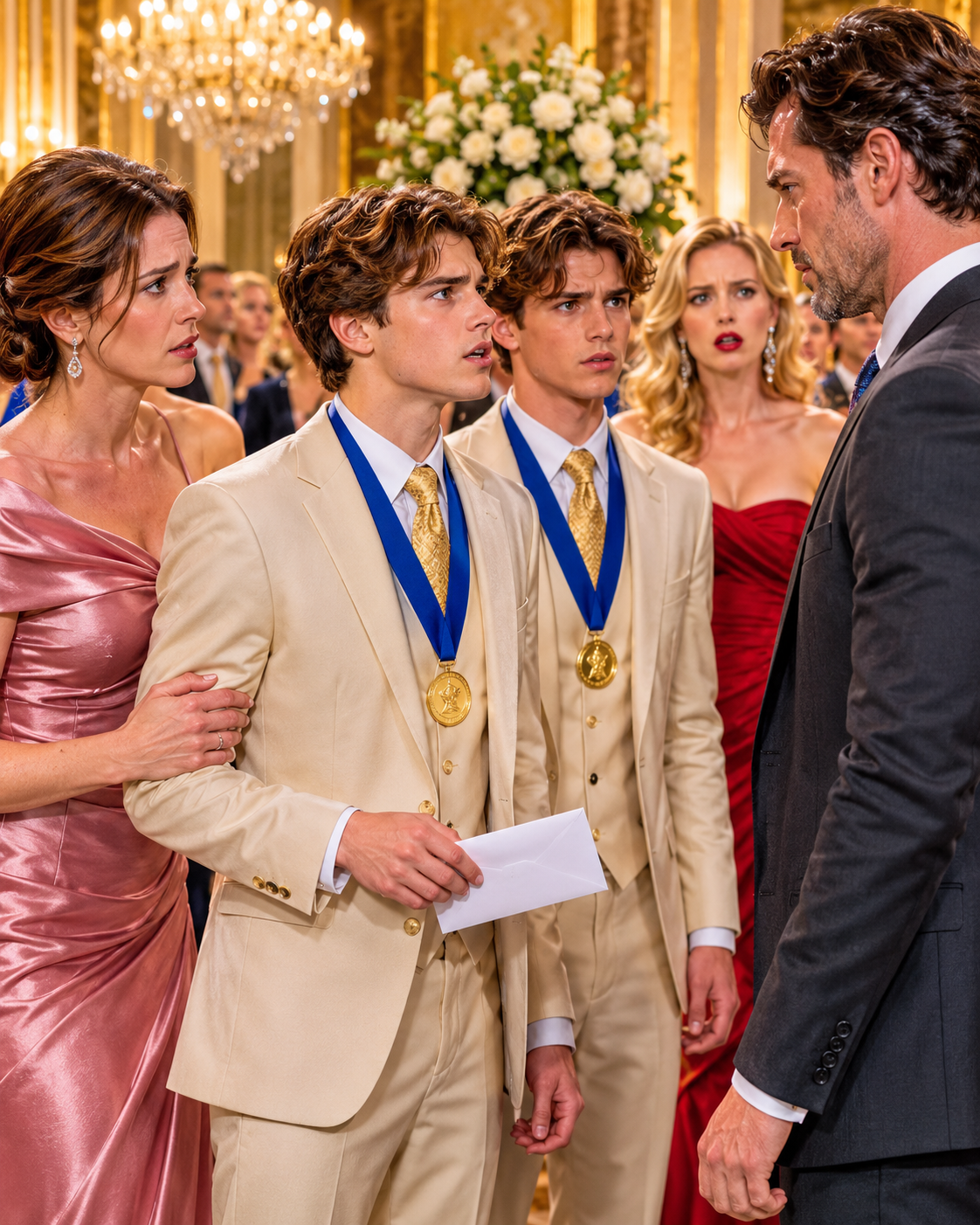
“What are you doing here?”
Rebecca stepped closer, the faint smile never leaving her mouth.
“This is a private event.”
“It’s a state competition,” I said. “It’s literally in the name.”
Michael lowered his voice.
“How dare you come here today.”
A few people nearby heard him.
What he never noticed were the two seventeen-year-old boys standing a few feet behind me.
Or maybe he saw them and simply failed to recognize them.
The last photograph Michael had ever seen of our twins was taken at their christening.
“I’m here for my children,” I said.
He laughed.
“Your children?”
His eyes moved over the boys and registered nothing.
“This weekend matters to our son.”
“It matters to mine too.”
I refused to argue further.
Thirteen years of birthdays, doctor visits, science fairs, school plays, late-night homework, and ordinary dinners stood between us.
“Come on, boys,” I said. “Registration closes in ten minutes.”
As we walked away, one of my sons asked quietly, “Mom, that was him, wasn’t it?”
“Yes.”
“Our dad?”
“Yes.”
Neither of them spoke again.
I thought they were in shock.
I was wrong.
At four o’clock the awards ceremony began.
When the announcer called the applied mathematics category, my first son’s name filled the auditorium.
Gold medal.
I had barely drawn breath when physical sciences was announced.
My other son took gold as well.
Then another announcement followed.
He had earned the highest raw score in the entire state.
Two brothers.
Two gold medals.
One shared surname.
I looked back at Michael.
He sat several rows behind me.
I watched the realization move across his face.
First he heard the name Hartley called twice.
Then he saw both boys stand.
Finally my second son walked onto the stage and smiled toward me.
He looked exactly like Michael.
The same eyes.
The same jawline.
The same expression.
A man nearby leaned toward his wife.
“Who are those boys?”
She glanced at the program.
“The Hartley twins. Their mother raised them alone.”
Then, loudly enough for our entire section to hear, she added, “Honestly, she deserves an award too.”
Michael heard every word.
His face changed.
That morning he had walked past his own sons without knowing them.
Now the boys he had left behind stood among the top students in the state.
One of them had just outscored every other competitor there—including the son Michael had actually come to support.
My son stepped down from the stage.
Instead of walking toward me, he turned.
He walked straight to Michael.
Michael rose slowly.
My son stopped in front of him, the gold medal still around his neck.
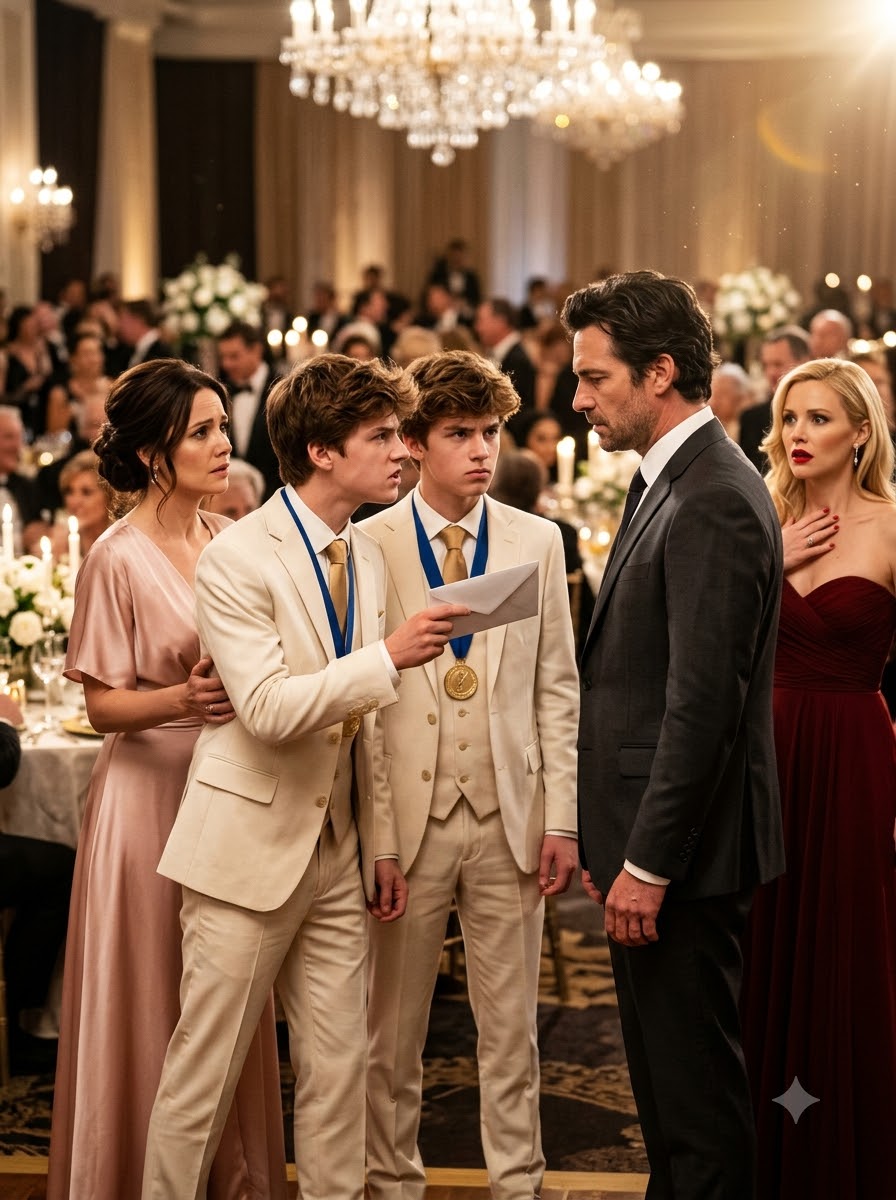
He reached into his jacket and took out an envelope.
“Dad,” he said quietly.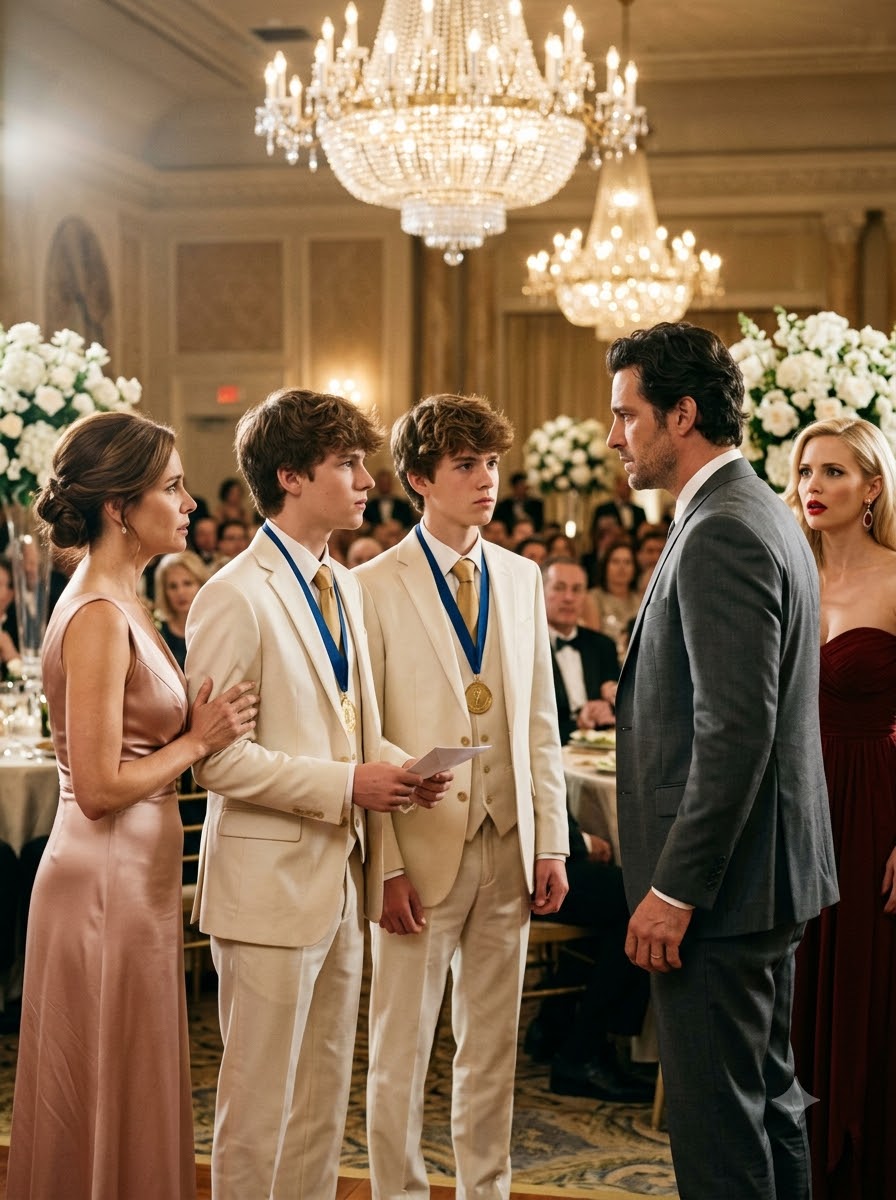
The word landed in the space between them like a dropped plate. Michael’s mouth opened, then closed. Rebecca’s hand tightened on the arm of their son—Connor, sixteen, who had finished somewhere in the middle of the pack and was still wearing the plastic lanyard from the morning session. Around them the auditorium continued its polite applause for the next category, but in our little pocket of seats the air had gone thin.
“What is that?” Michael asked. His voice came out lower than he intended.
PART 2
My son—Daniel, the one with the highest raw score—did not answer at once. He held the envelope out. It was ordinary white, the kind you buy in a pack of twenty at the drugstore. His twin, Ethan, had stopped a few feet behind him, gold medal catching the stage lights. Ethan’s hands were in his pockets. He was watching Michael the way he watched a hard problem on a practice exam: patient, measuring, already three moves ahead.
Daniel said, “We thought you might want these.”
Michael took the envelope. His fingers left a slight damp mark on the paper. He opened it. Inside were three photographs and a single sheet of lined notebook paper.
The first photo was the christening picture he remembered—two infants in white gowns, Laura in a green dress, himself in a suit he no longer owned. The second was a school portrait from third grade: two boys with the same cowlick, same gap-toothed smile, same navy polo. The third was taken last spring on the front steps of our house. Daniel and Ethan in button-downs, taller than me by half a head, the late-afternoon light turning their hair the exact shade Michael’s had been at that age. On the back of the third photo, in neat block letters, someone had written the date and the address of the house Michael had never visited.
The notebook page was covered in two different handwritings. One column listed every science fair, math olympiad, robotics tournament, and honor-roll semester from kindergarten through junior year. The other column listed every birthday, Christmas, and Father’s Day that had passed without a card, a call, or a check. At the bottom, in Daniel’s tighter script, a single line: *We stopped waiting when we were nine.*
Michael stared at the paper until the lines blurred. When he looked up, Daniel was still standing there, medal resting against his chest.
“I didn’t know,” Michael said.
“You knew we existed,” Ethan said from behind his brother. His voice was calm. “You just decided that was enough.”
Rebecca stepped forward. “This is not the place—”
“It’s exactly the place,” I said. I had not moved from my seat, but my voice carried. A few heads turned. The woman who had spoken earlier about the program was watching openly now. “They earned the right to stand here. You don’t get to decide the conversation ends because it’s inconvenient.”
Connor shifted, looking between his father and the two older boys who shared his eyes and none of his last name. Michael’s last name was on Connor’s birth certificate. Hartley had never appeared on any document Michael signed after the divorce papers.
Daniel reached into his other jacket pocket and pulled out a second, smaller envelope. This one he did not offer. He simply held it so Michael could see the return address: the county child-support enforcement office.
“We paid for the competition fees ourselves,” Daniel said. “Mom’s car needed tires last month. Ethan’s laptop died in March. We worked the summer at the warehouse on Route 9 and the tutoring center downtown. You can keep the first envelope. This one we already sent. They’ll be in touch.”
Michael’s face had gone the color of the program in his hand. “You can’t just—”
“We can,” Ethan said. “Mom never asked. We did. When we turned sixteen we looked up the statutes. Unpaid support doesn’t vanish because someone moves two states away and changes their phone number.”
A low murmur moved through the nearby rows. The announcer onstage was still calling names, but the people closest to us had stopped clapping. Rebecca’s composure finally cracked; she whispered something sharp to Michael that I couldn’t catch. Connor looked at the floor.
Daniel folded the support envelope and put it back in his pocket. “We’re not asking you to come to dinner. We’re not asking you to explain why you left. We already know why. You wanted a life that didn’t include diapers and night shifts and a wife who stopped pretending the marriage was working. Fine. You got it. What you don’t get is to stand in this building and act like we walked in here to ruin your afternoon.”
He turned then, not dramatically, just decisively, and walked back toward me. Ethan followed. When they reached our row I stood and the three of us moved into the aisle. Behind us Michael remained on his feet, the photographs still in his hand, the notebook page fluttering once as the air from the stage vents caught it.
We did not stay for the rest of the ceremony. Outside the auditorium the late-autumn light was already thinning. Ethan drove. Daniel sat in the passenger seat and rolled the window down an inch, letting the cold air in. I sat in the back with the two gold medals in my lap, the ribbons still warm from their necks.
For the first twenty minutes no one spoke. Then Ethan said, “He looked smaller than I remembered.”
“You were four,” I said. “Everyone looks big when you’re four.”
Daniel rested his head against the window. “Connor knew. Or he suspected. He kept looking at us during the morning session like he was trying to solve a puzzle.”
“Are you all right?” I asked.
“Yeah,” Daniel said. “We practiced what we were going to say. We just didn’t know if we’d actually say it.”
“You didn’t have to,” I told them.
“We did,” Ethan said. He changed lanes, checking the mirror out of habit. “Not for him. For us. So we wouldn’t spend the next ten years wondering what would have happened if we’d stayed quiet.”
We stopped at the diner on the edge of town, the one with the cracked red booths and the pie case that always smelled like cinnamon even when it was empty. The boys ordered the same thing they had ordered after every competition since they were twelve: burgers, fries, chocolate milkshakes. I got coffee I didn’t finish. Between bites they told me the rest of the scores. Daniel’s raw score had been fifty-three points higher than the next competitor. Ethan’s project on fluid dynamics had been the only one the judges asked to keep for the state science museum’s temporary exhibit. They argued, lightly, about whose medal looked heavier. They did not mention Michael again until we were back in the car and the highway lights had started to come on.
“Do you think he’ll call?” Ethan asked.
“I don’t know,” I said. “He might. Or he might convince himself the photographs were a stunt and the support letter will get lost in the mail.”
“If he calls,” Daniel said, “we don’t have to answer.”
“No,” I said. “You don’t.”
At home the boys hung the medals on the hooks by the back door, the same hooks that had held their backpacks for years. Ethan started the dishwasher. Daniel fed the dog. I stood at the kitchen sink and watched the last of the light leave the backyard. The maple tree had dropped most of its leaves; the twins had raked them last weekend and left a neat pile by the fence for the neighbor’s kids to jump in. Ordinary things. The kind of things that had filled the thirteen years Michael had chosen not to see.
Later, after the boys had gone upstairs, I sat at the table with the program from the competition and a pen. On the blank back page I wrote the date and two lines:
*They already knew who they were.
Today he learned it too.*
I folded the program and slid it into the drawer with the old report cards and the hospital bracelets from the day they were born. Then I turned off the kitchen light and went to bed. In the morning there would be school, and work, and the ordinary noise of a house that had never needed anyone else to feel complete. The medals would still be on the hooks. The boys would still be theirs. And somewhere two states away a man would still be holding three photographs and a piece of notebook paper, trying to decide whether the life he had built was large enough to hold the truth he had spent thirteen years refusing to look at.
The phone did not ring that night. Or the next. When it finally did, three weeks later, Daniel let it go to voicemail. He played the message once for Ethan and me, then deleted it. Michael’s voice had been careful, almost formal. He said he wanted to talk. He said he was sorry. He said he hadn’t known how to come back.
Daniel set the phone on the counter and picked up his calculus book.
“We already know how the story ends,” he said. “We wrote it ourselves.”
Ethan nodded. Outside, the first real snow of the year began to fall, soft and steady, covering the driveway the boys would shovel in the morning before school. The house stayed warm. The medals stayed on their hooks. And the three of us stayed exactly where we had always been—together, accounted for, and finished with waiting.
