

PART 1
At exactly 8:17 p.m., I parked in my parents’ driveway on the outskirts of Denver and switched off the engine. Yet my thumb remained pressed against the steering wheel, as though some part of me was still unwilling to step outside.
The porch light shone against the fading spring evening. A cold breeze moved through the hedges. Through the windows came the sounds of music, the aroma of roasted garlic, and the unmistakable scent of lemon polish my mother always used when she wanted our home to look more expensive than it was.
Five years had gone by, but that house could still make me feel like a seventeen-year-old girl.
I checked my reflection in the mirror.
My hair was pulled back. I wore a plain jacket. No medals. No ribbons. Nothing that might explain the woman I had become to a family that had already decided I was a failure.
Tiffany opened the door with her phone raised.
“Oh my God. You really showed up.”
Behind her, Mom arranged her face into a welcoming smile for the guests.
“Five years,” she declared. “No photos. No news. We barely even knew where she was.”
It wasn’t true.
Tiffany had my emergency contact number, a secure mailing address, and the information I had supplied when Grandma became ill. I had trusted her with the limited details of my life that I was permitted to disclose.
Then her gaze fell on the insignia on my shoulder.
“So… that’s the rank you have?”
Laughter moved through the room.
Brad, the man Tiffany was preparing to marry, stepped beside her.
“You’re actually in the military? You really don’t seem like the type.”
Tiffany leaned against him, making sure they both remained visible in her livestream.
“Brad is the real deal. Leadership. Recognition. My sister just handles some small job at a base.”
Dad couldn’t bring himself to meet my eyes.
“Just make sure you don’t embarrass us tonight.”
I said nothing.
The celebration continued as though I were barely there.
Ice clinked against glasses. Brad discussed his promotions while Mom rested her hand proudly on his sleeve, behaving as if his professional achievements had already become part of our family’s reputation.
At 8:43 p.m., I heard my father’s voice from the hallway.
“Put your signature here, and we can finalize the transfer,” said an unfamiliar man.
The office door was slightly open.
I stepped inside.
Documents covered Dad’s desk: property-transfer forms, a notary acknowledgment, a county recorder cover sheet, and an inventory of assets bearing my grandmother’s name in the margin.
One page displayed a Jefferson County Recorder watermark. Another contained an empty signature line where my name had no business appearing.
Across the thickest collection of papers was a single word.
TRANSFER.
Mom folded her arms.
“It’s meant for Tiffany. You weren’t here. We needed to be realistic.”
Realistic.
Apparently, that was the word my parents had chosen to describe taking away something Grandma had left me.
I noticed another absence.
The silver-framed photograph of Grandma and me, taken the day I departed for deployment, no longer hung behind Dad’s desk.
Only a lighter rectangle on the wall marked where it had once been.
Anger surged through me so suddenly that I wanted to scatter every document across the floor and give Tiffany’s audience the dramatic confrontation she had been waiting for.
But I didn’t.
Instead, I photographed the paperwork.
The notary seal.
The signature lines.
The county watermark.
The stranger’s business card.
Even the empty space where Grandma’s photograph had hung.
Then I went back to the party.
Three heavy knocks struck the front door.
The music quieted.
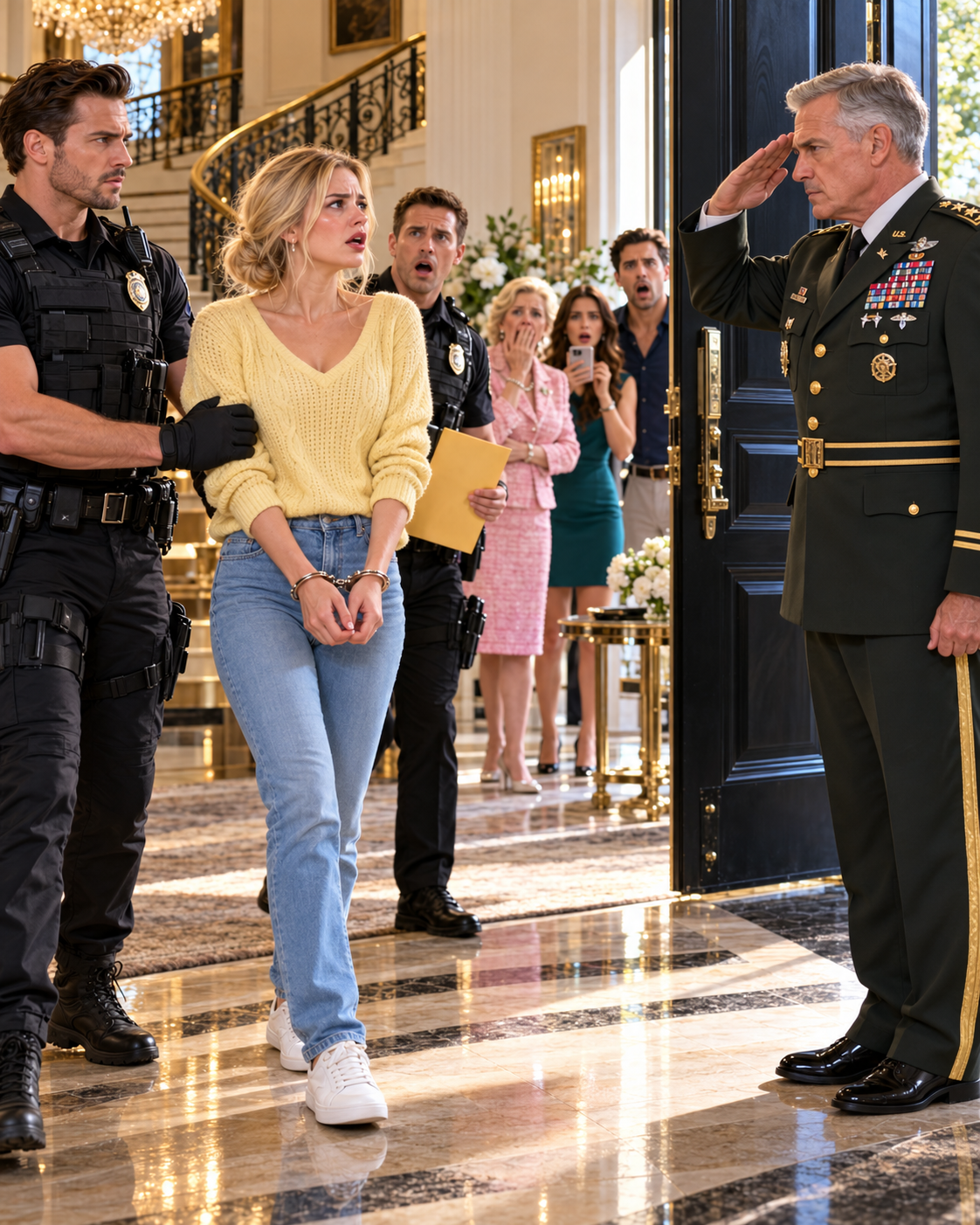
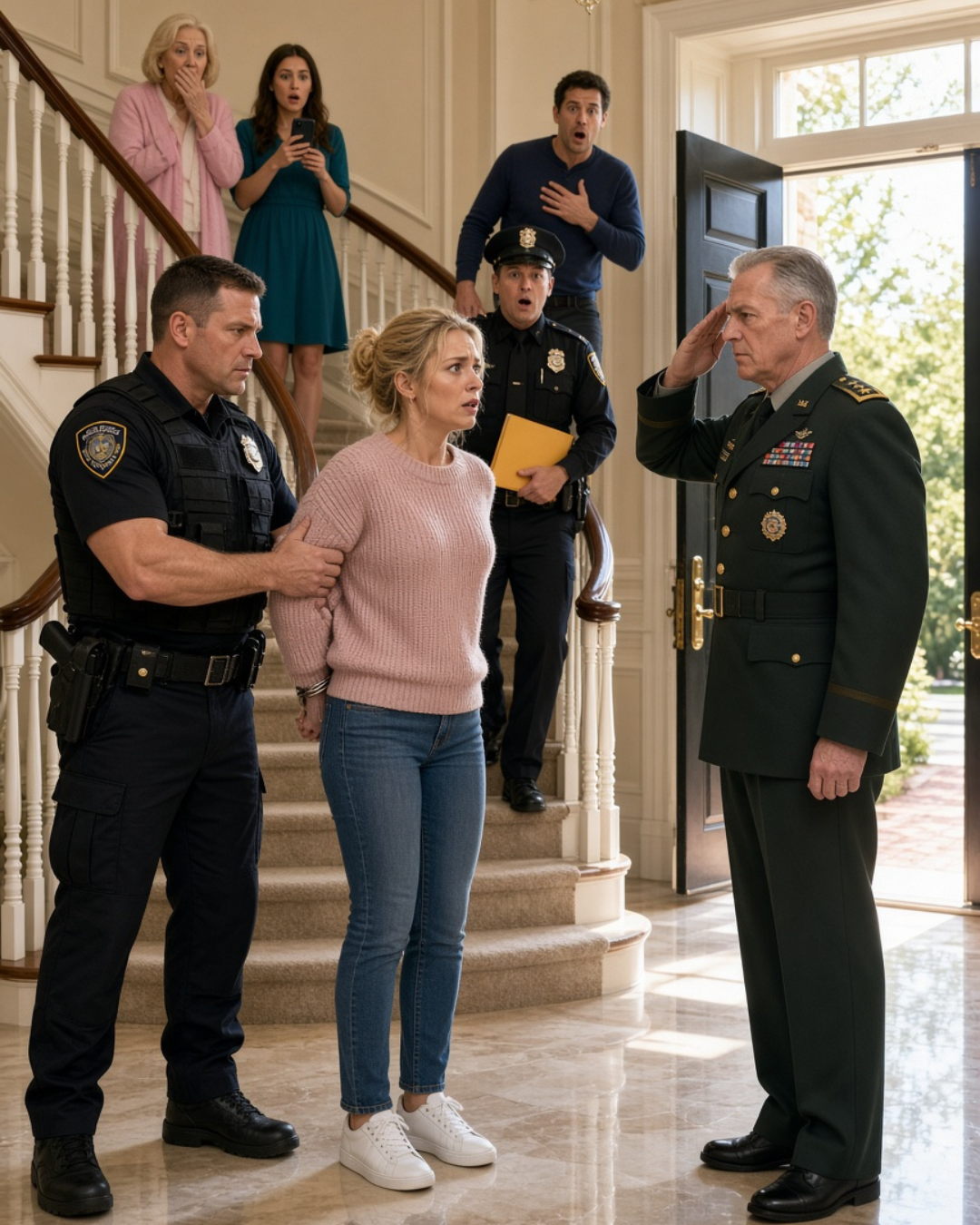
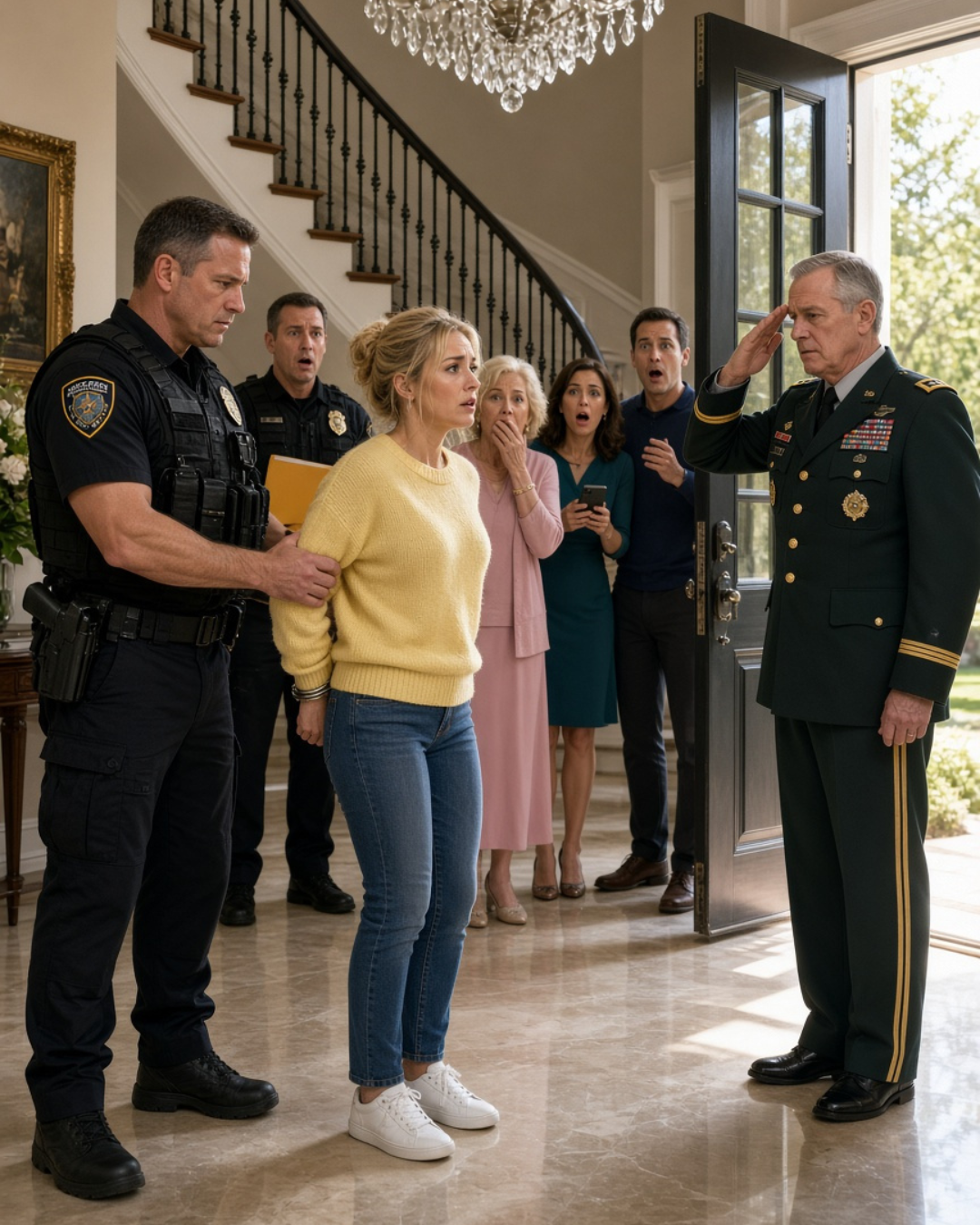
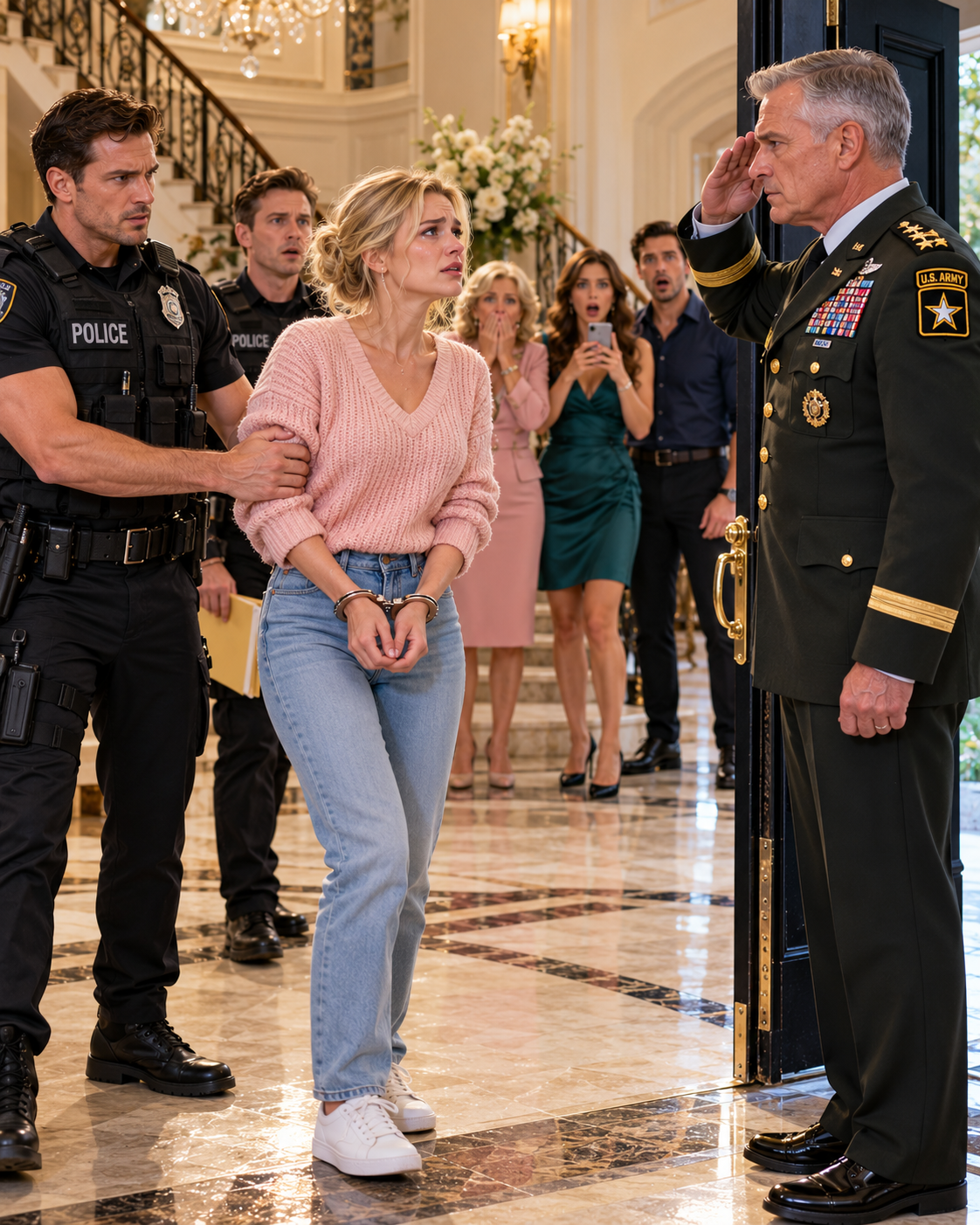
Two police officers entered. One held a folded complaint report. The other watched my hands.
Tiffany pointed at me immediately.
“Yes. That’s the one.”
My parents didn’t ask what I had supposedly done.
Neither questioned whether the accusation might be false.
Instead, relief appeared on their faces, as though the sight of me being arrested would finally prove everything they had believed about me.
One officer consulted his paperwork.
“Ma’am, we’re going to need you to come with us.”
I didn’t beg.
I didn’t offer excuses.
Static crackled from his radio.
Outside, headlights moved across the curtains.
A black SUV stopped beside the curb.
Then another arrived.
And another.
Tiffany was still livestreaming when the front door opened again.
A man in full military dress uniform stepped inside, four stars shining beneath the porch light.
His gaze traveled over the officers, the raised phones, the complaint report, and the paperwork visible through the open office door.
Finally, he looked at me.
He crossed the living room and stopped directly in front of me.
His hand rose toward the brim of his cap.
Both officers froze.
Brad’s confident expression disappeared.
Tiffany lowered her phone.
The four-star general turned toward the officers.
“Before anyone goes anywhere, I think there are a few facts everyone in this room deserves to understand.”
For a moment, nobody stirred.
Then he removed his cap and tucked it under his arm.
He hadn’t saluted me.
That distinction mattered.
He wasn’t staging a public display. He was simply observing the habits of a man who had spent more than four decades entering rooms with discipline.
The older officer spoke first.
“Sir, are you involved in this matter?”
“Not in the property matter.” The general’s voice was even. “And I have no jurisdiction over you.”
That answer seemed to confuse my family even more.
Tiffany lifted her phone again, though her confidence had clearly vanished. Her livestream continued, comments racing across the display.
Brad leaned toward her.
“Turn that off.”
She ignored him.
The general turned to me.
“Colonel Hale.”
Mom blinked.
Dad looked up.
Brad’s forehead creased.
Tiffany’s phone sank several inches.
The general continued.
“You were supposed to meet us at the hotel forty minutes ago.”
“I know, sir.”
“Your phone?”
“In the car.”
His gaze briefly moved toward the office.
“Complications?”
“Yes, sir.”
For nearly three years, I had worked alongside General Nathaniel Mercer.
He wasn’t the kind of commander who demanded explanations merely because an audience was present.
He gave a small nod before addressing the officers.
“My driver noticed the patrol vehicles when we came by. Colonel Hale had told my aide she was making a short family visit before joining us. When she didn’t answer, I came to make sure everything was all right.”
The younger officer looked at me.
“Colonel?”
“Yes.”
Tiffany gave a short laugh.
There was nothing joyful about it.
It was the sound of someone confronted with a reality she had never prepared herself to accept.
“You’re a colonel?”
I met her stare.
“Yes.”
“But you said—”
“I didn’t say anything.”
The truth settled over everyone.
She had invented the explanation herself.
So had the rest of them.
Mom stared at the subdued insignia on my jacket, almost offended that it hadn’t announced my position more dramatically.
Brad cleared his throat.
“Well, I mean, a colonel is—what, middle management?”
General Mercer regarded him calmly.
Not with anger.
Somehow, that made the moment worse.
“Something like that,” he said.
Brad stopped talking.
The older officer unfolded the complaint.
“Ma’am, we received a report regarding documents allegedly taken or copied without authorization and a disturbance inside the residence.”
“I took photographs,” I answered.
“Did you take any physical documents?”
“No.”
“Did anyone ask you to leave?”
“No.”
Dad looked down.
The officer noticed.
“Sir?”
My father hesitated.
Then the stranger from the office appeared behind him.
I had nearly forgotten the man existed.
He looked to be in his late fifties, with carefully combed gray hair and narrow glasses. His rigid posture suggested someone who had expected an uncomplicated appointment involving family paperwork and had instead stumbled into a disaster.
“I made the call,” he admitted.
Mom turned sharply.
“Dennis.”
He lifted both hands.
“Carol, she was photographing private documents. I had no idea who she was.”
“You could have asked,” I replied.
“I did ask your father.”
I looked at Dad.
The room became still.
He rubbed his jaw.
“I told him you were estranged from the family.”
Dennis shifted.
“You said she had no legal involvement in the estate.”
Dad’s expression hardened.
“That’s not exactly what I said.”
“It’s almost exactly what you said.”
“Dennis.”
Mom’s warning was unmistakable.
General Mercer stayed near the entrance.
He didn’t interfere.
That was one reason I respected him.
He understood that military rank wasn’t a universal source of authority.
It couldn’t resolve private family disputes.
It couldn’t override local law.
And it certainly couldn’t transform personal suffering into an official military matter.
The older officer looked back at me.
“Would you be willing to step outside and talk to us separately?”
“Yes.”
Tiffany interrupted.
“You’re just letting her go?”
The officer faced her.
“No one has been arrested.”
“But you said—”
“I said we needed her to come with us. I meant outside so we could speak without fifteen people talking at once.”
Several guests suddenly found their drinks fascinating.
Tiffany flushed.
Brad leaned closer.
“Turn the stream off.”
This time, she obeyed.
The quiet that followed felt strangely personal, as though everyone else had disappeared.
I accompanied the officers outside.
General Mercer remained indoors.
At first, that surprised me.
Then I realized he was intentionally allowing me to manage the situation without hovering over my shoulder.
The evening air had turned colder.
Beyond the neighboring rooftops, the mountains stood dark against the sky, with the last traces of snow barely visible.
The older officer introduced himself as Sergeant Alvarez.
His partner was Officer Chen.
Alvarez opened his notebook.
“Start from the beginning.”
I explained everything.
My arrival.
The party.
The voices from Dad’s office.
The documents I’d discovered.
The property-transfer paperwork.
The recorder forms.
Grandma’s asset inventory.
My name on documents nobody had ever shown me.
I offered him my phone.
“These are the photographs.”
He examined the images without touching the display.
Then he requested permission to scroll.
I agreed.
He moved slowly through the photographs.
His expression shifted when he reached the signature page.
“Is that your name?”
“Yes.”
“But not your signature?”
“No. That space is blank.”
He examined another image.
“What is this parcel?”
“I don’t know.”
“Your grandmother left property?”
“Yes.”
“What property?”
I glanced toward the house.
“That’s part of the problem.”
Nobody had ever given me a complete account.
Grandma had died eighteen months after my last visit home.
I was overseas at the time.
Not in combat, despite the stories Tiffany had apparently been telling her friends.
My assignments were less dramatic than people imagined and, in some ways, considerably harder to explain.
I worked with a joint planning group that traveled between Europe, the Middle East, and secure facilities in the United States.
Some months, I could call home regularly.
During others, I effectively disappeared from ordinary life.
When Grandma’s condition worsened, I was permitted to speak with her several times.
Our last conversation lasted eleven minutes.
I remembered all of it.
She sounded exhausted.
Her voice was weaker than I knew it.
But her mind remained sharp.
“Don’t let distance turn into absence, Evie.”
Only Grandma called me Evie.
“I’m trying.”
“I know.”
“I’ll get home.”
“You might not.”
I had shut my eyes in a windowless communications room thousands of miles away.
“Grandma—”
“That isn’t criticism. Life doesn’t schedule itself around our wishes.”
She coughed.
Then she said something I would replay countless times.
“I left you something that will ask a question of you.”
I smiled.
“What kind of question?”
“The kind money can’t answer.”
Back then, I assumed her medication had made her unusually philosophical.
Two weeks afterward, she was gone.
Mom told me settling the estate had been straightforward.
Grandma supposedly left personal possessions to relatives, some savings divided between Dad and his brother, and a few family heirlooms.
Nothing, I was told, required my participation.
Seven months later, a small package arrived.
Inside were Grandma’s silver compass, her handwritten peach cobbler recipe, and a birthday card she’d bought but never sent.
That was all.
Alvarez returned my phone.
“You never received estate documents?”
“No.”
“Did you sign a disclaimer? Waiver? Family settlement?”
“No.”
“You sure?”
“Yes.”
He nodded.
People sometimes questioned military officers twice to determine whether their certainty came from professional training or genuine recollection.
For me, it was both.
Officer Chen had remained silent until then.
“Do you have a lawyer?”
“Not for this.”
“You may want one.”
“That bad?”
“I’m not saying anything is criminal. But if your name is on an estate document you’ve never seen, and someone is preparing a transfer that requires your signature, you should have independent counsel review it.”
Her response was sensible.
Measured.
Free of accusations.
I appreciated it.
Alvarez glanced toward the house.
“As for tonight, there’s no basis for an arrest. The caller reported suspected theft of confidential documents. You photographed papers inside your parents’ home, but it appears at least some of those papers concern you personally. No physical documents were removed. No threat was alleged.”
He shut his notebook.
“The civil issues are another matter.”
“What happens to the complaint?”
“We document what we found.”
Then he added:
“You might also ask Mr. Dennis Vale why he was preparing paperwork involving you without contacting you.”
I intended to do exactly that.
We returned inside.
Most of the party had already dispersed.
Three guests were collecting their coats.
The music was off.
General Mercer stood by the fireplace speaking with Brad.
I nearly smiled.
Brad looked as though he were enduring the hardest oral examination of his life.
Mom approached Sergeant Alvarez.
“Well?”
“No arrest tonight, ma’am.”
Tiffany folded her arms.
“So that’s it?”
“For tonight.”
“But she went through Dad’s office.”
“I entered an open room after hearing my name discussed,” I replied.
“You photographed private things.”
“They had my name on them.”
“You always do this.”
The accusation came immediately.
Too immediately.
I stared at her.
“Do what?”
“Walk in after years away and suddenly everything revolves around you.”
There it was.
Something older than tonight’s livestream.
Older than Brad.
Older than the misunderstanding over my rank.
I wanted to list every phone call I’d attempted, every holiday when leave was denied, every email Tiffany had stopped answering after Grandma died.
Instead, I asked:
“Is that really what you think happened?”
She turned away.
Dad interrupted before she could answer.
“Enough.”
His voice sounded worn out.
Not commanding.
Simply tired.
“We’re not doing this tonight.”
I looked at him.
“Then when?”
He said nothing.
Dennis Vale stepped forward.
“Colonel Hale, I owe you an explanation.”
“That would be useful.”
He grimaced.
“I operate a title and document services firm. Your father contacted me about preparing a transfer for a property in Clear Creek County.”
“Not Jefferson County?”
“No. Jefferson County is where one of the affidavits would be recorded because your grandmother lived here at the time of her death. The property itself is west of Idaho Springs.”
I stared.
“What property?”
Mom sat down.
That worried me more than anything she’d said.
Dad gripped the back of a dining chair with both hands.
Dennis glanced between them.
“You haven’t told her?”
Dad remained silent.
Dennis took off his glasses.
“There’s an eighty-two-acre parcel near Chicago Creek. Mostly forested. An old cabin. A small amount of undeveloped land.”
Something stirred deep in my memory.
A green-painted porch.
Pine needles beneath the windshield.
Grandma singing badly along with the radio.
I had been eight.
Perhaps nine.
“Juniper Ridge?”
Mom shut her eyes.
My voice barely sounded like mine.
“Grandma sold that.”
“No,” Dad answered.
I faced him.
“You told us she sold it.”
“She almost did.”
“When?”
“Years ago.”
“But she didn’t?”
“No.”
The mountain cabin returned to me in vivid detail.
It had never been luxurious.
Cedar walls, uneven floors, two bedrooms, a stone fireplace, a tin roof, and a porch overlooking endless forest.
Every summer, Grandma took Tiffany and me there for a week.
We gathered wildflowers.
Burned marshmallows.
Played cards while thunderstorms rolled across the mountains.
Then, when I was eleven, those visits ended.
Mom said the drive had become too difficult for Grandma.
Later, Dad claimed she’d sold the property.
I believed him.
“Who owns it?”
The silence lasted too long.
Dennis finally answered.
“According to the probate documents I reviewed, ownership passed into a family trust.”
“What family trust?”
Dad sat down.
“The Eleanor Hale Family Trust.”
Grandma’s name.
My heartbeat quickened.
“Who is the beneficiary?”
Dad’s jaw tightened.
“Elena—”
“Who?”
Mom whispered:
“You and Tiffany.”
Tiffany turned sharply.
“What?”
And in that instant, I understood that my sister had been kept in the dark too.
Not about everything.
But about something important.
Her face went pale.
“What do you mean, me and Elena?”
Mom rose.
“Tiffany, this isn’t how we wanted—”
“You told me Grandma left the cabin to you.”
“I said it would eventually become yours.”
“No. You said it was yours.”
Dad looked at Dennis.
“You need to leave.”
Dennis seemed grateful for the opportunity.
“Yes. I think that’s probably best.”
Before leaving, he handed me his card.
“I’ll send you copies of everything I was provided, if you authorize an email address.”
“Tomorrow.”
“Of course.”
He paused.
“For what it’s worth, I was told your signature would be obtained before anything was recorded.”
I met his eyes.
“By whom?”
He looked from Dad to Mom.
“Both of your parents were present at our first meeting.”
Then he left.
The officers departed shortly afterward.
Sergeant Alvarez gave me a case number and repeated that, at this stage, the dispute appeared primarily civil.
When the door shut, silence filled the house.
General Mercer approached.
“We need to leave soon.”
“I understand.”
He glanced at my parents.
“Would you like five minutes?”
“Ten.”
“You have fifteen.”
That was Mercer.
Even his kindness came with room for operational adjustment.
He stepped outside.
Brad picked up his jacket.
“Tiff, maybe we should go too.”
“No.”
“Tiffany.”
“No.”
She faced me.
“For once I want to hear the whole thing.”
Mom touched her forehead.
“There is no conspiracy.”
“I didn’t say there was,” I replied.
Her eyes flashed.
“You’re thinking it.”
“I’m trying not to think anything until I know what happened.”
That silenced her.
I took a seat at the dining table.
Tiffany sat opposite me.
Dad remained at the head.
Mom stayed standing.
Nobody spoke for a while.
Finally, Dad said:
“Your grandmother made the trust six years before she died.”
“Why?”
“She wanted the land kept in the family.”
“Why Tiffany and me?”
“Because she thought you two loved it.”
Tiffany exhaled.
“We were children.”
“She remembered.”
I asked the question that mattered.
“So why were we never told?”
Dad rubbed his forehead.
“Because the trust gave your mother and me management authority until both of you reached thirty-five.”
My thirty-fifth birthday was nine days away.
I understood immediately.
“And then?”
“Then management passed to you and Tiffany jointly.”
Tiffany leaned back.
“You told me I could build there.”
Mom turned to her.
“You can.”
“How? If Elena owns half?”
“She hasn’t been home in five years.”
The words escaped Mom before she could stop them.
Everything shifted.
I suddenly understood the reasoning that had formed around my absence.
Because I hadn’t come home, they assumed I wasn’t involved.
Because I wasn’t involved, they decided I didn’t care.
Because I supposedly didn’t care, they felt entitled to make choices for me.
And after enough choices had been made, my return became a problem.
“What were the papers for?” I asked.
Dad stared at the table.
Tiffany answered.
“For my house.”
He looked up.
She turned toward him.
“Right?”
Dad sighed.
“Yes.”
Brad rested a hand on her shoulder.
She pulled away.
“You said the land was being transferred to me so Brad and I could build a house after the wedding.”
Mom stepped closer.
“That was the plan.”
“Without telling me I only owned half?”
“We were going to explain.”
“When?”
“After everything was settled.”
Tiffany gave a humorless laugh.
“That’s not explaining. That’s presenting me with a finished decision.”
I looked at my sister.
For the first time all evening, we were standing on the same side of something.
It felt strange.
Dad reached toward the documents.
“The plan was for Elena to sign a release of her interest.”
“You mean this?” I asked, displaying the photograph.
He nodded.
“You expected me to sign away forty-one acres of mountain property I didn’t know I owned?”
“It isn’t divided by acreage. You each have an undivided interest.”
“Dad.”
He exhaled.
“Yes.”
“Why would I sign?”
“Because you don’t live here.”
The answer hurt more than I expected.
Perhaps because he wasn’t trying to wound me.
He genuinely believed that was reason enough.
I surveyed the room where my family had spent years deciding what I felt without asking.
“You could have called.”
Mom folded her arms.
“We did call.”
“When?”
“Christmas two years ago.”
“You left a message asking when I’d be stateside.”
“You never responded.”
“I was in an operational blackout.”
“For three months?”
“Yes.”
“How were we supposed to know that?”
I started to respond.
Then stopped.
She was right about one thing.
They couldn’t know information I wasn’t allowed to share.
But my inability to explain my work didn’t account for everything.
“What about after that?”
Mom looked away.
“What about my secure mailing address?”
Silence.
“My emergency contact number?”
Dad’s expression tightened.
“Tiffany had it.”
I looked at my sister.
She stared back.
Confusion crossed her face.
Then recognition.
Then something resembling fear.
“Tiffany?”
She stood abruptly.
“I need my phone.”
Brad handed it over.
She began scrolling.
“What are you looking for?” Mom asked.
Tiffany didn’t answer.
Her thumbs moved faster.
Then stopped.
Her expression changed completely.
“What?”
I stood.
Tiffany looked straight at Mom.
“You told me this stopped working.”
Mom went still.
“What stopped working?”
“Elena’s emergency number.”
The room seemed to tilt.
Tiffany raised her phone.
“I tried it.”
“When?”
“After Grandma died.”
My voice dropped.
“You called?”
“Three times.”
I had never known.
Tiffany swallowed.
“The first time somebody answered and said you were unavailable but they could pass a family message.”
That was standard procedure.
“What did you tell them?”
“That Grandma’s funeral was Friday.”
My stomach tightened.
I had been informed of Grandma’s death.
But that particular message had never reached me.
Tiffany continued.
“The second time they said there was no message logged from me.”
I frowned.
“That shouldn’t happen.”
“I thought I’d done something wrong. So I called Mom.”
Every person in the room turned toward her.
Tiffany’s eyes filled, but her voice remained controlled.
“You said the number wasn’t really Elena’s. You said it was some general information line and that I should stop bothering strangers.”
Mom looked down.
For a moment, I forgot how to breathe.
“Mom?”
She pressed her lips together.
Dad whispered:
“Carol?”
He hadn’t known either.
Mom walked to the window.
General Mercer’s SUV waited outside beneath a streetlamp.
“I was angry,” she said.
Nobody answered.
She kept looking out.
“You had been gone so long. Your grandmother kept defending you. Every holiday, every birthday, every family dinner, it was always ‘Elena has important work’ and ‘Elena will come when she can.’”
Her voice grew thin.
“I was the one taking her to appointments. Your father and I were the ones handling the house and medications and doctors. Tiffany came every weekend. You were a voice on a telephone when it suited the government to let you call.”
My throat tightened.
“I know you took care of her.”
“No, you don’t.”
She turned.
She didn’t look furious anymore.
Only exhausted.
“That’s the problem. You know facts. You don’t know what those years felt like.”
I wanted to defend myself.
Every instinct I’d developed during my career urged me to present the chronology.
Orders.
Travel restrictions.
Denied leave.
Security requirements.
Those facts could explain nearly everything.
But they couldn’t explain away the loneliness of caring for a dying mother while a daughter remained thousands of miles away.
So I said:
“You’re right.”
Mom stared.
“But that doesn’t explain why you told Tiffany my number didn’t work.”
Her expression crumpled slightly.
“No.”
“Did you prevent her from contacting me?”
“I didn’t think—”
“Mom.”
She looked at me.
“Yes.”
The admission was barely audible.
That made it heavier.
Dad pushed his chair back.
“Carol.”
“I was angry!”
“For five years?”
“No. For one terrible month.”
“Then why didn’t you fix it?”
She couldn’t answer.
I turned toward Tiffany.
My sister was crying quietly now.
She wiped her cheek with the heel of her hand.
“I thought you ignored me.”
“I didn’t.”
“I sent you pictures from the funeral.”
“I never got them.”
“I wrote you this huge message.”
My eyes burned.
“I never got it.”
She stared as if the past five years had been rearranged before her.
“And you thought I stopped writing?”
“Yes.”
We both turned toward Mom.
She shook her head.
“I never touched your phones.”
“Then what happened?”
“I don’t know.”
Brad spoke from the doorway.
“Maybe we should actually check before deciding.”
Everyone looked at him.
He seemed embarrassed.
“I work in corporate compliance,” he said. “Not inheritance law. But when communication gets disputed, you don’t argue from memory. You pull records.”
I had underestimated him.
Not because he had impressed me earlier.
Because I had already accepted Tiffany’s description of him as the whole truth.
The irony wasn’t lost on me.
I collected my bag.
“I have to go.”
Tiffany looked startled.
“Now?”
“I have an official dinner.”
She glanced outside.
“With him?”
“Yes.”
She looked almost offended by the absurdity.
“Why didn’t you tell us any of this?”
I met her gaze.
“You never asked.”
The words were harsher than I intended.
I regretted them immediately.
Her face closed.
I took a breath.
“That isn’t entirely fair.”
She waited.
“I didn’t tell you either.”
Something softened between us.
Not everything.
But something.
I headed toward the door.
Dad followed.
“Elena.”
I stopped.
He looked older beneath the porch light.
“I wasn’t planning to forge your signature.”
“I didn’t say you were.”
“I need you to know that.”
“I do.”
“We thought you would agree.”
“That’s part of what worries me.”
He accepted the answer without argument.
I went outside.
General Mercer stood beside the SUV.
“You all right?”
“No.”
He nodded.
“Fair enough.”
He opened the rear door.
Before I could climb inside, Tiffany called out.
I turned.
She stood barefoot on the porch, arms wrapped around herself against the cold.
“I found something.”
I walked back.
She showed me her phone.
An old email account was open.
Grandma’s name appeared in the search results.
“I was looking for the messages I sent you after the funeral.”
I examined the screen.
“And?”
“I found this instead.”
The email was dated eight days before Grandma died.
Its subject line read:
FOR BOTH MY GIRLS. DO NOT LET YOUR PARENTS ANSWER THIS FOR YOU.
Tiffany’s hand trembled.
“I never opened it.”
“Why not?”
“It went to spam.”
I looked at her.
“Can you open it?”
She did.
The message contained only three sentences.
Evie and Tiff,
The mountain does not belong to the one who stays or the one who leaves. It belongs to the two people willing to decide together what home should mean.
There is one more envelope. Ask Harold.
I read the final line again.
“Who’s Harold?”
Tiffany shook her head.
“I have no idea.”
Then Dad spoke from behind us.
“I do.”
We turned.
He stood in the doorway.
And his expression told me that the eighty-two acres weren’t the only secret Grandma had left behind.
PART 2
My father offered no explanation about Harold that evening.
He said he wanted to tell us.
Then he admitted he couldn’t.
Those two statements, spoken together, revealed something fundamental about our family.
For years, we’d confused hesitation with deception.
Silence with indifference.
Distance with rejection.
And confidence with the truth.
I left with General Mercer at 9:38 p.m.
As the SUV pulled away, Tiffany remained under the porch light, Grandma’s email still open on her phone.
I watched her reflection become smaller in the tinted window.
Mercer sat across from me.
Neither of us spoke until we reached the highway.
Then he asked:
“Family?”
“Apparently.”
“Complicated?”
“Apparently.”
He nodded.
“That has been my experience.”
I nearly laughed.
Instead, I leaned back and closed my eyes.
The official dinner was nothing like the event my family might have imagined.
There was no magnificent ballroom packed with generals waiting to applaud me.
No secret medal.
No grand announcement.
It was a working dinner at a downtown Denver hotel, attended by eight people preparing for a joint planning conference the following morning.
General Mercer wore dress uniform because he’d just attended an event for a veterans foundation.
I’d chosen a simple service jacket because I expected to change at the hotel after visiting my parents.
Within the military, my rank mattered.
Outside it, rank was simply one part of my profession.
I hadn’t concealed it from my family out of embarrassment or secrecy.
I’d stopped trying to explain because every conversation eventually became a comparison.
Tiffany earned more.
Tiffany had purchased a condo.
Tiffany was engaged.
Tiffany had been promoted.
Why was I always “moving around”?
Why didn’t I own a home?
Why couldn’t I settle somewhere?
Wasn’t I getting too old for “temporary assignments”?
Eventually, saying nothing became easier.
That evening, I learned what silence could cost.
At 11:12 p.m., while I reviewed briefing notes in my hotel room, Tiffany texted.
Are you awake?
I stared at the message.
Then answered.
Yes.
Three dots appeared almost immediately.
Dad told me who Harold is.
I waited.
Grandma’s lawyer.
Another message followed.
He’s alive.
Then:
And Dad says Harold has something Grandma refused to put in the trust file.
I called her.
She answered immediately.
“Hi.”
“Hi.”
Such a strange greeting between sisters who had once stayed awake until two in the morning talking about absolutely nothing.
“Where are you?” I asked.
“At home.”
“Mom and Dad’s?”
“No. Mine.”
I heard a door close.
“Brad?”
“In the kitchen.”
“You okay?”
“No.”
“Same.”
She gave a small laugh.
For several seconds, neither of us said anything.
Then she spoke.
“Dad gave me Harold’s number.”
“Did you call?”
“I left a voicemail.”
“What exactly did Dad say?”
“That Grandma used Harold Levin for estate planning for years. Apparently the trust documents we saw were done by another firm after Harold retired.”
“Why?”
“Dad says Harold and Grandma had an argument.”
“About what?”
“He claims he doesn’t know.”
“You believe him?”
“I don’t know what I believe right now.”
I looked out at the lights of Denver.
Five years earlier, Tiffany’s uncertainty would have frustrated me.
She had always preferred immediate judgments.
Instant loyalties.
Instant villains.
Now, however, I heard something different.
She was trying not to repeat our family’s mistakes.
“Good,” I said.
“What?”
“Not knowing.”
“That’s good?”
“Sometimes.”
“You really did turn into a military fortune cookie.”
I laughed.
The sound surprised us both.
Tiffany went quiet.
“Elena?”
“Yeah?”
“I’m sorry about tonight.”
“For what part?”
“Most of it.”
“That’s broad.”
“I had five years to build material.”
I smiled.
Then she added:
“I meant what I said, though.”
“Which part?”
“That it felt like you walked away.”
I closed my eyes.
“I know.”
“Do you?”
“I do now.”
She fell silent.
I continued.
“I thought giving you the secure contact number was enough. I thought sending birthday gifts was enough. I thought because my reasons for being unavailable were legitimate, everybody would understand.”
“We didn’t.”
“I know.”
“I thought you didn’t care.”
“I cared so much that sometimes I avoided calling because I hated hearing everything I was missing.”
She drew in a breath.
“You could have said that.”
“Yes.”
“So could I.”
“Yes.”
The next silence felt easier.
At 7:10 the following morning, Tiffany texted.
Harold called. He wants both of us there. 4 p.m. Golden.
My conference session finished at three.
I requested personal time.
General Mercer approved it without asking for an explanation.
But as I approached the door, he called after me.
“Hale.”
I turned.
“Sir?”
“Whatever rank you are in that house, remember it probably isn’t colonel.”
I smiled.
“No, sir.”
“What is it?”
I thought of Tiffany.
“Older sister.”
“Harder job.”
“Some days.”
Harold Levin’s office occupied the floor above a bookstore in downtown Golden.
The building looked older than any of us.
A brass directory beside the stairs still listed his law practice.
A smaller plaque read:
SEMI-RETIRED — APPOINTMENT ONLY
Tiffany was waiting when I arrived.
Brad sat beside her.
I paused.
She noticed.
“He drove.”
Brad stood.
“I can leave.”
“No.”
He looked surprised.
“If Grandma intended this for both of us,” I said, “and Tiffany wants you here, stay.”
Tiffany gave me a grateful glance.
Harold Levin opened the office door.
He was eighty-one, thin, with unruly silver hair and glasses hanging from a cord around his neck.
He studied us.
“Elena?”
“Yes.”
“Tiffany?”
“Yes.”
He sighed.
“You look nothing alike.”
We glanced at each other.
“That’s what Grandma used to say,” Tiffany answered.
Harold’s expression softened.
“Come in.”
His office smelled of paper, coffee, and old dust warmed by sunlight.
Legal books lined the walls.
Photographs occupied the remaining spaces.
One immediately caught my attention.
Grandma stood beside Harold at what appeared to be Juniper Ridge.
She looked younger.
Perhaps sixty.
She wore hiking boots and held a hammer.
“What were you building?” I asked.
Harold followed my gaze.
“A porch rail.”
“You knew the cabin well?”
“I helped your grandmother buy it.”
I turned.
“My parents said it had been in the family.”
“It had not.”
Tiffany frowned.
“When did she buy it?”
“Nineteen ninety-eight.”
“Why?”
Harold smiled faintly.
“For you.”
We both stared.
He gestured toward the chairs.
“Sit down.”
Harold retrieved a folder from a small fireproof safe with chipped paint.
Nothing dramatic.
Just an old office safe.
He placed the folder between us.
“Your grandmother purchased Juniper Ridge after your grandfather died. She wanted a place where the family would have to be together without televisions in every room.”
“There was a television,” Tiffany said.
“It received one channel.”
“Exactly.”
Harold smiled.
“She believed inconvenience built character.”
“That sounds like her,” I said.
He opened the folder.
Copies of the original trust agreement lay inside.
“I drafted the original.”
“What happened between you and Grandma?” I asked.
His smile faded.
“She changed one provision.”
“Which?”
“The management clause.”
He turned several pages.
“Originally, after her death, your father was to serve as trustee until both of you turned thirty.”
“Thirty?” Tiffany repeated.
“Yes. Eleanor later extended it to thirty-five.”
“Why?”
Harold leaned back.
“That was our disagreement.”
I waited.
“She became concerned that the two of you would be living very different lives by thirty. She believed additional time would give you both perspective.”
“That doesn’t sound worth ending a relationship with her lawyer.”
“It wasn’t.”
“Then what was?”
He folded his hands.
“I told your grandmother she was using the trust to solve an emotional problem.”
I frowned.
“What problem?”
“Her fear that this family would eventually divide into people who stayed and people who left.”
Grandma’s email echoed in my mind.
Harold continued.
“Your grandmother saw it happening before the rest of you did. Your mother resented the military because it kept Elena away. Your father resented conflict and avoided conversations. Tiffany—”
My sister raised an eyebrow.
“Yes?”
“You wanted everyone in the same room.”
Her expression softened.
“And Elena wanted everyone to understand why she couldn’t be.”
I looked away.
It was uncomfortable to hear our lives described so accurately.
“I told Eleanor a property trust should not be used to force reconciliation. She told me I was an unimaginative old goat.”
Brad coughed to conceal a laugh.
Harold looked at him.
“She was correct about the goat part.”
“So you stopped representing her?” I asked.
“No. I retired.”
“Oh.”
“She took it personally.”
That sounded exactly like Grandma.
Harold opened a second folder.
“Six months before she died, she called me.”
He took out two sealed envelopes.
One bore my name.
The other Tiffany’s.
Grandma’s handwriting.
I reached toward mine, then hesitated.
“Have you read these?”
“No.”
“Dad knows about them?”
“He knows they exist.”
“Mom?”
“I don’t believe so.”
Tiffany touched her envelope.
“Why didn’t you send them?”
Harold appeared embarrassed.
“Because your grandmother gave me instructions I considered sentimental and inconvenient.”
I almost smiled.
“What instructions?”
“Both granddaughters had to be physically present.”
Tiffany stared.
“She knew I was overseas.”
“She knew.”
“So she was willing to let these sit here indefinitely?”
He nodded.
“She said if the two of you never sat in the same room again, then the letters would have no purpose.”
I looked at my sister.
Neither of us moved.
Finally, Tiffany asked:
“Together?”
“Seems appropriate.”
We opened the envelopes.
Mine contained three pages.
Hers had four.
For several minutes, only paper rustled.
Grandma didn’t begin with the property.
She began with us.
She reminded me of the summer I taught Tiffany to swim in Clear Creek, even though I was only two years older and barely capable of teaching anyone.
She reminded Tiffany of the six hours she’d spent beside my hospital bed after my appendix was removed because she’d overheard a nurse say I might wake up frightened.
Then I reached a sentence that stopped me.
You girls have always misunderstood the shape of courage in each other.
I read it twice.
Evie thinks courage means leaving when duty calls.
Tiff thinks courage means staying when people need you.
Both are right, and both can become foolish if taken too far.
My vision blurred.
I continued reading.
Leaving can become a way to avoid explaining yourself.
Staying can become a way to believe you are entitled to decide for everyone.
I glanced at Tiffany.
She had stopped at the corresponding section of her letter.
Grandma had chosen different examples.
But the message was the same.
Tiffany looked up.
“She really didn’t miss much.”
“No.”
“She was terrifying.”
“Yes.”
Harold smiled.
“She enjoyed that reputation.”
The final page addressed Juniper Ridge.
Grandma didn’t insist the land remain undivided forever.
Nor did she insist we preserve it.
She wanted us to choose.
We could sell.
Keep it.
Build on it.
Donate part.
Or arrange for one sister to buy out the other.
Nothing was forbidden.
There was only one condition.
Both of us had to understand exactly what we owned before deciding.
One sentence was underlined.
Neither of you is allowed to inherit a choice somebody else made on your behalf.
I sat quietly.
Then looked at Harold.
“The documents at my parents’ house would transfer my interest to Tiffany.”
“Yes.”
“Could they do that without me?”
“No.”
“Could they transfer the entire parcel?”
“Not lawfully without your consent after you reach thirty-five. Before then, the trustee has limited management authority, but not the authority to simply extinguish your beneficial interest.”
“So why did Dennis prepare those papers?”
Harold tightened his mouth.
“I cannot speak to documents I have not reviewed.”
I showed him the photographs.
He examined each one.
“These appear to be preliminary documents.”
“That’s what Dennis said.”
He stopped at one page.
“Interesting.”
“What?”
“This is not a deed.”
“I know.”
“It is a consent to modification of trust property.”
“What does that mean?”
“It would allow subdivision and construction planning before the trust terminates.”
Tiffany leaned closer.
“For my house?”
“Possibly.”
He examined another page.
“This one is more consequential.”
My signature line waited at the bottom.
Harold frowned.
“It appears to provide that Elena would receive a fixed cash payment in exchange for disclaiming future management rights.”
“How much?”
The compensation page wasn’t in my photographs.
Harold turned to Tiffany.
“Were you told?”
“No.”
He checked the documents again.
“There should be an exhibit.”
“There wasn’t one on Dad’s desk.”
Brad spoke.
“Could it have been separate?”
“Yes.”
I called Dad.
He answered reluctantly.
“Where are you?”
“With Harold.”
Silence.
I continued.
“There’s an exhibit missing from the transfer documents.”
Another pause.
“Dad?”
“I know.”
“What does it say?”
He sighed.
“I’d rather explain in person.”
“No.”
“Elena.”
“Read the number.”
Tiffany watched me.
Dad finally answered.
“Two hundred thousand.”
My sister straightened.
“What?”
I switched to speakerphone.
“Dad, Tiffany is here.”
“Oh.”
She leaned forward.
“You were going to give Elena two hundred thousand dollars?”
“In exchange for her interest.”
“With whose money?”
Dad hesitated.
“Our home equity line.”
I closed my eyes.
Tiffany’s anger turned into alarm.
“You were borrowing against your house?”
“We could afford it.”
“Why?”
“So you could build without having to buy out your sister yourself.”
“I never asked you to do that.”
“You wanted the land.”
“I thought you owned it!”
Dad fell silent.
Harold leaned back, wisely allowing the family to speak.
Tiffany’s voice softened.
“Dad, were you going to tell me?”
“Yes.”
“When?”
“Once Elena agreed.”
She sat back.
“That’s insane.”
“It was practical.”
“No, it was expensive.”
I almost laughed.
Even while upset, Tiffany remained financially precise.
Dad sounded defensive.
“I was trying to make something work for both of you.”
“By deciding what both of us wanted?”
“I knew what you wanted.”
“You knew what I wanted based on information that wasn’t true.”
He didn’t answer.
I asked:
“Why two hundred thousand?”
His hesitation lasted too long.
“Dad?”
“That was the valuation we received.”
Harold raised his eyebrows.
“Valuation from whom?” he asked.
Dad recognized his voice.
“Harold.”
“Yes.”
“I don’t want to discuss this with you.”
“That is entirely your right. But Elena asked a factual question.”
Dad sighed.
“An appraiser.”
“Name?”
“Michael Reeves.”
Harold picked up a legal pad.
“When?”
“January.”
Tiffany searched on her phone.
Then stopped.
“Dad.”
“What?”
“This says vacant land in that area is selling for much more than that.”
“It’s not all buildable.”
“I know, but eighty-two acres?”
Harold raised a hand.
“Online estimates are not reliable. We should not jump to conclusions.”
Again, he was calm.
Again, that helped.
“May I obtain an independent valuation?” he asked us.
“Yes,” I said.
Tiffany agreed.
Dad protested.
“You’re making this bigger than it needs to be.”
Perhaps he believed that.
Nothing we’d uncovered suggested he had deliberately set out to rob his daughters.
He had tried to solve a problem he found inconvenient.
Tiffany wanted land.
I was away.
He had access to home equity.
Mom wanted certainty.
So they created a plan.
Each individual decision probably seemed reasonable.
Together, those decisions nearly eliminated my right to choose.
“Dad,” I said quietly, “we need to stop doing this.”
“Doing what?”
“Calling decisions practical after we make them for somebody else.”
He went quiet.
Then:
“Come to the house tomorrow.”
“I will.”
We ended the call.
Harold arranged for an independent attorney and appraiser to examine the trust and the property.
Before we left, he handed us our original letters.
In the hallway, Tiffany leaned against the wall.
Brad went downstairs to bring the car around.
I stayed beside her.
“You still want to build there?” I asked.
“I don’t know.”
“That fast?”
She shrugged.
“I wanted what it represented.”
“What?”
“A place that was mine.”
I waited.
She studied Grandma’s envelope.
“Brad and I have been living in my condo. It’s fine. But Mom kept talking about the cabin, and then about building something permanent. A house where everyone could come for holidays.”
I smiled faintly.
“Mom wanted the house?”
“She picked three floor plans.”
“Of course she did.”
Tiffany laughed.
Then her expression grew serious.
“She kept saying you wouldn’t care.”
“That sounds familiar.”
“I believed her.”
I looked toward the stairs.
“And I believed you didn’t call after Grandma died.”
“We were both pretty efficient.”
“At misunderstanding?”
“World-class.”
Outside, late-afternoon sunlight illuminated Golden.
Instead of immediately going to our cars, we walked along Washington Avenue.
For the first time in years, we spoke without our parents present.
And we didn’t talk about inheritance.
We talked about ourselves.
Tiffany admitted that her livestream had begun as a joke during the pandemic and slowly developed into a small side business.
She had fifteen thousand followers.
Not millions.
She wasn’t famous.
But the audience was large enough that every family gathering had started to look like potential content.
“Why were you streaming me?” I asked.
She winced.
“I thought it would be funny.”
“You thought humiliating me would be funny?”
“When you say it like that, no.”
“How else would I say it?”
She stopped walking.
“I was angry before you arrived.”
“Why?”
“Because Mom spent two weeks talking about whether you’d actually show up.”
“That made you angry at me?”
“No.”
She inhaled.
“It made me scared you wouldn’t.”
I hadn’t expected that answer.
“So I decided if you did come, I’d act like I didn’t care.”
“By mocking me.”
“Yes.”
“Very mature.”
“Thank you.”
I smiled.
Then she said:
“I’m sorry.”
This time, I believed she understood what she was apologizing for.
“Thank you.”
“You were kind of judging Brad too.”
I looked toward the car where he waited.
“That obvious?”
“To me.”
“Fair.”
“He really did get promoted.”
“I never doubted it.”
“You hated him within four minutes.”
“Three.”
She laughed.
“He was showing off because my parents make him nervous.”
I stared.
“Brad?”
“He thinks Dad looks at him like an applicant.”
“That explains the résumé speech.”
“And Mom kept telling him you had some tiny military clerical job.”
I stopped.
“She said that?”
Tiffany nodded.
“Basically.”
I felt more exhausted than angry.
“So he thought he had to prove himself against me without ever meeting me.”
“Pretty much.”
Brad raised an awkward hand from the car.
“I may owe him an apology.”
“Please don’t tell him I said that. I need one functional relationship.”
The following afternoon, the four of us sat around my parents’ kitchen table.
No guests.
No livestream.
No military uniforms.
I wore jeans and a gray sweater.
Dad made coffee.
Mom baked lemon bars nobody touched.
Tiffany sat beside me.
That alone changed the atmosphere.
Dad produced the missing exhibit.
The two-hundred-thousand-dollar amount appeared plainly.
So did the appraisal.
Harold’s recommended attorney, Maya Rosenthal, joined us by video call.
She was patient and precise.
The transfer hadn’t been completed.
No signature had been forged.
No deed had been recorded.
The preliminary subdivision application hadn’t been submitted.
Legally, we had identified the problem before anything irreversible occurred.
Emotionally, repairing the damage would take much longer.
Maya explained the three available paths once Tiffany and I reached the required ages.
We could maintain joint ownership.
One sister could purchase the other’s interest.
Or we could sell the property and divide the proceeds.
Nobody else could make that decision.
Mom stared at the table.
“So the house Tiffany planned…”
“Cannot proceed unless both beneficiaries agree to subdivision,” Maya said.
Mom nodded.
She didn’t argue.
She simply accepted it.
After the call, Dad pushed the appraisal toward us.
“I thought I was helping.”
Tiffany answered:
“I know.”
That seemed to hurt him more than anger.
He looked at me.
“I assumed you’d take the money.”
“Why?”
“You never talked about coming back.”
“To Colorado?”
“To any kind of permanent life.”
I considered his words.
He wasn’t entirely wrong.
For years, whenever someone asked about my plans after the military, I answered by describing my next assignment.
“What did you think I would do?” I asked.
He shrugged.
“Keep going.”
“Forever?”
“I don’t know.”
Neither did I.
The realization unsettled me.
Mom carried the untouched lemon bars to the counter.
Without turning, she said:
“I need to tell you something else.”
Dad shut his eyes.
Apparently, he already knew.
Mom faced me.
“Your grandmother asked me to send you something after she died.”
My pulse quickened.
“What?”
“A recording.”
Tiffany whispered:
“Mom.”
“I didn’t delete it.”
“Where is it?”
“On her old tablet.”
“Why didn’t you send it?”
Mom gripped the counter.
“Because I listened to it.”
“And?”
“She told you things about me.”
The kitchen fell silent.
“What things?”
“She said I had made your leaving about myself.”
Mom’s eyes shone.
“She said I had spent so much time being angry that the Army took you away that I had never asked why you kept choosing to stay.”
An ache spread through my chest.
Mom continued.
“I was furious with her.”
“So you kept the recording.”
“Yes.”
“For five years?”
“Yes.”
“Why?”
Her voice almost vanished.
“Because every year that passed made admitting what I had done harder.”
There was no grand conspiracy.
No hidden criminal scheme.
Just shame growing heavier with every passing year.
I understood that more than I wanted to.
“Can I hear it?”
Mom nodded.
She went upstairs and returned with Grandma’s old tablet.
Its battery was dead.
Dad found the charger.
We waited fifteen minutes for it to power on.
Nobody tried to fill the silence.
Finally, the screen lit up.
Mom opened the audio file.
Grandma’s voice came through the speakers.
Thin.
Aged.
Weak.
But unmistakable.
“Evie, if you’re listening, your mother finally did what I told her.”
Mom made a small sound.
Grandma continued.
“I’m kidding, Carol. Mostly.”
Tiffany covered her mouth, smiling through tears.
Then Grandma spoke for nearly eleven minutes.
There was no revelation of a secret fortune.
No accusation.
She talked about our family.
About how Mom loved fiercely but sometimes mistook physical closeness for love itself.
About how Dad could negotiate contracts for hours yet leave a room rather than tell someone they had hurt him.
About how Tiffany tried to make people laugh whenever she was frightened.
And about me.
“Evie has become excellent at leaving before anyone can ask her to stay.”
I lowered my eyes.
“She calls it duty, and sometimes it is. Sometimes it is also easier than disappointing people up close.”
That hurt.
Because it was true.
Grandma’s voice softened.
“Home is not the place that proves you were right to leave or wrong to go. Home is the place where people have to learn you again.”
The recording ended.
Nobody spoke.
Mom cried quietly.
Tiffany took her hand.
Dad stared at the tabletop.
I sat there understanding that Grandma had seen every flaw in the room.
Including mine.
Eventually, I said:
“I’m not resigning from the Army.”
Mom laughed through her tears.
“I wasn’t going to ask.”
“You were thinking it.”
“A little.”
I smiled.
Dad asked:
“What will you do about the land?”
I looked at Tiffany.
“We haven’t decided.”
He nodded.
For once, he didn’t offer a solution.
Three days later, the independent appraisal arrived.
Juniper Ridge was worth considerably more than the earlier estimate.
It wasn’t an impossible fortune.
But the proposed two-hundred-thousand-dollar payment would have significantly undervalued my share.
Maya discovered something else.
The first appraisal hadn’t been fraudulent.
It had simply valued one proposed homesite and a limited area around it.
Dad had misunderstood what was being assessed.
Another mistake.
Another assumption.
But one item in Grandma’s records remained unexplained.
Six years earlier, someone had proposed a conservation easement.
It was never completed.
Attached to the correspondence was a handwritten note.
Harold—if the girls choose together, show them the north boundary survey. Do not show Robert. Not yet.
Robert was Dad.
Tiffany and I drove to Harold’s office that afternoon.
He read the note twice.
Then approached the old safe.
“I wondered when this would surface.”
He removed a rolled survey.
We spread it across his conference table.
Juniper Ridge appeared in careful lines.
The cabin.
The road.
The creek.
The eighty-two acres.
Along the northern boundary, another narrow parcel had been shaded in pencil.
Eleven acres.
Not included in the trust.
Tiffany pointed at it.
“What is that?”
Harold looked at us.
“Land your grandmother purchased separately.”
“Who owns it?”
He hesitated.
“That is where this becomes complicated.”
“Why?”
“Because she did not leave it to either of you.”
I studied the parcel.
“Then who?”
Harold took out one final document.
The deed carried an unfamiliar name.
MARGARET ANNE COLLINS.
Tiffany frowned.
“Who is Margaret Collins?”
Harold slowly removed his glasses.
“Your father’s sister.”
I stared.
“My father doesn’t have a sister.”
His voice softened.
“That is what he was raised to believe.”
And suddenly, the eighty-two-acre inheritance was no longer the greatest secret our family had kept.
PART 3
Some discoveries change your life by transforming everything that lies ahead.
Others change it by forcing you to reconsider everything you thought you knew about the past.
Margaret Collins belonged to the second kind.
Harold didn’t possess every answer.
That distinction was important.
He could only tell us what Grandma had shared with him, and she had always been careful about how much she revealed.
Margaret had been born three years before my father.
They shared the same mother, but not the same father.
Grandma had been nineteen years old, unmarried, and living in a small Colorado town where keeping anything private was nearly impossible.
Her daughter had been placed for adoption.
Three years afterward, Grandma married the man I knew as my grandfather.
Dad was born the following spring.
“She never told him?” I asked.
Harold shook his head.
“Not until much later.”
“How much later?”
“Two months before she died.”
I stared at him.
“She told Dad?”
“Yes.”
“Then he knows.”
Harold nodded.
Tiffany leaned back in her chair.
“That explains his face when we asked about the north parcel.”
I remembered Dad standing in the doorway, telling us he wanted to explain Harold but couldn’t.
Not that he wouldn’t.
That he couldn’t.
Perhaps some secrets were difficult to reveal because they didn’t belong entirely to the person carrying them.
“Did Grandma meet Margaret?” Tiffany asked.
“Yes.”
“When?”
“About twelve years ago.”
“Did Dad?”
“I don’t know.”
“Why the eleven acres?”
Harold looked down at the survey.
“Eleanor wanted Margaret to have something that connected her to the family without imposing a relationship on anyone.”
That sounded exactly like Grandma.
Even her attempts to make amends involved property law.
“Where is Margaret now?”
Harold hesitated.
“I have an address.”
My heart began beating faster.
“Does she know about us?”
“She knows Robert had children.”
“That wasn’t my question.”
“No. I don’t believe she knows much about either of you.”
Tiffany leaned forward.
“Can we contact her?”
“You can.”
“Should we?”
Harold gave a sad smile.
“That is not a legal question.”
Of course it wasn’t.
The most difficult questions rarely were.
We decided not to contact Margaret immediately.
Instead, we went to see Dad.
He was in the garage replacing a hinge on a cabinet door that appeared perfectly functional.
He had always repaired things when he felt anxious.
When I was twelve, I once watched him reorganize his entire toolbox while waiting for a telephone call from my middle-school principal.
He looked up when we entered.
Then he noticed the rolled survey in my hand.
His shoulders sagged.
“So Harold showed you.”
“Yes.”
Dad set down his screwdriver.
Tiffany leaned against the workbench.
“Why didn’t you tell us?”
He lowered himself onto an overturned bucket.
“Because I had only just learned about her myself when your grandmother got sick.”
“Five years ago.”
“Yes.”
“You’ve had five years.”
“I know.”
There was no defensiveness in his answer.
Only acknowledgment.
I sat opposite him.
“Did you meet her?”
Dad rubbed his palms against his jeans.
“Once.”
“Where?”
“At Juniper Ridge.”
That surprised me.
“Grandma arranged it?”
“Yes.”
“What was it like?”
He remained quiet for a long time.
Then a strange smile crossed his face.
It wasn’t quite happy.
It wasn’t entirely sad.
It was something more complicated.
“She looked like my mother.”
Tiffany sat beside me.
Dad stared toward the open garage door.
“It was unsettling. I had spent sixty years thinking I knew the basic facts of my life. Then a woman walked onto that porch carrying the same kind of lemon cookies Mom used to make, and suddenly I had a sister.”
“What did you talk about?”
“Not much.”
“Why?”
“I was angry.”
“At her?”
“No.”
He shook his head.
“At Mom. At being told so late. At having to feel something I hadn’t agreed to feel.”
I understood that more than I’d expected.
“She didn’t ask you for anything?”
“Margaret?”
“Yes.”
“No.”
“She knew about the land?”
“Grandma told her.”
“And?”
“She tried to refuse it.”
“Why?”
“She said she already had a life.”
Dad smiled faintly.
“She said eleven acres of trees weren’t going to make up for sixty years.”
Tiffany murmured:
“I think I like her.”
Dad nearly laughed.
“So did I.”
“But you only met once?”
“Twice.”
Their second meeting had taken place after Grandma’s funeral.
Margaret attended the service but remained near the back of the chapel.
Dad noticed her.
Mom did too.
Afterward, Dad invited Margaret to coffee.
They talked for two hours.
Then neither contacted the other again.
“Why?” I asked.
Dad looked embarrassed.
“I kept thinking I should call.”
“And?”
“Every week I waited made the next week harder.”
The pattern was becoming almost ridiculous.
Our family seemed extraordinarily talented at turning unanswered phone calls into problems that lasted generations.
Tiffany shook her head.
“You people are exhausting.”
Dad looked at her.
“You are one of us.”
“Unfortunately.”
I asked:
“Does Mom know?”
“Yes.”
“What does she think?”
“She thinks I should call Margaret.”
Tiffany and I exchanged a glance.
Neither of us had expected that.
Dad noticed.
“Your mother is complicated. She isn’t heartless.”
“I know,” I said.
And I meant it.
During the following week, something unusual happened.
Nothing particularly dramatic.
Nobody stormed out.
No new secret was exposed in front of an audience.
We simply began talking.
Actually talking.
We weren’t especially good at it.
Sometimes a conversation lasted only fifteen minutes before someone became defensive and needed to walk away.
But we came back.
That was the difference.
Mom apologized to Tiffany for claiming my emergency number no longer worked.
Then she apologized to me for withholding Grandma’s recording.
I didn’t pretend I had forgiven her immediately.
I hadn’t.
Instead, I told her the truth.
“I believe you’re sorry. I’m still angry.”
She nodded.
“I understand.”
“Do you?”
“No.”
That surprised a laugh out of me.
Mom smiled.
“But I’m trying not to pretend I do.”
It was a beginning.
I apologized to Dad for interpreting every question about my military career as an insult.
“Some of them were criticism,” he admitted.
“I know.”
“Some were also questions.”
“I know that now.”
Tiffany removed the livestream recording.
Before deleting it, she posted a short message for her followers.
She didn’t discuss my military career.
She didn’t reveal my rank.
She didn’t explain the inheritance dispute.
She simply acknowledged that she’d broadcast a family member without meaningful consent and had decided that private family moments should remain private.
When she showed me the message, I asked:
“That’s it?”
“What else should I say?”
“I don’t know.”
“I could make a fourteen-slide apology carousel.”
“Please don’t.”
“See? Growth.”
Brad surprised me as well.
He asked whether I wanted the resources his compliance team used to locate independent title specialists.
There was no performance.
No attempt to insert himself into the dispute.
He simply offered assistance.
I accepted.
Later, over coffee, he admitted he’d spent years trying to impress my parents because he knew they had once wanted Tiffany to marry someone else.
“Who?”
“Dentist.”
“Tragic.”
“Orthodontist.”
“Even worse.”
He laughed.
Then he said:
“Your dad kept comparing careers.”
“I know the experience.”
“He talked about you like you were drifting.”
“That sounds familiar.”
“I believed him.”
“So did I, in a way.”
Brad frowned.
“How?”
“Everybody thinks rank cures uncertainty.”
“It doesn’t?”
“No.”
I glanced through the café window.
“In some ways it increases it.”
For five years, I’d built my identity around being someone people could depend on in difficult situations.
Someone called.
I went.
A problem appeared.
I helped solve it.
Orders changed.
I adapted.
There was comfort in that structure.
At home, however, nobody issued clear instructions.
There were only needs.
Expectations.
Old wounds.
Conflicting versions of the truth.
There was no operational manual for being somebody’s daughter.
Two weeks after my birthday, Tiffany and I drove to Juniper Ridge.
The road was rougher than I remembered.
The cabin seemed smaller.
That felt unfair.
Places from childhood shouldn’t be allowed to shrink.
We unlocked the front door using a key Harold had kept.
Dust covered the furniture.
An old, faded quilt rested across the couch.
The stone fireplace was still there.
On the kitchen wall, pencil marks recorded our childhood heights.
Tiffany spotted hers first.
“Look.”
Tiff — age 8.
Above it was another mark.
Evie — age 10.
She touched the faded pencil lines.
“You were so bossy.”
“You required supervision.”
“You once made me eat a worm.”
“You told me worms were candy.”
“I was six.”
“Important lesson.”
“You are a terrible person.”
We laughed until the cabin stopped feeling abandoned.
Outside, the eighty-two acres stretched beneath an enormous blue sky.
The northern parcel lay beyond a stand of aspens.
We walked until we found the old survey marker.
Tiffany settled onto a fallen log.
“What do you want to do?”
There it was.
The question Grandma had left for me.
Not how much was the property worth.
Not which sister deserved it more.
What did I want?
“I don’t want to sell it yet.”
Tiffany nodded.
“Me neither.”
“I also don’t want a giant house here.”
She looked offended.
“My house wasn’t giant.”
“How many bathrooms?”
“Four.”
“For two people?”
“Guests have needs.”
“Your guests apparently require plumbing independence.”
She tossed a pinecone at my boot.
I smiled.
Then she grew serious.
“What if we fixed the cabin?”
“For us?”
“For everybody.”
I looked back at the building.
The roof needed repairs.
The deck leaned.
The windows were old.
The kitchen belonged to another century.
Restoring it would require money.
Time.
Cooperation.
Grandma would have particularly enjoyed the last requirement.
“And your house?” I asked.
Tiffany shrugged.
“Brad and I found a place in Lakewood we like.”
“You’d give this up?”
“I’m not giving it up.”
She looked toward the trees.
“I’m changing what I thought it had to become.”
I kept thinking about that sentence.
Perhaps growing older was partly about understanding the difference between abandoning a dream and allowing it to take a better form.
We agreed to retain Juniper Ridge jointly for at least five years.
There would be no subdivision.
No new primary residence.
We would restore the cabin.
Maintain the surrounding forest.
Allow relatives to use the property by mutual agreement.
And because the northern acreage connected to a larger wildlife corridor, we would reconsider Grandma’s proposed conservation agreement.
But there was still Margaret.
Dad hadn’t called her.
Tiffany established a rule.
“If he doesn’t call by Friday, we ask permission to call her ourselves.”
I raised an eyebrow.
“That sounds like deciding for him.”
She groaned.
“Fine. We ask him whether he wants us to.”
“Better.”
“You’re annoying.”
“Leadership.”
On Friday evening, Dad called.
“I contacted Margaret.”
I sat down.
“How did it go?”
“She answered.”
“That’s usually useful.”
“Don’t be funny.”
“I’m nervous.”
“So am I.”
He paused.
“I asked if she wanted to see the cabin.”
“And?”
“She said yes.”
The following Sunday, everyone gathered at Juniper Ridge.
It wasn’t a celebration.
There were no decorations.
No speeches.
Just lunch.
Margaret arrived at 11:20 a.m. in a dark blue Subaru.
She was sixty-seven, shorter than Dad, with silver hair.
She wore jeans, walking shoes, and a red scarf.
The moment she stepped out, I understood exactly what Dad had meant.
She had Grandma’s eyes.
Not merely similar eyes.
The same eyes.
Dad approached her.
For several seconds, they stood facing one another.
Then Margaret smiled.
“You called faster this time.”
Dad gave a nervous laugh.
“Only took me five years.”
“Improvement.”
Then they embraced.
Briefly.
Awkwardly.
Perfectly.
Mom approached next.
They’d met before, and their greeting was cautious but warm.
Then Margaret turned toward Tiffany and me.
“So these are Eleanor’s famous granddaughters.”
Tiffany looked delighted.
“Famous?”
“Exhaustingly.”
I smiled.
“I’m Elena.”
“I know.”
“Tiffany.”
“I know that too.”
Margaret looked at me.
“Army?”
“Yes.”
Then at Tiffany.
“Internet?”
Tiffany laughed.
“Unfortunately.”
Margaret nodded solemnly.
“Your grandmother’s descriptions were accurate.”
Lunch consisted of sandwiches, fruit, and Mom’s lemon bars.
For the first hour, nobody mentioned inheritance.
Instead, Margaret told us about her life.
She had grown up in Fort Collins.
Her adoptive parents had been teachers.
She’d spent thirty-six years teaching biology.
She was a widow.
Her adult son lived in Oregon, and she had two grandchildren.
Being adopted had not defined her existence.
That was important to her.
“I had good parents,” she told Dad gently. “Finding Eleanor didn’t repair some hole in my life. There wasn’t a hole.”
Dad nodded.
“I think I assumed there had to be.”
“No.”
She rested her hand on his.
“It added something. That’s different.”
Later, we walked toward the northern boundary.
Margaret stopped beside the survey marker.
“She gave me this because she didn’t know what else to give me.”
“You don’t want it?” I asked.
“I didn’t say that.”
I smiled.
“You really are related to Grandma.”
“Poor thing.”
She looked across the trees.
“I want to keep it natural.”
Tiffany nodded.
“We were thinking about a conservation agreement.”
Margaret turned toward her.
“Were you?”
“Yes.”
“That would make Eleanor smug from beyond the grave.”
“Also very on-brand.”
Margaret laughed.
By summer, the legal matters had been settled.
Tiffany and I became co-trustees before eventually assuming direct joint ownership under Grandma’s plan.
Dad withdrew the proposed transfer.
The home-equity credit line was never used.
Dennis Vale sent a formal letter confirming that he’d closed his file.
The police complaint remained a documented misunderstanding.
Sergeant Alvarez even called once to confirm that no fraudulent documents had appeared.
There was no lawsuit.
No arrest.
No spectacular public disgrace.
Nobody lost a career.
Nobody was disowned.
In one sense, real life was less satisfying than a revenge story.
In another, it was far more meaningful.
People had to keep living together after making mistakes.
That required more courage than I’d expected.
We began restoring the cabin in June.
Dad repaired the porch.
Brad discovered he was terrible at carpentry but exceptionally good at ordering lunch.
Tiffany painted.
Mom cleaned every surface with enough lemon polish to overwhelm the local wildlife.
Margaret planted native wildflowers near the old fence.
I helped whenever my leave schedule permitted.
Sometimes I disappeared for weeks.
But this time, I stopped forcing everyone to guess what my silence meant.
I still couldn’t always explain where I was.
I could, however, share what was permitted.
I’m safe.
I’m busy.
I miss you.
I’ll call Sunday if the schedule holds.
Simple sentences.
They made a difference.
Tiffany stopped interpreting delayed responses as evidence that I didn’t care.
Mom stopped asking whether every assignment would finally be my last.
Dad began expressing what he actually meant before attempting to solve problems nobody had asked him to fix.
None of us became perfect.
That would have been suspicious.
Six months after my return, I stood on the restored porch beside General Mercer.
By then, he’d officially retired from active service.
He wore khakis and a faded Denver Broncos cap.
He looked considerably less impressive.
I told him so.
“I can leave.”
“You drove two hours.”
“I’ll drive back.”
I handed him a cup of coffee.
He accepted it.
Inside, the family was preparing dinner.
Through the window, I could see Tiffany arguing with Brad about where to place a table.
Margaret and Dad were examining an old photo album.
Mom was polishing something that clearly didn’t need polishing.
Mercer leaned against the porch railing.
“You staying in?”
“The Army?”
“Yes.”
“For now.”
“Good.”
I glanced at him.
“That’s not very neutral career counseling.”
“I’m retired.”
“Convenient.”
He smiled.
“What changed?”
I looked toward the forest.
Six months earlier, I would have answered with a career objective.
A potential promotion.
A future assignment.
Now, I understood his question differently.
“I stopped thinking I had to choose between having a life and being useful.”
Mercer nodded.
“That takes some people forty years.”
“How long did it take you?”
“Forty-one.”
“Comforting.”
From inside, Tiffany shouted:
“Elena! Mom says dinner!”
I opened the door.
Mom immediately corrected her.
“I said dinner will be ready in ten minutes.”
“You’ve been saying ten minutes for half an hour.”
“I am managing expectations.”
Dad called from the table.
“Elena, come look at this.”
He held up an old photograph.
Grandma stood outside the unfinished cabin shortly after purchasing it.
On the back, in her familiar handwriting, she’d written:
A home should never be valuable because nobody can leave it.
It should be valuable because people are free to leave and still know how to return.
I read the words twice.
Then handed the photograph to Tiffany.
Her expression softened.
“Of course she wrote that.”
Dad smiled.
“She usually got the last word.”
Margaret looked over his shoulder.
“Only because everybody let her.”
Mom shook her head.
“Nobody let Eleanor do anything.”
We laughed.
Later that evening, after everyone else had gone to bed, Tiffany and I sat together on the restored porch.
The mountains were dark beneath a sky filled with stars.
She handed me a mug of tea.
“Remember the night you came home?”
“I try not to.”
“I was awful.”
“You had moments.”
“Brad still talks about the general.”
“He was terrified of Mercer.”
“He Googled military rank structure that night.”
“That explains why he called me ma’am for two weeks.”
Tiffany smiled.
Then grew quiet.
“Were you going to leave again without fixing things?”
I considered giving her an easy answer.
Instead, I told the truth.
“No.”
She glanced at me.
“I think I was.”
Her eyes dropped.
“Why?”
“Because I was angry. And leaving is something I’m good at.”
“What stopped you?”
I thought about Grandma’s letters.
Mom’s confession.
Dad’s mistakes.
Harold’s files.
Margaret driving up the mountain road.
But the real answer was simpler.
“You called.”
Tiffany’s eyes glistened.
She turned toward the dark trees.
“I almost didn’t.”
“I know.”
“That would’ve been stupid.”
“Yes.”
“Could you occasionally disagree with me?”
“No.”
She laughed.
We sat quietly together.
I realized forgiveness hadn’t arrived as one dramatic decision.
It had happened in small pieces.
Mom handing me Grandma’s tablet.
Dad withdrawing the transfer without trying to justify it.
Tiffany deleting her livestream.
Me admitting that even honorable responsibilities could leave ordinary wounds behind.
Brad offering assistance without seeking praise.
Margaret agreeing to meet relatives who’d spent decades unaware she existed.
Forgiveness didn’t mean declaring that the past no longer mattered.
It meant deciding that the future mattered too.
A year after I returned, Juniper Ridge entered a partial conservation agreement.
Most of the forest would be protected, while the family could continue maintaining and using the cabin.
Margaret retained ownership of her eleven acres and joined the conservation arrangement.
Tiffany and Brad married there in early September.
It was a small ceremony.
Thirty-six guests.
No livestream.
That had been Tiffany’s decision.
Mom began crying before the vows and denied it afterward.
Dad walked Tiffany along the short path between the aspens.
Margaret arranged the wildflowers.
Brad wore a suit and managed not to mention his career once.
General Mercer attended in civilian clothes and spent most of the reception discussing fishing with Harold.
I stood beside Tiffany while she exchanged her vows.
At one point, she turned toward me and smiled.
Nothing dramatic.
Just the familiar smile from before our lives had become divided into opposing categories.
Stay.
Leave.
Success.
Failure.
Important.
Unimportant.
After the ceremony, Mom found me near the creek.
“You look happy.”
“I am.”
She brushed a loose strand of hair behind my ear, just as she used to when I was little.
“Do you forgive me?”
There it was.
The question she’d never asked directly.
I looked at her.
“I think forgiveness started a while ago.”
Her eyes filled.
“But?”
“But trust takes longer.”
She nodded.
“I know.”
“I want to get there.”
“So do I.”
That was enough.
The following spring, I received new orders.
Two years overseas.
When I told my family, nobody celebrated.
But nobody accused me of abandoning them either.
Mom asked what information I was permitted to share.
Dad asked when I needed a ride to the airport.
Tiffany said:
“You’d better answer when I text.”
“I’ll do what I can.”
“That is an infuriating answer.”
“It is also accurate.”
She hugged me tightly.
This departure felt different.
Not easier.
Just different.
After passing through airport security, my phone vibrated.
A message had arrived in our family group chat.
It was a photograph of Juniper Ridge at sunrise.
Brad had taken it.
Golden light washed over the porch.
The restored cabin stood peacefully among the pines.
Beneath the photograph, Tiffany had written:
Still here.
Dad replied:
So are we.
Mom added:
Come home when you can.
I stood beside my gate while hundreds of travelers moved around me.
Five years earlier, those words might have sounded like an obligation.
Now they felt like permission.
Permission to leave.
Permission to return.
Permission to belong without constantly proving that I deserved to.
I typed:
I will.
Then, after a moment, I added:
Save me a room.
Tiffany answered almost instantly.
Absolutely not. We gave yours to the four-star general.
I laughed so loudly that a woman across from me looked up from her book.
Another message appeared.
Kidding. It’s yours.
Then a third.
Always was.
I looked through the airport windows toward the Colorado sky.
For most of my adult life, I’d believed resilience meant learning to carry difficult burdens without asking anyone else for help.
I’d been mistaken.
Sometimes resilience meant walking back into a room full of people who misunderstood you and choosing to speak anyway.
Sometimes it meant accepting that those who hurt you might genuinely regret what they’d done.
Sometimes it meant refusing to let a single mistake define someone forever.
And sometimes it was as simple as answering a phone call.
Months later, from another continent, I called home on a Sunday morning.
Tiffany answered from Juniper Ridge.
The picture shook as she carried her phone onto the porch.
Dad waved from a ladder.
Mom shouted for him to climb down.
Brad was making coffee.
Margaret sat beneath Grandma’s old quilt, reading.
Beyond them, the mountains rose against a cloudless blue sky.
“See?” Tiffany said.
“What?”
“We kept your room.”
I smiled.
“I never doubted you.”
She narrowed her eyes.
“Liar.”
“Maybe a little.”
For a moment, neither of us spoke.
Then she asked the question she always asked now.
Not where I was.
Not when I was coming back.
Not why I’d left.
“Are you okay?”
I looked around the small temporary room where I was living.
My boots stood beside the door.
Grandma’s silver compass rested on my desk.
A photograph of my family outside the restored cabin stood nearby.
“Yes,” I said.
And for once, the answer was simple.
“I’m okay.”
Tiffany smiled.
“Good.”
Behind her, Mom called everyone to breakfast.
Dad protested that it was almost lunchtime.
Margaret corrected them both.
Brad dropped something in the kitchen.
Everyone started speaking at once.
Tiffany turned the phone so I could see them.
I listened.
Thousands of miles separated me from that porch.
I wasn’t physically in the room.
But I was no longer absent from it.
And finally, I understood the difference.
THE END.
