

PART 1
Judge Elaine Morgan had passed through more federal courthouses than she could remember, but she had never stopped observing how certain buildings seemed to judge people before they even reached the security checkpoint.
That morning in Dayton, Ohio, polished marble floors reflected the pale sunlight pouring through the skylights. Towering white columns rose toward an enormous ceiling, their imposing architecture intended to communicate the permanence and authority of the federal government.
Lawyers hurried across the lobby with leather briefcases and folders tucked beneath their arms. Court clerks moved together toward the elevators, while visitors in dark business attire stood in nervous clusters, waiting to face decisions that could permanently change their lives.
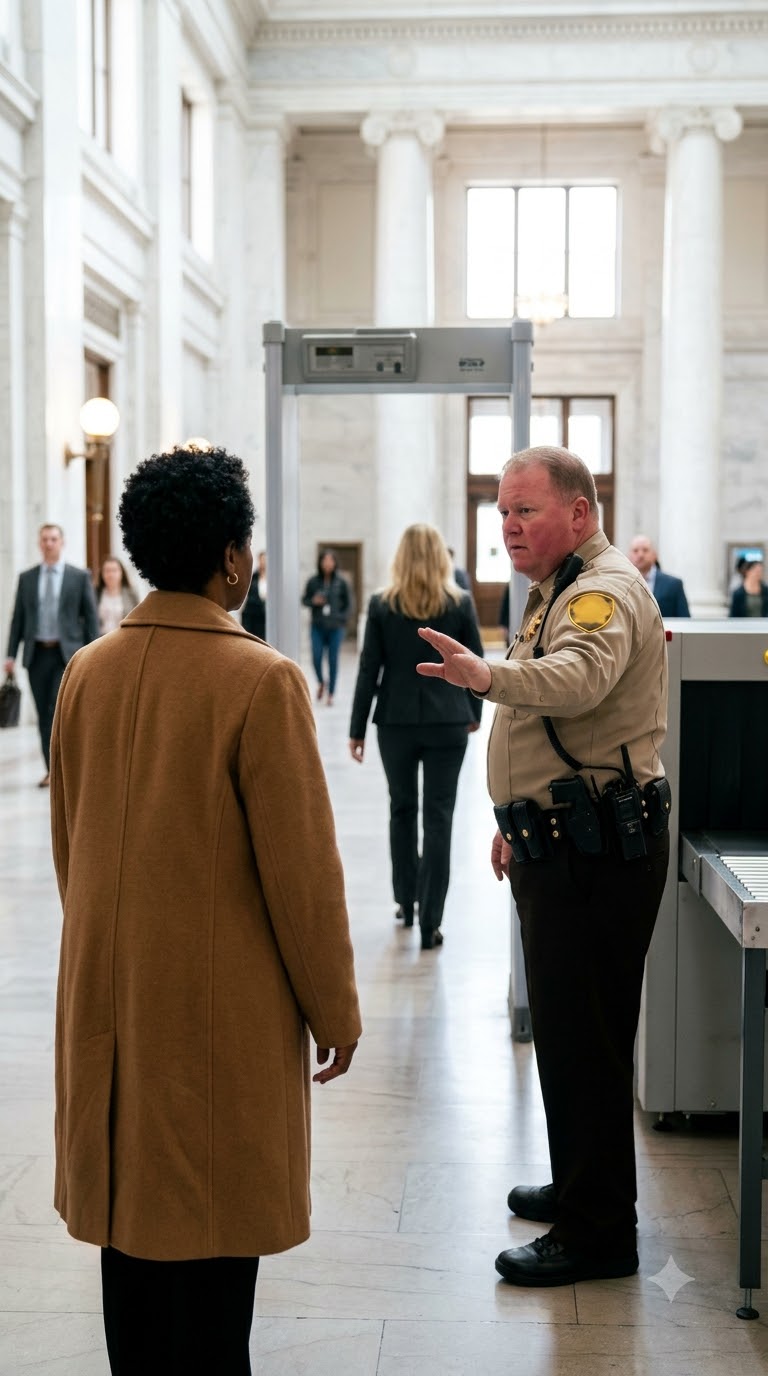
Elaine entered through the revolving glass doors, dressed in a camel-colored wool coat and carrying a black leather tote.
Nothing about her appearance immediately announced her judicial authority.
Her short hair carried distinguished streaks of gray. Small pearl earrings complemented her understated appearance, and her movements possessed the quiet confidence of someone who had never needed to demand attention to command respect.
She had arrived exactly twenty-three minutes early.
At fifty-five, Elaine had learned that arriving ahead of schedule often revealed more about an institution than any official inspection ever could.
Courtrooms could be spotless. Judges could deliver polished speeches about fairness. Clerks could recite regulations without hesitation, and security supervisors could describe every requirement in their training manuals.
But an institution’s character often revealed itself in the ordinary moments when its employees believed nobody important was watching.
That was why Elaine had intentionally avoided the private underground entrance designated for judges.
She wanted to walk through the same doors used by everyone else.
For four months, the courthouse had been the subject of an administrative review.
Officially, the investigation concerned security procedures, complaint management, and inconsistent treatment of lawyers, witnesses, interpreters, and members of the public.
Unofficially, the investigation had begun with a series of troubling letters delivered to the Administrative Office of the U.S. Courts.
Several writers described being treated disrespectfully at the security checkpoint.
Two complained that guards had mocked their accents and clothing.
A defense attorney reported repeatedly being forced into the public security line despite holding valid federal credentials, while younger white attorneys with considerably less experience were allowed to use the staff entrance.
No individual complaint, standing alone, definitively proved discriminatory conduct.
Together, however, the allegations suggested a troubling possibility.
That possibility had brought Elaine to Dayton.
She was not visiting as a distinguished celebrity expecting ceremonial treatment.
After twenty-four years on the federal bench, she had accepted an appointment to a judicial oversight panel, carrying with her a longstanding conviction that rules mattered most when following them offered no recognition or reward.
She knew how to distinguish a simple mistake from an established practice.
And she understood that one rude employee could be corrected, while an institutional culture that tolerated disrespect required something far more substantial.
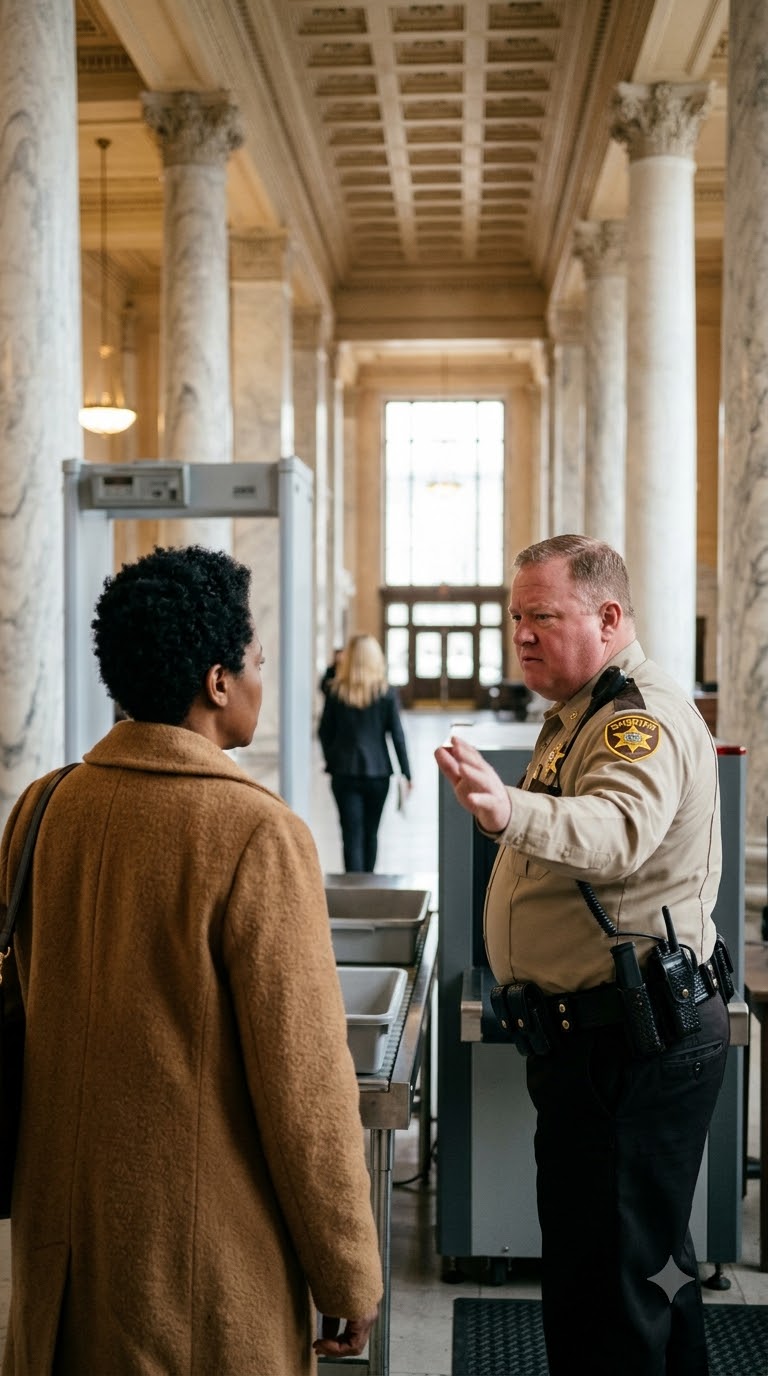
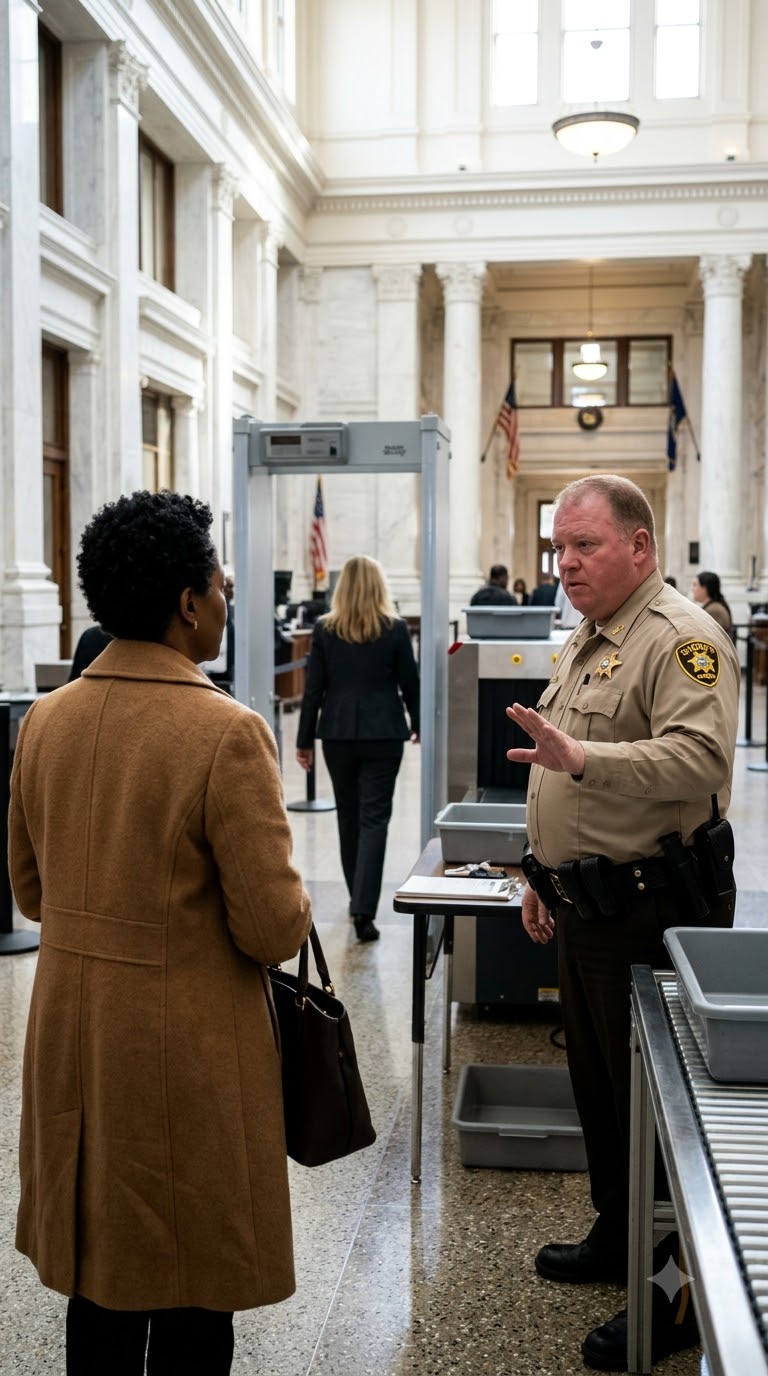
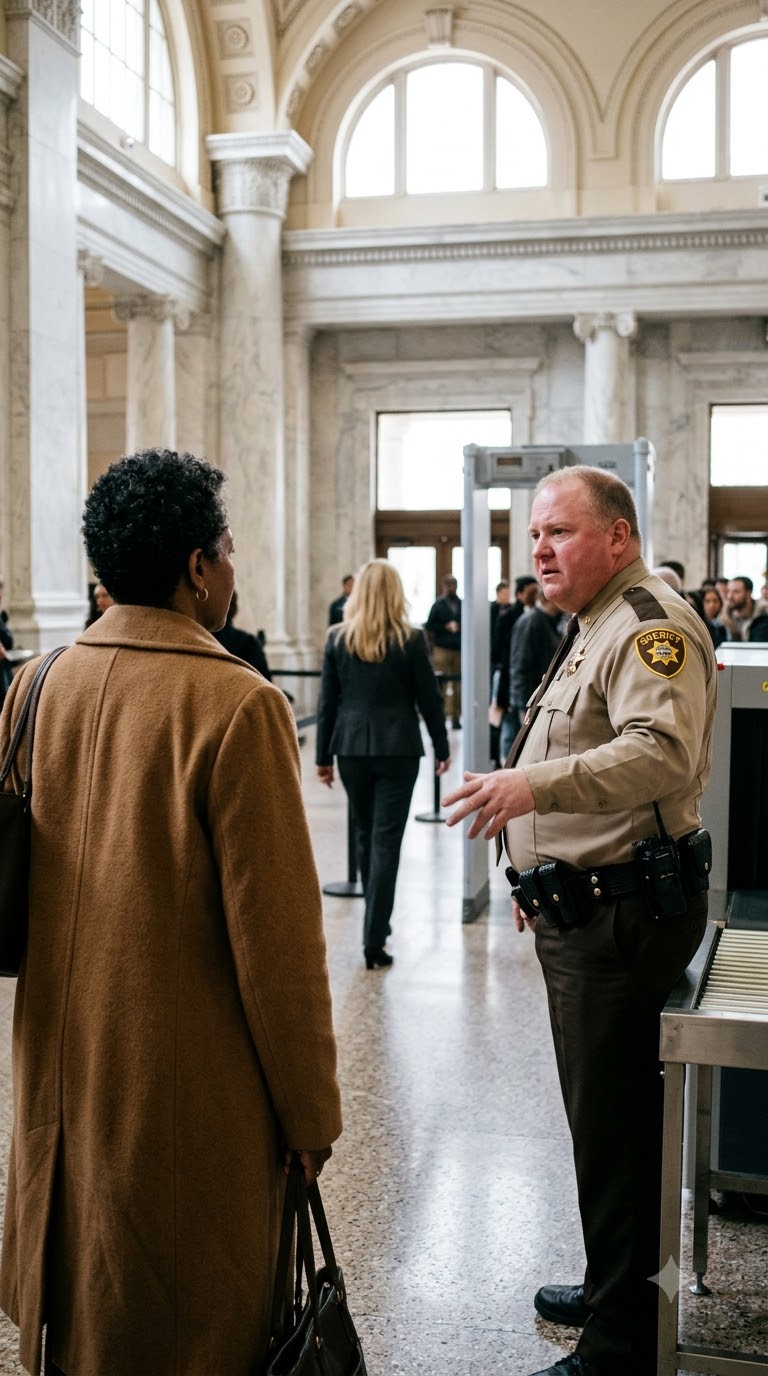
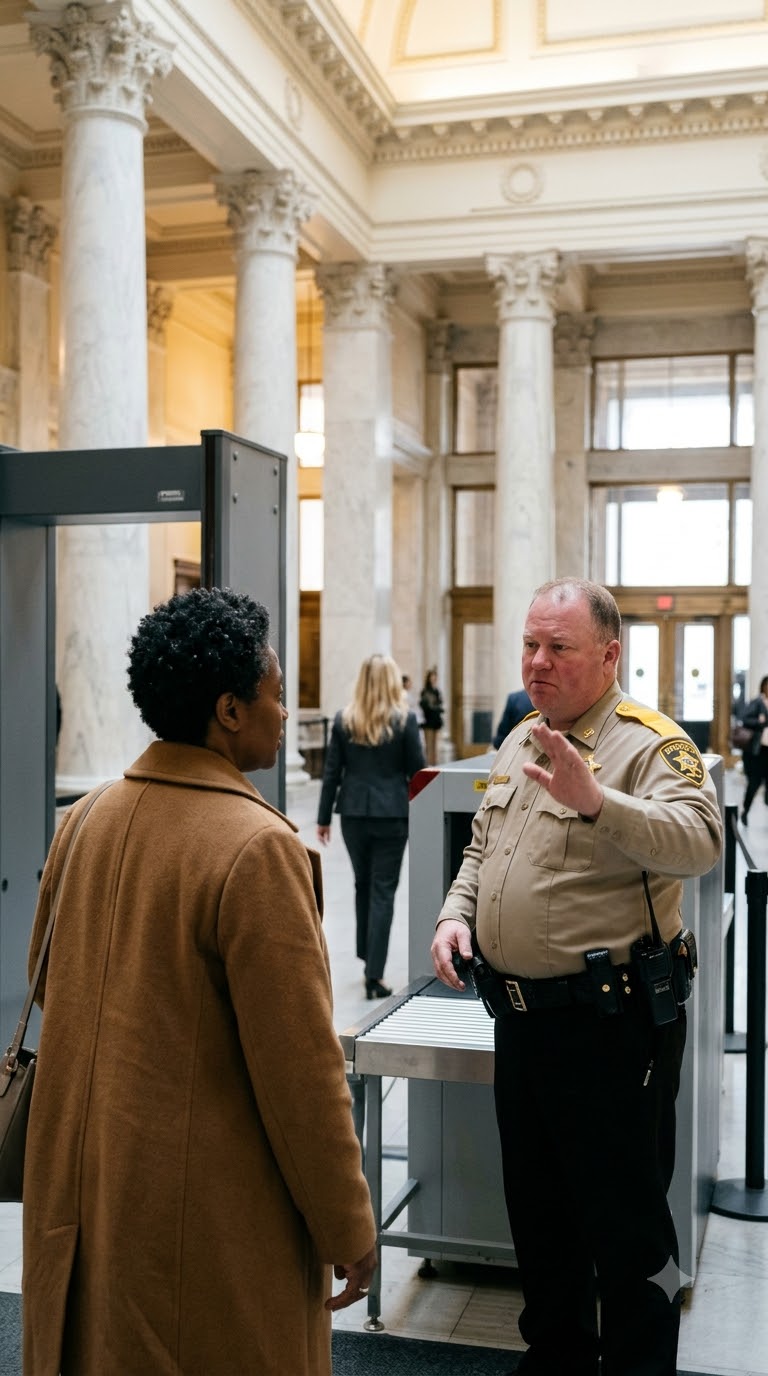
Two security officers stood beside the walk-through metal detector.
The senior guard, Boyd Keller, was a broad-shouldered white man in his mid-fifties with thinning, gray-blond hair. He moved with the relaxed certainty of someone who believed years of service had made him the unquestioned authority over everyone entering the building.
Beside him stood Terrence Brooks, twenty-six, noticeably more attentive and upright.
Terrence followed the movement of visitors carefully, displaying the alertness of a younger officer who still considered every security protocol worth following precisely.
Elaine spotted the staff access lane to the right of the public queue.
It was open.
She approached without hesitation.
Boyd immediately moved in front of her.
“Public line’s back there, sweetheart.”
His mouth curved into a slight smile, almost pleasant enough to disguise the condescension beneath it.
It was the kind of expression that could later be defended as harmless friendliness.
Elaine stopped.
“I’m aware,” she said.
Opening her leather tote, she withdrew a plastic identification card and offered it to him.
Boyd gave the credential only a passing glance before chuckling and looking toward Terrence.
“Everybody’s important today.”
Terrence glanced between his senior colleague and the woman standing before them.
He said nothing.
Boyd slid the identification card through the electronic reader.
The screen transformed instantly.
A brilliant gold background filled the monitor, displaying a circular federal seal as two unmistakable chimes sounded through the checkpoint.
The notification indicated a clearance classification Boyd had encountered only a handful of times throughout his career.
Terrence leaned toward the monitor.
Recognition crossed his face immediately.
“Boyd,” Terrence whispered, “that’s federal oversight clearance.”
Boyd’s amused expression vanished.
He stared at the monitor, then at the credential, before slowly lifting his eyes toward Elaine.
His face lost its color.
“Ma’am, I didn’t—”
Elaine took back her identification card without raising her voice.
“Your supervisor,” she said quietly. “My office. Now.”
Then she walked around him and continued toward the elevators.
Behind her, an uncomfortable silence settled over the checkpoint.
And it lasted considerably longer than she had expected.
Elaine did not look back.
She had spent too many years in courtrooms to confuse an embarrassed expression with genuine accountability.
Behind her, Boyd remained motionless beside the security reader.
Terrence finally reached across the counter and lowered the monitor’s brightness.
The gold notification disappeared, but the damage had already been done.
Several people waiting in the public line had witnessed the exchange. A middle-aged attorney adjusted the strap of his briefcase. An elderly woman stared at the floor. A young man holding a summons glanced toward Boyd before quickly looking away.
Nobody spoke.
Boyd cleared his throat.
“Keep the line moving,” he muttered.
Terrence resumed screening visitors, although his attention repeatedly drifted toward the elevator where Elaine had disappeared.
He knew the courthouse was under review.
Everyone on the security team knew.
What he had not realized was that the woman conducting the review might arrive without an escort, without advance notice, and without any visible indication of her position.
He also knew something Boyd did not.
The incident Elaine had just experienced was not unusual.
It was merely the first time someone powerful enough to challenge it had been standing on the receiving end.
Upstairs, Elaine entered the temporary office assigned to her by the courthouse administration.
The room overlooked a narrow stretch of downtown Dayton. A walnut desk stood beneath the window, and three sealed boxes of documents had been arranged along the opposite wall.
Her judicial assistant, Rebecca Shaw, was already waiting.
Rebecca was forty-two, meticulous, and had worked alongside Elaine for nearly eleven years.
She looked up from her laptop.
“Good morning, Judge Morgan. Did everything go smoothly downstairs?”
Elaine placed her tote on the desk.
“Not entirely.”
Rebecca immediately closed the document she had been reviewing.
“Security?”
Elaine nodded.
“I’d like the checkpoint footage preserved from seven-thirty this morning onward. Both camera angles, including audio if the system recorded it.”
Rebecca opened a new file.
“Any particular reason?”
Elaine removed her coat.
“An employee apparently decided my credentials weren’t worth examining until after he’d insulted me.”
Rebecca stopped typing.
“Who?”
“Boyd Keller.”
Recognition flickered across Rebecca’s face.
She had seen that name before.
“He’s mentioned in three of the complaint summaries.”
“Four,” Elaine corrected. “One was filed under an incident number instead of his name.”
Rebecca looked troubled.
Elaine sat down.
“And I want the original records. Not summaries. Not revised reports. Everything.”
Twenty minutes later, Chief Deputy Marshal Richard Harlan arrived at the office accompanied by courthouse security supervisor Martin Pierce.
Harlan was a tall, silver-haired man who had spent almost three decades in federal law enforcement. Pierce was younger, with a polished appearance and a strained smile that seemed carefully rehearsed.
Both men appeared uncomfortable.
“Judge Morgan,” Harlan began, “I understand there was an unfortunate misunderstanding at the entrance.”
Elaine gestured toward the chairs.
“Please sit.”
They obeyed.
Pierce spoke first.
“Boyd Keller has served this courthouse for eighteen years. He’s experienced, and I’m certain he didn’t recognize your credentials immediately.”
Elaine folded her hands.
“That much is obvious.”
Pierce attempted a small smile.
“He can be informal. Sometimes a little too familiar.”
“Is that how your department describes the incident?”
Pierce hesitated.
“Well, I wouldn’t want to characterize it before reviewing—”
“Then don’t.”
The room became quiet.
Elaine turned toward Harlan.
“Chief Deputy, when an individual presents federal credentials at a restricted access point, what is the officer required to do?”
“Examine and verify them before granting or denying access.”
“And is the officer permitted to substitute personal assumptions for that verification?”
“No, Judge.”
“Is there an approved procedure allowing an officer to dismiss credentials because the person presenting them doesn’t appear important?”
“Absolutely not.”
Elaine nodded.
“Then we agree this wasn’t simply a misunderstanding.”
Pierce shifted in his chair.
“Judge Morgan, I assure you, we’ll address the officer’s tone.”
“I’m less concerned about his tone than the possibility that his behavior reflects a routine practice.”
Harlan looked toward Pierce.
Elaine continued.
“Mr. Keller made a decision about where I belonged before examining my identification. When I presented it, he mocked the gesture. Only after the electronic system confirmed my authority did his attitude change.”
Neither man responded.
“That distinction matters.”
She opened a folder.
“According to the complaints I’ve reviewed, several other visitors experienced similar treatment. They simply lacked the clearance that caused a monitor to flash gold.”
Pierce’s expression tightened.
“Some of those complaints were investigated.”
“Then I would like to see the investigative records.”
“Of course.”
“Along with the names of everyone interviewed, the video reviewed, and the reasons each complaint was closed.”
Pierce glanced at Harlan.
“Some of those files are archived.”
“Then retrieve them.”
Elaine paused.
“And Mr. Pierce, I don’t want anyone punished for speaking honestly to this panel. That includes your officers.”
Harlan nodded.
“Understood.”
But Elaine noticed that Pierce did not immediately agree.
That omission interested her.
After the two men departed, Rebecca entered carrying a thin folder.
“The original complaint records are arriving this afternoon,” she said. “But I found something you should see.”
She placed a printed spreadsheet on Elaine’s desk.
It contained security incident classifications covering the previous eighteen months.
Elaine examined the entries.
Most were routine: prohibited items, forgotten identification, improperly displayed badges, and visitors attempting to enter restricted areas.
But several records carried a classification she had not expected.
Visitor conduct — disruptive.
She counted twenty-seven such incidents.
Seventeen involved individuals whose written statements described disputes over access credentials or security personnel’s behavior.
Eleven of those seventeen complaints had been closed without a recorded interview.
Elaine looked up.
“Who classified these incidents?”
Rebecca pointed toward a column.
“Supervisor approval. Martin Pierce.”
Elaine read the list again.
Then she noticed something else.
Terrence Brooks appeared as a secondary officer on six of the reports.
And in four of them, his name had been removed from the final version.
“Rebecca, request the original electronic audit logs.”
“All of them?”
“Every revision.”
Elaine leaned back.
“Someone has been changing the story after the fact.”
By lunchtime, the courthouse had begun whispering.
Employees who had barely noticed Elaine’s arrival now spoke about the gold security alert.
Some claimed she was investigating corruption.
Others insisted she was there to remove the entire security department.
One clerk said Boyd Keller had been suspended.
Another said he had been escorted from the building.
Neither rumor was true.
Elaine had requested that Boyd remain available for questioning while the incident was reviewed through proper channels.
She had no intention of making him a spectacle.
She wanted the truth.
And the truth required more than a frightened apology.
At 1:15 p.m., Terrence Brooks knocked on her office door.
Rebecca admitted him.
He stood near the entrance, holding his uniform cap in both hands.
“Judge Morgan, I was told you wanted to speak with me.”
“Yes, Officer Brooks. Please sit.”
He lowered himself into the chair opposite her desk.
Elaine studied him for a moment.
“You recognized my clearance immediately.”
“Yes, ma’am.”
“Why didn’t you intervene before Mr. Keller scanned the card?”
Terrence swallowed.
“Because he’s the senior officer.”
“That isn’t what I asked.”
He looked down.
“I thought if I corrected him in front of someone, he’d make things difficult for me afterward.”
Elaine waited.
Terrence’s fingers tightened around the cap.
“It’s happened before.”
“To you?”
“Yes, ma’am.”
“Tell me.”
He hesitated.
Then the words came slowly.
Three months earlier, a Spanish-speaking interpreter had arrived with valid authorization to enter a restricted courtroom corridor.
Boyd had questioned her repeatedly about whether she was actually employed by the court.
Terrence had verified her credentials and attempted to explain that the authorization was valid.
Boyd had told him to stop interfering.
The interpreter eventually entered, but only after nearly twenty minutes of questioning.
She missed the beginning of the hearing.
The following day, Terrence received a written warning for failing to follow the senior officer’s instructions.
Elaine made a note.
“Did you appeal the warning?”
“No, ma’am.”
“Why?”
Terrence gave a humorless smile.
“Because the person reviewing it was Supervisor Pierce.”
Elaine closed her pen.
“Have you seen similar incidents?”
Terrence stared at the floor.
“Yes.”
“How many?”
“I couldn’t tell you exactly.”
“More than five?”
“Yes.”
“More than ten?”
He hesitated.
“Probably.”
Elaine felt a familiar heaviness settle in her chest.
The problem was no longer one man’s careless language.
It was a workplace where younger employees had learned that enforcing the rules could create more trouble than ignoring misconduct.
“Officer Brooks, I need you to understand something.”
He looked up.
“Your obligation is to follow lawful security procedures. Not to protect another employee’s pride.”
“Yes, ma’am.”
“And if someone retaliates against you for telling the truth, I want that documented immediately.”
Terrence nodded.
But before leaving, he stopped at the doorway.
“Judge Morgan?”
“Yes?”
“There’s something else.”
Elaine waited.
PART 2
Terrence looked toward Rebecca, then back at Elaine.
“The camera from the staff entrance doesn’t always go down when the reports say it does.”
Rebecca slowly lifted her head.
“What do you mean?” Elaine asked.
Terrence took a breath.
“Sometimes the footage is there.”
“Where?”
“On the backup server.”
The room went completely still.
Within an hour, Elaine requested a formal preservation order for the courthouse’s security recordings, including backup files, access logs, deletion records, and administrative changes.
She did not attempt to seize the equipment herself.
Instead, she directed the appropriate officials to secure the evidence and document every transfer.
That distinction mattered.
An investigation into improper procedures could not be conducted by disregarding procedures.
By late afternoon, an independent technical specialist had confirmed that the backup server contained recordings missing from several complaint files.
The recordings had not necessarily been destroyed.
Some had simply been excluded from the materials provided during earlier reviews.
Elaine watched the first recovered video in a small conference room.
It showed the courthouse lobby on a rainy Tuesday morning.
A Black defense attorney approached the staff entrance and presented his credentials.
Boyd Keller examined them.
Then he pointed toward the public line.
The attorney appeared to explain something.
Boyd shook his head.
A white attorney entered the frame less than thirty seconds later.
He presented a credential of the same general classification.
Boyd waved him through.
Elaine watched without speaking.
Rebecca sat beside her.
The technical specialist advanced the recording.
The Black attorney eventually joined the public queue.
A second recording showed an elderly woman using a cane.
She appeared confused about which entrance to use.
Boyd pointed sharply toward the far side of the lobby.
The woman attempted to ask another question.
He turned away.
A third recording showed the Spanish-speaking interpreter Terrence had described.
Her credentials were valid.
Terrence could be seen checking them on the terminal.
Boyd stepped between them.
The exchange continued until the interpreter finally passed through the checkpoint.
Elaine asked for the associated incident report.
Rebecca handed it over.
The report stated that the interpreter had become argumentative and delayed security operations.
There was no mention of Terrence verifying her authorization.
No explanation for why she had been detained.
No record of the warning Terrence later received.
Elaine placed the document on the table.
“This is why the original records matter.”
Rebecca nodded.
“The written version doesn’t match the footage.”
“No,” Elaine replied. “It doesn’t.”
By the following morning, the inquiry had expanded.
Elaine arranged confidential interviews with employees who had been reluctant to speak during the original investigation.
A court interpreter described being repeatedly asked whether she belonged in restricted areas despite carrying valid credentials.
A public defender recalled being addressed by her first name while male colleagues were called by their professional titles.
A clerk admitted that staff members sometimes warned new employees to avoid challenging Boyd.
One witness described hearing a supervisor dismiss complaints as the inevitable frustrations of people unfamiliar with courthouse rules.
Each statement required verification.
Elaine knew that recollections could be incomplete and that a fair investigation had to consider explanations as well as allegations.
But the consistency of the accounts was becoming difficult to ignore.
By noon, Martin Pierce requested a private meeting.
He entered Elaine’s office looking exhausted.
“Judge Morgan, I’m concerned this investigation is becoming broader than the original security review.”
Elaine gestured toward the chair.
“Why does that concern you?”
“Because we’re dealing with personnel matters that should be handled internally.”
“Internal handling is precisely what we’re examining.”
Pierce pressed his lips together.
“I don’t believe it’s fair to judge eighteen years of service based on a handful of complaints.”
“Neither do I.”
He appeared relieved.
Then Elaine continued.
“That’s why we’re reviewing eighteen months of records, multiple witness statements, original security footage, and the department’s response to previous complaints.”
His relief disappeared.
Elaine opened another folder.
“Mr. Pierce, did you approve the closure of complaint number 19-447?”
He glanced at the page.
“Yes.”
“Did you review the video before closing it?”
“I relied on the incident summary.”
“Who prepared that summary?”
“Officer Keller.”
“And did you interview the complainant?”
“No.”
“Did you interview Officer Brooks, who was present?”
Pierce remained silent.
Elaine waited.
Finally, he answered.
“No.”
“Then what exactly did your investigation establish?”
Pierce stared at the desk.
“That the officer followed procedure.”
“Based solely on the officer’s own account?”
He said nothing.
Elaine leaned forward slightly.
“Mr. Pierce, I’m not asking whether you personally dislike the complainants or whether you intended to discriminate against anyone. I’m asking why your department repeatedly accepted one employee’s explanation without examining available contradictory evidence.”
Pierce rubbed his forehead.
“We were understaffed.”
“Understaffing can explain delays. It doesn’t explain inaccurate findings.”
“We had pressure to close complaints.”
“From whom?”
Pierce looked toward the door.
For the first time, his carefully controlled expression cracked.
“From the administration.”
Elaine said nothing.
Pierce continued.
“There was a performance review. They wanted unresolved incidents reduced. Open complaints made the department look inefficient.”
“So you closed them.”
“We believed most were minor.”
“Without reviewing the evidence?”
Pierce lowered his head.
Elaine felt no satisfaction.
She had seen similar failures in other institutions.
An employee behaved improperly.
A supervisor minimized the complaint.
Administrators rewarded low complaint numbers.
And eventually, the absence of recorded problems was mistaken for proof that no problems existed.
It was a system designed to protect its own appearance.
Not necessarily its integrity.
“Mr. Pierce,” Elaine said, “you will provide a complete written statement describing who directed those closures and what criteria were used.”
He nodded.
“And you will preserve every communication related to complaint targets, performance evaluations, and incident classifications.”
“Understood.”
When he left, Rebecca looked at Elaine.
“Do you think he’s telling the truth?”
“Parts of it.”
“Which parts?”
“The parts he can no longer deny.”
That afternoon, Boyd Keller finally appeared for his interview.
He entered wearing his security uniform, though he had been temporarily reassigned away from public screening duties pending the review.
He looked older than he had at the checkpoint.
His shoulders were stiff, and he avoided looking directly at Elaine.
An authorized personnel representative accompanied him.
Elaine explained the purpose of the meeting and the procedures governing his participation.
Boyd listened.
Then he cleared his throat.
“Judge Morgan, I want to apologize for what happened yesterday.”
Elaine nodded.
“I’m listening.”
“I shouldn’t have called you sweetheart. It was unprofessional.”
“Why did you?”
Boyd looked uncomfortable.
“I was trying to be friendly.”
“Would you have addressed Chief Deputy Harlan that way?”
“No.”
“Would you have addressed a male federal judge that way?”
He hesitated.
“Probably not.”
“Why?”
Boyd stared at his hands.
“I suppose I didn’t realize who you were.”
Elaine let the silence settle.
“That is the central issue, Mr. Keller.”
He looked up.
“You believe your behavior was inappropriate because you failed to recognize my authority.”
“No, ma’am, that’s not what I meant.”
“Then help me understand.”
Boyd took a breath.
“I’ve worked that entrance for eighteen years. You learn to recognize people. You learn who’s supposed to be there.”
“By checking their credentials?”
“Usually.”
“Or by deciding whether they look like someone who belongs?”
Boyd shifted in his chair.
“I don’t think that’s fair.”
“Then let’s examine the records.”
Elaine presented the recovered footage and the associated incident reports.
Boyd watched the recordings.
At first, he offered explanations.
The attorney had approached too quickly.
The interpreter had seemed confused.
The elderly woman had entered the wrong lane.
Elaine listened to each response.
Then she asked him to explain why visitors with comparable credentials had been treated differently.
He struggled.
Eventually, his answers became shorter.
“I don’t remember.”
“I can’t explain that.”
“I must have made a mistake.”
Elaine did not raise her voice.
She simply continued asking questions.
At one point, Boyd looked toward his representative.
“I’ve never thought of myself as someone who treats people differently.”
Elaine studied him.
“Then these recordings should concern you as much as they concern me.”
Boyd looked down.
For several seconds, he said nothing.
Finally, he spoke.
“My father was a courthouse deputy. He taught me that the people who worked here deserved respect.”
Elaine waited.
Boyd swallowed.
“I guess somewhere along the way, I started thinking the people coming through the doors had to earn it.” Elaine’s expression remained composed.
“Respect for the law doesn’t begin with someone’s job title.”
Boyd nodded faintly.
“And a public courthouse isn’t a private club.”
His eyes filled with embarrassment.
“I understand.”
Elaine closed the folder.
“Understanding is a beginning. Accountability is what comes next.”
Over the following week, the investigation moved beyond the behavior of individual guards.
The oversight team discovered that the courthouse had no reliable method for tracking complaints involving discourteous treatment at security checkpoints.
Visitors were routinely directed to a general administrative mailbox.
Some messages were forwarded to security supervisors.
Others were classified as customer-service concerns.
Several never received a documented response.
There was no consistent requirement to preserve video footage when a complaint alleged misconduct.
And although employees received annual instruction on security procedures, the training materials offered little practical guidance on handling disputed credentials without bias.
The problems extended beyond Boyd Keller.
They involved procedures that had been allowed to deteriorate while senior administrators focused on maintaining the appearance of efficiency.
Elaine requested a meeting with the courthouse’s senior administrative leadership and the officials responsible for security oversight.
She made it clear that the purpose was not to embarrass anyone.
The purpose was to determine what had failed, who had authority to correct it, and how future complaints would be handled.
The meeting took place in a windowless conference room on the fourth floor.
Chief Deputy Harlan sat near the head of the table.
Martin Pierce occupied a chair beside him.
Two administrative officials, a personnel specialist, and an attorney assigned to advise the reviewing authorities completed the group.
Elaine placed a thick binder in front of her.
“Before we begin,” she said, “I want everyone to understand that the issue before us is larger than a discourteous remark at a security checkpoint.”
Nobody interrupted.
“A federal courthouse represents the rule of law. People enter these buildings to seek protection, answer accusations, testify about difficult experiences, and resolve disputes that may affect the rest of their lives.”
She glanced around the table.
“Many are frightened. Some have never been inside a courthouse. Others have limited English proficiency or disabilities that make security procedures more difficult to navigate.”
Harlan nodded.
“Those circumstances do not eliminate security requirements,” Elaine continued. “But neither do security requirements excuse unnecessary humiliation.”
She opened the binder.
“Over eighteen months, we identified twenty-seven incidents classified as disruptive visitor conduct. Seventeen involved disputes concerning access procedures or employee behavior.”
An administrator adjusted his glasses.
“How many were substantiated?”
“That question is part of the problem.”
Elaine turned a page.
“Eleven were closed without documented interviews. Several were resolved without reviewing available footage. In four cases, the final incident reports omitted the names of officers who appeared in the original records.”
Pierce stared straight ahead.
“These findings do not mean every allegation is true,” Elaine said. “They mean the institution failed to conduct reliable investigations capable of establishing what was true.”
The personnel specialist began taking notes.
Elaine continued.
“We also found evidence that complaint-resolution statistics were emphasized in performance reviews without adequate consideration of investigative quality.”
One administrator spoke.
“Those metrics were intended to encourage efficiency.”
“Efficiency is useful when it measures the timely completion of proper work,” Elaine replied. “It becomes dangerous when it rewards the premature closure of unresolved complaints.”
The administrator fell silent.
Harlan leaned forward.
“What corrective measures are you recommending?”
Elaine outlined the immediate priorities.
All disputed access incidents would require documented credential verification and supervisory review.
Complaints involving alleged misconduct would trigger appropriate preservation of available footage.
Visitors would receive clear instructions explaining how to report concerns without having to submit those concerns directly to the employees involved.
Supervisors would be trained to distinguish security risks from ordinary confusion, language barriers, and disagreement.
And allegations of retaliation against employees who reported misconduct would receive independent review.
Harlan listened carefully.
“Those changes are reasonable.”
“They’re necessary,” Elaine replied.
She turned toward Pierce.
“Mr. Pierce, the evidence also raises questions about your handling of prior complaints. Those questions will be referred through the appropriate personnel and administrative processes.”
Pierce nodded slowly.
He had expected that.
Boyd’s case would also be reviewed separately.
Elaine had no intention of personally deciding his employment outcome.
The appropriate officials would evaluate the evidence, allow him to respond, and determine what disciplinary action was justified.
Accountability, she believed, was weakened whenever a powerful person bypassed due process merely because the evidence appeared compelling.
After the meeting, Harlan remained behind.
He stood near the window, watching the courthouse plaza below.
“Judge Morgan, I’ve spent most of my career believing this building was run properly.”
Elaine gathered her papers.
“Parts of it probably are.”
He turned.
“That almost makes this worse.”
“Why?”
“Because the problems were happening right in front of us.”
Elaine considered his words.
“Sometimes institutions become so accustomed to familiar behavior that they stop examining it.”
Harlan looked troubled.
“I should have seen it.”
“Perhaps.”
He accepted the answer without protest.
Elaine closed her binder.
“The important question now is what you do after seeing it.”
PART 3
Two days later, Terrence Brooks received notice that the written warning issued after the interpreter incident was being reconsidered.
He read the message twice before believing it.
The following morning, he approached Elaine outside the conference room.
“Judge Morgan, may I speak with you?”
“Of course.”
“I heard they’re reviewing my disciplinary record.”
“They are.”
Terrence looked nervous.
“I don’t want anyone thinking I came forward just to get my warning removed.”
Elaine regarded him carefully.
“Why did you come forward?”
He thought about the question.
“Because I kept watching things happen, and every time I told myself it wasn’t my responsibility.”
Elaine waited.
“Then yesterday morning, when Boyd stopped you, I knew exactly what he was doing.”
Terrence looked away.
“And I still didn’t say anything until the screen changed.”
His voice tightened.
“I’ve been thinking about that ever since.”
Elaine spoke gently.
“Recognizing a mistake doesn’t erase it. But it gives you a chance to make a different decision next time.”
He nodded.
“I will.”
“Good.”
Terrence hesitated.
“Do you think they’ll actually change anything?”
Elaine looked through the glass wall toward the busy corridor.
“I think change becomes possible when people stop pretending the problem doesn’t exist.”
It was not the reassurance he had expected.
But it was one he believed.
Three weeks after Elaine’s arrival, the courthouse implemented its first round of corrective procedures.
New signs appeared near the public entrance, clearly explaining the difference between public screening and authorized staff access.
Security personnel received updated guidance requiring consistent credential verification.
A complaint process independent of the immediate checkpoint staff was introduced, and the courthouse began conducting regular reviews of disputed access incidents.
The administrative investigation into prior report handling remained open.
Martin Pierce was temporarily removed from responsibility for reviewing misconduct complaints while the appropriate authorities examined his actions.
Boyd Keller was placed on administrative leave pending the completion of his personnel review.
The decision was not announced as a public punishment.
It was recorded as part of a formal process.
Elaine believed that distinction was important.
The purpose of the investigation was not to produce a dramatic moment of humiliation.
It was to establish whether the courthouse could be trusted to enforce its own rules.
During her final scheduled week in Dayton, Elaine received a letter from the defense attorney whose complaint had helped initiate the review.
His name was Jonathan Ellis.
He had practiced federal criminal defense for fourteen years.
In his letter, he described the exhaustion of repeatedly having to prove that he belonged in professional spaces where his credentials should have settled the question.
He explained that he had eventually stopped complaining because every report seemed to produce the same response.
The security officers had acted appropriately.
The visitor had misunderstood.
The matter was closed.
Elaine read the letter twice.
One passage remained with her.
Jonathan wrote that the most frustrating part had never been waiting in the public line.
It was watching the rules change depending on who stood in front of the guard.
He had never asked for special treatment.
He had asked for the same treatment everyone else received.
Elaine placed the letter beside the original complaint file.
Then she asked Rebecca to arrange a meeting.
Jonathan arrived the following afternoon.
He was forty-six, dressed in a charcoal suit, and carried a battered leather briefcase that looked as though it had accompanied him through hundreds of hearings.
He seemed surprised when Elaine greeted him personally.
“Mr. Ellis, thank you for coming.”
“Thank you for inviting me, Judge Morgan.”
They sat across from each other.
Elaine opened his file.
“I wanted to hear directly from you about your experience.”
Jonathan gave a small, tired smile.
“I’ve already written everything down.”
“I know.”
“More than once.”
“I know that too.”
He looked at her.
“Then why am I here?”
Elaine answered without hesitation.
“Because your complaint deserved to be heard by someone willing to examine the evidence.”
Jonathan’s expression changed.
For a moment, he appeared uncertain how to respond.
Then he leaned back.
“You know what bothered me most?”
“Tell me.”
“It wasn’t being sent to the wrong line. I can wait in a line.”
Elaine listened.
“It was being made to feel like I was lying about who I was.”
He glanced toward the window.
“I’ve argued cases in federal court for fourteen years. I’ve represented people who had nobody else willing to stand beside them. I’ve spent nights preparing motions and weekends visiting clients who were terrified about what might happen to them.”
His voice grew quieter.
“And I still had to stand at that checkpoint and convince someone I wasn’t pretending to be a lawyer.”
Elaine nodded.
“That should not have happened.”
Jonathan looked back at her.
“People kept telling me not to take it personally.”
“Did you?”
“How could I not?”
Elaine allowed the question to remain unanswered.
Jonathan continued.
“After a while, you start wondering whether complaining makes you look difficult. You worry that the next time you enter the building, somebody will remember your name for the wrong reason.”
He shook his head.
“So you stop saying anything.”
Elaine closed the folder.
“That silence is one of the reasons these problems persist.”
Jonathan studied her.
“Are things really going to change?”
“Some procedures already have. Other matters remain under review.”
“That’s not exactly a promise.”
“No,” Elaine said. “It isn’t.”
He gave a brief laugh.
Elaine continued.
“I can’t promise that nobody in this building will ever behave unfairly again. I can promise that the findings won’t be concealed simply because they’re uncomfortable.”
Jonathan considered that.
Then he nodded.
“I can live with that.”
When the meeting ended, he stood and extended his hand.
Elaine shook it.
At the doorway, Jonathan paused.
“Judge Morgan?”
“Yes?”
“I’m glad somebody finally looked at the footage.”
After he left, Elaine remained seated for several minutes.
She thought about how easily the entire investigation might have unfolded differently.
If Boyd had checked her identification immediately, there would have been no gold alert that morning.
If he had recognized her face, he might have greeted her with elaborate courtesy.
If she had used the private judicial entrance, she would never have witnessed the checkpoint’s ordinary behavior firsthand.
But none of those possibilities changed the underlying evidence.
The complaints had existed long before she arrived.
The recordings had existed.
The inconsistent reports had existed.
What had been missing was the institutional willingness to confront them.
On her final morning, Elaine returned to the courthouse entrance.
She wore the same camel-colored coat and carried the same black leather tote.
The marble floors still gleamed beneath the skylights.
Attorneys still hurried toward their hearings.
Visitors still waited nervously beside the security barriers.
The building looked almost exactly as it had on the morning she arrived.
But the checkpoint was different.
Terrence Brooks stood beside the electronic reader.
A second officer, a woman in her early forties, was assisting visitors with their belongings.
Elaine watched from a short distance.
An elderly man approached the wrong lane.
He appeared uncertain where to go.
The female officer stepped forward.
“Good morning, sir. May I see your identification?”
The man fumbled with his wallet.
“I’m sorry. I don’t come here very often.”
“That’s all right. Take your time.”
She examined his documents and calmly explained which line he needed.
The man thanked her.
Then a young attorney approached the staff entrance.
Terrence checked his credentials carefully.
The attorney passed through without incident.
A woman carrying an interpreter’s badge arrived next.
Terrence verified her authorization using the same procedure.
No jokes.
No assumptions.
No unnecessary questions.
Elaine approached.
Terrence recognized her immediately.
“Good morning, Judge Morgan.”
“Good morning, Officer Brooks.”
He stood a little straighter.
“Are you leaving us today?”
“I am.”
“I’m sorry to hear that.”
Elaine smiled faintly.
“Most people are relieved when an oversight review ends.”
Terrence smiled back.
“I suppose that’s true.”
She handed him her identification card.
For a moment, he seemed surprised.
“Judge, I know who you are.”
“I know.”
He understood.
Terrence turned toward the reader and scanned the card.
The monitor flashed gold.
Two familiar chimes sounded.
A few visitors glanced toward the checkpoint.
Terrence examined the display, confirmed the authorization, and returned the credential.
“You’re cleared, Judge Morgan.”
“Thank you.”
Elaine took the card.
Then she glanced toward the public queue.
“Officer Brooks, do you know what I remember most about my first morning here?”
He hesitated.
“The way Boyd spoke to you?”
“Not exactly.”
Terrence waited.
“I remember that you recognized the problem before anyone else did.”
His expression became serious.
“And I remember that you were afraid to say so.”
He lowered his eyes.
Elaine continued.
“I hope that changes.”
Terrence looked directly at her.
“It already has, ma’am.”
Elaine nodded.
“Then keep it that way.”
She walked toward the elevators, leaving him to continue his work.
The gold alert disappeared from the monitor.
The screen returned to its ordinary blue background.
Another visitor stepped forward.
Terrence greeted him politely, requested his identification, and followed the same procedure he had used for everyone else.
Elaine watched for a moment before turning away.
For the first time since arriving in Dayton, she felt cautiously hopeful.
Not because the courthouse had become perfect.
Not because one investigation had erased years of harmful habits.
And certainly not because a security monitor had recognized her authority.
She felt hopeful because the people working at that checkpoint were beginning to understand something the building’s impressive architecture had never been able to teach them.
Respect was not a privilege reserved for those whose credentials carried special clearance.
It was the foundation of public service.
And the real test would come when the next person entered without an impressive title, without powerful connections, and without an identification card capable of turning a screen gold.
EPILOGUE — THE REAL MEASURE OF JUSTICE
Six months later, Elaine received the final administrative review report.
She was sitting in her chambers when Rebecca brought the document to her desk.
The report contained more than a hundred pages of findings, corrective actions, and follow-up recommendations.
Several previously dismissed complaints had been reopened and reassessed.
The investigation confirmed that security procedures had been applied inconsistently in multiple documented incidents.
It also established that supervisory failures had contributed to unreliable complaint findings.
Martin Pierce had been removed from his supervisory position following the completion of the appropriate personnel proceedings.
Boyd Keller’s employment had ended after the disciplinary review concluded.
The report did not describe either outcome as a victory.
It recorded the findings, the procedures followed, and the administrative decisions reached.
Elaine appreciated that restraint.
The review also documented meaningful improvements.
Security officers now received scenario-based instruction on credential verification, professional communication, and the proper handling of complaints.
Supervisory decisions were subject to periodic independent audits.
Footage associated with misconduct allegations was preserved under clear retention procedures.
And employees could report concerns without routing those reports through the supervisor whose conduct might be questioned.
The report included a short section about Terrence Brooks.
His earlier written warning had been rescinded after the original incident was reviewed.
He had completed additional training and had been selected to assist with mentoring newly assigned security personnel.
Elaine smiled when she read that.
Not because Terrence had been rewarded for telling her what she wanted to hear.
But because the institution had finally recognized the importance of employees who took procedures seriously, even when doing so was uncomfortable.
Rebecca stood near the desk.
“Was it worth it?”
Elaine looked up.
“What?”
“The trip. The investigation. All those interviews.”
Elaine considered the question.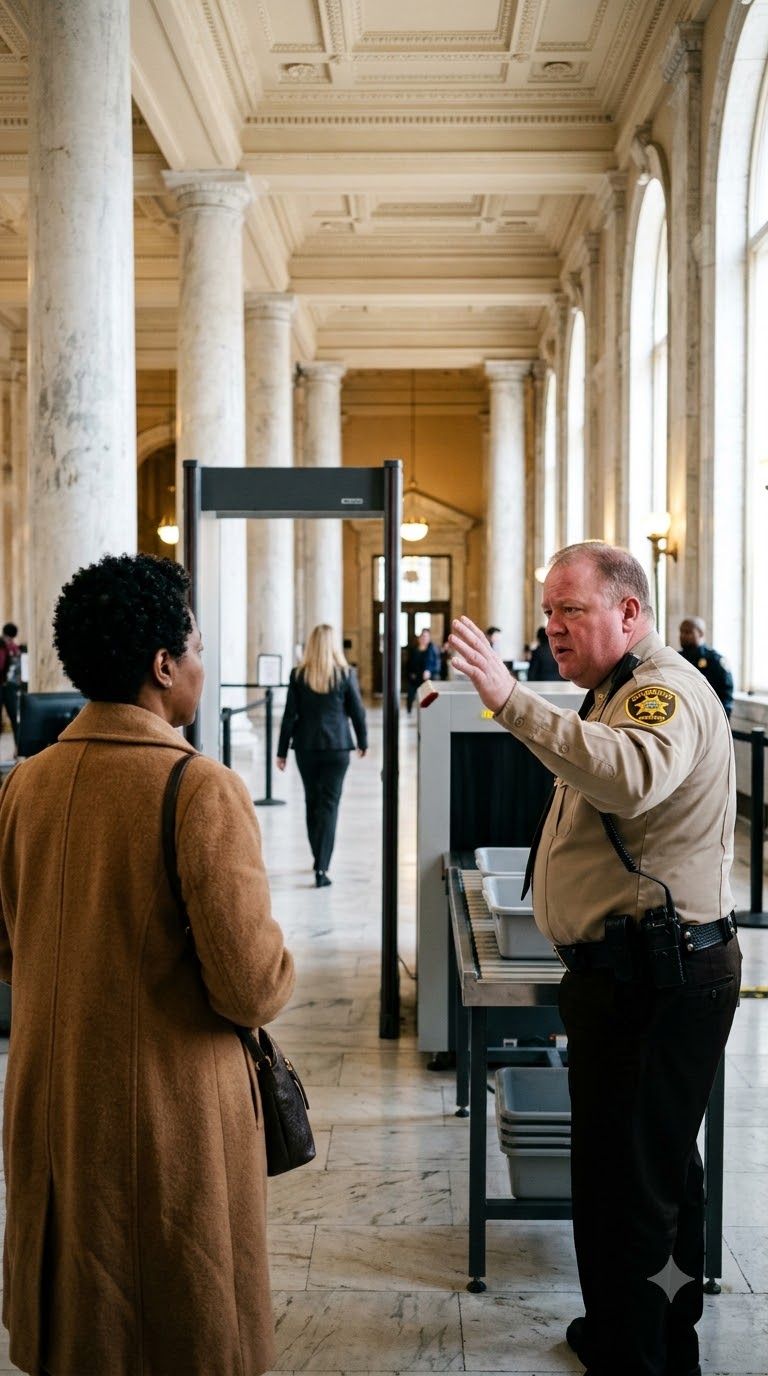
Then she reached for a letter clipped to the back of the report.
It had been written by a courthouse visitor several weeks earlier.
The woman described arriving for a difficult hearing with her elderly mother, who struggled to walk and became confused by the security instructions.
Instead of becoming impatient, an officer had explained the process slowly and helped them find the appropriate entrance.
The woman had written simply to express her gratitude.
Elaine handed the letter to Rebecca.
“This,” she said, “is what makes it worth it.”
Rebecca read the page.
When she finished, she smiled.
“That’s a very different kind of complaint.”
“Yes.”
Elaine returned her attention to the report.
Outside her chambers, the courthouse continued its daily work.
Cases were filed.
Hearings began.
Attorneys argued.
Witnesses testified.
Judges made decisions that would shape the lives of people they might never meet again.
And somewhere in Dayton, another ordinary visitor was approaching a security checkpoint.
Perhaps that person was a lawyer.
Perhaps a witness.
Perhaps a frightened parent carrying documents they barely understood.
Perhaps someone who had spent the night worrying about what would happen inside the building.
Whoever they were, they deserved to be treated with dignity.
Elaine signed the final acknowledgment and closed the folder.
She remembered Boyd Keller’s smile.
She remembered his dismissive words.
“Public line’s back there, sweetheart.”
And she remembered how quickly his expression had changed when the security monitor flashed gold.
At the time, the moment had seemed dramatic.
But six months later, Elaine understood that the most important change had nothing to do with the screen.
It was the realization that nobody should have to reveal extraordinary authority before receiving ordinary respect.
A gold clearance notification could open a restricted door.
It could command attention.
It could instantly transform the way a careless employee treated the person standing before him.
But it could not create integrity.
That required something more difficult.
It required people willing to follow the rules when nobody influential was watching, supervisors prepared to confront uncomfortable evidence, and institutions strong enough to admit when they had failed.
Elaine placed the completed report in her outgoing tray.
Then she returned to the cases waiting on her desk.
The work of justice continued.
And its first responsibility, she believed, was not to recognize the powerful.
It was to protect the dignity of everyone who walked through the door.
