

PART 1
At exactly 5:12 p.m., Javier Ortega stepped inside his house in Pozuelo de Alarcón, prepared to dismiss the housekeeper. Instead, he heard something that had been missing from his home for almost two years.
His children were laughing.
Javier stopped in the entrance hall.
From the living room came the sound of an awkward melody, a child’s guitar, and the irregular beat of someone tapping a wooden box.
The music was far from perfect.
But to Javier, it was more beautiful than anything he had heard in years.
It sounded like life returning.
Without removing his jacket, he followed the noise.
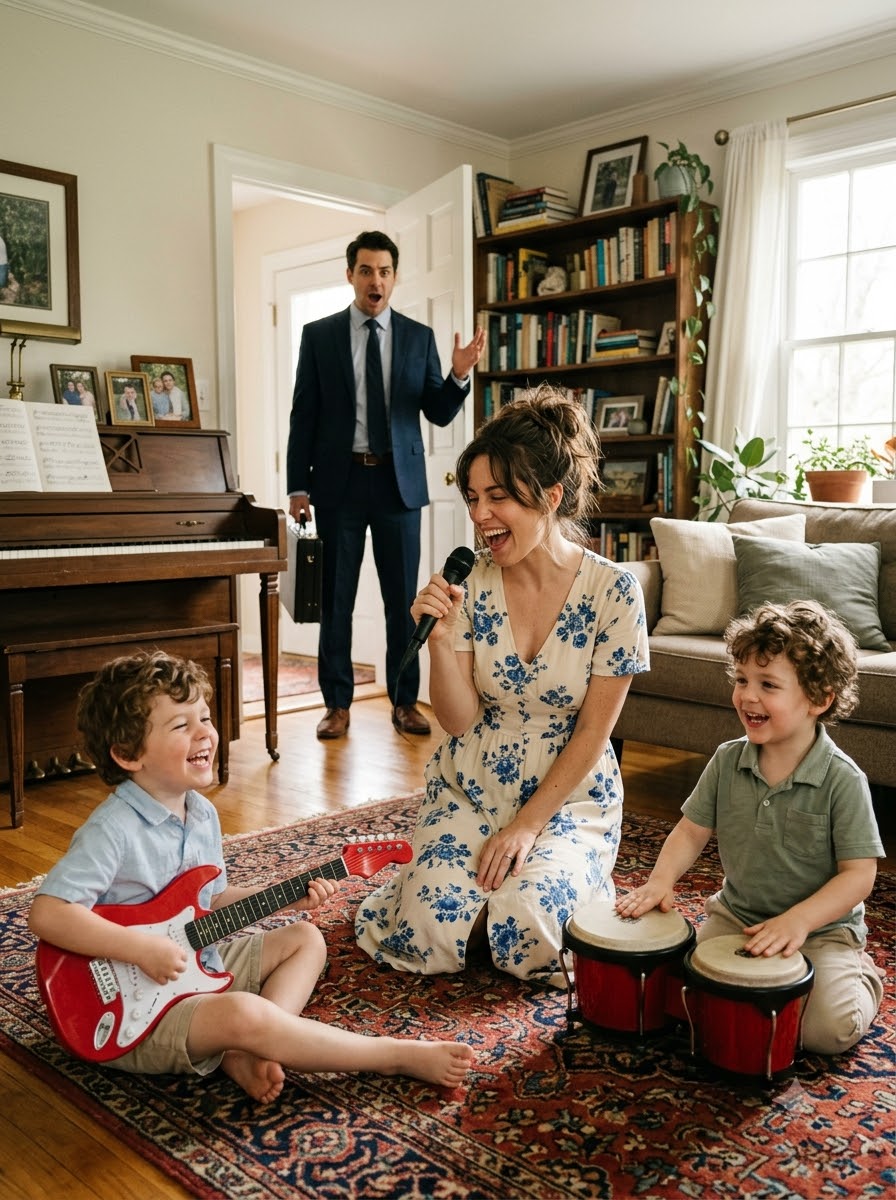
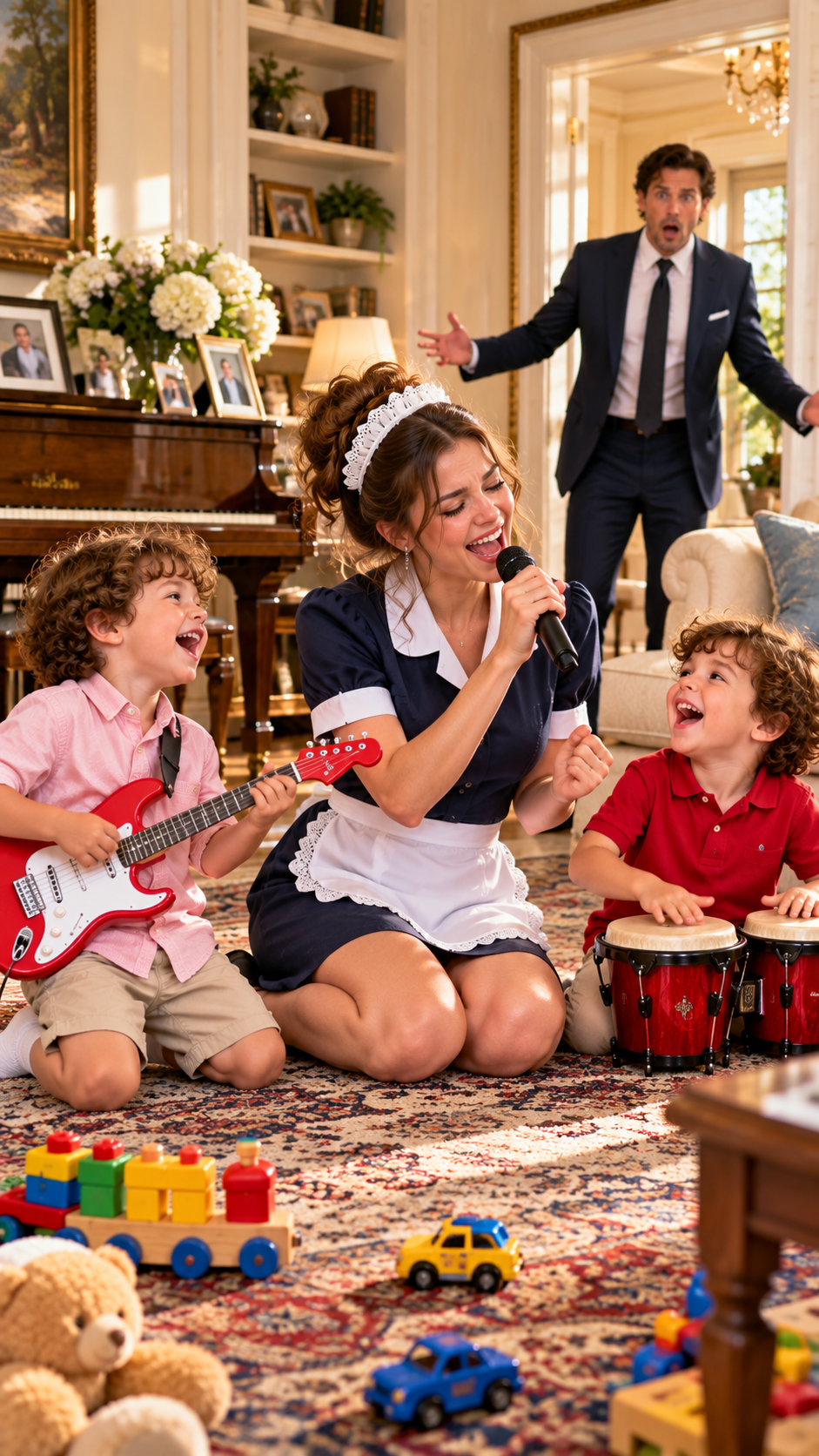
Nuria, the woman he had employed four months earlier to handle the cooking, cleaning, and childcare until he returned from work, sat cross-legged on the living room carpet.
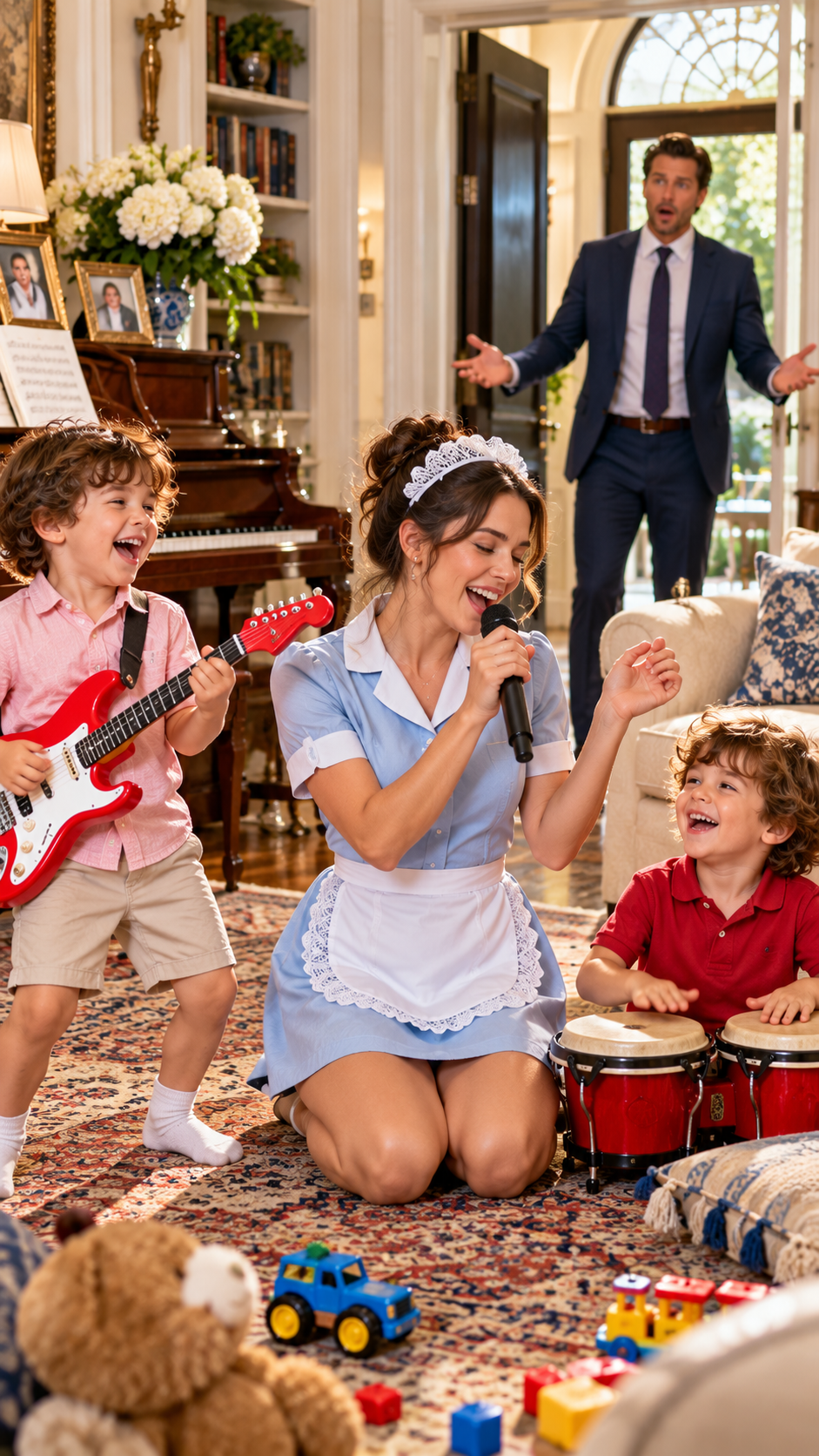
She was holding a wooden spoon like a microphone.
Beside her, seven-year-old Lucas strummed a blue guitar, while his twin brother, Martín, tapped a wooden box with both hands and sang in a voice barely louder than a whisper.
Javier stood motionless.
He felt as though the air had disappeared from his lungs.
Since his wife Elena’s death, Lucas had stopped singing altogether. Martín had withdrawn so deeply into himself that he rarely spoke to anyone outside the family.
Javier had tried everything he could think of.
He had hired psychologists, arranged activities, transferred the boys to another school, and consulted a therapist specializing in childhood bereavement.
He had purchased toys that remained untouched and filled their bedrooms with things he hoped might make them happy.
He had spent money on every possible solution.
But he had hardly spent any time with them.
“One more time from the beginning,” Nuria said. “And if we get it wrong, even better. Then we’ll have an excuse to laugh.”
Martín missed the beat.
Lucas immediately burst into laughter.
Nuria responded with an exaggerated theatrical bow.
Then Lucas looked toward the doorway and noticed his father.
“Daddy, you’re here.”
There was no excitement in his voice.
Only genuine surprise.
Javier placed his briefcase on the floor.
“Yes. I’m here.”
Martín looked up from his improvised drum.
“Nuria says the song doesn’t have to be perfect,” Martín said. “It just has to be ours.”
Javier felt the words settle painfully inside him.
For months, he had defended his long working hours by insisting that everything he did was for his sons.
He worked twelve-hour days to provide them with comfort, security, and opportunities.
But standing in the doorway, watching their faces, he finally confronted a truth he had avoided.
His children did not need another explanation for why their father was absent.
They needed him to come home.
And stay.
When the song ended, Lucas held out the blue guitar.
“Do you want to play?”
Javier smiled uncertainly and shook his head.
“I don’t know how.”
Martín regarded him with complete seriousness.
“Neither do we.”
The three of them laughed.
Javier joined in, although the emotion rising in his throat forced him to lower his eyes.
Later, while the twins ate their afternoon snack, Javier asked Nuria how the music sessions had begun.
She explained that she had discovered the guitar in the storage room.
It had been a gift from Elena.
Lucas had looked at it every day, but he had never dared touch it.
Rather than ask him to play, Nuria simply placed the instrument in the living room.
She said nothing about it.
On the third day, Lucas picked it up.
Martín began tapping a rhythm against the table with his fingertips.
Little by little, the silence between them had started to change.
“I didn’t want to force them to talk,” Nuria said. “I just wanted them to have a way to express things without having to explain them.”
Javier looked at her, searching for an appropriate response.
Before he could speak, the front door opened.
Clara, Elena’s older sister, entered carrying a folder beneath her arm.
She stopped when she saw the scene.
The guitar.
The wooden box.
The afternoon snack scattered across the carpet.
And Nuria sitting among the children as though she belonged there.
Her expression hardened.
“What’s going on here?”
Lucas immediately lowered the guitar.
Clara turned toward Javier.
“That woman works in this house. She is not their mother.”
Nuria rose to her feet.
The color drained from her face.
Javier looked at his sister-in-law.
For two years, Clara had been one of the few constants in the boys’ lives. She visited regularly, helped with appointments, and preserved Elena’s belongings with almost religious care.
Javier knew her grief was real.
But he had just heard his sons laugh.
And now they were silent again.
He did not argue.
Instead, he walked toward Elena’s piano.
The instrument had remained closed since her funeral.
He lifted the lid of the piano bench, something he had not done in nearly two years.
Beneath the wooden seat, he noticed a yellowed envelope secured with tape.
He carefully detached it.
The handwriting on the front was unmistakable.
Elena’s.
Four words were written across the envelope:
“For When You’re Afraid.”
Javier stared at them.
He had not seen his wife’s handwriting in so long that even those few words made his chest tighten.
Clara moved toward him.
“Don’t open it in front of her.”
Javier looked up, startled.
“Why?”
Clara swallowed.
Then she admitted something he had never known.
Elena had written the letter before her death.
She had asked Clara to deliver it “when the house started living again.”
But Clara had kept it hidden.
For two years, she had been unable to bring herself to fulfill her sister’s request.
She had feared that Javier would interpret moving forward as forgetting Elena.
Nuria picked up her handbag.
“I’m leaving. I don’t want to be the cause of a family argument.”
Lucas immediately jumped to his feet.
“Are you leaving because of us?”
Martín pressed the blue guitar against his chest.
“You promised we’d finish the song tomorrow.”
Clara closed her eyes.
The fear on the boys’ faces was painfully familiar.
It was the same expression they had worn after losing their mother.
Javier straightened.
“Nobody is leaving,” Javier said.
Clara stared at him.
“Are you going to choose an employee over Elena’s family?” Clara asked.
Javier held the envelope firmly.
“I’m choosing my sons.”
He broke the seal.
Inside was a letter written in the familiar handwriting of the woman he had loved.
He unfolded the first page.
Then he read the opening sentence.
“Javier, if you’re reading this, someone has probably started making music in the house again. Don’t send her away.”
He stopped breathing for a moment.
Clara began to cry.
Nuria stood frozen beside the carpet.
Elena had left instructions about someone she had never met.
And somehow, from a letter written before her death, she had understood exactly what was happening inside the house.
Javier looked at the next paragraph.
His hands trembled.
For the first time in two years, he felt as though Elena were speaking directly to him.
And what she had written would force him to confront everything he had done to survive without her.
PART 2
Javier read the first sentence again.
He could hardly believe what was written on the page.
Elena had known.
Not Nuria’s name, not the precise circumstances, and certainly not the day the twins would begin singing again.
But she had understood that one day someone might help bring laughter back into their home.
And she had anticipated the fear that happiness could create.
Javier began reading aloud.
His voice broke before he finished the first paragraph.
Elena had written the letter three weeks before her final admission to the hospital.
She had no way of knowing who would eventually discover it or how long the house would remain silent.
That was why the letter named no one except Javier.
“If Lucas and Martín ever start singing with someone again, don’t be jealous of that bond. Don’t think they’re replacing me. Children don’t replace a mother. They learn to love without erasing anyone. And you’ll have to learn that too.”
Clara covered her mouth with one hand.
Javier continued reading.
Elena described something she had noticed during the hardest months of her illness.
Whenever Javier became frightened, he escaped into work.
The less control he had over what was happening at home, the more hours he spent at the office.
Contracts, deadlines, numbers, and negotiations offered him something grief never could.
They followed rules.
They could be managed.
They allowed him to feel useful.
Elena had understood that his work was not simply a responsibility.
It had become a hiding place.
“Don’t turn grief into a schedule,” she had written. “If I’m gone, don’t buy them a perfect childhood. Sit on the floor with them. Let them get angry. Let them laugh. Let someone love them, even if that love doesn’t look like mine.”
Javier lowered the letter.
His eyes filled with tears.
He had spent nearly two years trying to compensate for his absence with money.
He had bought his sons everything except the thing they most needed.
His presence.
Lucas watched him quietly.
Martín stared at the envelope.
“Did Mommy know Nuria would come?” he asked.
Nuria immediately shook her head.
“No, sweetheart. Your mother didn’t know who would be here.”
Clara took a slow breath.
“But she knew that someday someone might come along who could help you.”
Javier turned to the final paragraph.
It was addressed to Clara.
“Elena wrote: ‘Clara, if you’re there, don’t guard my memory as though it were a locked house. You know me. You know I’d rather have a table covered in crumbs and music than a spotless, sad living room. If you ever see my children happy and it hurts you, don’t stop them. Stay with them until it stops hurting.'”
Clara sank onto the sofa.
For two years, she had visited every Wednesday.
She brought meals, accompanied the boys to medical appointments, and treated everything belonging to Elena as something sacred.
No one was allowed to touch her sheet music.
Her photographs remained exactly where she had left them.
The piano stayed closed.
Clara had believed that protecting those objects meant protecting her sister’s memory.
Now she understood that she had also been protecting herself from the pain of accepting change.
“I found the letter after the funeral,” she confessed. “I kept it in the bench because I couldn’t bring myself to give it to you. Every time I came here, I thought it still wasn’t the right moment.”
Javier looked at her.
“And when would it have been?” Javier asked.
Clara turned toward the twins.
“I suppose today.”
No dramatic reconciliation followed.
There were no elaborate promises.
Clara simply approached Nuria and apologized.
“It frightened me to see them reaching for you,” she admitted. “I thought that if they loved you, they loved Elena less.”
Nuria took a moment before answering.
“Children’s love doesn’t work like a cake. It doesn’t run out because they give someone else another slice.”
Lucas smiled.
“She says that because she always buys small cakes.”
Everyone laughed.
For the first time since Clara entered, the tension began to dissolve.
But Nuria had something else to say.
She still intended to leave at the end of the week.
Javier stared at her.
“After all this?”
“Precisely because of all this,” she replied. “If I stay, things have to change. I can’t be the person who sings with them, comforts them, cooks, cleans, and also covers for your absence. I can be there for them, but you have to start being their father again, even when work gets complicated.”
Javier lowered his eyes.
Nobody had spoken to him so directly since Elena.
“What do you need?”
“A real schedule. And help with the housework. If you want me to spend part of my working day making music with them, that time has to actually exist, not come out of my breaks.”
Javier listened.
Then he opened his calendar.
He blocked off the hours between 6:00 p.m. and 8:00 p.m. every weekday.
No appointments.
No calls.
No exceptions made simply because a client believed their business was urgent.
When his business partner, Alberto, noticed the change, he laughed.
“What’s ‘nonnegotiable family time’? Is that a joke?”
“A meeting I’ve canceled far too many times.”
For a while, Javier kept his promise.
He arrived home earlier.
He sat with the twins.
He tried playing the piano again.
His fingers were stiff, and he made mistakes, but the boys found his awkward playing hilarious.
Then Wednesday arrived.
A call from Barcelona continued longer than expected.
At 6:26 p.m., Javier received a photograph from Clara.
Lucas sat beside the window with the guitar resting on his knees.
Martín was looking at the clock.
Beneath the image were three words.
“Today counts too.”
Javier stared at the photograph.
Then he closed his laptop in the middle of the call.
“We’ll continue tomorrow.”
Alberto protested.
“Javier, we’re talking about an eight-million-euro contract.”
“And I’m talking about something I can’t buy back later.”
He reached home at 7:03 p.m.
Lucas did not run toward him.
He did not even greet him.
“You said six o’clock.”
“I know.”
“You always say that.”
Javier opened his mouth.
He was ready to explain the difficult client, the extended call, and the traffic.
Then he remembered Elena’s letter.
He stopped.
“You’re right. Tomorrow, I’ll try to let my actions speak before my apologies.”
Martín pushed the wooden box toward him.
“You can practice in the meantime. You still play terribly.”
Javier accepted it.
He understood that keeping his promise would require more than one emotional evening.
It would require changing the habits that had controlled his life for years.
On another evening, the twins watched an old video of Elena dancing barefoot in the kitchen.
Her hair was tied up, and she held a spoon while moving to music.
Martín became unusually quiet.
“I think I can’t remember her voice anymore without the videos.”
Javier felt his throat tighten.
Previously, he would have rushed to reassure his son.
He might have told him that of course he remembered, or that there was no reason to be upset.
This time, he sat beside him.
“That can happen.”
Martín looked frightened.
“Does that mean I’m forgetting her?”
“No. It means you’re growing up. Some things become blurry, and that’s why we tell each other stories about them.”
Lucas raised his hand as though he were sitting in a classroom.
“I remember Mommy used to say, ‘Shoes off,’ and then she never wore shoes herself.”
Clara laughed from the sofa.
“That’s completely true.”
Martín smiled.
Javier finally understood what Elena had been trying to tell them.
She had never asked them to preserve her memory unchanged.
She wanted them to keep it alive.
And living memories changed as they passed between people.
Two months later, the twins’ school announced a talent show.
Martín wanted to participate immediately.
Lucas refused.
“I’m going to make a mistake in front of everyone.”
“Definitely,” Javier said.
Lucas frowned.
“Dad.”
“I make mistakes every time we play, and you still let me sit at the piano.”
“Because you’re hopeless,” Martín said.
Nuria nearly choked with laughter.
Eventually, the family agreed to prepare an original song.
Lucas would play the guitar.
Martín would provide percussion.
Nuria would sing only the chorus.
And Javier would accompany them on the piano.
Before agreeing, Lucas imposed one condition.
“There’s one condition,” Lucas said.
“Anything you want.”
“You can’t cancel.”
“I won’t cancel.”
“Not even for work.”
Javier took a business card from his pocket.
He wrote the performance date and 6:30 p.m. on it.
Then he signed his name.
“Contract.”
Lucas carefully placed the card inside his guitar case.
For the boys, the performance became something more important than a school activity.
It was proof that their father would be there.
Not arriving afterward.
Not apologizing the following morning.
Not explaining why an important meeting had prevented him from coming.
Actually there.
Two days before the performance, Alberto brought unexpected news.
A group of German investors could only meet with them on the same afternoon as the school event.
The company had spent five months preparing the deal.
Alberto believed Javier had no choice.
“You can go to the school afterward,” he insisted. “They’re children. They’ll understand.”
Javier looked toward the conference room clock.
For several seconds, an old thought returned.
Just this once.
It was the phrase he had used to justify countless missed dinners, postponed outings, and evenings spent away from his sons.
He reached into his wallet.
Inside was the business card Lucas had returned to him that morning.
On the back, in crooked handwriting, were three words.
“Daddy plays too.”
Javier stood.
“Reschedule it.”
Alberto stared at him.
“You’re going to risk millions over a school performance?”
“No. I’ve risked my children too many times for meetings that always had another possible date.”
Javier left the office.
He reached the school twenty-eight minutes early.
When Lucas spotted him in the hallway, he ran straight toward him.
He did not speak.
Instead, he checked Javier’s pocket with his fingers to make sure the signed card was there.
Then he hugged him.
At 6:30 p.m., the family walked onto the small stage.
Clara sat in the front row.
Inside her handbag was a photograph of Elena.
But she did not take it out.
She no longer felt compelled to turn every happy moment into a reminder of loss.
The song was called “Open Windows.”
It told the story of a house where everyone had been afraid to make noise.
Then someone discovered a guitar.
Someone else began tapping a rhythm on a table.
One window opened.
Then another.
Then another.
Halfway through the second verse, Lucas played the wrong chord.
His fingers stopped moving.
He froze beneath the stage lights.
For a moment, he looked as though he might abandon the performance entirely.
Nuria did not rush to save him.
Martín continued the rhythm.
Javier kept playing the piano.
Lucas turned toward his father.
Javier smiled.
And the boy finally took a breath.
He placed his fingers back on the strings and joined the song again.
When the final note faded, the auditorium remained silent for two long seconds.
Then applause filled the room.
Martín raised both arms.
Lucas searched for his father.
Javier was crying openly.
He made no attempt to hide it.
For the first time in years, his tears were not only about what he had lost.
They were also about what had returned.
PART 3
As the family stepped down from the stage, Clara approached Nuria.
Her expression was different from the one she had worn that afternoon in Javier’s living room.
The fear had softened.
In its place was gratitude.
“Now I understand why Elena wrote that letter.”
Nuria gently shook her head.
“I didn’t do what she asked. I just found two children waiting for someone to have time for them.”
Clara looked toward the boys, who were still excitedly discussing their performance.
“And you made us find that time.”
“That’s up to you now.”
Nuria’s words stayed with Javier.
He had once believed that providing for his family meant making enough money to protect them from every difficulty.
Now he understood that no amount of money could replace the daily decision to be present.
And that decision would have to be made repeatedly.
The following months were not perfect.
Javier was late again on a few occasions.
Lucas sometimes refused to play his guitar for an entire week.
Martín went through a period when almost everything made him angry.
Clara still experienced moments of guilt whenever she looked at Elena’s photographs.
There were disagreements, missed rhythms, difficult mornings, and evenings when nobody felt like singing.
But the family no longer treated every setback as evidence that they had failed.
They had begun to understand that grief did not disappear simply because happiness returned.
Both could exist in the same house.
A year later, the living room looked almost unrecognizable.
Elena’s piano still stood in its familiar place.
But it was no longer a shrine.
On top of it rested an old photograph of Elena laughing.
Beside that photograph stood another picture taken during the school performance.
The blue guitar leaned against the wall.
Martín’s percussion box had a broken corner.
Sheet music lay among pencils, toys, and abandoned socks.
The room was no longer perfectly organized.
And Javier had never loved it more.
One afternoon, he arrived home at 5:48 p.m.
Before opening the living room door, he heard the twins arguing.
“That rhythm is terrible,” Lucas complained.
“Your song is terrible,” Martín replied.
“You’re both terrible,” Nuria said, laughing.
Javier set down his briefcase.
“Do you need a mediocre pianist?”
“No!” the twins shouted at the same time.
He walked toward the piano anyway.
The boys protested playfully as he sat down.
Before touching the keys, Javier opened the piano bench.
Elena’s letter was still inside.
They had kept it there since the evening they discovered it.
He unfolded the pages carefully.
He no longer needed to read the entire letter.
One underlined sentence was enough.
“A family doesn’t honor someone who’s gone by remaining silent. It honors them by learning to live with all the love they left behind.”
Javier remained still for a moment.
He thought about the man he had been when he first came home at 5:12 p.m.
The man who had intended to dismiss Nuria.
The man who believed expensive toys and professional appointments could compensate for the evenings he spent away from his children.
The man who was so frightened of losing control that he had allowed work to consume the very life he was trying to protect.
Elena had understood him better than he understood himself.
She had known that after her death, he might confuse staying busy with staying strong.
She had known that Clara might mistake preserving every object for preserving love.
And she had known that the twins would someday need permission to laugh without feeling they were abandoning their mother.
Her letter had given all of them that permission.
Javier folded it again and returned it to the envelope.
Then he closed the bench.
Lucas began strumming the guitar.
Martín found the beat on his wooden box.
From the kitchen, Nuria sang while finishing the fruit she was cutting.
Clara arrived a few moments later and opened the windows, even though the air outside was slightly cold.
Music filled the living room.
So did laughter.
Arguments.
Wrong notes.
Voices calling to one another from different rooms.
It was not the orderly sound of a family that had solved every problem.
It was the beautiful disorder of people who had decided to keep living.
Nobody had replaced Elena.
Nuria had not become the twins’ mother.
Clara had not stopped missing her sister.
Javier had not recovered the two years he had spent emotionally distant from his sons while living beneath the same roof.
Those losses remained real.
But something else was real now.
Lucas and Martín had begun laughing again.
They were no longer afraid to touch the guitar Elena had given them.
They could watch videos of their mother without feeling that every memory had to end in silence.
They could love Nuria without loving Elena any less.
They could see Clara smile without wondering whether she had forgotten her sister.
And they could count on Javier to sit beside them, even when he had no idea how to play the song.
Whenever work threatened to consume his life again, Javier reached into his wallet.
There, carefully folded, was the card from the school performance.
The date.
The time.
His signature.
And the three words Lucas had written on the back.
“Daddy plays too.”
It was never really a reminder about music.
It was the simplest way a child had found to explain something no psychologist, specialist, or expensive treatment had managed to make his father understand.
Being present did not mean merely living in the same house.
It meant noticing when your children needed you.
It meant listening when they were angry.
It meant admitting when you were wrong.
It meant putting aside a meeting when a promise mattered more.
It meant sitting down on the carpet without worrying about whether the room was tidy.
It meant accepting that laughter could return without erasing grief.
And sometimes, it meant walking through the door, joining the people you loved, and staying with them.
Even when the song had already begun.
