

PART 1: The Caregiver He Almost Destroyed
The afternoon Gabriel Ferrer discovered his 79-year-old father folding napkins in the kitchen, he fired the only woman who had managed to bring happiness back into his parents’ lives.
He believed he was protecting them from exploitation.
What he didn’t know was that his older brother had spent months preparing a scheme to take control of the family estate—and that the woman Gabriel was throwing out had already discovered part of the truth.
“Pack your things and get out of my house immediately!” Gabriel shouted, pointing toward the door.
Julia Vidal, the 37-year-old caregiver, froze beside the kitchen table.
Vicente Ferrer, still struggling with the effects of a stroke, dropped the cloth napkin he had been carefully folding.
“Son… listen…”
Gabriel shook his head.
“Dad, you don’t have to defend her. No one is ever going to force you to work again.”
But the elderly man’s expression was not one of relief.
It was fear.
And Gabriel had no idea that the real danger was coming from someone much closer to the family.
Everything had begun earlier that morning.
Gabriel was in Barcelona, negotiating an important contract for his food distribution company, when his fiancée, Claudia, called him.
She sounded furious.
“You need to come back to Valencia. I caught Julia treating your parents like employees. Your mother is cleaning, and your father can barely sit upright.”
Before Gabriel could properly understand what had happened, his older brother Ricardo confirmed the accusation.
“I’ve been warning you for weeks. That woman is taking advantage of the fact that you’re never home.”
At 45, Gabriel managed the business his father had founded decades earlier.
He lived in a spacious house in Rocafort with his elderly parents and his ten-year-old daughter, Marina.
Four years had passed since his wife, Elena, died.
Her death had changed everything.
Gabriel had thrown himself into the company because business was something he could still control. Contracts, shipments, financial reports, and negotiations occupied nearly every hour of his day.
At home, however, grief had left him uncertain and emotionally distant.
Marina had become unusually quiet after losing her mother.
Vicente needed rehabilitation following a stroke that had affected his speech and mobility.
Amparo, Gabriel’s mother, suffered from memory difficulties that sometimes made it hard for her to remember recent conversations or keep track of dates.
Seven months earlier, a social worker had recommended Julia Vidal.
She had experience caring for older adults and understood the importance of maintaining their independence.
Within weeks, she had developed a special relationship with the family.
Marina began smiling more often.
Amparo seemed more engaged.
And Vicente, who had previously spent hours sitting silently, started showing interest in everyday activities again.
But Gabriel was rarely home long enough to notice the changes.
When he returned from Barcelona that afternoon, he walked directly into the kitchen.
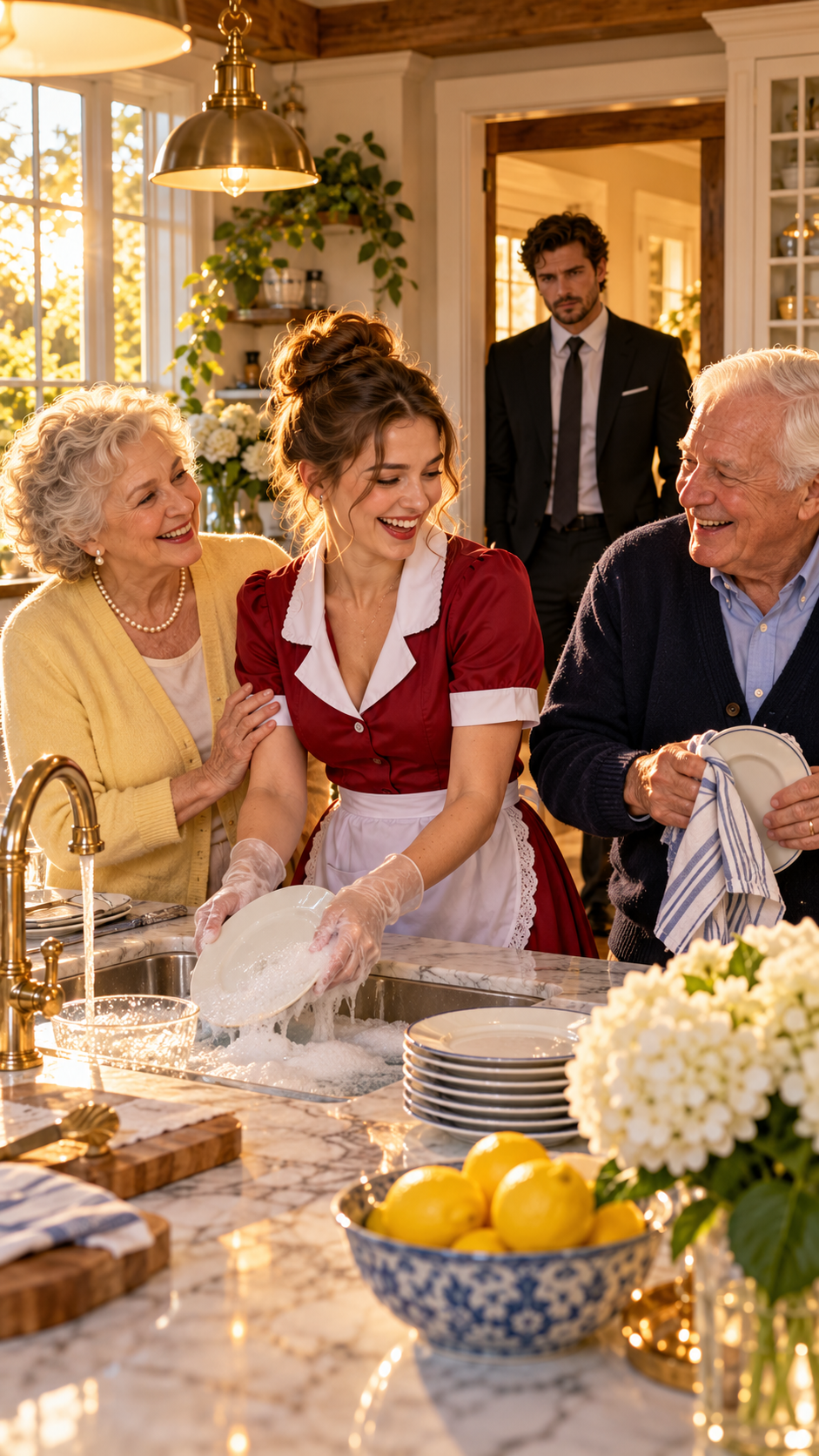
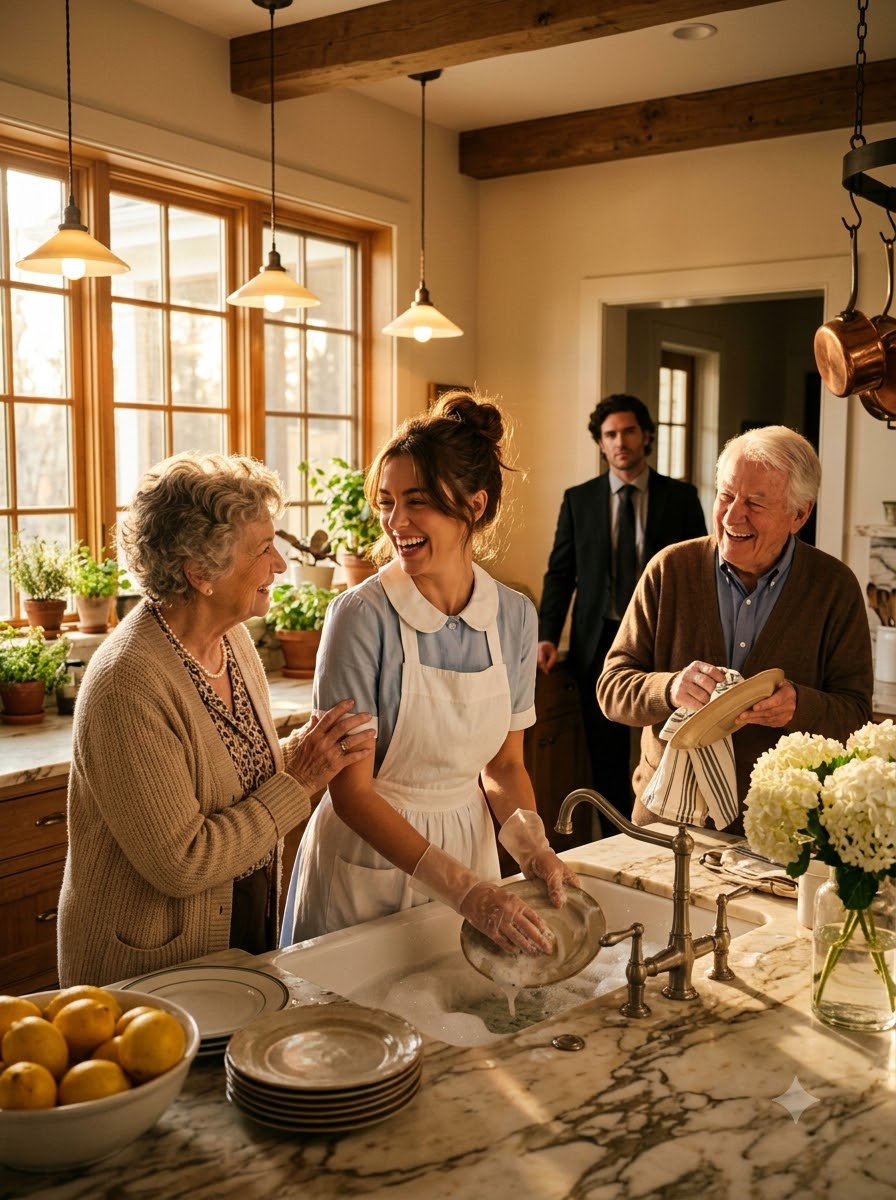
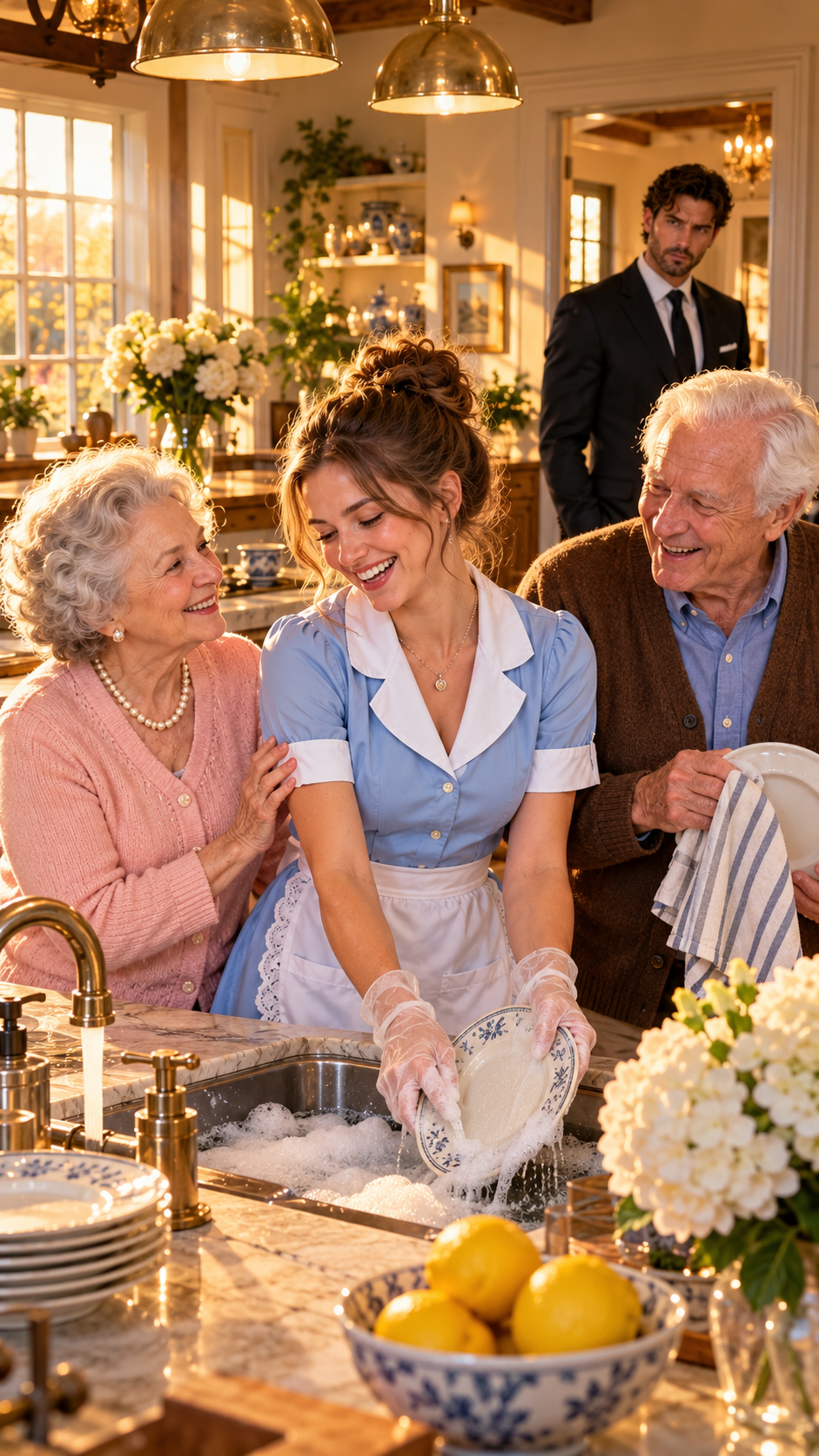
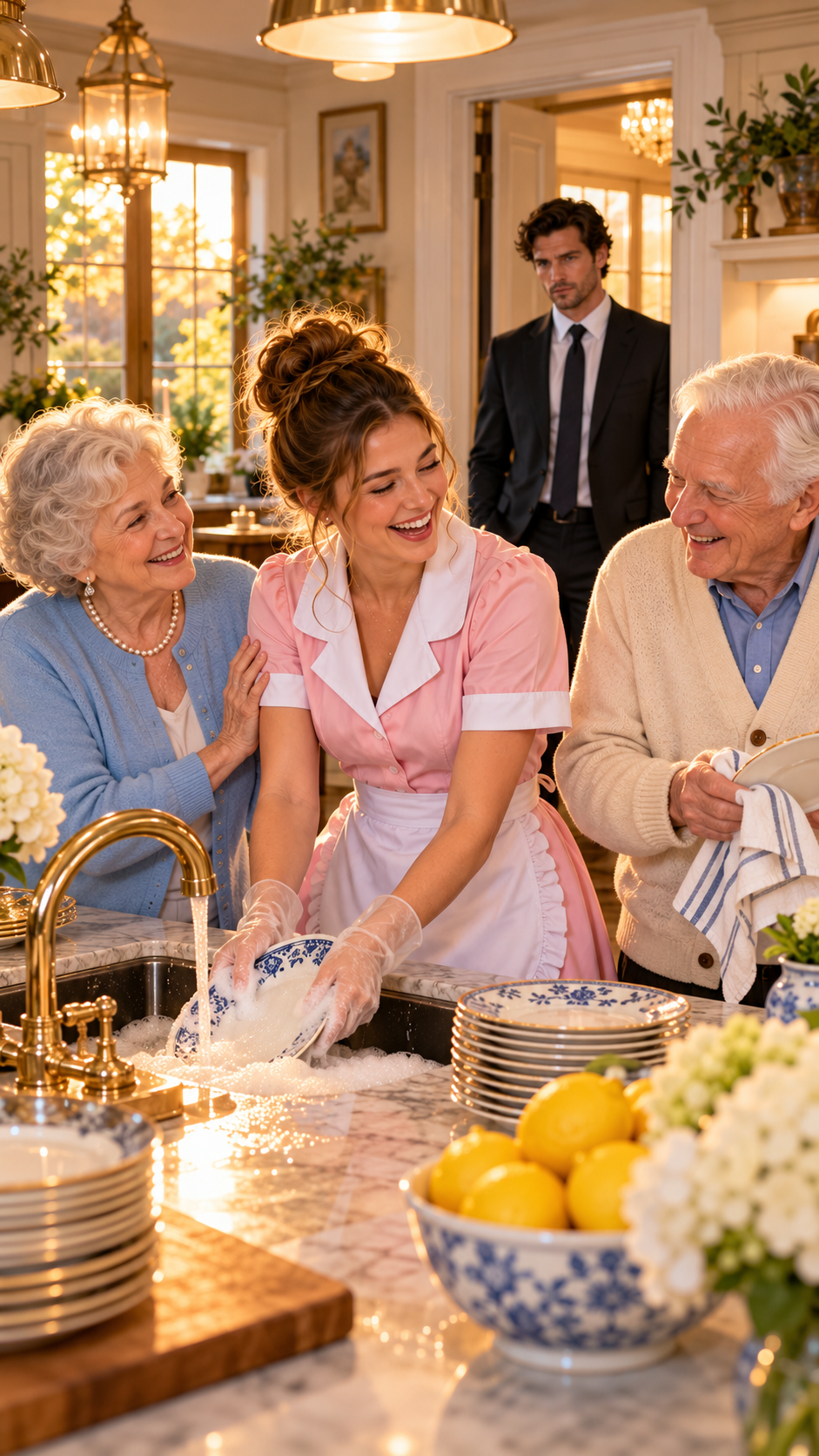
There sat his father, carefully folding cloth napkins.
Amparo stood nearby, stirring flour in a bowl while Julia supervised.
To Gabriel’s surprise, both of his parents were laughing.
“Vicente, you always leave the corners crooked!” Amparo teased.
“You… always… complaining,” he replied with difficulty.
Julia smiled at their exchange.
For a moment, Gabriel was almost overwhelmed by the sight.
He could not remember the last time his parents had looked so content.
Then Claudia appeared behind him.
“See? While she takes it easy, your parents are doing the chores.”
Gabriel’s expression hardened.
He looked at his father’s unsteady hands, then at the flour covering his mother’s fingers.
Without asking another question, he confronted Julia.
She tried to explain that the activities were part of a therapeutic routine recommended by an occupational therapist.
Folding napkins helped Vicente practice coordination and fine motor movements.
Preparing simple dough encouraged Amparo to recall familiar routines.
For thirty-five years, Vicente and Amparo had operated a small bakery in the Cabanyal neighborhood.
The smell of flour, the feel of dough, and the simple rhythm of working together helped reconnect them with memories that remained meaningful despite their health problems.
But Gabriel was too angry to listen.
“I don’t need any more explanations. You’re fired.”
Julia stood motionless.
She had expected questions.
Perhaps concern.
But not an immediate dismissal without being allowed to explain her work.
Before she could respond, Marina ran into the kitchen.
The little girl threw her arms around Julia.
“Daddy, no! Grandpa was teaching me how he used to make bread when he was young!”
Gabriel gently tried to separate them.
He told himself that his daughter was simply attached to her caregiver.
Then Vicente struck the table with his cane.
“Gabriel!”
The force in his voice silenced the room.
The elderly man rose slowly and approached his younger son.
He took Gabriel’s hand.
“Julia… isn’t leaving.”
Gabriel looked at him with concern.
“Dad, you’re confused.”
Vicente shook his head.
Then he glanced toward the hallway, making sure Ricardo was not nearby.
His fingers tightened around Gabriel’s hand.
“Your brother… wants to take our house away. And Julia… found what he was hiding.”
Gabriel stared at his father.
For several seconds, he could not speak.
Ricardo had always presented himself as the responsible older brother, the one who managed difficult family matters while Gabriel traveled for business.
The suggestion that he was trying to seize their parents’ home seemed impossible.
But Vicente’s expression was unmistakably serious.
And for the first time, Gabriel wondered whether he had been listening to the wrong people.
PART 2: The Necklace, the Accusation, and the Hidden Key
Gabriel felt as though the ground had shifted beneath him.
Before he could question his father further, Ricardo entered the kitchen.
He had apparently heard enough to understand what Vicente was saying.
“Not those stories again,” he said, attempting to smile. “Ever since the stroke, Dad has been mixing up documents and conversations.”
Gabriel turned toward him.
Ricardo appeared calm, almost amused.
But Vicente did not look away from his younger son.
That evening, Gabriel allowed Julia to remain in the house.
He did not apologize for his outburst, and the trust between them had clearly been damaged.
Nevertheless, something had changed.
For the first time in months, Gabriel began observing what happened in his home instead of relying entirely on reports from Claudia and Ricardo.
He discovered that Julia’s routines were not improvised household chores.
They were structured activities developed with professional guidance.
Vicente practiced movements that helped maintain his remaining mobility.
Amparo participated in familiar tasks that encouraged memory and conversation.
And Marina was becoming more like the cheerful child she had been before Elena died.
One morning, Gabriel entered the kitchen and found his daughter preparing toast beside her grandmother.
“Mommy used to say people love each other more when they have breakfast together,” Marina remarked.
Gabriel turned away.
He had avoided speaking about Elena because remembering her hurt too much.
Now he realized that his daughter had been carrying those memories alone.
Julia had given Marina permission to speak about her mother without fear of upsetting anyone.
That realization made Gabriel reconsider many things.
Then Julia showed him something far more disturbing.
She had found unidentified pills in a medication organizer Ricardo used during visits to their parents.
The pills did not match the prescribed medication list.
“I don’t know who put them there, but your father usually seems especially drowsy after those visits,” she explained.
Gabriel immediately contacted the geriatrician.
The doctor instructed him to keep the unidentified pills separate and arrange a careful review of the treatment regimen.
Subsequent examinations confirmed that Vicente and Amparo had genuine medical conditions.
However, certain medications could worsen confusion and drowsiness.
Gabriel could no longer dismiss his father’s concerns as symptoms of illness.
He began reviewing family documents.
What he found alarmed him.
Ricardo had requested paperwork that would give him extensive authority over the family’s properties.
Vicente still owned 52% of the company’s shares.
His authorization was essential for certain property transactions.
If Ricardo could convince others that Vicente was no longer capable of making decisions, he might gain control over assets his father had never intended to surrender.
Gabriel confronted him.
“I’ve spent years solving the problems you abandon every time you get on a plane. And now you’re going to believe an employee over me?”
Claudia immediately defended Ricardo.
Both insisted that they were only trying to protect the family.
Gabriel wanted to believe them.
But he could not ignore the documents.
What he still did not know was that Claudia and Ricardo had been meeting privately with a financial adviser.
Julia was beginning to uncover their activities.
And Ricardo had decided that she needed to disappear from the household before she found anything else.
His opportunity arrived with Vicente’s birthday.
The family organized a celebration in the garden of the Rocafort house.
Fifty-eight guests attended.
The tables were decorated with flowers, and relatives gathered to honor the elderly man who had built the family’s business from a small neighborhood bakery.
Amparo wore a pearl necklace Vicente had given her for their wedding anniversary.
Julia helped her dress and carefully fastened the necklace before returning to the kitchen.
For a while, the celebration seemed peaceful.
Vicente enjoyed seeing old friends.
Marina moved excitedly between the tables.
Gabriel allowed himself to hope that the family’s recent tensions might finally settle.
Then Claudia appeared, visibly distressed.
“The necklace is missing! Julia was the last person with Amparo!”
Conversations stopped.
Guests turned toward the house.
Ricardo immediately demanded that Julia’s belongings be searched.
Gabriel resisted at first.
He knew how damaging such an accusation could be.
But Claudia insisted that the necklace had disappeared, and Ricardo claimed there was no other reasonable explanation.
The argument escalated until someone called the police.
When the officers arrived, they spoke with those involved and examined Julia’s handbag in her presence.
Inside was Amparo’s pearl necklace.
Julia stared at it in disbelief.
“Someone put it there. I didn’t take anything.”
Ricardo stepped forward.
He claimed that Julia had experienced similar problems at a previous job.
The accusation made several guests exchange suspicious looks.
Gabriel remained silent.
And Julia looked at him.
She had defended his parents, cared for his daughter, and helped restore warmth to a grieving household.
Yet once again, he could not bring himself to stand beside her.
The silence hurt more than Ricardo’s words.
Then Amparo rose from her chair.
Her voice trembled, but her determination was clear.
“Julia didn’t take my necklace! It was Claudia! I saw her go into the room where the handbag was kept!”
Ricardo tried to interrupt.
He insisted that their mother was confused and could not reliably remember what she had seen.
But Vicente lifted his cane slightly, demanding attention.
Then he raised an old green apron.
It was the apron he had worn during his years as a baker.
The fabric was faded and worn, but he had kept it carefully.
“Gabriel… inside pocket.”
Gabriel approached.
He felt along the fabric and discovered a small hidden pocket near the seam.
Inside was a key wrapped in a folded piece of paper.
He unfolded the note.
There was an address.
A bank reference.
And a number.
Vicente gripped his son’s arm.
“Box 214. That’s where… the real reason Ricardo wants us to seem incapable… is hidden.”
Gabriel slowly looked toward his brother.
Ricardo’s face had lost its color.
For the first time that evening, the older man seemed genuinely frightened.
And Gabriel realized that the necklace might be only a small part of something much larger.
PART 3: What Box 214 Revealed About the Family
Gabriel stood in the garden with the key pressed into his palm.
Around him, the birthday guests watched in uncomfortable silence.
Some had witnessed Julia being accused of theft.
Others had heard Vicente claim that Ricardo was trying to take the family home.
Nobody knew what to believe.
Ricardo stepped toward his younger brother and reached for the key.
“That belongs to Dad’s private affairs. Give it to me, and we’ll clear up this misunderstanding tomorrow.”
Gabriel closed his fist.
“You won’t touch another document belonging to our parents until we know what’s going on.”
Ricardo’s expression hardened.
“Are you really going to turn against your own brother because of what two sick elderly people and a stranger are saying?”
Vicente slowly lifted his head.
“Sick… yes. Incapable… no.”
Ricardo fell silent.
The words were difficult for Vicente to pronounce, but their meaning was unmistakable.
He understood what was happening.
And he refused to allow his illness to be used as an excuse to take away his rights.
The police officers explained that they needed to establish how the necklace had entered Julia’s handbag.
They collected statements and requested that any relevant recordings be preserved.
Julia cooperated fully.
But before leaving to complete her statement, she approached Gabriel.
Her expression was filled with disappointment.
“When your daughter asked me why her mother couldn’t come back, I always tried to answer her with kindness and without lying to her. Today, you had the opportunity to stand up for the truth, and you chose to remain silent.”
Gabriel could not answer.
He felt ashamed.
Not because Julia had accused him of anything.
Because she had told him something he knew was true.
Julia left with a female officer.
Marina ran after her.
“Julia, come back tomorrow! Grandpa still has to teach me how to make rosquilletas!”
Julia knelt and embraced the little girl.
“Take care of your grandparents, sweetheart. And remember, you can talk about your mommy whenever you want.”
Gabriel watched from the doorway.
His daughter was facing another painful separation.
And this time, he had helped cause it.
That night, Gabriel refused to let Ricardo or Claudia remain in the house.
Claudia tried to persuade him that everything had been a misunderstanding.
“Gabriel, that woman was manipulating your parents. We were only trying to protect them.”
He stared at her.
“Then explain why my mother says she saw you near the handbag.”
Claudia immediately argued that Amparo frequently confused people and events.
Gabriel did not continue the argument.
For once, he decided to investigate before choosing whom to believe.
The following morning, he contacted Victoria Rius, a lawyer specializing in property and estate matters.
He also spoke with Santiago, the man responsible for maintaining the house.
Santiago had worked for the family for eighteen years.
He had witnessed many changes, including Vicente’s illness and the increasing influence Ricardo and Claudia had gained over household affairs.
“Mr. Gabriel, there’s something you should see,” he warned.
Santiago showed him footage from the service hallway security cameras.
The recording showed Claudia entering the room where Julia kept her personal belongings.
She remained inside for almost four minutes.
When she emerged, she looked around as though checking whether anyone had noticed her.
Gabriel watched the footage several times.
It did not show Claudia placing the necklace in the handbag.
But it directly contradicted her claim that she had never entered the room.
He gave the recording to the authorities.
Then he called Claudia.
“What were you looking for in Julia’s room?”
“Some napkins for dinner.”
“The napkins were in the dining room sideboard. You know that perfectly well.”
Silence followed.
Claudia struggled to find an explanation.
Finally, she began crying.
“Ricardo assured me that Julia was trying to get her hands on the inheritance. He said we had to make sure you fired her.”
Gabriel felt sick.
“Did you put the necklace in her handbag?”
Claudia hesitated.
“I thought you’d just throw her out. I never imagined anyone would call the police.”
Gabriel closed his eyes.
For two years, he had believed Claudia might help him rebuild the family life he had lost after Elena’s death.
He had trusted her around his daughter.
He had welcomed her into his parents’ home.
Now he knew she had participated in an attempt to destroy an innocent woman’s reputation.
He ended their engagement.
He also informed her that the conversation and available evidence would be provided to his lawyer and the authorities.
He no longer wanted explanations.
But the greatest discovery was still waiting.
With the appropriate authorization, Gabriel accompanied Vicente and Victoria Rius to the bank identified in the note.
Despite his mobility difficulties, Vicente insisted on entering the secure area himself.
He leaned heavily on his cane.
“I want… to do it myself,” he explained.
Gabriel stayed close without interfering.
Inside box 214, they found six folders and a brown-covered notebook.
Gabriel immediately recognized his father’s handwriting.
The notebook contained dated entries, suppliers’ names, payment amounts, and notes about transactions Vicente had considered suspicious.
There was also a report prepared by an independent auditor.
Gabriel began examining the records.
For nearly two years, the company had been paying for logistics services that appeared never to have been provided.
Several suppliers shared directors or addresses with businesses indirectly connected to Ricardo.
The questionable transfers amounted to approximately €2,600,000.
Gabriel felt a chill.
He had approved some financial statements without examining the underlying transactions.
Whenever questions arose, Ricardo had provided explanations.
And Gabriel had accepted them because he believed his brother was handling the details.
The folders contained even more troubling documents.
There were draft powers of attorney designed to grant Ricardo extensive control over his parents’ assets.
Other correspondence concerned the possible sale of the family home.
Gabriel found a note written by Vicente.
“Ricardo keeps insisting that I sign. He says I no longer understand business. I don’t want to lose our home.”
Beneath it was another sentence.
“I’ve asked to speak with Gabriel seven times.”
Gabriel stared at the words.
Seven times.
He remembered calls he had declined because he was in meetings.
He remembered telling his father he would call back after returning from a business trip.
He remembered Vicente attempting to show him papers one afternoon, only for Gabriel to suggest that he rest.
He had mistaken his father’s difficulty speaking for an inability to understand.
He had mistaken silence for peace.
And while he was busy protecting the company his father had created, he had failed to protect the man himself.
Gabriel placed the notebook on the table.
“Dad… why didn’t you keep trying?”
Vicente looked at him sadly.
“I did… son.”
Gabriel began crying.
“Forgive me. I left you alone when you needed me most.”
Vicente reached for his hand.
“You’re… here now.”
Those words hurt and comforted Gabriel at the same time.
He could not recover the months he had ignored his father.
But he could stop making the same mistake.
Over the following weeks, the investigation into the Ferrer family’s assets intensified.
The company’s board temporarily suspended Ricardo from his duties while an external audit examined the transactions.
Legal complaints were filed.
Measures were introduced to protect the family’s properties and prevent unauthorized decisions.
The auditors identified significant irregularities in invoices and contracting arrangements.
Some money was eventually recovered through settlements and legal proceedings.
Ricardo denied wrongdoing.
He maintained that his decisions had been necessary to protect the business.
But the documents and witness statements raised serious questions about his explanations.
The unidentified medication was investigated separately.
Vicente and Amparo’s geriatrician confirmed that some pills found in the house were not included in their prescribed treatments.
Certain substances could have worsened confusion and drowsiness.
However, investigators could not immediately determine who had introduced them or how long they had been administered.
Medical supervision was strengthened while the inquiries continued.
Gabriel understood that his parents needed more than legal protection.
They needed to be heard.
Their illnesses were real.
Vicente still struggled with speech and movement.
Amparo continued experiencing memory difficulties.
Neither regained perfect health.
But they gradually became more comfortable in their own home.
They were no longer treated as people whose opinions could be dismissed whenever they became inconvenient.
The accusation against Julia was eventually dismissed.
The hallway recording, witness statements, and Claudia’s contradictory explanations undermined the allegation.
Julia was cleared of suspicion.
Yet she did not return to work for the Ferrer family.
She moved back to her small apartment in Alboraya and began looking for another position.
Gabriel wanted to apologize.
But he knew that simply saying he was sorry would not undo the humiliation she had endured.
Several weeks passed before he finally visited her.
He carried a handwritten letter from Vicente and a drawing from Marina.
Julia opened the door and looked surprised.
“Mr. Ferrer. I wasn’t expecting you.”
“I haven’t come to ask you to return. I’ve come to apologize.”
She hesitated, then invited him inside.
Gabriel explained the evidence they had uncovered, the steps taken to protect his parents, and the consequences of Ricardo and Claudia’s actions.
Then he placed Vicente’s letter on the table.
Julia unfolded it carefully.
The handwriting was uneven.
Some letters were shaky.
But every word had been written with effort and purpose.
“Dear Julia, thank you for treating me like a man who still has something to offer. Thank you for not allowing my silences to make my voice disappear. Amparo and I will never forget what you did.”
Julia stopped reading.
She covered her face.
Tears ran between her fingers.
Gabriel waited until she lowered her hands.
“My father loves you very much,” he murmured.
“I love him too. And Amparo. And Marina.”
“Then why don’t you want to come back?”
Julia looked at him.
“Because loving someone doesn’t mean accepting humiliation.”
Gabriel lowered his head.
She explained that years earlier, while working at a nursing home, she had been accused after some belongings went missing.
There had been no evidence against her.
Nothing had ever been proven.
Nevertheless, she lost her job and spent months trying to restore her reputation.
Her husband had died shortly before that incident.
She had already been grieving when the accusation destroyed the stability she desperately needed.
“When I found work at your house, I thought I’d finally put that chapter behind me,” she explained. “But on the night of the birthday party, it happened all over again.”
Gabriel felt ashamed all over again.
“I don’t expect you to forgive me immediately. I just want you to know that I was wrong.”
Before leaving, he gave her Marina’s drawing.
It showed Vicente, Amparo, Julia, and Marina making bread together around a kitchen table.
Underneath, in the little girl’s handwriting, were the words:
“When we’re together, Grandpa laughs again.”
Julia held the drawing against her chest.
Gabriel left without asking her to change her mind.
Over the following months, he began changing the way he lived.
He delegated some responsibilities at the company and arranged to work from home several days each week.
He accompanied Vicente to rehabilitation appointments.
He attended Amparo’s medical consultations.
And he began spending his afternoons with Marina.
He discovered that his father could still recognize problems in business reports that younger executives overlooked.
Vicente needed more time to express his thoughts, but his judgment remained valuable.
Gabriel also learned that his mother’s memory was not simply disappearing.
Some things became difficult for her to recall.
Others remained wonderfully clear.
She might forget where she had placed her glasses.
But she could still explain exactly how to prepare the bread she and Vicente had sold forty years earlier.
One afternoon, while Amparo mixed flour and oil, Gabriel asked why she enjoyed those familiar activities so much.
She smiled.
“Because these hands haven’t forgotten everything they did for us.”
Gabriel never forgot that answer.
He also began listening more carefully to Marina.
His daughter started sharing memories of Elena.
She talked about songs her mother had sung, breakfasts they had prepared together, and small moments Gabriel had almost forgotten.
For years, he had avoided those conversations because they made him sad.
Now he understood that Marina needed to remember her mother without feeling responsible for protecting her father’s emotions.
As the legal proceedings involving Ricardo continued, Vicente occasionally asked about his eldest son.
“Is he… all right?”
Gabriel answered as honestly as he could.
He did not hide the seriousness of the investigation.
One day, Vicente spoke slowly.
“I love him… because he’s my son. But… he can’t make decisions for us anymore.”
Gabriel nodded.
His father had taught him something important.
Love did not require surrendering boundaries.
Nine months passed.
Julia found employment at a day center in Valencia.
She occasionally visited Vicente and Amparo, not because she was obligated to care for them, but because she genuinely loved them.
Gabriel never offered her the old position again.
Instead, he began getting to know her outside the circumstances that had first brought them together.
At first, they shared coffee after her visits.
Later, they walked through the Turia Gardens.
They talked about their childhoods, their losses, and the ways grief had changed them.
Julia discovered a different side of Gabriel.
Without the constant pressure of business, he could be thoughtful, gentle, and surprisingly humorous.
Gabriel learned that Julia dreamed of creating a community space where elderly people could cook, share memories, and enjoy companionship.
Their friendship deepened gradually.
Neither wanted to rush.
Then one afternoon, while walking along Malvarrosa Beach, Gabriel stopped.
“Julia, I’ve fallen in love with you. But I want you to know that I don’t expect anything in return for what you did for my family.”
Julia remained silent for a moment.
Then she reached for his hand.
“I have feelings for you too. I just needed to be sure that you’d learned to see me as a person, not as someone who was supposed to solve all your problems.”
Gabriel smiled.
“I still have a lot to learn.”
“Then we can learn together.”
They began a relationship built on mutual respect.
Julia continued her professional work.
Gabriel never treated her affection as an extension of her former responsibilities.
And Marina welcomed the news with undisguised happiness.
Some time later, Gabriel reclaimed the family’s old bakery premises in Cabanyal.
Together with Julia and several professionals, he transformed the space into a community center for older adults.
They organized traditional cooking classes, memory workshops, artistic activities, and gatherings that brought different generations together.
They called it La Mesa Verde.
The name honored the old green apron Vicente had kept for so many years.
The apron that had once concealed the key to box 214.
On opening day, the former bakery filled with people.
Amparo prepared dough with Julia’s help.
Marina handed napkins to the guests.
Vicente looked around the room where he and his wife had once worked side by side.
The walls had changed.
The equipment was different.
But the smell of fresh bread brought back memories that made him smile.
When someone asked him to speak, Vicente slowly stood.
“Here… we learned to work,” he said. “And now… we want no one to forget… that they can still do something beautiful.”
Applause filled the room.
A year later, Gabriel and Julia celebrated a simple wedding in the garden of the Rocafort house.
Marina carried the rings.
Amparo wore her recovered pearl necklace.
Vicente sat beneath an orange tree with the old green apron folded across his knees.
After the ceremony, Gabriel approached his father.
“Would you like to help me clear away the cups?”
Vicente looked up and smiled.
“As long as… you don’t fire Julia… this time.”
Gabriel burst out laughing.
So did his father.
Amparo overheard them and began singing a song she used to sing while kneading bread.
Marina joined in.
Julia appeared carrying a dish towel.
Gabriel stood for a moment, watching the people he loved.
He remembered the afternoon he had returned from Barcelona furious, convinced that his parents were being exploited.
He had seen them folding napkins and preparing dough.
He had assumed that the activities were humiliating.
He had failed to notice the laughter.
He had failed to ask why they looked happier than they had in months.
And he had nearly driven away the woman who had helped them regain something no fortune could purchase.
The feeling of being useful.
The joy of participating.
The dignity of being treated as people who still had something to offer.
Vicente pointed toward a cup in Gabriel’s hand.
“That one… is still wet.”
Gabriel smiled and dried it again.
His father nodded approvingly.
Years later, the old green apron still hung beside the kitchen.
Its fabric was faded, and the small seam concealing the hidden pocket remained visible.
Nobody wanted to repair or replace it.
It reminded the family of the day Vicente had refused to let others speak for him.
It also reminded Gabriel that illness, disability, or difficulty remembering did not erase a person’s judgment, history, or right to be respected.
He had once believed his greatest mistake was trusting Ricardo.
Now he understood that the deeper failure had been refusing to listen to his parents when they needed him most.
That evening, after the last guests had departed and the wedding decorations were being cleared away, Vicente asked Gabriel to sit beside him.
Gabriel immediately did.
His father took several seconds to gather the words.
“Before… you never had time.”
Gabriel reached for his hand.
“Now I do, Dad.”
Vicente smiled.
Then he slowly rested his head against his son’s shoulder.
Gabriel remained beside him in the quiet garden.
He knew that no amount of money could return the years he had spent being too busy to listen.
He could not undo the missed conversations, the unanswered calls, or the moments when his father had tried to warn him.
But he could make a different choice now.
He could listen.
He could stay.
And he could make every day they still had together matter.
Because the greatest inheritance Vicente Ferrer had ever given his son was not the company, the family home, or the fortune hidden behind financial records.
It was the understanding that love means very little unless the people we claim to love can feel it in the way we treat them.
