

Part 1: The Girl They Decided Didn’t Belong
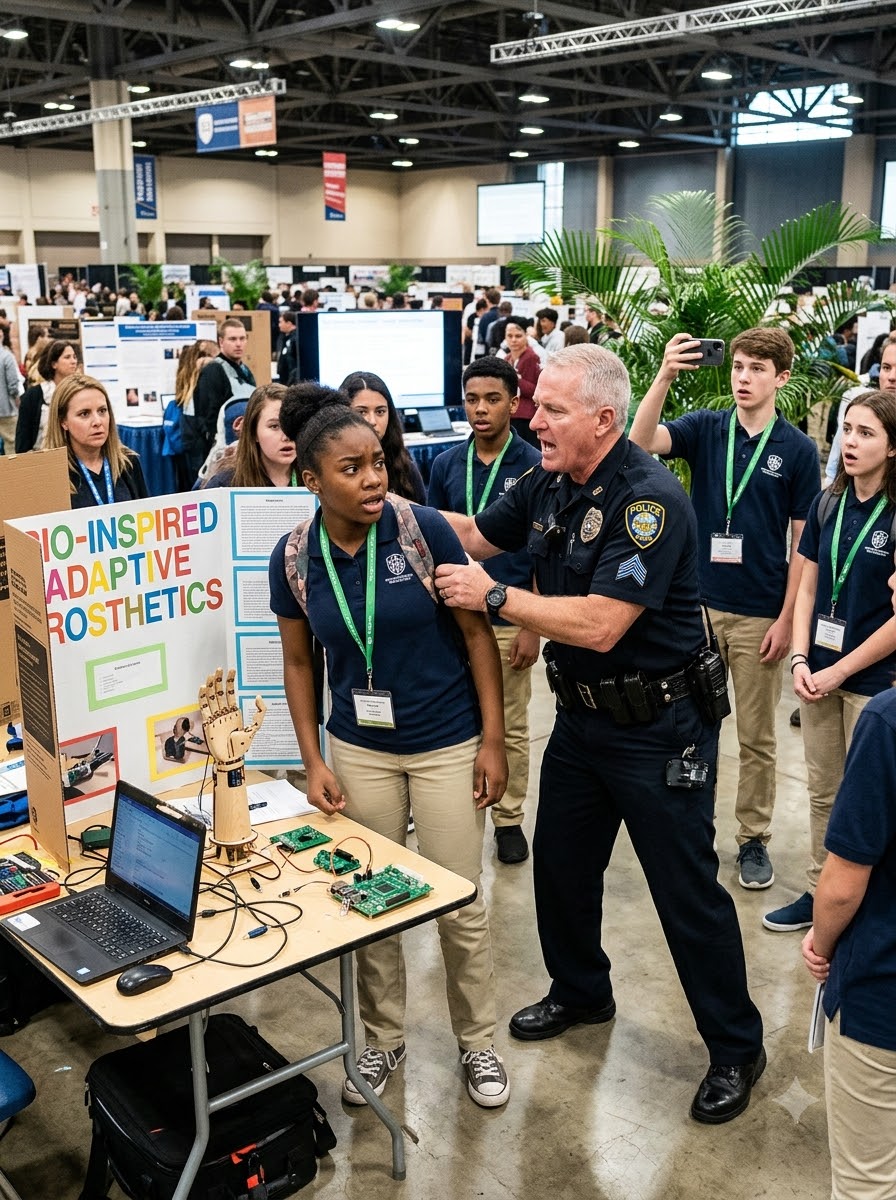
“Get your hands off that equipment before I call the real police.”
Officer Dale Cunningham’s voice thundered across the crowded exhibition hall, drawing startled glances from nearby students and parents.
Before sixteen-year-old Amara Jefferson could respond, his hand shot forward and seized the strap of her backpack.
Hard.
“This area is for actual participants, not thieves.”
Amara stumbled backward, struggling to keep her balance. Her heart was pounding, but she forced her voice to remain controlled.
“Sir, I am a participant. My booth is number 23. I have my badge.”
“I don’t care what number you think you have.”
Cunningham snatched the poster board from her display. The cardboard tore beneath his fingers before he threw it onto the floor.
“Where’d you steal this stuff?”
He pointed accusingly toward the exposed circuitry on her table.
“These circuits look expensive.”
“I built them myself. I can show you my documentation.”
“Sure you did.”
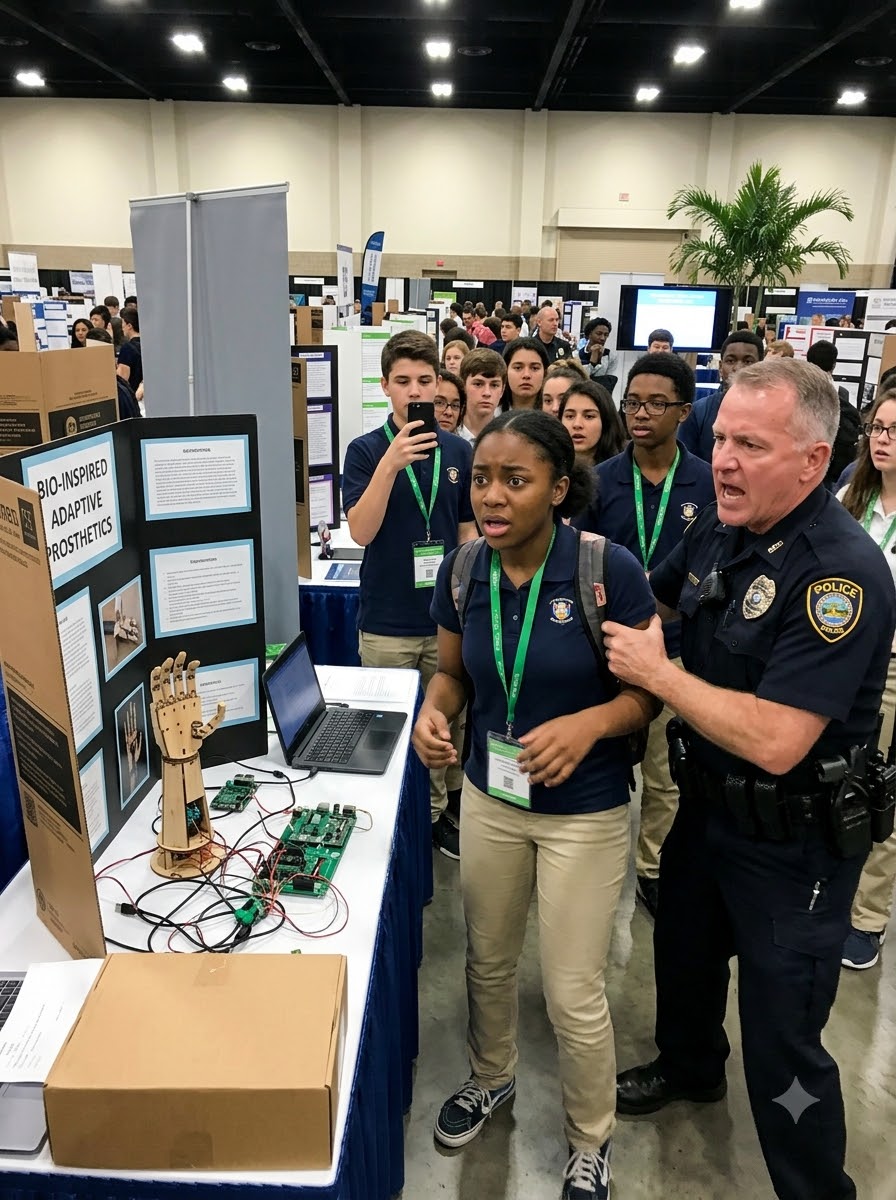
His hand closed around her upper arm.
“You’re coming with me now.”
All around them, conversations stopped.
White parents guided their children away. Several students stared at their phones, pretending not to notice. Others watched without saying a word.
Nobody stepped forward.
And Amara, who had spent eighteen months building a medical device that could change people’s lives, suddenly found herself being treated like a criminal before she had even presented it.
Only a few hours earlier, she had believed this would be the most important day of her life.
Amara was a junior at Lincoln Technical High School on Chicago’s South Side. She was sixteen, brilliant, determined, and accustomed to working harder than most people realized.
Her mornings began at 5:30.
In the small apartment she shared with her grandmother, the alarm would sound while the city outside was still dark. Coffee brewed in the kitchen, mingling with the familiar lavender fragrance of her grandmother’s soap.
Amara studied beneath the single kitchen light while her grandmother prepared for another shift at the hospital.
Getting to school required two buses and forty-five minutes each way.
She used those journeys to write code on a refurbished laptop with a cracked screen. Her headphones kept out the surrounding noise, allowing her to concentrate on algorithms while the bus rattled through Chicago.
The computer wasn’t impressive.
But it worked.
That was enough.
Amara’s father had been an electrician. He died in a workplace accident when she was twelve, leaving behind memories, tools, and the practical skills he had patiently taught his daughter.
Her mother served overseas as an Army medic, sending money whenever possible.
At home, thin apartment walls offered little privacy. Arguments from neighboring units often continued late into the night.
Amara learned to study through all of it.
She maintained straight A’s, perfect attendance, and membership in the National Honor Society. Her classes included AP Physics and AP Calculus.
She completed scholarship applications whenever she could, sometimes writing them by hand after the school’s computer lab closed.
Yet none of those accomplishments mattered to her as much as the project she had carried across the country.
NeuroConnect.
A low-cost prosthetic arm controlled through neural signals.
The idea began with her neighbor, Mr. Washington, who lived in apartment 3C.
Three years earlier, a factory accident had taken his left arm. His insurance company denied his claim, and a commercial prosthetic costing approximately $50,000 was far beyond his means.
Amara watched him struggle with everyday tasks most people performed without thinking.
Opening doors.
Carrying groceries.
Holding his grandchildren.
She wondered why a medical device capable of restoring some of those abilities had to cost more than many families earned in an entire year.
Then she began researching.
She studied neural interfaces, brain-computer communication, signal processing, and prosthetic engineering.
She visited the recycling center near her school, collecting discarded motherboards, sensors, wiring, and electronic components.
For eighteen months, she worked in a cramped school science laboratory, often remaining long after classes ended.
Her teacher, Ms. Carter, sometimes stayed to help her troubleshoot.
On weekends, Amara visited the public library and read scientific papers that initially seemed almost impossible to understand.
Gradually, the unfamiliar concepts began making sense.
Her first successful prototype wasn’t beautiful.
The plastic casing had been 3D-printed and was slightly uneven. Wires remained visible through sections of the housing.
But the arm worked.
The previous month, she had fitted the prototype to Mr. Washington and calibrated its sensors.
When he concentrated on moving his fingers, the mechanical fingers responded.
For the first time in three years, he could control a hand again.
He cried.
Amara cried with him.
The entire prototype had cost $247.
In March, NeuroConnect won first place at the Illinois State Science Fair.
The judges were astonished that a student without institutional funding or access to a professional research laboratory had created something so promising.
That victory qualified her for the National Youth Science and Innovation Expo in Washington, D.C.
Fifty finalists would compete for the National Medal of Science Youth Division.
The winner would receive a $100,000 scholarship, presidential recognition, and an opportunity for a research internship at MIT or Stanford.
For Amara, the prize represented something greater than personal success.
It could help bring NeuroConnect to people who needed it.
Her grandmother managed to save $400 for the journey.
A flight was too expensive, so Amara spent fourteen hours on an overnight Greyhound bus, protecting her prototype inside a carefully packed cardboard box.
When she reached the Washington Convention Center that morning, she carried a backpack, a poster tube, and the most important eighteen months of her life.
Her outfit was simple.
Pressed khakis.
A navy-blue school polo.
Clean but worn sneakers.
She looked around the enormous convention center, trying not to feel overwhelmed.
Glass walls reflected the morning light. Marble floors stretched beneath towering ceilings. Professional exhibition displays filled a hall large enough to hold several football fields.
Other finalists arrived with parents, advisers, expensive equipment cases, and professionally printed banners.
Some displays had dedicated lighting.
Others included sophisticated robotics or genetic analysis equipment.
Amara had a cardboard box and hand-drawn poster boards.
But she knew what was inside that box.
At exactly 8:00 a.m., she approached registration.
Jennifer Hartley, the silver-haired volunteer coordinator, was warmly assisting a white family.
“Welcome to the expo.”
Jennifer smiled as she handed over their badges.
“Your daughter’s project sounds wonderful. Booth 47 is in the prime center aisle.”
Amara waited patiently.
When Jennifer finished, her gaze passed over Amara and moved toward the people standing behind her.
“Excuse me,” Amara said politely.
“I’m a finalist. Amara Jefferson, booth 23.”
Jennifer’s welcoming expression disappeared.
She examined Amara’s sneakers, uniform, and cardboard tube.
“Booth 23.”
Her tone suggested disbelief.
“That’s the biomedical engineering section.”
“Yes, ma’am. I’m presenting a neuroprosthetic interface.”
Jennifer checked the computer, clicking through several screens.
“Hm. It does show your name here.”
She hesitated.
“Did someone help you with the application? A teacher? Parents?”
“I filled it out myself.”
Jennifer printed a badge and slid it across the counter.
It was yellow.
Amara examined it.
“This says visitor. I need a finalist badge.”
“Oh.”
Jennifer sounded irritated.
“Let me reprint it.”
She produced the correct green badge without apologizing, then immediately turned toward the next person.
Amara headed into the exhibition hall.
Booth 23 stood in a back corner, away from the main flow of visitors and the judges’ entrance.
To her left, Exit Prep Academy had installed a polished robotics display beneath an expensive banner.
To her right, Thornton Private Academy presented a genetics project with a glass case and professional DNA models.
Amara’s assigned space contained only a folding table and black backdrop.
She began unpacking.
Her diagrams were carefully drawn in marker. The research pages were printed on ordinary paper and stapled together.
They weren’t glossy.
They were accurate.
That mattered more.
“Excuse me.”
Amara turned.
Brian Mitchell, an event coordinator in his thirties, stood behind her holding a clipboard.
“Are you waiting for the participant? We need all booths set up by 9.”
“I am the participant.”
Brian glanced at her materials.
“Oh, where’s your faculty adviser? Students under 18 need supervision.”
“My mentor is Dr. Patricia Carter from MIT. She’s attending virtually. She submitted all the required forms.”
Brian checked his list.
“Right, Carter. Got it.”
As he walked away, Amara heard him mutter to another staff member.
“They really lowered the bar this year.”
The remark stung.
She swallowed the hurt and continued working.
By 8:30, the hall was alive with preparations.
Parents adjusted lighting. Students practiced presentations. Photographers arranged equipment.
Amara worked alone.
She positioned her posters, opened her laptop, and carefully placed NeuroConnect on the table.
She was connecting the final cable when she became aware of someone standing nearby.
A tall white security officer in his mid-forties was watching her.
His uniform was dark blue, and his belt carried handcuffs, a flashlight, and a radio.
The name tag read D. Cunningham.
“Where’d you get this?”
He pointed toward her circuit boards.
“I built it. It’s my project.”
Cunningham stepped closer.
“These components look expensive.”
“I sourced them from recycling centers and donations. I have all the documentation.”
“You have receipts.”
“Some parts were donated. I have letters from the donors. It’s all in my project binder.”
Cunningham lifted his radio.
“Yeah, this is Cunningham.”
He continued speaking into it.
“Got a situation at booth 23. Need you to run a check on some suspicious equipment.”
Amara felt her stomach tighten.
“Sir, I’m a registered finalist. You can verify with—”
“Anyone can print a badge.”
He inspected her green identification card as though it were counterfeit.
“I’m going to need you to come with me for verification.”
“The doors open in 20 minutes. I need to finish setting up.”
Cunningham raised his voice.
“I’m not asking, I’m telling you.”
He leaned over her table.
“This area is for actual participants, not kids looking to steal equipment.”
Amara’s hands began trembling.
“I am an actual participant. You can check with the coordinator or the head judge or show me your student ID.”
She handed him her Lincoln Technical High School identification.
He barely examined it.
“This does not prove you’re supposed to be here.”
His expression hardened.
“For all I know, you snuck in and grabbed someone else’s project.”
“That’s not true.”
Amara reached for her documentation binder.
Cunningham immediately seized her backpack strap.
“Don’t touch anything. If this is evidence, it stays exactly where it is.”
“Evidence of what? I haven’t done anything wrong.”
Nearby students turned.
A young man at booth 24 began recording.
Cunningham pulled down one of her posters, tearing the corner, and threw it onto the floor.
“You can collect your stuff after we verify you’re supposed to be here. Let’s go.”
He gripped her arm.
“Sir, please don’t touch me. I’ll come with you, but please don’t make this harder than it needs to be.”
His fingers tightened.
A mother nearby whispered to her daughter.
“Stay away from that booth.”
Brian Mitchell noticed the confrontation.
He looked directly at Amara.
Then he turned and walked away.
Cunningham marched her toward a rear corridor, leaving her laptop running and the prosthetic arm unattended.
His radio crackled.
“Cunningham, you need backup.”
“Nah, just a shoplifter trying to blend in. Got it handled.”
“I’m not a shoplifter.”
Amara’s voice broke.
“My name is Amara Jefferson. I’m booth 23. Please just call the head judge, Dr. David Reynolds. He knows me.”
Cunningham laughed.
“Sure he does. Let me guess. You’re his special little project.”
The words were familiar in the worst possible way.
Amara had heard that tone in stores where security followed her and in restaurants where employees watched her as though she might steal.
Now it was happening at the competition she had worked so hard to reach.
They entered a concrete hallway where fluorescent lights flickered overhead.
No cameras were visible.
Cunningham released her arm.
Amara rubbed the painful spot.
“Empty your backpack. Everything now.”
“You can’t search my belongings without probable cause.”
His face reddened.
“Probable cause? Listen to this one.”
He leaned closer.
“Been watching TV lawyers.”
Then came the threat.
“Either you cooperate or I call the real cops. Tell them you were belligerent. Resisting. See how that goes for you.”
Amara thought about her grandmother.
Mr. Washington.
The sleepless nights.
Her one chance.
She slowly opened her backpack and placed her laptop, tools, notebooks, and research documents on the floor.
Cunningham examined them as though searching for something incriminating.
He held up her wire cutters.
“Why does a science student need these?”
“For electrical work. It’s standard.”
“Standard for what? Breaking into things.”
He opened her laptop and began examining the files.
“What’s all this code? You hacking something?”
“That’s Python. It’s a programming language for the neural interface I built.”
“Neural interface?”
He shook his head.
“Where’d you really get this equipment?”
“I told you I built it. I salvaged parts. I have donor letters.”
“Salvaged? That’s just another word for stolen, isn’t it?”
Amara felt tears burning behind her eyes.
She refused to let them fall.
The public-address system sounded.
“Expo doors opening in 5 minutes. Judges will begin rounds at 9:15 a.m.”
Her presentation was slipping away.
Cunningham took out his phone.
“I’m calling the D.C. Metro Police. Let them sort this out.”
“Please.”
The word escaped before she could stop it.
“Please, sir. This is my one chance. I worked so hard. I can prove everything. Just let me go back.”
He looked at her without sympathy.
“Should have thought about that before you showed up here with borrowed equipment.”
Then he dialed.
And as Amara listened to him report her as a suspected thief, she realized the competition might end before anyone even saw what she had built.
Part 2: Forty Minutes That Nearly Destroyed Everything
The hallway felt colder with every passing minute.
Beyond its concrete walls, the National Youth Science Expo was opening to visitors.
Inside, Amara Jefferson stood beside her scattered belongings while Dale Cunningham spoke to the police.
“Yeah, this is Officer Dale Cunningham, private security at the National Youth Science Expo, Washington Convention Center. I’ve detained a juvenile suspect. Possible theft of electronic equipment. Need an officer to verify ownership.”
“Sir, please.”
Amara stepped forward.
“Just call Dr. David Reynolds. He’s the head judge. He can verify everything.”
Cunningham covered his phone.
“You’re not in a position to make demands.”
He finished the call and turned toward her.
“They’ll be here in 20 minutes. Until then, you stay put.”
Twenty minutes.
By then, the judges would already be evaluating projects.
Even if someone eventually cleared her name, she might lose the opportunity she had traveled fourteen hours to reach.
Amara clenched her fists, then forced her fingers to relax.
A second security officer entered the corridor.
He was younger, Latino, and wore a badge identifying him as M. Torres.
“Dale, what’s going on?”
“Got a theft situation. Equipment doesn’t match her profile.”
Torres examined the electronics and notebooks on the floor.
“This stuff looks like science supplies. She is at a science expo.”
“That’s what I’ve been trying to tell him,” Amara said.
Cunningham glared at her.
“I didn’t ask you to speak.”
Torres picked up one of her notebooks.
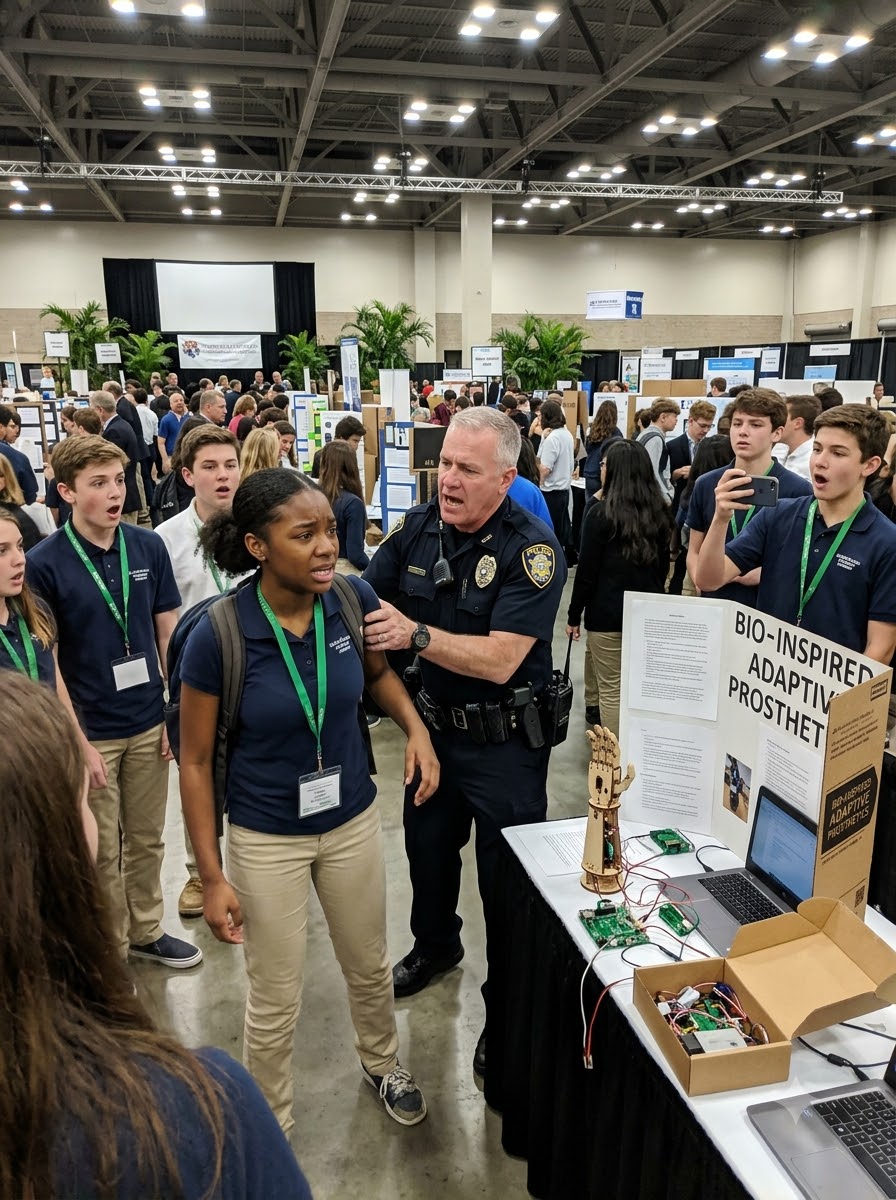
He turned through pages of calculations, circuit diagrams, revisions, and dated annotations.
“Dale, this is clearly her work. Look at the handwriting. The dates go back months.”
“Could be copied. Could be someone else’s research.”
Torres shook his head.
“This is detailed. Original annotations, personal notes.”
Cunningham took the notebook from him.
“Just back me up on this. All right. Something’s off.”
Torres hesitated.
His expression suggested he knew the situation was wrong.
But he said nothing further.
Brian Mitchell appeared holding his clipboard.
“What’s the holdup? Her booth is still empty.”
Cunningham pointed toward Amara.
“Need you to verify if this individual is actually registered.”
Brian checked his tablet.
“She’s registered. Amara Jefferson, booth 23, biomedical engineering.”
Amara waited for him to tell Cunningham to release her.
Instead, the officer continued.
“Registration might be legit. But that doesn’t explain where she got this equipment. These are expensive components. Where’s the proof of purchase?”
“I told you,” Amara said.
“Some parts were donated, some I bought, some I salvaged from recycling. I have documentation.”
“Salvaged.”
Cunningham turned toward the other men.
“That’s just another word for stolen. She probably grabbed these from trash bins.”
“That’s not illegal,” Torres said quietly.
“It is if the equipment was thrown out but still belongs to the company. That’s theft of corporate property.”
Amara could hardly believe what she was hearing.
Every explanation became another accusation.
“I have permission letters,” she insisted.
“From the recycling center, from my school, from the donors.”
“Letters can be forged.”
Cunningham raised his phone again.
“I’m calling the police back, telling them to expedite.”
Brian shifted his weight.
“Look, the judges are about to start rounds. If she’s registered, maybe…”
“Maybe what? Let her walk off with stolen property.”
Cunningham’s voice sharpened.
“You want that liability?”
Brian looked toward Amara.
For one hopeful moment, she thought he might finally defend her.
Instead, he checked his watch.
“Just resolve it quickly.”
He walked away.
The announcement system sounded again.
“Judges beginning the first round. All finalists should be at their booths.”
Amara blinked rapidly.
“Please,” she whispered.
“My project is unattended. Someone could damage it. Please.”
Cunningham folded his arms.
“Should have thought about that before.”
“Before what?”
Her frustration finally broke through.
“Before being black at a science fair.”
The hallway fell silent.
Torres lowered his eyes.
Cunningham’s face darkened.
“You want to play that card? This has nothing to do with race. This is about suspicious activity.”
“What’s suspicious? A student at a student science fair?”
“A student whose equipment doesn’t match her background?”
“My background?”
Amara stared at him.
“What background is that?”
He refused to answer.
Torres tried to intervene again, but Cunningham cut him off.
“Dale, maybe you should remember who’s the senior officer here. I’ve been doing this for 20 years. I know it’s suspicious when I see it.”
He reopened Amara’s laptop and began reading her emails.
“Sir, that’s private. You need a warrant.”
“I need probable cause, which I have. Suspected theft.”
He examined her correspondence with researchers, teachers, and scholarship organizations.
“Who’s Dr. Patricia Carter?”
“My mentor from MIT. She’s been helping me remotely.”
“Remotely?”
He looked at her school identification.
“So, an MIT professor is mentoring a kid from…”
He paused.
“Lincoln Technical High School, Chicago’s South Side.”
“Yes. She saw my research proposal and offered to help.”
“Why would she do that?”
Amara understood what he was implying.
“Because my work is good,” she answered quietly.
Cunningham snorted.
“Right.”
He found another email.
“What’s this? Congratulations on national medal finalist pool. This real?”
“Yes, that’s why I’m here.”
“National medal you?”
He laughed.
“What’s your GPA?”
“4.0.”
“At what kind of school?”
“A public magnet school. One of the top STEM programs in Illinois.”
“Public school.”
His contempt was unmistakable.
“And they just let you use all this equipment.”
“My teacher stayed late to supervise. I signed equipment logs. I followed every protocol.”
Cunningham examined a circuit board.
“This soldering work is pretty clean. Professional level. You do this yourself?”
“Yes.”
“With no help.”
“My father was an electrician. He taught me before he died.”
“Convenient story.”
Amara’s throat tightened.
“It’s not a story. It’s my life.”
“And where’s your mom?”
“Deployed military.”
“So, you’re here alone? No supervision.”
“Dr. Carter is attending virtually. My grandmother is in the city.”
“I can call your grandmother.”
He exchanged a glance with Torres.
“Does she even know you’re here?”
“Of course. She helped pay for my bus ticket.”
“Bus ticket? You took a bus from Chicago?”
“I couldn’t afford a flight.”
Cunningham leaned back, smiling as though he had finally uncovered something.
“So, let me get this straight. You’re a scholarship kid from the South Side. Took a bus 14 hours. Showed up with equipment you built from garbage. No parents. And you expect me to believe you’re a national medal finalist?”
“I am a finalist.”
“Oh, I’m sure your name is on some list. Probably some diversity quota thing.”
He made mocking quotation marks with his fingers.
“But that doesn’t mean you built this.”
Torres stepped forward.
“Dale, that’s enough.”
“I’m doing my job.”
“Your job is security, not interrogation.”
“My job is protecting this event from people who don’t belong.”
Amara looked at him.
Those words hurt more than the others.
Not because they were unfamiliar.
Because she had spent so much of her life proving she belonged in rooms where people like Cunningham had already decided otherwise.
The radio crackled.
“All units be advised. Head judge Dr. Reynolds is looking for the booth 23 participant. Repeat. Requesting Amara Jefferson.”
Amara’s heart leaped.
Cunningham raised the radio.
“Tell him she’s unavailable. Security matters.”
“Copy that.”
“That’s the head judge,” Amara pleaded.
“He knows me. Please let me go to him.”
“If he wants to talk, he can come here.”
“My project is unattended.”
“Your project is fine.”
But she couldn’t know that.
Her prototype contained delicate wiring and components that had taken months to assemble and calibrate.
One careless movement could destroy everything.
Tears finally slid down her cheeks.
Cunningham noticed.
“See, guilty conscience.”
“That’s not—” Torres began.
“Go check the main hall. I’ve got this.”
Torres hesitated.
Then he left.
Amara was alone with Cunningham.
He stepped closer and lowered his voice.
“Here’s what’s going to happen.”
He pointed toward the belongings on the floor.
“You’re going to admit you took this equipment without permission. Tell me where you really got it.”
He paused.
“Then the cops decide what to do.”
Another pause.
“Or you can make this easy. Pack up, leave, go home.”
“I won’t,” Amara whispered.
“I worked too hard.”
“Then you’re making a mistake.”
The PA system sounded again.
“Judges beginning second round. Booth 23, please report. Final call for booth 23.”
Cunningham smiled.
“Sounds like you’re disqualified anyway.”
Amara closed her eyes.
She remembered her grandmother’s encouragement.
Stay strong.
Stay dignified.
She opened her eyes and faced him.
“I’m not going anywhere and I’m not admitting to something I didn’t do.”
His smile disappeared.
“We’ll see how tough you are when the cops get here.”
Then footsteps echoed from the far end of the hallway.
Several people were approaching quickly.
A man’s voice rang out.
“Officer, what is happening here?”
Cunningham turned.
Dr. David Reynolds stood at the entrance.
He was sixty-two, with silver hair, wire-rimmed glasses, and a navy blazer.
Beside him was Katherine Woo, the expo director, dressed in a tailored black suit and carrying a tablet.
Three other judges followed.
None of them looked pleased.
“I asked you a question, officer.”
Dr. Reynolds’s voice was cold.
“What is happening here?”
Cunningham straightened.
“Security matter, sir. Suspected theft. I’m handling it.”
“Suspected theft.”
Dr. Reynolds approached.
“Theft of what?”
“She has equipment that doesn’t match her background. Expensive components. No proof of ownership.”
“Her background.”
Dr. Reynolds stopped directly in front of him.
“Explain that statement.”
Cunningham hesitated.
“I mean, she’s a student. The equipment looks professional. I was verifying.”
“You were verifying nothing.”
Dr. Reynolds turned toward Amara.
“Amara, are you all right? Did he hurt you?”
She struggled to steady her voice.
“He grabbed my arm, searched my things without permission, kept me here for 40 minutes.”
Dr. Reynolds’s expression hardened.
“This young woman is Amara Jefferson, one of three finalists for the National Medal of Science Youth Division. I have been her remote mentor for 14 months. I have reviewed every component of her project, every circuit, every line of code.”
Cunningham stared at him.
“I didn’t know.”
“You didn’t ask.”
Dr. Reynolds opened the folder he carried.
“Here is her complete documentation. Receipts, donation letters, permission forms, time logs showing 18 months of work, all verified, all legitimate.”
He held out the papers.
Cunningham didn’t take them.
Katherine Woo stepped forward.
“Officer Cunningham, you detained a national medal finalist.”
“Ma’am, I was doing my job. She looked suspicious.”
“Looked suspicious how?”
Katherine’s voice sharpened.
“Be specific.”
“She had expensive equipment, and she’s from…”
He stopped speaking.
“From where?”
Katherine waited.
“Finish that sentence.”
Cunningham remained silent.
Dr. Michelle Johnson, a Black neuroscience researcher, stepped forward.
“Because she’s black.”
She looked directly at him.
“Is that what you’re not saying?”
“No, that’s not what I meant. I didn’t.”
“For what?” Dr. Anjali Patel interrupted.
“For a teenage girl. For a public school student.”
Cunningham could no longer find an explanation.
A young man appeared at the corridor entrance.
He was the student from booth 24.
“Excuse me. I recorded everything from the beginning.”
Katherine turned.
“You recorded this?”
“Yes, ma’am. I was worried. The way he grabbed her looked wrong.”
“Send that to me immediately.”
The student transferred the video.
Katherine opened it.
Cunningham’s voice played through the tablet.
“This area is for actual participants, not kids looking to steal equipment.”
The recording showed him grabbing Amara, tearing her poster, and ignoring her repeated explanations.
Katherine watched.
Her expression grew colder.
When the video ended, she faced Cunningham.
“You’re relieved of duty. Badge and radio. Now.”
“Ma’am, please. I can explain. I made a judgment call.”
“A judgment call based on racial profiling.”
She extended her hand.
“Badge, radio, phone, all of it.”
“I have a family. I need this job.”
“You should have thought about that before you assaulted a minor.”
Her hand remained outstretched.
“Everything now.”
Cunningham’s fingers trembled as he surrendered his equipment.
Dr. Reynolds turned toward Amara.
“Amara, I am profoundly sorry. This should never have happened. We’re going to get your project set up. You’ll have an extended time.”
“My booth?”
Her voice shook.
“Is my equipment still there?”
“Everything’s intact. Some items scattered, but nothing damaged.”
Katherine was already making a call.
“Yes, this is Katherine Woo, expo director. I need D.C. Metro Police at the Washington Convention Center immediately. We have assault, illegal detention, and civil rights violations involving a minor.”
She listened.
“Yes, the suspect is secured. We have video evidence.”
Cunningham stared at her.
“You’re calling the police on me?”
Dr. Johnson answered.
“You called them on an innocent child?”
Her voice remained cold.
“Turnabout is fair play.”
Torres returned and stopped when he saw Cunningham without his badge.
“Dale, what did you do?”
“I made a mistake,” Cunningham whispered.
“I’m sorry. I didn’t know.”
Dr. Reynolds shook his head.
“You didn’t want to know.”
His voice grew quieter.
“You saw a Black teenager with scientific equipment and you assumed criminality. You assumed she didn’t belong.”
“I was trying to protect—”
“You were protecting your own prejudices.”
Two Metropolitan Police officers entered the corridor.
“Someone called about an assault.”
Katherine indicated Cunningham.
“This man illegally detained a 16-year-old finalist, searched her without cause, physically grabbed her, destroyed her property. We have video and witnesses.”
The female officer faced him.
“Sir, turn around and place your hands behind your back.”
“Wait, please. This is a misunderstanding.”
“Turn around. Hands behind your back.”
Cunningham looked toward Torres.
Then the judges.
Finally, Amara.
She stood motionless, tears still shining on her cheeks.
The handcuffs clicked shut.
“You have the right to remain silent.”
As the officers led him away, Amara felt no triumph.
Only exhaustion.
Dr. Reynolds gently touched her shoulder.
“Let’s get you to your booth. You have a presentation to give.”
He smiled.
“And Amara, you’re going to win.”
They returned to the exhibition hall together.
Dr. Reynolds walked beside her, with Dr. Johnson on her other side and Katherine Woo leading the way.
By then, news of the confrontation had begun spreading.
Students whispered.
Parents stared.
A crowd was gathering around booth 23.
Amara’s torn poster lay on the floor. Her laptop remained open, and the prosthetic arm had shifted across the table.
The exposed wires made her stomach tighten.
Dr. Reynolds immediately began helping.
“Dr. Park, can you help with the circuit boards? Dr. Patel, the poster needs repair. We’ll use tape from the registration desk.”
The distinguished researchers knelt beside the table, gathering scattered materials and restoring the display.
The student from booth 24 approached.
“I’m Kevin Carter. If you need anything, extra supplies, whatever, just ask.”
A blonde student from booth 22 came forward.
“I’m so sorry. I saw what happened. I should have said something. I should have helped.”
Amara looked at her.
“Why didn’t you?”
The girl’s face flushed.
“I don’t know. I was scared. It felt safer to look away.”
Her voice trembled.
“That was wrong. I’m sorry.”
Other students offered assistance.
Some apologized for witnessing the confrontation without intervening.
Others helped replace damaged materials.
Jennifer Hartley appeared at the edge of the booth.
She had been crying.
“Amara, I need to apologize. The way I treated you at registration, I made assumptions. Terrible assumptions. I’m so sorry.”
Katherine turned toward her.
“Mrs. Hartley, you’re suspended pending review. We’ll be examining security footage from the registration desk. If we find a pattern of discriminatory behavior, you’re terminated.”
Jennifer looked devastated.
“Please, I’ve volunteered for 15 years.”
“Then you should have known better.”
Katherine pointed toward the exit.
“Leave now.”
Jennifer departed.
Brian Mitchell approached next.
“Amara, I saw Cunningham detaining you. I should have stopped it immediately. Instead, I walked away.”
He swallowed.
“That was cowardice. I’m deeply sorry.”
Katherine took him aside.
After a quiet conversation, Brian left with a pale expression.
“What did you tell him?” Dr. Johnson asked.
“Written reprimand, mandatory bias training. One more incident and he’s gone.”
Katherine watched him leave.
“People who look away are almost as guilty as people who act.”
By 10:30, booth 23 had been restored.
Kevin provided a professionally printed banner.
The judges secured the posters and checked every connection.
Someone brought flowers.
Dr. Reynolds tested the circuits one final time.
“It’s perfect,” he said.
“Better than perfect. You’re ready.”
Amara straightened her navy polo.
“I missed two judge rounds.”
“You’ll present to all of them together.”
Katherine made an announcement.
“Attention all judges. Special presentation at booth 23 in 5 minutes. Mandatory attendance.”
She ended the call and faced Amara.
“Every judge will see your work. You’ll have 45 minutes instead of 15.”
Then her expression softened.
“And Amara. What happened to you today represents everything wrong with our society. What you’re about to show them represents everything right about the next generation.”
She paused.
“Make it count.”
Five minutes later, eight judges assembled around booth 23.
A crowd gathered behind them.
Amara stood before the prototype that had taken eighteen months to create.
Her hands were still trembling.
But when Dr. Reynolds smiled and said, “Whenever you’re ready,” she drew a deep breath.
Then she began.
Part 3: The National Medal and the Future She Refused to Lose
“NeuroConnect is a low-cost prosthetic limb controlled by a brain-computer interface. Traditional prosthetics cost between $40,000 and $60,000. Mine cost $247.”
Amara lifted the prosthetic arm from its stand.
The semi-transparent plastic casing revealed the circuitry beneath it.
The device looked modest compared with the expensive displays surrounding her.
But the technology was extraordinary.
“The technology uses electroencephalography sensors to detect neural signals. When the user thinks about moving their hand, the sensors pick up specific brain wave patterns. My algorithm translates those patterns into motor commands.”
She explained the system carefully, showing how the sensors interpreted neural activity and converted it into movement.
Dr. Park volunteered for the demonstration.
Amara positioned the sensors and checked the connections.
“Think about closing your fist.”
He concentrated.
The prosthetic fingers slowly curled inward.
A gasp moved through the audience.
“Think about opening.”
The fingers extended.
Amara continued.
“This isn’t a pre-programmed movement. This is real-time neural interpretation. The user learns to control it naturally within hours rather than months.”
She opened her laptop and displayed the machine-learning code she had written.
“I trained the model using open-source neural data sets, optimized it for low power consumption. The entire system runs on a battery that lasts 16 hours and costs $12 to replace.”
Dr. Johnson leaned forward.
“How did you solve the signal noise problem? Neural data is notoriously messy.”
Amara immediately answered.
“I implemented a Kalman filter with adaptive noise reduction. It learns the user’s baseline brain activity and filters out everything else.”
Dr. Johnson raised her eyebrows.
“That’s graduate level signal processing.”
“I read a lot of research papers,” Amara replied quietly.
She moved to her testing documentation.
There were diagrams, photographs, dated revisions, and results from her trials.
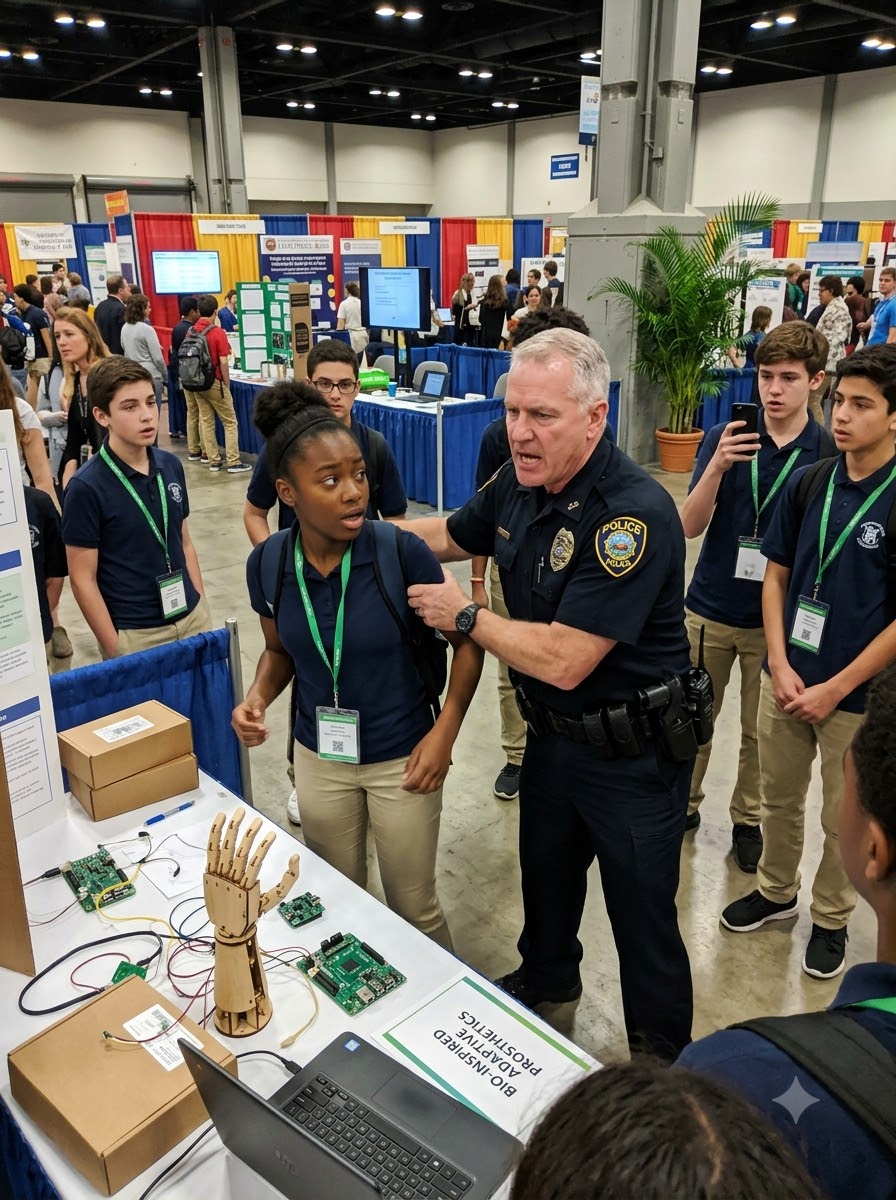
One photograph showed Mr. Washington wearing the prototype, tears running down his face as he moved mechanical fingers for the first time in three years.
“I tested this on three local amputees. All of them achieved functional control within six hours. One of them can now tie his shoes, open doors, hold his grandchildren.”
Her voice faltered briefly.
Then she looked directly at the judges.
“Medical devices should not be luxuries. They should be accessible. That’s why I built this.”
For the remainder of her presentation, Amara explained the engineering decisions behind NeuroConnect, the limitations she had overcome, and the possibilities for making it available to more patients.
She answered technical questions without hesitation.
When her forty-five minutes ended, the exhibition hall erupted.
Applause rolled through the crowd.
Students cheered.
Parents stood.
Several judges were visibly emotional.
Dr. Reynolds wiped his eyes.
“That was extraordinary.”
The judges gathered to compare their evaluations.
Five minutes later, Dr. Patel stepped forward.
“Technical execution: 10 out of 10. Innovation: 10 out of 10. Real-world application: 10 out of 10.”
The other judges reported equally outstanding assessments.
Perfect marks.
Every category.
Katherine Woo approached Amara.
“Amara Jefferson, on behalf of the National Youth Science Expo, I am honored to inform you that you are the recipient of this year’s National Medal of Science Youth Division.”
For a moment, Amara couldn’t move.
The words seemed too enormous to understand.
Then the applause grew louder.
Kevin Carter whistled.
Students shouted congratulations.
Amara covered her mouth.
And she cried.
Not because Cunningham had humiliated her.
Not because she had almost lost her opportunity.
But because eighteen months of sacrifice had finally brought her here.
Dr. Reynolds embraced her.
“I told you. I told you you’d win.”
The medal was only the beginning.
Kevin’s recording of Cunningham’s confrontation had already spread across social media.
He had posted the footage with a caption describing how a Black teenage scientist had been racially profiled and detained at the National Science Expo.
Within two hours, the post had accumulated 12,000 retweets and 50,000 likes.
By noon, the video had reached one million views.
By evening, twenty million people had watched it.
News organizations arrived at the convention center.
Local reporters came first.
Then national networks, including CNN, MSNBC, Fox News, and NBC.
Everyone wanted to speak to the young scientist whose project had earned a national medal after she was nearly removed from the competition.
Amara stood before the cameras with the medal around her neck.
“I’m grateful for the judges who believed in me,” she said.
“But this shouldn’t have happened. Officer Cunningham looked at me and saw a criminal. Not a scientist, not a student, just a Black girl who didn’t belong.”
A reporter asked what she hoped people would learn.
“That bias has consequences. That we need to do better. And that young scientists of color deserve the same respect as everyone else.”
Her words circulated alongside the video.
Hashtags multiplied.
Justice for Amara.
NeuroConnect.
Black Girls in STEM.
Soon, universities began contacting Dr. Reynolds.
MIT called.
Then Stanford, Caltech, Carnegie Mellon, Harvard, and Princeton.
Their representatives wanted to discuss Amara’s future.
Dr. Reynolds made one thing clear.
“Gentlemen, ladies, I appreciate your interest, but Amara will make her own decision.”
Medical-device companies also reached out.
They saw the potential in a prosthetic that cost a fraction of existing alternatives.
They wanted licensing agreements, manufacturing partnerships, and access to the technology Amara had developed.
A venture capitalist offered $1.2 million for the patent rights, with Amara retaining twenty percent equity.
She reviewed the agreement in a conference room at the convention center.
Her grandmother sat beside her.
When Amara signed, her hands were shaking again.
But this time, the emotion was excitement.
Online fundraising campaigns appeared almost overnight.
People donated to support her research and to create more opportunities for students in underfunded schools.
Within three days, the campaigns raised $500,000.
Meanwhile, reporters began investigating Dale Cunningham’s past.
What they discovered made the incident even more disturbing.
Over eight years, twelve complaints of racial profiling had been filed against him.
His departure from the Metropolitan Police Department followed a lawsuit involving the wrongful detention of another Black teenager.
That case had ended in a $60,000 settlement.
A previous security employer in Baltimore confirmed Cunningham had been dismissed following similar complaints.
He had concealed that history when applying for his latest position.
The private security company issued a public statement.
“We are appalled by Mr. Cunningham’s actions. His employment is terminated. We are implementing comprehensive bias training for all staff. This will never happen again.”
But the controversy did not end with his dismissal.
Six weeks later, Cunningham appeared in D.C. Superior Court.
Journalists, activists, and members of the public filled the courtroom.
Amara sat in the front row beside her grandmother and Dr. Reynolds.
The charges included civil-rights violations under 18 U.S.C. Section 242, false imprisonment, illegal search and seizure, and destruction of property.
Prosecutors presented the recording.
Forty minutes of evidence documented the confrontation, detention, interrogation, and threats.
Former colleagues testified.
Other people who had previously complained about Cunningham described similar treatment.
The prosecution argued that Amara’s experience was not an isolated mistake.
It was part of a repeated pattern.
Cunningham’s attorney insisted that the incident had been a misunderstanding.
An unfortunate judgment call.
The jury deliberated for four hours.
Then returned.
Guilty on every count.
Judge Denise Harper, a Black woman in her fifties, looked directly at Cunningham.
“Mr. Cunningham, you abused your position of authority. You targeted a minor based solely on the color of her skin. You attempted to destroy her future because you couldn’t see past your own prejudice.”
Cunningham lowered his head.
“This court will not tolerate such discrimination.”
The sentence followed.
Eighteen months in federal prison.
A $50,000 fine payable to Amara as restitution.
Five years of probation after release.
Mandatory bias counseling.
A permanent prohibition against working in security or law enforcement.
The gavel fell.
Cunningham’s wife cried.
His children stared toward the floor.
Amara watched as he was escorted away.
She did not celebrate his humiliation.
She felt only the quiet weight of knowing that the man who had tried to destroy her future had finally been held accountable.
Outside the courthouse, reporters surrounded her.
“How do you feel about the verdict?”
Amara stepped toward the microphones.
“I feel that the system worked. Not perfectly, not quickly enough, but it worked. Officer Cunningham will face consequences. That matters.”
Another reporter asked about her plans.
“What’s next for you?”
“I start at MIT in the fall. I’m continuing work on NeuroConnect and I’m launching a nonprofit to provide STEM equipment to underfunded schools. No student should have to build their dreams from garbage because their school can’t afford supplies.”
Camera shutters clicked.
The girl Cunningham had decided did not belong at a science exhibition was preparing to enter one of the world’s most prestigious research institutions.
Six months later, autumn sunlight spread across the MIT campus.
Students hurried between red-brick buildings while fallen leaves collected along the walkways.
Inside a biomedical engineering laboratory, Amara Jefferson sat at a workbench surrounded by equipment she had once only seen in photographs.
She was attending MIT on a full scholarship.
A private research station had been assigned to her.
And in front of her sat NeuroConnect 2.0.
The new model was sleeker and more refined than the original prototype.
But its purpose remained unchanged.
Affordable technology for people who needed it.
The licensing agreement had been completed.
A medical-device startup was manufacturing the prosthetic.
Its retail price was $800.
Five hundred patients were already using the device.
Mr. Washington had been the first customer.
Amara had offered him one without charge, but he insisted on paying.
“You earned this,” he’d said.
“Don’t undervalue your work.”
Now he could embrace his grandchildren with both arms.
For Amara, that meant more than the medal.
One afternoon, Dr. Reynolds knocked on her laboratory door.
“Amara, you have visitors.”
Three middle-school students entered.
Two Black girls.
One Latino boy.
Their expressions combined nervousness and wonder.
“These are students from Second Chances STEM,” Dr. Reynolds explained.
“Your nonprofit’s first scholarship recipients.”
Amara smiled.
Second Chances STEM had launched three months earlier.
Its funding came from donations, restitution payments, and income from her patent.
The organization supplied equipment, mentorship, and educational resources to schools that lacked adequate STEM funding.
It had already reached fifty schools and approximately five thousand students.
One of the girls pointed toward the original NeuroConnect prototype.
“You built that from trash?”
“From salvaged parts,” Amara corrected gently.
“There’s no shame in using what’s available. Some of the best innovations come from limitations.”
The boy took a small circuit board from his bag.
Its soldering was uneven, and several components looked improvised.
“I’m building a water purification sensor for my neighborhood, but I can’t get the readings right.”
Amara examined it.
“Your concept is solid, but you need a different resistor here. Let me show you.”
They spent the next hour working together.
Amara explained the circuitry, answered questions, and listened as the children described their ideas.
They were curious.
Determined.
Excited.
She recognized herself in them.
And she understood that helping them was another way of continuing the work she had begun in her grandmother’s kitchen.
After the students left, Amara stood beside the laboratory window.
Her phone vibrated.
A news alert appeared.
Dale Cunningham had been released on parole after nine months.
He had served half his sentence and was now living in a halfway house while working at a warehouse.
His security license remained permanently revoked.
The article prompted mixed reactions.
Some people believed nine months was far too little punishment.
Amara considered what had happened.
The prison sentence was only one consequence.
Cunningham had lost his career, his professional reputation, and the authority he had misused.
The public record of his conduct would remain.
For her, the more important question was whether other institutions would learn to prevent similar abuses.
Her phone vibrated again.
This time, the message was from her grandmother.
“Proud of you, baby. Your daddy would be proud, too.”
Amara smiled.
She typed back.
“Love you, Grandma.”
For a moment, she thought about her father.
He had taught her how to solder, how to understand electrical circuits, and how to solve problems without giving up when the first attempt failed.
He had shown her that practical skill and intellectual curiosity belonged together.
Although he had been gone for six years, his lessons remained part of everything she built.
Stay curious.
Stay humble.
Stay persistent.
Never allow someone else to decide where you belong.
Amara turned away from the window.
NeuroConnect 2.0 still needed calibration.
Three meetings with potential donors were scheduled for the following day.
The next week, she would testify before Congress about access to STEM education.
Her work was expanding in directions she could scarcely have imagined during those long nights in Chicago.
But she never forgot the hallway at the science expo.
She remembered standing beside her scattered belongings while Cunningham questioned whether someone from her neighborhood could possibly have created sophisticated technology.
She remembered the people who watched and remained silent.
She remembered Torres trying to object but failing to intervene decisively.
She remembered Brian Mitchell walking away.
And she remembered the moment Dr. Reynolds finally appeared and demanded to know what was happening.
The experience had taught her something that no scientific textbook could explain.
Talent did not always protect people from prejudice.
Hard work did not guarantee fair treatment.
And even the most extraordinary achievements could be overlooked when someone had already decided a person was unworthy of being heard.
But it had also shown her the power of people who chose to act.
The student who recorded the confrontation.
The judges who demanded accountability.
The volunteers who helped rebuild her display.
The mentors who refused to let an injustice determine the outcome of her competition.
Those choices mattered.
Amara picked up her soldering iron and returned to the prototype.
The laboratory was quiet except for the hum of equipment.
She adjusted a connection, checked the circuit, and opened her laptop to review the latest readings.
There was more research to complete.
More patients to help.
More students who needed access to tools, mentors, and opportunities.
Her national medal had opened doors.
But she wanted those doors to remain open for the children who came after her.
Because the most important part of her story was never that a security officer had mistaken a brilliant young scientist for a thief.
It was that Amara Jefferson had refused to let his prejudice decide her future.
And now, through NeuroConnect and Second Chances STEM, she was working to ensure that other children would not have to fight the same battle simply to be given a chance.
The girl who had once stood alone in a concrete hallway, begging to return to her science project, was now helping build a future where talent mattered more than appearance, opportunity was not determined by a ZIP code, and every young mind had room to grow.
That was the future she had nearly lost.
And it was the future she intended to make possible for everyone else.
