

PART 1: The Woman in the Gardening Boots
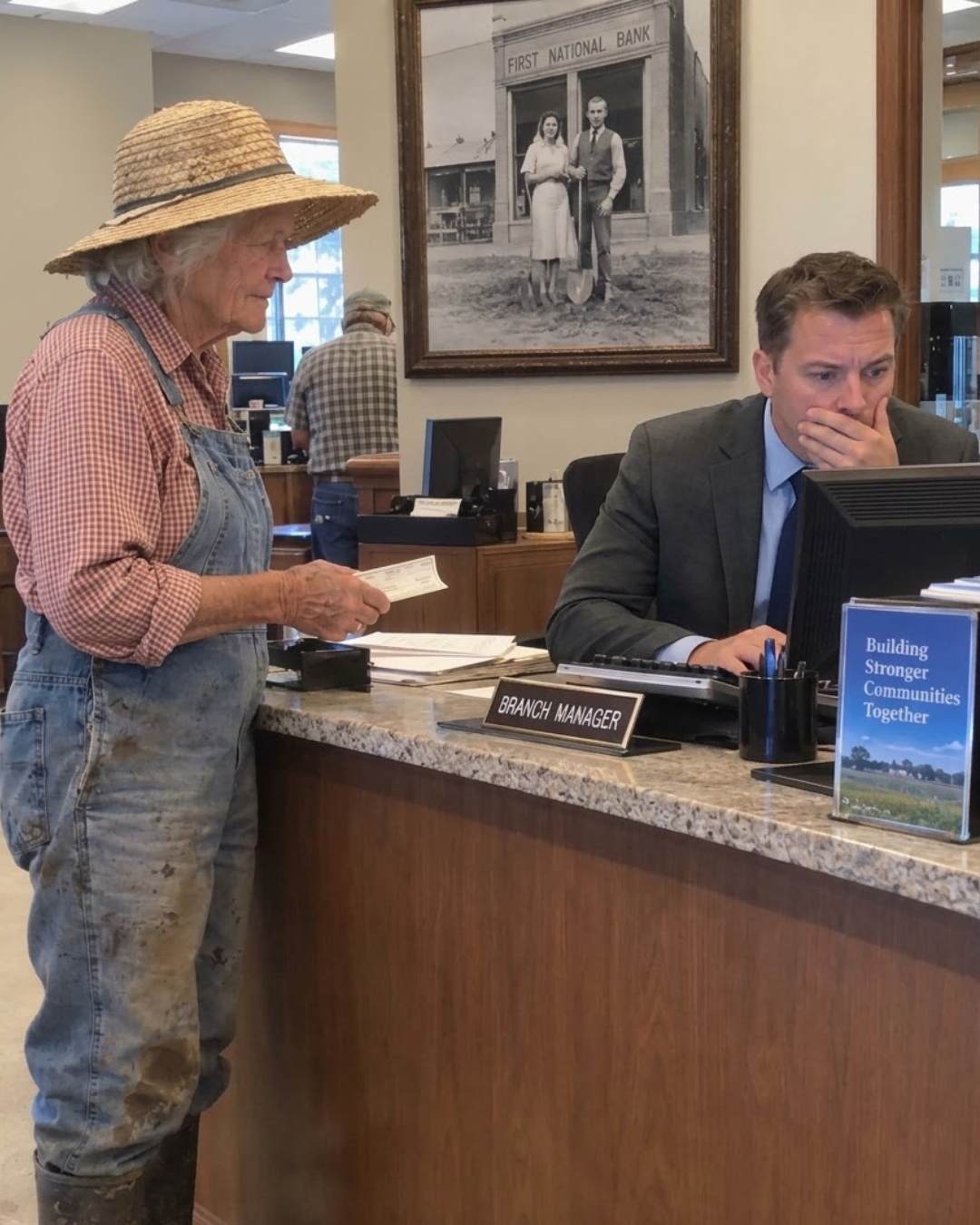
I walked into the bank wearing my gardening clothes.
Looking back, perhaps that was my first mistake.
It was a Tuesday morning in June, and by ten o’clock, Millbrook was already sweltering. The heat rose from the sidewalks and settled across my shoulders like a damp blanket.
I had spent the morning tending my tomatoes, fastening the Better Boys to their supports and removing the suckers from the Romas.
There was dirt on my knees, beneath my fingernails, and probably across my nose.
I wore George’s old straw hat, the one with the fraying brim and the faded sweat stain that had been there since the Carter administration. My blue work shirt had patches sewn over both elbows, and my green rubber boots were still muddy from the garden.
None of that bothered me.
I was seventy-nine years old. I had spent most of my life working in gardens, kitchens, and fields. I had never believed that a little dirt made someone less respectable.
The check in my pocket was from the Methodist church.
Forty dollars.
Payment for four rhubarb pies I had baked for their fundraising sale.
Reverend Collins had personally delivered it on Sunday afternoon.
“Dot, you’ve been giving us pies for free for forty years,” he said. “Let us pay you once.”
I finally agreed.
So after finishing with the tomatoes that Tuesday, I walked four blocks down Main Street to cash the check.
I had been a customer of Farmers & Merchants Bank in Millbrook for fifty-eight years.
There was no reason to imagine that morning would be any different.
The bank occupied a modest two-story red brick building at Main and Second. White columns framed its entrance, although George always insisted they were far too grand for a town of four thousand residents.
Beside the front door hung a brass plaque.
FARMERS & MERCHANTS BANK — EST. 1968.
Inside, the familiar smell of old carpet, money, and peppermints greeted me.
The air conditioning was running so strongly that the sweat on my neck immediately turned cold.
Usually, Shelly Haskins was behind the teller window.
Shelly was fifty-four and had worked there since 1998. She had known George for years. When he died, she attended his funeral, brought a casserole, and cried harder than some members of his own family.
Every time I visited, she asked about my garden.
“How are the Peace roses this year, Dot?”
“Blooming like crazy, Shelly. I’ll bring you some.”
And I always kept that promise.
I would arrive with a bundle of roses wrapped in damp newspaper, and Shelly would arrange them in a coffee can beside her window.
But Shelly wasn’t there that morning.
Instead, a young man stood behind the counter.
He looked about thirty, thin and meticulously groomed, with short hair held in place by something shiny. His white shirt was stiffly starched, and his tie was the pale blue of a robin’s egg.
His name tag identified him as Brandon Pierce, Branch Manager.
I knew the name.
Everyone in Millbrook did.
Brandon had arrived in April, transferred from the city by Heartland Bancorp, the Des Moines company that had purchased most of Farmers & Merchants in 2015.
He had been in town only two months, but complaints about him were already circulating.
He had removed the peppermint bowl because he considered it unhygienic.
Ruth Abernathy said he had demanded unnecessary paperwork when she deposited her Social Security check.
Earl Lindquist claimed Brandon had questioned whether he truly wanted to withdraw two hundred dollars from his own savings.
“Like I was a child,” Earl said at the diner. “Like I didn’t know my own mind.”
I had assumed they were making too much of it.
Then I approached his window.
I slid the check beneath the glass.
“Good morning,” I said. “I’d like to cash this, please.”
He glanced at the check.
Then his eyes moved downward.
First to my green boots.
Then to George’s straw hat.
Then to my stained knees and weathered hands.
I watched him examine the dirt beneath my nails and the knuckles enlarged by arthritis.
Finally, he leaned toward the glass.
“MA’AM. DO YOU HAVE AN ACCOUNT WITH US?”
He spoke loudly and slowly, as though I were incapable of understanding an ordinary question.
“I do,” I answered.
“I’LL NEED TO SEE SOME IDENTIFICATION.”
My hearing was perfectly fine.
His manners were another matter.
I said nothing about either.
Instead, I removed my driver’s license from the plastic sleeve in my shirt pocket and passed it beneath the glass.
He held it toward the light.
Turned it over.
Compared the photograph with my face.
Then looked at the photograph again.
The picture was three years old. I had worn my blue church dress and pearls, and my hair had been freshly styled.
That morning, I looked like the same woman after several hours in a tomato patch.
“I’ll need two more forms,” he announced.
“Two more? For forty dollars?”
“A utility bill. A passport. Something with your address.”
“Young man, I live four blocks from here. On Elm Street. The yellow house with the roses.”
He placed my license on his side of the counter.
He didn’t return it.
“Ma’am,” he said. “We have to be careful with people like you.”
The room fell silent.
There were only six customers inside, but every one of them heard.
Behind me stood Kayla Brandt, holding her toddler, Wyatt, against her hip. Her grandmother had belonged to my Garden Club for thirty years.
At the loan desk, Harvey Kessler stopped writing.
Harvey had worked at Farmers & Merchants since 1979.
Near the entrance, security guard Tommy Ruiz lowered his eyes.
I had taught Tommy’s mother in Sunday School.
People like you.
I wondered what Brandon meant.
Old women?
Poorly dressed women?
Widows wearing their late husbands’ hats?
But I didn’t ask.
George had always believed that anger revealed less than patience.
“Dot,” he would tell me, placing a reassuring hand on my knee whenever I was about to lose my temper, “Let ’em talk. Let ’em show you who they are. Then you’ll know what to do.”
So I let Brandon speak.
And while he waited for me to argue, my eyes drifted toward the wall near the entrance.
There was an old black-and-white photograph hanging in a cheap gold frame.
The glass was dusty, and the frame had tilted slightly to one side.
It had been there for decades.
The photograph showed a young couple standing in an empty lot, each holding a shovel.
The man wore a narrow tie and had dark hair combed neatly backward. His grin suggested he had just accomplished something extraordinary.
The young woman wore a white dress patterned with tiny blue flowers and a pillbox hat.
She was smiling broadly, although she held her shovel rather awkwardly.
Behind them stood a handmade sign.
FUTURE HOME OF FARMERS & MERCHANTS BANK.
The photograph was taken in 1968.
Hardly anyone noticed it anymore.
Customers walked beneath it, waited in line with their backs toward it, and hurried out without ever looking up.
But I looked at it.
And I remembered.
I remembered the difficult loans.
The long arguments in the back office.
The bank examiners who arrived carrying briefcases and unpleasant news.
I remembered the winter of 1985, when farms throughout the county were collapsing under debt.
And I remembered George coming home at two in the morning, sitting on the edge of our bed in darkness, and whispering:
“Dot. I think we’re going to lose it.”
We nearly did.
But we survived.
I turned back toward Brandon.
He was watching me impatiently.
I suspected he expected tears, an argument, or an angry departure.
Instead, I smiled.
“I appreciate careful,” I said.
He looked surprised.
“You do?”
“I do. Careful is how you keep a bank alive.”
I folded my hands on the counter.
“Would you do one thing for me before I go home for the rest of my papers?”
He sighed heavily.
“What?”
“Would you look up account number 0001?”
“Ma’am, I can’t just—”
“It’s my account,” I said. “You have my license right there.”
He rolled his eyes toward Tommy Ruiz.
Tommy refused to meet his gaze.
Brandon turned to his computer and began typing.
Zero.
Zero.
Zero.
One.
He pressed Enter.
Then stopped.
His fingers hovered above the keyboard.
He stared at the monitor.
Scrolled downward.
Then upward again.
He leaned forward and read something carefully.
I watched his lips move.
He looked at me.
Then back at the screen.
Finally, he turned toward the photograph near the door.
His gaze settled on the young woman wearing the white dress with blue flowers.
The color drained from his face.
He reached for the telephone.
His hands shook so badly that he had to dial twice.
I knew exactly what he had discovered.
But to understand why account number 0001 frightened him so badly, you need to understand what George and I built.
And why it had taken fifty-eight years for that little number to matter.
I was born Dorothy Mae Lund in 1947 on a dairy farm three miles south of Millbrook.
I was the youngest of six children.
My father milked forty Holsteins twice a day for thirty years without taking a vacation.
My mother raised chickens, tended vegetables, and preserved enough tomatoes each summer to feed a small army.
I met George Whitaker at the county fair in 1964.
He was showing a Hereford steer.
I was entering a rhubarb pie.
His steer won reserve champion.
My pie earned a blue ribbon.
After the judging, he approached the baking tent with his ribbon pinned proudly to his shirt.
“I hear yours beat mine.”
“Pies and steers aren’t in the same category,” I told him.
“Everything’s in the same category if you look at it right,” he replied.
I wasn’t entirely sure what he meant.
I still wasn’t certain when I married him two years later.
But I knew he was a good man.
George came from a farming family with two hundred acres of corn and soybeans west of town.
He had served in Korea, attended Iowa State through the GI Bill, and earned an economics degree.
After returning home, he found employment at First National Bank in the county seat, twenty miles away.
He wore a suit to work and drove an old Ford.
And he hated what he saw.
“They don’t understand farming, Dot,” he complained over dinner. “They look at a farmer and see a risk. They see dirt and old boots and a pickup truck with rust on the fenders. They don’t see the man who’s been feeding this country for three generations.”
He watched the bank reject honest farmers whose families had cultivated the same land for generations.
Those men arrived in their best shirts, hats held respectfully in their hands.
And young loan officers who had never stepped into a barn turned them away.
In 1967, it happened to my father.
His milking equipment had broken down.
He needed eight thousand dollars to replace it.
Without the equipment, he would have to sell his herd.
Forty cows.
Thirty years of work.
The loan officer was twenty-six years old and had never worked on a farm.
He examined my father’s worn clothes, chapped hands, and old truck.
Then refused the loan.
That Sunday, George and I visited my parents for dinner.
My father sat silently at the kitchen table for nearly an hour.
George watched him.
Then he walked outside and stood among the cows.
When he returned, he looked at me.
“Dot. We’re going to start a bank.”
Everyone thought he had lost his mind.
We were twenty-one and twenty-three, living in a tiny apartment above the hardware store.
Our savings amounted to eleven hundred dollars.
But George had been considering the idea for years.
He visited farmers, merchants, widows, and anyone who might trust a small local bank.
“Put your money in a bank that knows you,” he told them. “A bank that’s owned by people like you.”
People like you.
Those were his words.
He repeated them in kitchens, barns, church basements, and living rooms throughout the county.
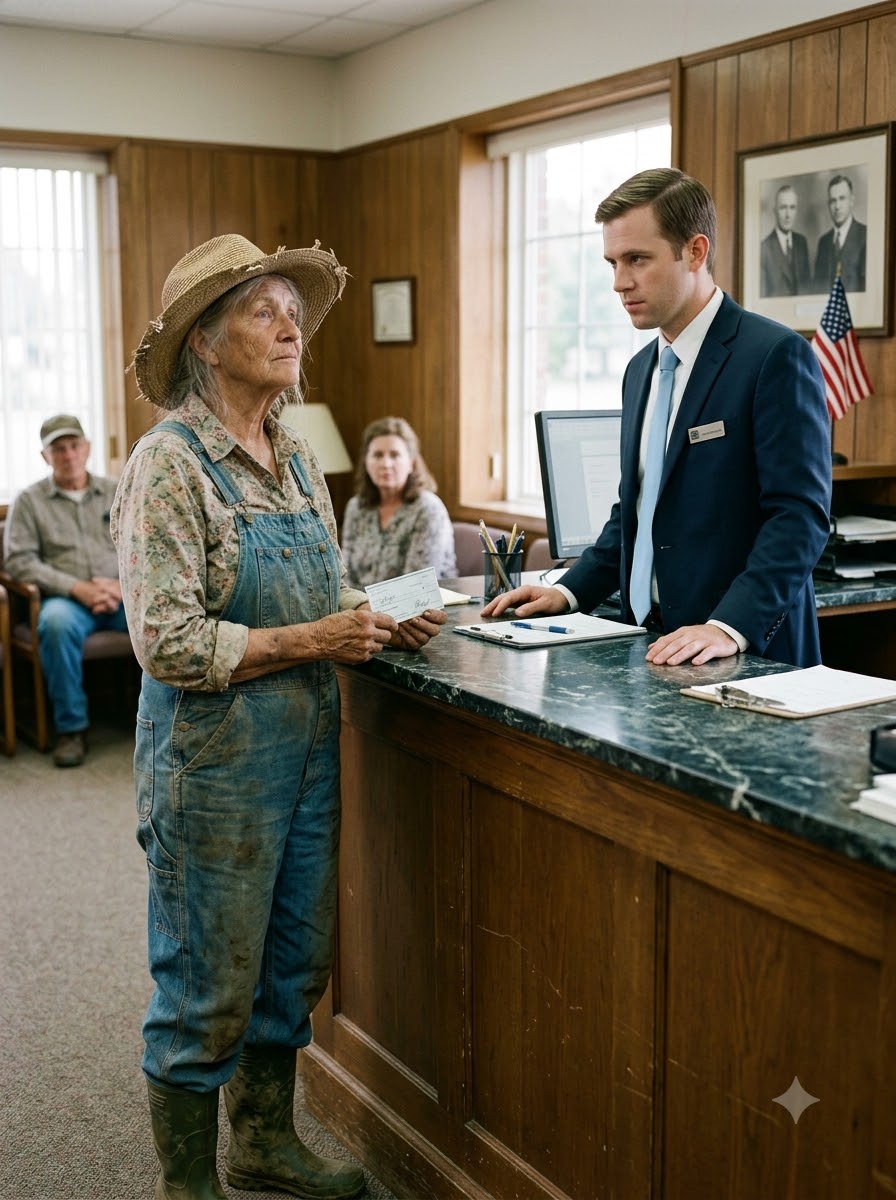
Gradually, people believed him.
Farmers contributed five hundred dollars, a thousand dollars, sometimes two thousand.
Mrs. Jorgensen, widowed during the war, arrived at our kitchen with six thousand dollars in a cardboard box tied with string.
“George Whitaker,” she warned, “if you lose this, I will haunt you.”
George never lost her money.
In August 1968, we broke ground at Main and Second.
The local newspaper photographed us holding shovels in our Sunday clothes.
That was the photograph still hanging inside the bank.
Two months later, Farmers & Merchants opened.
Its first account belonged to George and me.
We deposited one hundred and twelve dollars, the remainder of our wedding savings.
Account number 0001.
Account number 0002 belonged to my father, Arvid Lund.
And the bank’s first loan was eight thousand dollars for his new milking equipment.
He repaid every cent in four years.
Ahead of schedule.
George spent the next five decades building Farmers & Merchants into something more than a financial institution.
He served as president for thirty-two years, then became chairman of the board.
He remembered customers’ names, their children, their farms, and their struggles.
He approved loans for people larger banks rejected.
Young couples without established credit.
Widows starting small businesses.
Farmers whose crops had failed.
A Mexican family who wanted to open a restaurant in 1981, despite people insisting Millbrook would never support one.
That restaurant, Casa Ruiz, was still operating.
Tommy Ruiz, the security guard standing by the bank entrance, was the owner’s grandson.
George was cautious with money.
He examined applications carefully and visited farms before approving loans.
But he never judged anyone by their clothes.
Not once.
I worked as a teller during the bank’s early years.
For eleven years, I counted cash, stamped deposit slips, and greeted customers from the same window Shelly occupied decades later.
The peppermint bowl was my suggestion.
“People get nervous at banks,” I told George. “Give them something sweet.”
After our daughter Sarah was born, I stayed home.
But I continued helping with bank events, baking pies, meeting customers, and occasionally joining George’s discussions with the board.
Then came 1985.
The farm crisis.
Interest rates soared.
Land values collapsed.
Farmers who had borrowed during better years could no longer meet their payments.
Banks began foreclosing on properties that had belonged to the same families for a century.
Three farmers in our county died by suicide that winter.
I attended every funeral.
The larger banks called in their loans.
George refused.
He spent countless nights arguing with the directors of Farmers & Merchants.
The board feared the bank would collapse.
Regulators from Des Moines pressured him to collect the debts.
Everyone insisted he had to protect the institution.
But George asked one question.
“If I call in those loans, half this county loses its farms. And then who are we a bank for?”
Eventually, he made a decision that frightened me more than anything else in our marriage.
He mortgaged our yellow house on Elm Street.
Then he mortgaged his father’s two-hundred-acre farm.
He placed the proceeds into the bank’s reserves.
“I’m not asking any farmer to risk more than I’m risking,” he told the board.
That night, he returned home after midnight.
He sat beside me in the darkness.
“Dot. I think we’re going to lose it.”
I took his hand.
“Then we’ll lose it together.”
But we didn’t.
The spring rains arrived.
The harvest improved.
Farmers made payments when they could.
Some needed years.
A few never repaid everything.
But most kept their land.
And the bank survived.
Afterward, every Christmas brought gifts to our porch.
Hams.
Honey.
Homemade quilts.
Pies.
Little packages left by families who still owned their farms because George refused to abandon them.
Most gifts arrived without cards.
We knew who had sent them.
George died in 2017.
Heart failure.
He was seventy-two.
He passed away in his sleep in the same yellow house we had almost lost during the crisis.
Two years before his death, however, he faced another painful decision.
Small community banks were struggling to survive.
Regulations had become expensive, technology complicated, and compliance requirements difficult for independent institutions.
Heartland Bancorp, a regional banking company based in Des Moines, offered to purchase Farmers & Merchants.
George resisted.
He loved that bank.
But the lawyers and accountants warned that without additional resources, it might fail within five years.
Eventually, he agreed to sell sixty percent.
We retained forty.
Yet George refused to sign until he had secured one final promise.
I remember him sitting at our kitchen table with two hundred pages of merger documents spread before him.
He read every paragraph.
Three times.
Then he spent two hours speaking with our longtime attorney, Walt Brennan.
Afterward, he turned to me.
“Dot. I want to put something in the agreement. Something they won’t notice until they need to.”
“What?”
“A covenant,” he explained. “A promise. That Millbrook gets its bank. Forever. No matter who owns it.”
“Will they agree to that?”
“Not if I ask for it straight out,” George replied. “They’ll say no. They’ll want the right to close branches. Cut staff. Consolidate. That’s what big banks do.”
He tapped the contract.
“So I’m not going to ask for it straight out. I’m going to tie it to something they’ll think is just sentimental.”
“What?”
He smiled.
“Account number 0001.”
And that was how Section 14.3 entered the merger agreement.
Page 147.
Buried between provisions concerning computer systems and parking lot maintenance.
The section stated:
In recognition of the founding of Farmers & Merchants Bank, the holder of Account Number 0001 shall retain the following rights in perpetuity, regardless of any change in ownership: No branch of Farmers & Merchants Bank located within the city limits of Millbrook, Iowa, shall be closed, consolidated, or reduced in staff without the prior written consent of the holder of Account Number 0001. Any action taken in violation of this section shall be considered void.
A second paragraph provided:
The holder of Account Number 0001 shall also retain ownership of the real property located at 200 Main Street, Millbrook, Iowa, and shall lease said property to Farmers & Merchants Bank for the sum of one dollar ($1.00) per year, for as long as Section 14.3 is honored.
Heartland’s lawyers approved it.
They thought it was a sentimental gesture from an elderly banker.
A harmless tribute to the institution’s first account.
They signed without understanding what George had accomplished.
The holder of account 0001 now possessed extraordinary authority over the Millbrook branch.
And the building itself belonged to that account holder.
Not to Heartland.
Not to Farmers & Merchants.
To us.
“Why do it that way?” I asked George afterward. “Why not just put your name on it?”
“Because names die,” he answered. “Accounts don’t. Whoever holds 0001 after we’re gone, they’ll have the power to protect this town. Maybe it’ll be Sarah. Maybe the grandkids. Maybe somebody else. But somebody will always be able to stand up for the bank.”
When George died, the account passed to me.
For years, I had no reason to invoke those rights.
Heartland modernized the systems, changed the paperwork, and updated the signage.
But the bank remained open.
Shelly stayed at her window.
Harvey continued working at his loan desk.
And I visited whenever I needed to deposit money or cash a check.
Nobody cared what I wore.
Until Brandon Pierce arrived.
Until that Tuesday morning in June.
And until he entered four digits into his computer.
