

PART 1
The baton struck the back of my shoulder before I could reach the side gate.
For one second, everything turned white.
Then the pain arrived.
Heavy.
Blunt.
Deep enough to make my left leg give way.
I dropped onto one knee in my own St. Augustine grass.
Behind the man who had struck me, three other men in dark navy uniforms were already moving up my driveway.
Badges were displayed on their chests.
Batons hung at their waists.
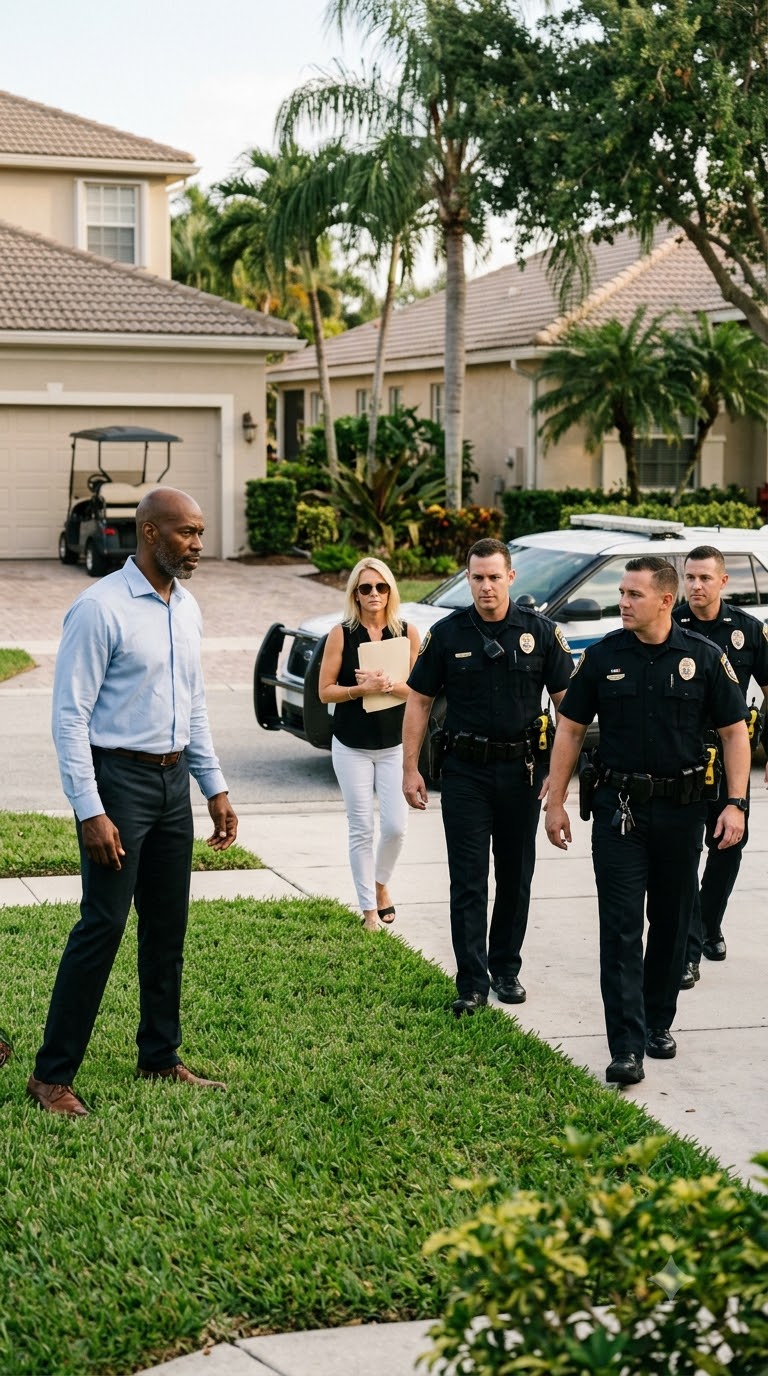
Handcuffs.
Tasers.
A blue-and-amber light flashed from the golf cart they had driven onto my property.
From a distance, the shoulder patches looked almost like legitimate law enforcement.
Almost.
But the wording was wrong.
SENTINEL ESTATE PROTECTION.
The man standing over me raised his baton.
“Hayes Talmadge, you are under HOA arrest.”
I looked up at him.
Even with pain shooting through my shoulder and down my arm, I nearly laughed.
“There is no such thing as an HOA arrest.”
His expression hardened.
Another man reached toward his Taser.
What none of them knew was that four cameras positioned around my house had already recorded their approach.
A fifth camera across the street had captured the golf cart turning onto Bayou Drive.
A federal surveillance team nearby had already witnessed the baton strike.
And within minutes, men and women carrying legitimate federal credentials would be moving toward the cul-de-sac.
My name is Hayes Talmadge.
I was sixty-two years old that morning.
For twenty-eight years, I worked as a special agent with the Federal Bureau of Investigation.
Most of my career involved civil-rights investigations.
Police impersonation.
Abuse under color of law.
Unlawful detention.
Officers who treated badges like permission to do things the Constitution had never authorized them to do.
Eventually, I became a supervisor in the FBI’s Tampa field operation before retiring in 2022.
I believed retirement would mean fishing.
Restoring an old Jeep Wagoneer.
Taking my granddaughter to tennis practice.
I thought I was finished dealing with men who put on uniforms and convinced themselves the uniform made them untouchable.
I was wrong.
My wife, Estelle, and I lived in Bayou Pines Estates in eastern Manatee County, Florida.
Stucco homes.
Palm trees.
A heated community pool.
Perfectly maintained lawns.
Too many committees.
The kind of gated neighborhood where residents could argue about mailbox colors as though national security depended on them.
Estelle was sixty.
She was a retired pediatric nurse who had spent thirty-two years at Sarasota Memorial.
She was steadier than I had ever been.
We had been married long enough for her to know what kind of trouble I was thinking about simply by the way I set down a coffee mug.
Our granddaughter, May, lived with us most of the time.
Fourteen.
Freckles.
A sharp mouth.
An excellent backhand on the tennis court.
Her mother, our daughter Annalee, had died from pancreatic cancer three years earlier at thirty-six.
Annalee had been a middle-school art teacher.
Ceramics.
Paint.
Clay beneath her fingernails.
She was the kind of teacher who bought supplies with her own money and pretended not to notice when students who couldn’t afford lunch stayed in her classroom during breaks.
Her husband, Beck, worked offshore rotations as a mechanic.
When he was home, May stayed with him.
When he was working, she stayed with us.
Annalee’s ceramic mugs still lined our kitchen windowsill.
May still laughed into her sleeve exactly like her mother had.
That was the life I wanted to protect.
Small.
Quiet.
Ordinary.
The first indication that Bayou Pines was anything but ordinary came four months after I retired.
Estelle returned from the community pool looking angry.
Not loudly angry.
Her dangerous kind.
Quiet.
“What happened?”
She set down her purse.
“They handcuffed Reuben.”
“Who?”
“Mr. Halverson.”
Reuben Halverson was eighty-one.
A retired pipefitter.
A Vietnam veteran.
He drove an old Cadillac with gospel music playing far too loudly because his hearing had deteriorated.
“Who handcuffed him?”
“The security company.”
That made me stop.
“What security company?”
“Sentinel.”
According to Estelle, three men wearing navy uniforms had stopped Reuben at the front gate because the radio in his car supposedly violated an HOA noise rule.
They ordered him out.
When he argued, they put him in handcuffs.
Reuben had cried.
Not because he was weak.
Because an eighty-one-year-old man who had survived war suddenly found himself restrained in his own neighborhood by men pretending to possess authority they did not have.
I drove to the gate that afternoon.
A Sentinel guard stood beside a patrol golf cart.
Dark navy shirt.
Badge.
Shoulder patch.
Baton.
Taser.
Handcuffs.
From twenty feet away, he looked enough like a sheriff’s deputy that most ordinary residents would never question him.
The badge on his chest read:
CONSTABLE.
Florida does not create private HOA constables.
I went home.
Opened a notebook.
And made a phone call.
Camille Mortenson answered on the third ring.
She had worked under me years earlier.
Smart.
Patient.
The kind of investigator who became more dangerous the quieter a suspect became.
“Hayes.”
“Camille.”
“You sound retired.”
“I retired into a problem.”
She laughed.
“What kind?”
“Uniforms.”
The laughter stopped.
A week later, I walked into the FBI office carrying my first folder.
Twelve incidents.
Twelve Bayou Pines residents who said Sentinel employees had stopped, detained, threatened, handcuffed, or physically controlled them over HOA matters.
Most were elderly.
I had interviewed every one of them with permission.
I had copies of HOA citations.
Photographs of uniforms.
Descriptions of badges.
Dates.
Times.
Names.
Camille read the file for nearly an hour.
Then she leaned back.
“The man who owns Sentinel is Spencer Voorhees.”
“You know him?”
“Former Florida Highway Patrol.”
“What happened?”
“Lost certification after an excessive-force case.”
That explained the posture.
Not the rest.
Camille closed the folder.
“We need more.”
“I have more.”
“How much?”
“Fourteen additional incidents I haven’t typed.”
She looked at me.
“Type them.”
So I did.
I did not become an FBI agent again.
That distinction mattered.
I was not conducting an investigation.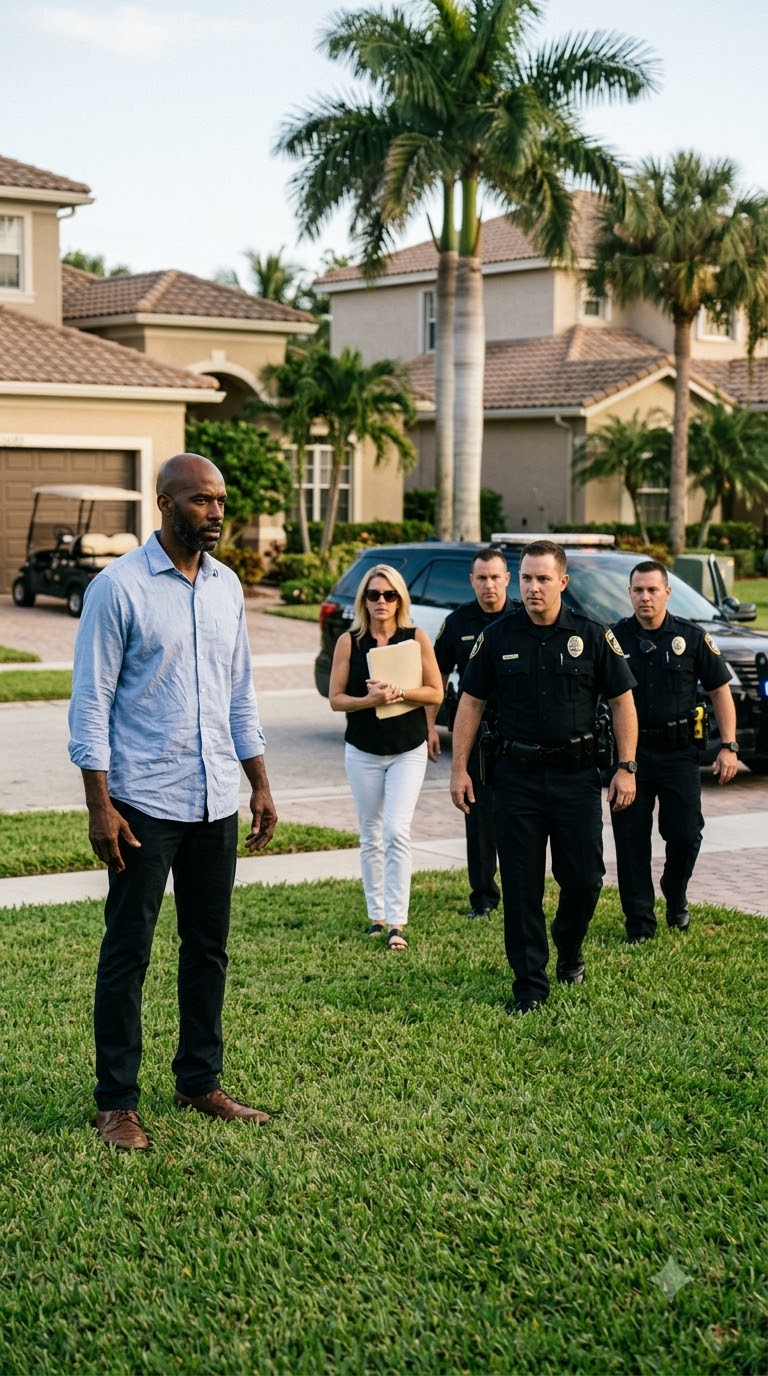
I was a retired resident providing information.
Once the Bureau opened the case, it belonged to the agents assigned to it.
They obtained records through lawful process.
They interviewed victims independently.
They compared Sentinel contracts across communities.
What began in Bayou Pines expanded.
Hammock Cove.
Cypress Lakes.
Other gated developments throughout Sarasota, Manatee, and DeSoto counties.
Sentinel held contracts with fifteen HOAs.
The company claimed it provided enhanced community security.
The financial records revealed something else.
Millions of dollars in security assessments had passed through affiliated companies.
Some of that money reached accounts connected to Spencer.
Other funds moved through companies tied to his wife, Carleen Voorhees.
Carleen happened to be president of the Bayou Pines HOA.
Blonde.
Fifty-seven.
Always perfectly dressed.
Always smiling in photographs.
Always talking about “community standards.”
She had never liked me.
That became obvious the first time we met.
She had knocked on our door one Saturday morning holding a folder.
“Mr. Talmadge?”
“Yes.”
“I’m Carleen Voorhees. HOA president.”
“I know.”
Her smile tightened.
“I wanted to discuss your lawn.”
I looked down.
My lawn was freshly cut.
“What about it?”
“You’ve allowed the grass along the eastern border to grow slightly above association guidelines.”
I stared at her.
“It’s grass.”
She didn’t smile anymore.
“We have standards.”
“I retired from federal law enforcement, Mrs. Voorhees. I can assure you the grass is not a threat to national security.”
She didn’t laugh.
“I’d appreciate it if you treated this association with more respect.”
“I would appreciate it if the association treated residents with the same respect.”
She left.
Three weeks later, I received my first violation notice.
Then another.
Then another.
The notices became increasingly absurd.
A garden hose visible from the street.
A trash bin left outside for twenty minutes too long.
A lawn chair on the porch.
A flag that was supposedly too large.
A basketball hoop that May had used twice.
Each violation came with a fine.
Each fine came with a warning.
Then came the demand that I attend a disciplinary hearing.
I did.
Carleen sat at the head of the table.
Spencer sat beside her.
Three other board members were present.
