

The Card That Made the Captain Go Pale
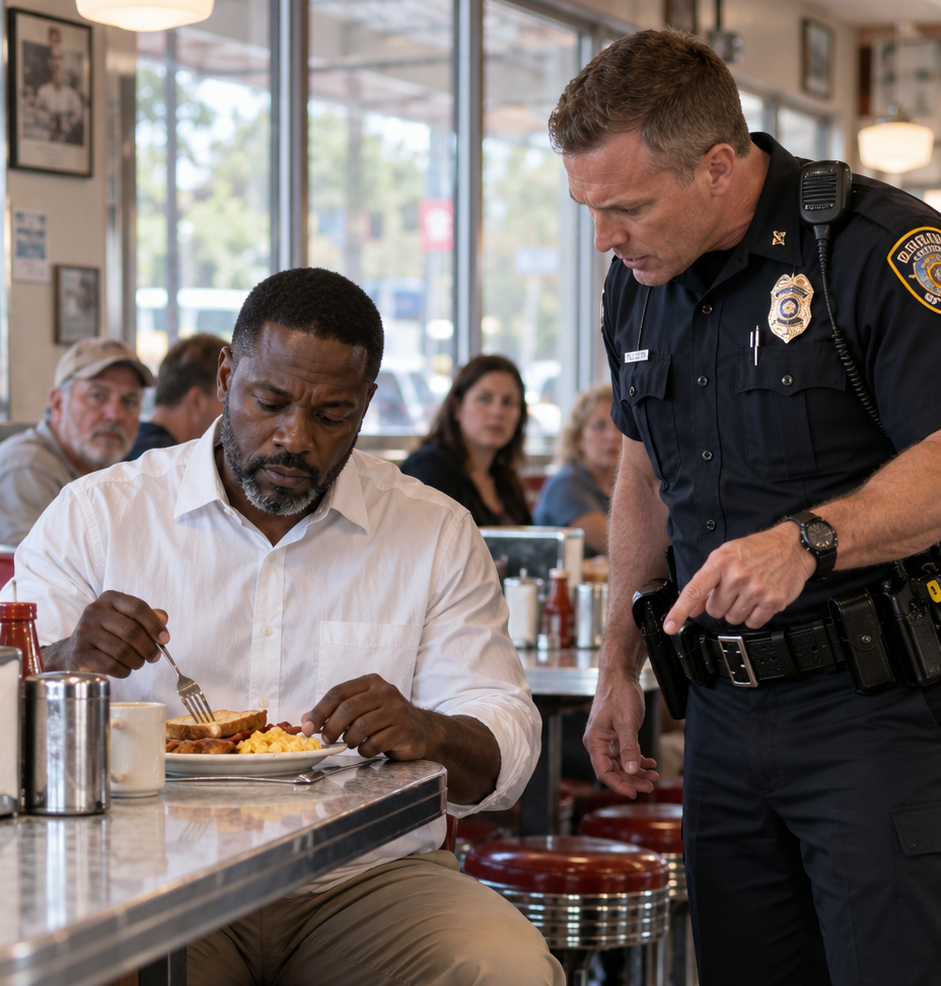
The officer made Andre Walker stand beside the register where every table in the diner could see him.
That was the detail Andre would remember years later. Not the accusation. Not the handcuffs. Not even the card that eventually drained the color from his captain’s face. It was the placement.
Officer Evan Cole could have questioned him quietly at his booth. He could have waited until the facts settled. Instead, he pointed toward the front of Miller’s Family Diner.
“Over there.”
Andre looked at the register, then around the room — the Saturday breakfast crowd, families, truck drivers, a youth baseball team still in muddy cleats, two elderly women splitting a stack of pancakes, waitresses weaving between tables with coffee pots. Nearly forty people.
He looked back at Cole. “Why?”
“So I can see your hands and talk to you.”
“My hands are on the table.”
“I gave you an instruction.”
Andre held still one more second before standing. Forty-six. Black. Six feet tall, lean, in dark slacks and a white shirt with the sleeves rolled to his forearms. No tie. His charcoal jacket sat folded on the seat beside him, a black leather briefcase underneath it. He left both behind and walked to the register.
Everyone watched. Cole followed close behind; his partner, twenty-seven-year-old Officer Melissa Grant, stayed a few steps back. She’d been silent since they walked in. Andre noticed the red light on her body camera. Recording. Good.
Cole stopped him beside the pie case. “Turn around.”
“For what purpose?”
“Sir.”
“My name is Andre Walker.”
“I didn’t ask your name yet.”
“You were about to.”
Cole just stared. Andre pressed on. “Why do you want me to turn around?”
“Because property’s missing, and a witness put you near it.”
Andre glanced toward booth twelve, where seventy-year-old Harold Benton stood looking shaken. Minutes earlier he’d discovered that a brown bank envelope holding six hundred dollars — collection money for his church’s weekend food drive — had vanished from the seat beside him. Someone mentioned Andre had passed his table on the way to the restroom. That, apparently, was enough to bring two officers running.
“Did anyone see me take the envelope?” Andre asked.
“We’re investigating.”
“That’s not what I asked.”
Cole stepped closer. “Trying to make this difficult?”
“No. I want to know if anyone actually saw me take something.”
Cole glanced around the room, aware now that people were openly staring. His shoulders stiffened. His voice climbed half a notch. The audience was changing the shape of the encounter, and rarely for the better.
“Turn around,” he repeated.
Andre weighed refusing, then decided it wasn’t worth the immediate cost. He turned.
“Hands on the counter.”
He placed them there. The humiliation stopped being abstract and became visible — a Black man standing with his palms flat on a diner counter while strangers watched over their coffee. Somewhere behind him, a child whispered, “Mom, what did he do?” and was quickly hushed. Andre closed his eyes for half a second, then opened them again.
“Any weapons on you?” Cole asked.
“Yes.”
The air in the diner shifted. Cole’s hand drifted toward his holster. Melissa straightened. A few customers gasped. Andre didn’t move.
“Where?” Cole snapped.
“Lawfully concealed, right hip.”
“Don’t move.”
“I’m not.”
“What kind?”
“Glock nineteen.”
“You have a permit?”
“Yes.”
“Where is it?”
“In my wallet.”
“Where’s the wallet?”
“Inside jacket pocket. Left side.”
Cole looked toward the booth, where the jacket — and the briefcase beneath it — sat untouched across the room. “You left an armed weapon on your body and your ID clear across the diner?”
“My license is in the jacket. My firearm is on my person. My carry permit happens to be in the same wallet as my license.”
“Why didn’t you tell me you were armed the second I walked up?”
“You didn’t ask.”
It was the right answer, legally. Emotionally, it landed wrong. Cole’s jaw tightened. “That’s the kind of thing you volunteer.”
Andre turned his head slightly. “Virginia doesn’t require a person to disclose firearm possession to an officer without a specific reason for the officer to ask.”
Melissa’s eyes flicked toward her partner. She knew that too.
“You a lawyer?” Cole asked.
A pause. “Yes.”
Something about the answer seemed to needle him further. “Of course you are.”
“What’s that supposed to mean?”
“Nothing.”
“You said it like it meant something.”
Cole didn’t answer. He removed Andre’s firearm for the length of the detention — a step Andre didn’t fight, understanding that an officer investigating a suspected theft, upon learning the suspect was armed, had some reasonable claim to a temporary safety measure. He cooperated fully.
The trouble was that Cole treated every act of cooperation as confirmation that his suspicions had been right from the start. He patted Andre down, handed the weapon to Melissa, then said, “Now let’s see what’s in that bag of yours.”
Andre glanced toward his briefcase. “No.”
“What?”
“I don’t consent to a search of the briefcase.”
Cole almost smiled. “If you didn’t take anything, why would you care?”
There it was — the sentence every constitutional law professor wished would go extinct. Andre turned to face him fully, slow and deliberate. “Because exercising a right isn’t evidence of guilt.”
“Hands back on the counter.”
He complied. Melissa stepped in closer. “Evan.” He glanced at her. “We should talk to the witness again,” she said quietly.
“In a minute.”
Andre heard every word. Near the kitchen door, the diner’s manager, fifty-nine-year-old Peter Lawson, stood watching with visible unease — he hadn’t called the police himself; one of his waitresses had, right after Harold reported the missing envelope. Now he looked like a man regretting every second since.
That waitress, twenty-three-year-old Chloe Martin, crossed to Melissa. “Officer?”
“I need to say something,” Chloe said, glancing nervously at Cole before settling on Melissa instead. “I was refilling coffee at booth eleven when Mr. Benton’s envelope went missing. I saw the whole aisle. Mr. Walker never got near that table. He walked straight past it to the restroom and straight back. Nobody stopped, nobody reached over — I’d have seen it.”
Melissa’s expression didn’t change, but her pen did — she started writing. “Did you see anyone else near booth twelve?”
Chloe hesitated, then nodded toward the baseball team’s table. “One of the boys. The tall one in the red cap. He walked by twice. Once before Mr. Benton noticed the envelope, once right after.”
Cole, still standing beside Andre, exhaled through his nose like a man losing patience with a story that refused to end the way he’d already written it. “That’s not what the witness said.”
“Which witness?” Melissa asked.
“The one who called it in.”
“That was me,” Peter Lawson said, stepping forward at last, wringing a dish towel in both hands. “And I didn’t say I saw him take anything. I said Harold thought he remembered a Black man walking past his table around the time he noticed the envelope was gone. That’s — that’s all I said. I never said saw.”
The diner had gone very quiet. Even the baseball team had stopped scraping syrup off their plates.
Cole’s certainty, which had walked in with him twenty minutes earlier fully formed, was now visibly cracking in front of forty witnesses and a running body camera. “Let’s just check the bag,” he said, an edge of desperation creeping into his voice. “If there’s nothing in it, this is over in ten seconds.”
“There’s nothing in it,” Andre said, “because I don’t have your envelope. But you don’t get to search it anyway, because you don’t have probable cause — you have an assumption, and a witness who’s already told you she saw the opposite of what you assumed.”
Melissa lowered her notepad. “Evan, we don’t have grounds.”
Cole looked at her, then at the room, then, finally, at Andre — really looked at him, maybe for the first time since he’d said over there — and something in his face began to change from certainty to the first flicker of doubt.
It was at that moment that Harold Benton, still standing beside booth twelve, made a small sound. He’d reached into his coat — the one he’d hung on the hook behind him — checking, out of habit, for his church keys.
His fingers found something else.
“Oh,” he said, and his voice cracked. “Oh, no.”
He pulled out the brown envelope. Six hundred dollars, exactly where he’d tucked it before hanging up his coat and forgetting he’d ever moved it from the seat.
“I put it in my coat,” Harold whispered, mortified. “I remember now — I moved it when the boys walked by, so it wouldn’t fall on the floor. I forgot. I’m so sorry. I’m so sorry, all of you.”
For a long moment nobody spoke. Then Cole turned back to Andre, and for the first time his voice had no edge in it at all. “Mr. Walker, I—”
“Save it,” Andre said, not unkindly, just tired. “Give me back my firearm and my ID, please.”
Melissa handed both over without a word, her eyes not quite meeting Cole’s.
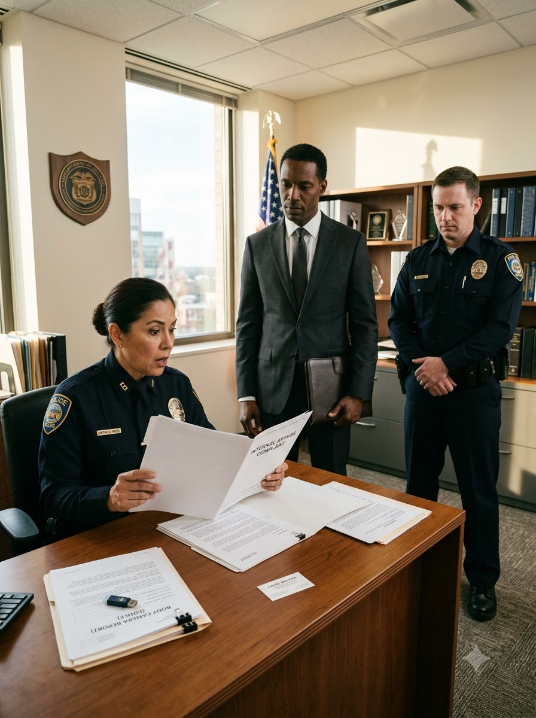
The story didn’t end in the diner. Andre filed a formal complaint the following Monday — not out of anger, he told the internal affairs officer who took his statement, but because a pattern unaddressed is a pattern repeated. Attached to the complaint was a single business card, the kind Andre rarely had reason to hand anyone: Andre Walker, Senior Counsel, Civil Rights Division.
It was the card that, three weeks later, made Captain Diane Reyes go pale in her own office, halfway through what she’d assumed would be a routine review of a minor customer complaint. She hadn’t expected the file to include a federal civil rights attorney’s name, a body-camera timestamp, and a waitress’s sworn statement contradicting her own officer’s report — all before she’d finished her coffee.
Officer Cole was placed on administrative leave pending review. Andre didn’t ask for anything beyond a mandatory retraining program and a written acknowledgment in Cole’s file — not because he wanted mercy, but because he’d spent enough of his career watching outrage burn hot and fast and change nothing. He wanted something that would still be true in five years.
Harold Benton mailed him a card a week later — a short, shaky note of apology, and a photograph of the church food drive, fully funded after all, six hundred dollars and a little more besides. Andre kept it in his desk drawer, not because he needed reminding of what had happened, but because it was proof that ordinary people, given the chance to make something right, usually did.
He never went back to Miller’s Family Diner for breakfast again. But sometimes, driving past it, he’d think of Chloe Martin, twenty-three years old, refilling coffee cups and telling the truth in a room where the easier thing would have been to say nothing at all — and he’d think that was the part of the story worth remembering most.
