

“Get on the ground.”
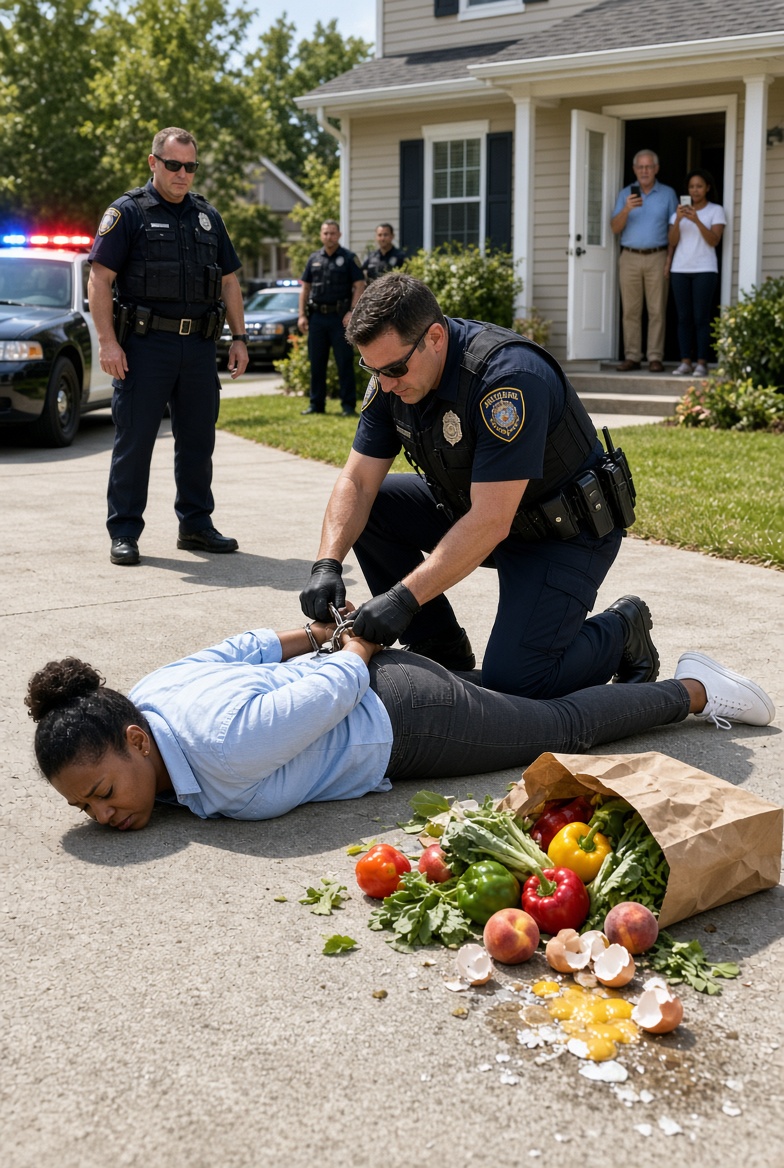
Major General Evelyn Carter turned with two grocery bags in her arms and thought, for half a second, that she had misheard.
She had survived convoy briefings in Iraq, sandstorms in Kuwait, emergency logistics calls from Germany at three in the morning, and enough high-pressure rooms to know the difference between urgency and aggression.
This was not urgency.
This was a command fired at her like she had already been tried, convicted, and sentenced between the time she opened her car door and reached for the milk.
Four patrol cars blocked the end of her driveway.
No sirens.
Just flashing lights slicing red and blue across the quiet Georgia afternoon.
Evelyn stood beside her old gray Honda in front of the blue-shuttered ranch house she had owned for nine years.
A bag of groceries hung from each hand.
Eggs, chicken, rice, spinach, peaches, and the cookie dough ice cream her daughter had asked for three times that morning.
“Officer,” she said carefully, “this is my home.”
The man approaching her did not slow down.
His nameplate read Harlan Pike.
His jaw was square, his sunglasses dark, and his hand rested near his weapon like the grocery bags in Evelyn’s hands were something that might explode.
Three other officers fanned out around the driveway, cutting off paths she had not tried to use.
“Set the bags down,” Pike barked.
“I’m happy to comply,” Evelyn said, keeping her voice steady.
“Can you tell me what this is about?”
“You people never listen, do you?”
The sentence reached her before the violence did.
Pike’s boot swept behind her ankles.
Evelyn fell hard.
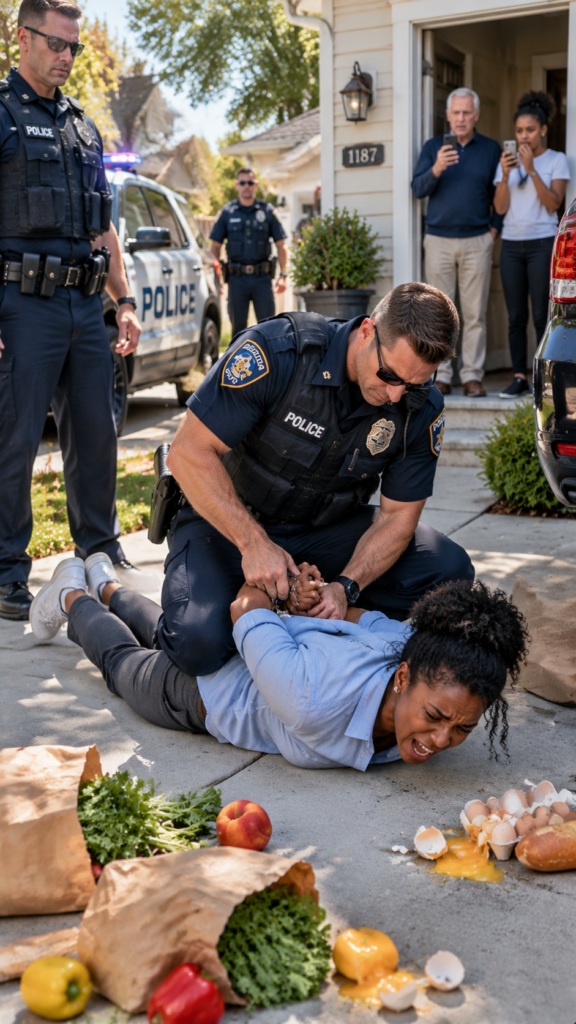
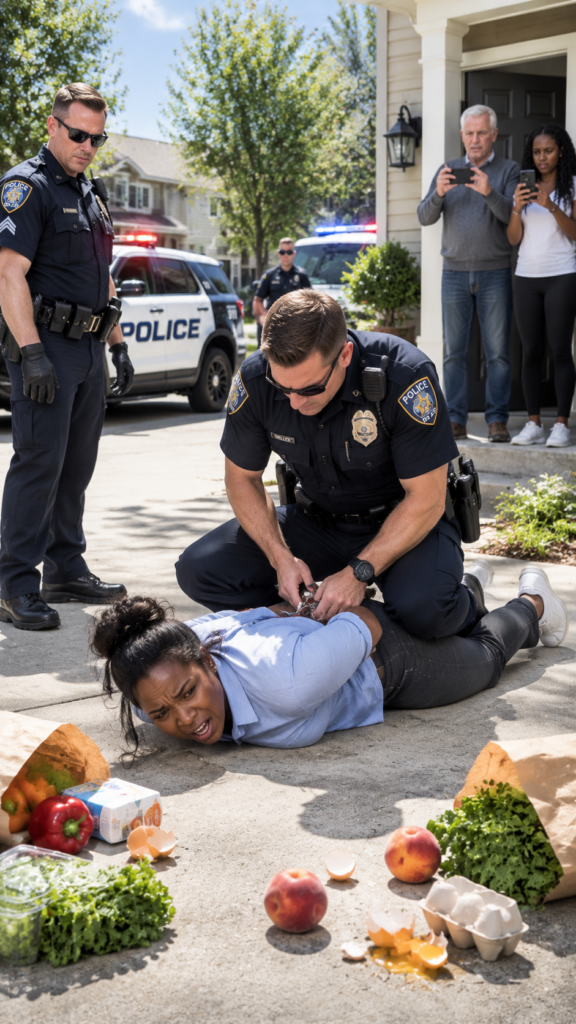
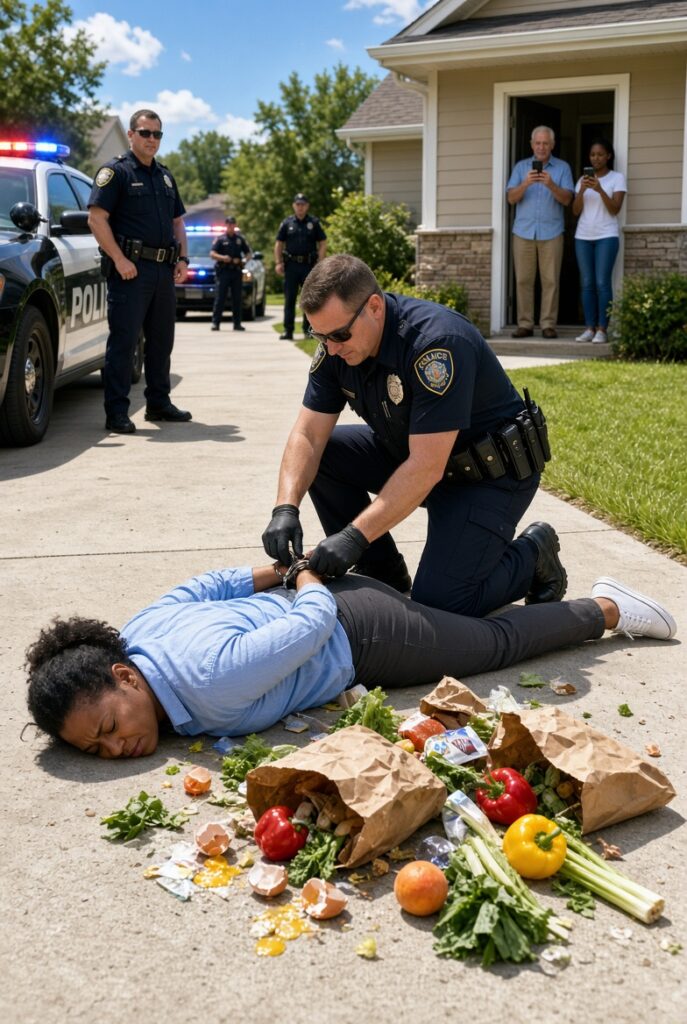
The groceries exploded across the concrete.
Eggs cracked open under her hip.
The milk burst and spilled white across the hot driveway.
Her palms slapped asphalt that had baked all day under the Georgia sun, and the heat bit into her skin before pain had time to organize itself.
For one stunned second, she could not breathe.
Then Pike’s knee drove between her shoulder blades.
“Stay down.”
“I am down,” Evelyn managed, cheek pressed against the driveway.
He shoved her face harder against the concrete.
From inside the house, a screen door banged open.
“Mom?”
Evelyn’s daughter stood barefoot in the doorway, frozen.
Maya Carter was sixteen, tall, sharp-eyed, with her natural hair piled into a loose puff and the oversized college T-shirt she had bought during a campus tour before Evelyn deployed.
Her face went white when she saw her mother pinned to the driveway by four officers.
“What are you doing to her?” Maya screamed.
One of the officers turned toward her.
“Get inside before you join her.”
That was the moment Evelyn stopped being frightened.
Not because the danger had passed.
Because it had touched her child.
Twenty-three hours earlier, Evelyn Carter had stepped off a military transport at Hartsfield-Jackson with a duffel bag, a stiff neck, and the strange emptiness that came after too many months of being needed by too many people.
Six months in Germany had turned her mind into a map of supplies, personnel, aircraft, fuel windows, medical shipments, and contingency plans for thirty-two hundred troops.
She had moved equipment across borders, solved problems before they became disasters, and answered to generals who understood that logistics was invisible only when it worked.
All she wanted now was home.
Her own bed.
Her own shower.
Her daughter’s voice not filtered through a screen.
The Uber driver from the airport barely spoke, and Evelyn was grateful.
She leaned her head against the window and watched Atlanta slide by, familiar and changed at once.
New glass towers rose where low brick buildings used to be.
Old streets carried new coffee shops, new apartments, new prices.
The city she grew up in still existed, but sometimes only in flashes: a corner store sign, a church marquee, a line of kids waiting at a bus stop in uniforms too bright for the heat.
When the car turned into Willow Ridge, her breathing changed.
The neighborhood smelled like cut grass, charcoal smoke, and summer rain evaporating from warm pavement.
It was middle-class Georgia in all its contradictions.
Ranch houses with brick mailboxes.
Kids’ bikes abandoned in driveways.
HOA warnings about lawn edges.
Political yard signs that disappeared every other week depending on who was mad at whom.
Evelyn’s house sat under two old oak trees, modest and stubborn, with blue shutters that badly needed repainting.
Maya burst through the screen door before Evelyn could even lift her duffel.
“Mom!”
Evelyn caught her with both arms and nearly lost her balance.
Maya hugged like she was trying to put six months back into place by force.
Evelyn breathed in the coconut smell of her daughter’s shampoo and felt the tight thing in her chest loosen for the first time since she left.
“You said tomorrow,” Maya mumbled into her shoulder.
“Caught an earlier transport.”
“You lied.”
“I strategically withheld information.”
Maya pulled back, grinning with tears in her eyes.
“That sounds like general talk for lying.”
“It is.”
Inside, the house felt both strange and familiar.
The refrigerator hummed its same uneven note.
The air conditioner rattled like it had been threatening to die for two years.
A stack of mail waited on the counter, and one of Maya’s sneakers sat in the hallway exactly where Evelyn had told her not to leave shoes since she was ten.
It was perfect.
There was no food in the house, so they ordered pizza.
They ate on the couch and watched a movie Maya claimed was “actually deep” despite having seven explosions in the first twenty minutes.
Halfway through, Maya fell asleep with her head on Evelyn’s shoulder the way she used to when she was small.
Evelyn did not move.
She sat in the blue glow of the television, one arm around her daughter, thinking of everything she had missed: school events, bad days, regular dinners, jokes that were only funny if you were there, the quiet accumulation of motherhood that deployment always interrupted.
Later, she carried Maya to bed even though the girl was nearly as tall as she was.
Maya stirred.
“Mom, I’m not five.”
“No,” Evelyn whispered.
“But I missed five too.”
Maya was asleep before she could answer.
The next day was supposed to be ordinary.
That was what made the memory so cruel later.
Evelyn woke late by military standards, which meant 7:30 instead of 4:45.
She made coffee, opened the windows, and listened to birds argue in the oak trees.
Maya came downstairs in pajama shorts, hair half-wrapped, scrolling through messages from friends who wanted proof that her mother was actually home.
They made a grocery list together.
Chicken.
Rice.
Vegetables.
Cereal.
Peaches.
Ice cream.
“Cookie dough,” Maya said.
“You wrote ice cream.”
“Cookie dough is not a flavor.
It is a legal category.”
Evelyn laughed and added it.
By early afternoon, the heat had turned the street soft and bright.
Evelyn drove to the Piggly Wiggly four blocks away, grateful for the boring errand.
She liked the dull rhythm of normal life after deployment: choosing peaches, checking expiration dates, standing behind someone paying with exact change, deciding whether one gallon of milk was enough.
It felt like civilian life welcoming her back through small inconveniences.
She pulled into her driveway at 1:52 p.m.
Mr. Arthur Bell from three houses down was watering his roses.
He was seventy, a retired history teacher with a straw hat, a bad knee, and the moral certainty of a man who had spent forty years telling teenagers that facts mattered even when they were inconvenient.
He lifted a hand.
“Welcome home, General!”
Evelyn smiled.
“Thank you, Mr. Bell.”
She had just opened the trunk when the first patrol car turned onto the street.
Then another.
Then two more.
They boxed her driveway with a precision that made her body understand danger before her mind did.
Her first thought was Maya.
Something happened.
Someone called.
Emergency.
She dropped one bag back into the trunk and raised both hands slightly.
Officer Pike got out first.
“Ma’am, step away from the vehicle.”
Evelyn did.
Her hands were visible.
“My daughter is inside,” she said.
“Can you tell me what happened?”
Pike ignored the question.
“Hands where I can see them.”
“They are.”
“Turn around.”
“Officer, I live here.”
“Hands on the car.”
Something in his tone told her this was no welfare check.
She was not being informed.
She was being handled.
“I will comply,” Evelyn said, slow and clear.
“But I want to know the reason for this stop.”
Pike grabbed her wrist hard enough that pain shot into her hand.
Her training surged up automatically.
Break grip.
Step left.
Control wrist.
Create distance.
She killed every instinct.
A Black woman resisting four armed officers in her own driveway could become a headline before it became the truth.
“I am not resisting,” she said.
“I am complying.”
Pike spun her into the car.
Her hip struck the doorframe.
The metal was hot beneath her palms.
“I have identification,” she said.
“Military ID.
Driver’s license.
Home address.
It’s in my purse.”
“Stop talking.”
Then came the sweep.
Her knees hit first.
Then her palms.
Then her cheek.
The world went white around the edges.
Concrete scraped skin from her face.
Her lip split against her teeth.
The smell of milk, hot asphalt, and broken eggs rose around her like some ugly joke about domestic life turned into evidence.
Pike cuffed her too tightly.
The metal bit into the bones of her wrists.
Inside, Maya heard the sound no child should hear from her own driveway.
A body hitting ground.
A voice barking.
A mother not answering.
Maya ran to the door with her phone already in hand.
“What are you doing to her?”
“Get back inside,” an officer shouted.
“She lives here,” Maya cried.
“This is her house!”
Mr. Bell dropped his hose.
Water sprayed across the grass behind him as he walked fast toward the driveway, phone in hand.
“That is Evelyn Carter,” he shouted.
“She is my neighbor.
She just came home from deployment.”
Pike did not look at him.
“Sir, step back or you will be detained.”
“She’s a general.”
That word should have mattered.
It did not.
Pike hauled Evelyn up by the arm.
She tasted blood and kept her face still.
She counted in fours.
Inhale.
Two.
Three.
Four.
Exhale.
Two.
Three.
Four.
A battlefield technique, adapted now to her own driveway, where her daughter was sobbing and her groceries were bleeding across concrete.
Pike pushed her toward the back of the patrol car.
No charges.
No explanation.
No rights.
Maya screamed, “Mom!”
Evelyn turned only enough to find her daughter’s face.
“Maya,” she said, calm by force, “record everything.”
Maya did.
Her hands shook so hard the video tilted, but she kept filming.
Pike pushing Evelyn’s head down into the cruiser.
The milk spreading under the wheel.
Mr. Bell arguing.
The officers ignoring him.
The screen door swinging open behind Maya, proof that the house was theirs and had been before the lights arrived.
Mr. Bell’s Ring camera captured the rest.
Timestamp.
1:51:38 p.m.
Permanent cloud backup.
At Ridgemont Precinct, they brought Evelyn through the rear entrance.
The building was squat brick, old enough to smell like dust and old coffee no matter how much disinfectant they poured over the floors.
Pike did not take her to the front desk.
He did not ask for her ID.
He did not process her in a way that resembled procedure.
He placed her in a holding cell at the end of a hallway and locked the door.
Four hours passed.
No phone call.
No charge.
No explanation.
Evelyn sat on a metal bench bolted to the wall, wrists bruising, cheek throbbing, lip swollen, still wearing dirt from her own driveway.
Somewhere down the hall, officers laughed at something on a phone.
The sound bounced off cinder block and made the cell feel smaller.
She had commanded troops across continents.
Now no one would tell her why she was behind a locked door.
At 2:14 p.m., while Evelyn sat in that cell, Maya posted the video.
She wrote the caption through shaking hands.
They arrested my mom for coming home with groceries.
No crime.
No explanation.
Just Black in her own driveway.
She posted it on TikTok first.
Then Instagram.
Then X.
Then Facebook, because Mr. Bell told her older people still used Facebook and older people voted.
By 3:00, the video had twenty thousand views.
By 4:00, it had crossed two hundred thousand.
By 5:00, a local news van was outside the Carter home, and a reporter stood in front of the driveway where the groceries still lay in the heat because nobody wanted to disturb what might become evidence.
Mr. Bell gave the first interview.
He stood in his rose garden with the hose still running behind him, soaking one patch of lawn into mud.
“I’ve known Evelyn Carter for years,” he said.
“She is quiet, respectful, military, a mother, a neighbor.
There was no reason for what happened today.
No reason except the one folks keep trying not to say out loud.”
By 6:00 p.m., other neighbors were talking.
A Black engineer two streets over described being pulled over six times in one year while driving home from work.
A Latina nurse said Ridgemont officers followed her from the grocery store twice, then parked outside her house until she went inside.
A white couple with two adopted Black sons talked about patrol cars slowing down when their boys played basketball in the driveway.
The story changed shape.
It was no longer only Evelyn’s driveway.
It was the whole neighborhood speaking after years of swallowing the same fear.
At 7:12 p.m., a desk sergeant opened Evelyn’s cell.
“You’re free to go.”
Evelyn stood slowly.
“Why was I detained?”
The sergeant did not meet her eyes.
“You’ll have to speak with the officers involved.”
“I’m speaking with you.”
“If you want to file a complaint, the forms are online.”
That sentence sat between them like a locked door.
Evelyn walked out into evening heat with bruised wrists, a split lip, and more restraint than the building deserved.
Maya waited in the parking lot with Mr. Bell.
The second she saw her mother, she ran.
Evelyn caught her with both arms, and Maya shook against her like a child half her age.
“I recorded it,” Maya whispered.
“Everything.
Everybody’s seeing it.”
Evelyn did not yet know what everybody meant.
She did not know her face was already on half the phones in Atlanta.
She did not know #JusticeForEvelyn had begun trending locally.
She did not know that by morning, strangers across the country would know her driveway, her groceries, her daughter’s scream, and the exact sound of Officer Harlan Pike’s handcuffs closing around her wrists.
All she knew was that Maya was safe.
For that night, it had to be enough.
The internet identified her before the police apologized.
At 6:41 the next morning, someone posted her public military biography on Reddit.
The screenshot spread fast: Evelyn Denise Carter, Major General, United States Army.
Current assignment: Deputy Commander, Logistics Readiness Command, Fort Stewart, Georgia.
Twenty-seven years of service.
Four deployments.
Bronze Star.
Legion of Merit.
Responsible for coordinating personnel and equipment movement across multinational operations.
The top comment had over fifty thousand upvotes by breakfast.
They tackled a two-star general in her own driveway.
Another read:
If this is what happens when she has stars on her shoulders, imagine what happens to everyone else.
By 8:00 a.m., national news had the story.
By 9:15, someone at the Pentagon made a phone call.
Not a junior public affairs officer.
Not a polite inquiry.
Someone with stars of his own called the Atlanta police chief and asked why one of the Army’s senior logistics commanders had been thrown onto her driveway, held for four hours, and released without explanation.
The call lasted seven minutes.
The effects came faster.
At 10:03 a.m., Ridgemont Precinct Captain Victor Hensley called Evelyn.
She let it go to voicemail.
His voice was polished, careful, and completely useless.
General Carter, this is Captain Hensley from Ridgemont Precinct.
I’d like to discuss yesterday’s incident and express our regret for any misunderstanding.
Please call me back at your earliest convenience.
Evelyn listened once.
Then again.
Incident.
Regret.
Misunderstanding.
Not assault.
Not unlawful detention.
Not failure.
She deleted nothing.
She saved everything.
At 11:00 a.m., the police department issued a statement.
They were aware of the incident.
They were reviewing the circumstances.
Officer Pike was placed on administrative leave.
They took all complaints seriously.
They remained committed to professionalism and respect.
Administrative leave with pay.
A vacation wrapped in bureaucracy.
While Evelyn’s cheek was still raw and Maya still flinched every time tires slowed near the house, the man who shoved her into concrete was being paid to wait out the news cycle.
Lena Brooks, an investigative reporter at the Atlanta Ledger, read the statement three times and laughed without humor.
She had covered policing for eleven years.
She knew the language.
Administrative leave meant stall.
Review meant contain.
Professionalism and respect meant there was already a problem too ugly to name directly.
Lena opened a blank document and started making calls.
“If they did this to a general,” she told her editor, “they’ve done it to people nobody recognized.”
The first public records request went out before noon.
All complaints against Officer Harlan Pike for five years.
All disciplinary outcomes.
All body-camera malfunction logs.
All arrest records tied to last-hour-of-shift processing.
All internal communications from Ridgemont Precinct about productivity metrics.
By the time Evelyn sat down to dinner with Maya, the first wall had already cracked.
The records arrived redacted.
That was expected.
But redaction can still reveal shape.
Pike had nine formal complaints in five years.
Six excessive-force allegations.
Two racial-profiling complaints.
One false arrest claim dismissed after charges collapsed.
None sustained.
Every review closed by Captain Hensley.
Nine complaints.
Zero discipline.
Lena created a spreadsheet.
Dates.
Complaint types.
Witnesses.
Video availability.
Outcome.
Hensley’s signature appeared again and again like a stamp from a machine built to say no.
Then she found the camera logs.
Pike’s body camera had “malfunctioned” during seven of the nine complaint incidents.
The department average was nowhere near that.
Bad luck does not usually follow one man so loyally.
The real break came from a source inside Internal Affairs.
He met Lena at a gas station outside Decatur, wearing a Braves cap low over his face and exhaustion in the lines around his mouth.
His name was Malcolm Trent, though she agreed not to publish it without consent.
He had investigated complaints for twenty-one years and looked like a man who had filed too many truths into drawers marked insufficient evidence.
“Pike isn’t special,” Malcolm said.
“He’s just careless.”
“Careless enough to get caught?”
“Careless enough to think nobody important would be the victim.”
He slid a thumb drive across the table.
“CAD logs.
Overtime reports.
Emails.
Bodycam service tickets.
You didn’t get this from me.”
“Why now?” Lena asked.
Malcolm looked toward the gas pumps, where a mother buckled a child into a car seat.
“I have daughters,” he said.
“And I am tired of pretending paperwork can’t bleed.”
That night, Lena opened the files on an offline laptop.
The CAD logs showed Pike called in Evelyn’s vehicle before she pulled into her driveway.
Suspicious Black female.
Late-model sedan.
Residential area.
No neighbor call.
No reported crime.
No emergency.
He had created the stop out of thin air.
The overtime logs told a second story.
Ridgemont officers made a startling number of arrests in the final thirty minutes of their shifts.
Those arrests triggered processing time, which triggered overtime, which boosted paychecks.
Many charges were later dropped or never filed.
The pattern was too clean to be coincidence and too expensive to be incompetence.
Then came the email.
From Captain Hensley.
Subject: July Productivity Expectations.
It never used the word quota.
It did not have to.
Fifteen arrests per officer minimum.
We are behind district average.
Overtime approvals will reflect output.
Hit the numbers if you want the hours.
Arrest quotas were illegal under Georgia law.
The email danced around the law like a man who knew exactly where the line was and had built a business stepping over it in the dark.
Lena wrote until sunrise.
The article published Thursday at 6:00 a.m.
The headline was simple:
The Ridgemont Pattern: How Illegal Arrest Pressure And Overtime Pay Created A System Of Abuse
By 8:00, it had been shared fifty thousand times.
By noon, the Fulton County district attorney announced a review.
By three, Lena’s phone rang from a blocked number.
Malcolm Trent’s voice was low.
“They transferred me.”
“Where?”
“Night patrol.
Zone Seven.
They’re calling it routine rotation.”
“I’m sorry.”
“Don’t be sorry.
Keep digging.”
“Into what?”
“All precincts,” he said.
“Follow the overtime.
Ridgemont isn’t the exception.”
The line went dead.
Lena followed the overtime.
What she found made Evelyn’s driveway feel like the doorway to a much larger room.
Twelve precincts.
Similar last-minute arrest spikes.
Similar overtime jumps.
Similar body-camera gaps.
Five captains using language that looked different on paper but meant the same thing in practice: bring in arrests, get paid.
Ridgemont’s questionable overtime totaled roughly $360,000 a year.
Districtwide, the number passed $4 million.
Four million taxpayer dollars tied to arrests that often dissolved before trial.
Four million dollars rewarding officers for dragging people into the system, whether the system had any legal reason to hold them or not.
That number changed the temperature of the room.
City council members who had stayed cautious began demanding hearings.
The district attorney expanded the investigation.
Federal prosecutors started watching.
The FBI Public Corruption Unit requested documents.
The police union responded exactly as expected.
The Atlanta Police Benevolent League released a statement defending Officer Pike as a dedicated public servant with nine years of honorable service.
They warned against trial by media, praised officers who made difficult split-second decisions, and said accountability activists were undermining public safety.
No mention of nine complaints.
No mention of the CAD log.
No mention of overtime.
No mention of Evelyn’s scraped face or Maya’s scream.
Union Vice President Colin Rusk went on television that Friday.
He wore his uniform, though he was off duty.
“People need to understand,” he said, “officers make decisions with incomplete information.
We don’t know what happened before the video started.”
The host replied, “The Ring video starts before Officer Pike uses force.”
Rusk smiled with patient disappointment.
“I won’t litigate evidence on cable news.”
It was polished.
It was effective for people who wanted permission to doubt the obvious.
By Saturday, anonymous claims began spreading.
Evelyn was difficult.
Evelyn had argued with neighbors.
Evelyn had a temper.
Evelyn had probably escalated things before the camera began.
Mr. Bell went back on television and destroyed that version with a teacher’s precision.
“Evelyn Carter has been deployed half the year,” he said.
“She is the quietest person on this street.
If they are inventing stories now, ask yourself why the truth scares them so badly.”
But the smears had a purpose.
They did not need to convince everyone.
Only make fighting feel exhausting.
Sunday evening, Evelyn received a blocked voicemail.
The voice was male.
Low.
Slow.
General Carter, you’re making noise that can get people hurt.
Accidents happen.
Think about your daughter before you keep pushing.
Fourteen seconds.
Evelyn saved it to three accounts and sent it to Lena, her attorney, and a colonel she trusted.
She did not call Ridgemont Precinct.
She had learned enough.
Monday morning, a senior officer from the Pentagon called.
He had known Evelyn for twelve years, and his tone carried the careful softness people use when delivering threats they want to deny later.
“Evelyn, some folks are worried this is becoming political.”
“It was political when they tackled me in my driveway.”
“I’m not disagreeing.
But your promotion file is still active.
Major general review boards can get uncomfortable with public controversy.”
There it was.
Not a command.
Not exactly.
Just a polite hand placed on the scale of her future.
“Are you advising me to be quiet?” Evelyn asked.
“I’m advising you to be strategic.”
She almost laughed.
Strategy was what people called surrender when they wanted it to sound intelligent.
After she hung up, she sat at the kitchen table and opened her laptop.
She drafted an email to Lena.
I need to step back.
My family is under pressure.
I hope you understand.
Her finger hovered over send.
Then Maya came home early.
Her face was blotchy from crying.
Her backpack slid off one shoulder and hit the floor.
“What happened?” Evelyn asked, though part of her already knew.
“Mr. Nolan played the union interview in civics class,” Maya said.
“Then he asked if anyone wanted to discuss both sides.”
Evelyn closed the laptop halfway.
Maya’s mouth twisted.
“Brandon said people like us are why cops get killed.
He said if you had just complied, none of this would have happened.”
“You did comply,” Evelyn said.
“I know.”
Maya sat down across from her.
“He didn’t say Black,” she added.
“But he didn’t have to.”
Evelyn felt the words in her chest.
All the lessons she had given her daughter: stay calm, follow instructions, respect authority, let the truth protect you.
All the lessons Black parents give because they are trying to keep children alive, even when the lessons do not guarantee safety.
Maya looked at the laptop.
“What were you doing?”
Evelyn did not answer quickly enough.
Maya’s face changed.
“You were going to stop.”
“I was thinking about protecting you.”
Maya laughed once, bitter and broken.
“They already hurt me.”
“Maya.”
“No, Mom.
They hurt me when they put you on the ground.
They hurt me when my class talked about you like you were a topic and not my mother.
They hurt me when adults pretended there were two sides to whether you deserved it.”
Evelyn looked away.
Maya’s voice softened, but it became sharper somehow.
“You always told me rules matter.”
“They do.”
“Then make them matter.”
That sentence ended the email.
Evelyn deleted every word.
Then she typed a new message.
Lena, I am moving forward.
Tell me what you need.
She sent it.
Maya watched.
“So we’re fighting?”
Evelyn closed the laptop.
“We’re fighting.”
Maya nodded, picked up her backpack, and headed upstairs like they had decided what to make for dinner.
Evelyn sat alone for a while.
She thought of her father, Joseph Carter, who had died when she was nineteen after a lifetime of working machines harder than any man should.
He had told her once, on a hot porch evening after she complained about unfairness, “Doing right only matters when it costs you something.”
She had carried that sentence into the Army.
Into combat zones.
Into command rooms.
Now it had followed her home.
The lawsuit came next.
Rachel Voss from the ACLU of Georgia called on Tuesday morning.
She spoke quickly, but not carelessly.
Fourth Amendment.
Fourteenth Amendment.
Unlawful detention.
Excessive force.
Municipal liability.
Policies that incentivized false arrests.
Failure to discipline.
“This is not only about Pike,” Rachel said.
“This is about the machine that kept rewarding him.”
“What are the odds?” Evelyn asked.
“With Lena’s evidence?
Strong.
But more importantly, discovery forces them to answer under oath.”
The complaint was filed Friday in federal court.
Ninety-seven pages.
Meticulous.
Devastating.
The first sentence read:
This case is not an isolated incident.
It is the predictable result of a system that paid officers to manufacture suspicion.
By then, Mr. Bell had started a petition.
Justice for General Carter and Accountability for Ridgemont Police.
His grandson helped him set it up because Mr. Bell believed in democracy but not passwords.
Within twenty-four hours, it had five thousand signatures.
The comment section became its own archive of lived evidence.
A veteran wrote about being stopped in uniform because an officer said his rental car looked “out of place.”
A mother wrote about teaching her son to keep school ID, driver’s license, insurance, and college acceptance letter in one folder in his car.
A nurse wrote, I have saved lives in this city and still been followed home like a threat.
The Veterans of Foreign Wars post where Evelyn had spoken twice issued a statement.
Then organized a motorcade.
By Monday morning, two hundred motorcycles, trucks, and cars rolled toward City Hall with American flags and handwritten signs taped to windows.
SERVED HER COUNTRY.
PROTECT HER RIGHTS.
IF IT CAN HAPPEN TO A GENERAL, IT CAN HAPPEN TO ANYONE.
Maya stood beside Evelyn on the sidewalk watching veterans climb off motorcycles in dress caps and denim vests, some with canes, some with oxygen tanks, some with medals pinned above hearts that had learned long ago how heavy love of country could become.
One old Marine saluted Evelyn.
She returned it.
For the first time since the driveway, her hands did not shake.
Then came the recording.
Lena received it through an encrypted email with no message, only an audio file labeled RollCall_06_12.
The voice was Captain Hensley’s.
Not implied.
Not coded.
Explicit.
“Fifteen arrests per officer minimum.
I don’t care if it’s loitering, suspicious behavior, jaywalking, whatever you can articulate.
Hit the numbers or lose overtime.”
A younger voice asked, “Captain, isn’t there a state law against quotas?”
Hensley answered, “There is no law against productivity.”
Lena had the audio authenticated by two experts before publishing.
The article went live at 6:00 a.m.
By 10:00, the city council called an emergency session.
By noon, the mayor promised full cooperation.
By 3:00, three captains had retained lawyers.
By Friday, union vice president Colin Rusk resigned for “health reasons.”
On Saturday, Lena published union meeting minutes showing Rusk had encouraged quota-based overtime pressure across multiple precincts while publicly pretending the union had no knowledge of it.
That article changed the investigation from misconduct to conspiracy.
Federal subpoenas followed.
Then grand jury notices.
Then silence from men who had spent weeks talking.
The grand jury convened in late July.
Evelyn entered the courthouse in her Army service uniform.
Not for drama.
For truth.
If they had put her face on the ground while she carried groceries, they could look at the full weight of who she was when she testified.
Maya sat outside the sealed room with Rachel Voss and Mr. Bell.
She wore a yellow cardigan, her mother’s old watch, and the expression of a teenager learning that justice was slower than anger but heavier when it finally arrived.
Inside, prosecutor Dana Whitfield asked Evelyn to describe the afternoon.
Evelyn did it with military precision.
“I pulled into my driveway at 1:52 p.m.
Four patrol vehicles arrived within approximately two minutes.
Officer Pike ordered me from my vehicle.
I complied.
I asked for the reason for the stop.
He did not answer.
He used force, swept my legs, handcuffed me, and detained me for approximately four hours.
I was never charged.”
“Did you resist?”
“No.”
“Were you told why you were being detained?”
“No.”
“Did you identify yourself?”
“I attempted to.
My military ID was in my purse.
Officer Pike never checked it.”
Then came the evidence.
Maya’s video.
Mr. Bell’s Ring footage.
The CAD log.
Pike’s complaint history.
The quota email.
The roll-call audio.
The overtime records.
The body-camera malfunctions.
Pike appeared with a lawyer and invoked the Fifth Amendment seventeen times.
Captain Hensley tried to explain the email as motivational language.
Dana Whitfield played the audio.
Hit the numbers or lose overtime.
The grand jury forewoman, a Black woman in her sixties, leaned forward slowly.
“Captain,” she said, though she was not supposed to question witnesses directly.
“Motivation doesn’t usually sound like a price list.”
Hensley’s lawyer objected to nothing because there was no judge in the room and no good answer available.
After six hours of testimony, the grand jury deliberated for ninety minutes.
The indictments came back.
Harlan Pike: assault under color of law, official misconduct, unlawful detention, and theft by deception tied to overtime fraud.
Victor Hensley: conspiracy, official misconduct, violation of Georgia’s arrest quota statute, and obstruction.
Colin Rusk: racketeering, conspiracy to commit fraud, and facilitating a districtwide quota scheme.
Others followed.
Not all at once.
But enough to make the walls shake.
Evelyn sat in the hallway when Rachel came out.
Maya stood first.
“Well?” she asked.
Rachel’s eyes were bright.
“They indicted them.”
Maya covered her mouth.
Evelyn did not speak for a moment.
Then she exhaled, long and controlled, like she had been holding her breath since the asphalt.
“It’s not over,” Rachel said.
“No,” Evelyn replied.
“But it has started telling the truth.”
Two weeks later, the Pentagon announced Evelyn’s promotion.
Major General Evelyn Carter received her second star at Fort Stewart under a white tent on a morning so bright it made everyone squint.
The citation praised her leadership, operational excellence, and grace under extraordinary pressure.
Maya pinned the second star on her mother’s uniform.
Her hands trembled, but she did not cry until after the pin was secure.
Evelyn bent slightly and whispered, “Mission accomplished.”
Maya laughed through tears.
“Strategically withheld emotion until the end.”
“That’s my girl.”
The applause rolled across the field.
Soldiers, veterans, reporters, neighbors, and strangers stood together.
Mr. Bell wore his best suit and saluted badly, which made Evelyn smile despite herself.
That week, Atlanta issued General Order 24-11.
Body cameras became mandatory with automatic cloud upload.
Unexplained deactivation meant suspension.
Arrest-quota language was banned and monitored.
Overtime tied to arrests required independent review.
Ridgemont’s leadership was replaced.
An outside monitor was appointed for three years.
Quarterly stop data would be made public.
No reform could undo what happened in the driveway.
But reform meant the driveway had not swallowed the truth.
In September, Maya spoke at a community meeting in the Ridgemont high school auditorium.
Two hundred people filled the room.
Parents, officers, veterans, students, teachers, neighbors, reporters.
Maya stood at the podium, hands gripping both sides, voice thin at first but growing stronger as she went.
“My mom taught me to follow the rules,” she said.
“I still believe rules matter.
But rules only mean something if they apply to the people with power too.”
The room went silent.
“She came home with groceries.
That was all.
And if a decorated general can be treated like a threat in her own driveway, then the question is not what did she do.
The question is who else did this happen to when no one was filming?”
Evelyn stood in the back.
Her cheek had healed.
Her wrists had healed.
Something deeper was still working its way toward healing.
When Maya finished, the room rose.
Forty-three seconds of applause.
Mr. Bell timed it because history teachers are strange that way.
Later, Lena Brooks asked Evelyn how she felt.
They stood outside the auditorium under a humid night sky while cameras packed up and neighbors talked in small clusters.
Evelyn thought about the asphalt.
The milk.
The eggs.
The knee between her shoulder blades.
The voice telling her daughter to get inside before she joined her.
“They looked at me and saw a threat,” Evelyn said.
Lena waited.
Evelyn looked toward Maya, who was laughing with two friends near the steps.
“It turns out I was a threat,” she continued.
“Just not the kind they expected.”
The trials would come later.
So would motions, delays, hearings, denials, appeals, and all the slow machinery of law that tests whether outrage can survive paperwork.
But that night, Evelyn Carter went home with her daughter.
The driveway had been cleaned weeks ago, though a faint stain remained near the place where the milk had spread.
Maya said they should leave it.
Evelyn said concrete did not need monuments.
Mr. Bell said history lived everywhere whether people marked it or not.
Evelyn stood there for a moment before going inside.
The house was quiet.
The oaks leaned over the street.
A patrol car passed slowly at the far corner and kept going.
Maya took her hand.
Not because she was scared.
Because she could.
“Mom?”
“Yeah?”
“Are we okay?”
Evelyn looked at the house, the driveway, the porch light, the daughter who had turned panic into evidence and fear into testimony.
“We’re getting there,” she said.
Maya nodded.
Inside, the groceries had been replaced days ago.
Chicken, rice, vegetables, peaches, milk, eggs, and cookie dough ice cream.
Ordinary things.
Necessary things.
The things a woman should be able to carry into her own home without becoming a target.
Evelyn put the ice cream in the freezer, washed her hands, and stood at the kitchen sink for a long moment, looking out at the driveway where everything had broken open.
Then she turned off the light.
Not because the fight was over.
Because tomorrow, she would continue it.
And this time, the whole city knew her name.
