

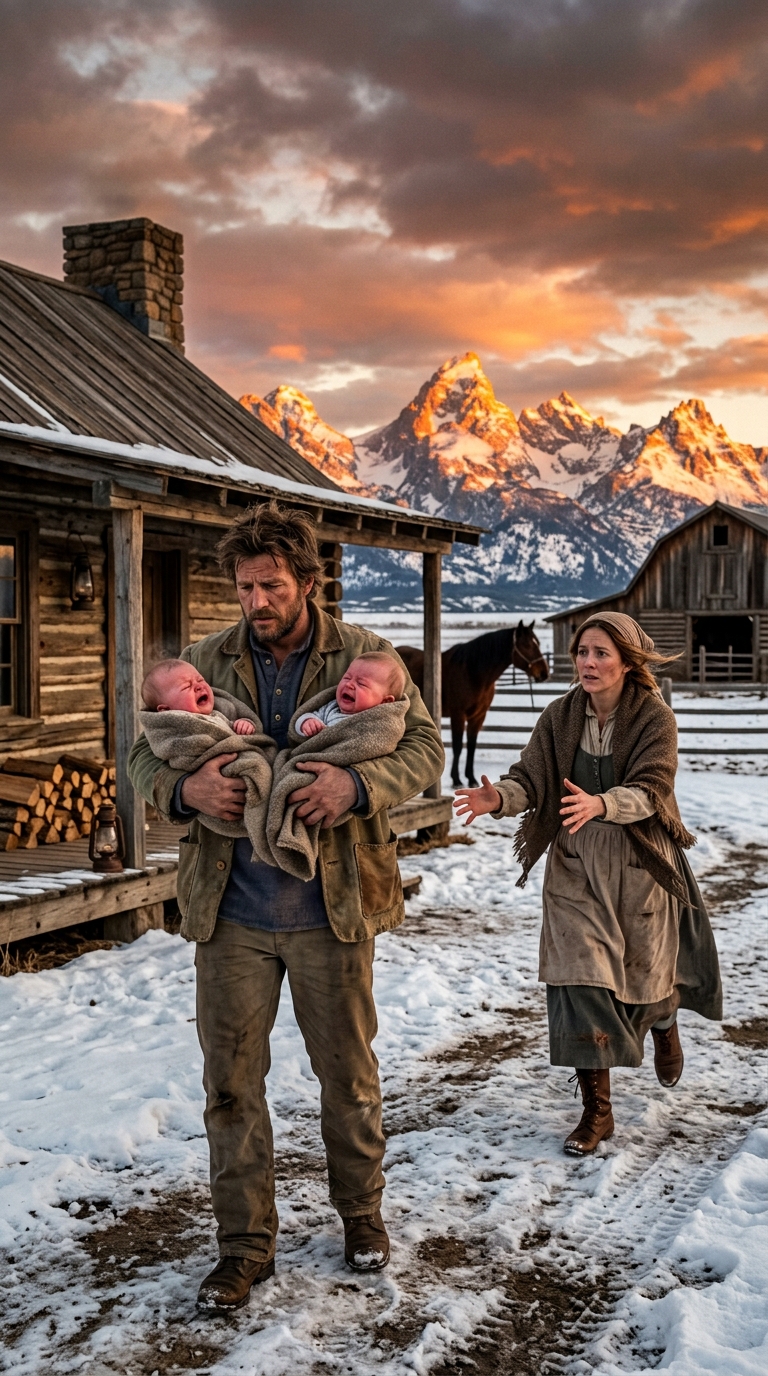
“Let me stay,” Aurelia Mendoza said. “I’ll take care of your children.”
Elías Barragán looked at the stranger from the doorway of his house, unsure if he had heard correctly.
Behind him, the milk was burning on the iron stove. Smoke filled the kitchen. One of the twins cried against his shoulder while the other clung to his shirt with tiny clenched fists.
Elías could lift an injured cow, repair a fence in the rain, and cross the ravines of the Sierra de Chihuahua alone. Yet he didn’t know how to calm two terrified children at the same time.
Aurelia had arrived at Rancho El Enebro shortly before nightfall in September 1889. She was only looking for water, directions to the town of San Lorenzo, and a place to sleep before continuing her journey.
Instead, she had found a widower losing a battle that no physical strength could win.
“May I hold her?” she asked.
Elías hesitated before handing over little Elena.
Aurelia carefully supported her head, held her against her chest, and walked slowly down the hallway. The crying turned into a whimper, and a few minutes later, the girl fell asleep.
Elías looked at his daughter, then at little Mateo, who was still crying in his arms.
“What do you want in return?”
Aurelia observed the smoke-filled kitchen, the dry fields, and the clouds beginning to cover the mountain peaks.
“A place by the fire, food on the table, and not to be thrown out before the first snowfalls.”
They signed no agreement. Elías simply stepped aside and let her in.
Rancho El Enebro had not collapsed overnight. It had been dying slowly for eleven months.
Lucía Ocampo, Elías’s wife, had died when the twins were barely two months old. It started with a fever that seemed ordinary. The doctor lived more than half a day’s ride away, and Elías waited until the next morning to go fetch him.
By the time they returned, it was too late.
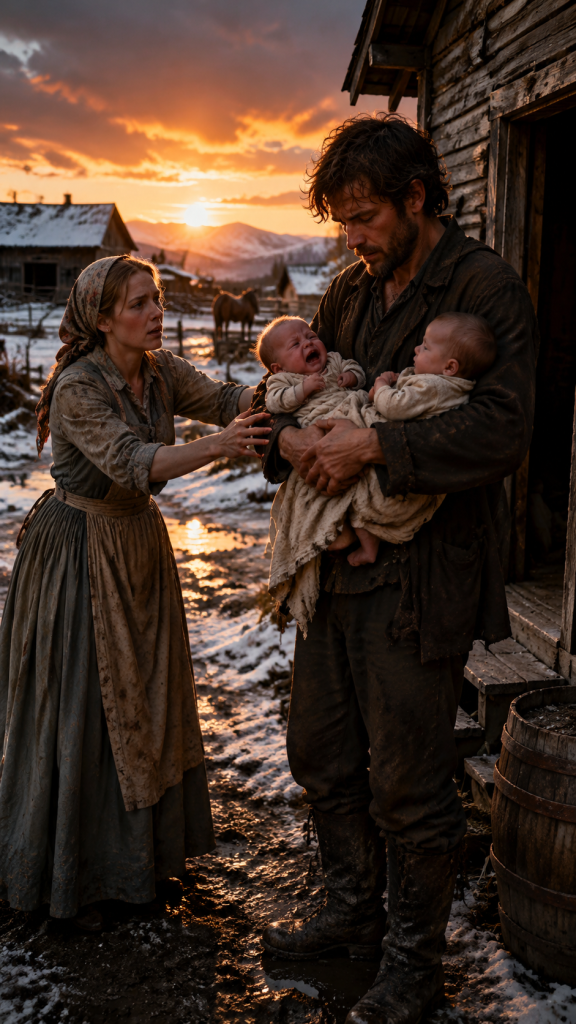
Since then, Elías had tried to be father, mother, rancher, cook, carpenter, and manager all at once. The children received milk and clean clothes, but little more. Lucía’s bedroom remained closed. Her labels still hung from the sacks in the storeroom. The empty rooms consumed firewood, and many nights Elías fell asleep sitting up, with one baby on his chest and the other in a basket beside his boots.
Aurelia knew that kind of silence.
Her husband had died two years earlier, crushed by a cart loaded with logs. Afterward, she worked on a small property near Durango until the owner sold the land. Since then, she had traveled with a change of clothes, a blanket, and a few coins.
She had not come to El Enebro by destiny or miracle. She came because life had left her homeless, just as it had left Elías living inside a house that no longer felt like his own.
“What do you know about children?” he asked that first night.
“I helped my mother during several births. I took care of babies on ranches where the doctor took days to arrive. I know how to recognize when a child is cold, hungry, or having trouble breathing.”
“I can’t pay you a wage.”
“I’m not asking for one.”
Aurelia mixed fresh milk, changed the twins, and placed both cradles near the stove. Mateo protested for a few minutes. Elena fell asleep immediately.
Elías watched as she finished one task before starting the next.
“You can stay,” he decided. “But if the children get worse or you give me any reason to distrust you, you’ll have to leave before the snow closes the road.”
“Agreed.”
“The barn, my documents, and the north room are off-limits.”
Aurelia nodded without asking questions.
Her room was small and next to the kitchen. That night she listened to the wind entering through the cracks in the walls. The whole house felt like a poorly woven basket unable to hold in the heat.
She rose before dawn.
The stove had gone out, but three empty rooms remained open, stealing what little heat was left. The cradles were separated and placed near a cold wall. Elena woke with a slight cough.
Aurelia did not start by repairing the walls. She changed the way they lived inside them.
She moved the table closer to the stove and placed the cradles together. She hung old blankets from wooden poles to create a smaller room inside the kitchen. She closed the empty rooms and blocked the space under the doors with rolled rags.
When Elías returned from the corral, he found half the house transformed.
“What did you do?”
Aurelia placed two pots of hot water: one inside the blanket-enclosed space and one outside.
“Wait.”
Four hours later, the water inside the small room was still warm. The other was cold.
Elías did not praise her. He also never moved the furniture again.
Four days later, the firewood lasted longer and the twins slept better.
But the cold of the sierra could not be defeated with blankets alone.
Aurelia built a wooden frame around the cradles using boards from an old box. She filled small fabric bags with dry straw and placed them between the boards and a wool lining. The top remained open.
The first night, Mateo slept for several hours straight.
In the morning, Aurelia touched the inside of the frame. The wool was damp. The children’s breath had been trapped.
She disassembled part of the structure before breakfast.
“So it didn’t work,” Elías commented.
“Not yet.”
She reduced the height of the front panel, opened two upper vents, and changed the entire lining. She also moved the cradles away from the stove so the heat would distribute without concentrating.
The second night she checked the humidity three times.
At dawn, the inside was dry and Elena had not coughed.
Elías understood something important: Aurelia was not trying to prove she was always right. She was willing to destroy her own work if it could put the children in danger.
Days later, while preparing breakfast, Aurelia found a potato with a long sprout. She went down to the storeroom and discovered it was not the only one.
The onions were damp. Some pumpkins had mold. The apples had been stacked in such a way that one bruised fruit had rotted the others. The ground corn formed hard blocks, and a sack of beans gave off a sour smell.
“My grandfather stored everything like this,” Elías protested. “And he survived worse winters.”
Aurelia broke open a potato and showed him the decomposed pulp.
Then she lifted a box. The wood at the bottom was wet.
In one of the containers she found a label written by Lucía: “Use first. Keep dry. Save for the children.”
Aurelia cleaned the dust without erasing a single word.
She separated the rotten items and sorted what could still be saved.
“You’re throwing away our winter,” Elías said harshly.
“The winter started taking it long before I opened this door.”
She spread the potatoes in thin layers and left them in the dark. She hung the onions and garlic in a dry place. She stored carrots and turnips in barely damp sand. She placed the pumpkins on boards and wrapped the apples one by one.
The beans and corn were moved to closed chests raised off the ground.
Anselmo Ruiz, an elderly worker who had helped Elías for years, found her sorting boxes.
“This storeroom has served us all our lives,” he said, almost laughing.
Aurelia lifted a board and showed him the moisture.
Anselmo touched it.
He never mocked her again.
Instead, he helped her build shelves and narrow aisles so air could circulate.
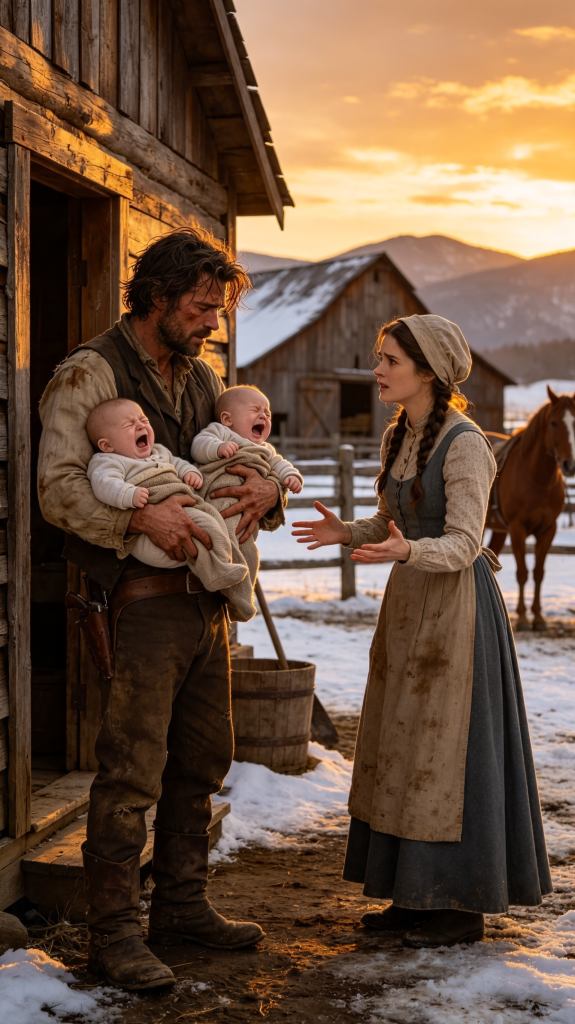
A week later, Aurelia discovered her own mistake. She had moistened the sand for the carrots too much, and some began to rot.
She removed them, discarded the damaged ones, let the sand dry, and started over.
“Are you going to tell Elías?” Anselmo asked.
“Food doesn’t wait for pride to decide who is at fault.”
From then on, the house began to follow a different rhythm.
Aurelia rose before dawn, lit the stove, and prepared soft atole for the twins. While they slept, Elías could work for hours without returning every moment.
Mateo learned to hold onto a chair. Elena’s cough almost disappeared.
One afternoon, Elías stopped outside the kitchen when he heard laughter.
Aurelia was hiding a wooden spoon behind her apron and then making it appear again. Mateo laughed loudly. Elena looked at her brother and ended up imitating him.
It was the first time Elías had heard his two children laugh since Lucía’s death.
Shortly afterward, Elena crawled to the hallway and placed a hand on the closed door of the north bedroom.
Aurelia did not touch the lock.
“Maybe there’s a thicker blanket in there,” she said.
That night, Elías stood for a long time in front of the door.
The next morning he left the key on the table.
They entered together.
The room seemed frozen in time. Lucía’s shawl hung behind the door. Her scissors rested next to a spool of thread. On the bed lay a wool blanket with an unfinished edge.
Aurelia waited for Elías to enter first.
She did not touch Lucía’s clothes. She only took the blanket when he nodded.
On the table they found a notebook. Lucía had noted the weekly use of flour, beans, potatoes, firewood, and oil. She had also marked which potatoes should be saved as seed for the next spring.
Aurelia read the pages and closed the notebook without taking it.
She did not want to write over the last words of a dead woman.
Instead, she placed a small board next to the kitchen and wrote in charcoal: “Weekly firewood. Oil used. Remaining flour. Reserved seeds.”
She kept Lucía’s system alive without erasing her presence.
“She used to say a house didn’t need more things,” Elías recalled. “It only needed everything to be in its place.”
“She was right.”
For the first time, they spoke of Lucía not only as the woman who had died, but as the woman who had built something valuable.
At the beginning of November, the west wind struck the house. Every morning frost appeared around the nails on the north wall.
Aurelia did not have enough wood to reinforce it. She used bales of hay that were too old to feed the cattle but still dry. She stacked them outside, leaving an air space between the hay and the wall. She placed stones underneath to prevent moisture and covered the top with a slanted tarp.
Hilario Treviño, owner of the neighboring ranch, saw the strange structure.
“It looks like you’re feeding the house instead of the cows.”
Elías remained silent.
Three days later, Aurelia found a wet bale. She disassembled that section, raised the stones, and rebuilt it.
Hilario passed by again.
“I warned you it was foolish.”
Aurelia nailed two pieces of iron, one behind the hay protection and one on the exposed wall.
The next morning, the exposed iron was covered in ice. The protected one barely had any moisture.
She did not point out the difference.
Elías watched her and brought more stones.
It was the first time he helped instead of just watching.
The first snowfall came early. Old snow froze on the kitchen roof and new snow began to accumulate on top.
Aurelia noticed how the beams creaked. The storeroom door began to scrape the floor.
“That roof has withstood twenty winters,” Elías said.
“And it’s already warning that this one may be different.”
With Anselmo, she built a long rake and removed the snow little by little, balancing both sides so as not to twist the structure.
“You’re working on something that hasn’t broken yet,” Elías protested.
“Roofs don’t wait to fall to speak. They whisper first.”
The next day, the door opened again without scraping.
Aurelia also installed a rope from the hallway to the barn and the wood shed. She tied it to tall posts and added knots that could be felt with gloves.
Hilario laughed again.
“Now El Enebro needs a leash so it doesn’t get lost.”
A week later, thick fog covered the ranch. Anselmo followed the rope from the barn and realized he had deviated several steps from the path without noticing.
Elías tested it that same night.
When he returned, he only said:
“The center post needs another base.”
Aurelia tied a piece of blue fabric to the first knot near the house. Even in the dark, the way back would have a beginning.
In December, a closed carriage arrived.
Doña Beatriz Ocampo, Lucía’s mother, descended accompanied by a coachman. Behind her were two small trunks.
Elías understood immediately.
Beatriz had not traveled to visit her grandchildren. She had come to take them away.
She examined the twins’ hands, faces, and breathing. She checked their clothes and stayed outside the kitchen until she heard them sleeping without coughing.
Then she turned to Aurelia.
“Do you think you have become their mother?”
“No.”
Aurelia looked at the north room.
“They already have a mother. Her name is still written all over this house.”
Beatriz went down to the storeroom. She found her daughter’s labels intact. The review dates had been written on the back. The seeds were still separated for spring.
She looked for proof that Aurelia had erased Lucía.
She found the opposite.
Even so, she announced that after Christmas she would take the twins.
“Respect does not turn a stranger into family.”
That night she spoke with Elías in the hallway.
“You have replaced my daughter too soon.”
“Aurelia is only here temporarily,” he replied.
The words left his mouth and, for the first time, sounded cowardly to him.
He looked out the window. Aurelia was folding the twins’ clothes while Mateo held onto her skirt.
“No,” he corrected. “That is no longer true.”
Beatriz waited.
“Aurelia did not replace Lucía. She preserved what she built. This house is still alive because of both of them.”
“Do you love her or do you only need her?”
Elías contemplated the dark ranch.
“If she leaves, I won’t just lose the person who takes care of my children. I’ll lose the only one who looked at this place again as a family.”
Aurelia heard some of the words through the wall.
Later, Elías found her by the stove.
“I should have defended you when Hilario mocked you. I should also have stopped calling you temporary.”
“If you want me to stay,” she replied, “don’t say the opposite every time someone is watching.”
Aurelia put the children’s clothes in a drawer instead of placing them in her travel bag.
Beatriz decided to wait until the storms passed.
At the end of January, the sierra became strangely silent. The horses turned their backs to the west. The birds disappeared and a pale circle surrounded the moon.
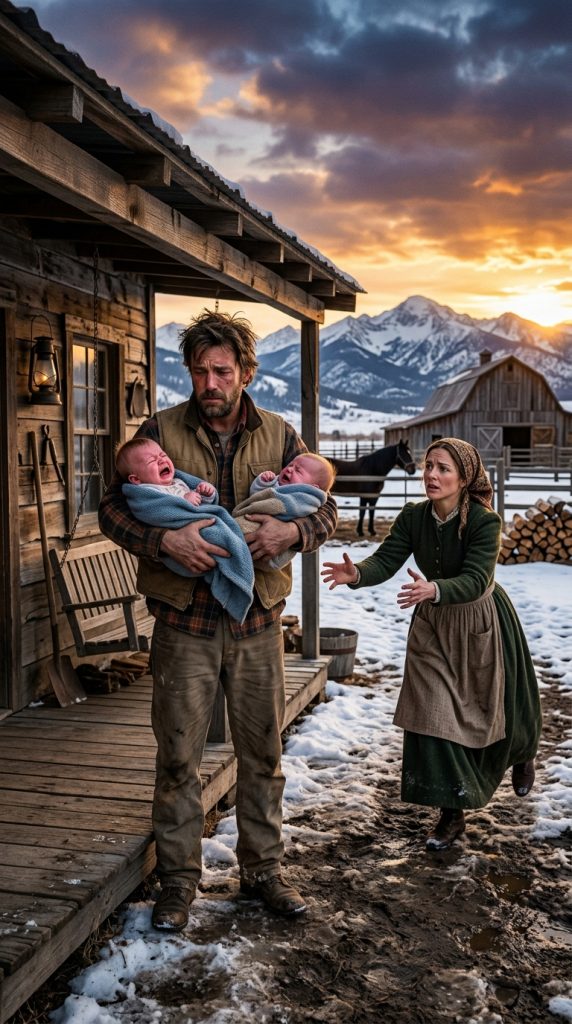
Aurelia checked everything.
She tightened the ropes. She reduced the space around the cradles. She heated stones by the stove and stored dry branches, corn stalks, and emergency fodder in the barn.
A cow named Estrella was about to give birth.
Hilario visited the ranch.
“In town they say it will be just another snowfall.”
Aurelia offered space for his calves.
He refused.
“I will not prepare my ranch for an imaginary tragedy.”
“Storms don’t give time to prepare,” Aurelia said. “They only reveal who did it beforehand.”
The wind arrived after midnight.
The first blow shook the north wall as if a tree had fallen on the house. Snow entered through every crack. Before dawn, the windows were covered.
The hay protection stopped most of the wind. The small room around the cradles retained the heat. The roof creaked, but the old snow had already been removed.
In the barn, Estrella began to give birth.
Elías and Anselmo followed the rope through the blizzard. An hour later, they shook it three times—the agreed signal to ask for hot water and dry cloths.
Aurelia wrapped hot stones, placed the twins in a small sled, and covered them with Lucía’s unfinished blanket.
“We can’t take the children out,” Beatriz protested.
“If the fire goes out, one person alone won’t be able to protect the house and help in the barn.”
Aurelia took the rope.
After hesitating, Beatriz placed a hand behind hers.
The path had disappeared.
The rope was still there.
The birth was difficult. Elías injured his shoulder helping Estrella. The calf was born motionless, wet, and barely breathing.
Aurelia ordered it dried before bringing it near the heat. They placed it in a box raised off the ground, with hot cloths underneath and small vents on top.
Beatriz knelt and rubbed the animal’s body with the same patience Aurelia had used to calm Elena.
Almost two hours later, the calf managed to stand for a moment and then fell beside its mother.
“You saved her,” Elías said.
“We just gave her time to start saving herself.”
The storm continued for a second day.
Suddenly, the rope tensed violently.
Elías and Anselmo went out. They found Hilario clinging to one of the posts. He carried three calves covered by a frozen blanket.
The roof of his barn had collapsed. He had tried to reach El Enebro guided by memory.
Memory failed.
The rope did not.
They led him step by step to the barn.
There, Hilario saw everything he had ridiculed working: the warm box, the emergency fodder, the hay wall, and the rope that was now the only visible path in the sierra.
No one demanded an apology.
Aurelia handed him a hot cup.
“Anselmo, bring more dry sacks.”
The storm ended after three days.
Rancho El Enebro was almost buried, but the house remained standing. The barn held. The twins were healthy, the livestock survived, and the provisions remained intact.
Beatriz watched Elena and Mateo sleeping under Lucía’s blanket.
Two women—one absent and one present—had protected them together.
“I will not take the children,” she said.
Then she took Aurelia’s hands.
“I came believing I wanted to erase my daughter. Now I understand that you kept alive everything she left behind.”
When Beatriz returned to town, the two trunks went back empty.
A week later, Elías found Aurelia on the same threshold where she had asked for shelter months before.
“I will not ask you to stay because I need someone to raise my children,” he said. “I ask you to stay because I want you by my side when we decide what to build next.”
Aurelia smiled.
“You still wait for things to start breaking before repairing them.”
“I’m learning.”
“I won’t stay to patch up your life, Elías. I’ll stay to build a new one with you.”
The wedding was celebrated when the snow began to melt. Beatriz brought Lucía’s blanket and personally finished the edge her daughter had left incomplete.
“I don’t want you to replace her name,” she told Aurelia. “I want this to continue warming the family that both of you protected.”
In spring, Aurelia planted the reserved potatoes. Mateo and Elena patted the earth with their small hands.
When Aurelia lifted Elena, the girl rested her head on her shoulder.
“Mommy,” she whispered.
Maybe it was a word. Maybe just a sound.
Elías heard it and did not correct her.
Rancho El Enebro began a new season. It was not free of pain or work, but it no longer survived one day at a time.
Because the wisdom of a family is not proven during quiet days.
It is proven by everything that remains standing when the storm finally passes.
