

PART 1
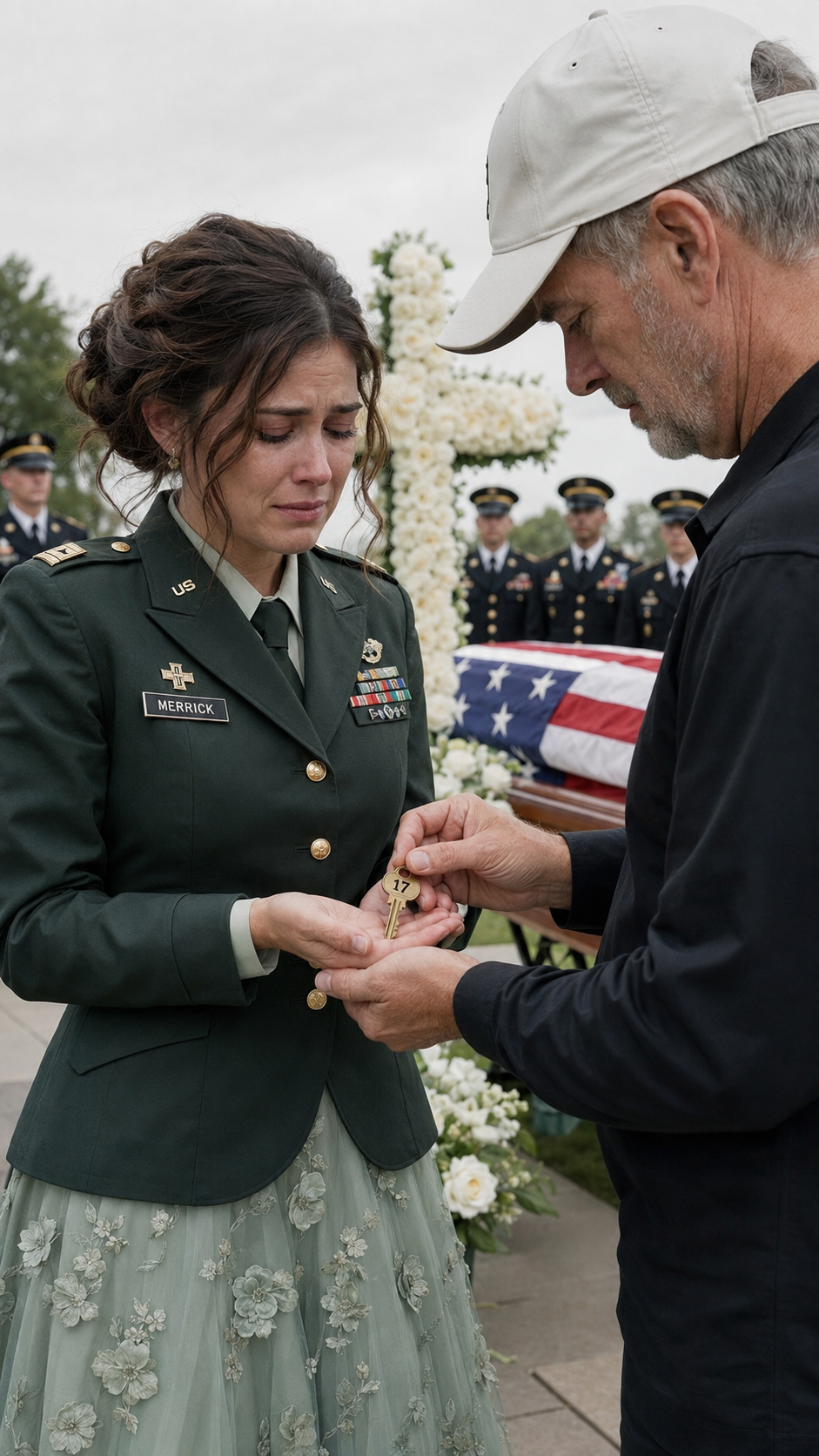
The last notes of the funeral hymn echoed through the chilly New Jersey cemetery as the mourners gradually drifted away. Neighbors shared quiet embraces, Army officers who had served beside my father offered respectful nods, and my mother stood next to the hearse with tears running down her face.
I stayed at the graveside, unable to take a single step.
My name is Colonel Beatrice Sinclair. For over twenty years, I had served in the United States Army, leading soldiers through dangerous missions where remaining calm often meant surviving.
Yet nothing in my military career had prepared me to bury my father.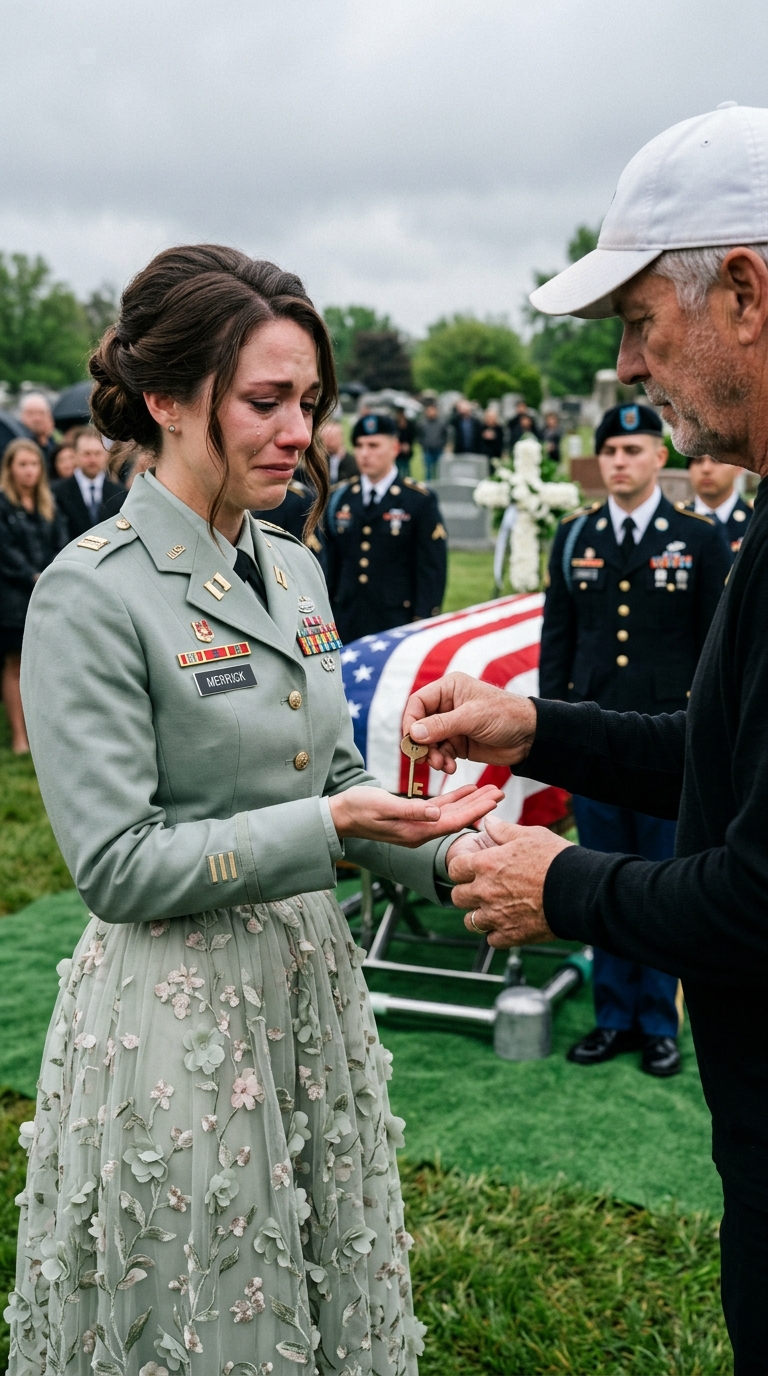
Everyone believed Richard Devereux had suffered a sudden heart attack in his study at sixty-six years old. For three days, I organized the funeral, comforted my grieving mother, and signed endless documents, convincing myself there was nothing suspicious about his death.
Then the gravedigger quietly walked over to me.
“Your father paid me,” he whispered.
I frowned. “Paid you for what?”
He looked around to be certain no one was close enough to hear. “To bury an empty coffin.”
The words stole the breath from my lungs.
“That’s impossible,” I said. “I identified his body.”
He slowly shook his head. “You saw exactly what he wanted you to see.”
Every instinct I had built as an Army officer snapped into place. The old man reached into his coat, removed a cold brass key, and placed it in my hand. One number was engraved on it.
“Don’t go home,” he said. “No matter who calls. No matter what they tell you. Go to Route 9 Storage. Unit Seventeen.”
“My father died three days ago.”
The gravedigger met my eyes. “He planned this more than twenty years ago.”
Before I could ask anything else, my phone vibrated. A text from my mother.
Come home alone.
I stared at the message. Something immediately felt wrong. My mother never texted like that. She always called me sweetheart. She never wrote in short, emotionless sentences. And she was standing less than fifty yards away. Why would she send a text instead of walking over?
The gravedigger saw the change in my expression. The little color left in his face disappeared.
“Don’t answer.”
Then he handed me a worn envelope. Across the front, written in unmistakable handwriting, was my name.
Beatrice.
“He gave me this twenty years ago,” the old man said softly. “He told me I’d know exactly when to deliver it.”
Twenty years. Before West Point. Before my commission. Before I had ever put on an Army uniform. My father had set this in motion long before I truly understood what planning meant.
After the gravedigger vanished among the rows of headstones, I climbed into my SUV and opened the envelope. Inside was a single sheet of paper. No farewell. No explanation. Only one instruction.
Go to Unit 17. Trust the woman waiting there. Do not return home until you understand why.
I did exactly as instructed.
By the time I arrived at Route 9 Storage, dark clouds had consumed the afternoon sky. Standing beneath the office awning was a woman in a black overcoat, watching me approach without hesitation. She reached into her pocket and held up an FBI badge.
“Colonel Sinclair,” she said calmly. “Your father knew you’d come alone.”
I looked from the brass key in my hand to the storage unit only a few yards away. “What is inside?”
Her expression became grim. “Enough evidence to explain why your father needed an empty coffin.”
Before I could ask another question, my phone began ringing.
Mom.
The FBI agent glanced at the screen and quietly said, “Whatever you do… don’t answer.”
Then a slow electronic beeping sounded from inside Unit 17, and I realized my father’s funeral had never been the end of his story…
PART 2: THE REDACTING OF RICHARD DEVEREUX
The brass key slid into the heavy padlock of Unit 17 with a dry metallic click. I gripped the lock, my gloved fingers damp from the freezing rain, and turned it.
Beside me, FBI Special Agent Fiona Black kept one hand inside her coat while her eyes swept across the empty asphalt lanes of the storage facility. I pulled the rusted corrugated metal door upward. It screeched along its tracks, exposing a large, windowless space lit only by the dim green glow of a military-grade server rack humming in the corner. That steady, rhythmic beeping came from an active network transmission.
“This isn’t a storage unit,” I muttered as my boots echoed across the concrete floor. “It’s an operations post.”
“Your father was a brilliant structural engineer, Colonel,” Fiona said, lowering the metal door behind us and shutting out the storm. “But before he built Devereux Capital, he spent twelve years in the early nineties designing classified underground facilities for the Defense Threat Reduction Agency. He knew how to hide things in plain sight.”
In the middle of the room stood a steel drafting table. Spread across its surface were dozens of red folders, satellite photographs of a private airstrip in Maine, and a heavy glass canister containing a small encrypted hard drive.
I reached for the first folder. Across the cover were the words Operation Glass House.
As I read the opening page, the room seemed to spin around me. The file described a massive counterintelligence investigation that had spanned decades. For twenty years, my father had secretly served as a deep-cover civilian asset for the FBI’s public corruption and national security division.
His targets were not foreign enemies.
They were Americans.
The primary target identified in the files was Dominic Vance—my mother’s younger brother, my uncle, and a powerful senior partner at a prestigious defense contracting firm.
“Twenty years ago,” Fiona explained, leaning against the drafting table, “your father uncovered that Dominic was using Devereux Capital’s international shipping routes to smuggle compromised microprocessors into domestic military supply chains. When Richard tried to report him, Dominic threatened you.”
I froze, gripping the papers tightly. “Me?”
“You were a cadet at West Point, Beatrice. Highly visible. Highly vulnerable. Dominic made it clear that if your father spoke, your career—and your life—would end in a tragic training accident. So Richard did the only thing a structural engineer knows how to do.”
“He built a vault,” I whispered as the truth hit me like a blow.
“He played the role of the quiet, submissive brother-in-law,” Fiona said with a nod. “He let Dominic believe he had won. But over the next twenty years, he documented every transaction, every offshore account, and every corrupt politician on Dominic’s payroll, waiting until you were powerful enough to protect both yourself… and him.”
I looked toward the softly humming server rack. “If he’s alive, where is he?”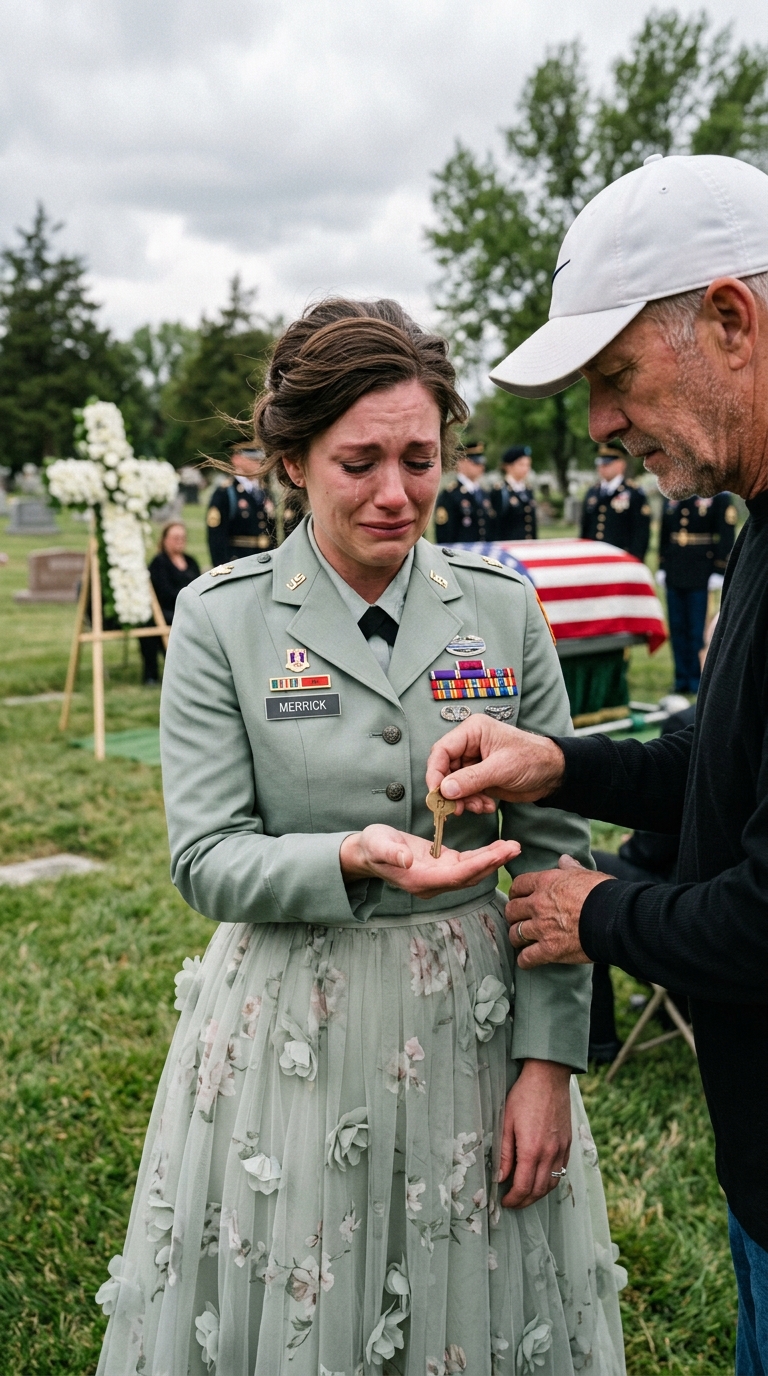
“At 2:00 AM three days ago, Dominic’s cleanup crew entered your father’s study to stage a fatal heart attack,” Fiona replied, lowering her voice. “But we were already there. We extracted your father, staged the scene with a medical decoy, and moved him into a federal safe house in New York. The empty coffin was the only way to convince Dominic the threat had been buried.”
My phone vibrated once more inside my pocket.
The screen lit up.
Mom.
“They’re at your mother’s house,” Fiona warned, glancing at the display. “Dominic’s associates. They know your father’s personal archives disappeared from his study, and they believe you have them. If you go there alone, Beatrice, you’ll be walking into a slaughterhouse.”
I lowered my eyes to the brass key in my palm, then looked at the FBI badge clipped to Fiona’s coat.
“I’ve spent twenty years leading soldiers in combat, Agent Black,” I said, my voice settling into the cold, lethal tone of a military commander. “I don’t run from local syndicates. We’re going to my mother’s house. But we aren’t going alone.”
PART 3: THE RECONSTRUCTION
The drive through the freezing New Jersey rain passed in complete silence, the windshield wipers scraping a slow, hollow rhythm across the glass.
I contacted my executive officer at Fort Dix, ordering a discreet security detail of active-duty military police to position themselves two blocks away from my mother’s estate. If Dominic Vance wanted to treat this as a civilian dispute, he was about to learn the full authority of a federal tactical operation.
We arrived at the gated entrance of the Devereux family home at exactly 5:15 PM.
The sprawling stone mansion appeared dark and nearly deserted, except for the warm yellow light glowing from the first-floor study. Two black luxury sedans sat in the circular driveway with their engines still running, exhaust drifting into the damp evening air like gray smoke.
“My team is moving into position at the rear exits,” Fiona whispered, checking her service weapon before we stepped out of the SUV. “The moment we go inside, we take control.”
“No,” I replied, resting my hand on the door handle. “I’m going in first. I want Dominic to believe he’s still holding the cards.”
I climbed the stone steps, my military dress uniform remaining immaculate despite the rain. I didn’t bother knocking. I turned the handle of the heavy oak door and walked into the foyer.
The silence inside the house was suffocating.
“Beatrice?”
My mother’s voice came from the doorway of the study. She looked fragile, her eyes swollen from crying, but her posture was rigid with fear. Standing directly behind her, one hand resting with practiced warmth on her shoulder, was my uncle, Dominic Vance.
“There’s my favorite niece,” Dominic said, flashing the polished, white-toothed smile that had charmed the state’s highest political circles for decades. “We were worried about you, Beatrice. You disappeared from the cemetery.”
I walked into the study, my boots clicking softly across the Persian rug.
Two men in matching dark suits were seated on the leather sofa. They didn’t look like mourners. Their jackets were unbuttoned, and each kept his right hand resting casually near his lapel.
“I had to take care of some of Dad’s loose ends,” I said, keeping my expression completely unreadable.
Dominic’s smile grew sharper. “Of course. Richard was a meticulous man. He kept quite a few… personal files in this room. We’ve been searching for his primary financial ledger. Your mother says she has no idea where it is.”
“She doesn’t,” I answered.
Dominic stepped closer, his eyes dropping to the pocket of my uniform jacket, where the faint outline of the encrypted hard drive could be seen.
“But you do,” he murmured.
“My father spent twenty years building a cage for you, Dominic,” I said, my voice dropping to a deadly whisper. “He knew about the microprocessors. He knew about the offshore shell companies in Panama. He knew about the cash transfers to the port authority inspectors.”
My mother let out a quiet, horrified gasp. Dominic’s eyes turned ice cold. The caring uncle vanished, replaced by the calculating, ruthless predator who had controlled the family through fear for decades.
“You’re a very distinguished officer, Beatrice,” Dominic said, motioning toward the two men on the sofa, who immediately rose to their feet. “But you’re in my house now. You will hand over that drive, you will sign the probate releases for your father’s estate, and you will accept that Richard is gone. Otherwise, your mother is going to suffer a sudden, tragic stroke from the grief of her loss.”
My mother began to shake.
I didn’t move. Slowly, I reached into my pocket, removed the encrypted hard drive, and held it between two fingers.
“You think this is a local board meeting, Dominic,” I said. “You think you can threaten a federal officer in her own home and walk away smiling.”
“I know I can,” Dominic sneered as he reached for the drive. “Who’s going to stop me? Your little army?”
I smiled.
“Yes,” I replied. “Exactly.”
I pressed the button on my tactical watch.
FINAL PART: THE PERIMETER SECURE
The study window exploded inward in a shower of glittering glass as three flashbangs detonated in the front courtyard.
The foyer door burst from its hinges with a thunderous crash.
“Federal agents! Nobody move!” Fiona Black’s voice thundered through the smoke as a dozen heavily armed FBI tactical officers poured into the hallway. Behind them, a squad of military police in full combat gear locked down the perimeter, their weapons raised, red laser sights fixed on the chests of Dominic’s security team.
The two men in the study were driven to the floor before they could even reach their holsters. Dominic was slammed against the mahogany desk, his face forced onto his own expensive leather blotter as a tactical officer secured his wrists with heavy-duty zip ties.
“You can’t do this!” Dominic screamed, his voice cracking with panic. “I have diplomatic immunity through the defense contracts! I have senators on my board!”
Fiona Black stepped into the room holding a federal arrest warrant.
“Your board was dissolved forty minutes ago, Mr. Vance,” Fiona said calmly. “The Department of Justice has seized every asset belonging to Vance Global. The senators you bribed are currently being processed by the U.S. Marshals.”
Dominic turned toward me, his face twisted with hatred and disbelief.
“You… you destroyed the family,” he hissed.
I crossed the room and wrapped my arm around my mother’s trembling shoulders. Looking down at the man who had held our lives hostage for two decades, I spoke without raising my voice.
“No, Dominic,” I said, my words carrying the unwavering authority of a Colonel. “My father built this family. You were nothing more than a parasite we chose to remove.”
As officers dragged Dominic into the freezing rain, red and blue emergency lights reflecting across the wet stone driveway, my mother looked at me through streaming tears.
“Beatrice… is it really over?” she whispered. “Is your father… really gone?”
I reached into my pocket, took out my secure personal phone, and dialed a single classified number.
A warm, familiar voice answered on the very first ring.
“Beatrice?”
My mother gasped, covering her mouth with one hand.
“He’s safe, Mom,” I said, placing the phone in her hand. “The coffin was empty, but our home is finally full.”
Six months later, the afternoon sun stretched long golden shadows across the lawn of a quiet, unmarked estate in upstate New York.
There were no military officials, no corrupt defense contractors, and no lingering ghosts of the past. Only birds singing from the maple trees and the peaceful breathing of a family that had finally survived the darkness.
My father, Richard Devereux, sat on the front porch steps, healthy color restored to the face of a man who no longer had to live beneath the weight of secrecy. He looked up as I approached, my military dress uniform replaced by a simple civilian jacket.
“You look good, Colonel,” he said with a warm, genuine smile.
“I feel good, Dad,” I replied as I sat beside him. “The federal court approved the final asset forfeitures this morning. The Vance name has been completely removed from the corporate registries.”
He gazed across the peaceful garden, his eyes lighter than they had been in twenty years.
“I spent half my life building structural vaults to protect you, Beatrice,” he said softly, giving my hand a gentle squeeze. “I never imagined the strongest vault I would ever build would be the daughter who came back to save me.”
I smiled and looked toward the horizon.
For years, I believed serving my country meant fighting wars in distant places. But as I watched my parents laugh together on the porch, finally safe, I understood the truth.
Sometimes, the most important mission isn’t the one you fight for a nation. It’s the quiet, tactical victory required to clear the board, secure the perimeter, and bring the people you love back from the dead.
The empty coffin was finally laid to rest. But the Sterling and Devereux family line remained whole, enduring, and beautifully unbroken.
THE END
