

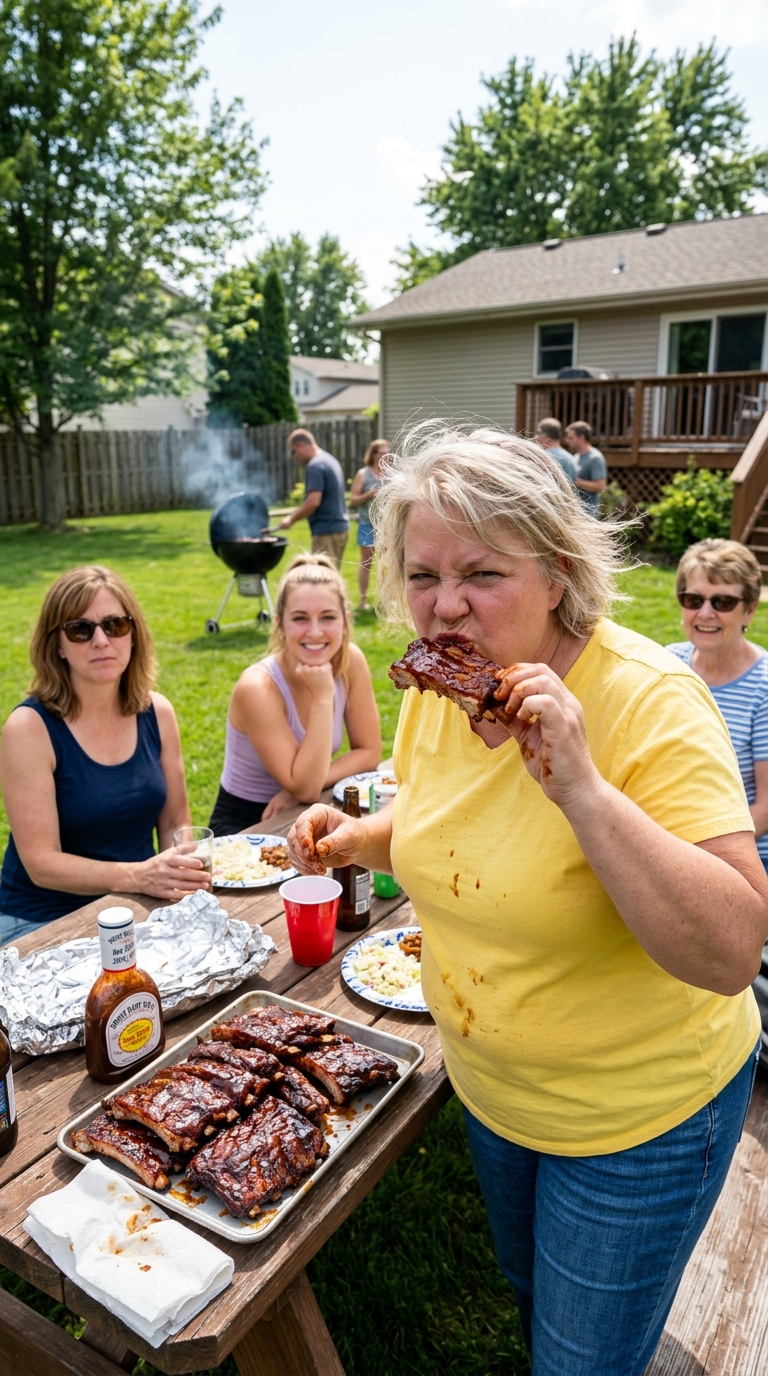
Part 1: Every family has that one person who treats your home like a luxury resort but never thinks to bring even a simple bag of chips. For me, that person was my mother-in-law, Juliette. She never showed up by herself either. She arrived with her daughters, their children, their endless opinions, and absolutely nothing to offer. So when they came empty-handed once again for the Fourth of July, I decided it was finally time to give them a meal they would never forget.
My name is Annie, and after years of preparing family cookouts, I discovered one frustrating truth: hosting my husband’s relatives felt less like having loved ones over and more like running a restaurant where nobody paid, nobody tipped, and somehow everyone still acted like I owed them even more.
I had been married to Bryan for seven years. We had two wonderful children, a comfortable home in the countryside, and a life that once felt peaceful and simple. Then Juliette turned our house into her favorite holiday destination.
She carried herself like royalty, judged everything like a professional critic, and had about as much awareness as a paper plate caught in a storm. Whenever she visited, she brought her two daughters, Sarah and Kate, along with six grandchildren who seemed to appear the moment they stepped through the door.
They arrived like a traveling circus filled with noise, demands, sticky fingers, and completely empty hands.
A few weeks before the Fourth, she called to announce their Memorial Day visit as if she were giving me a gift.
“Annie, darling, we’re coming for Memorial Day,” she said brightly. “The kids just love your ribs.”
Of course they loved them.
I bought the ribs. I prepared the marinade. I cooked everything. I served the meal.
Then Juliette sat comfortably in my patio chair and explained everything I had done wrong.
That Memorial Day became another exhausting performance.
Juliette entered my home and immediately began moving my furniture around as if she had been hired to redesign the entire place.
“This couch would look much better facing the window,” she said, already pushing it across the floor.
“I actually like it where it is,” I replied.
“Nonsense, dear. I have a good eye for these things.”
She shifted my sectional until the coffee table was almost blocking the hallway, then stepped back proudly as if she had created something impressive.
“And those roses outside,” she added. “You really should trim them. They’re looking a little wild.” Those roses were my pride and joy. I had spent three years carefully growing them. But to Juliette, anything that did not follow her standards needed to be fixed.
While she judged my furniture and flowers, Sarah and Kate claimed the kitchen island as their own. They scattered snacks, bags, cups, wipes, and toys across my freshly cleaned counters without a second thought. Their children raced through the house like a hurricane wearing shoes.
Eight-year-old Tyler spilled popsicle juice across my white carpet and immediately asked where the bathroom was.
“Down the hall, sweetie,” I said, already grabbing the carpet cleaner.
His sister Madison opened my pantry and complained, “Why don’t you have good snacks?”
The “good snacks,” of course, were always the ones I purchased. The ones they never contributed. The ones that somehow appeared every holiday while coming directly out of my grocery budget.
From the patio, Juliette called out, “Annie, the meat looks a little dry. Are you sure you’re not overcooking it?”
I smiled because yelling would not have been appropriate.
By the time they finally left that evening, they had consumed nearly two hundred dollars’ worth of food, scattered garbage around my yard, left sticky fingerprints on my doors, and forgotten juice boxes behind the couch.
Bryan helped me fill the dishwasher while I pulled popsicle sticks from my flower beds.
“Bee,” I said, using his nickname, “your mother moved the couch again.”
“She’s just trying to help, Nini,” he replied softly, though I noticed the guilt in his expression.
“She also ate two hundred dollars’ worth of groceries. Again.”
He let out a sigh. “I know. I’ll talk to her.”
But we both knew he probably wouldn’t. Bryan loved me, but he had spent his entire life avoiding conflict with his mother. And I had spent years trying to be understanding.
The following morning, Juliette called.
“Annie, darling! We had such a wonderful time yesterday. The children are still talking about those ribs.”
“I’m glad they enjoyed them,” I said.
“And we’re all coming for the Fourth of July,” she continued. “The whole gang. We’ll make a weekend of it. Won’t that be fun?”
My grip tightened around the phone.
“The whole weekend?” I asked.
“Yes! We’ll arrive Friday afternoon. Make sure you get plenty of those little sausages. The kids devour them. And Sarah has not stopped talking about your potato salad. Don’t forget the ribs, dear. Juicy, like last time.”
PART 2:
Then she hung up.
She didn’t ask. She didn’t offer to bring anything. She simply announced that I would be responsible for feeding her entire family for three days.
That evening, I told Bryan.
“She’s coming for the Fourth.”
He looked up from his laptop, already looking uneasy. “That’s… nice?”
“With everyone. For the entire weekend.”
He closed the laptop. “Are you okay with that?”
Was I okay with spending another three hundred dollars on groceries for people who treated my home like a free vacation rental? Was I okay with being judged while I cooked, cleaned, served, and smiled?
I looked at him and gave a sweet smile.
“I’m fine,” I said. “Absolutely fine.”
And that was the moment my plan started.
Friday afternoon arrived with three cars in the driveway and not a single grocery bag.
Juliette stepped out first, wearing an oversized sun hat and the expression of someone expecting complete service. Sarah and Kate followed behind her, carrying designer purses and nothing else. The six children rushed onto the lawn like someone had opened the gates at a zoo.
“Annie!” Juliette said, pulling me into a perfume-filled hug. “I hope everything is ready. We’re starving.”
“Almost ready,” I said cheerfully.
The picnic table looked perfect. I had arranged mason jars filled with wildflowers from my garden, folded cloth napkins, and a pitcher of fresh lemonade shining in the afternoon sunlight. It looked like something from a magazine.
Sarah sat down and smiled. “You always make things look so nice.”
Kate looked around. “Where’s the food?”
“Coming right up,” I answered.
I went into the kitchen and returned with my creation.
A tray of cucumber sandwiches.
The crusts were removed. The slices were carefully cut into neat triangles. Next to them sat a pot of lukewarm black tea.
For a moment, everyone was silent.
Juliette stared at the tray as though I had placed a bill in front of her.
“Annie,” she said slowly, “where is the barbecue?”
I tilted my head and smiled.
“Oh, I didn’t shop this time. Since everyone loves our barbecue so much, I thought you would want to bring the meat yourselves.”
The silence that followed was wonderful.
Sarah’s mouth dropped open. Kate froze. Juliette blinked as if her mind needed a moment to process what had happened.
“There’s a butcher about fifteen minutes down Riverview Road,” I continued happily. “They’re open until six. The grill is ready, and there’s fresh charcoal in the storage bin.”
Juliette’s expression hardened.
“But you invited us,” she said.
“Actually,” I replied calmly, “you invited yourselves.”
The children immediately started complaining.
“Where are the hot dogs?” Tyler demanded.
“I want hamburgers!” Madison shouted.
Three-year-old Connor poked at his sandwich and said, “This tastes like plants.”
Juliette stood so quickly that her chair scraped across the deck.
“This is incredibly rude, Annie. We’re family.”
“Exactly,” I said. “And family helps family. We have hosted every holiday for four years. I thought it was time everyone contributed.”
Sarah and Kate exchanged shocked looks as if I had done something unforgivable.
Bryan, who had been quietly standing near the kitchen door, finally stepped forward.
“Morrison’s Meat Market has a great selection,” he said. “I can give you directions, or we can all go together.”
Juliette turned toward him.
“I cannot believe you’re supporting this selfishness.”
Bryan remained calm.
“I’m supporting my wife.”
In that moment, I loved him more than I could explain.
They left less than an hour later, but not before Juliette delivered one final dramatic statement.
“You’ve turned my son against his own family,” she hissed while the disappointed children climbed into the cars. “I hope you’re happy.”
“I’m getting there,” I said, waving as they drove away in a cloud of dust and wounded pride. The following morning, I woke up to seventeen missed calls and a Facebook post that nearly made my blood pressure rise through the roof.
Juliette had written a long, emotional complaint about her “heartless daughter-in-law” who had “ruined the Fourth of July for innocent children.” She claimed I had refused to feed them, turned Bryan against his family, and treated them terribly despite all the “love and joy” they had supposedly brought into our lives.
That was where Juliette made her mistake.
She forgot one important thing.
I keep records.
I didn’t argue. I didn’t attack her. I didn’t write an angry response online.
Instead, I collected photos from every barbecue we had hosted throughout the years. Tables overflowing with food. Juliette sitting happily with a plate in her hands. Sarah and Kate smiling beside trays of ribs, burgers, sausages, potato salad, fruit, and desserts. Children enjoying themselves in my backyard.
Then I took pictures of the grocery receipts.
PART 3:
Hundreds of dollars.
Dated. Organized. Impossible to deny.
I uploaded the photos with one simple caption:
“Just sharing some happy memories from all our family gatherings. So grateful for the wonderful times we’ve had together.”
That was it.
No accusations. No anger. No drama.
Only proof.
People understood immediately.
Comments began appearing beneath my post.
People questioned why such a “loving family” never seemed to contribute anything. Others shared their own experiences with relatives who treated them like unpaid caterers. Several pointed out that cucumber sandwiches were still food, meaning Juliette’s statement that I had “refused to feed them” wasn’t even accurate.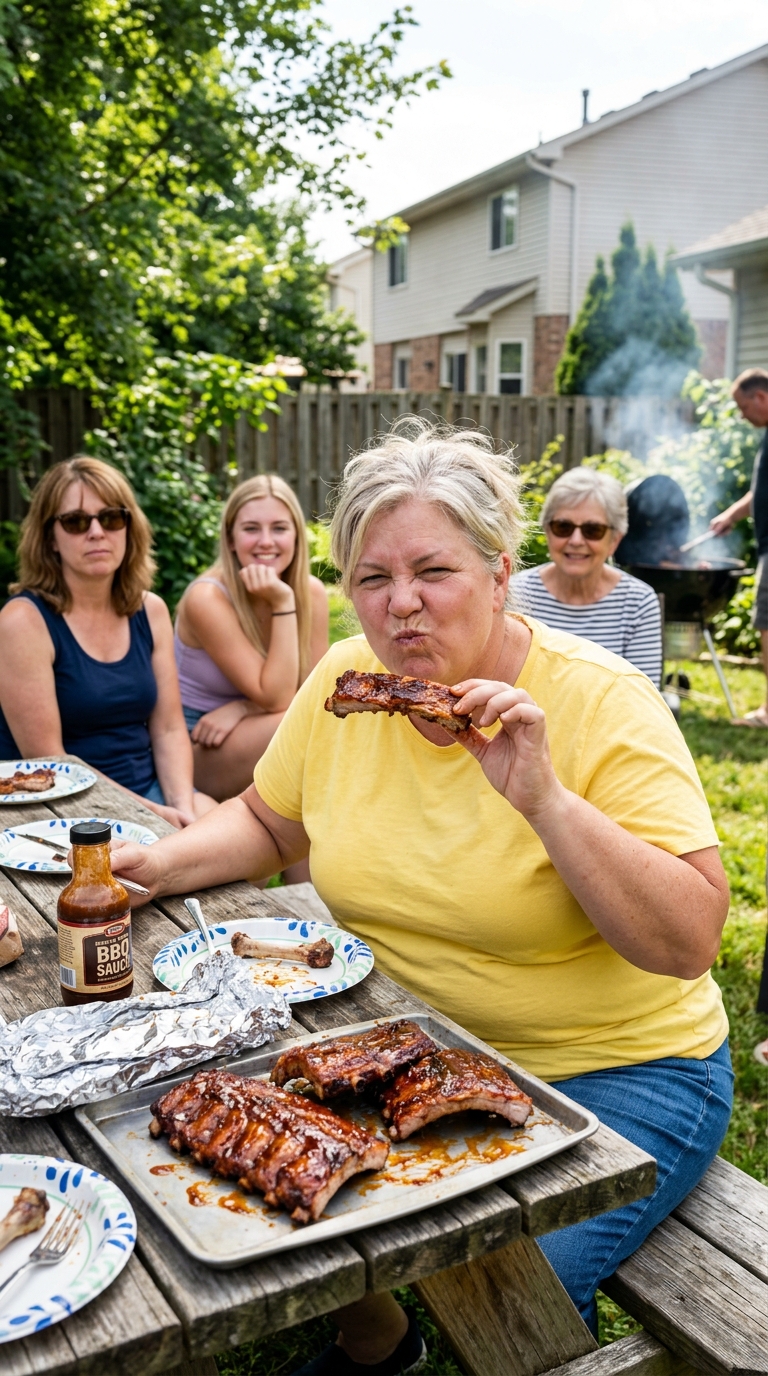
Within two days, Juliette’s emotional post vanished.
No apology.
No explanation.
Just disappeared.
And for the first time in years, my home stayed peaceful during a holiday weekend.
Sometimes the strongest statement isn’t something you shout.
Sometimes it is placed on a tray, with the crusts carefully removed.
And sometimes, when people repeatedly take advantage of your kindness, the best thing you can offer them is exactly what they brought to the table.
Nothing.
