

PART 1
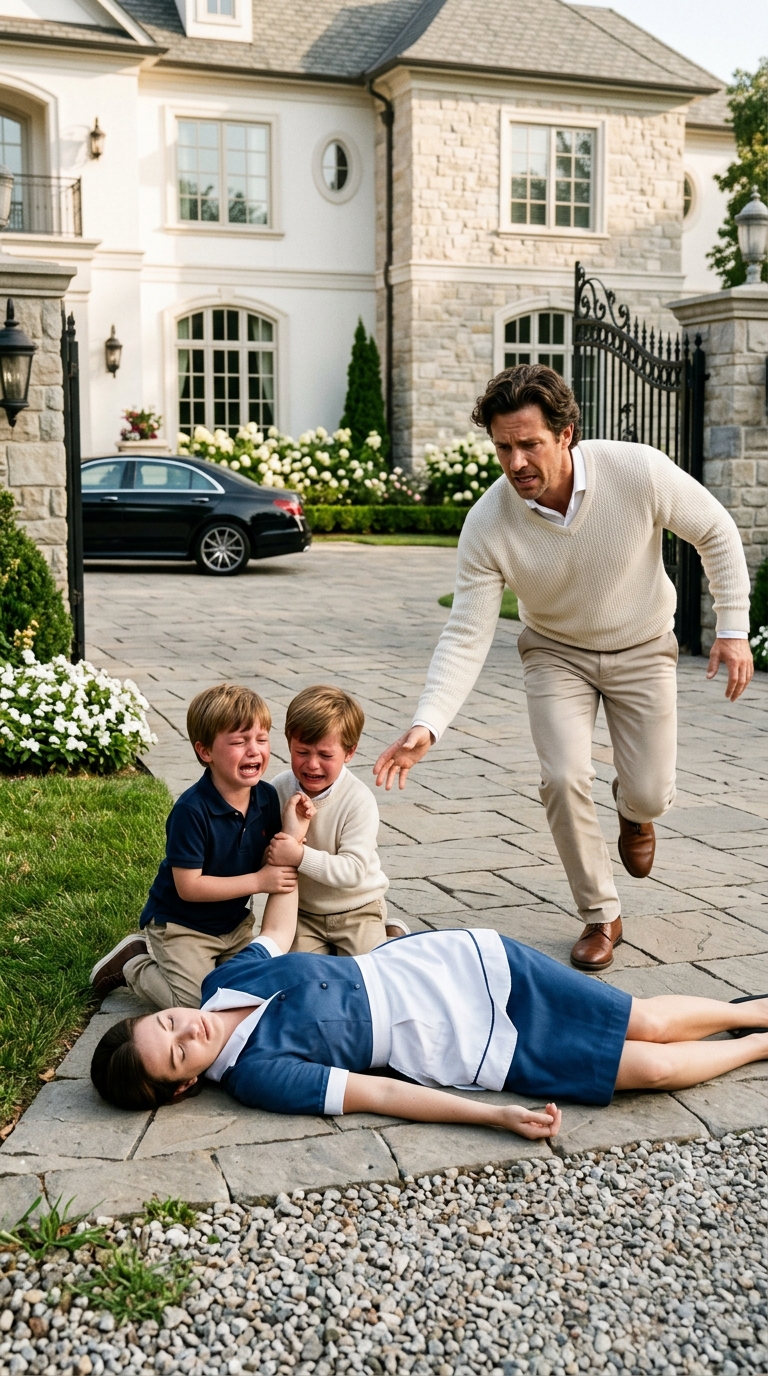
Alejandro Montes had closed deals worth 22 million pesos without his hand trembling, but nothing made him run like that afternoon when he heard his children screaming from the gate of his house in Las Lomas.
“Dad! Dad, help her! She won’t wake up!”
The truck had barely stopped at the entrance when Alejandro jumped out. He was still wearing the navy blue suit from his meeting in Santa Fe, his tie loose and his phone vibrating wildly in his pocket.
But when he saw Clara lying on the stone path, none of that existed anymore.
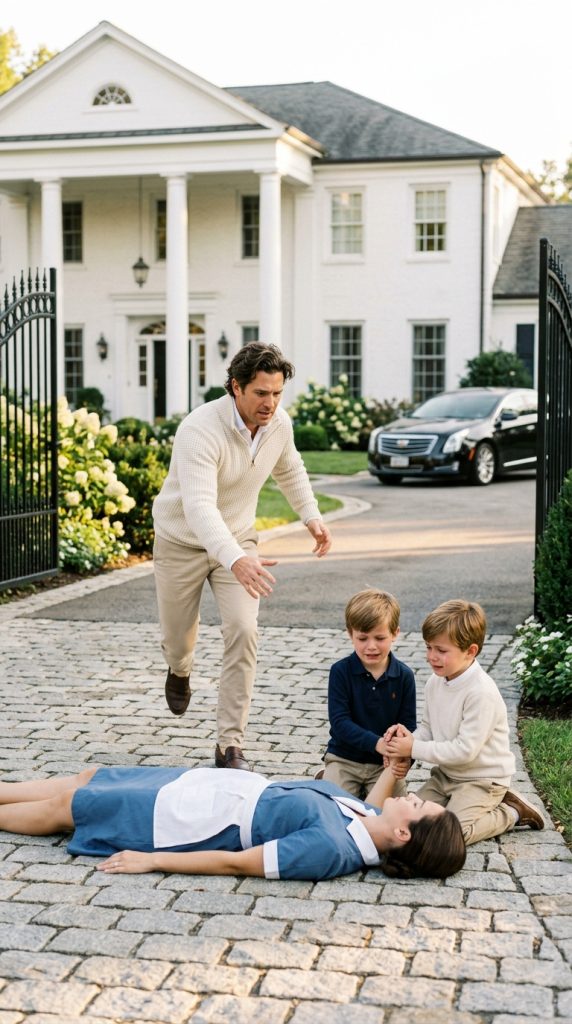
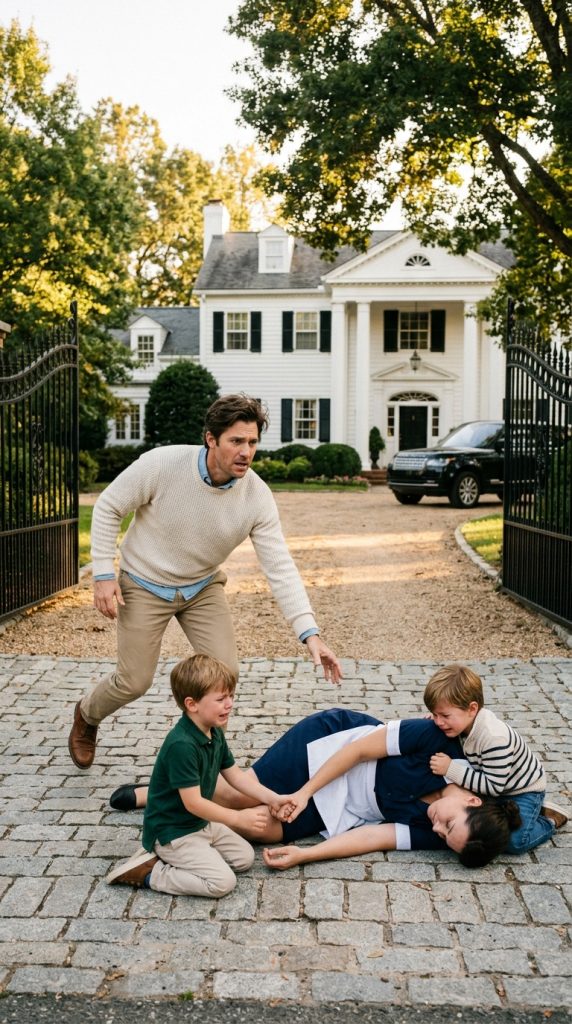
Clara Mendoza, 28 years old, the new household worker, was lying on her side next to the black gate. Her uniform was wrinkled and damp with sweat, and her face had a pallor that froze his blood.
Mateo and Leo, his 5-year-old twins, were kneeling beside her, crying as if the world had ended once again.
“Clara…” Alejandro said, touching her shoulder. “Clara, can you hear me?”
She didn’t respond.
Mateo tugged at his sleeve.
“Dad, please. Don’t let her go.”
Leo could barely speak. He held Clara’s hand in his and kept repeating:
“Aunt Clara, wake up. You promised me hot cakes tomorrow.”
Alejandro went cold.
Aunt Clara?
He didn’t even know his children called her that.
He checked for a pulse in her neck. Weak. Fast. But it was there. Her breathing was shallow, as if her body could no longer go on.
Alejandro knew almost nothing about this woman.
Doña Ernestina, the housekeeper who had been in charge of the house since before his wife Lucía died of cancer, had hired her. Clara was quiet, polite, and diligent. That was all he remembered from her file.
He didn’t know where she lived.
He didn’t know if she had family.
He didn’t know why his children had been smiling more since she arrived.
He knew nothing.
“Into the car,” he ordered, carefully lifting Clara.
The children climbed into the back without asking. Leo wouldn’t let go of her hand. Mateo stroked her arm, as if that could keep her in this world.
Alejandro drove to ABC Hospital like he had never driven before.
He had driven fast to meetings, airports, and hospitals when Lucía was sick, but this was different. This was pure panic.
At every stoplight, he checked the mirror.
Clara was breathing.
Her chest rose.
It fell.

It rose again.
“Dad,” Mateo whispered, “is Aunt Clara going to die like Mom?”
Alejandro nearly lost control of the steering wheel.
“No,” he said, even though he had no right to promise it. “Not while I can prevent it.”
Leo cried even harder.
“She can’t die. She knows the song of the stars.”
The song of the stars.
Lucía’s song.
The one his wife sang when the twins were babies and couldn’t sleep. Alejandro hadn’t sung it since the funeral. He didn’t even hum it. It hurt too much.
He had buried that song with Lucía.
But Clara had found it.
In the emergency room, Alejandro carried her in.
“I need help! She fainted. She’s barely responding.”
A nurse approached with a gurney.
“Name?”
“Clara Mendoza.”
“Medical history?”
Alejandro swallowed.
“I don’t know.”
“Medications?”
“I don’t know.”
“When did she last eat?”
Alejandro felt ashamed before answering.
“I don’t know.”
The nurse looked at him in a way that stung more than an insult. As if she had seen many rich people who didn’t know even the basics about the people who kept their homes running.
As they took Clara away, his children clung to his legs.
His phone vibrated again. His assistant. His financial director. An investor. A woman his sister had insisted he take to dinner because “it was time to live again.”
Alejandro turned off the phone.
For the first time in years, the money could wait.
Twenty minutes later, he called Doña Ernestina.
“Clara collapsed at the gate. I’m at the hospital.”
There was silence.
“Sir… I should have told you something.”
Alejandro clenched his jaw.
“Say it now.”
“Clara hasn’t been feeling well for days. She fainted twice this week. Once in the laundry room and once in the kitchen.”
Alejandro closed his eyes.
“And you didn’t call me?”
“She said she was fine. That she needed the job. I thought it was just tiredness.”
“Tiredness?”
“I gave her one of my blood pressure pills…”
Alejandro felt his blood boil.
“You gave her someone else’s medication, saw her faint twice, and let her keep working?”
Before Ernestina could answer, Mateo lifted his tear-soaked face and said something that left him breathless:
“Dad… Clara didn’t fall on her own. She was trying to reach the gate to ask for help without Doña Ernestina seeing her.”
PART 2
Alejandro slowly lowered the phone.
“What did you say, Mateo?”
The boy shrank as if he had done something wrong. Leo hid behind his brother but didn’t let go of his father’s sleeve.
“She said she didn’t want to cause problems,” Mateo whispered. “But she couldn’t breathe properly anymore. Doña Ernestina told her that if she left before finishing, you would get angry because the house was a mess.”
Alejandro felt a blow to his chest.
The house.
The shiny floors.
The fresh flower vases.
The impeccable table.
The damn perfection that he didn’t even notice when he came home late.
“Did Ernestina say that to you?”
Leo shook his head.
“Not to us. To Aunt Clara. But we heard her.”
Alejandro looked at the doors where they had taken Clara. His children were trembling, as if they were reliving their mother’s death in another body.
Then he understood something brutal: in that house, the children had learned to listen to what the adults kept silent.
A doctor came out almost an hour later.
“Mrs. Mendoza is stable. She has severe anemia, dehydration, and very low blood pressure. It wasn’t just a simple faint. Her body reached its limit.”
“Can I see her?”
“Only for a few minutes.”
The twins wanted to go in, but the doctor asked them to wait.
“I’ll tell her you’re here,” Alejandro promised.
Clara was in a small bed, with an IV in her arm and her eyes barely open. The first thing she did was try to sit up.
“Mr. Montes… I’m sorry. I’ll come back tomorrow. Really. It won’t happen again.”
Alejandro quickly approached.
“Don’t get up.”
“Please don’t fire me,” she said, her voice broken. “I need the job. My mom is sick. Her medicines are expensive. I can do better. I can stay later.”
Alejandro’s throat tightened.
Clara wasn’t worried about her health.
She was terrified of losing her salary.
“I’m not going to fire you.”
She cried anyway.
“I know I sometimes take longer with the laundry because the children ask me things. And I know I shouldn’t play with them, but Leo won’t eat dinner if no one sits with him, and Mateo has nightmares. I thought that if I finished everything later…”
Alejandro couldn’t speak.
She was apologizing for loving his children.
She was apologizing for doing what he hadn’t been able to do.
“What did you eat today?” he asked.
Clara looked away.
“A coffee.”
“That’s not food.”
“I was going to eat after preparing dinner for them.”
“And yesterday?”
The silence was the answer.
Alejandro brought a hand to his mouth.
Outside that room, he was a man who commanded in boardrooms, banks, and construction companies. There, in front of an employee with an IV in her arm, he felt like a coward.
“My children call you Aunt Clara.”
A tear rolled down his cheek.
“I told them not to.”
“Why?”
“Because I work for you. I didn’t want to cross the line.”
“You sing Lucía’s song.”
Clara broke down.
“Leo cried a lot during the first week. He said his mom sang something about stars. I didn’t know the song, but he hummed it. I learned it from him.”
Alejandro looked at the IV, the tape on her skin, her hands dried out from detergent.
This woman had learned a dead mother’s song because two children were drowning in sadness and their father was too busy to notice.
“Clara, I need the truth. What’s happening in my house?”
She pressed her lips together.
“If I answer wrong, will I lose my job?”
“No.”
“People always say that.”
Alejandro didn’t defend himself.
Because she was right.
The next day, when Clara was discharged, Alejandro took her home with the twins sitting beside her like two little bodyguards.
The doctor had been clear: rest, food, treatment, tests. If she continued working like that, the next collapse could be worse.
In the car, Mateo and Leo murmured. Clara signaled them to be quiet.
Alejandro saw it in the mirror.
“Tell me.”
Mateo cried.
“We thought you were going to yell at her.”
“Why would I yell at her?”
“Because she got sick.”
Leo added:
“And because the house wasn’t perfect.”
Alejandro felt shame down to his bones.
“Did I make you believe the house matters more than people?”
Neither answered.
That was enough.
When they arrived, the gate opened and the children started crying again. Alejandro saw the exact spot where Clara had fallen. A stone near the rose bushes. Nothing dramatic. Nothing broken. Just the point where a woman finally stopped resisting.
Clara wanted to get out by herself.
“I can walk.”
“I know,” Alejandro said. “But you walked until you fainted. Today let someone help you before you reach that point.”
He offered her his arm.
She looked at it as if it were something in another language. Then she lightly rested her fingers on his sleeve.
Inside the mansion, everything was the same: marble, flowers, silence.
Alejandro hated that silence.
It was the silence of a house where the children had learned not to bother anyone.
He sat Clara down in the living room.
“I’m going to make lunch.”
The twins’ eyes widened.
“You?” Leo asked.
Clara, pale but calmer, almost smiled.
“Mr. Montes, with all due respect… do you know how?”
“More or less.”
Mateo whispered:
“We’re going to die.”
For the first time since the hospital, Clara let out a weak laugh.
Alejandro prepared sandwiches burned on one side and apples cut into huge pieces. The children teased him. Clara tried to get up three times to help, and three times he stopped her.
Afterward, he called his lawyer.
“I want to review all the domestic staff contracts. Schedules, payments, insurance, breaks, duties. Everything.”
“Is there a lawsuit?”
Alejandro looked at Clara drinking water while the children built a tower at her feet.
“No. There’s awareness.”
That night, he confronted Doña Ernestina in the library.
The woman stood stiffly, with her impeccable gray hair and hands clasped.
“Why didn’t you tell me Clara was fainting?”
“I thought she was exaggerating.”
“She fainted twice.”
“She’s young. Girls these days are very delicate.”
Alejandro looked at her steadily.
Before, he would have let that comment pass to avoid conflict. He would have thought that Ernestina had been in the house for years, that she knew how to manage the staff, that he had more important things to deal with.
Not anymore.
“My children thought they were watching another woman they loved disappear. Clara has severe anemia, unstable blood pressure, and a sick mother who depends on her. You saw the signs and decided they were a nuisance.”
Ernestina turned red.
“I kept this house standing during Mrs. Lucía’s illness, during the funeral, and during your mourning.”
“And I thank you for that,” he replied. “But gratitude does not excuse cruelty.”
The woman lowered her gaze.
“From today, this house will not run on anyone’s invisible exhaustion. Clara will not do four jobs for one salary. No one will be punished for getting sick. If she can’t work like this, I’ll give her severance and a letter of recommendation.”
Ernestina swallowed.
“I understand, sir.”
When she opened the door, Mateo and Leo were sitting on the floor.
“Did you hear?”
“A little,” Leo said.
“How much is a little?”
“Everything,” Mateo admitted.
Alejandro crouched down in front of them.
“I’m not proud of taking so long.”
Mateo touched his tie.
“But you’re here now, right?”
Alejandro nodded.
“I’m here.”
Leo looked at him seriously.
“Or are you going to disappear into work again?”
The question deserved more than a pretty promise.
“I’m going to work,” Alejandro said, “but I’m not going to disappear. I’ll take you to school twice a week. I’ll have dinner with you if there’s no real emergency. If I travel, we’ll do a video call before bed. And on Sundays there will be no work.”
Mateo wrinkled his nose.
“Does rich people yelling count as an emergency?”
Alejandro let out a sad laugh.
“Definitely not.”
The children clung to him. It wasn’t complete forgiveness. It was something more fragile: two sons testing if their dad was safe again.
Over the following months, the house changed.
Alejandro hired another person for cleaning, adjusted Clara’s salary, set schedules, breaks, and medical insurance. He also sent a doctor to see Clara’s mother in Ecatepec, a proud woman who at first said she wouldn’t accept charity.
Alejandro spoke to her on the phone.
“It’s not charity, ma’am. Your daughter got sick carrying responsibilities in my house that I allowed. I’m taking responsibility.”
The woman fell silent for a long time.
“You speak very nicely, young man. I hope you act the same way now.”
And that phrase stayed with him.
Clara improved slowly. She regained color. She stopped trembling when she sat down to eat. At first she looked at the clock as if resting were a crime. Then she began to believe that no one would fire her for drinking water, for having lunch, or for saying “I can’t today.”
The children changed too.
They stopped asking if she would come back every time she left. They started talking more about Lucía. One Sunday, Alejandro brought down a box of photos that had been hidden in the closet for two years.
Mateo pointed to an image.
“Was Mom laughing?”
“Yes,” Alejandro said. “She was making fun of me because I burned some fish.”
“You still burn things,” Leo said.
Clara, sitting nearby with some towels, smiled.
That night, Alejandro sang the song of the stars for the first time since Lucía’s death. His voice broke on the second line, but his children didn’t laugh. They just snuggled closer to him.
Clara passed by the hallway, paused for a second with her hand on her chest, and kept walking.
Almost a year later, one April afternoon, the twins made a drawing.
It was the house gate covered in flowers. Alejandro was wearing a huge tie. Mateo and Leo had giant smiles. And Clara appeared beside him, in a green dress she didn’t even own, holding a watering can.
Below, in crooked letters, Mateo wrote:
Family.
Clara was left breathless.
“Oh, children… how beautiful, but I’m not…”
Alejandro looked at her and she stopped.
He crouched down next to the drawing.
“No one replaces anyone. Your mom is your mom forever. But family can also be the people who show up when we’re most afraid.”
Mateo said it as if it were obvious:
“Then Aunt Clara is family.”
Clara cried.
“I work here.”
Leo climbed onto her lap and hugged her.
“But you love it here.”
That phrase disarmed her.
Alejandro did not allow love to become a cage.
That same afternoon, he gave Clara a new contract, with clear benefits, limits, medical support for her mother, and an option to study early childhood education if she ever wanted to.
“You don’t have to sign it,” he said. “If you stay, you stay with rights and respect. If you leave, I’ll recommend you myself. You helped my children when I was failing them, but gratitude cannot become a prison.”
Clara read the pages with tears in her eyes.
“I’ll stay,” she whispered. “But with one condition.”
“Tell me.”
She looked him straight in the eyes.
“Never again let those children ask for help so quietly that only the staff hears them. Never again confuse paying the bills with being a father. And never again allow this house to look perfect while the people inside are breaking.”
Alejandro didn’t answer quickly.
Some promises should not be made lightly.
Finally, he nodded.
“I promise. And if I forget, remind me.”
“I will remind you.”
The twins ran toward them and hugged both at the same time, trying to fit everyone into an impossible hug from two 5-year-old children.
Alejandro looked at the mansion.
For years he had believed that success meant not needing anyone. He thought his children were fine because they had a private school, a driver, expensive toys, and a huge house.
But a woman collapsed at his gate, and his children told him the truth.
They didn’t need a bigger house.
They needed their father to come home.
