

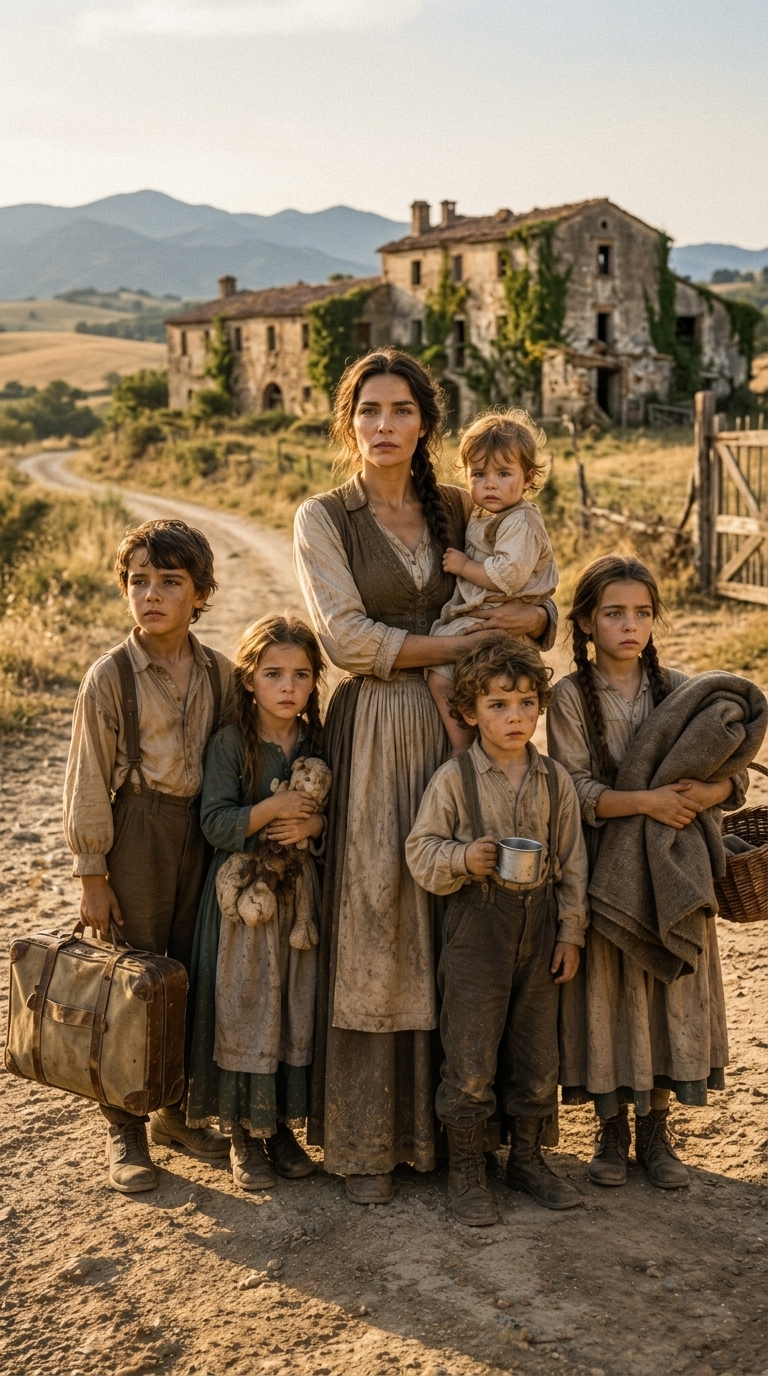
The dust on the road rose behind Hermelinda Vázquez as if it, too, were tired of following her.
She had been walking for four days.
Four days with the sun beating down on the back of her neck, her feet swollen inside worn-out sandals, her throat dry from swallowing so much fear so her children wouldn’t see it. Four days since she had left the only house she had known as a wife — a house she had swept, washed, mended, and cared for for years, but which, on paper, had never belonged to her.
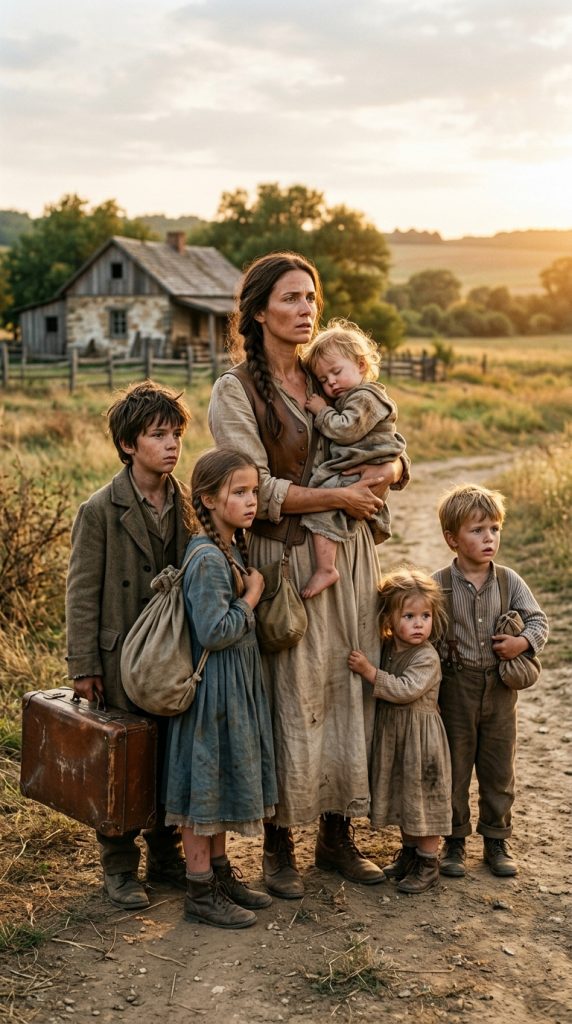
She carried the youngest, Eliseo, wrapped in her rebozo against her chest. He was just a warm little bundle against her body, asleep more from exhaustion than from peace. Holding her hand was Bonifacio, five years old, who no longer asked how much farther they had to go, because poor children learn far too early that some questions don’t fill the belly.
Behind them came the other three.
Refugio, the oldest, twelve years old, carrying a bundle of clothes almost as big as she was. She walked upright, without complaining, as if life had already told her a hard secret: when the mother walks ahead, the oldest daughter learns not to fall.
Hilario, ten years old, carried an empty canteen around his neck. He had shaken it several times that morning, hoping for a miracle of water, but only heard the dry clank of hollow metal.
And Crescencia, seven years old, dragged her feet with silent stubbornness. Her eyes were red, but she didn’t cry. Not because she didn’t want to. Because she had seen Hermelinda looking straight ahead with such desperate firmness that she understood if she cried, her mother might break too.
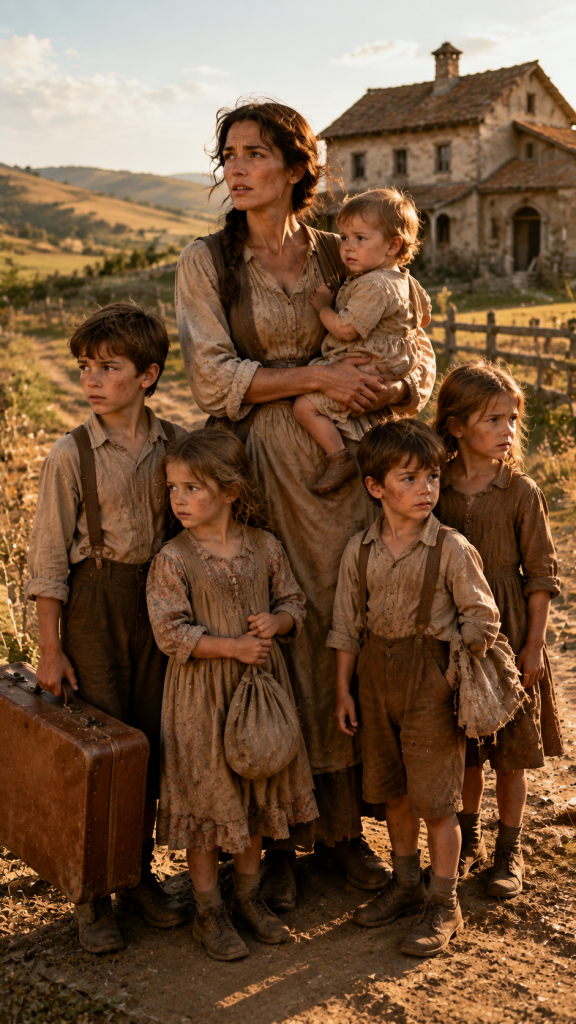
Hermelinda was thirty-two years old, but that week she seemed to carry the weight of a hundred. The handkerchief tied around her head was stained with dust and sweat. Every so often she wiped her forehead without stopping, because stopping would mean giving desperation the upper hand.
And Hermelinda had already given life far too many advantages.
The road began to curve around a low hill, and that was when she saw it.
An old, half-fallen gate.
Behind it, an adobe house with peeling walls, an incomplete tiled roof, and a porch held up by wooden pillars that seemed to stand more out of habit than strength. The yard was overrun with tall weeds, dry branches, and unchecked brush. At first glance, it was just an abandoned small farm, a piece of land that time had forgotten.
But then Hermelinda heard the buzzing.
Low.
Constant.
Alive.
At first she didn’t know where it was coming from. She thought it might be the wind slipping through the grass or some insect lost in the afternoon heat. But when she got a little closer, she saw the white boxes at the back of the yard, leaning against a low wall, their old paint peeling from the years.
Beehives.
Eight abandoned beehives.
And yet the bees kept coming and going, working with a mysterious discipline, as if no one had told them the humans had left, as if they knew there were things that should not be abandoned just because no one was watching.
Hermelinda stopped in front of the gate.
The five children gathered around her.
No one spoke.
The air smelled of hot earth, dry flowers, dust, and something sweet coming from the back of the yard. A light, hidden sweetness, almost impossible, like a promise too delicate to be spoken aloud.
Hermelinda didn’t know it yet, but those forgotten beehives held what Saúl, the father of her children, had never wanted to give them.
An opportunity.
A home.
A name of their own.
It had all started much earlier, in a small mountain village that almost no one mentioned anymore. That was where Hermelinda was born, the daughter of Feliza, a thin woman with hard hands and a firm heart, who knew about herbs, childbirth, mending, and long silences. Feliza had no land or money to leave her daughter, but before she died she taught her three things worth more than a written inheritance.
She taught her to boil mullein when the chest tightened.
She taught her to mend a dress so it would last three more seasons.
And she taught her not to trust a man who made promises without looking her in the eyes.
Hermelinda was fifteen when she buried her mother with a handful of white flowers. The burial was poor, just like Feliza’s life had been, but Hermelinda remembered the smell of wet earth and the weight of being left alone. From then on, she learned to rely on herself with a kind of stubbornness that didn’t look big from the outside but held an entire life together from within.
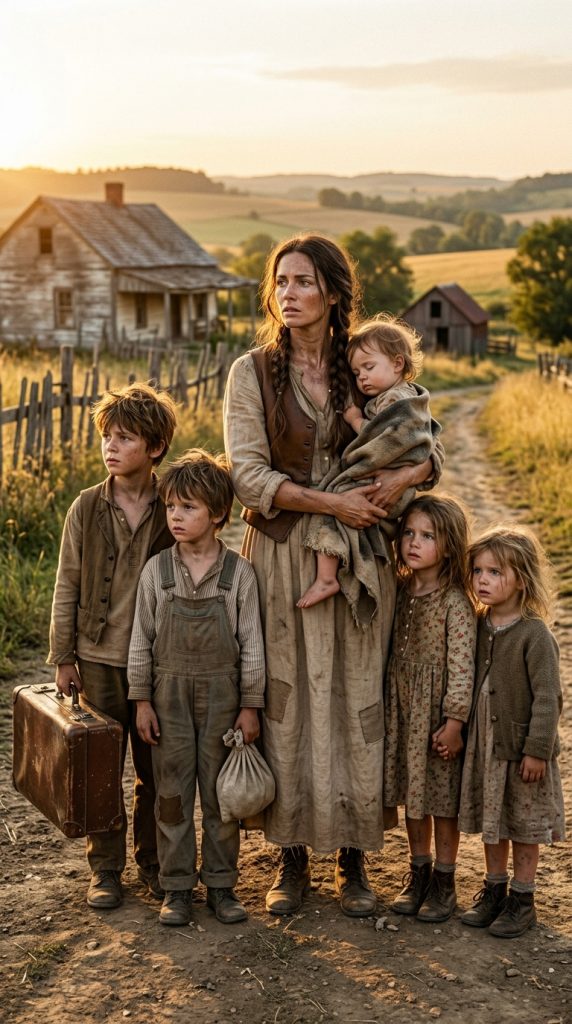
At seventeen she met Saúl.
He was tall, dark-skinned, with an easy laugh and quick words. He had the kind of charm that can sound like destiny to a lonely girl. He told her she was different. That with her he wanted a home. That he would work hard. That he would never let her go hungry. That a woman like Hermelinda deserved a good life.
She believed him.
Not because she was foolish.
Because she was also young.
And sometimes youth confuses hope with proof.
They were married in church on a Sunday in May. Hermelinda wore a borrowed dress, mended on the inside so it would fit, and Saúl looked at her before the altar with eyes that seemed sincere. The first years were good. Not perfect, but good. The kind of years where a woman falls asleep tired but still believes the tiredness has meaning.
Refugio was born.
Then Hilario.
Then Crescencia.
Then Bonifacio.
And finally Eliseo, the youngest, who still couldn’t walk when everything began to fall apart.
Saúl started coming home late.
At first, Hermelinda said nothing. In the villages, men sometimes come home late, and women learn to ask carefully so they don’t get a bad answer.
Then he stopped coming home some nights.
Later he stopped looking at Hermelinda when she served him coffee. That was what scared her most. Not the lateness. Not the silence. The absence in his eyes. As if he were already far away even while sitting at the same table.
One ordinary Tuesday, without a big argument, without a goodbye, without even looking at his children, Saúl packed clothes into a bag, took the lard can where they kept their savings, and left with a woman from the neighboring village who, it was later said, had promised him a life “without so many mouths to feed.”
Hermelinda did not follow him.
She did not shout down the road.
She did not run after him.
She stood by the cold stove with Eliseo in her arms, staring at the empty space where the money can had been. She didn’t cry at that moment. Five children were watching her. And when five children look at their mother with hunger and fear, a woman allows herself to break only on the inside.
Three weeks later, Doña Eriberta, her mother-in-law, arrived.
She came with her mouth tight, a folded paper, and a cousin who was a lawyer and cleaned his glasses with too much importance. Doña Eriberta had never liked Hermelinda. She considered her unworthy of her son, even though that son had just abandoned her with five children and a debt at the store.
“The house belongs to Saúl’s family,” she said, without even inviting her to sit. “You have no right to stay here with those kids. If you want anything, go find your husband. Or go back to your people, if you still have any.”
Hermelinda looked at the paper.
She looked at her mother-in-law.
She looked at the kitchen where she had cooked for years, the walls she had whitewashed with her own hands, the patio where her children had played, the shade of the tree where she had washed diapers, the corners where she had kept simple dreams.
The house had been hers in every way except on paper.
And in this world, papers weighed more than a woman’s work.
She did not beg.
She did not give Doña Eriberta the pleasure of seeing her on her knees.
She gathered the children’s clothes into two bundles. She tucked among the rags a picture of the Virgin that had belonged to her mother and a little notebook of remedies written in Feliza’s crooked handwriting. She tied Eliseo to her chest, took Bonifacio by the hand, and walked out through the gate of that house without looking back.
She walked for four days.
She asked for work at ranches where doors were closed before they even heard her story. She slept under borrowed roofs, in corrals, beside cold walls, wherever night caught them. They ate hard tortillas that a kind woman gave them on the road, a handful of cold beans, well water, and sometimes nothing.
On the fourth day, when Hermelinda was beginning to think God had turned His face away, the abandoned small farm appeared.
The gate gave way with a tired creak.
The yard was covered in waist-high weeds. The adobe house had a crooked door and broken tiles. On the porch lay a fallen bench. At the back, the beehives buzzed like a hidden heart.
“Stay here,” Hermelinda told Refugio, handing her Eliseo. “Don’t go near the back. I’m going to check.”
She entered the house with her heart pounding.
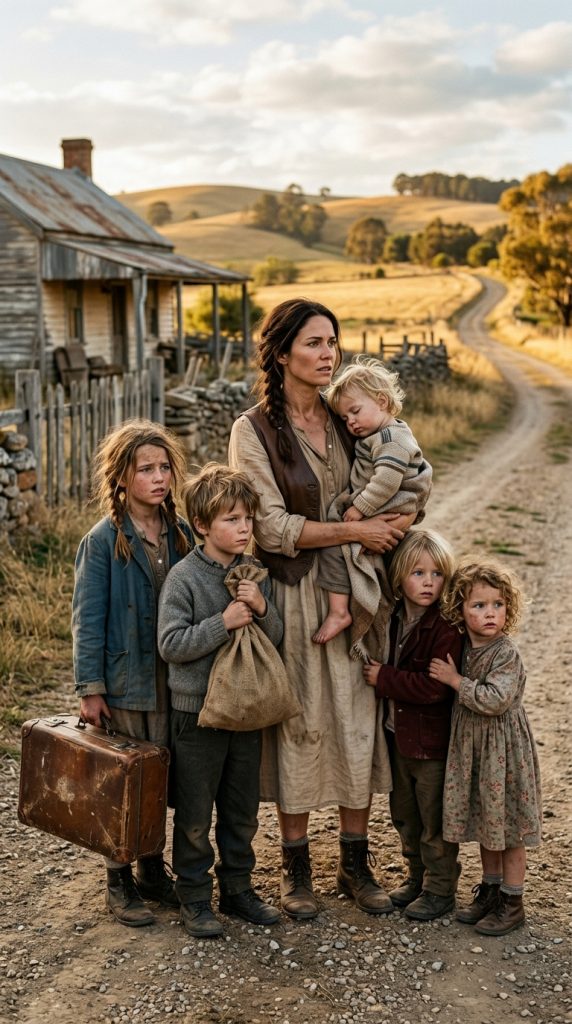
The kitchen smelled of old dust, abandonment, and years without a broom. There was a cold stove, a wobbly table, a cupboard with two empty jars, and cobwebs so old they seemed part of the furniture. In the back room she found a cot without a mattress and a dresser with one drawer open. On the dresser was a yellowed portrait of an older man and woman dressed in their Sunday best, staring into nowhere, as if they were still waiting for someone.
Hermelinda stepped out onto the porch.
The sky was turning orange behind the hill.
The house was empty.
Beaten up, yes.
Full of holes, yes.
But it had walls.
It had a roof.
And after four days on the road, that seemed almost like a miracle.
She called the children.
The five of them entered slowly, with those big eyes children have when they don’t know if the new thing is going to save them or scare them.
“We’re going to sleep here tonight,” Hermelinda said, making her voice sound firm even though she was trembling inside. “Tomorrow we’ll see.”
She was untying the bundle of clothes to make an improvised bed when she heard a voice behind the gate.
“I’ve been waiting a long time for someone to come.”
Hermelinda turned quickly.
An elderly woman was standing outside. She was thin, with white hair braided down to her waist, sun-weathered skin, and a brown rebozo crossed over her shoulders. She carried a basket covered with a cloth. Her eyes were light, a faded blue, but alive.
“I’m Praxedis,” said the old woman. “I live on the other side of the hill. I saw dust on the road and knew someone had arrived.”
She looked at the children.
“You came with all of them?”
“Yes, ma’am.”
“And your man?”
Hermelinda pressed her lips together.
She didn’t answer.
Doña Praxedis nodded slowly, as if the lack of an answer was a complete story.
“I brought tortillas and a little cheese. It’s not much, but it’s enough for tonight. Tomorrow we’ll talk about the rest.”
She entered without asking permission, with the naturalness of someone who knows a house more by memory than by right. Hermelinda accepted the basket without pride. Because when five children are hungry, a mother learns that refusing help can be too expensive a luxury.
That first night the six of them slept huddled together on the porch, on the bundles of clothes. The buzzing of the beehives came from the back of the yard like a strange lullaby. Stars peeked through the gaps in the roof. The children fell asleep exhausted.
Hermelinda didn’t sleep.
She sat against a wooden pillar, staring into the darkness, listening to her children’s breathing. She did the math. Everything came out wrong. She had no money. She had no permission. She didn’t know who owned the land. She didn’t know if someone would come the next day to throw her out again.
The only things she had were her hands.
Her children.
And an unknown old woman who had come with tortillas as if heaven had sent her.
Doña Praxedis returned before dawn.
She brought a bundle of firewood, a pot of beans from the day before, and two buckets. She lit the stove without ceremony, heated the food, and while the children woke to the smell of woodsmoke and warm broth, she told Hermelinda the story of the small farm.
“This house belonged to Don Severo and Doña Tula. Good people. They died without heirs nearby. The land was left waiting. No one has stepped on it in eight years. But the bees stayed. And when the bees stay, daughter, it’s for a reason.”
Hermelinda looked toward the beehives.
“I don’t know anything about bees.”
“I do,” said Doña Praxedis. And for the first time she smiled. “And it can be taught.”
That was how it all began.
Not with a great miracle.
Not with a bag of money.
Not with a repentant Saúl.
It began with a twig broom, a pot of beans, an old woman who knew too much, and a woman who had nothing left to lose.
The days turned into weeks.
Hermelinda cleaned the yard little by little, cutting weeds until the children could walk without getting lost in the brush. She mended the roof with tiles that Don Liborio, another neighbor from the hill, brought up in exchange for her washing his clothes once a week. Refugio took care of her younger siblings during the day. Hilario learned to draw water from the well. Crescencia mended clothes sitting on the porch with a crooked needle. Bonifacio gathered firewood. Eliseo slept tied in the rebozo while his mother worked.
And the bees kept buzzing.
Doña Praxedis came every two days.
She taught Hermelinda to approach the beehives with smoke from dry leaves, not to make sudden movements, to listen to the sound of the bees as one listens to the mood of a house. She taught her to open the boxes slowly, to tell good wax from bad, to remove honeycomb without harming the queen, to strain the honey in clean cloth, to store it in jars, to recognize orange-blossom honey by its color and mesquite honey by its scent.
“The bees recognize those who don’t come to steal from them,” the old woman said. “If you treat them with respect, they give to you. If you come with greed, they drive you away.”
One morning, Hermelinda opened a box without her hands shaking.
The bees rose around her but did not attack.
Doña Praxedis looked at her with an almost sacred seriousness.
“They already know you. This land has accepted you.”
Hermelinda wanted to believe her.
But life doesn’t fix itself just because an old woman says so.
One afternoon, while straining honey on the porch, she heard hoofbeats on the road.
She looked out.
A rider was approaching the gate.
He was a stout man with a gray mustache, an expensive hat, and boots too clean for someone who worked the land. He didn’t get off his horse. He stayed there looking at the yard as if calculating, measuring, deciding.
“Good afternoon,” he said. “How long have you been here?”
“Three weeks.”
“And with whose permission?”
Hermelinda wiped her hands on her apron.
“The house was empty. My children had nowhere to sleep.”
The man let out a short laugh.
“Well, I’m letting you know this land has an owner. I, Anselmo Quintanilla, have been paying the property taxes on this farm since the old folks died. And in this town, that counts for more than moving in where you weren’t invited.”
Hermelinda felt her heart sink to her feet.
“I’ll give you fifteen days,” he continued. “Gather your things. Leave with your children. I don’t want to be cruel, but this land is mine. And the beehives too.”
He turned his horse and left before she could reply.
Dust hung in the air on the road.
Hermelinda remained on the porch with the wooden spoon in her hand. Honey dripped slowly onto the table.
At first she felt fear.
Then something else.
Something old.
Something that had not died with Saúl’s abandonment, nor with Doña Eriberta’s humiliation, nor with four days on the road.
Stubbornness.
The same that Feliza had left in her blood.
When Doña Praxedis arrived the next day and heard the story, she was not surprised.
She sat on the bench, looked toward the beehives, and remained silent for a long time.
“Anselmo has been wanting this farm for years,” she said at last. “When Don Severo and Doña Tula died, he went to the town hall and started paying the taxes saying he was a distant relative. He’s no relative of anyone. He just knows that in towns where few people can read, a misused piece of paper can crush the truth.”
“And what can I do?”
Doña Praxedis looked at her.
“I kept something.”
Hermelinda frowned.
“Something I’ve been keeping for eight years, waiting to know who it was for. Last night I understood.”
The next day, Doña Praxedis arrived with an old, dented tin box, its green paint almost worn away. She placed it on the porch table as if depositing a treasure that didn’t shine but weighed more than gold.
“I knew Don Severo and Doña Tula since I was a little girl,” she began. “They raised me almost like a daughter when my parents died. When they got sick, I cared for them until their last day. Doña Tula, before she passed, called me to the edge of her cot and gave me this box.”
The old woman swallowed.
“She told me: ‘Praxedis, this stays with you. When a woman with many children arrives at this farm, give it to her. I don’t know when it will be, but it will be. The bees will call her.’”
Hermelinda felt the air catch in her throat.
Doña Praxedis opened the box.
Inside were yellowed papers, carefully folded sheets, and a thick envelope with an old seal.
“They are the titles. Don Severo and Doña Tula left a will. The farm would go to the woman who arrived with her children and knew how to care for the bees. Don Hilarión Mendiola, the notary in San Juan, is still alive. I sent word to him. He’s expecting you tomorrow.”
Hermelinda took the papers with trembling hands.
Her mother had taught her to read from an old primer, and although it was difficult, that afternoon she read every line as if reading her own destiny.
The farm.
The two hectares.
The eight beehives.
The adobe house.
All set aside for a woman who would arrive with children and care for the bees.
Hermelinda raised her eyes to Doña Praxedis.
Neither of them said anything.
They cried in silence, face to face, while in the background the beehives kept buzzing under the sun as if they had known everything from the beginning.
The next day Hermelinda put on the only dress she had without visible mends. She combed her children’s hair. She left Refugio to watch the little ones and set out with Doña Praxedis and Hilario toward San Juan, three hours away.
The notary, Don Hilarión Mendiola, was a tall man, bent by the years, with an office that smelled of old ink and wood. When he saw the box, he didn’t seem surprised.
“Doña Tula brought me that will the year before she died,” he said, taking out a thick book. “I told her it was a strange way to inherit. She replied: ‘Important things are not left to the first person who comes along, Don Hilarión. They are left to whoever deserves them. The bees know how to choose.’”
Hermelinda signed with a trembling hand.
When the notary wrote her full name, he added Saúl’s surname.
Hermelinda stopped him.
“Just Hermelinda Vázquez, Don Hilarión. The other I already buried in another town.”
The notary looked at her, understood, and continued writing.
When they left with the copy of the title folded in her rebozo, Doña Praxedis squeezed her arm.
“Now comes the hard part. Anselmo won’t stay quiet. But now you have papers. And when the papers are yours, they weigh more than the tongue of any ambitious man.”
Anselmo returned four days later.
This time he came with two workers.
He stopped in front of the gate and shouted Hermelinda’s name as if calling an intruder.
She stepped out onto the porch with her rebozo neatly in place. Doña Praxedis stood beside her. The five children peeked from the door.
“I don’t see you hurrying, ma’am,” said Anselmo. “I gave you fifteen days.”
Hermelinda took out the envelope.
“This farm is mine.”
The man looked at her as if he had heard a joke.
“Yours?”
“Registered at Don Hilarión Mendiola’s notary office, according to Doña Tula’s will. She left it to the woman who arrived with her children to care for the bees. That woman is me.”
Anselmo fell silent.
Then he looked at Doña Praxedis.
“I see who stuck their hand in. Nosy old woman.”
“Old, yes,” Praxedis replied. “Nosy when necessary.”
Anselmo’s face hardened.
“I paid the taxes for eight years.”
“And you will be reimbursed what is due, with receipts,” said Doña Praxedis. “But paying for something that belongs to someone else doesn’t make it yours. We’ve already consulted on that.”
The horse shook its head, restless.
Anselmo looked at Hermelinda, at the papers, at the children, at the beehives.
For the first time he did not see a weak woman with five mouths to feed.
He saw an owner.
He did not apologize. Men like him rarely do.
He only said:
“We’ll see.”
And he left.
He never came back.
Three weeks later, it became known that he had sold some land and moved to the city, leaving debts and murmurs behind. People said he left out of shame for trying to take a farm from a woman with five children. But Hermelinda knew something more: he left because he understood he could not win where the land had already chosen.
Months passed.
Then a year.
Hermelinda learned to live from the honey.
The eight beehives became twelve, then fifteen. She harvested twice a year. She went down to the village with clean glass jars and people began to talk about Doña Hermelinda’s honey, the woman from the hill. They said it had a different flavor, a hint of dry flowers, soft smoke, and something no one could name. They bought one jar and came back for another.
Refugio learned to keep accounts in a notebook made from used pages.
Hilario learned to care for animals with Don Liborio. Soon they had two goats and a skinny donkey that carried jars to the village.
Crescencia became skilled with the needle, able to mend dresses until they looked new.
Bonifacio fell in love with the orchard.
And Eliseo, the baby in the rebozo, grew up with the buzzing of the beehives as his lullaby and learned to put his hands into the boxes without being stung, as if they recognized him from that first day he arrived asleep in the rebozo.
Doña Praxedis continued to come down every two days.
Until one morning she didn’t.
Hermelinda went up to the house on the other side of the hill and found her in bed, with the brown rebozo crossed over her shoulder, a slight smile, and the peaceful face of someone who had finished fulfilling a promise.
They buried her under a mesquite tree in the yard.
Hermelinda prayed a rosary with the five children around her and promised that the farm would always be a home for women who arrived with children and fear in their feet.
Saúl returned three years later.
He appeared one October afternoon in front of the gate, with worn boots, an unshaven beard, and sunken eyes. The woman he had left with had abandoned him. The savings hadn’t lasted long. Life, that harsh teacher, had charged him interest on every lie.
He arrived believing it would be enough to say “I’m back.”
That it would be enough to be a father.
That family, simply because it was called family, would be waiting where he had left it.
Hermelinda saw him from the porch.
She recognized the silhouette first.
Then the face.
Refugio, now fifteen, came out and stood beside her mother.
“Hermelinda,” said Saúl. “I came to see you. I came to see my children.”
She did not raise her voice.
“You have no children here, Saúl.”
He blinked.
“Here are five children who grew up without you. There is a house that was rebuilt without you. There is a life that was made without you. You left on a Tuesday and took the money from the stove. I buried you that same day.”
Saúl lowered his gaze.
“If you came to eat, there are beans,” she continued. “If you came to stay, there is no room.”
He stood for a while on the other side of the gate.
Then he wiped his face with the back of his hand and left down the red dirt road.
He never returned.
That afternoon Hermelinda did not cry.
She sat on the porch bench and looked at the beehives under the orange sun. Refugio sat beside her and took her calloused hand.
Sometimes the most important goodbyes happen long before the person comes back to knock on the door.
They say in San Juan de los Pinos that the farm on the hill never closed its gate again.
They say that if a woman arrives walking with tired children and dust on her feet, Doña Hermelinda comes out with coffee, beans, and a clean blanket. She asks where she comes from only if the woman wants to tell it. If not, she lets her sleep. Because Hermelinda learned that not all wounds need an explanation before receiving shelter.
They say that eleven women passed through that house in the following years.
Three stayed to live nearby.
All of them left with a jar of honey in their basket and a new idea in their chest: perhaps starting over was not a shame.
Perhaps it was a form of courage.
The beehives grew to more than thirty. Hermelinda spoke to them softly when she opened them, as if the bees were the only ones who understood certain things she never wanted to say out loud.
Her children grew up strong.
Refugio became a teacher.
Hilario built his own farm higher up the hill.
Crescencia sewed wedding dresses for girls from three villages.
Bonifacio planted corn and beans with a patience that seemed inherited from the land.
And Eliseo, the baby from the rebozo, became the most respected beekeeper in the region, teaching others what Doña Praxedis had taught his mother.
When someone asked Hermelinda what the most important day of her life had been, she never mentioned signing the title, the first honey sale, or the day Anselmo left defeated.
She always gave the same answer.
“The day they threw me out of the house that was not mine. Because that day began the road that brought me to the house that is.”
Some people look at a dirt road and see only dust.
Some people look at the same road and see a way out.
Hermelinda Vázquez was not born knowing how to care for bees. She was not born knowing how to read wills or confront ambitious men with a yellow envelope in her hand. She was not born knowing how to raise walls, sell honey, defend a gate, or open her house to other women broken by life.
She was born knowing not to give up.
And sometimes that is enough for the world to start moving.
Because there are places that are not found by chance.
Sometimes it is the places that find the exact person at the exact moment.
Sometimes God places an abandoned farm at the end of four days of hunger.
Sometimes He leaves eight living beehives where everything seems dead.
Sometimes He sends an old woman with a tin box and a promise kept for eight years.
And sometimes a woman who arrives with nothing ends up discovering that she did not come to ask for shelter.
She came to claim the home that had been waiting for her.
