

The Night My Son Closed the Door
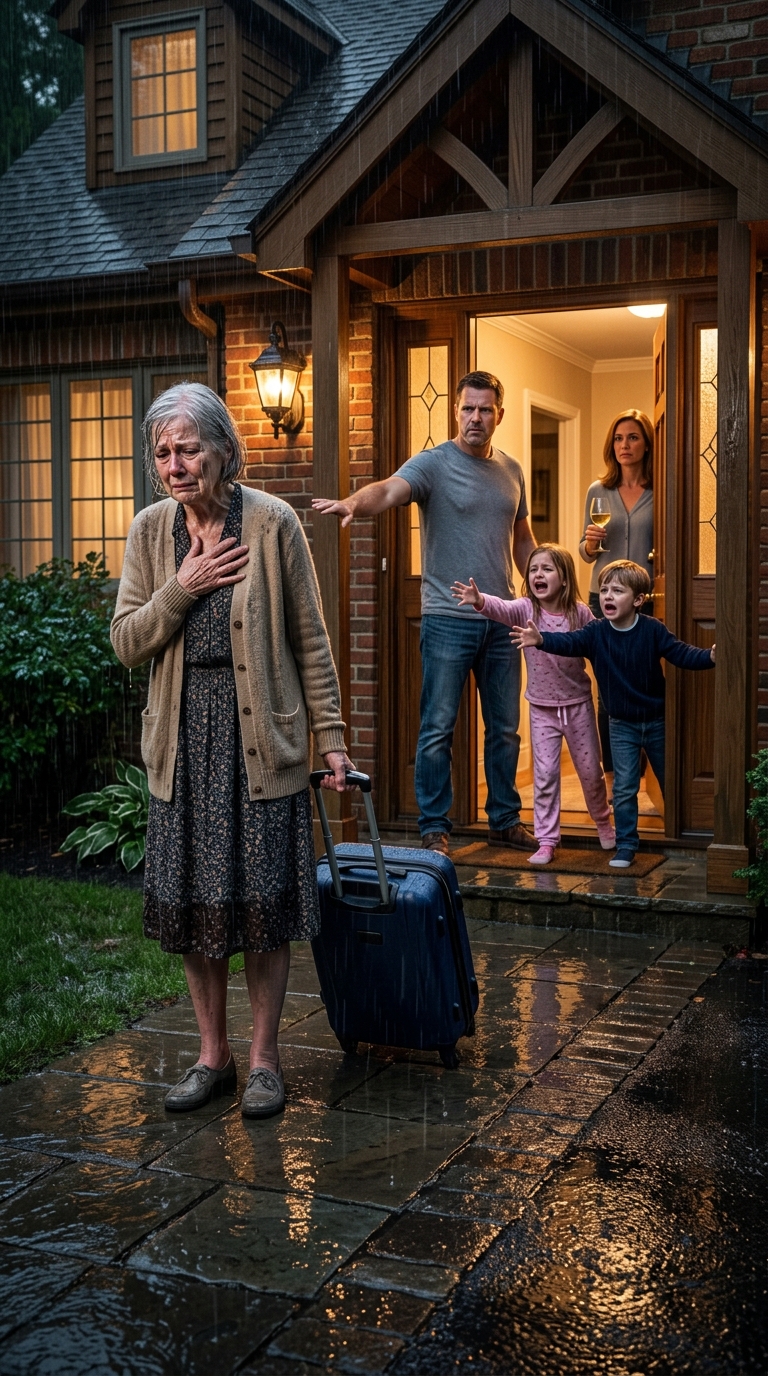
The night my son turned me away, I stood on his porch with a small suitcase, a pharmacy bag, and a pain in my right hip that made every breath feel heavier than the last.
Rain had been falling over Grand Rapids since late afternoon. Not a storm, just a cold November drizzle that made the sidewalks shine and turned the neighborhood quiet. My son’s house sat at the end of a clean suburban street, with trimmed hedges, warm porch lights, and a two-car garage I had helped him afford years earlier.
I had not come there to stay forever.
I had not come to take over his home.
I had slipped on the wet steps outside my apartment building that morning. The doctor said nothing was broken, but he looked me straight in the eye and told me not to spend the next few days alone. My elevator barely worked. My closest neighbor was visiting her daughter in Ohio. I was sixty-four years old, hurting, dizzy from medication, and trying very hard not to be afraid.
So I called my son, Nolan.
He did not answer.
I told myself he was busy. I told myself any decent son, once he saw his mother standing at his door, would say, “Come in, Mom. We’ll figure it out.”
I was wrong.
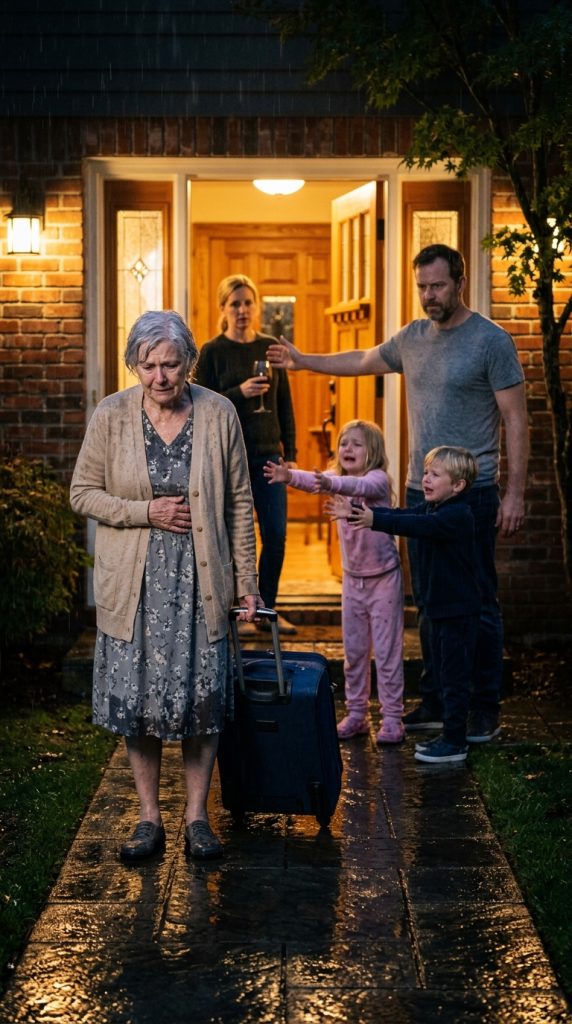
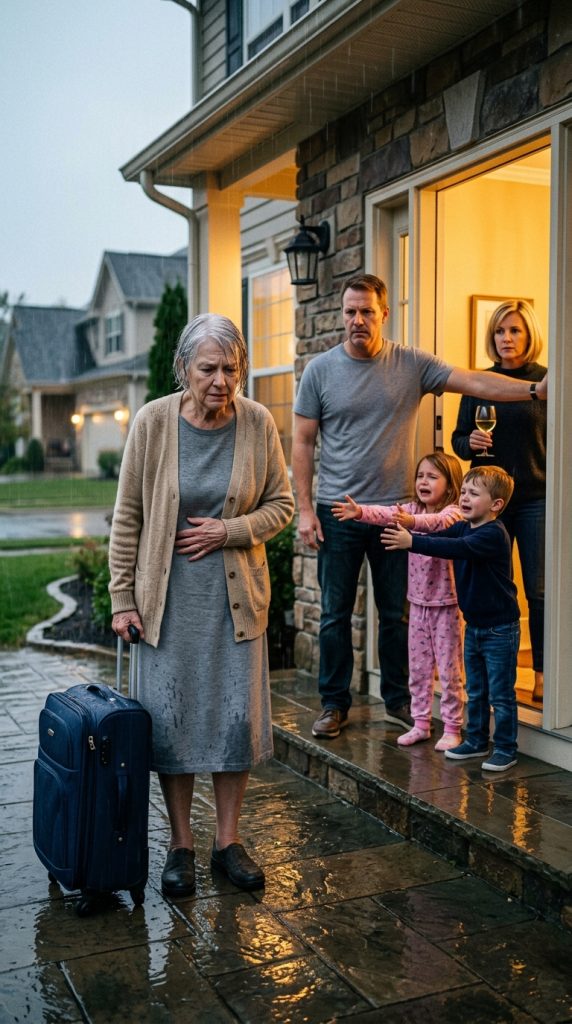
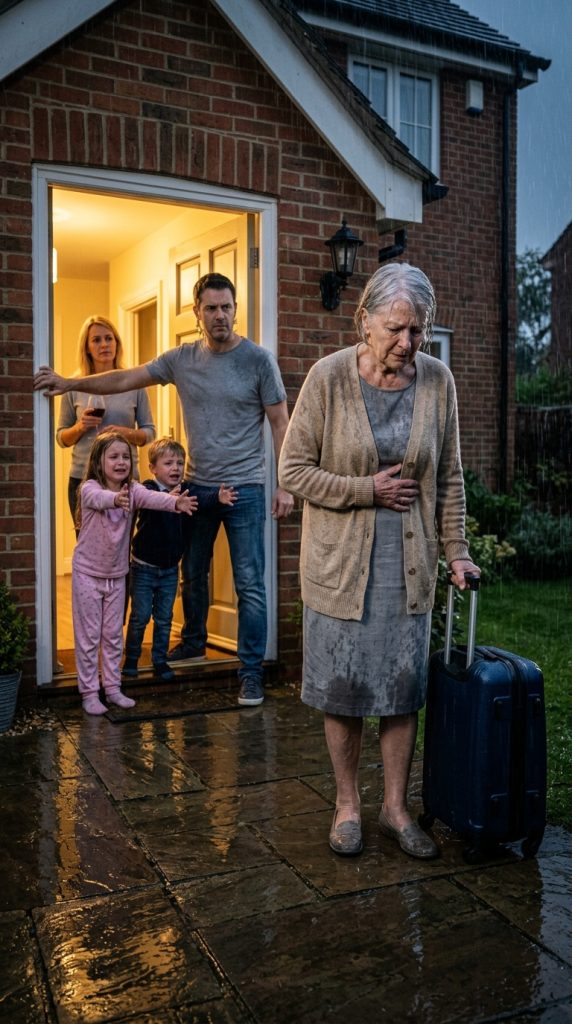
When the door opened, Nolan stood there in a gray T-shirt and jeans, his face already tired of me before I even spoke. Behind him, his wife, Whitney, leaned against the kitchen island with a glass in her hand. She did not move toward me. She did not smile.
From the staircase, my granddaughter Harper peeked through the railing in pink pajamas.
“Mom,” Nolan said, looking first at my suitcase, then at my face. “What are you doing here?”
I swallowed my embarrassment.
“I called you,” I said softly. “I had a fall today. The doctor said I shouldn’t be alone for a few days. I only need a week, Nolan. Just until I can move around safely.”
He let out a slow breath, the kind people release when they are inconvenienced, not concerned.
“This isn’t a good time.”
The words were quiet, but they landed hard.
“I won’t be in the way,” I said. “I can sleep in the guest room. I just need a little help.”
That was when he said it.
Not with anger. Not even with shame.
He said it as if he were explaining a rule.
“Mom, we’re not a shelter. We don’t have room for this.”
For a moment, the whole world became small.
The rain. The suitcase handle cutting into my fingers. Harper’s little face on the stairs. Whitney’s silence. My son’s hand still holding the door halfway closed.
We’re not a shelter.
I had given birth to that man. I had worked double shifts as a school secretary after his father left us. I had sold my old house so he could make the down payment on this one. I had watched his children when they were sick, cooked meals, covered bills, signed papers, and told myself every cold little moment was just stress, not truth.
Harper took one step down.
“Dad,” she whispered, “Grandma is hurt.”
Nolan did not even turn around.
“Go back upstairs, Harper.”
Whitney finally spoke, but not to me.
“Listen to your father.”
No one touched my suitcase. No one offered a glass of water. No one said, “Let’s call someone.” No one did anything that looked like love.
So I nodded.
“I understand.”
Then I turned around as carefully as I could and walked back to the waiting taxi with my hip burning and my pride breaking in silence.
The Kitchen Where I Finally Saw the Truth
When I got back to my apartment, the night felt too quiet.
The security guard helped me out of the taxi. I lied and told him I was fine. Then I took the elevator halfway up before it stopped, limped down the hall, and unlocked my door with shaking hands.
My apartment looked exactly the same as it had that morning. The blue dish towel still hung beside the sink. The bowl of apples sat on the counter. My reading glasses were beside an unfinished crossword puzzle.
But I was not the same woman who had left earlier that day.
I sat at my kitchen table with my medication bag in front of me and realized something painful.
That door had not started closing tonight.
It had been closing for years.
My name is Eleanor Grace Whitcomb. I was sixty-four when my only son told me there was no room for me in a house my sacrifices had helped build. I had spent more than twenty-five years working in a public middle school outside Grand Rapids. I raised Nolan mostly on my own. I gave him more than I gave myself, and for a long time, I believed that was what a good mother did.
I never thought motherhood was a transaction.
I never expected my son to repay me for loving him.
But I did believe that love, if planted faithfully enough, would grow into basic decency. A phone call. A chair at the table. A warm place to sleep when your mother could barely walk.
That night, sitting in my kitchen, I understood that I had mistaken my usefulness for belonging.
And the moment I stopped being useful in the way Nolan wanted, he treated me like an inconvenience.
The List That Changed Everything
I did not sleep.
At four in the morning, I made coffee and pulled out a hard-cover notebook my friend Marion had given me for Christmas years earlier. I had never used it because it felt too pretty for ordinary things.
That morning, it became necessary.
On the first page, I wrote four questions.
What have I given Nolan?
What is still in my name?
What can I close?
What must I document?
At first, my hand trembled. Then the memories came quickly.
The college payments when Nolan fell behind. The money I gave him after his first business loan was delayed. The car I co-signed when he and Whitney got married. The medical bills for my grandson Cole when insurance took too long to process. The holiday gifts, school fees, summer camps, repairs, groceries, emergencies.
Then came the big one.
The house.
Years earlier, I had sold my small home in Lansing. It was not fancy, but it was mine. It had a narrow porch, an old maple tree, and a kitchen where Nolan had done his homework as a boy. I told myself the house was too much for one aging woman. I told myself selling it made sense.
When Nolan and Whitney said they needed help buying a better home for the children, I gave them a large part of the money.
No contract.
No written agreement.
No name on the deed.
Just trust.
That was my first mistake.
Not helping my son.
But believing love would protect me better than paperwork.
Then there was the business credit line.
Nolan had asked me to open it in my name when his small logistics company was still getting started. “Only for six months, Mom,” he had promised. “As soon as the company financing comes through, we’ll move everything out of your name.”
Six months had become seven years.
I opened my filing cabinet and pulled out every folder I had. Bank statements. Emails. Copies of credit documents. Transfer confirmations. Notes I had made in the margins because I had always been careful with money.
And there it was.
Primary account holder: Eleanor Grace Whitcomb.
Responsible party: Eleanor Grace Whitcomb.
Risk: Eleanor Grace Whitcomb.
My son had not just accepted help.
He had built comfort on top of my signature.
The Lawyer Who Did Not Flinch
At nine o’clock, I called my lawyer, Audrey Keene.
Audrey had handled my will, my apartment purchase, and a few small legal matters over the years. She was calm, direct, and not easily impressed by emotional stories.
I told her everything.
The fall.
The porch.
The sentence Nolan had said.
The money.
The house.
The credit line still in my name.
When I finished, she was quiet for a few seconds.
Then she asked, “Did you sign anything giving Nolan permanent authority over that credit line?”
“No.”
“Is the account still legally yours?”
“Yes.”
“Did you agree in writing that he could use it forever?”
“No.”
Audrey’s voice stayed calm.
“Then you can close it.”
I pressed my hand over my mouth.
“Just like that?”
“Just like that,” she said. “Eleanor, helping an adult child is one thing. Allowing your name and credit to carry his business indefinitely is something else. You have every right to protect yourself.”
The next morning, I went to the bank.
It took me almost an hour to get dressed because my hip was still stiff and sore. But I went. I sat across from the account manager, signed the forms, and gave clear instructions.
Close the credit line.
Do not reopen it.
Do not redirect it.
Do not negotiate by phone.
When I stepped outside, the air was cold and sharp. For the first time in days, I felt something besides pain.
I felt steady.
When the Phone Started Ringing
Nolan found out two days later.
The first message came at 7:13 p.m.
“Mom, call me now.”
Then another.
“What did you do at the bank?”
Then Whitney.
“Eleanor, this is not the way family handles things.”
I did not respond.
Not because I was afraid.
Because for the first time in my life, I understood that silence could be protection, not weakness.
That night, Harper called me from her tablet. Her face filled the screen, her brown eyes worried.
“Grandma Ellie,” she said, “Daddy was really upset. He said your name.”
My heart tightened.
Children should not carry adult problems. But children also know when the air in a house changes.
“Are you okay, sweetheart?” I asked.
She nodded.
“Mom said you’re trying to make things hard.”
I closed my eyes for one second.
“Listen to me,” I said gently. “Grown-ups sometimes have problems that are not for children to fix. I love you. I love Cole. That has not changed.”
“Are you still coming to my school concert?”
“If I’m allowed to be there, I will be in the front row.”
Her little shoulders dropped with relief.
After we hung up, I opened my notebook and wrote everything down.
Date.
Time.
Words spoken.
Because I had learned something important.
Memories can be questioned.
Records cannot.
The Visit I Knew Was Coming
Nolan came to my apartment that Saturday.
He knocked three times, too hard.
When I opened the door, he stepped inside without hugging me. He looked tired, tense, and angry in the way people become angry when their control stops working.
“You closed the account,” he said.
“Yes.”
“Do you understand what kind of problem you created?”
I looked at him carefully.
“I understand the problem I stopped carrying.”
His jaw tightened.
“This is about what happened at the house, isn’t it? You got mad, and now you’re punishing us.”
“No,” I said. “This is about seven years of my name supporting a business you promised would remove me in six months. And yes, it is also about the fact that when I needed seven nights of help, you told me there was no room.”
He looked away first.
Only for a second.
But I saw it.
“You can’t just show up and expect everyone to change their life for you,” he said.
I almost laughed, but there was nothing funny about it.
“I didn’t ask everyone to change their life. I asked my son for a bed while I recovered.”
Then he said the thing I had expected and dreaded.
“Maybe it’s better if you don’t see the kids for a while. This tension isn’t good for them.”
There it was.
The sharpest tool he had.
I stood slowly, walked to my desk, and placed a folder on the table between us.
“In this folder are bank statements, transfer records, emails, dates, and notes. If you or Whitney try to use Harper and Cole to pressure me, I will speak with Audrey about every legal option available to protect my relationship with them. I am done being handled.”
His face changed.
Not with guilt.
With calculation.
That hurt more than anger would have.
He left without saying goodbye.
I wrote that down too.
The Lunch With a Hidden Request
For nearly two weeks, I heard nothing.
Then a card arrived in the mail. Cream-colored paper. Flowers on the front. Whitney’s handwriting inside.
She wrote that the children missed me. She wrote that family should heal. She invited me to lunch.
I knew exactly what that meant.
Still, I agreed to meet them at my apartment. Not because I believed them. Because I wanted to hear the request out loud.
They arrived dressed neatly, carrying takeout from an Italian restaurant I used to love. For ten minutes, they talked about school, weather, basketball practice, and Harper’s art project.
Then Whitney set down her fork.
“Eleanor,” she said softly, “we all know emotions were high. Nolan could have chosen better words.”
Could have chosen better words.
Not “He was wrong.”
Not “We are sorry.”
Just a polished way of making the wound sound like a misunderstanding.
Nolan leaned forward.
“We need a temporary bridge account,” he said. “Three months, maybe four. I’m working on company financing, but until then, things are tight.”
There it was.
The lunch.
The card.
The children missing me.
All of it led back to my name.
I looked at my son.
“Do you have anything to say to me that is not a request?”
He blinked.
“I’m trying to fix this.”
“No,” I said. “You’re trying to restore access.”
Whitney’s voice cooled.
“We don’t want this to become unpleasant.”
I folded my hands on the table.
“It already became unpleasant when you both decided my help was expected but my needs were inconvenient.”
Nolan pushed his chair back.
“So that’s it?”
“That’s it,” I said. “I will not open another account. I will not sign another document. I will not put my future under your bills again.”
For the first time, Whitney had no soft answer ready.
They left with most of the food untouched.
After the door closed, my hands shook. But I was not sorry.
Sometimes strength does not feel like power.
Sometimes it feels like trembling and still not changing your answer.
The Email That Proved the Promise
A few weeks later, while organizing old files, I found the email.
It was from Nolan, written seven years earlier.
“Mom, this is completely temporary. Once the business loan is approved, we’ll move everything out of your name. Six months at most. I promise.”
I stared at those words for a long time.
Six months.
Not seven years.
Not forever.
Not until I finally refused.
I forwarded the email to Audrey. She called me within the hour.
“This matters,” she said. “It confirms he understood the arrangement was temporary from the beginning.”
She drafted a formal letter.
No insults.
No dramatic language.
Just facts.
The original promise. The long use of my credit. My legal right to close the account. My refusal to provide future financial backing.
Nolan received the letter on a Thursday.
He called that night.
“You had a lawyer send me a letter?”
“I had a lawyer document the truth.”
“This isn’t how family acts.”
That sentence almost made me tired.
“Tell me how family acts, Nolan,” I said. “Does family promise six months and take seven years? Does family turn away a mother who can barely walk? Does family threaten access to children when money is no longer available?”
There was silence.
Then Whitney’s voice came on the line.
“You’re building a case against us.”
“No,” I said. “I’m preserving the truth.”
Nolan came back on.
“You gave us the house money as a gift. You can’t act like you own anything.”
“I know I don’t own your house,” I said. “But I do own my name. I own my credit. I own my peace. And I am taking them back.”
For the first time, neither of them had an answer.
The Life I Built After No
Winter passed slowly.
Nolan’s business did not disappear, but it had to shrink. He eventually opened a new credit line under his own name, using his own assets. That was where the risk should have been all along.
I did not celebrate his stress.
But I did not rescue him from it either.
That is a lesson some mothers learn late: other people’s discomfort is not always your responsibility. Sometimes it is simply the sound of consequences arriving.
In spring, I moved to a brighter apartment with a reliable elevator, wide windows, and a small balcony facing a row of maple trees. I painted the kitchen pale yellow. I bought new curtains. I donated old clothes. I changed the dishes.
It looked like a simple move.
It was not.
It was the first home I had ever arranged entirely around my own comfort.
Harper still called me on Sundays. Cole showed me science projects through video chat and sometimes asked if I still made cinnamon pancakes. I did. And when Nolan finally agreed to let them visit, I kept things calm.
No adult bitterness.
No heavy explanations.
Just pancakes, puzzles, movies, books, and a grandmother who loved them without letting their parents use that love as a leash.
One afternoon, Cole looked up from his homework and asked, “Grandma, did you really help Dad buy his house?”
I paused.
“Yes,” I said. “I helped.”
“Then why don’t you come over like before?”
I sat beside him.
“Because sometimes adults have to learn how to treat each other better. And sometimes that means making new rules.”
He nodded slowly.
“My teacher says boundaries are how people protect their feelings.”
I smiled.
“Your teacher sounds very wise.”
The Birthday Party
Almost one year after the night on the porch, Harper turned ten.
Her birthday party was held in a small rented garden on a sunny October afternoon. There were yellow tablecloths, cupcakes, paper lanterns, and children running across the grass.
I arrived with a wrapped book and a sweater I had knitted for her.
Nolan stood near the grill. Whitney arranged plates near the dessert table. We were polite to each other in the careful way people are polite when too much truth stands between them.
Later, while Harper opened gifts, Nolan came to stand beside me.
For a long moment, he said nothing.
Then, without looking directly at me, he spoke.
“I shouldn’t have talked to you that way that night.”
It was not a full apology.
He did not say everything.
He did not mention the door, the credit line, the threats, or the years of taking my help for granted.
But for Nolan, who had always treated admitting fault like surrender, it was something.
I looked at him.
For one second, I saw the boy he used to be. The child with scraped knees. The teenager who brought me report cards with a proud grin. The young man I had loved beyond reason.
“No,” I said quietly. “You shouldn’t have.”
I did not hug him.
I did not say it was okay.
Because it was not okay.
But I also did not need to punish him with more words.
Harper ran over then, breathless and smiling, asking if she could stay at my apartment the next weekend.
Nolan nodded.
“That’s fine,” he said.
And that small answer meant more than any polished speech.
The Place Where My Love Belongs
When I drove home that evening, the sunset filled my windshield with soft gold.
I thought about the rainy night when I had stood on Nolan’s porch with my hip aching and my suitcase beside me. I thought about the taxi ride home. The notebook. The bank. The lawyer. The shaking hands. The yellow kitchen. The grandchildren who still knew my love was safe.
For a long time, I believed love meant enduring everything.
I believed a mother should understand, forgive quickly, stay available, and never make anyone uncomfortable with her own needs.
But I was wrong.
Love without limits can turn into a room where everyone is comfortable except the person giving the most.
I did not get my money back.
I did not get back the years I spent making myself smaller.
I did not get the son I imagined I had raised.
But I gained something better.
I gained the right to sit at my own table without fear.
I gained the right to grow older without funding someone else’s comfort.
I gained the right to love my grandchildren from a place of dignity, not humiliation.
And I learned that the door my son closed was not the end of my life.
It was the beginning of the first home where I finally made room for myself.
A mother’s love can be generous, patient, and forgiving, but it should never be treated like an endless account that others can use whenever they refuse to carry their own responsibilities.
Sometimes the most painful moment in a family is not when someone says something cruel, but when their words finally reveal a truth you have been trying not to see for years.
Helping someone you love is beautiful, but protecting your name, your peace, your health, and your future is not selfish; it is wisdom earned through experience.
A closed door can break your heart, but it can also wake up the part of you that has been sleeping beneath years of excuses, silence, and misplaced loyalty.
Children learn more from what adults allow than from what adults say, which is why dignity can become one of the greatest lessons a grandmother ever gives.
Forgiveness does not always mean returning to the same place, opening the same account, signing the same papers, or pretending the pain never happened.
Some people only call your boundaries “cold” because they were comfortable when you had none.
The truth does not need to be shouted to be strong; sometimes it only needs dates, documents, a calm voice, and the courage to stop explaining yourself to people who already know what they did.
Family should be a place of care, not a system where one person keeps sacrificing so everyone else can keep pretending nothing is wrong.
Peace often begins the day you stop asking why they did not make room for you, and start building a life where your own heart finally has a place to rest.
