


Part 1: The Conversation Behind the Door
Two days before our wedding, I stood barefoot in the catering kitchen of a lovely North Carolina estate, still wearing my white rehearsal dinner dress, and listened to my fiancé explain why he had picked me. It wasn’t love. It wasn’t that four years together had persuaded him I was the one. It was because I was thirty-seven, and Ryan Caldwell was convinced that women my age could feel their options slipping away.
"She’s safe," he told his best man. Then he laughed. "She’s not going anywhere, Eric. Claire knows what dating looks like at her age."
My hand closed around a champagne bottle, and for several seconds my fingers felt as if they belonged to someone else. The kitchen door was open about three inches. Past the service hall, Ryan and Eric were drinking bourbon in a small library while the staff cleared away the rehearsal dinner plates. Neither of them had any idea I could hear.
Eric mumbled something I couldn’t catch. Ryan’s reply came through clearly. "Natalie is exciting. Claire is a life."
My heart slammed painfully. Eric gave a nervous laugh. "Man, you’re getting married Saturday." "I know exactly what I’m doing." A pause followed, and then Ryan said the words that saved my life. "Claire makes me look stable. Natalie makes me feel alive. Those are two different jobs."
I didn’t drop the champagne. I didn’t burst through the door. I didn’t slap him, shout, cry, or demand answers. I set the bottle back in its ice bucket, walked into the women’s restroom, locked myself in a stall, and stared down at my engagement ring.
Six weeks earlier, I would have called that ring the safest choice of my life. Ryan was thirty-nine, polished, successful, and handsome in the carefully groomed way wealthy men often are. As a senior financial adviser at Harrow & Lane, a private wealth firm, he remembered birthdays, sent flowers whenever people were watching, knew which fork to use at formal dinners, and knew which expensive bourbon to order when someone important was paying.
I was Claire Bennett, thirty-seven, director of administrative operations for a regional hospital network outside Raleigh. I managed budgets larger than some small businesses, and nearly four hundred employees reported to me. When a department was short twenty-three nurses, a vendor threatened to sue, and a ventilation system failed all on the same Tuesday, people called me because I stayed calm. My reputation rested on one skill: I noticed details. Yet for four years I had noticed everything about Ryan except what mattered. I knew he hated pulp in his orange juice. I knew his left eye twitched when he told small lies. I knew he called his mother every Sunday, unless he was annoyed with her, in which case he waited until Monday to make his point. I knew he wanted senior partnership more than almost anything, and that he valued a woman who made his life easier. I had confused being useful with being loved.
Maybe that was why I stayed silent in that stall. Beneath the shock, my mind was already working. Natalie. I knew that name. Ryan had mentioned Natalie Brooks, a colleague, several times in recent months, always casually. Natalie had planned a client dinner. Natalie had botched a reservation. Natalie had stayed late on presentations. Natalie was "young but ambitious." Those were his words. Young. I studied my reflection. My mascara was still perfect, and the expensive white dress fit exactly as it had the day I bought it. Then I remembered Ryan’s remark when I’d tried it on three months before: "You look ten years younger in that." I had smiled then. Now I understood it had never been praise.
Someone knocked. "Claire?" It was Aunt Linda, sixty-four, my late mother’s older sister, a woman who could spot someone who’d been crying from across a grocery store parking lot. She searched my face. "What happened?" "Nothing yet." Her eyes sharpened; that answer worried her more than tears would have. "Claire." "I need you to do something for me. Go back to the dinner. Smile. Tell everyone I have a headache and needed some air." She stared, then nodded. Mom always said Linda had two gifts: knowing when to ask questions, and knowing when to keep quiet. She touched my wrist. "I’m in room 214." "I know." "I mean it." "I know." Then she left.
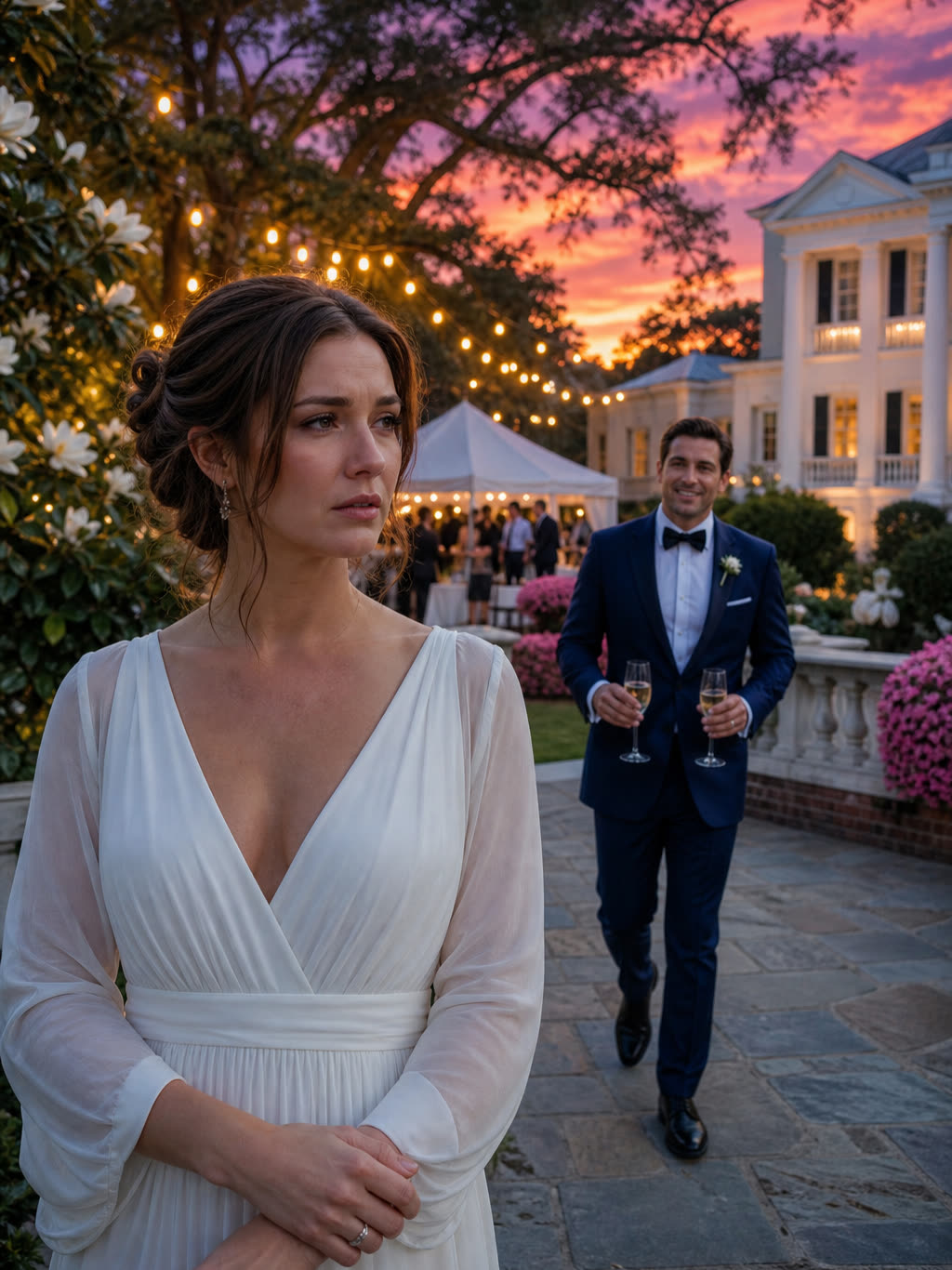
I waited thirty seconds before slipping back into the service corridor. The library was empty. Ten minutes later, Ryan found me in the garden, holding two glasses of champagne. String lights glowed in the oak trees behind him, and our families laughed under a white tent. Dad had died when I was twenty-six and Mom five years ago, so Linda had helped arrange nearly everything.
Willow Crest Estate stretched across forty acres of magnolias, stone terraces, and an old white mansion that seemed built for lavish wedding photos. On Saturday afternoon, I was supposed to walk down a flower-lined aisle toward Ryan.
He handed me a glass. "There you are." "Here I am." He kissed my forehead. "You okay?" "Just tired." "You’ve been doing too much." I almost laughed. Instead I asked, "Are you happy?" Ryan smiled. "Baby, look around."
I did. One hundred and forty guests. A twelve-piece reception band. Fourteen thousand dollars in flowers. A wedding fund that should have held thirty-one thousand dollars before the final vendor payments. And a man whose breath still smelled of bourbon from the conversation where he’d told his best friend I was too old to leave him. "Yes," I said quietly. "I’m looking."
That night, Ryan slept in his own suite on the estate. His mother had insisted on tradition, separate rooms before the wedding. For once, I was grateful for her meddling.
At 12:17 a.m., I sat on my bed and called Nora Ellis, my friend since I was twenty-four. After thirty-two years as a paralegal, she had retired and now attacked paperwork with the passion other women saved for crime documentaries. She picked up on the fourth ring. "If somebody isn’t dead, they better be getting divorced." "We’re not married yet." Silence. Then her voice changed. "Talk."
I repeated everything I’d heard, word for word, without crying. When I finished, Nora asked, "Is your name on Ryan’s house?" "He said we’d add it after the wedding." "Wedding accounts?" "We have one joint savings account." "Can you access it?" "Yes." "Have you checked it recently?"
I opened my laptop. "I’m checking now." The estate’s Wi-Fi crawled, and a loading circle spun for thirteen seconds. Then the account appeared, and I stopped breathing. "What?" Nora asked. "The balance." "What about it?" "It’s wrong."
Part 2: The Money Trail
After the deposits we’d already paid, our wedding account should have held a little over eighteen thousand dollars. Instead it showed $9,460. I opened the transaction history and found transfers I didn’t recognize. $1,250. $975. $1,500. $840. $1,300. Six transfers over five months, all sent to a single business account: Briar North Consulting LLC.
"Nora." "I’m here." "I found something." I began taking screenshots. Nora didn’t tell me to calm down; she knew me too well. Instead she said, "Document first. Feel later." So I did.
At 1:06 a.m., something else surfaced: a recurring lunch on the shared calendar Ryan had insisted we use for wedding planning. Every Thursday, 12:15 p.m., N.B. Fourteen weeks in a row. Natalie Brooks. My stomach knotted. But something didn’t fit. An affair explained Natalie. It didn’t explain the money, and the financial betrayal was starting to look far more serious.
At 1:30, Nora said, "Sleep." "I can’t." "You don’t need sleep. You need rest. Lie down anyway." "What are you going to do?" "Public records." "Nora—" "You called a retired paralegal after midnight two days before your wedding. What did you think was going to happen? Knitting?" Despite everything, a sound escaped me, half laugh, half sob. Her voice softened. "Claire?" "Yes?" "Do not marry him just because one hundred and forty people bought plane tickets." I looked at the white garment bag hanging in the closet, my wedding gown inside. "I won’t." It was my first decision that night, and the easiest.
At 7:12 the next morning, after maybe ninety minutes of sleep, Nora called. "I found Briar North." I sat up. "And?" "Registered five months ago. No website. No listed employees. No meaningful business activity I can find." "Who owns it?" "Technically, ownership records aren’t straightforward. But the registered agent is." My grip tightened. "Natalie." "Yes." The mailing address was a Raleigh condo complex where Natalie Brooks owned a unit.
"How much did Ryan transfer?" "From the screenshots you sent me, $6,865." I almost laughed at how ordinary it was. That was the strange thing about betrayal. You expected thunder. Sometimes all you got was $6,865. "I contributed more than half the money in that account." "I know." "What can I do?" "Financially? You have options. But today I’m more interested in keeping you from signing anything. You sent me the prenuptial agreement." I’d nearly forgotten it. Ryan’s attorney had sent a final version three days earlier, and Ryan had called it routine, protection for us both.
"There’s a clause relating to property acquired during the marriage through jointly funded entities," Nora said. "In English." "If you signed this agreement and Ryan later moved certain funds through a company that became marital property, sorting out who owned what could get very expensive." A chill ran through me. "You think Briar North is connected?" "I think you should assume nothing is accidental until you know otherwise." I got out of bed. For the first time, heartbreak wasn’t my strongest feeling. Anger was. Not the explosive kind. The productive kind.
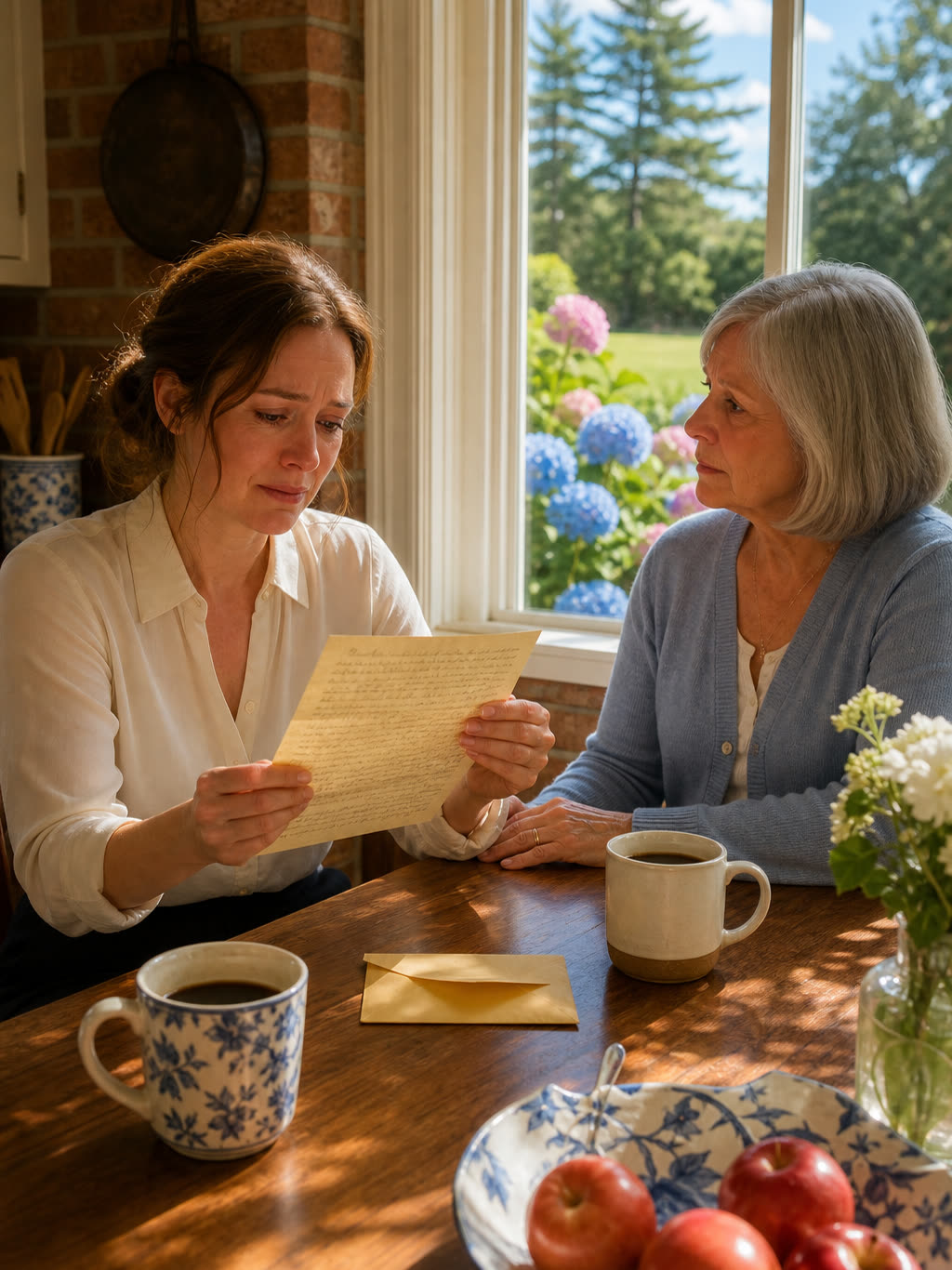
I showered, put on black slacks and a cream blouse, and drove twenty-five minutes to Aunt Linda’s brick ranch house with blue shutters and the hydrangeas Mom had helped plant. Linda opened the door before I knocked. "You look like your mother." "That bad?" "That determined." Over coffee, I told her everything: the conversation, Natalie, the transfers, the prenup. She listened in silence, then went to a drawer beside the refrigerator and came back holding a yellow envelope. "What is that?" "Something I should have given you a year ago."
She sat across from me. "Ryan came here before he proposed. He said he wanted my blessing. Then he started asking questions about your mother’s estate. How much she left you. Whether there was property. Investments. Life insurance. Whether you were likely to inherit anything else from your grandmother’s trust." The kitchen went still. "What did you tell him?" "That your mother’s estate had been modest and settled years earlier." "And then?" "He looked disappointed." A memory hit me so hard I could almost hear Ryan’s voice: eleven months ago, at a rooftop restaurant downtown, he had asked whether I wished Mom had invested differently, then laughed that he was just thinking like a financial planner. Two weeks later, he proposed. Sometimes one revelation doesn’t just add to what you know; it changes the meaning of everything before it. Ryan hadn’t come to see me as a desperate thirty-seven-year-old after four years. He had assessed me that way before he proposed: steady job, reliable income, possible inheritance, good reputation, no children, a woman eager enough to marry that she might not read the terms.
"What’s in the envelope?" I asked. "Your mother’s letter. She wrote it during her last year. Not specifically about Ryan. I think today is the day you should have it." My hands shook as I opened it. Two pages in Mom’s slightly right-leaning handwriting, mostly ordinary: my career, my stubbornness, her pride that I’d built a life without waiting for someone else to build it for me. Near the end of the second page, one sentence stopped me cold. Never confuse a man needing you with a man valuing you. I read it three times, then folded it.
Linda watched me. "You don’t have to destroy him." "I don’t want to." "Good." "I want the truth to stand in the room without me protecting him from it." She nodded slowly. "That sounds more like your mother."
At noon I returned to Willow Crest. Ryan stood on the terrace with Eric and two groomsmen, and he opened his arms when he saw me. "There’s my runaway bride." The joke sounded different now. I let him hug me. "You sleep okay?" "Eventually." He studied me. "You look different." "Do I?" "Serious." "I’m getting married tomorrow." That satisfied him. Ryan had always mistaken my seriousness for devotion.
Upstairs, his laptop sat open on the desk in his suite. He’d left it there while getting coffee, the screen still awake. An email preview glowed: from Natalie Brooks, subject: After Saturday. I didn’t touch the laptop. I photographed the screen. Then another notification appeared: Ryan, please tell me you’re actually going to do what you promised.
Footsteps sounded in the hall, and I stepped away. Ryan came in with his coffee, glanced at the laptop, then at me, and for the first time I saw fear cross his face before he hid it. "Were you using my computer?" "No." His shoulders relaxed too fast. "Okay." I smiled. "Why?" "No reason." And there it was, the twitch in his left eye. A lie about something that mattered.
That afternoon I called the bank, confirmed what records existed, changed my personal passwords, and redirected my paycheck away from any account Ryan could reach. I left the joint savings alone, for now. Nora emailed a folder of Briar North’s public filings, and the timeline was brutal. Ryan proposed October 18. Briar North was registered December 22. The first transfer from our wedding account went out January 4. Natalie’s weekly lunches began January 11. This wasn’t an affair that had gotten tangled up in money. It had been planned.
At 4:40 p.m., I called Natalie. "Hi, this is Natalie." "This is Claire Bennett." Silence, traffic in the background. Then: "Claire." Not who, not which Claire. She knew. "I’m not calling to scream at you." "I don’t know what Ryan told you." "That makes two of us. Did Ryan tell you where the money funding Briar North came from?" "What?" "Six thousand eight hundred sixty-five dollars transferred from our wedding savings." "That’s not possible." "You’re the registered agent." "Yes, but Ryan said those were his funds." "They weren’t."
Her breathing changed. "Claire, I swear to you—" "Did you know he was marrying me tomorrow?" "Yes." Even expecting it, that hurt. "But he said—" "Whatever comes after that sentence is probably something he designed for both of us." She went quiet, then said softly, "He said your marriage was practical. He said you knew. That you two had an arrangement. He said you wanted the social stability of marriage and he wanted the same thing. He said you hadn’t been romantic in years." For a moment I couldn’t speak. We had made love eight days earlier, and afterward Ryan had cupped my face and asked if I was nervous about becoming Mrs. Caldwell.
"I didn’t know," Natalie whispered. "You knew enough." "Yes." I respected the honesty. Then she added, "Briar North was supposed to become his independent advisory firm. He said after the wedding he’d have enough capital to leave Harrow & Lane." "After the wedding?" "Yes." "And you?" "He told me I’d run client relations." I sank onto the bed. Ryan wasn’t only marrying me for stability. He meant to bankroll a business with my money and build a future with Natalie inside it. My wedding was paying for my replacement.
She started crying. "I’m so sorry." Even I was surprised by my answer. "I believe you’re sorry." Remorse didn’t make her innocent, but it made her human. "What are you going to do?" I looked out the window, where workers were raising the arch where Ryan and I were meant to exchange vows. "I’m going to my wedding." "Claire—" "Goodbye, Natalie."
Part 3: The Vows I Changed
That evening Ryan found me in the bridal suite and shut the door. "You’ve been strange all day." "Wedding nerves." He laughed. "Finally. I was starting to think nothing rattled you." "You like me rattled?" "Sometimes." He stood behind me, hands on my shoulders, our reflections side by side in the mirror: him confident, me composed. "Tomorrow," he said, "everything changes." "Yes." He kissed my head and smiled at the mirror. "We make sense, Claire."
That hurt more than I expected. Not I love you. We make sense. Like a merger, a balance sheet, two matching columns. I laid my hand over his and, for one last moment, remembered the Ryan I thought I loved: lazy Sundays, road trips, his hand on my lower back, the night Mom died when he sat with me on the kitchen floor because I couldn’t stop shaking. Not all of it had been fake. That was the hardest part. Leaving someone plainly cruel is easier than leaving someone who was once truly tender and later used your love. Ryan had loved me in whatever narrow way he understood love. It just hadn’t stopped him from using me.
"You should get some sleep," I said. He grinned. "Big day tomorrow." "Yes," I said. "It is."
Saturday broke bright and cool. At 2:40 p.m., Aunt Linda fastened Mom’s pearl earrings. At 2:45, Nora zipped my gown. At 2:51, the photographer posed me by a window. "You look incredibly calm," she said. "I am." She laughed. "You’re the first bride I’ve ever heard say that." At 3:05, my bridesmaid Megan handed me my bouquet. At 3:12, the string quartet began. At 3:15, all one hundred and forty guests rose, and I walked down the aisle toward Ryan, waiting beneath the oaks in a black tuxedo.
People later asked how I managed to walk toward a man I already knew I wouldn’t marry. The answer was simple. I wasn’t walking toward Ryan. I was walking toward the last version of myself who believed leaving meant failure, and each step buried part of her: the woman sure thirty-seven was too late, the woman who saw compromise as the price of company, the woman who mistook being chosen for being cherished.
"You’re beautiful," Ryan whispered, taking my hands. The officiant spoke of partnership, trust, honesty. If the universe has a sense of humor, subtlety isn’t its strong suit. Ryan had insisted we write our own vows, and he went first. "Claire," he began, his voice already thick with rehearsed emotion, "from the day I met you, you have been the steady place in my life." Steady. I nearly laughed. "You make me better. You remind me what loyalty looks like. You have built a home with me, a future with me, and I promise never to take that for granted."
Behind him, Eric met my eyes and went pale. He knew. Maybe guilty people sense when consequences finally arrive. "You are my best decision," Ryan finished, and several guests were crying; his mother dabbed her eyes. The officiant turned to me. "Claire." I handed Megan my bouquet and faced Ryan. "I wrote vows too." His smile widened. "But I need to change them." A few guests chuckled. Ryan kept smiling. So did I.
"I was going to promise you patience," I said. "I was going to promise partnership. I was going to promise that no matter what happened, we would solve problems together." His expression shifted. "But two nights ago, standing outside the library at our rehearsal dinner, I heard you tell Eric that I was safe because I was thirty-seven and knew I had nowhere better to go." The silence was so sudden I could hear the leaves rustling above us.
Ryan let go of my hands. "Claire." "You said Natalie made you feel alive and I made you look stable." Someone gasped behind me. Ryan looked at Eric, who stared at the grass. "Claire, not here." "You chose the location when you chose the conversation." His jaw tightened. "Can we speak privately?" "For four years, I gave you privacy. You used it to build two lives."
His mother whispered his name. I turned toward the guests. "I apologize to everyone who traveled here expecting a wedding. There will still be dinner. There will still be music. The bar is paid for." Nervous murmurs rippled through the rows. "But there will not be a marriage." Ryan stepped closer. "You’re humiliating both of us." "No. I’m telling the truth about one of us."
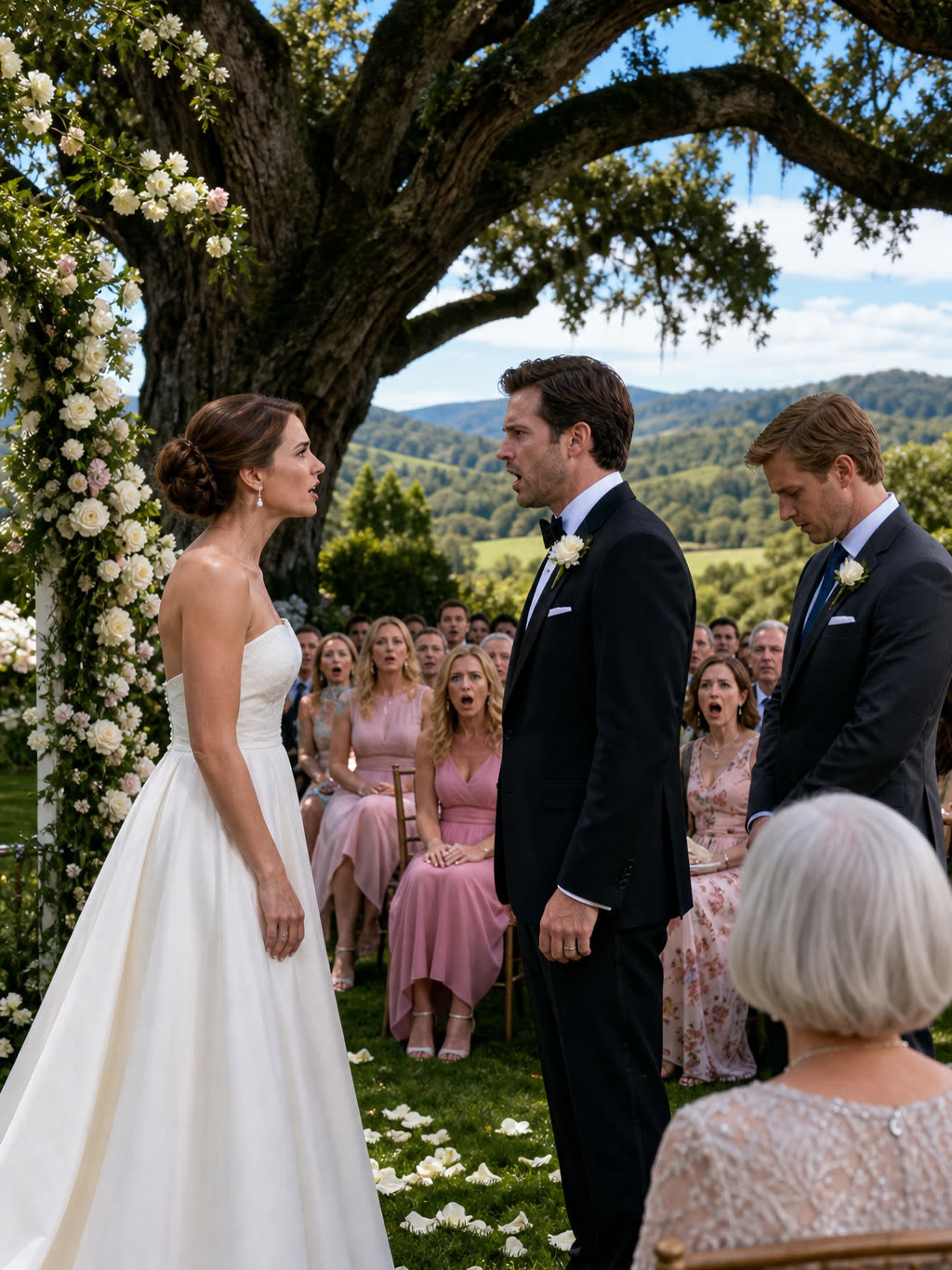
His face hardened, and for the first time I saw the man from the library without his mask. "You’re making a huge mistake." "Am I?" "You heard part of a private conversation and invented the rest." Nora and I had expected that. From the front row, she passed Aunt Linda a thin cream folder, and Linda rose and handed it to me. "What is that?" Ryan asked. "The rest."
I opened it. "Five months ago, Briar North Consulting LLC was registered using Natalie Brooks’s address. Beginning thirteen days later, money started leaving our wedding account and entering that business." His father stood. "Ryan?" Ryan ignored him. "Claire, those were investments." "Then why didn’t I know about them?" "You don’t understand the structure." "I understand the numbers. Six thousand eight hundred sixty-five dollars." Three rows back, Martin Shaw, Ryan’s senior colleague, changed expression, and Ryan saw it. Naturally, that mattered to him. So I went on. "The company receiving our money was supposed to become the private advisory business Ryan planned to launch after our wedding." "Stop." "And Natalie was going to run client relations."
"You called her?" "Yes." Now he looked scared. "You had no right." "My money bought me the right to ask where it went." He dropped his voice. "You’re emotional." For the first time that day, I smiled. "No, Ryan. That’s your problem. I’m not." I slid off my engagement ring and set it on the folder. Four years of my life, reduced to a diamond clicking softly against cardstock.
"I’m not too old to leave you," I said. No one moved. "I was simply old enough to believe staying was more important than asking whether I was respected. And for the record, you were right about one thing." "What?" "I did make you look stable. But that was because I was carrying the weight you kept hiding."
I turned and walked. Behind me Ryan shouted, "Claire!" I kept going as the guests parted. Aunt Linda met me at the end of the aisle, took the bouquet from Megan, put it back in my hands, and said, "Your mother would have loved that last line." I laughed, then fell apart, not gracefully, not like a film, crying until my ribs hurt while Nora held me and the wedding behind us dissolved into whispers.
The marriage never happened. The reception did, at Linda’s insistence. "Food is paid for," she said. "Band is paid for. Flowers are dying either way." I changed into a simple navy dress, the one Ryan had once said made me look younger, and this time wore it because I liked it. The first hour was awkward, the second better, and by the third people were dancing. Nora ate two slices of cake. Someone removed the bride-and-groom topper. At 8:30, I danced with Aunt Linda to an old soul song Mom had loved. Ryan had left an hour earlier with his parents.
At 9:15, Natalie walked in, terrified, holding a folder. "I know I shouldn’t be here." "Probably not." "But there’s something you need." Inside were printed emails, dates, plans, forecasts, and a draft business proposal projecting a $25,000 capital contribution after the wedding, its source labeled family liquidity. My family. My liquidity. "He told me you would sign off on this after the honeymoon." "I wouldn’t have." "I know that now. I ended everything with him this afternoon. I’m not asking you to forgive me. I just don’t want him telling you later that you imagined any of it." It was the first truly decent thing she’d done for me. "Thank you."
Three days later, Martin Shaw called, choosing every word carefully. "Did Mr. Caldwell ever advise you to move personal assets into any investment vehicles connected to him?" "No." "Did he ever represent Briar North Consulting as an approved outside business activity?" "I didn’t know it existed." Two weeks later, Ryan’s partnership review was suspended; a month after that, he resigned. I never learned whether he jumped or was pushed, and eventually I stopped caring. After Nora’s formal demand, Ryan repaid the full $6,865 within seventeen days. No apology, just a transfer. Eric texted: I’m sorry I laughed. I read it once and deleted it. Some apologies come from regret. Others are just debts paid once consequences show up.
Six weeks later, I leased a small Charlotte apartment in my name alone: three windows, hardwood floors, terrible cabinets, and I loved every inch. I applied for a senior regional operations director role, the kind of move I’d once feared because it might cost me Ryan. When the COO asked why I wanted it, I said, "Because I spent several years making decisions around a future that belonged to someone else. I’m ready to build one that belongs to me." She smiled. "I respect that answer." I got the job.
Fourteen months later, on a rainy Sunday, I found a plain stainless-steel serving spoon at the bottom of a box I hadn’t opened since leaving Ryan’s house. Holding it on my floor, I remembered standing in his kitchen, serving people who barely noticed how much of myself I was handing over, and the thirty-seven-year-old I’d been, terrified of starting over, convinced love had an expiration date. I wished I could tell her that four years can be wasted without sacrificing a fifth, that loneliness hurts but staying with someone who shrinks you hurts more, and that no age makes disrespect a fair price for company.
I put the spoon in a drawer, brewed strong coffee, and cracked two eggs into the cast-iron skillet I’d bought with my first post-promotion paycheck. My phone buzzed: Aunt Linda, right on schedule. "What are you doing?" she asked. "Making breakfast." "For one?" I smiled. "For me." A pause. "That sounds like enough."
I looked around at the painting I’d bought just because I loved it, the books no one criticized, my running shoes by the door, the keys on a lease with only my signature. Enough used to scare me; I thought it meant settling. Now I knew it meant no longer begging someone else to confirm I already had value. "I think it is," I said. Ryan believed thirty-seven meant my options were running out. He was wrong. Thirty-seven was the year I started choosing for myself, and the wedding I walked away from became the first day my life belonged entirely to me.
