

Part 1: The Thermos
“Stop going through my stuff!” Mason shouted, slamming the bathroom door shut. “I’m running late and I don’t need an interrogation every time I have a business trip!”
I stood motionless beside the bed. In seven years of marriage, my husband had hardly ever traveled for work. Yet over the past six months, “out-of-town meetings,” “client visits,” and “urgent deals” had been cropping up every two weeks.
“I just asked how long you’d be gone,” I replied, trying to keep my voice steady.
“Three days. Maybe four. The real estate market is tough right now, and someone has to bring home the money.”
That remark hurt. For years I had worked as a senior accountant for a major construction firm here in Phoenix, Arizona. I earned an excellent salary, paid the mortgage, covered the utilities, bought the groceries, and had never once asked him for a cent. Still, lately Mason talked as though our entire life rested on his shoulders alone.
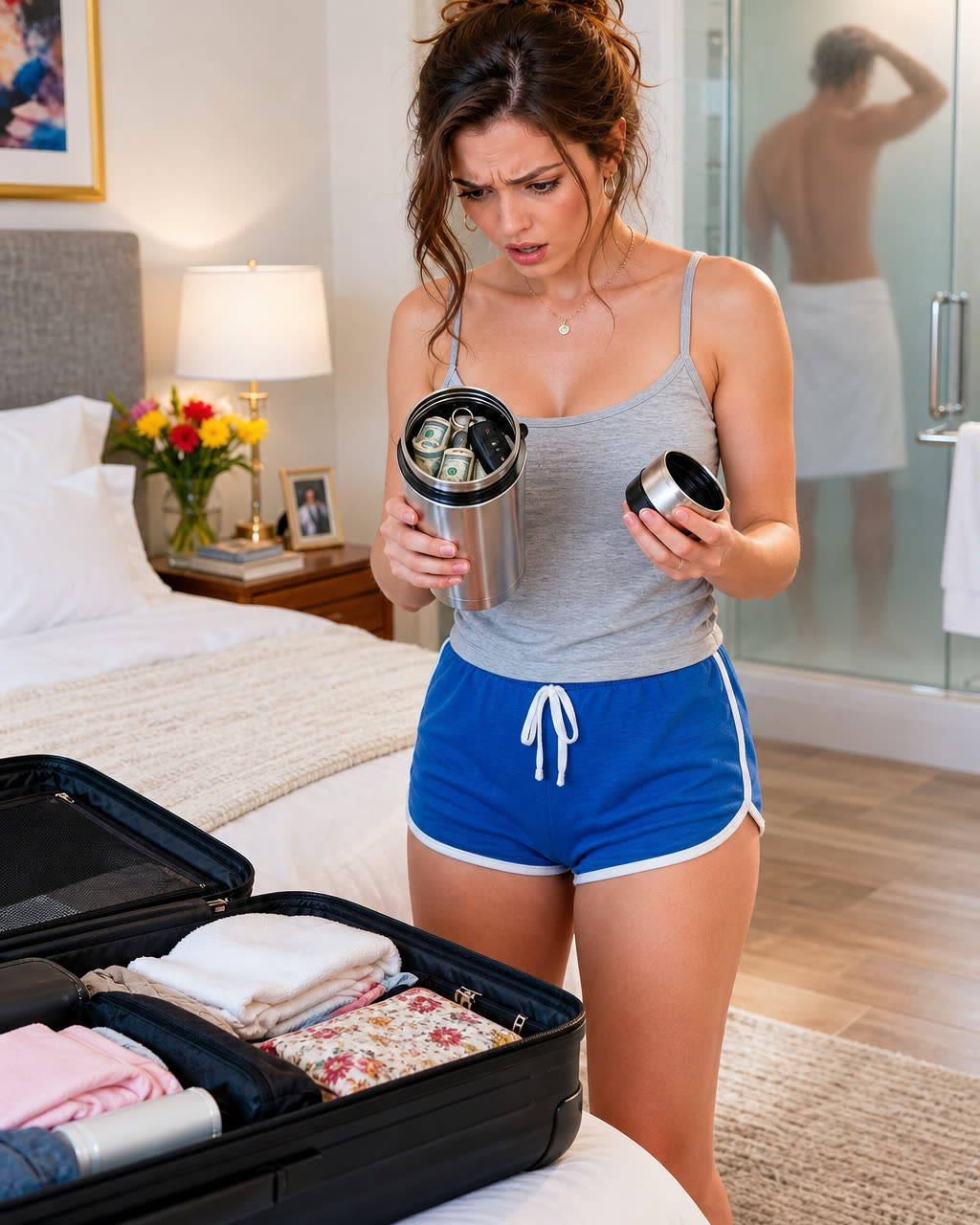
While he showered, I decided to tuck a couple of stray shirt cuffs back into his duffel bag. That was when I noticed a heavy stainless steel thermos lying at the bottom. I frowned. Mason refused to drink reheated or stored coffee—he was an espresso snob who constantly mocked anyone carrying an insulated tumbler.
I lifted it. It was far too light to hold any liquid. I unscrewed the cap, peered inside, and felt my heart begin pounding against my ribs. Tucked within was a tightly wrapped bundle sealed in black plastic.
I glanced toward the bathroom door; the water was still running. With shaking hands, I drew the bundle out. Inside were several stacks of hundred-dollar bills, a set of keys I had never seen before, and a sleek flash drive.
I’ve always been a cautious, practical person, but for months my gut had been telling me something was wrong.
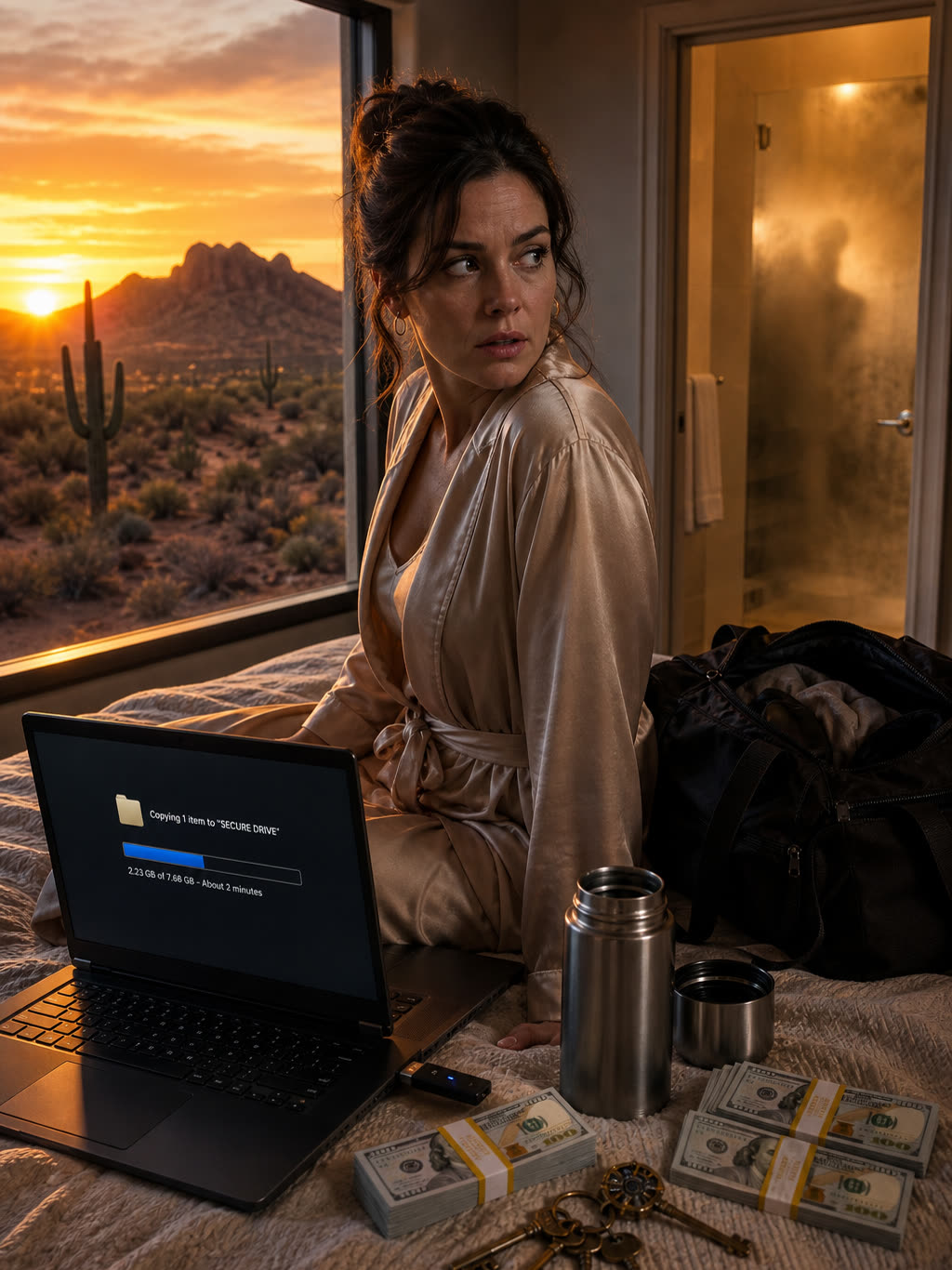
Without a moment’s hesitation, I plugged the flash drive into my laptop and started copying the files. Every second stretched like an hour. The instant I heard the shower stop, I put everything back into the thermos exactly as I had found it and zipped the duffel closed.
Mason stepped out of the bathroom in a far better mood. “What are you doing?” he asked, eyeing me.
“Just making sure you packed clean shirts.”
He studied me for a moment, then smirked. “Tuck the navy blue tie in there too.”
An hour later, I watched his truck pull out of our driveway. The second he turned the corner, I opened the copied files on my computer.
The first folder held bank statements, wire transfers, and complicated spreadsheets. As an accountant, I needed less than ten minutes to make sense of the figures. Someone had been systematically embezzling from the real estate development firm where Mason worked, channeling the money through a string of shell companies. And the final beneficiary was Mason. The transactions totaled millions of dollars.
But that wasn’t even the worst part. Another folder contained notarized property documents tied to our home—the house in Central Phoenix my late grandmother had left me as an inheritance before she passed away. I opened one scanned deed, then another, and an icy wave of shock swept over me. According to the paperwork, I had supposedly granted power of attorney to transfer the title to Mason. My signature was on the final page. It was forged.
The house where I had cared for my grandmother in her final days—the only property I truly owned—was now listed as collateral for a high-risk commercial loan I had never applied for. I logged into my online banking, checked auto-debits I had overlooked for months, and confirmed that loan payments were being drawn straight from an account linked to the property.
I pressed both hands over my mouth, tears of sheer disbelief stinging my eyes. My husband was gambling with my inheritance behind my back.
I kept digging. There were text threads with shady contacts discussing “fixing signatures,” “altering county records,” and “keeping the notary quiet.” Then I opened a folder labeled simply “N”.
Inside were hundreds of photos. Mason holding a young woman. Mason kissing her. Mason with her at luxury resorts in Sedona, upscale restaurants in Scottsdale, and beachfront hotels in Cabo. I recognized her immediately: Chloe, the young executive assistant to the owner of Mason’s firm. The timestamps proved the affair had been going on for nearly three years.
Three years. While I clipped coupons and guarded our household budget, Chloe was posing with designer handbags Mason bought her. While I postponed cosmetic dental work because “we needed to save,” Mason was booking five-star spa resorts. While I cried in private over our struggle to conceive and begged him to consider fertility treatments, Mason told me he “didn’t want to waste money on doctors.”
I closed the laptop. I didn’t scream. I didn’t smash anything. Instead, I called someone I hadn’t spoken to in years—Justin, a former college classmate who was now a senior cybersecurity specialist and digital forensics expert. He went completely quiet as he reviewed the encrypted files I sent over a secure server. An hour later, he called me back.
“Nora… this isn’t just a garden-variety affair. Your husband is knee-deep in serious corporate fraud and forgery.”
“Can I save my house?” I asked, my voice barely a whisper.
“If the signature on that deed is forged, you have a solid legal case. But you’re going to need forensic handwriting experts, a rock-solid attorney, and formal evidence.”
I took a long, steadying breath. “I also need to know where Mason actually is right now.”
Justin remembered that years earlier he had helped us set up a family location-sharing app on our phones for safety. Mason had completely forgotten it was still running in the background. He wasn’t on any interstate heading out of state. His phone was pinging from a luxury high-rise condo building in downtown Phoenix—less than ten miles from our front door.
I parked across the street and waited nearly three hours. When Mason finally walked out through the glass doors, something vital inside me withered and died. Chloe was clinging to his arm, her head resting on his shoulder.
“So what’s the plan?” Mason was laughing, pulling her closer. “Should we head to the resort in Paradise Valley, or drive up to Flagstaff?”
“I wanted the beach,” Chloe pouted playfully. “You promised me San Diego!”
“Next week, babe. This ‘business trip’ is only supposed to last three days.”
They both burst out laughing. Alone in my car, I realized that every late night at the office, every urgent client meeting, and every financial worry he had ever dumped on me had been a carefully rehearsed lie.
I didn’t confront them. I drove home and packed two large suitcases with my clothes, personal documents, computer, and a few treasured mementos from my grandmother. A close friend let me stay in her spare room near the Maricopa County Medical Center. I needed time—and above all, I needed Mason not to realize how much I knew before my legal strategy was in place.
Three days later, Mason came home with a fresh tan and a polished story about difficult buyers and back-to-back presentations. He walked into a spotless, silent house. “Nora?” he called out. No answer. My clothes were gone from the closet. My papers were missing from the safe. He called my cell twenty times. It went straight to voicemail.
Panicked, he called Chloe. “My wife is gone!”
“Well, congratulations!” she answered nonchalantly. “Now we don’t have to hide anymore.”
Mason tried to laugh, but a cold knot tightened in his stomach. I was never impulsive. If I had walked out without leaving a note, it meant I knew something.
Part 2: The Stranger on the Sidewalk
An hour later, Mason received an urgent call from his boss, Robert Vance, the firm’s founder. “Get into my office. Right now.” Mason showed up defensive. Robert was a gentle, soft-spoken man in his late fifties whom Mason had always considered too trusting to see through his games. So he was stunned to find Robert behind his mahogany desk with a thick leather binder in front of him.
“Sit down, Mason.” “What’s going on, Robert?” Robert pushed the binder across the desk. “Explain to me why over eight hundred thousand dollars is missing from our escrow accounts.”
Mason turned white as a sheet. “That… that has to be an accounting error.” “I hired an independent forensic audit firm five weeks ago,” Robert said flatly.
Mason’s mouth went bone dry. “Dozens of people have access to those systems!” “And curiously, every dollar traces back to shell companies linked directly to your personal accounts.”
Mason rose to leave. Robert slammed his palm on the desk. “You have twenty-four hours to account for what you can before I hand this entire file over to the state prosecutor and the FBI.” “I need more time!” “You’ve had three years.”
Mason staggered out, drenched in sweat, and called Chloe at once. “We have a massive problem. I need you to grab the cash from the condo safe and prepare the account offshore.” “I’m at brunch with my friends right now, Mason.” “Chloe, the firm caught on! They audited the escrow!” She hung up on him.
The next morning, he hurried to Chloe’s apartment and let himself in with the spare key she had given him. It was stripped bare. Her clothes, suitcases, and luxury bags were all gone. On the kitchen counter lay a single sheet of paper: “Figure it out yourself. Don’t look for me. If you try to drag me down with you, I will hand over every message, record, and transfer log I have.”
Frantic, Mason opened the hidden wall safe where he kept his emergency cash. Empty. Then he remembered the thermos and the flash drive. For months he had kept backups of his fraudulent transfers and forged documents as leverage against his co-conspirators. But before his last trip, he had accidentally left the thermos at Chloe’s overnight. She had seen everything. His mistress had abandoned him, taking the cash and holding enough evidence to ruin him forever.
Meanwhile, I faced a crisis of my own. My firm used the days I had taken off during the initial shock to fire me, citing unexcused absences. Within days I had lost my husband, my job, and my sense of security about my grandmother’s home, and my savings were draining fast.
One afternoon, walking back to my rented room after a discouraging job interview, I watched an elderly man collapse on the sidewalk right in front of me. People kept walking past him. I rushed to his side. “Sir! Can you hear me?” “My chest…” he gasped, clutching his coat. I dialed 911 immediately.

He pressed a simple cell phone into my hand. “My son… Caleb… tell him…” Then he lost consciousness.
I rode with him in the ambulance to the emergency room at Banner Health, where the ER doctor confirmed a severe myocardial infarction. I scrolled through his phone, found “Caleb,” and called. Twenty minutes later, a man in surgical scrubs rushed down the hallway.
“I’m Dr. Caleb Mercer. Did you help my father?” “I just did what anyone should have done,” I said.
Caleb looked at me, his eyes full of emotion. “No. Most people walked right past him.”
His father’s name was Arthur, and thanks to the quick response, the medical team had stabilized him in time. But Caleb had his own crisis. He was a widower raising a five-year-old daughter, Lily, who had severe hearing loss. The temporary nanny was waiting at his house, but Caleb was stuck at the hospital on an unalterable surgical call.
“I can watch her for you tonight,” I heard myself say. Caleb blinked in surprise. “Are you sure?” I didn’t even know why I’d offered. Maybe I couldn’t stand watching someone else drown in helplessness. Maybe I desperately needed to feel useful again.
At his house, the nanny was pacing the entryway, furious, while Lily hid behind a hallway chair, crying softly. “I’m done!” the nanny snapped. “She refuses to listen or follow instructions. You need to put her in a special institution!”
Caleb paid her and sent her away on the spot, but then his phone buzzed—an emergency trauma surgery needed him back immediately. I was left alone with Lily. I didn’t know American Sign Language (ASL), and she refused to wear her hearing aids. For a few awkward minutes, we sat on the rug staring at each other.
Then Lily pulled out a drawing pad and crayons. She drew a potato, then a piece of meat. I smiled. “Are you hungry for mashed potatoes and a burger?” Lily beamed and nodded eagerly.
That night we talked through drawings, gestures, and laughter. Before bed, Lily drew two figures under a blanket in the same bed, and I understood she was afraid of being alone in the dark. I lay beside her, holding her hand until she drifted off.
Caleb came home at dawn, worn out from surgery, to find his daughter asleep with her arm around a total stranger. Lily woke, saw I was still there, and let out a bright, joyful laugh—a sound Caleb later told me he hadn’t heard in the two years since his wife died. For the first time since Mason’s betrayal, the future didn’t feel entirely terrifying.
“Work for us,” Caleb proposed that morning over coffee. “At least for a while.” I stared at him. “As a nanny?”
“Yes. I know you don’t have formal child-care credentials, but Lily connected with you overnight. We’ve gone through nine nannies in two years, and none of them made her feel safe.”
“I don’t even know ASL,” I pointed out. “You can learn. I’m still learning too.”
I watched Lily munching toast while drawing superhero capes on a napkin, and something tugged at a deep, aching place in my heart. For years I had dreamed of being a mother, and Mason had always shut the subject down, calling fertility treatments, adoption, or specialists “wasn’t worth the emotional or financial hassle.” Now I knew he simply had another life planned. “Let’s try it for a few weeks,” I agreed. Caleb offered a salary comparable to my old one and a private guest room. It was a lifeline—and the first respect I’d felt in months.
The following weeks changed everything. I studied ASL every day, and Lily loved playing teacher, giggling whenever I signed wrong before gently guiding my hands into place. I discovered her passion for art. “I took fine arts classes in college,” I told Caleb one evening. “We can really build on this.” We filled her room with watercolors, clay, and canvasses, and Lily blossomed. Working with her speech therapists, she grew comfortable wearing her hearing aids and making sounds at her own pace.
Arthur was discharged two weeks later. “So you’re the young woman who kept me from taking my final breath on a concrete sidewalk,” he said, hugging me warmly. “Please, don’t exaggerate, Arthur.” “I’m not exaggerating. Caleb told me everything.” He treated me like family almost instantly. Many evenings the four of us ate dinner together in the kitchen. It felt remarkably like a real family—and that terrified me.
Meanwhile, Mason’s world was crumbling. Robert filed criminal embezzlement charges, the firm fired Mason, the court froze his accounts, and his former associates began cooperating with police to save themselves. The fraudulent loan on my home defaulted, and the bank started foreclosure proceedings.
That’s when my late grandmother’s former neighbor spotted me near the medical center. “Nora, dear! What on earth is happening with your house? Process servers and investigators have been coming by, taking photos and asking about Mason!” My stomach dropped.
She handed me a business card. “A financial crimes investigator from the prosecutor’s office came by looking for you, too.” I held that card for hours, unaware that Mason was already busy crafting a story to frame me as his accomplice—and federal investigators were reviewing every word.
Part 3: The Truth Comes Out
That night, Caleb found me sitting alone in the dark kitchen. “What’s wrong, Nora?”
“I’m terrified of going to the prosecutor,” I confessed. “I should have reported the forgery the day I found it. I panicked and ran away. Now Mason can say whatever he wants to frame me.”
Caleb sat across from me, his gaze steady. “Hiding isn’t going to undo what he did. It only gives him power.” “What if he successfully blames me?” “Then you lay out every piece of evidence you have.”
I thought about the copied flash drive. The next morning, I made the call and met the lead fraud investigator at the county courthouse. His first question hit hard: “Why didn’t you respond to our initial notices, Mrs. Hayes?”
I told him everything—the affair, the forged deed, the hidden thermos, and my frightened departure—then handed over a hard drive with a full copy of Mason’s encrypted files. He scrolled through the logs. “Your husband claims you were fully aware of the firm’s offshore transfers. He claims that as an accountant, you engineered the tax evasion scheme.”
My throat went dry, but I held my voice steady. “He is lying. Perform a full forensic audit on my personal bank accounts, my tax records, my emails, my work computer—everything. I never received or touched a single dollar of that stolen money.”
He nodded slowly. “We will. And we will also conduct a forensic handwriting analysis on the property power of attorney.” I formally filed forgery charges against Mason. Two weeks later, my attorney called: the analysis confirmed my signature was forged, the notary confessed to taking Mason’s bribe, and the bank voided the loan claim on my house and joined the state prosecution.
“So… can I clear the title to my house?” I asked, weeping silently. “Yes,” my lawyer confirmed. “The fraudulent lien is being stripped. The house is legally and entirely yours.” I cried with profound relief—not over the money, but for my grandmother, who had worked her whole life to give me a safe place that Mason had tried to steal.
Seeing me cooperate with prosecutors, Mason agreed to a fast-track divorce to dodge more civil liability. Then came the blow he never anticipated: federal agents found Chloe. To avoid prison, she surrendered every text, voice note, transfer, and secret recording from three years—proof that Mason had acted alone and kept his wife completely in the dark. Yet he made one last desperate move.
One afternoon, as I left a grocery store near Caleb’s house, Mason stepped out from behind a parked SUV. “Nora. We need to talk.”
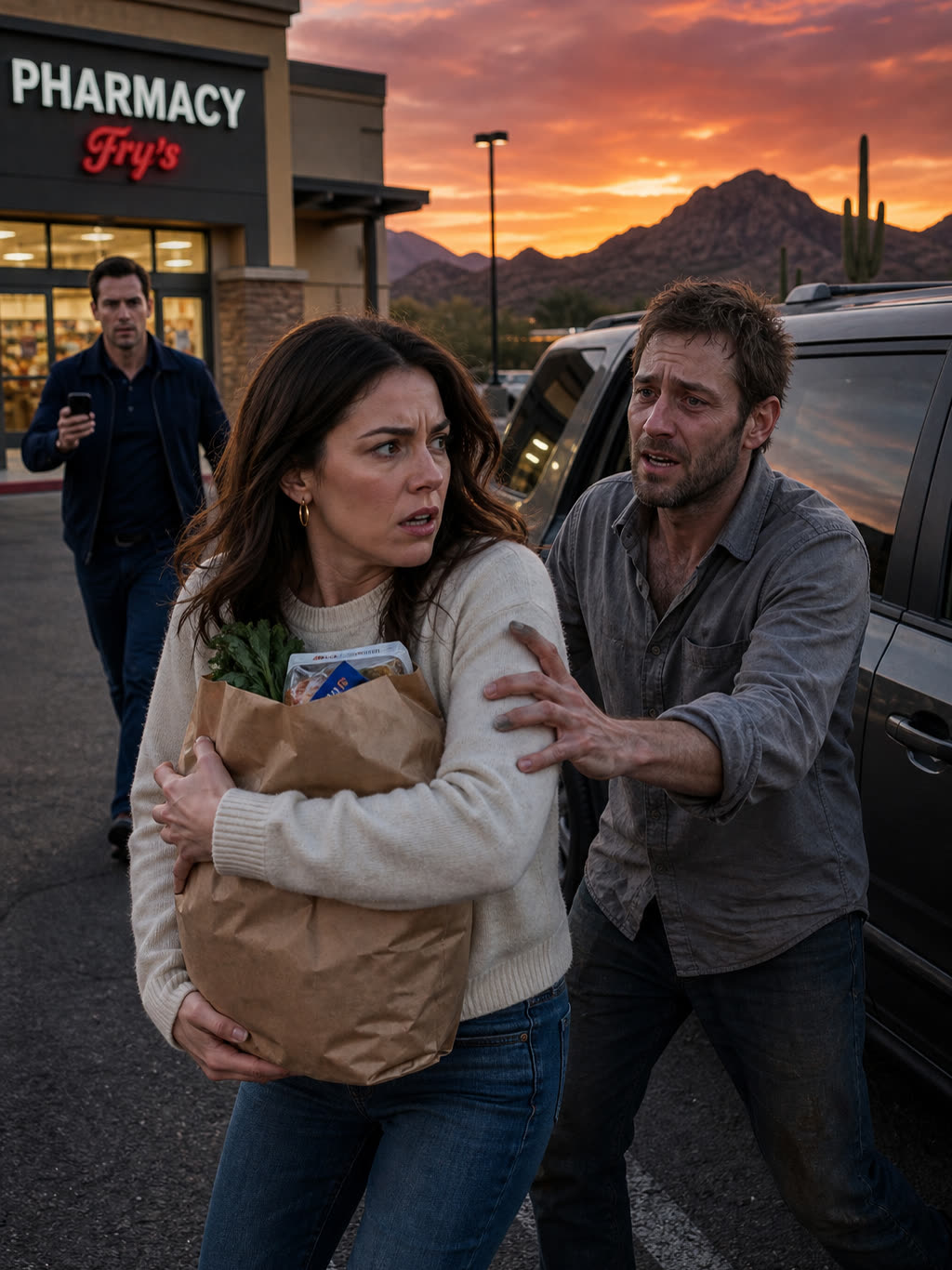
I backed away instantly. “Stay away from me, Mason.” “Please! We were married for seven years!” “Which is why you should know I have nothing to say to you.”
He came closer, looking gaunt and frantic. “I made mistakes!” I gave a bitter, cold laugh. “You call forging my signature and stealing millions a ‘mistake’?” “Chloe manipulated me! I was confused!” “Were you confused when you bought her luxury purses while telling me we were too poor for fertility treatments?”
His voice sank into pathetic pleading. “Drop the forgery charges, Nora. If you drop the claim on the house, I can settle part of the restitution.” I stared at him, disgusted. “That’s why you came here.” “If you help me, we can work out a private agreement! I can come back to you!” “I would rather spend the rest of my life alone than spend another second near you.”
His face twisted with rage. “Don’t play the innocent victim with me! If you don’t drop the charges, I will drag your name through every mud pit in court! I’ll make sure everyone thinks you were in on it!”
My blood ran cold, but before I could answer, a tall figure stepped up beside me. Caleb had walked over from the pharmacy across the lot. “She told you to stay away from her,” he said, his voice quiet, calm, and dangerous.
Mason sneered. “Who the hell are you? Her new boyfriend?” “I’m the person calling the police right now to report a violation of a civil protection order,” Caleb replied, holding up his phone, which was recording. Shoppers were watching. “This isn’t over!” Mason snarled, retreating to his battered sedan.
My hands shook uncontrollably until Caleb gently drew me close and the trembling stopped. That night, Lily sat beside me on the couch and quietly signed: You safe now. I love you. I hugged her tightly, tears spilling down my cheeks.
Facing overwhelming digital evidence, forensic signature analysis, and testimony from Chloe and Robert Vance, Mason pled guilty to grand larceny, wire fraud, and felony forgery. He was sentenced to seven years in federal prison and ordered to pay full restitution. My house was cleared of every fraudulent lien. Too painful to live in, I rented it out and placed the income in a trust for Lily’s education and medical care.
After the trial, Robert invited me to lunch. “Nora, I know how hard this year has been for you. My firm needs a chief financial auditor—someone with absolute integrity who knows how to spot fraud before it happens. I want to offer you the position.” “Robert, I was fired from my last job.” “You were let go during a personal crisis after seven years of flawless performance. I checked your professional references myself. You are one of the most brilliant forensic accountants in this city.”
I accepted. Within months, I rebuilt the firm’s financial controls, closed its weaknesses, and restored its stability. My professional pride returned. Yet every evening I came home to Caleb’s house—Lily signing happily at the door, Arthur with fresh tea, Caleb smiling up from his medical journals.
One evening on the back porch, as Lily drew chalk murals on the patio, I turned to Caleb. “I think it’s time I stop taking a salary as Lily’s nanny.” He set his mug down, his face falling. “I understand. You have your high-powered career back now. It makes sense that you’d want your own place…”
I laughed softly through tears. “Caleb, you’re a brilliant trauma surgeon, but you can be remarkably slow when it comes to personal matters.” “What do you mean?” “I don’t want a salary because I don’t work here anymore.” “Nora…” “This is my home,” I whispered. “Lily is part of my heart. Arthur is family. And you…” He took my hands. “And me?” “I love you, Caleb.”
He pulled me into a fierce, tender kiss. Lily dropped her chalk, ran over, and wrapped her arms around our legs. Eyes sparkling, she used her voice and hands together to say the word she had practiced for months: “Ma… ma.” I sank to my knees, pulling them both into my arms, weeping with pure happiness.
I once believed losing Mason meant my life was over. Instead, his betrayal forced me to tear down a lie and build something far greater: a life rooted in truth, integrity, and a love that never asks you to surrender who you are.
