

Part 1: Twelve Years of Empty Lunchboxes
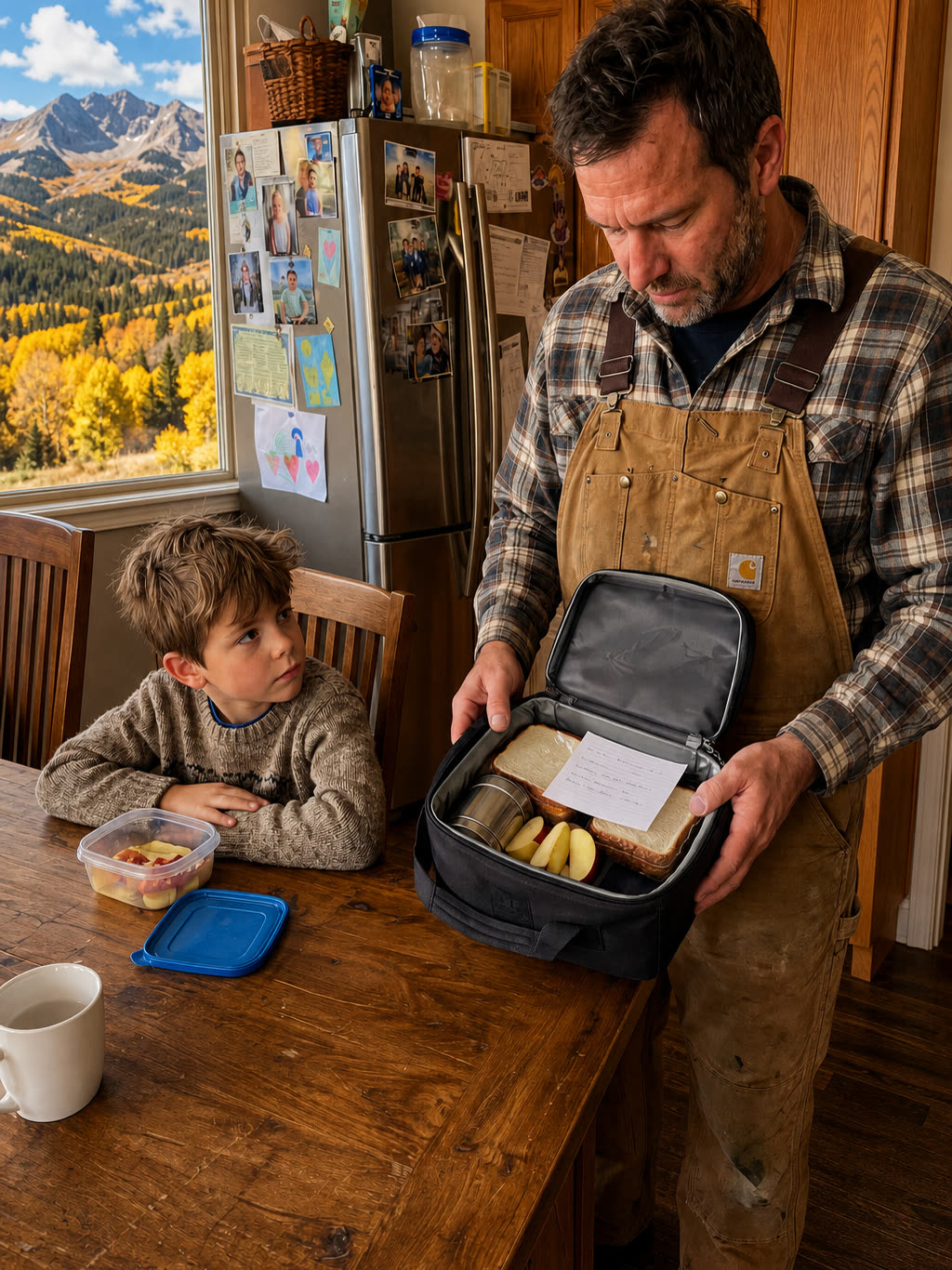
For twelve years, I packed the same lunch for my husband every single morning: two sandwiches, sliced apples, a thermos of black coffee, and a handwritten note folded beneath his napkin. The apples were there because Edward had once mentioned that his mother tucked them into his lunches when he was a boy. The notes had started during our first week of marriage, when I looked at his plain brown lunch bag and decided it needed something more, something that would remind him I had been thinking about him before he was even awake. It was such a small ritual, and I never imagined it could one day carry so much weight.
“Have a good day. Love you.” I can no longer say for certain that those were the exact words on the first card, but I do remember that Edward told me that evening he had read the note twice. He said it almost shyly, as if admitting to something he feared might embarrass him. So the next morning I wrote another, and the morning after that, another, and before long I had stopped deciding whether to write one at all. The card was simply part of the lunch, as ordinary and necessary as the bread.
Over time, those little cards stopped being a gesture and became part of the structure of our marriage. Some mornings I wrote a joke, other mornings a reminder, and on the harder mornings only a few tired words scribbled before the coffee had finished brewing. When our son Jamie grew old enough to write, he began contributing his own messages, pressing his pencil so firmly into the cards that the letters nearly tore through the paper. “BE SAFE DAD.” “BRING PIZZA HOME.” “I LOVE YOU DAD. FROM JAMIE.” I kept a stack of blank index cards in the kitchen drawer, and that stack never seemed to run out, because there was always something left to say to the man I loved.
Every evening, Edward came home from his construction job and set his lunchbox on the counter, and every evening it was empty. I never questioned it, because there seemed to be nothing to question. A man who worked with his hands all day was supposed to be hungry, and a man who came home with an empty lunchbox was a man who had been fed. In my mind, fed meant cared for. I would take the box, rinse the thermos, and begin planning the next morning without a second thought, never suspecting that the emptiness I found so reassuring might be hiding something enormous.
Then one Tuesday morning, ten-year-old Jamie wandered into the kitchen while I was spreading mustard across Edward’s sandwiches. He was still in his pajamas, one side of his hair standing straight up, and he watched me for a long moment before he spoke. “Mom, maybe don’t make Dad lunch today.” I laughed, assuming it was one of those odd little comments children make before breakfast, the kind that vanish by the time the cereal bowls are empty. “Why?”
Jamie frowned, as though the answer should have been obvious to any reasonable adult. “Because he throws it away by the corner anyway.” My knife stopped against the cutting board, and suddenly I could hear the hum of the refrigerator, the tick of the clock above the stove, and nothing else at all. “What?” Jamie looked at me with perfect patience, the way he did when explaining something I should have already known. “Our school bus stopped there yesterday. I saw Dad leave your food next to the trash.”
Before I could make sense of that, Jamie added something even stranger. “And he changed into his wedding suit and got into a lady’s car.” I stared at him, waiting for the punchline that never arrived. His expression was completely serious, the same expression he wore when reporting facts that he had no idea could shatter anything. My mouth had gone dry, and for a moment I could only grip the edge of the counter. “Jamie, go get dressed for school.” He shrugged and trudged upstairs, leaving me alone with a half-finished sandwich and twelve years of suddenly questionable memories.
I told myself there had to be an explanation. Children misunderstand things constantly: a bus window, a quick glimpse, a man who only looked like his father from a distance. Still, my hands trembled as I finished Edward’s lunch exactly as I always did. I wrapped the sandwiches, sliced the apples, filled the thermos, and wrote a note that I can barely remember now. At 6:50, he came downstairs, kissed my forehead, picked up the bag, and told me he would be home around six. I watched him walk out the door and felt, for the first time in our marriage, that I was watching someone I did not entirely know.
I barely slept that night, and the following morning I made a decision I never imagined I would make. I waited until his truck had disappeared down the street, grabbed my keys, and followed him from a careful distance, feeling ridiculous and frightened in equal measure. Edward drove toward the construction site where I believed he worked, and for the first few blocks I almost convinced myself that I was being foolish. Then he turned onto a quiet residential street and stopped beside a corner trash can. I pulled over about a hundred yards away and sat gripping the steering wheel, my heartbeat so loud that I could hear it over the engine.
Jamie had been right, but Edward did not throw the lunch away. He carried my bag toward the trash can and set it down beside it with surprising care, then opened it and removed my handwritten note. He read the card once, paused, then returned to the beginning and read it again before folding it carefully and slipping it into his pocket. Then he retrieved a duffel bag from his truck, pulled off his construction overalls right there on the sidewalk, and changed into the dark navy suit he had worn on our wedding day twelve years earlier.
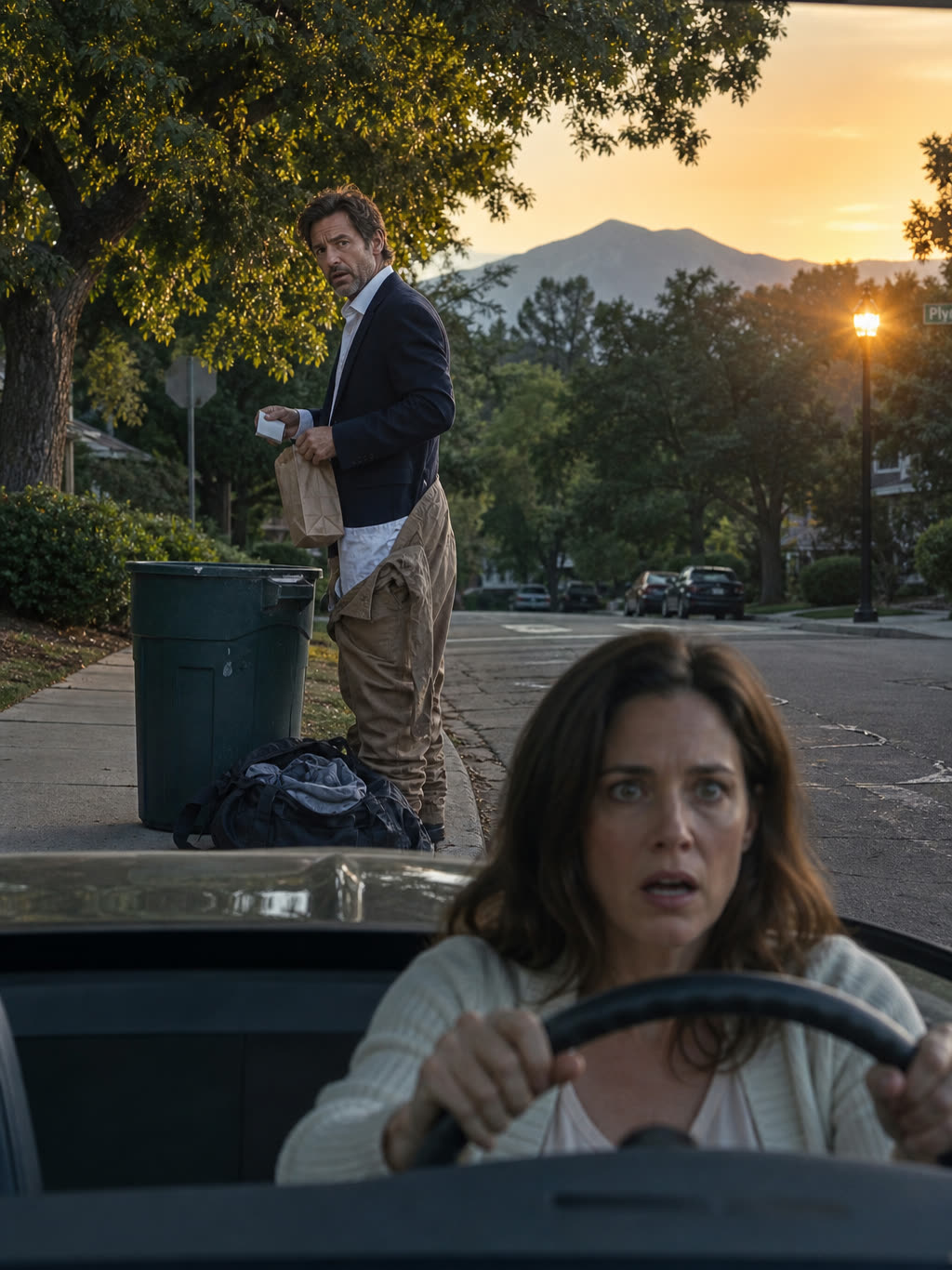
I sat frozen behind the wheel, unable to decide which part of the scene hurt more: the abandoned lunch or the tenderness with which he had treated my note. If he had tossed everything into the garbage, I might have understood anger, or carelessness, or even cruelty. Instead, he had performed this strange ritual as though he were handling something precious, and that made it impossible to dismiss. A man does not read a grocery list twice. A man does not fold a note so gently unless it matters to him, and yet he had left the food I had made with my own hands beside a trash can, like something he was ashamed to carry any farther.
Twenty minutes later, a silver car arrived. A dark-haired woman in professional clothes stepped out and walked directly toward my husband, and after they hugged, Edward climbed into her passenger seat. I could not breathe. Every ugly assumption I had been refusing to make rushed into my mind at once, crowding out everything else. The suit, the secrecy, the woman, the hug: they fit together so neatly that I felt almost sick with how obvious it all seemed. I started my car with shaking hands, telling myself that I only needed to see where they went.
I followed them across town, staying several cars behind, past neighborhoods I rarely visited and streets I could not have named. At last they pulled into the parking area of a modern glass-and-steel building whose windows flashed in the morning light. It looked nothing like a construction site and nothing like the hotel I had been bracing myself to see. I parked, stepped out, and walked toward the entrance without any plan at all, only a burning need to understand what my husband had been doing with the other half of his life.
As I approached the doors, I heard the woman speaking, her voice sharp and clear in the quiet morning air. “Twelve years, Edward. Your wife still thinks you’re a construction worker?” I stopped cold, my feet suddenly rooted to the pavement. Edward lowered his voice, but I was close enough to catch every word. “You’re right. I can’t keep hiding who I really am.”
Then he said the words that made my heart pound against my ribs. “I’ll tell her tonight.” Twelve years of mornings rushed through my mind, every sandwich, every note, every kiss on my forehead. I do not remember deciding to move, only that I was suddenly stepping forward with my hands shaking at my sides. “What exactly are you going to tell me?”
Part 2: The Man Behind the Suit
Edward spun around so quickly that the color seemed to drain from his face all at once. The woman beside him immediately stepped back, clearly realizing that whatever secret she had helped him keep was about to collapse in front of her. For a moment none of us moved, and the only sound was a distant car passing on the street behind me. He looked at me the way a man looks at the edge of a cliff he has been walking toward for years. “Rachel.”
I ignored the shock in his voice, because I had no room left for his shock when mine was so much larger. “Jamie saw you Tuesday. He saw you leave the lunch beside the trash, change into that suit, and get into her car.” Edward took a cautious step toward me, his hands open as though approaching a frightened animal. “I’m not having an affair.” “Then tell me what this is. The clothes, the lunches, her, this building. All of it.” He glanced at the woman, then turned back to me, and I watched him decide something. “Come inside.”
I followed them through the glass doors, expecting almost anything except what I found. Architectural models of hospitals, bridges, libraries, and office buildings covered one wall, each one built with such delicate precision that I could see the care in every tiny window and railing. Framed photographs of completed projects filled another wall, sunlit buildings against open skies. Behind the reception desk was a polished sign reading MERIDIAN ARCHITECTURE GROUP, and several employees looked up, their eyes moving curiously from Edward to me and then quickly away.
Then I noticed the display case. Among the awards and project photographs stood my husband, not once but repeatedly: in a suit beside a ribbon-cutting, with a rolled set of plans beneath his arm, smiling at the camera in front of buildings I had never connected to him. I turned slowly toward him, feeling the floor shift beneath me. “This is my firm,” he finally said. “What?” “Meridian. I own it.”
For several seconds, I could not speak. The words made sense individually, but they refused to join into anything I could believe. “I’ve owned it for nine years.” “You’re an architect?” “Yes.” My legs suddenly felt too weak to hold me, so I sat down in a chair near the reception desk, staring at the polished floor as though it might offer an explanation. All around me, the office hummed quietly with the work of people who knew exactly who my husband was.
“Nine years? Jamie is ten.” “I know.” “So for almost his entire life, you’ve been pretending to work construction?” Edward lowered his eyes, and when I demanded to know why, his answer somehow made the deception even harder to understand. “When you met me, I really was a construction worker. That’s the man you fell in love with. I was afraid that if I became something else, maybe I wouldn’t be the person you loved anymore.”
“That makes no sense.” “I know. It was cowardly.” I looked at him, searching his face for the husband I thought I had known, and found him there, only buried beneath layers I had never been shown. “You didn’t trust me.” The silence stretched between us until it felt almost physical. At last Edward lifted his head and gave me the truth, though it clearly cost him. “No. I didn’t.”
The woman introduced herself as Margaret Chen, Edward’s business partner. She had helped him establish Meridian, and she had apparently spent almost nine years telling him that hiding an entire career from his wife was a terrible idea. Then Edward revealed something even stranger: I had already been inside three buildings he had helped design. “The children’s hospital on Grant Street,” he said. “The library extension on the east side. And the pedestrian bridge.” My stomach dropped. “I’ve walked across that bridge.” “I know.” “I sent you a photograph when it opened. I told you it was beautiful.” “I remember.”
I stared at him, trying to understand how many moments in my marriage suddenly carried completely different meanings. I had once photographed my own husband’s work, praised it to him, and never realized that the person responsible was sitting on the other end of my message. Then my mind wandered back to the lunches, to the corner and the trash can, and the question that had followed me all morning finally pushed its way out. “What happened to the food?” Edward hesitated. “There’s a man named Robert. He works the early shift at a diner on Farber Street. He’s sixty-two, and money has been difficult for him.” I narrowed my eyes. “He eats the lunches?” “Yes.” “For nine years?” “Yes.” “He eats my sandwiches?” Edward almost smiled. “He calls them Rachel sandwiches.” Despite everything, I nearly laughed.
Then I asked the question that mattered more. “And my notes?” Edward reached inside his suit jacket and removed the folded card I had written that morning. “You kept this?” “All of them.” I stared at him. “All?” “Every single one.” There were twelve years of notes, hundreds of mornings that I had imagined disappearing into construction-site lunch breaks. “Where are they?” “My office.” I stood immediately. “I want to see them.” Edward led me upstairs into a corner office filled with architectural drawings, photographs of Jamie, our wedding picture, and a candid photograph of me laughing in our kitchen. Then he knelt and opened the bottom drawer. Inside was an old shoebox overflowing with folded index cards: twelve years of my handwriting, twelve years of Jamie’s little messages, and twelve years of mornings Edward had secretly carried into a life I never knew existed.
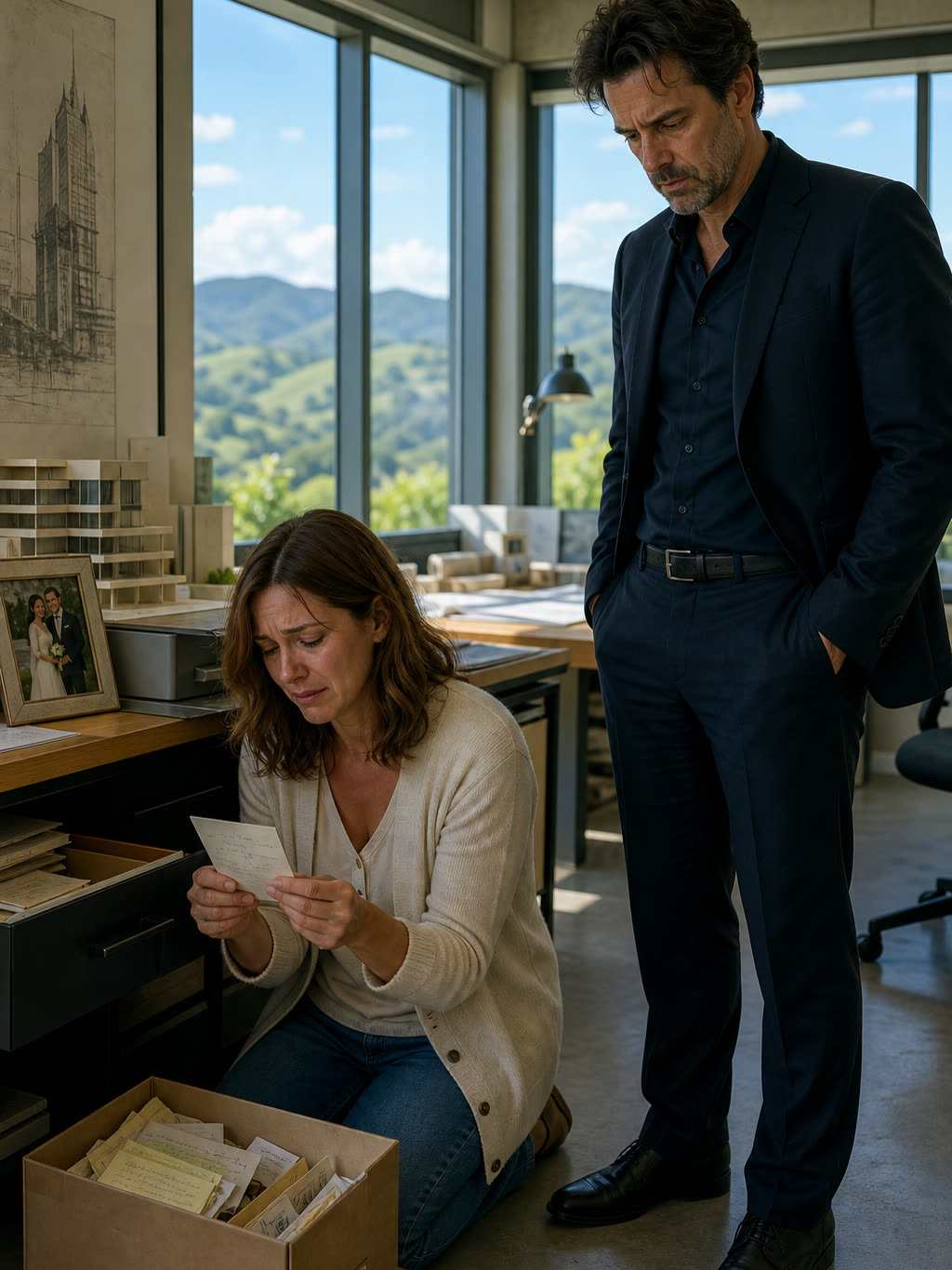
I lowered myself onto the floor beside the drawer, afraid to touch the box, as though the cards might crumble. Then I reached in and picked one at random. Jamie’s uneven childhood handwriting covered the front. “I LOVE YOU DAD. YOU ARE THE BEST DAD.” Underneath it was a message from me explaining that Jamie had written it himself and I had only helped him spell. I picked up another card from before Jamie was born, then another about apples, another about an argument, and another joking that Edward owed me after Jamie had asked where babies came from. Every card was creased from being folded and unfolded, and I understood that these had not simply been saved. They had been read, again and again.
“You actually kept all of them.” “All of them.” “Even the ones when I was angry?” “Especially those.” Edward explained that the notes mattered because I never performed for him in them. Whatever I felt that morning, whether affection, frustration, exhaustion, or amusement, was exactly what I wrote before folding the card and placing it in his lunch. “I’ve carried the truth of our life in my pocket for twelve years.” I wanted to be moved by that, and part of me was, but the office surrounding us kept reminding me that Edward had carried my truth while hiding his own.
Margaret appeared at the door to remind him about an afternoon presentation. Edward hesitated, clearly unwilling to leave me alone after everything I had discovered, but I told him to go. “We have a lot to discuss, but you have a presentation and Jamie gets out of school at three-thirty. I need some time.” Before leaving, Edward told me I could stay as long as I wanted and ask his employees anything. Their curious expressions suddenly made sense, because they all knew who I was from the photographs in his office and from the notes Edward occasionally shared.
Then Margaret admitted that she had recently given him an ultimatum. “If he didn’t tell you by Friday, I was going to.” “You seem sensible.” Edward sighed. “She usually is.” After he left, Margaret sat across from me and confessed that she had known from the beginning that hiding Meridian from me was a terrible idea. However, she had convinced herself that Edward’s marriage was not her responsibility. She also told me something I had never understood about my husband. During Meridian’s difficult first year, Edward often doubted whether he was talented enough to succeed, but one morning, after reading one of my notes at his desk, he had looked at Margaret and said: “I remember why I’m doing this.”
That afternoon, I stayed in Edward’s office and read through pieces of our marriage. I found cards about Jamie’s birth, school mornings, vacations, arguments, family jokes, and completely ordinary Tuesdays. I had always believed the sandwiches were feeding my husband. Instead, they had been feeding Robert, but every word I wrote had reached Edward. He had read them, saved them, and carried them with him through a life that he had been too afraid to share with me.
Edward returned around 4:30, and we talked for hours. He finally told me about the night classes he had taken after construction shifts, architecture school, licensing exams, and the fear that had started the entire lie. At first, he had hidden school because he was terrified of failing. “I would’ve loved you through failing,” I told him. “I know that now.” “I would have loved every version of you.” “I believe you.” That was the part that hurt most. Edward had built hospitals and bridges because he understood how structures carried enormous weight, yet he had never trusted our marriage to carry the truth.
Eventually, he asked what I wanted from him. I thought about the photographs downstairs, the architectural models, and one particular structure I had admired without knowing it belonged to my husband’s secret life. “I want you to show me your bridge.” Edward stared at me. “The pedestrian bridge?” “Yes.” “Now?” “Right now.” For the first time since I had followed him that morning, I wasn’t interested in uncovering another secret. I wanted Edward to finally show me the man he had spent nine years hiding. Yet as he reached for his keys with a hand that was not quite steady, I couldn’t shake the feeling that the bridge was where he would finally say the thing he had been too afraid to say all day.
Part 3: No More Costumes
The sun was beginning to set when Edward and I reached the pedestrian bridge. I had crossed it before, admired its graceful structure, and even taken a photograph of it when it first opened, but that evening I saw it differently, because I finally knew whose mind had helped create it. The river beneath it glowed copper and gold, and the arch of the bridge seemed to carry the last of the daylight across the water.
Edward began explaining the design almost immediately. He told me about the unusual bend in the river, the engineering problems it created, the neighborhood objections, months of planning meetings, and the redesigns required before construction could begin. He spoke carefully at first, like a man testing whether the ground would hold him, and then more freely as I kept listening.
As he spoke, something changed in him. His hands moved constantly, his attention sharpened, and the man who had spent the afternoon apologizing suddenly seemed completely at ease. I realized I had never seen that expression on his face, not at dinner, not on vacation, not even on our wedding day. “You love this.” “Yes.” “This is who you are.” Edward looked toward the bridge. “Yes.”
I studied the structure again, the long curve of its railing and the way the lamps along it were beginning to flicker on. “It really is beautiful.” A faint smile appeared on his face. “You’ve told me that before.” “I sent you a photograph of your own bridge.” “Yes.” “And you still didn’t tell me.” “No.” The word hung between us, simple and heavy, and I let it stay there rather than rushing to soften it.
I asked what he had felt when my message arrived. Edward remained silent for several seconds, watching the water slide beneath the bridge, before he answered. “Like I was the luckiest man alive.” Then his expression changed, and the light seemed to leave his eyes. “And the worst.” I did not interrupt, because I understood that he was finally telling me something he had never said aloud to anyone.
Every evening for nine years, he had returned home wearing construction clothes and promised himself that tomorrow would be the day he finally told me. But each morning, fear won again. “And tomorrow became nine years.” “Then tell me now.” “All of it?” “Everything.” He drew a long breath, the kind a person takes before stepping into cold water, and then he began.
We sat on a bench beside the river for nearly two hours while Edward unfolded the life he had hidden from me. He told me about projects that succeeded, designs that failed, buildings he loved, how he met Margaret, how Meridian survived its earliest years, and the community center they were currently designing with a roof garden, children’s play areas, and a performance room. I listened to every word, and the longer he talked, the more the stranger from that morning gave way to a man I recognized.
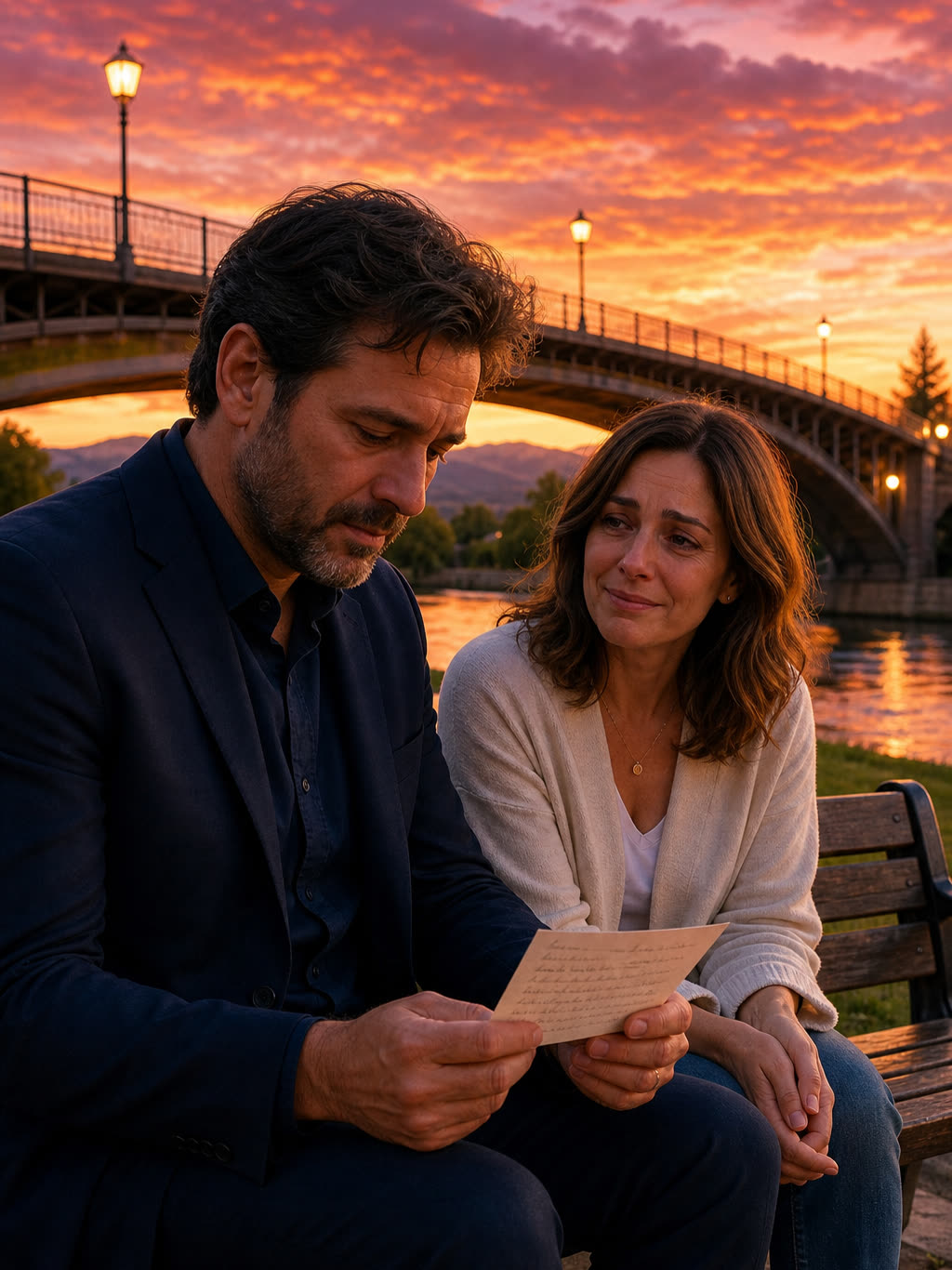
When he finally finished, the sky had deepened to violet and the first stars were appearing above the water. I asked about the note I had packed that morning. Edward removed it from his pocket, unfolded it carefully, and held it toward the fading light. “You are my favorite part of the morning. Be great today,” he read. His voice was quiet, almost unsteady. “Did you believe it?” “Yes.”
“Even knowing you were about to change into a suit and become someone I didn’t know existed?” “Especially then. Because you and Jamie were always the real part.” I looked at the card in his hands, softened by its folds, and felt something in my chest loosen even as another part of me stayed guarded. I couldn’t forgive nine years of deception in a single evening, but I also couldn’t pretend the man sitting beside me was a stranger. He was still Edward, only larger and more complicated than the version he had allowed me to know. “We have a lot of work to do.” “I know.” “And first, we have to explain to Jamie why his father has apparently been changing costumes behind a trash can every morning.” For the first time all day, Edward almost laughed.
When we returned home, Jamie was sitting at the kitchen table doing homework. He looked up and immediately asked the question neither of us expected. “Did you follow Dad?” “Yes.” “Is everything okay?” Edward sat across from him, folding his hands on the table as though preparing to present something far more important than any building. “Jamie, there’s something I need to tell you. I haven’t been completely honest with you or Mom.”
Jamie leaned forward suspiciously. “Are you a spy?” Edward looked at me, and I looked back at him. “Because honestly,” Jamie continued, “I would be okay with that.” The tension finally cracked, and I started laughing, the sound escaping before I could stop it. Edward joined me while Jamie looked increasingly disappointed. “So you’re not a spy?” “No.” “What are you?” “I’m an architect.” Jamie blinked. “Like buildings?” “Exactly.”
Edward explained everything as simply as he could. He told Jamie that he had once worked construction but later became an architect, and that construction crews now built the buildings he designed. Jamie considered this information seriously, his forehead wrinkled, and then delivered his verdict. “That’s actually cooler.” Edward smiled. “It has its moments.” Then Jamie asked the harder question. “Why didn’t you tell us?” Edward’s expression changed. “Because years ago, I made a mistake. Then I kept making the same mistake because I was afraid.” “Afraid of what?” “That if I showed the people I love who I really was, they might not love that version of me.”
Jamie stared at him. “That’s dumb.” Edward nodded. “Yes. It is.” Then Jamie shrugged. “I’d love you even if you didn’t have a job.” Something shifted in Edward’s face, a tightness I had seen all day finally releasing. “I know that now.” Watching him, I realized our ten-year-old had understood in seconds what his father had been too frightened to believe for nine years.
Then Jamie turned toward me and asked whether I had known. When I told him I had only discovered the truth that day, his next question was inevitable. “Are you mad?” “I’m complicated.” “What does that mean?” “It means I love your dad, and I’m also upset with him. Adults can feel both things at the same time.” Jamie accepted that explanation more easily than most adults probably would. He returned to his homework, and about thirty seconds later, without looking up, he asked one final question. “Dad?” “Yes?” “Are you going to keep throwing Mom’s lunches away?” “No.” “Good. Her sandwiches are really good.”
The next morning, I stood in the kitchen and packed Edward’s lunch again. I prepared two sandwiches, apple slices, and black coffee, but this time I used a different bag. The old construction lunchbox belonged to a version of Edward that no longer needed to exist. Then I sat down with an index card. For twelve years, writing those notes had been effortless because I thought I understood the life Edward entered every morning. I had imagined him reading my words during a construction break before returning to the day I believed he was living.
Now I knew differently. I knew about Meridian, Margaret, the night classes, the licensing exams, the architectural models, the bridge, and the hundreds of notes stored inside his office. I also knew Edward would probably read whatever I wrote twice, so I chose my words carefully. “I know who you are now. I want to know everything else.” Edward read the note at the kitchen table. For years, he had folded my cards and slipped them into his pocket before secretly changing clothes beside a trash can. That morning, he placed the note carefully inside his wallet, in the compartment where he kept the things he never wanted to be without.
Then he stood. “I’ll be home by six.” For twelve years, those words had been part of our routine. Yesterday, I would have imagined a construction site, dusty boots, and physical work beneath the sun. Now I pictured drafting tables, architectural plans, meetings, and the office filled with photographs of our family. I looked at him. “I know.”
Edward kissed me and walked toward the door. There were still nine years of deception between us. Discovering why he had lied did not erase the lie, and loving him did not automatically repair the trust he had damaged. We would have to rebuild that slowly, conversation by conversation, until I no longer had to wonder which parts of his life were real. But for the first time, we were rebuilding from the same set of plans.
Edward opened the front door and stepped outside. He was wearing the dark navy suit, the same suit Jamie had seen him secretly change into, the same suit that had made me believe my husband was meeting another woman, and the same suit Edward had once worn when he married me. Except this morning, there were no construction overalls hidden underneath it. There was no duffel bag waiting in his truck, and there was no corner where he needed to change clothes. Edward left for work as the man he had become, and this time, I knew exactly where he was going.
Disclaimer: This story is a work of fiction inspired by real-life themes. Names, characters, places and events are fictionalized, and any resemblance to real persons is purely coincidental. Images are for illustration purposes only.
