


The first time Jonathan Hale seriously considered disappearing, he was sitting alone on the fifteenth floor of Hale Industries with a silver pen in his hand and three hundred twenty-eight lives spread across his desk like a row of quiet funerals.
Rain glimmered against the glass walls of his office, turning the city below into a blurred field of white lights and smeared shadows. Inside, everything smelled of paper, cold coffee, and defeat. The clock on the wall had passed nine, then ten, then eleven. Still, Jonathan remained in the same chair, jacket on, tie loosened, sleeves rolled once at the wrist as if he had prepared for a fight he already knew he would lose.
He signed one page. Then another. Then another.
Each sheet carried a name. A department. A title. A legal phrase dressed up to sound humane.
Termination notice. Effective immediately.
His hand began to cramp, but he kept going.
Because if he stopped, he would have to think. And if he thought, he might finally admit the one thing he had spent the last year refusing to say aloud.
He had failed his father.
Not just the company. Not just the shareholders. Not just the board that smiled at him in meetings and bled him dry in private. He had failed the man whose portrait hung in the lobby downstairs—the founder, the legend, the one employees still spoke about like he might walk through the doors any day and shake every hand himself.
Edward Hale had built Hale Industries from a rented warehouse and a borrowed truck. Jonathan had inherited towers, contracts, respect, and a name that opened every door in the city.
And now, under his leadership, the empire was collapsing so fast it sounded like silence.
“I’m sorry,” Jonathan whispered, though whether he was speaking to his father, his employees, or himself, he didn’t know.

Then came the sound that broke the spell.
Click.
The door opened only a few inches.
“Sorry, sir… I just came to pick up my kids.”
The voice was cautious, almost apologetic.
Jonathan looked up with eyes so tired they felt borrowed.
Maria.
The night cleaner.
She stood half inside the doorway, one hand still on the handle, wearing her pale blue work uniform and sneakers that had seen too many shifts. Her dark hair was pulled into a low bun, and there was always something careful about the way she carried herself—as if she had spent years trying not to take up too much space in a world that kept shoving her aside.
At first Jonathan only nodded. “Come in.”
Then he saw the children.
Three little boys stood beside her in a straight line, identical as reflections. Same dark hair. Same solemn eyes. Same blue shirts. Same small hands hanging at their sides.
They were still. Too still.
Not shy exactly. Not afraid. Watching.
Jonathan frowned. “I didn’t know you brought them here at night.”
Maria stepped in another inch, embarrassed. “Daycare closed early. My neighbor usually watches them, but her husband got sick, and I… I couldn’t miss tonight.”
He glanced back at the papers. “You should have told someone.”
Her smile was thin. “Some people can afford to miss a shift, sir.”
The words weren’t rude. They were worse. They were true.
Maria lowered her gaze and turned to the boys. “Ethan, Lucas, Daniel… stay by me.”
But they didn’t.
One of them took a step forward. Then another. Then all three began walking across the office toward Jonathan with a slow certainty that made the room feel suddenly strange.
Jonathan sat up. “What are they doing?”
Maria’s voice sharpened with alarm. “Boys—no, stop. Come back here.”
They kept moving.
Jonathan should have stopped them. Any other night, he probably would have. The office wasn’t a nursery. His desk was covered in confidential documents. He was the CEO, exhausted, half sick with dread, and in no condition for whatever odd scene this was becoming.
But he didn’t stop them. He just watched.
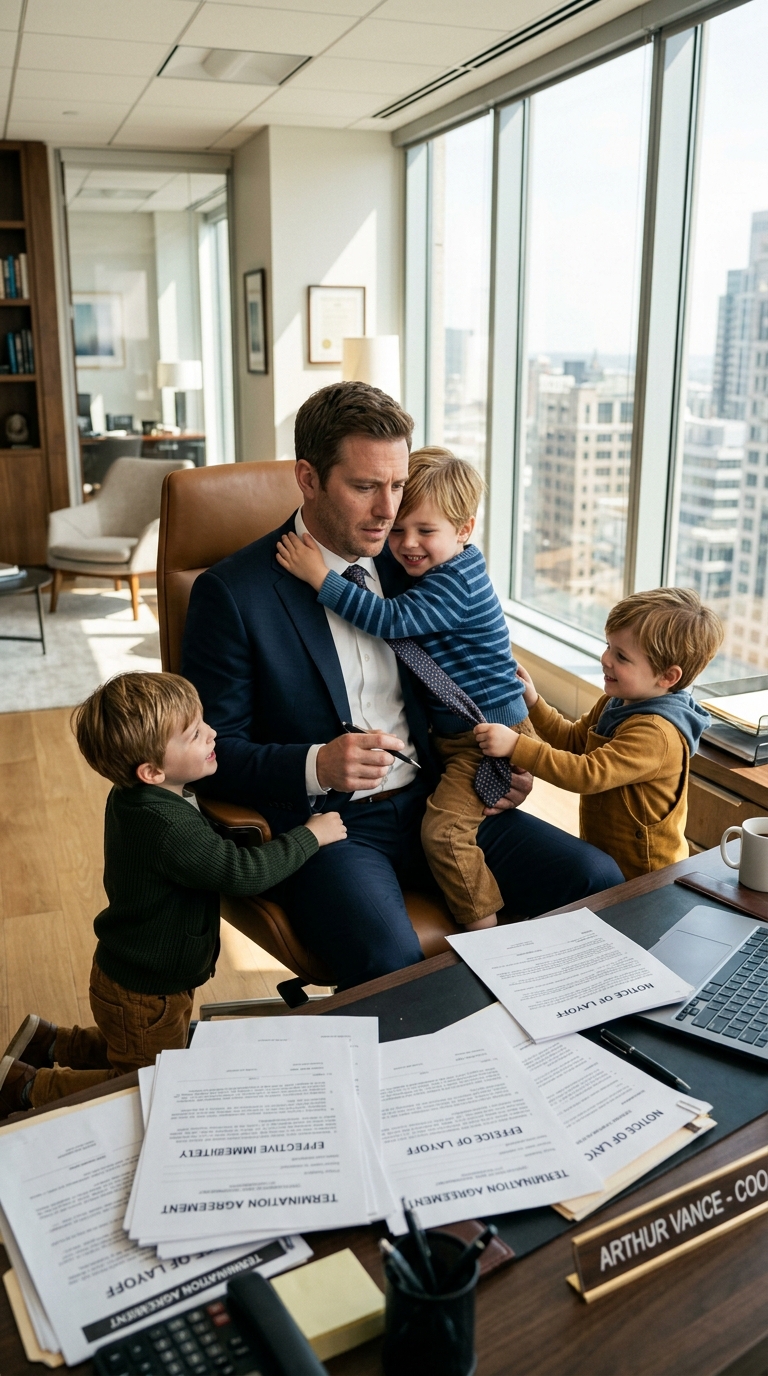
The first boy reached him and climbed up against his knee with complete confidence, as if Jonathan were someone he already knew. The second caught hold of his loosened tie and tugged gently. The third wrapped both small arms around Jonathan’s leg and laid his cheek against expensive wool.
Jonathan froze.
Maria went white. “I’m so sorry, sir. They never do this. They don’t go near people. Not strangers. Not anyone.”
But the boys weren’t merely curious. They were clinging.
As though they had found something in him they recognized before he had even recognized it himself.
One climbed carefully into his lap and settled there like a bird landing on a branch.
Jonathan looked down, stunned.
The child looked back at him with deep, unguarded seriousness.
In the silence, Jonathan became aware of something he hadn’t felt in months.
Not hope. Not happiness. Just… air.
The iron band around his chest loosened a little. He inhaled without pain.
“Let them stay,” he said quietly.
Maria blinked. “Sir?”
“It’s okay.”
He didn’t know why he said it. Maybe because the warmth of the little boy in his lap felt impossibly human in a room that had been filled with death only seconds earlier. Maybe because tiny fingers tugging at his tie felt more honest than every handshake he’d endured from men in sharper suits than his. Maybe because the child hugging his leg made him feel, for the first time that entire year, less like a machine built to sign away lives.
One of the boys pointed at the pen.
Jonathan managed something that almost resembled a smile. “You want this?”
The boy nodded.
Jonathan handed it over, and the child grinned so suddenly and brightly that the entire office changed shape.
Maria pressed a hand over her mouth.
“I’ve never seen them do that,” she whispered.
Jonathan glanced at her. “Do what?”
She swallowed. “Trust someone.”
The boy in his lap patted Jonathan’s cheek. Another leaned into his side. The third studied the papers on the desk with solemn fascination, then looked up with a frown far too old for his face.
“Mister…” he said softly.
Jonathan’s breath caught.
The child touched his chest.
“You sad.”
The words struck harder than any boardroom ambush, any banker’s warning, any article speculating whether he was fit to lead the company.
Because the boy was right.
Jonathan laughed then—one broken, startled sound that almost turned into something else.
“Yes,” he said hoarsely. “I’m sad.”
And then, as if sadness were something that could be fixed by instinct alone, the little boy leaned in and kissed his cheek.
Another followed. Then the third.
Three quick, clumsy, innocent kisses.
Jonathan shut his eyes.
When he opened them, Maria was crying.
“I’m sorry,” she said, wiping her face. “I don’t know why they’re acting like this.”
But Jonathan thought he did.
Children had a way of walking straight past masks and finding what adults spent years hiding.
He looked at the termination notices. Then at the boys. Then at Maria.
“And their father?” he asked quietly.
Her face closed.
“He left,” she said. “When he found out there were three.”
Jonathan stared at her.
She gave a brittle laugh that held no humor. “Some men don’t want difficult things, Mr. Hale.”
He almost told her she was wrong.
Then he looked at the stack of papers under his hand and realized he had built his entire week around proving her exactly right.
Something restless stirred inside him. Not a solution. Just resistance.
“Maria,” he said, “if someone offered you a way out… a real one… would you take it?”
She gave him a tired look. “Men with money always ask questions like that right before they disappoint you.”
Despite himself, Jonathan smiled again. “Fair.”
The boys had now spread his papers into a crooked fan across the desk. One had picked up a gold paperweight and was rolling it carefully between his palms. Another had crawled down and was standing beside Jonathan’s chair, using his knee for support. The third still sat in his lap, calm and quiet, as if he belonged there.
Jonathan’s eyes moved over the names on the papers. Three hundred twenty-eight.
He knew what the board wanted. Cut payroll. Sell two divisions. Close the regional plant. Preserve executive compensation. Protect investor confidence. Let the working people absorb the impact and call it strategic restructuring.

He also knew something the board didn’t.
There was one final route left—one his father had written into the company charter decades ago and buried so deeply in the corporate structure that even most senior executives had forgotten it existed.
A dormant worker equity trust.
His father had created it for emergencies, believing no family-built business should ever survive by sacrificing only the families at the bottom. It had never been activated because it required something almost impossible:
The CEO had to surrender controlling personal ownership.
Jonathan had the legal power to trigger it.
But if he did, he would lose everything the board respected—his voting advantage, his private leverage, perhaps even his title.
And worse, the board would fight him like wounded animals. They might destroy the company first.
Still…
For the first time, destruction no longer felt inevitable. It felt negotiable.
He leaned forward, elbows on his knees. “Maria, I want you to work for me.”
She stared at him. “I already do.”
“Not as a cleaner.”
Her expression emptied in confusion. “What?”
“I need someone in my office every evening for the next few weeks. Someone the board ignores. Someone observant. Someone nobody thinks matters.”
“Sir, I clean floors.”
“No,” Jonathan said, his voice tightening with sudden force. “You survive impossible things and still show up on time. That is not the same skill set.”
Maria looked frightened now. “What exactly are you asking me to do?”
Jonathan hesitated.
Then he opened his desk drawer and pulled out a battered leather folder. He laid it on the desk and opened it to reveal copies of old corporate documents, handwritten notes in his father’s blocky script, and a series of internal transfer records.
Maria leaned closer.
Jonathan tapped one page.
“This company isn’t actually broke.”
Her eyes snapped to his.
He held up a hand. “No, don’t say anything yet. Listen first.”
He explained it in low, precise sentences.
The board had been insisting Hale Industries was beyond repair. Revenues were down, yes, but not catastrophically. What had gutted the company were a series of internal asset transfers—money moved through subsidiaries, supply contracts rerouted, losses artificially exaggerated. Someone had been draining value out of the company while using the appearance of collapse to justify mass layoffs and force an emergency sale.
Maria shook her head slowly. “That’s illegal.”
“It is if I can prove intent.”
“If?”
Jonathan’s jaw hardened. “The last internal audit vanished. The outside counsel withdrew. My CFO resigned two days before he was supposed to present financial reconciliation.”
Maria stared at the pages. “So they’re stealing from you.”
He gave a bleak laugh. “From the employees. From my father’s company. I’m just the idiot they left holding the pen.”
The boys had fallen silent again, as if listening.
Jonathan lowered his voice even further.
“My father suspected something like this years ago. He created a failsafe. If the company was ever being cannibalized from the inside, the CEO could activate the worker trust and freeze certain asset movements—but only if enough evidence was gathered before the quarterly vote.”
Maria whispered, “And the vote is when?”
“Tomorrow morning.”
Her head snapped up. “Tomorrow?”
Jonathan nodded.
She looked from him to the documents to the children. Then back again.
“What does any of that have to do with me?”
“Because,” Jonathan said, “the board members don’t notice the people who clean up after them. They talk in front of you. They leave files out. They assume you are invisible.”
Maria’s face changed.
Not because she was offended. Because she knew he was right.
Jonathan continued. “My father’s private archives are in the old executive records room on twelve. Security locked it under board instruction last year. The keycard permissions were quietly changed. But the custodial team still has after-hours access to the utility corridor behind it.”
Maria’s eyes widened. “You want me to go in there?”
“I want you to retrieve a file box labeled Founder’s Contingency—E.H. If it’s there, it may contain the original trust instructions and the authorization trail I need.”
“That could get me fired.”
He met her gaze. “Tomorrow, three hundred twenty-eight people are getting fired anyway.”
The words hung between them like a blade.
Maria looked down at her boys.
One of them had fallen asleep against Jonathan’s shoulder. Another was drawing crooked circles on a blank notepad with the silver pen. The third stood by Maria now, clutching her pant leg and peering up at Jonathan with solemn trust.
“Why me?” she asked at last.
Jonathan didn’t answer immediately.
Because the honest answer sounded insane.
Because the honest answer was that in a room full of predators, exhausted lawyers, and smiling traitors, the only people who had made him feel human again were a cleaning woman and three children who trusted no one.
Because somewhere between the first kiss on his cheek and the boy whispering you sad, he had realized that if he went down tomorrow, he would rather do it trying to save something than signing its obituary.
“Because I think,” he said quietly, “you still know the difference between what people call important and what actually is.”
Maria stood very still.
Then she nodded once.
“All right.”
Jonathan exhaled, long and slow.
The next hour moved like a storm.
He called no one. He sent no emails. He disabled the auto-backup on his office terminal, printed two pages of legal language from memory, and burned a handwritten note his father had once left him about never trusting unanimous votes. Maria slipped out with her boys through the service corridor while Jonathan remained upstairs, forcing himself to finish signing enough documents to avoid suspicion.
At 12:17 a.m., his office phone rang once and stopped.
That had been the signal they agreed on.
Jonathan left immediately.
The hallway outside was dark except for emergency lighting. His shoes made almost no sound on the carpet. On the twelfth floor, Maria waited by the utility door, the triplets bundled beside her on a bench with Jonathan’s jacket draped over them.
In her hands was a gray archive box.
Jonathan’s pulse kicked hard.
“You found it?”
Maria nodded, pale and breathless. “And something else.”
She opened the lid.
Inside were folders, ledgers, trust certifications, and an encrypted flash drive taped beneath the cardboard flap. On top of everything sat a sealed envelope with Jonathan’s full name written in his father’s hand.
He stared at it for a second that felt like a year.
Then he opened it.
Inside was a single page.
If you are reading this, Edward Hale had written, the theft has begun from inside the house. Do not protect the men who speak most loudly about saving the company. They are the ones preparing to eat it. Trust the one person in the room with no power. They are the only one who has nothing to gain by lying.
Jonathan read it twice. Then a third time.
Maria whispered, “What is it?”
He looked up slowly.
And that was when he heard footsteps.
Not one person. Several. Fast.
Jonathan spun toward the far end of the hallway.
Three figures appeared out of the dark—security, headed by Victor Sloane, the board’s outside “risk consultant,” a man whose smile always looked rehearsed and whose eyes never warmed.
Sloane stopped when he saw the box in Jonathan’s hands.
For a second, nobody moved.
Then Sloane smiled.
“There you are,” he said. “I was afraid you’d found it.”
Maria backed up instinctively, pulling the boys behind her.
Jonathan stepped in front of them without thinking. “You followed her.”
“I followed the access breach.” Sloane’s gaze dropped to the envelope in Jonathan’s hand. “Mr. Hale, hand me the box.”
Jonathan’s heart was thundering now, but his voice came out sharp. “You manufactured the losses.”
Sloane’s expression did not change.
“You won’t prove it.”
“Maybe not. But this will.”
Sloane gave a tiny sigh. “You always were your father’s sentimental weakness.”
The words hit Jonathan harder than they should have.
“Meaning what?”
For the first time, Sloane’s smile became real. And cruel.
“Meaning Edward should have told you the truth before he died.”
Jonathan’s blood went cold.
Sloane nodded toward the triplets.
“Don’t you see it yet?”
The boys clung to Maria, peering around her with wide, frightened eyes.
Jonathan frowned. “See what?”
Sloane tilted his head.
“Why they went to you.”
Silence crashed into the hallway.
Maria looked confused. Jonathan felt suddenly unsteady, as if the floor had shifted a fraction beneath him.
Sloane’s voice lowered, almost conversational.
“Twenty-nine years ago, Edward Hale had an affair with a woman in housekeeping. It produced a child. Quietly paid for. Quietly buried. That child grew up, changed her name after foster placement, and now cleans your office at night.”
Maria stared at him as though he had spoken another language.
Jonathan felt his grip loosen on the box.
“No,” Maria whispered.
Sloane kept going.
“Edward’s blood runs in her. Which means,” he said, glancing from Maria to Jonathan, “the reason those children trusted you is very simple.”
Maria’s face had gone bone-white. Jonathan could barely hear his own breathing.
Sloane smiled one final time.
“She isn’t your employee, Mr. Hale. She’s your sister.”
And in the stunned, breathless silence that followed, one of the triplets looked up at Jonathan with trembling lips, reached for him through the dark corridor—
and called him uncle.
