

Three days after surgeons operated on my spine, I realized a marriage could emotionally end without either person ever saying the words
I don’t love you anymore.
Sometimes it disappeared quietly.
Sometimes it happened as rain streamed down a hospital window while your husband called from his sister’s birthday celebration to explain why everyone had decided her rooftop party mattered more than your spinal surgery.
I was standing beside my hospital bed when Ethan called.
Or at least attempting to stand.
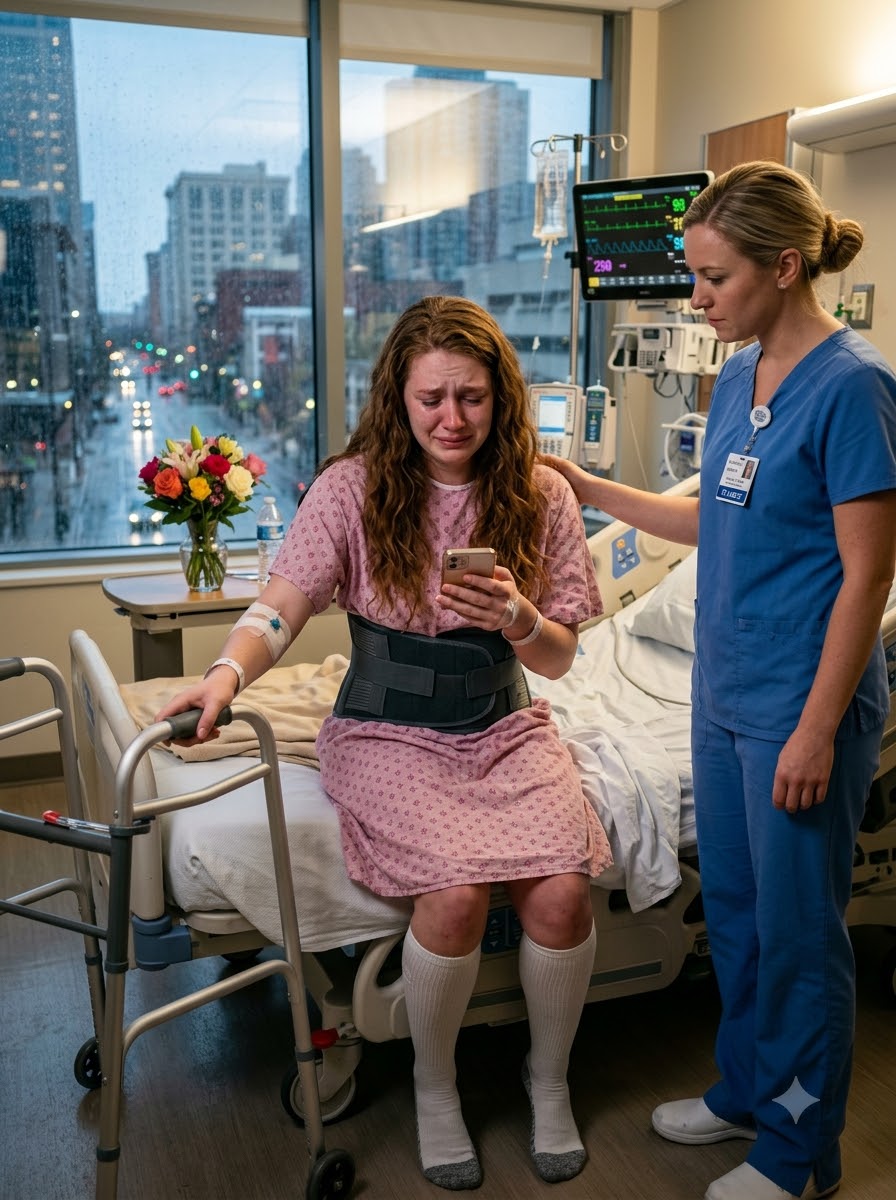
Both hands were wrapped around the cold metal handles of a walker.
My legs trembled beneath the hospital gown, compression socks pulled up to my knees.
Every time I shifted my weight, pain moved from my lower spine toward my left hip.

“Easy,” Jenna, my physical therapist, said.
She remained close enough to steady me without making me feel completely incapable.
“One more step.”
I took it.
Four steps. Four painful, remarkable steps.
Then my phone buzzed on the tray table.
Ethan Carter.
My husband.
I almost laughed.
Except laughing hurt.
Jenna looked at the screen, then back at me.
“Want to answer that?”
“I suppose I should find out whether I’m still married.”
Her expression changed.
She helped me sit down.
“I’ll give you a minute.”
Once the door closed behind her, I answered.
“Hey, Nat,” Ethan said.
Warm.
Careful.
Almost upbeat.
Like I’d undergone a simple dental procedure instead of a five-hour operation on my spine.
“How are you feeling?”
“My spine feels like somebody rearranged it.”
He laughed awkwardly.
“Well, technically—”
“Don’t.”
The laughter disappeared.
My name is Natalie Hayes Carter.
I was thirty-two years old when I learned that
disappointment eventually stops feeling like heartbreak and starts feeling like evidence.
Before that week, I believed Ethan and I had a normal, somewhat strained marriage.
Work. Bills.
His consulting business.
My worsening back pain.
Dishes. Laundry. Forgotten groceries.
I knew things weren’t perfect.
I just didn’t realize I had become optional.
“I hope you understand why we couldn’t be there,” he said.
I stared at the rain smearing the city outside.
“We?”
“Mom.
Dad.
Olivia.
Everyone.”
“I know who you mean.”
“It was Olivia’s thirtieth, Nat.
The rooftop had been booked for months.
People traveled in.
Deposits were paid.
And after everything with Trevor…”
Of course.
Trevor.
Olivia’s former fiancé had called off their engagement six months earlier.
Ever since, Ethan’s younger sister had treated the heartbreak like a life-altering emergency.
I had answered her calls after midnight.
Delivered groceries. Canceled dinners.
Driven forty minutes because she was crying over a dining table she and Trevor had picked together.
But when surgeons operated on my spine?
Apparently a prepaid rooftop deposit won.
“My surgery lasted nearly five hours.”
“I know.”
“Do you?”
“Of course.”
“When I woke up, my dad was sitting beside me.”
Silence.
“My father drove four hours from Harrisburg.”
“I know Robert came.”
“Tessa took unpaid leave.”
“Natalie—”
“She slept in a hospital chair because she didn’t want me waking up alone.”
“Nat—”
“And my husband sent me a text saying, ‘You’ll be fine.
Call when you wake up.’”
That silence felt different.
Behind him, I could hear dishes.
Laughter.
Then Olivia’s voice.
His entire family was together.
Again.
“You’re making it sound worse than it was,” Ethan said.
I looked down at the walker.
“I had spinal surgery.”
“You know what I mean.”
“No.
I don’t.”
He sighed.
“Olivia needed us.”
“So did I.”
“That’s unfair.”
Those words changed everything.
Not because they were cruel.
Because they were unmistakable.
For months, I had been terrified of surgery.
My condition had progressed from pain to numbness to weakness until my surgeon stopped saying eventually and started saying “before permanent nerve damage becomes a serious risk.”
Ethan had watched me drop a coffee cup when my hand went numb.
He had found me crying on the bathroom floor.
“What if I wake up and I can’t walk?”
I had whispered.
He’d held me.
“You won’t go through this alone.”
Apparently promises changed when they became inconvenient to family celebrations.
“When are you coming?”
I asked.
“Tomorrow morning.”
“No.”
Pause.
“What?”
“Don’t come tomorrow.” “Natalie, stop.”
“My discharge paperwork was signed an hour ago.”
“What?”
“I’m leaving today.”
“But I’m supposed to pick you up tomorrow.”
“No.
You were supposed to be here three days ago.”
In the background, Olivia said clearly:
“Is she seriously still upset?”
Something inside me suddenly became calm.
Ethan muttered, “Liv, not now.”
“Put me on speaker,” I said.
“Natalie—”
“Put me on speaker.”
A few seconds later, the background fell completely silent.
His mother, Diane.
His father, Paul.
Olivia.
Every one of them listening.
“My dad is taking me home,” I said.
Ethan inhaled.
“What do you mean, home?”
“My home.”
“Natalie, I live there too.”
“For now.”
His mother gasped.
Ethan lowered his voice.
“Nat… what did you do?”
I looked down at my discharge papers.
For the first time since surgery, I smiled.
“You’ll find out.”
Then I ended the call.
My father arrived thirty minutes later.
Robert Hayes was sixty-three, silver-haired, stubborn, and carried an anger so quiet it was far more intimidating than shouting.
He slung my bag over one shoulder.
Tessa walked beside him with my prescriptions.
Neither of them asked what I had done.
They already knew.
Because I had made the decision at 2:17 that morning.
A nurse had helped me get to the bathroom while my husband posted smiling photographs from Olivia’s rooftop birthday.
Yes.
I had seen them.
One picture showed Ethan holding champagne.
Another showed Diane kissing Olivia’s cheek.
Another showed the entire Carter family gathered beneath strands of golden lights.
Family shows up when it matters.
I stared at those words for a long time.
Then I called my father.
After that, I contacted an attorney.
The house Ethan and I shared belonged to my grandmother.
When she died, she left it entirely to me.
Ethan moved in after our wedding.
His name had never been placed on the deed.
That detail had always seemed irrelevant.
Until suddenly it wasn’t.
At the hospital entrance, Dad carefully helped me into his SUV.
“You sure?” he asked.
I understood what he meant.
“Completely.”
He nodded.
“Then we go home.”
When we pulled into the driveway, Ethan’s black SUV was gone.
But another vehicle was waiting there.
A locksmith’s van.
I had arranged everything from my hospital room.
Tessa had gone ahead that morning using my spare key.
Ethan’s clothes, shoes, laptop equipment, golf clubs, consulting documents, and toiletries had all been packed carefully.
Nothing was damaged. Nothing was thrown into the street.
I wasn’t seeking revenge.
I wanted distance.
Twenty-two labeled boxes were lined up inside the garage.
A garment rack held his suits.
His belongings remained untouched.
The locksmith had replaced the exterior locks.
My attorney had explained exactly what I could legally do and what I needed to avoid.
By six that evening, I was resting on our downstairs guest bed because I couldn’t handle the stairs.
Dad heated soup.
Tessa arranged my medication.
At 7:43 p.m., headlights swept across the curtains.
Ethan.
Dad looked at me.
“You want me here?”
“Yes.”
The front door handle rattled.
Then again.
Harder.
“Natalie!”
I closed my eyes.
“Natalie!”
Dad opened the door.
Ethan stood on the porch.
Diane and Olivia were behind him.
Of course they were.
“What is going on?”
Ethan demanded.
Dad’s voice remained calm.
“Lower your voice.”
“This is my house.”
“No,” I called from the guest room.
“It isn’t.”
Ethan stepped past Dad and stopped when he saw me.
Hospital bracelet. Back brace. Walker. Pill bottles.
For half a second, guilt crossed his face.
Then frustration took its place.
“You changed the locks?”
“Yes.”
“You packed up my belongings?”
“Yes.”
His mother stepped inside.
“Natalie, this is unreasonable.”
Dad positioned himself between us.
“This discussion is between Natalie and Ethan.”
Diane stiffened.
“We’re family.”
I looked directly at her.
“Were we family on Monday?”
Her mouth shut.
Olivia crossed her arms.
“You’re actually ending your marriage over one birthday?”
I almost admired the nerve.
“No, Olivia.
I’m ending a pattern because your birthday finally made it impossible to keep pretending the pattern didn’t exist.”
Ethan stared at me.
“Ending?”
“I spoke with a divorce attorney.”
His face went pale.
“You what?”
“I’m filing.”
Diane whispered, “Oh my God.”
Olivia scoffed.
“This is unbelievable.”
“Maybe.”
I gripped the walker and slowly pushed myself upright.
Pain shot through my spine.
Dad stepped toward me, but I raised one hand.
I needed to handle this myself.
“I asked my husband to stay beside me for the most frigh.ten.ing medical procedure of my life,” I said.
“He chose a celebration.
Then three days later he told me I was unfair for feeling hurt.”
Ethan moved toward me.
“I made a mistake.”
“No.
You made a decision.”
“There’s a difference?”
“Yes.
Mistakes happen unintentionally.
Choices reveal your priorities.”
His eyes reddened.
“Natalie, please.”
And for one dangerous second, I nearly softened.
Eleven years together can do that.
Memories don’t vanish simply because someone disappoints you.
I remembered our first apartment.
His proposal during a snowstorm.
The terrible dancing at our wedding.
The night he stayed awake after my mother died.
The years when he had treated me with kindness.
Maybe that was what made betrayal so complicated.
People rarely disappoint you because they were awful from the beginning.
Sometimes they hurt you because, somewhere along the way, they decide your love will tolerate everything.
“I’ll go to counseling,” he said.
“Maybe you should.”
“We’ll go.”
“No.
You go.”
His expression fell.
Diane took his arm.
“Come on.”
Before leaving, Olivia turned around.
“For what it’s worth, I told Ethan he could go to the hospital.”
I stared at her.
“What?”
Ethan became completely still.
Olivia blinked.
“What?”
“You told him he could go?”
She glanced toward Ethan.
He looked furious.
“Olivia,” he warned.
“No, wait,” I said.
“What exactly does that mean?”
Olivia’s confidence disappeared.
“I just meant… he kept saying he should probably leave early because your surgery was the following morning.”
I looked at Ethan.
The entire atmosphere shifted.
“You told me your family pressured you into staying.”
His jaw tightened.
“I never said pressured.”
“You said your mother would never forgive you for missing Olivia’s thirtieth.”
Diane looked confused.
“I said what?”
Ethan snapped, “Mom, don’t.”
She stared at him.
“Ethan, I told you to leave.”
Nobody moved.
Diane’s voice became firmer.
“I told you Saturday afternoon that Natalie’s surgery was more important.”
My heartbeat quickened.
Paul had remained outside until that moment.
Now he walked inside. “I told him the same thing.”
Ethan’s face went pale.
I felt sick.
“So nobody stopped you?”
“Natalie—”
“You decided not to come.”
He dragged both hands over his face.
“I thought…”
“What?”
“I thought everything would be okay.”
“You misled me.”
“I didn’t lie.”
“You allowed me to believe your family expected you to stay.”
He dropped his gaze.
That told me enough.
And somehow, it hurt more than his absence ever had.
“Leave,” I whispered.
“Nat—”
“Leave.”
He did.
The first month following surgery was exhausting.
I learned how to shower without bending over. How to sleep while wearing a brace. How to measure recovery by the length of hallways I could walk.
Ethan called every day.
I stopped answering.
He emailed.
I ignored most of them.
He sent flowers.
I left them at the nurses’ station during a follow-up appointment.
My attorney, Claire Benson, filed the divorce petition.
Ethan responded quickly.
At first, his messages were polite.
Then the financial issues surfaced.
And the politeness vanished.
Ethan’s consulting company had been struggling for two years.
I knew that.
What I hadn’t understood was just how severe the situation had become.
Claire called me one Tuesday.
“We need to talk about your finances.”
“I gave you everything.”
“Not Ethan’s.”
My stomach tightened.
“What about them?”
“He has substantial debt.”
“How much?”
“Potentially more than two hundred thousand dollars.”
I sat down.
“That can’t be possible.”
“Business credit cards.
Personal guarantees.
Loans.”
“He never told me.”
“That isn’t the only concern.”
There it was.
The sentence no attorney delivers before sharing good news.
Claire placed several documents across her desk.
A home-equity application.
My address. My property. My name.
A signature that looked like mine.
I stared at it.
“What is this?”
“He attempted to obtain business funding using your house.”
“I never signed this.”
Claire’s expression changed.
“You’re certain?”
“Absolutely.”
My hands began trembling.
The signature was close.
Extremely close.
But it was wrong.
The N in Natalie curved differently.
The application had been dated six weeks before my surgery.
My attorney leaned closer.
“Natalie, this could involve fr@ud.”
I almost laughed.
Not because anything was funny.
Because my mind could no longer comprehend how many parts of my marriage apparently weren’t what I had believed.
“He copied my signature?”
“We need document verification before reaching that conclusion.”
But I knew.
Ethan had imitated my signature for years.
Birthday cards.
Package deliveries.
Once, jokingly, he had signed my name on a restaurant receipt.
He knew how.
That evening, I finally called him.
He answered immediately.

“Nat?”
“What did you do?”
Silence.
“What are you talking about?”
“The loan.”
Another silence.
This one lasted longer.
“Can I explain?”
My entire body went cold.
“So you did it.”
“It wasn’t like that.”
“You signed my name.”
“I was planning to tell you.”
“When?
After the bank took my grandmother’s house?”
“They wouldn’t have.”
“You used my property as collateral.”
“The company needed cash flow.”
“You signed my name without permission.”
“It was temporary.”
“There’s nothing temporary about using someone’s signature without permission.”
“Natalie, listen to me.”
“No.”
“You don’t understand.”
“Then explain it.”
He breathed heavily.
“I had a major client preparing to sign.
I needed a bridge loan.
I thought if I could just make it through sixty days—”
“You thought my house was yours to risk.”
“I thought our house—”
“My house.”
He stopped.
Then he said something I would never forget.
“We’re married.
It shouldn’t matter whose name appears on the paperwork.”
I closed my eyes.
There it was again.
Entitlement disguised as intimacy.
“You didn’t miss my surgery because of Olivia.”
Silence.
“What?”
“You were avoiding me.”
“Natalie—”
“You knew I was frightened.
You knew the surgery was serious.
And you had signed my name six weeks earlier.”
“That had nothing to do with it.”
“I think it had everything to do with it.”
He said nothing.
So I ended the call.
The financial investigation expanded.
Bank records. Emails. Loan applications. Transfers.
I gave Claire access to everything.
That was when we found another name: Carter Horizon Holdings.
A company I had never heard of.
Registered eighteen months earlier.
Its managing member?
Olivia Carter.
Claire raised an eyebrow.
“Did you know your sister-in-law had involvement in Ethan’s business?”
“No.”
She turned the laptop toward me.
Carter Horizon had received three transfers from Ethan’s consulting company.
$38,000.
$51,500.
$72,000.
“What is that?”
“We’re finding out.”
Suddenly, Olivia’s birthday no longer seemed like an isolated issue.
Neither did Trevor.
Trevor himself called me two days later.
I nearly ignored the unfamiliar number.
“Natalie?”
“Yes?”
“This is Trevor Monroe.”
My entire body became alert.
“Olivia’s Trevor?”
A humorless laugh.
“Not anymore.”
“What do you want?”
“I heard you’re divorcing Ethan.”
“Word travels fast.”
“Not word.
Subpoenas.”
I sat up straighter.
“What subpoenas?”
“My company received one.”
Trevor owned a small commercial real-estate business.
“I think there’s something you need to know,” he said.
“About what?”
“Why Olivia and I ended things.”
I remained silent.
“She told everyone I cheated.”
“That’s what we heard.”
“I didn’t.”
“What happened?”
“She took money.”
My mouth went dry.
“How much?”
“Trevor.”
“Nearly ninety thousand.”
I stood too quickly, and pain shot through my back.
I grabbed the counter.
“She had access to one of our project accounts.
She transferred funds into a company Ethan controlled.”
My ears began ringing.
“Ethan?”
“Yes.”
“You knew about this?”
“Eventually.”
“And you never told anyone?”
“I threatened legal action.
Olivia’s father paid some of it back.”
“Paul?”
“Yes.”
That made no sense.
“Paul knew?”
“He knew part of it.”
My thoughts raced.
“Why would Ethan need Olivia to transfer money?”
“I don’t know.
But Natalie…”
Trevor paused.
“There was something strange about the timing.”
“What?”
“The first transfer happened two days after your grandmother passed away.”
I stopped breathing.
My grandmother.
The house.
My inheritance.
Eighteen months earlier.
Before my pain became serious. Before surgery was even being considered. Before Ethan’s company supposedly began struggling so badly.
A disturbing possibility began taking shape.
“Trevor, did Ethan know I inherited the house?”
“He talked about it constantly.”
The truth unfolded slowly.
Then, all at once.
Ethan had not simply made desperate financial decisions.
He had created a plan.
After my grandmother died, I inherited the house without a mortgage.
It was worth almost $640,000.
My inheritance also included a modest investment account.
Ethan began encouraging us to “combine everything.”
I resisted only because my grandmother’s attorney had advised me to keep inherited assets separate.
Ethan acted as though that distinction meant nothing.
Instead, he established companies.
Moved debt.
Borrowed money.
And apparently waited. For what? Claire found the answer in an email uncovered during discovery.
It had been sent by Ethan to a financial advisor.
The date was seven months before my surgery.
One sentence changed everything about the divorce.
“If Natalie becomes medically unable to manage her affairs, I assume I can act for her as spouse?”
I stared at the screen until the words blurred in front of me.
Claire spoke in a low voice.
“There’s more.”
There was another email.
Three months later.
Ethan had asked about power of attorney.
Then disability.
Then the legal difference between temporary incapacity and permanent incapacity.
My mouth went completely dry.
“He thought surgery could leave me unable to manage things.”
Claire stayed silent for a moment.
“We don’t know what his intentions were.”
But suddenly, I remembered something.
The night I had cried on the bathroom floor.
What if I wake up and I can’t walk?
Ethan had held my hands.
He had promised everything would be okay.
Now I wondered what had actually been running through his mind.
I confronted him at mediation.
He arrived wearing the navy suit I had purchased for our fifth anniversary.
He looked thinner.
Older.
For the first hour, the attorneys discussed everything.
Property.
Debt.
Business valuation.
Then I slid a printed copy of the email across the table.
“Explain this.”
Ethan read it.
His expression changed.
“I can.”
“Please do.”
He glanced at Claire.
Then back at me.
“I was trying to prepare.”
“For what?”
“Worst-case situations.”
“You were researching control over my finances.”
“In case surgery went badly.”
“Seven months before I even knew I needed surgery?”
His mouth opened.
Then closed.
That was when Claire put another document on the table.
A copy of neurological records bearing my name.
They weren’t from my hospital.
They came from a private physician.
Dr.
Lawrence Webb.
An appointment I had never attended.
My name.
My date of birth.
Notes describing “progressive cognitive confusion.”
I stared at the document.
“What is this?”
Claire turned toward Ethan.
“That is what we’d like Mr.
Carter to explain.”
Ethan suddenly stood.
“This meeting is finished.”
Dad, seated behind me, stood as well.
“You sit down.”
“Robert—”
“Sit.”
Ethan lowered himself back into his chair.
My hands shook so badly that I could barely hold the page.
“You made a doctor believe I was mentally impaired?”
“No.”
“Then why is my name on this?”
“It was never supposed to go anywhere.”
I stared at him.
“What is that supposed to mean?”
He looked trapped.
Then the mediation-room door opened.
A woman walked in.
She was in her late forties, wearing a dark suit.
A federal badge was clipped to her belt.
Everyone froze.
“Ethan Carter?”
His face went pale.
She introduced herself as Special Agent Marissa Cole from financial crimes.
Another investigator stood behind her.
Ethan’s attorney rose from his chair.
“What is this about?”
Agent Cole looked at him.
“Mr.
Carter is being taken into custody.”
My breath caught.
“For what?”
She glanced at me briefly.
“Financial fr@ud, identity theft, conspiracy, and attempted unlawful transfer of protected assets.”
Ethan turned toward me.
“Natalie, listen—”
The agent put him in handcuffs.
But before she led him away, he shouted something that made the entire room go silent.
“Ask your father!”
Everyone stopped.
I stared at him.
“What?”
Ethan gave a strained laugh.
“You think I did all of this alone?”
Dad’s face turned white.
And for the first time in my entire life, I saw fear in my father’s expression.
“Dad?”
He wouldn’t look at me.
My heart began racing.
“Dad, what is he talking about?”
Agent Cole stepped between us.
“Ms.
Carter, we should discuss this privately.”
“No.”
I looked straight at my father.
“You tell me.”
Tessa whispered, “Natalie…”
Dad slowly lowered himself into his chair.
His hands were trembling.
“I was trying to protect you.”
The words made my stomach twist immediately.
“From what?”
He closed his eyes.
“Your grandmother.”
I almost laughed.
“She’s gone.”
“I know.”
“Then what are you talking about?”
My father looked at me.
And shattered the story I had believed my entire life.
“Your grandmother didn’t leave that house to you because you were her favorite.”
I stared at him.
“She left it because
it never truly belonged to her.”
Silence filled the room.
“She was holding it for you.”
“Why?”
Dad swallowed.
“Because your biological father purchased it.”
The room seemed to tilt beneath me.
“My what?”
Dad’s eyes filled with tears.
“I’m not your biological father.”
Everything around me seemed to disappear.
For thirty-two years, Robert Hayes had been Dad.
Baseball games. School dances. College.
My wedding. My mother’s funeral.
Everything.
“What are you telling me?”
“Your mother was already pregnant when we met.”
“You told me I was born two years after you got married.”
“We changed the timeline.”
My vision blurred.
“Who was he?”

Dad glanced toward Agent Cole.
And suddenly, I understood this went far beyond a family secret.
“His name was Daniel Mercer.”
Agent Cole spoke gently.
“He was a federal informant.”
The room seemed to vanish around me.
Daniel Mercer had helped expose one of the largest regional investment-fraud operations of the 1990s.
Before giving testimony, he placed assets into trusts.
One of those properties was the house.
He vanished before the trial.
Presumed dead.
But his testimony eventually sent three men to prison.
One of those men—
