

Chapter 1: The Cost of Bone
The military clinic reeked of industrial bleach, old coffee, and the unmistakable metallic scent of futures falling apart. It was a sterile, unforgiving setting for the end of a career I had built through sacrifice, hard work, and broken bones.
I was still wearing my combat boots when the orthopedic surgeon essentially told me that my right leg wasn’t worth five thousand dollars.
He had just said the word disability—not as some distant possibility, but as a definite, approaching reality. Without off-base surgical reconstruction within the week, the necrotic tissue spreading through my shattered tibia would become a permanent, crippling condition.
I held my phone tightly against my ear. My right boot was partly unlaced, and my knee was swollen so badly that the camouflage fabric of my fatigues pulled painfully against my skin, radiating a feverish, unbearable heat. I was a Combat Medic. I had completed two tours in the dust of foreign deserts, kneeling beneath the terrifying whistle of incoming mortar fire while pressing combat gauze into the bleeding wounds of nineteen-year-old soldiers. I knew exactly what a dying limb looked like. And now I was staring at one of my own.
It had happened during an intense medevac training exercise while carrying a hundred pounds of equipment. There had been no enemy fire and no heroic leap to save someone. Just a sharp, wet pop that absolutely should never have come from a human body, followed by a blinding burst of white agony.
Now, stretched out on a narrow examination table covered in paper, I listened as the phone rang. Military bureaucracy moved at an agonizing pace. The soonest they could authorize the complicated, specialized ligament reconstruction I needed was six weeks away. Waiting that long meant permanent nerve damage. A lifelong limp. The abrupt, humiliating end of my service. But a civilian surgeon just off-post could perform the procedure on Thursday—for five thousand dollars upfront.
My father, Richard Sterling, answered on the fourth ring.
Before he said a word, the sounds behind him told me everything. I heard the unmistakable pop of a champagne cork, followed by a chorus of wealthy-sounding cheers. Crystal glasses clinked together in a bright rhythm that seemed to mock the painful pounding of my heartbeat.
“Richard, darling, tell the caterers to bring out the caviar!” a woman called from the background. My mother, Eleanor.
“Hey, kiddo,” my father said into the phone, his voice loud, upbeat, and completely distracted. “You’re on speaker. We’re in the middle of a toast!”
“Dad,” I said, sounding much calmer than the cold terror twisting inside me. “I got hurt on the training course today. It’s bad.”
I kept my explanation clinical. I was a soldier; I wasn’t going to beg. I described the bone fragments, ligament tears, danger of permanent disability, the military’s delayed schedule, and the price of immediate civilian surgery. I promised I would arrange a payment plan with interest. I only needed a temporary loan. I only needed my family.
The lively conversation in the background suddenly died down for a brief, uncomfortable moment. Then I heard my father release a long, familiar breath.
“Sarah, sweetheart,” Richard said evenly, using the polished boardroom tone he reserved for dismissing junior executives. “We just closed on the new yacht today. The Oceanic Grace. A hundred and fifty thousand dollars, Sarah. The timing on this is just terrible.”
I shut my eyes. Nausea rolled over me, mixing with the relentless pain in my knee. “Dad. It’s my leg. If I don’t do this by Thursday, I might never walk properly again. I’ll be medically discharged.”
“Well,” he answered, taking a noticeable sip of his drink. “You’re young. You’ll adapt. With a bad leg, you can always move into an administrative position. There are plenty of desk jobs in the world.”
My sister, Chloe, jumped into the conversation. She was the family’s “Investment”—the golden child whose failed wellness boutiques and social-media startups my parents continuously funded without question. Her voice came through the phone, cheerful, careless, and saturated with expensive vintage wine.
“Oh my god, Sarah, seriously?” Chloe complained. “Can’t you just take a Motrin from the medics? You’re totally killing the vibe of the pre-launch party. The yacht is for my new brand image! You always figure things out. You’re the tough one!”
She laughed. The bright, cutting sound bounced around the linoleum walls of the clinic and drove straight into my chest.
“I understand,” I whispered.
And I did. Completely. I didn’t cry. I didn’t fight with them. I ended the call and sat alone in the humming examination room. My legs had carried wounded brothers-in-arms through mud, yet to my own family, they weren’t worth even a fraction of a fiberglass boat.
Two agonizing days later, I was trapped inside my tiny off-base apartment, making my way down the narrow hallway with heavy aluminum crutches. Every step burned like a reminder of the clock running out. I had thirty-six hours left to find five thousand dollars. I had exhausted my small credit cards, investigated payday lenders, and even thought about selling my battered sedan. I was drowning.
Then came a heavy, uncertain knock at my front door.
I struggled over and unlocked it. In the dim hallway stood my older brother, Marcus. He wore a grease-stained canvas jacket, and deep circles of exhaustion darkened the skin beneath his eyes. He worked sixty hours every week at a worn-down mechanic shop three towns away, saving every penny so he could eventually open his own garage. He was the only Sterling who truly understood what a dollar earned through hard work meant.
He looked at my heavily braced, purple-and-blue leg, his jaw tightening until a muscle jumped in his cheek. “They didn’t help you,” he said. It wasn’t a question.
I shook my head, squeezing the foam handles of my crutches until my knuckles went white.
Marcus walked inside. He didn’t offer hollow reassurance. Instead, he reached into the deep pocket of his jacket and pulled out a thick wad of cash—fifties, twenties, and crumpled tens—and placed it on my cheap kitchen counter. Then he set down a heavy, battered metal box.
“Eight hundred and forty dollars,” Marcus said, his voice thick with emotion he was struggling to contain.
I stared at the money, my chest tightening. Then I looked at the box. I knew it immediately. “Marcus… that’s Grandpa’s vintage toolkit. The one he left you.”
He turned away, focusing on a crack in my drywall. “I sold the tools inside to a pawn shop. And I emptied my garage fund.”
The air rushed from my lungs. “No. Marcus, no. You need those to start your business. I can’t take your dream.”
“I need my sister walking,” he said fiercely, his eyes returning to mine with absolute, unwavering loyalty. “I can buy new wrenches someday, Sarah. I can’t buy you a new leg.”
Hot, unexpected tears finally slipped down my cheeks. I reached toward the empty metal box, my fingers tracing its rusted clasps. When I pressed against the worn felt lining at the bottom, something crinkled.
I stopped. The felt was loose.
Slowly, using my fingernails, I lifted the false bottom of the antique toolbox. Beneath the lining was a perfectly preserved, slightly yellowed photograph. I pulled it free and held it beneath the overhead light.
It showed our late grandfather standing proudly in his decorated Army uniform. But he wasn’t the person who made my heart pound. Beside him stood another man—a younger man in uniform, his arm resting across my grandfather’s shoulder.
I recognized him immediately. His face now appeared on the letterhead of my ongoing medical review board. It was General Thomas Vance.
I turned the photograph over. In my grandfather’s messy handwriting were the words: To my brother-in-arms, Tommy Vance. Owe you my life, kid.
An eerie, electric silence settled over the apartment. I stared from the photograph to my damaged leg, a desperate, dangerous idea beginning to form in the darkness of my mind. Chapter 2: The Stolen Blood
For three hours, Marcus and I sat at my kitchen island, the photograph lying between us like a loaded weapon.
“You think a two-star General is going to care about a picture from thirty years ago?” Marcus asked softly as he handed me a glass of water. “Sarah, these guys are insulated. They have layers of bureaucracy protecting them.”
“Grandpa pulled him out of a burning transport in Desert Storm,” I answered, keeping my voice steady while staring at the photograph. “The military doesn’t forget blood debts. And I’m not asking for a favor. I just need him to authorize an emergency advance on my medical compensation. Five thousand dollars. Just enough to save my leg.”
It was a desperate Hail Mary, a nearly impossible shot in the dark, but it was the only chance I had left. I didn’t have time to follow the normal channels.
I opened my laptop. With my military credentials, I bypassed the public contact forms and searched the internal global directory. I located the direct office email for General Vance’s staff. I didn’t write a plea or tell a sob story. I scanned the photograph, attached it to the message, and typed three sentences:
General Vance, I am the granddaughter of Staff Sergeant Elias Sterling. I am a Combat Medic facing imminent, permanent disability due to a bureaucratic delay in funding my surgery. I respectfully request five minutes of your time to authorize an emergency medical advance.
I pressed send. Then I waited.
The night crawled forward at an agonizing pace. The throbbing in my knee intensified into a sharp, blinding crescendo. Marcus eventually fell asleep on my worn sofa, his grease-stained hands tucked beneath his chin. I remained awake in the darkness, watching the microwave clock move from 2:00 AM to 3:00 AM.
At 7:15 AM, my cell phone suddenly vibrated against the laminate counter.
It wasn’t an email. It was a phone call. The Caller ID displayed: U.S. ARMY CRIMINAL INVESTIGATION DIVISION (CID).
My stomach dropped. Had I broken protocol? Was I about to be reprimanded for going around the chain of command? I drew a shaky breath and answered.
“Sergeant Sarah Sterling?” a deep, gravelly voice asked.
“Speaking.”
“This is Special Agent Miller, CID. I’m calling on behalf of General Vance’s office. The General received your email this morning.”
“Sir, I apologize if I overstepped,” I began, the words spilling out quickly. “I’m just out of time, and I need the advance for the surgery—”
“Sergeant, stop,” Agent Miller cut in, his professional tone suddenly becoming deeply serious. “There is no advance to authorize.”
A cold sweat formed across the back of my neck. “What do you mean? Am I denied?”
“I mean there is no advance because your file is closed,” Miller said carefully, stressing each word. “General Vance personally expedited your medical board review three months ago because of your exemplary service record. You were awarded full permanent disability and medical compensation. A lump-sum check for two hundred thousand dollars was issued and cashed ninety days ago.”
The room seemed to lose all its air.
The walls of my kitchen appeared to close in around me. I grabbed the edge of the counter, my knuckles whitening. “That… that can’t be possible. I have forty-seven dollars in my bank account. I never received a check. I never signed any paperwork.”
I heard the quick tapping of a keyboard on Miller’s end. “The check was mailed to your permanent legal address on file. The residence in Oak Brook.”
My parents’ house.
“And the endorsement signature?” I whispered, my voice hollow and distant.
“Countersigned. Deposited into a joint trust account under the names Richard and Eleanor Sterling.” Agent Miller paused, allowing the silence to stretch. “Sergeant. Did your parents tell you about this deposit?”
I shut my eyes as the pieces suddenly collided, forming a picture so disturbing that I felt sick.
Three months earlier. That was exactly when Chloe had announced that she had obtained “angel investing” for her struggling brand. That was when my father began boasting at the country club about expanding his portfolio. And that was why they had suddenly been able to afford a one-hundred-and-fifty-thousand-dollar yacht.
They hadn’t simply refused to lend me five thousand dollars. They had taken two hundred thousand dollars that belonged to me. They had exchanged my mobility, my suffering, and my future for a fiberglass boat and an extravagant party.
“No, Agent Miller,” I said, a frightening calm settling over me. The pain in my leg disappeared beneath a cold, deliberate anger. “They did not.”
“Sergeant Sterling,” Miller replied, his voice dropping into a deadly seriousness. “Forging a signature to misappropriate federal military compensation is a Class B Federal Felony. We take the exploitation of wounded soldiers extremely seriously. I need you to tell me exactly where your parents are right now.”
I looked through my small window as the morning sunlight began appearing over the horizon.
“They’re getting ready for a party,” I said evenly. “A yacht christening. Tomorrow night at the marina.”
“Do not approach them,” Miller instructed. “I’m mobilizing a financial crimes unit and a federal warrant team. We’re going to trace the serial numbers on that deposit. If they purchased a boat with federal funds, that boat is federal evidence.”
“Agent Miller,” I interrupted, my voice firm. “I’ll cooperate completely. But I want to be there. When you take them down. I want to be the one standing in front of them.”
There was a long silence. I could almost hear the experienced investigator considering the optics, the protocol, and the human significance of my request.
“Get your Class-A dress uniform out of the closet, Sergeant,” Miller finally said. “I’ll pick you up tomorrow at 1800 hours.” Chapter 3: The Gathering Storm
The following forty-eight hours became a masterclass in psychological warfare.
Agent Miller and his team operated with the frightening, quiet precision of a military strike force. They didn’t need to break down doors; they only needed keyboards. Within twelve hours, CID forensic accountants had subpoenaed the Oak Brook bank records. The financial trail was damning, arrogant, and careless.
My father had deposited the military treasury check into a shell trust, personally forging my signature. Three days afterward, he wired one hundred and fifty thousand dollars to Prestigious Marine Sales for the Oceanic Grace. The remaining fifty thousand was transferred into Chloe’s business accounts to cover her marketing team, designer clothes, and the extravagant catering for the christening party.
They had constructed a throne from my shattered bones.
While Miller assembled the airtight federal case, I remained in my apartment with Marcus. I had to tell him. When I explained what our parents had done, Marcus didn’t shout. He didn’t smash anything. He simply sat at the kitchen table, tears of pure disgust running down his grease-streaked face.
“They sold you,” Marcus whispered, staring down at his calloused hands. “They actually sold your life for a party.”
“They think they did,” I corrected him quietly. “But they just bought their own federal indictments.”
Through General Vance’s direct intervention, the military approved an immediate emergency wire transfer to the civilian hospital to cover my leg surgery, scheduling it for the morning after the party. The general personally called my phone, his voice heavy with controlled fury, promising that the United States Army protected its own.
As Friday evening approached and the setting sun cast long, bruised shadows across my bedroom floor, I opened my garment bag.
I removed my Army Class-A dress uniform. The dark green fabric was flawless. The brass buttons shone beneath the light. I attached my ribbons across my chest—the commendations, service medals, and silent reminders of the blood I had shed in the sand. Then I secured the heavy, rigid brace around my damaged knee, locking it firmly into place. I wouldn’t use crutches tonight. I would walk, even if doing so tore the remaining ligaments apart. I would not display weakness on the battlefield.
At exactly 6:00 PM, a black, unmarked SUV came to a stop outside my apartment building.
I walked through the front doors, relying heavily on Marcus’s arm for support. Agent Miller emerged from the driver’s side. He was tall and broad-shouldered, with iron-gray hair and eyes that seemed to have witnessed humanity at its worst. He wore a dark suit, his federal badge clearly visible on his belt, his sidearm secured at his hip.
He glanced at my uniform and the medals shining in the fading light, then gave me a crisp salute.
I returned it.
“Warrants are signed, Sergeant,” Miller said as he opened the rear door for me. “Two squad cars and a federal seizure team are waiting two blocks from the marina. We move on your signal.”
“Let’s go ruin a party,” Marcus said as he climbed into the back seat beside me, his jaw rigid.
The drive to Oak Brook Marina passed in silence. The SUV felt charged with anticipation. When we entered the VIP parking lot, the spectacle on the docks was almost nauseating in its extravagance.
String lights stretched between the masts of multimillion-dollar yachts. A live jazz quartet played quietly on a wooden deck. Servers dressed in crisp white tuxedos carried silver trays filled with champagne and caviar through a crowd of local politicians, bank executives, and wealthy socialites.
And at the end of the premier slip sat the Oceanic Grace. Massive, sleek, and brilliantly white beneath the marina lights.
My family stood on the yacht’s bow.
My mother, Eleanor, wore designer silk and laughed loudly at something a city councilman had said. Chloe was livestreaming on her phone, posing for the camera while wearing a diamond necklace purchased with my money. And my father, Richard, stood at the center, holding an enormous ribbon-wrapped bottle of vintage champagne as he prepared to deliver his speech.
“Target is stationary,” Agent Miller murmured into his lapel microphone. “Hold the perimeter. Wait for the Sergeant.”
I stepped out of the SUV. The salty night air swept across my face. My knee screamed with pain, but the adrenaline coursing through my body drowned it out.
I didn’t limp. I locked my brace, straightened my shoulders, and started the long walk down the wooden pier. Chapter 4: The Ghost at the Feast
My heavy combat boots struck the wooden dock with ominous echoes. Thud. Thud. Thud.
Behind me, moving in a frighteningly synchronized V-formation, came Agent Miller, two federal agents in tactical vests, and two uniformed local police officers. We looked like the grim reaper arriving to collect a debt.
The jazz music was the first thing to stop. The saxophone player spotted us beyond the crowd and slowly lowered his instrument. The wealthy guests sensed the sudden change in the atmosphere and turned toward us.
The crowd instinctively split apart. Champagne glasses remained suspended in their hands as they stepped backward, eyes widening at the sight of a decorated soldier surrounded by federal law enforcement in the middle of their high-society gala.
I kept my gaze fixed straight ahead. On the yacht’s bow. On my father.
Richard tapped a silver spoon against a crystal flute, calling everyone to attention. “Friends, colleagues, investors,” he boomed, his voice carrying across the silent marina. “Tonight is about legacy. It is about the rewards of hard work, of sacrifice, and of uncompromising vision. This magnificent vessel…”
He stopped, finally noticing the unnatural silence among his guests. Slowly, he looked down the pier.
His confident smile froze. The color drained from his face so quickly that he appeared almost lifeless.
“Sarah?” Eleanor gasped as she moved toward the yacht’s railing, one hand flying to her throat. She looked at my Class-A uniform, then at the federal agents spreading out behind me. “What… what on earth are you doing here dressed like that? You’re interrupting your father’s speech!”
Chloe lowered her phone, the livestream still running, her mouth hanging open. “Are you serious right now? Did you bring cops to my launch party?”
I stopped at the edge of the slip, only five feet from the yacht’s bow. Water gently moved against the fiberglass hull. Complete silence settled over the dock. The local elite watched in stunned anticipation, realizing they were witnessing a spectacular public reckoning.
“I’m not here for the party, Chloe,” I said. I wasn’t shouting. My voice was a cold blade cutting through the salty air. “And I didn’t bring the cops. They brought me.”
Richard swallowed, his eyes frantically shifting toward Agent Miller’s badge. “Officer, I don’t know what my daughter has told you, but she is heavily medicated. She suffered a severe trauma to her leg. This is a private event.”
“We know exactly what happened to her leg, Mr. Sterling,” Agent Miller said as he stepped forward, his voice carrying the authority of the federal government. “And we know exactly how much the United States military compensated her for it. Two hundred thousand dollars.”
Shock rippled through the crowd.
Eleanor clutched the railing, swaying slightly. “I… I don’t know what you’re talking about.”
“I’m talking about the check, Mom,” I said, moving closer to the dock’s edge and looking directly into my father’s frightened eyes. “The permanent disability check. The one the Treasury Department mailed to your house ninety days ago. The one I begged you for five thousand dollars from while you were drinking Bollinger and laughing at me.”
“Sarah, please,” Richard whispered urgently, his corporate mask finally falling away as panic entered his voice. “Let’s go inside the cabin. We can talk about this like a family. Don’t do this here.”
“Family?” I repeated, the word leaving a bitter taste in my mouth. I reached into the breast pocket of my uniform jacket and removed a folded sheet of paper. It was the high-resolution copy of the cashed check that CID had provided.
I held it up where everyone could see.
“You forged my signature on federal documents, Richard!” I shouted, my anger finally breaking free. “You stole the blood out of my veins to buy a toy boat! You looked me in the eye and told me my leg wasn’t worth fixing, knowing you had two hundred thousand dollars of my pain in your bank account!”
A guest near the front gasped. A wealthy bank manager turned away from the yacht, visibly disgusted.
Chloe let her phone fall. It struck the fiberglass deck with a sharp clatter. “Dad… is she telling the truth? Did you steal the money for the boat?”
Richard was unable to answer. He breathed rapidly while staring at the federal agents now moving onto the gangway.
“Richard Sterling and Eleanor Sterling,” Agent Miller announced, his voice carrying across the marina. He pulled a thick bundle of warrants from inside his jacket. “You are under arrest for federal wire fraud, identity theft, and the misappropriation of government funds. You have the right to remain silent.”
Chapter 5: The Reckoning of Ash
Chaos erupted.
The polished illusion of the christening celebration shattered into countless jagged fragments. Guests began hurrying toward the parking lot, desperate to put as much distance as possible between themselves and the radioactive fallout of federal indictments.
Two tactical agents stepped aboard the yacht. They didn’t ask for permission. They seized Richard by the arms, turned him around, and pressed him face-first against the pristine white bulkhead of the Oceanic Grace. The sharp click-clack of handcuffs locking into place rang across the water.
“Sarah! Sarah, tell them to stop!” Eleanor shrieked, tears streaming down her face as a female officer seized her wrists and pulled them behind her back. “We’re your parents! We were going to pay you back! We were just borrowing it for the brand!”
“You let my leg die, Mom,” I said quietly, the adrenaline draining from my body and leaving behind a deep, hollow exhaustion. “You let me rot.”
They escorted my father down the gangway. His tailored suit was disheveled, his face flushed and wet with tears of humiliation. As he passed me on the dock, he refused to meet my eyes. He kept staring at the wooden planks beneath his feet, a shattered, pitiful man laid bare before everyone.
Chloe remained alone on the yacht’s bow. She wasn’t arrested—the CID had determined that she had been too oblivious to be involved in the actual forgery—but her entire world was collapsing around her.
Agent Miller approached the gangway carrying a large fluorescent orange sticker. He pressed it directly onto the polished mahogany cabin door of the yacht. It read: PROPERTY OF THE U.S. FEDERAL GOVERNMENT. SEIZED FOR EVIDENCE.
“You can’t do that!” Chloe screamed, her voice breaking. “That’s my brand’s property! I have a photoshoot tomorrow!”
“Miss Sterling,” Miller said coldly. “This vessel was purchased with stolen federal funds. It now belongs to the United States Treasury. I suggest you pack your personal belongings and disembark immediately. If you are still on this boat in five minutes, you will be arrested for trespassing on federal property.”
Chloe stared at the sticker, then turned her eyes toward me. The smug, entitled influencer mask disappeared, revealing a terrified, bankrupt girl beneath it. She rushed down the gangway, clutching her designer purse, and ran past me without uttering a word.
The dock emptied. The jazz band had packed away their instruments and fled. The only sounds remaining were the gentle movement of the water and the distant wail of police sirens carrying my parents away.
Marcus came to stand beside me. He said nothing. He simply draped his heavy, grease-stained jacket over my trembling shoulders.
“It’s over,” I whispered, leaning against him as the pain in my knee finally came roaring back.
Agent Miller returned down the gangway, adjusting his cuffs. He looked at me, and a rare expression of deep respect softened his hardened features. “Your surgery is scheduled for 0800 tomorrow at St. Jude’s, Sergeant. The military is covering everything. When you wake up, we’ll need your official statement for the federal prosecutor.”
“I’ll be there, Agent Miller,” I said, giving him a tired but sincere smile. “Thank you. For believing me.”
“We take care of our own, Sergeant,” Miller replied. He gave me one final salute, turned around, and headed back toward the flashing squad cars.
Marcus helped me turn around. Together, we started the slow, painful walk back along the pier. But for the first time in months, the weight I carried no longer felt like a burden. It felt like liberation. Chapter 6: The Foundation of Steel
The reconstruction surgery was a grueling, six-hour triumph of modern medicine. When I opened my eyes in the recovery room, the sterile scent of the hospital no longer filled me with dread. Instead, it smelled like a second chance.
The military doctors repaired the torn ligaments, removed the necrotic tissue, and stabilized the damaged bone. The pain was intense, but it was a clean kind of pain. It was the pain of something being rebuilt, not the pain of watching it fall apart.
The legal consequences for the Sterling family came quickly and without mercy.
Federal prosecutors do not offer lenient plea deals to civilians who steal from wounded combat veterans. Richard and Eleanor were indicted on five counts of federal fraud. Their trial became a media spectacle that completely destroyed whatever remained of their social standing. They were sentenced to forty-eight months in federal prison.
Chloe’s wellness brand, built entirely with the stolen money, collapsed overnight. The government seized all of her business accounts to recover the fifty thousand dollars. She was forced to file for Chapter 7 bankruptcy and move into a studio apartment, taking a job as a barista to pay down her personal credit cards.
I didn’t attend the sentencing. I was too busy learning how to walk again.
Physical therapy became a brutal, agonizing battle of endurance, but I attacked it with the relentless discipline of a soldier. My therapist pushed me to the absolute limits of what I could endure, forcing my muscles to forget the limp and teaching the grafted tissue to carry the weight of my life again.
Six months after the arrests, the federal government officially returned the remaining unspent funds from the recovered assets to me. It wasn’t the entire two hundred thousand—the yacht had depreciated after being seized—but it was still a substantial amount.
I didn’t buy a house. I didn’t buy a car.
On a crisp Tuesday morning in November, I drove my beat-up sedan to the edge of the city. I no longer needed my brace. I still walked with a slight stiffness, but my stride was steady. My head was held high.
I pulled into the gravel lot of a huge, newly renovated commercial building. It had sleek glass bay doors, freshly painted brick, and a large new sign hanging above the entrance.
Inside, the scent of motor oil, degreaser, and cold concrete greeted me like a warm embrace. Classical rock played through a high-end stereo system.
Marcus stood in the middle of the spotless, fully equipped garage, wiping his hands with a clean rag. He looked up as I walked through the door.
I reached into my pocket and tossed a heavy ring of keys toward him. He caught them effortlessly, then looked down at the engraved metal tag attached to the ring.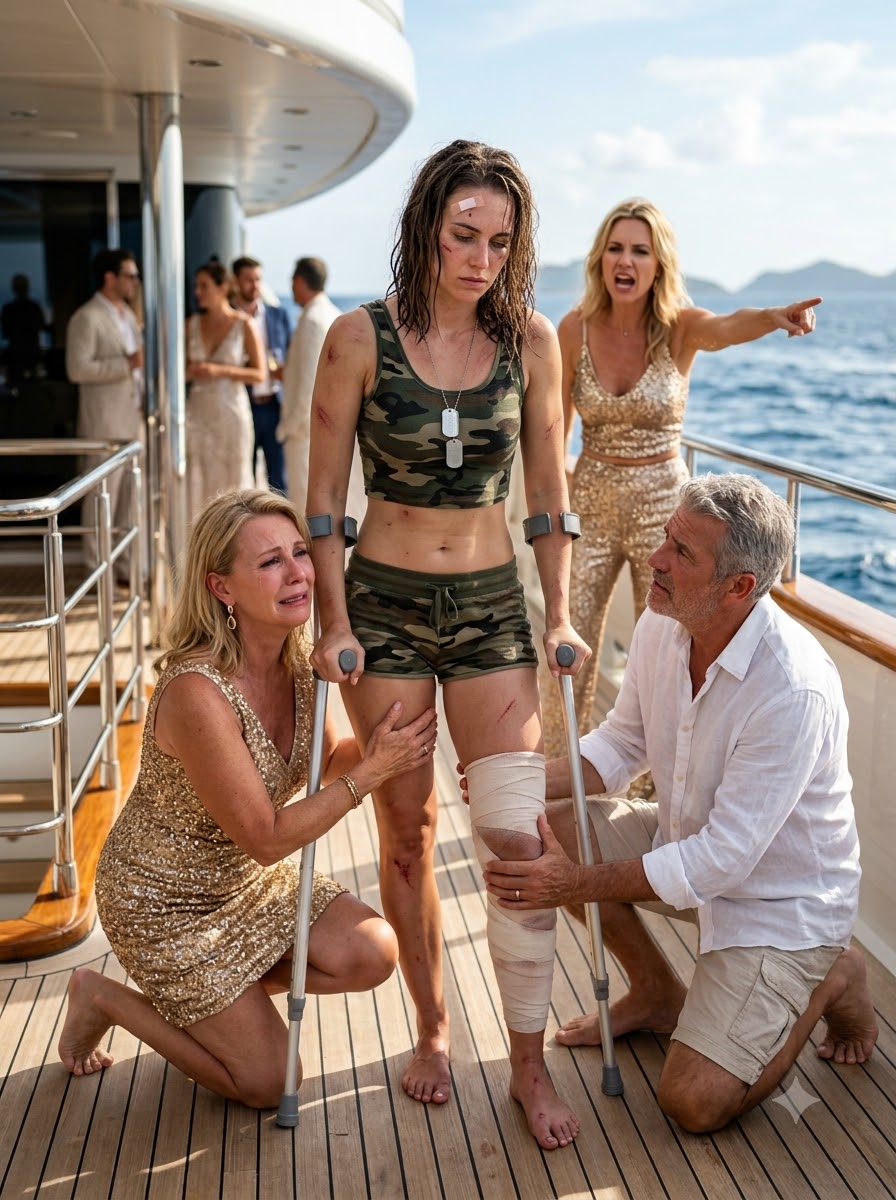
Sterling & Grandson Automotive.
Marcus looked up, every trace of color draining from his face. “Sarah… what did you do?”
“I bought you your garage, Marcus,” I said, a huge smile spreading across my face. “The deed is in your name. The lifts are paid for. The tools are top-of-the-line. You never have to work for someone else again. You never have to sell your dreams for me again.”
He stared down at the keys, his broad shoulders beginning to tremble. He dropped the rag, crossed the concrete floor in three long strides, and pulled me into a crushing embrace. He cried quietly against my shoulder, years of backbreaking work and silent desperation washing away beneath the smell of fresh motor oil.
“You didn’t have to do this,” he whispered fiercely.
“You showed up when I was bleeding, Marcus,” I replied, holding him just as tightly. “You were the only one who did. We build our own legacy now.”
I left the military honorably a year later, having passed my physical fitness tests with flying colors. I now handle the logistics and accounting for Marcus’s garage, which has grown into the premier independent auto shop in the county.
I learned a profound truth in that clinic room, listening to the clinking of champagne glasses while my bones were dying. Family isn’t defined by blood or shared last names. Family is defined by who stands beside you when you are broken, and who is willing to empty their own pockets to buy your bandages.
I didn’t destroy my parents. I simply held up a mirror and allowed them to collapse beneath the weight of their own reflection.
