


“You people never make it easy, do you?”
Before Major General Denise Carter could respond, Officer Grant Mallory swept her legs from beneath her.
Her knees slammed into the concrete first. Then her palms. Then the side of her face struck the driveway so hard she could taste blood. The Georgia sun had scorched the pavement all afternoon, and the heat burned against her cheek, sharp enough to cut through the shock.
Two grocery bags tumbled beside her.
Eggs shattered across the driveway. A milk carton split open, sending a white stream toward the grass. A pint of ice cream rolled beneath the rear bumper of her Honda, melting in the heat before anyone even considered picking it up.
Denise heard her own breathing.

Short.
Controlled.
Her military training took over before fear had a chance.
Do not fight the grip. Do not jerk your arm. Do not give them the movement they are waiting to call resistance.
Mallory pressed his knee between her shoulder blades.
“Stay down.”
“I am not resisting,” Denise said, voice tight against the concrete.
“Then stop talking.”
The words nearly made her laugh, although there was nothing funny about what was happening. She had spent twenty-seven years in uniform issuing orders in war zones, moving supplies through damaged roads and hostile checkpoints, ensuring young soldiers had food, fuel, ammunition, medicine, and a route home. Generals had shouted at her, colonels had questioned her, contractors had underestimated her, and once she had slept beside a runway in Afghanistan while rockets landed close enough to shake dust from the ceiling.
Now she was face down in her own driveway because four local officers had decided a Black woman carrying groceries looked suspicious in a quiet Atlanta suburb.
The screen door opened.
Her daughter stood barefoot on the porch.
“Mama?”
Denise turned her head as far as the knee on her back permitted.
“Stay inside, Maya.”
But Maya Carter was sixteen, furious, frightened, and far too much her mother’s daughter to follow a bad order simply because it came from someone with authority.
“What are you doing to her?” Maya screamed.
One of the officers moved toward the porch.
“Get back inside before you join her.”
Maya stopped for half a second.
Then she raised her phone.
That one movement changed everything.
Twenty-three hours earlier, Denise Carter had stepped off a military transport at Hartsfield-Jackson carrying one duffel bag, one laptop case, and a headache that had begun somewhere over the Atlantic. She had spent six months in Germany coordinating movement plans for more than three thousand troops and enough equipment to fill a small city. Every day had been urgent. Every hour belonged to somebody else.
All she wanted was home.
Her own shower.
Her own sheets.
Her daughter’s voice coming from the kitchen instead of through a screen.
The Uber driver barely spoke, and Denise appreciated the silence. From the back seat, she watched Atlanta pass beyond the window, new towers rising where old corners had been, cranes towering over neighborhoods that had changed while she was gone. The city felt both familiar and unfamiliar, the way home can feel after you have spent too long being needed somewhere else.
The driver dropped her in Oakridge Heights shortly after six on Monday evening.
Her home was a modest three-bedroom ranch with blue-gray shutters, a porch light that flickered in cold weather, and a lawn that had obviously lost its battle with July. The neighborhood carried the smells of charcoal, freshly cut grass, pool chlorine, and hot asphalt. Bicycles sat abandoned in driveways. Someone’s dog barked twice before falling silent.
Maya burst through the screen door before Denise could reach the porch.
She threw her arms around her mother so hard the duffel slipped from Denise’s shoulder.
“You said tomorrow.”
“Caught an earlier flight.”
“You lied.”
“I conducted a strategic surprise operation.”
Maya laughed against her shoulder, and Denise closed her eyes.
For the first time in six months, there was nothing in her hands that needed fixing.
Maya had grown into long limbs, with natural hair gathered into a puff and a Howard University T-shirt she had worn three times that week because she was already imagining college as a country she intended to conquer. Denise held her and felt the private ache of everything she had missed: school events, bad moods, laughter from upstairs, arguments about dishes, ordinary days that nobody properly appreciates until distance takes them away.
They ordered pizza because the refrigerator held mustard, bottled water, and one lemon that had given up on life.
They watched a movie packed with too many explosions and not enough sense.
Maya fell asleep halfway through, her head resting on Denise’s shoulder just as it had when she was eight. Denise remained there in the television glow, barely following the movie, listening to her daughter breathe. Later, she carried Maya to bed even though Maya was nearly as tall as she was and would have complained if she had been awake.
At the doorway, Denise lingered.
Tomorrow, she thought, would be normal.
Groceries.
Laundry.
Emails.
Maybe she would finally have the air conditioner serviced.
Tomorrow she could simply be Denise.
Not General Carter.
Not Ma’am.
Not the person everyone called when the plan went wrong.
Just a mother who was finally home.
By two o’clock Tuesday afternoon, she had a grocery list tucked into her pocket and a cart filled with chicken, rice, tomatoes, salad greens, cereal, coffee, and Maya’s favorite cookie dough ice cream. The store was four blocks away. She recognized half the cashiers by face and one by name. When the cashier noticed the military ID in Denise’s wallet, she welcomed her home.
Denise smiled.
It felt good to be recognized in such a small way.
She pulled into her driveway at 1:51 p.m.
Three houses down, Mr. Leonard Briggs was watering his roses beneath a straw hat that made him resemble a retired history teacher, which he was. A patrol car sat idling at the corner, but Denise hardly noticed it. Frozen groceries were in the back seat, and her daughter had already texted twice asking whether she remembered the ice cream.
Then four patrol cars arrived.
No sirens.
Only lights.
Blue and red flashing sharply across her garage door.
Denise’s first thought was Maya.
An emergency.
A threat.
Something inside the house.
Her stomach sank.
Officer Grant Mallory exited the first car with one hand resting near his weapon. He was in his late thirties, broad-chested, sunglasses covering his eyes, his mouth fixed in the stern expression of a man who had already decided he controlled the next few minutes.
“Ma’am, step out of the vehicle.”
Denise opened the door slowly, keeping both hands visible.
“Of course, Officer. Can you tell me what this is about?”
He gave no answer.
Another officer moved to her right. Two more blocked the driveway.
“Keep your hands where I can see them.”
“They are right here.”
“My ID is in my purse if you need it.”
“Turn around. Hands on the vehicle.”
Denise sensed the change.
It was no longer a request.
It was no longer a misunderstanding being cleared up.
It was a trap taking shape around compliance.
“Officer, I live here. My daughter is inside. If there is some kind of—”
Mallory seized her wrist hard enough to send pain up her arm.
Her training reacted instantly.
Break grip.
Step out.
Control the threat.
But she was not in a war zone. She was standing in a driveway. And in America, a Black woman dealing with police often has to be less trained than she actually is.
“I am complying,” she said. “I am not resisting.”
He turned her toward the vehicle.
Her hip hit the open door.
Her hands struck the hot metal.
“Hands behind your back.”
“I need to understand why I am being detained.”
“You need to stop making this difficult.”
Then he swept her legs.
After that, everything became concrete, heat, blood, and Maya screaming from the porch.
Mr. Briggs dropped his hose.
Water ran across his lawn as he stepped toward the sidewalk, his phone already in his hand.
“That’s Denise Carter,” he called. “She lives here. She’s my neighbor.”
An officer turned toward him.
“Sir, step back or you’ll be detained too.”
Mr. Briggs stepped back.
But he continued recording.
The doorbell camera recorded too.
So did Maya.
Mallory pulled Denise upright and escorted her toward the patrol car. He never read her rights. He never explained what charge she faced. He pushed her head downward as he forced her into the back seat, even though she was already under control.
Maya ran down the driveway.
Mr. Briggs stopped her before she could reach the car.
“Let me go,” she cried. “That’s my mother.”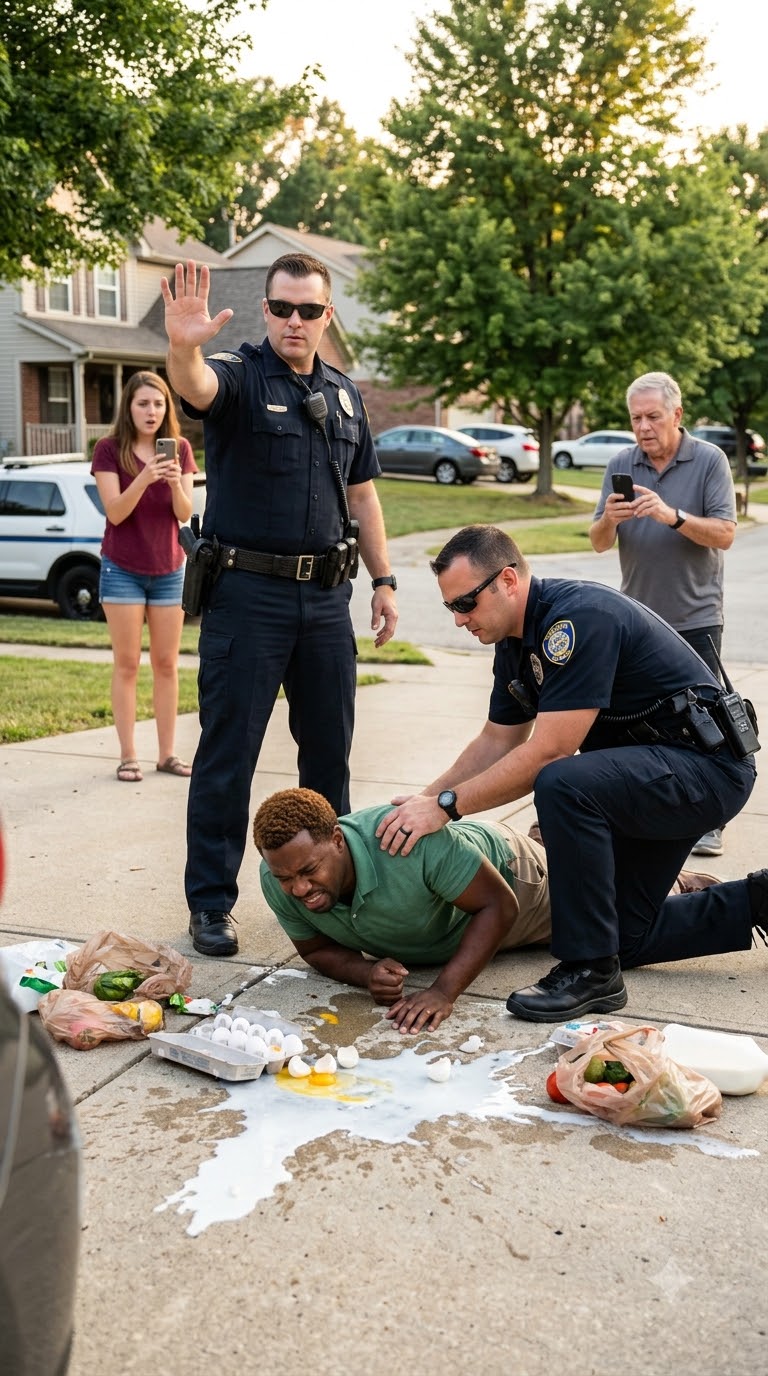
“I know,” he said, his voice breaking. “Keep recording.”
Denise saw her daughter through the window.
She wanted to say something.
Anything.
But the door slammed shut.
The patrol car drove away.
The grocery bags stayed behind in the driveway, the milk growing warm, the eggs broken, and the ice cream melting beneath the bumper in the July heat. At the Oakridge Precinct, Denise was placed in a holding cell without being properly booked.
No fingerprint record she could see.
No formal charges.
No phone call.
No explanation.
The cell reeked of disinfectant, sweat, aging metal, and despair that seemed to have settled into the concrete long before she arrived. Her wrists ached from cuffs that had been fastened too tightly. Her cheek still burned. Blood and dirt stained her uniform shirt.
She sat on the metal bench and waited.
Time crawled when nobody felt obligated to give you answers.
Outside, Maya’s video was already spreading online.
She posted it to TikTok first because she was sixteen, and that was where panic traveled fastest. Then she uploaded it to Instagram, X, and Facebook, sending it to three friends with one message.
They arrested my mom in our driveway. She didn’t do anything.
The video shook because Maya’s hands were shaking.
But the truth stayed steady.
A Black woman lying face down on concrete.
A white officer’s knee between her shoulder blades.
Groceries scattered around her.
A daughter shouting that it was her mother.
A neighbor confirming that she lived there.
No weapon.
No threat.
No explanation.
By 2:30, the video had reached twelve thousand views.
By 3:15, it had passed seventy thousand.
By 5:00, local reporters were outside Denise’s home, stepping carefully around the groceries because Mr. Briggs had refused to move them.
“That driveway is evidence,” he said.
On camera, he looked exactly like what he was: a sixty-four-year-old retired teacher who had spent four decades teaching young people that history mattered and had now found himself standing inside it.
“I’ve known Denise Carter for seven years,” he told the reporter. “She is quiet, respectful, military, a good mother, a good neighbor. There was no reason for what happened today. No reason except the one people always pretend they don’t see.”
By that evening, more neighbors began speaking out.
A Black accountant two streets away said he had been stopped six times in one year while driving home from work. A Latina mother described patrol cars following her from the grocery store and remaining parked outside until she went indoors. A white couple with two adopted Black sons said police slowed down almost every time their boys played basketball in the driveway.
A pattern was beginning to emerge.
Not on paper yet.
In voices.
At 7:22 p.m., a desk sergeant opened Denise’s cell.
“You’re free to go.”
Denise slowly rose.
“Why was I detained?”
The man avoided her eyes.
“You’ll need to speak with the officers involved.”
“I am speaking with you.”
“You were released without charges.”
“That is not an answer.”
“If you have a complaint, you can file a grievance online.”
He delivered the words like a weather report.
Denise stepped out of the precinct into heat that felt almost personal.
Maya was waiting in the parking lot with Mr. Briggs.
She rushed into her mother’s arms, trembling so badly that Denise had to steady them both.
“I recorded it,” Maya whispered. “Everything. Everybody’s seeing it now.”
Denise still did not understand what everybody meant.
She did not know the video had already passed two million views.
She did not know the hashtag was trending across Atlanta.
She did not know strangers had paused the footage, zoomed in on her uniform insignia, searched her name, and discovered what Officer Mallory had never taken the time to learn.
By sunrise, the entire country knew who had been thrown onto that driveway.
At 6:47 Wednesday morning, a screenshot surfaced on Reddit.
Denise Carter’s professional biography.
Major General, United States Army.
Twenty-seven years of service.
Four deployments.
Bronze Star.
Current assignment: Deputy Commander, Strategic Logistics Command, Fort Stewart, Georgia.
The top comment read, They put a two-star general on the ground for bringing home groceries.
By 8:00 a.m., national news outlets had picked up the story.
By 9:30, cable panels were debating it.
By 10:15, someone from the Pentagon called the Atlanta police chief directly.
The call lasted eight minutes.
No transcript was released.
It was unnecessary.
At 10:41, Oakridge Precinct Captain Russell Dane called Denise.
She allowed the call to go to voicemail.
“General Carter, this is Captain Dane with Oakridge Precinct. I’d like to discuss yesterday’s unfortunate incident and extend our regrets for any misunderstanding.”
Denise listened to it twice.
Unfortunate incident.
Regrets.
Misunderstanding.
Not assault.
Not unlawful detention.
Not an apology.
She deleted the voicemail.
At noon, the department released a statement.
They were aware of the incident. They were reviewing what happened. Officer Grant Mallory had been placed on administrative leave pending an investigation. The department took every complaint seriously and remained committed to professionalism, transparency, and community trust.
Paid leave.
Carefully chosen language.
No admission.
Denise understood institutional language.
She had written enough official statements to recognize when a sentence was designed to protect the truth and when it was designed to bury it.
That afternoon, investigative reporter Claire Whitaker read the department’s statement three times at her desk inside the Atlanta Ledger newsroom.
Then she opened a new file.
Claire had spent eleven years reporting on police misconduct. She knew what administrative leave often meant. Delay. Exhaustion. Waiting for public outrage to fade. Protecting the officer. Blaming training. Promising review. Changing nothing.
But this case felt different.
Not because Denise deserved more than anyone else.
Because she was harder to make disappear.
Claire began with the records.
Internal affairs complaints against Grant Mallory.
Use-of-force reports.
Body camera failures.
Overtime logs.
Computer-aided dispatch records.
For three days, the city stalled.
Then a source helped.
Detective Aaron Vale met Claire at a coffee shop thirty miles from Oakridge. He was forty-five, tired around the eyes, and carried the expression of a man who had held onto something troubling for too long.
“Mallory isn’t the disease,” he said. “He’s a symptom.”
Claire said nothing.
Vale pushed a thumb drive across the table.
“Arrest targets. Overtime manipulation. Body camera failures. Complaints buried by Captain Dane. They call it productivity. It is a quota system, even if nobody writes the word quota where lawyers can see it.”
“Why give this to me?”
He lowered his eyes to his coffee.
“I have daughters.”
That was all he said.
The first file contained the dispatch log from Denise’s arrest.
Mallory had reported a suspicious person before Denise had even reached her driveway. There was no neighbor complaint. No emergency call. No reported crime. He had spotted her car, followed her, and turned her mere presence into suspicion.
The second file contained body camera malfunction records.
Mallory’s camera had malfunctioned nine times over seventeen months, almost always during incidents that later produced complaints. The precinct average was nowhere close to that. Bad luck did not fail with that kind of precision.
The third file was an email from Captain Dane.
June 18.
Subject: July productivity expectations.
Fifteen arrests minimum per officer. Overtime approvals will reflect performance. No exceptions.
Claire stared at the screen.
Georgia law prohibited arrest quotas.
Dane had avoided the word, but not the meaning.
The fourth file made her lean back.
Overtime.
Mallory and six other officers had reported extraordinary overtime hours tied almost entirely to arrests made during the final thirty minutes of their shifts. Those arrests triggered processing time. Processing time triggered overtime. Most of the charges were later dropped, dismissed, or never properly filed. The scheme was more than abusive.
It was profitable.
Claire created the spreadsheet herself.
Names.
Dates.
Arrests.
Charges.
Dismissed cases.
Overtime payments.
Complaints.
Body camera failures.
The pattern was not concealed because it was complicated.
It was concealed because those behind it believed nobody important enough would ever examine it.
Her article was published Monday morning.
The Oakridge Pattern: How Arrest Targets And Overtime Fraud Built A System Of Abuse.
By noon, the mayor’s office was demanding answers.
By 3:00, the Fulton County district attorney announced a preliminary review.
By that evening, Claire’s phone was overflowing with messages from people in other precincts claiming they had experienced the same thing.
That was when the police union intervened.
The Atlanta Police Protective Association issued a statement describing Officer Mallory as a dedicated public servant with ten years of exemplary service. They cautioned against rushing to judgment. They argued that officers made split-second decisions under pressure. They warned that media narratives endangered police.
They said nothing about the video.
Nothing about Denise complying.
Nothing about the complaints, the quota email, the overtime records, or the fact that Mallory had initiated the stop himself.
Union vice president Paul Sutter appeared on television that night.
“I wasn’t there,” he said smoothly. “We don’t know what happened before the camera started.”
The host glanced down at her notes.
“The doorbell camera shows the entire encounter.”
Sutter offered a practiced smile.
“Video rarely tells the whole story.”
The phrase worked for people who wanted an excuse to doubt what they had witnessed.
The following day, rumors began circulating.
Anonymous accounts claimed Denise had caused problems at HOA meetings. Someone alleged there had been noise complaints. Another claimed she had a temper and enjoyed pulling rank. None of it came with evidence. It did not need evidence to cause damage.
Maya saw the comments at school.
Her classmates saw them too.
One boy whose father was an officer told her, “Your mom is making it harder for good cops to do their jobs.”
Maya stared at him.
“My mom came home with groceries.”
He shrugged.
“People don’t get arrested for nothing.”
That sentence stayed with her all day.
When she arrived home, her eyes were red.
Denise sat at the kitchen table with her laptop open, staring at an email she still had not sent.
Dear Ms. Whitaker, after careful consideration, I have decided to withdraw my cooperation.
The message had remained on the screen for an hour.
That morning, a Pentagon colleague had called with a cautious voice and concern that carried a threat beneath it.
“Denise, you know I respect you, but some senior people worry this is becoming politically charged. You are up for a command review next year. Nobody wants civilian controversy complicating your future. Maybe accept the department’s apology, take a quiet settlement, and move forward.”
Denise understood exactly what he meant.
Fight less.
Keep your career.
Protect your daughter.
Allow the system to bruise you and call it peace.
Then Maya came through the door, dropped her backpack, and told her mother what had happened at school.
Denise shut the laptop.
“I’m sorry.”
Maya looked at her.
“Why are you sorry?”
“Because this is touching you now.”
“It touched me when I watched them put you on the ground.”
Denise had nothing to say.
Maya sat across from her.
“You always told me to follow the rules and I would be okay.”
Denise flinched.
“I know.”
“You followed every rule.”
Silence filled the room.
Maya angrily wiped her face.
“So what am I supposed to learn from this? That rules only protect people when someone important is watching? That you have to be a general before anyone cares?”
Denise looked at her daughter.
The truth rested between them, painful and clear.
Then she deleted the email.
She opened another.
Dear Ms. Whitaker, I am ready to move forward. Tell me what you need.
She pressed send.
Maya watched.
“So we’re fighting?”
Denise exhaled.
“We’re fighting.”
“Good.”
Maya grabbed her backpack and headed upstairs.
“I have homework. Tell me if you need me to testify or whatever.”
Denise almost laughed.
Almost.
Three days later, the ACLU of Georgia filed a federal civil rights lawsuit on Denise’s behalf.
The complaint did not describe the incident as one officer simply losing control. It named Grant Mallory, Captain Russell Dane, the City of Atlanta, and the policies that had made the arrest predictable. Fourth Amendment violations. Fourteenth Amendment violations. False detention. Excessive force. Unlawful arrest quotas. Retaliation. Systemic failure to discipline officers with repeated complaints.
Paragraph three stated:
This case is not an isolated incident. It is policy.
That sentence transformed the story.
Then Claire Whitaker received another file.
An audio recording.
Captain Dane’s voice filled her headphones.
“Fifteen arrests each. Minimum. I don’t care if it’s loitering, obstruction, suspicious activity, whatever fits. Hit the numbers or you lose overtime. Clear?”
A younger officer asked, “Captain, isn’t there a state law against quotas?”
Dane snapped, “There is no law against productivity.”
Claire published the transcript after forensic confirmation.
The following morning, the city council called an emergency session.
By afternoon, the finance director had referred the overtime records to federal investigators.
Then Claire traced the money beyond Oakridge.
Twelve precincts.
The same overtime pattern.
The same late-shift arrests.
The same dismissed charges.
The same carefully worded emails avoiding the word quota while enforcing the practice itself.
The figure exceeded four million dollars in questionable overtime.
That number changed everything.
Four million dollars was not a misunderstanding.
Four million dollars was not one bad officer.
Four million dollars was a machine.
Federal prosecutors began examining the matter.
The FBI public corruption unit opened an inquiry.
The blue wall began to crack, not because it had suddenly developed a conscience, but because people inside it started wondering who would be sacrificed first.
Detective Aaron Vale was transferred to midnight patrol two days after the first article.
He texted Claire from a blocked number.
Keep digging. It goes higher than Dane.
She did.
Union records came next.
Meeting notes showed Paul Sutter had urged captains to increase “productivity-linked overtime opportunities” eighteen months earlier. He had helped create the system, then appeared on television defending one of the officers who benefited from it.
Sutter resigned, citing health reasons.
Nobody believed him.
The grand jury convened on August 12.
Denise entered the courthouse wearing her Army service uniform, ribbons straight, posture steady, the bruises mostly faded but not forgotten. Maya sat outside the grand jury room with Mr. Briggs, who had brought peppermints because he believed every civic crisis required peppermints.
Inside, Denise raised her right hand and swore to tell the truth.
The prosecutor asked her to describe July 14.
She did it the way she would brief a command failure.
Time.
Location.
Sequence.
Officer statements.
Physical contact.
Injuries.
Detention.
No charges.
No explanation.
No probable cause.
“Do you believe race played a role?” the prosecutor asked.
Denise paused.
“Yes.”
“Why?”
“Because Officer Mallory saw a Black woman in a neighborhood he decided did not fit her. Because he created suspicion before I spoke. Because he ignored my compliance. Because the system behind him had rewarded that behavior before. Because this did not happen in a vacuum.”
The jurors listened.
Then they watched the video.
Maya’s video.
Mr. Briggs’s video.
The doorbell footage. The dispatch log.
The body camera failures.
The quota audio.
The overtime charts.
Mallory testified after her.
He invoked the Fifth Amendment seventeen times.
Captain Dane attempted to justify the productivity expectations.
Then prosecutors played his own voice.
Hit the numbers or lose overtime.
His lawyer instructed him to stop answering.
The grand jury reached its decision in less than two hours.
Grant Mallory was indicted for assault under color of law, false imprisonment, official misconduct, and theft by deception.
Captain Russell Dane was indicted for conspiracy, violation of Georgia’s arrest quota statute, official misconduct, and fraud.
Paul Sutter was indicted on conspiracy and racketeering-related charges connected to the overtime scheme.
Six additional officers were charged over the next month.
The first time Denise saw Mallory brought into court in handcuffs, she felt no happiness.
Joy would have been too small.
What she felt was recognition.
For years, the system had placed metal around the wrists of innocent people.
Now that metal had found someone who had helped construct the reason.
Weeks later, the Army announced Denise Carter’s promotion to Lieutenant General.
Three stars.
The ceremony took place at Fort Stewart beneath a pale blue sky. Soldiers stood in formation. Cameras filled the back of the area. Reporters whispered as Maya stepped forward to pin the new star onto her mother’s uniform.
Her hands trembled.
Denise leaned down slightly so her daughter could reach.
Maya whispered, “You look taller.”
Denise whispered back, “That’s the shoes.”
Maya laughed, and the sound nearly broke Denise’s composure.
During her remarks, Denise did not mention Mallory.
She did not mention Dane.
She did not mention the men who had attempted to turn accountability into controversy.
Instead, she spoke about service.
“An oath is not a decoration,” she said. “It is a responsibility. It means nothing when it is easy. It means everything when keeping it costs you.”
The applause continued longer than she had expected.
Oakridge changed afterward.
Not magically.
No city transforms itself simply because one report is published or one lawsuit is filed. But the old machine had lost its hiding place. Mandatory body cameras were installed with automatic cloud uploads. Officers could no longer manually disable them during civilian encounters without immediate suspension. Arrest-related overtime required independent review. Civilian oversight received subpoena power. Complaint histories could no longer disappear into sealed personnel folders.
Captain Dane was removed.
Two precinct commanders resigned.
The city established a public dashboard tracking stops, use-of-force incidents, complaints, and overtime patterns by precinct.
It was not enough.
But it was no longer nothing.
Maya spoke at the first community meeting following the announcement of the reforms.
She stood behind a podium inside a school gym packed with neighbors, officers, reporters, veterans, activists, and people who had come because, for the first time in years, they believed someone might listen.
She was sixteen.
Her voice trembled only once.
“My mother taught me to follow rules,” she said. “I still believe rules matter. But rules have to apply to the people with power too, or they are not rules. They are just instructions for the powerless.”
The gym fell silent.
Then Mr. Briggs rose and applauded.
Others joined him.
The applause lasted forty seconds.
Maya stepped away from the podium and returned to her seat beside Denise.
“You did good,” Denise whispered.
Maya stared straight ahead, trying not to smile too much.
“I know.”
Months later, Claire Whitaker received awards for the series.
She accepted them politely, then returned to work because awards did not repair systems, and systems never ran out of ways to protect themselves.
Detective Aaron Vale testified under subpoena and eventually left the department.
He became an investigator for the civilian oversight board.
Mr. Briggs finally replanted the roses he had drowned on the day Denise was arrested.
The new blooms came in red and stubborn.
As for Grant Mallory, his trial did not move quickly. Justice rarely moved quickly once lawyers were being paid by the hour. He pleaded not guilty. Dane pleaded not guilty. Sutter claimed political persecution. Their lawyers used every delay available to them.
Denise attended every hearing she could.
Not because she needed to watch them punished.
Because the record mattered.
Presence mattered.
Refusal mattered.
Nearly a year after the arrest, Denise pulled into her driveway one evening with groceries again.
Chicken.
Rice.
Vegetables.
Cookie dough ice cream.
For a moment, she remained in the car and stared at the concrete.
The stains were gone.
Rain had washed away the milk. Heat had erased the ice cream. Mr. Briggs had cleaned up the broken eggs after investigators finished photographing the scene. Nothing visible remained from the afternoon that had changed their lives.
But Denise could still see it.
Her body remembered the heat.
The knee.
The metal.
Maya’s voice.
She slowly got out.
Maya opened the front door.
“You need help?”
Denise picked up two bags.
“No. I’ve got it.”
Then she stopped.
Actually stopped.
She looked at her daughter, then at the driveway, then at the quiet street where children rode bikes beneath old trees and neighbors seemed a little more alert to one another than they had before.
“Take the ice cream,” Denise said.
Maya smiled.
“Strategic priority?”
“Always.”
Together, they carried the groceries inside.
Years later, people would tell the story in shorter versions.
They would say police tackled a Black general in her own driveway and that it brought down a corrupt precinct. They would talk about the viral video, the arrest quotas, the overtime fraud, the indictments, the promotion, and the reforms. They would describe it as though one dramatic event had changed everything.
But the truth was larger and more difficult.
A daughter pressed record while terrified.
A neighbor refused to look away.
A journalist followed paperwork until the pattern had nowhere left to hide.
A whistleblower chose conscience over comfort.
A mother nearly quit to protect her child, and the child reminded her what courage had always meant.
Denise Carter had spent her life moving supplies through war zones, making sure the right things reached the right people before disaster became permanent. She had never imagined that the hardest supply line of her career would run through a suburban driveway, a viral video, a courthouse, a newsroom, and the frightened heart of her own daughter.
But that was the nature of service.
You do not always get to choose the battlefield.
Sometimes it finds you while you are carrying groceries.
Sometimes it throws you to the ground.
Sometimes it tries to convince you that silence is safer than truth.
And sometimes, when enough people refuse to look away, the person they tried to break becomes the reason the entire system finally has to answer.
On the day she received her third star, a reporter asked Denise how she felt about everything that had happened.
She thought about the concrete.
The cell.
The smear campaign.
The threats.
Maya sitting at the kitchen table and asking what rules meant if they only protected some people.
Then Denise smiled without softness.
“They looked at me,” she said, “and saw a threat.”
She paused.
“They were right. Just not the kind they expected.”
