

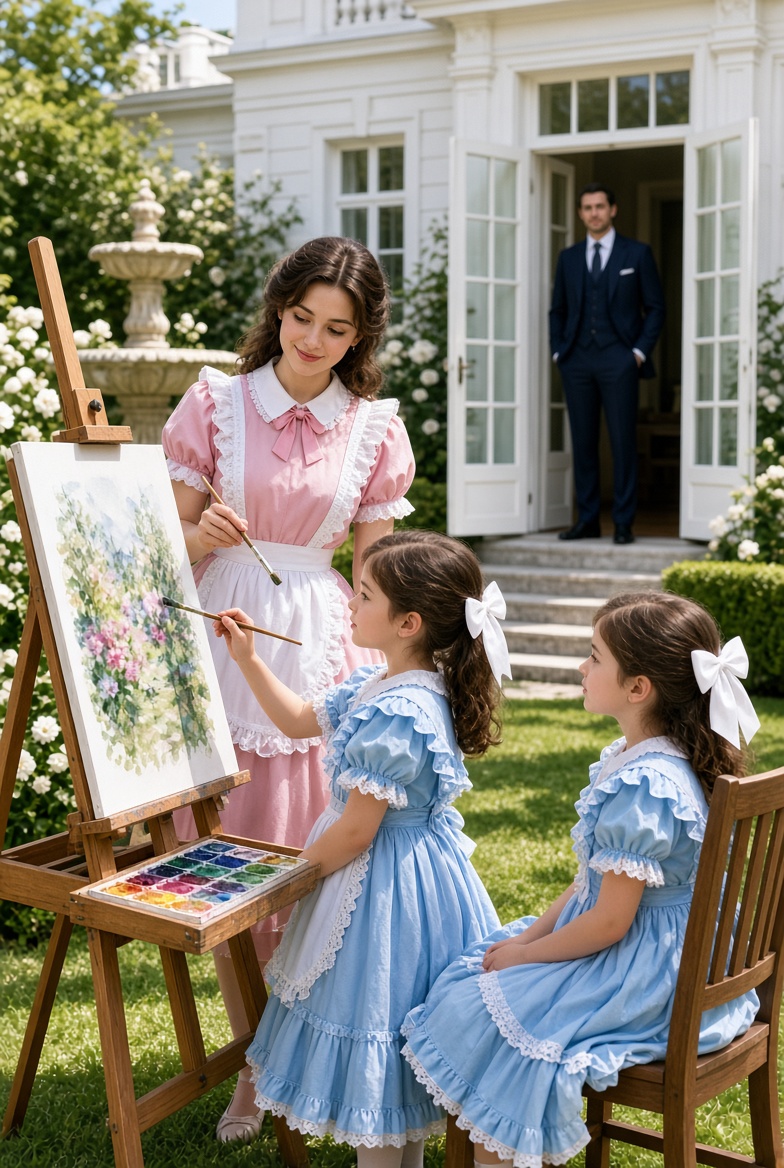
When widowed tech CEO Daniel Morgan stepped into the backyard of his estate in Westchester County, New York, he was not prepared for what he saw.
His twin daughters, Emma and Lily, were laughing.
For the first time in months.
Ever since their mother, Rachel Morgan, had died, the girls had done almost nothing but cry and withdraw. They rejected hugs. They answered questions with a silence that had weight. The once lively mansion — the house Rachel had filled with music and the smell of cut flowers and the particular disorder of a family that was not afraid of being loud — had become a mausoleum of grief. Staff moved through it on the balls of their feet. Daniel came home after dark and left before breakfast and told himself that work was the only thing he still knew how to do without breaking.
But there they were, sitting on the grass in the late afternoon light, covered in paint, smiling as if the world had not ended in a hospital corridor the previous winter.
And kneeling beside them was Sophie Carter, the twenty-three-year-old housekeeper he had hired strictly for cleaning.
She was teaching them how to paint.
Daniel stood frozen behind the glass doors. He had come home early by accident — a canceled call, a driver who had taken the parkway instead of the longer route — and the accident had delivered him to a scene he had not known how to invent. Emma held up a canvas with a crooked yellow sun, the kind of sun a child makes when joy has only just remembered its own shape. Lily pointed proudly to a messy but determined painting of the stone fountain in the garden, the one Rachel had chosen the year the twins were born. Sophie guided them gently, patiently, her voice low enough that Daniel could not hear the words, only the tone. It was a tone he had not managed in months. He had tried. He had sat on the edges of beds and offered the right sentences. The girls had looked through him as if he were another piece of furniture the house had inherited from a life that was over.
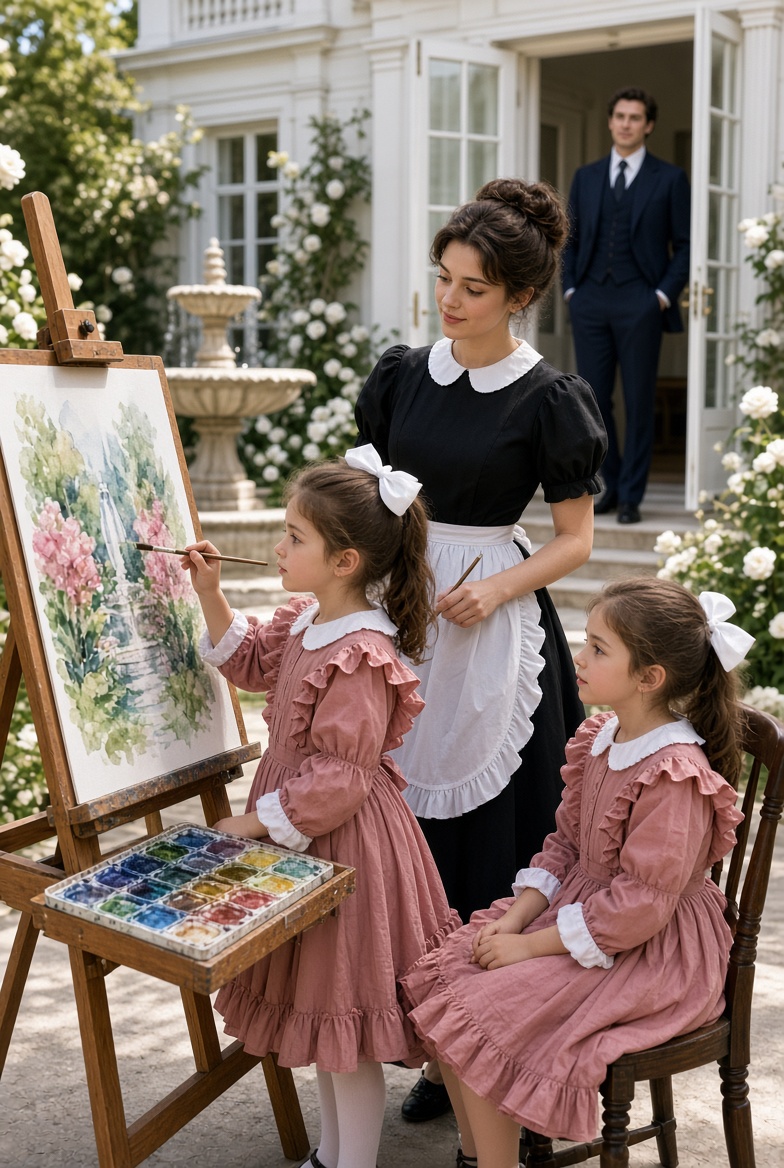
He pushed the door open.
Sophie stiffened at once, the brush suspended midair. Paint marked her wrist and the hem of the apron she wore over a plain dress. She looked, in that first second, like a person preparing to be dismissed.
“Mr. Morgan, I can explain. The girls asked. I brought leftover supplies from when I used to volunteer at a community art center. I didn’t mean to overstep.”
The apology arrived fully formed, the way apologies do when a young woman has spent her working life expecting to be in the wrong.
Daniel looked at Emma’s sun. He looked at Lily’s fountain. He looked at his daughters’ faces, which had color in them again.
“Don’t stop,” he said quietly. “Please. Continue.”
Sophie hesitated, as if the sentence might be a test. Then she lowered the brush and turned back to the girls, and the afternoon resumed as if a man in a dark suit had not just walked out of a dead house into a living one.
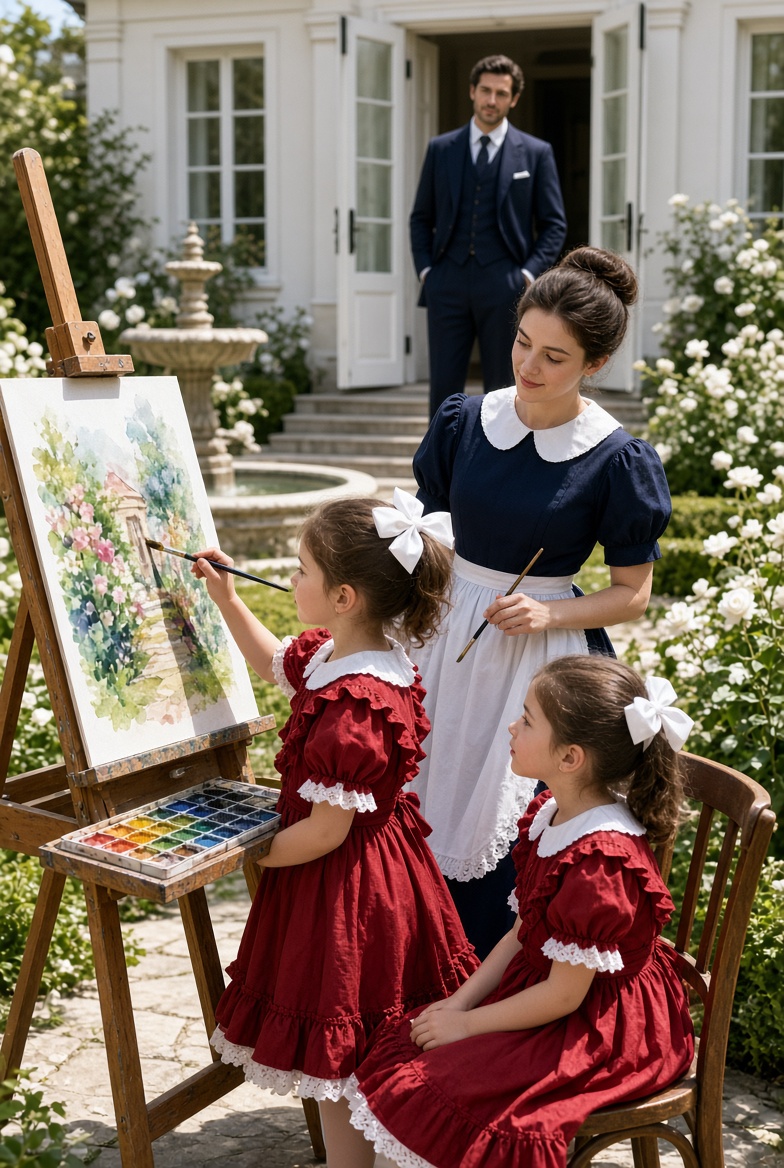
That afternoon changed everything, though it did not announce itself as a turning. Daniel canceled the remaining meetings from the stone bench near the hedge, his thumb moving across the screen with a carelessness that would have alarmed his chief of staff. He sat in the grass, not close enough to crowd them, close enough to be present. He watched Emma mix yellow until it became something that wanted to be gold. He watched Lily frown at the fountain and then laugh when the water on the canvas refused to stay inside the lines. He watched Sophie correct nothing that did not need correcting and praise nothing that was not true.
When the light went thin and the girls’ hands were a chaos of color, Sophie cleaned the brushes in a jar of cloudy water and spoke to them the way Rachel had once spoken to them — not as a performance of motherhood, but as a conversation with two particular people.
Daniel carried the canvases inside himself. He set them on the sideboard in the hall where Rachel’s last arrangement of dried hydrangeas still stood, because no one had known how to move them.
Later that night, after the twins had been bathed and the paint had been argued out of Lily’s hair and Emma had fallen asleep with her sun still drying downstairs, Daniel found Sophie in the kitchen rinsing the last of the palettes.
He asked her, not as an employer taking inventory, but as a man who had seen something he did not understand.
She told him the rest without ornament.
She had studied art. Not as a hobby. As a vocation she had believed would be allowed to last. Her mother had been an art teacher in a public school that lost its funding the year Sophie graduated high school, and the apartment had grown quieter after that in the way apartments do when a calling is taken away. Sophie had lasted three semesters at college before the math of tuition and rent and her mother’s prescriptions became a problem no talent could solve. She dropped out. She took work that paid on Fridays. She volunteered at a community art center on the two evenings a week she could still give away, because brushes and cheap paper were the last remaining proof that the other life had been real.
She had talent. Real talent. Daniel was not a collector in the fashionable sense, but he had spent enough years in rooms with expensive things to know the difference between decoration and a hand that saw.
He made a decision that night, sitting at the kitchen table after she had gone upstairs to the small staff room at the end of the west corridor.
From the next day forward, Sophie would no longer focus on heavy cleaning. He hired additional staff — a woman named Mrs. Pell who had raised four children and did not require the house to be explained to her, and a younger man for the floors and the windows and the work Sophie’s back should not have been doing at twenty-three. Sophie’s priority would be the girls.
He told her so in the morning in the same kitchen, before the twins came down. She stood with her hands at her sides and did not immediately accept, because acceptance, for her, had so often been a prelude to a condition.
“I am not promoting you into a performance,” he said. “I am asking you to keep doing the one thing this house has not been able to do since October.”
She nodded once. Then she went to wake Emma and Lily, and the day began with the sound of two children arguing over who would use the blue first. It was the most ordinary sound in the world. In that house it was a resurrection.
Over time, laughter returned the way light returns to a room when someone finally opens a curtain that has been closed from habit rather than need. The twins painted in the garden when the weather held and at the long table in the sunroom when it did not. Sophie taught them that a mistake on paper was not a verdict. She taught them that grief could sit in the corner of a picture and still leave room for a sun.
Daniel began coming home early. At first he told himself it was to check on the arrangement. Then he stopped telling himself anything. He took off his jacket in the hall. He sat on the floor. He learned the names of colors he had not thought about since he was a boy. He started healing too, which surprised him more than the girls’ laughter had, because he had assumed healing was a resource he had already spent.
Weeks turned into months. The house learned a new grammar. Sophie still lived in the staff room, still ate some meals separately from habit, still called him Mr. Morgan in front of anyone who might be keeping score. But the evenings lengthened. They talked after the twins were asleep — not always about Rachel, though Rachel was in the room whether they named her or not, and not always about art, though art was the language they had found for the things that would not otherwise come out. Affection arrived the way weather arrives: first as a change in the air, then as a fact no one could honestly deny.
Daniel did not rush it. He had buried a wife. He would not turn a young woman’s kindness into a convenience. Sophie did not rush it either. She had learned, in other houses, what it cost to be mistaken for available.
Love, when it declared itself, did so without a speech. It was in the way he looked for her when he came through the door. It was in the way she waited, without seeming to wait, until he had seen the girls first.
When his mother arrived, the house remembered an older set of rules.
Margaret Morgan was a rigid socialite from Manhattan, a woman who had survived three decades of charity luncheons and two husbands and the particular education that teaches a person to rank rooms by who is allowed to stand in them. She came for a weekend and lasted less than an afternoon before she found Sophie in the garden with a brush in her hand and the twins’ paint on her sleeve.
The insult was not loud. Margaret’s insults rarely needed volume. They needed an audience and a place.
Sophie had forgotten hers, Margaret said. A housekeeper who sat on the lawn as if she belonged to the family was a confusion the house could not afford. There were schools. There were proper tutors. There were women of a certain background who could be hired to do what Sophie was doing without the unfortunate suggestion of attachment.
Sophie set the brush down. She did not answer. She had answered women like Margaret before, and the answers had never traveled farther than the door.
Daniel heard it from the terrace.
He did not raise his voice. He did not perform outrage for the staff who had gone still in the doorway. He walked into the garden and stood between his mother and the young woman who had given his daughters back their afternoons, and he said the sentence the house had been waiting, without knowing it, to hear.
“I am defending the woman I love.”
Margaret looked at him as if he had spoken in another language. Perhaps he had. It was not the language of the clubs she still belonged to, or of the columns that would have found the match irregular, or of the caution he had lived by since Rachel’s funeral.
It was simply true.
The weekend ended earlier than planned. Margaret left with the dignity of a woman who intended to be right later. Daniel did not follow her to the car to soften it. Sophie stood in the garden after the engine faded and looked at him as if the ground had shifted under a place she had been careful not to claim.
“You didn’t have to say it like that,” she said.
“I did,” he answered. “I have spent a year not saying the things that mattered. I am finished with that.”
Three months later they married in the same garden where it had begun.
There was no cathedral and no guest list designed to impress a city that had already been impressed enough. Emma and Lily wore white dresses that did not stay white for long, because the fountain was still there and children are not interested in remaining ceremonial. Sophie carried no bouquet large enough to hide behind. She carried a small bunch of whatever was blooming along the wall Rachel had planted, and she looked at Daniel as if the future were a canvas that had frightened her once and no longer did.
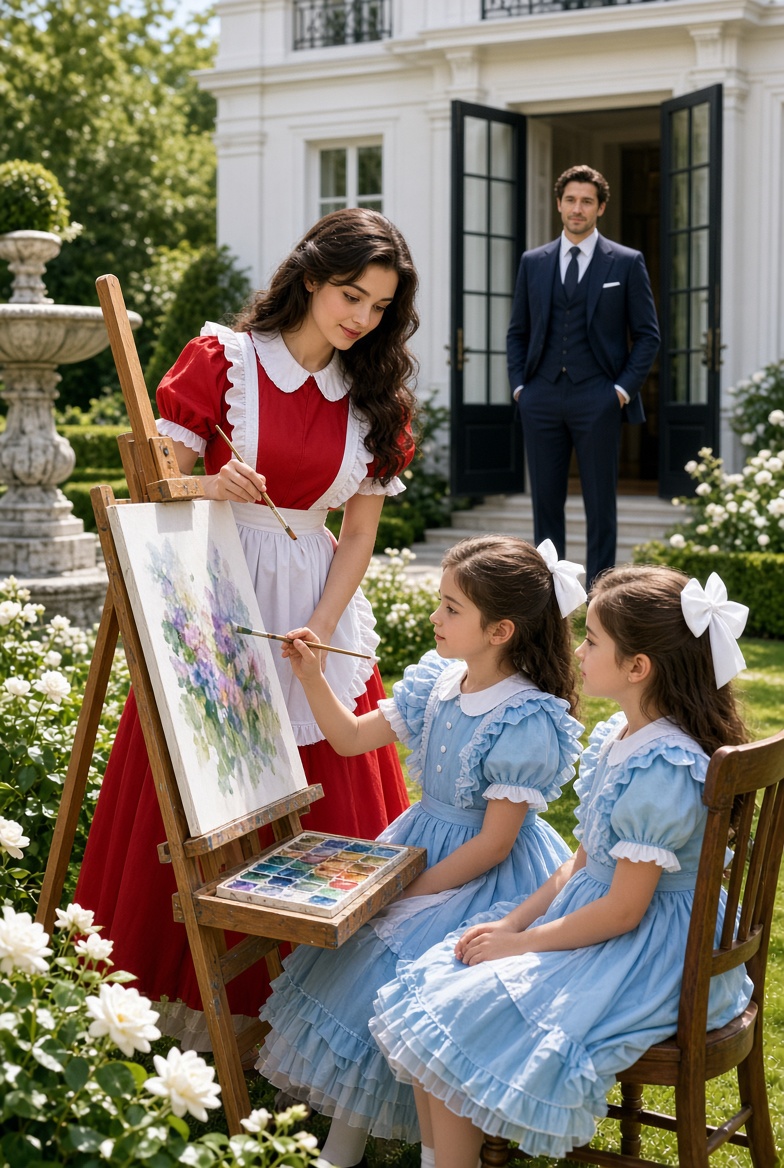
The picture she had been making all those months — the one the title of their life would later insist upon — was not a single canvas. It was the accumulated work of afternoons: two girls learning that color could hold what words could not, a father learning to come home while there was still light, a young woman learning that talent was not a luxury she had to apologize for. If there was a secret the picture revealed, it was not a scandal. It was the quieter fact the house had been too grieved to see: that worth does not announce itself in a résumé, and that the person hired to polish the floors may be the only one still able to see the light in the room.
Sophie finished her Fine Arts degree with Daniel’s support — not as a gift that created a debt, but as the completion of a sentence poverty had interrupted. She went to class. She came home and painted with the twins. She submitted work that did not flatter anyone’s idea of a Cinderella story, because she refused to make her life into a theme.
Her graduation exhibition was centered on healing through art. The rooms were not grand. The paintings were. They held grief without decorating it. They held children without sentimentalizing them. They held a garden in Westchester that had been a graveyard and then, slowly, a studio.
The exhibition caught the attention of the Metropolitan Museum of Art in New York City. Attention of that kind is never a single phone call; it is a chain of people who know other people, and then a visit, and then a conversation in which Sophie was asked to speak about process and instead spoke about two little girls who had forgotten how to laugh. National recognition followed, as recognition does when a story is both true and usable. Sophie used it carefully. She did not become a mascot for other people’s inspiration.
Eventually she founded the Carter-Morgan Art Institute.
It offered free art education to underprivileged children — the kind of children she had been, the kind who learn early that paper is expensive and encouragement is rarer than that. The institute did not require a parent to know the right people. It required a child to show up with hands that wanted to make something. Daniel sat on no stage at the opening. He stood at the back and watched Sophie welcome a room full of students who did not care that he built software, and he thought of a yellow sun drying on a sideboard in a silent house.
Years later, when people asked Daniel when his life changed, he always said the same thing.
“The day I came home early, and found my housekeeper painting in the garden.”
He did not add the rest, because the rest belonged to the people who had lived it: to Emma and Lily, who still painted when they needed to remember their mother without having to say her name; to Sophie, who had walked into a mausoleum with a jar of leftover brushes and refused to treat grief as a rule against color; to Rachel, whose fountain remained in the garden and in a child’s first picture and in the fact that love, in that family, had learned how to continue.
Because sometimes the greatest masterpieces are not painted on canvas.
They are built through love, courage, and the willingness to see someone’s true worth — even when that someone arrived in a plain dress, holding a broom, and was never supposed to be the person who taught a house how to live again.
