

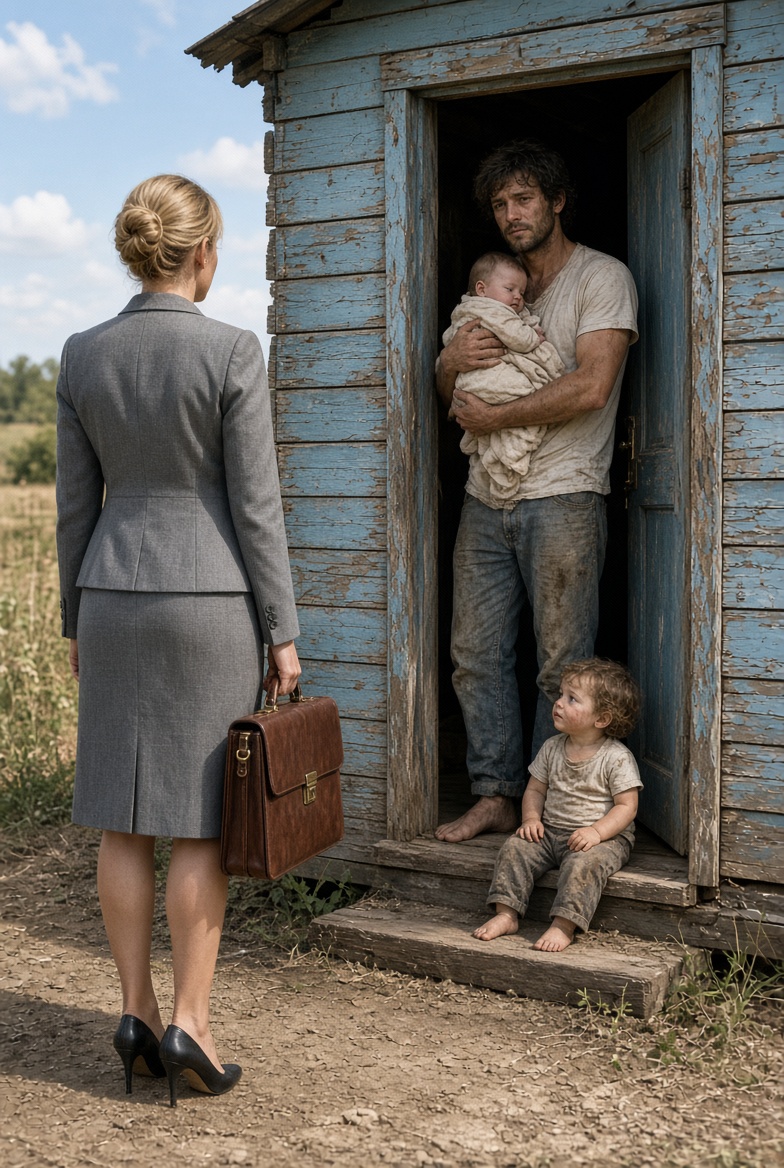
Laura Bennett had built her empire on control.
At thirty-nine she was the CEO of one of the largest real estate firms on the East Coast. Glass towers. Luxury developments. Multimillion-dollar closings that moved faster than the men who signed them. Everything in her world ran with a precision she had spent two decades enforcing. People showed up. Deadlines were met. Excuses were not a language her offices were permitted to speak.
The firm occupied the upper floors of a building she had not designed, though she had bought the air above it and the view beyond it and the silence that came with both. From her desk she could see the lake on clear mornings and the construction cranes on the others. She liked the cranes. They meant something was being replaced.
So when Daniel Carter — her quiet, reliable office janitor — missed work for the third time in a single month, something in her snapped with the small, clean sound of a rule being broken.
“Family emergencies,” he had said each time, standing in the service corridor with his cap in his hands, not quite meeting her eyes. The first absence she had allowed without comment. The second she had noted. The third she treated as a pattern, and Laura Bennett did not believe in coincidences. She believed in patterns. And to her this looked like irresponsibility wrapped in a convenient story.
“Get me his address,” she told her assistant, the words as cold as the glass behind her. “I want to see this emergency for myself.”
Thirty minutes later her black Mercedes-Benz left the garage and turned south, then west, into a part of Chicago she had never stepped foot in.
The streets were cracked. Puddles filled the gaps in the pavement and held the gray sky like cheap mirrors. Kids played barefoot near rusted fences. A bus exhaled at a corner and did not seem in any hurry to leave. People stopped and stared as her car crawled down the narrow road like an animal that had wandered out of its own climate.
It did not belong.
Neither did she.
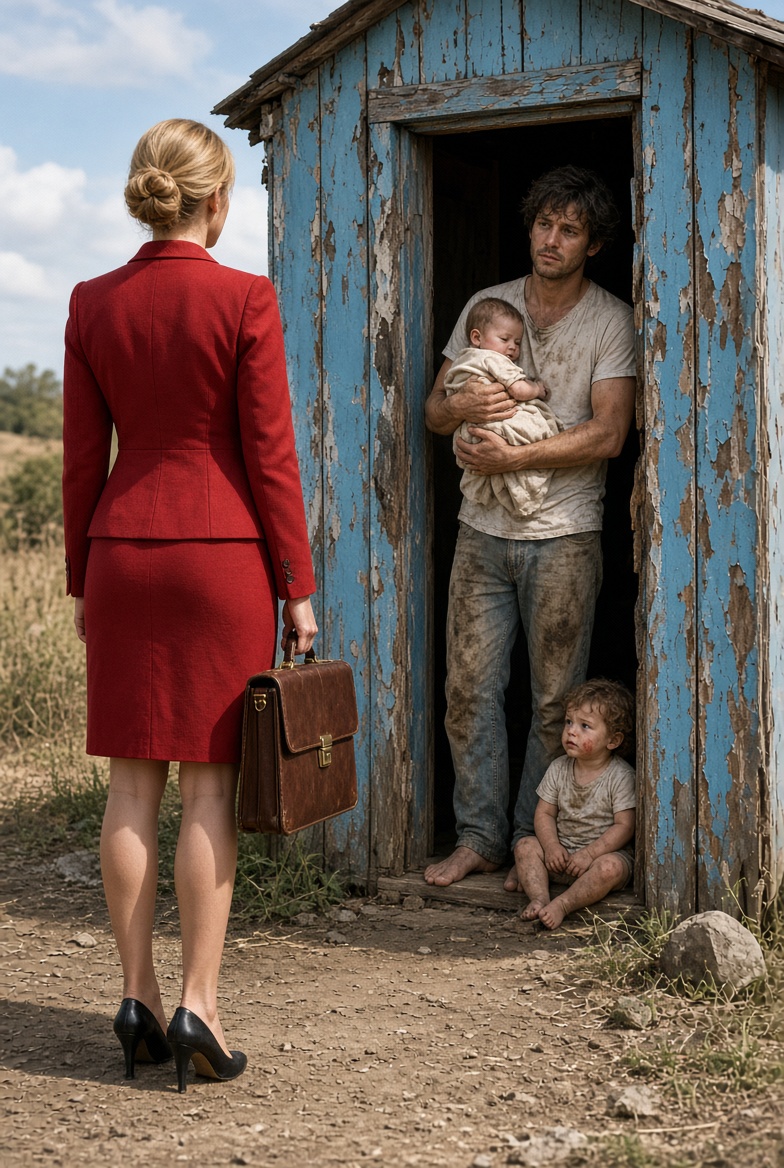
But Laura stepped out anyway — dark suit still perfect from the morning meeting, polished heels finding the uneven concrete, the diamond watch on her wrist catching a thin blade of sunlight — and walked straight toward a small, faded blue house.
Number 847.
The paint had once been proud. Now it chalked off under the weather in pale flakes. A plastic toy, faded to no particular color, lay on its side near the step. The window beside the door held a curtain that had been closed from the inside and not opened again.
She knocked.
Hard.
At first, nothing.
Then — movement. Children’s voices, overlapping, not quite words. A baby crying with the raw, circular insistence of hunger or fear. Quick footsteps that hesitated before they reached the latch.
The door crept open.
And everything Laura thought she knew shattered in the space of a single threshold.
Daniel stood there, but he did not look like the man she recognized from the lobby and the late floors, the man who emptied bins after the last associate had gone and never left a streak on the glass. His shirt was worn at the collar. His eyes were hollow with a kind of exhaustion that sleep does not fix. In his arms a baby whimpered softly against his shoulder. A little boy, perhaps five, clung tightly to his father’s leg and stared up at Laura with cautious, wide eyes, as if wealth itself had arrived on the porch and might yet decide to be dangerous.
Behind him the house told the rest of the story without needing to be asked.
A small table covered in medicine bottles, some full, some nearly empty, labels worn from handling. A thin mattress in the corner, pulled away from the wall as if the person on it needed air that the room could barely spare. A woman lying there — pale, barely conscious, her hair damp at the temples, one hand resting on the blanket as if even that small weight required permission.
Laura’s voice caught in her throat.
“What… is this?”
Daniel hesitated. She watched him decide, in the space of a breath, whether to protect his dignity or tell the truth. Dignity, she understood then, was a luxury that required a closed door and a clean shirt. He had neither.
“My wife,” he said quietly. “She’s been sick. The hospital said we couldn’t afford treatment anymore.”
The baby cried louder. The boy’s fingers tightened in the cloth of Daniel’s trousers.
“I stay home when it gets bad,” he continued. He did not look at Laura when he said it. He looked at the mattress, as if the explanation belonged there. “There’s no one else.”
Laura felt something unfamiliar twist in her chest — not pity, which she had always been able to file and dismiss, but a recognition that arrived without her consent. This was not irresponsibility. This was survival arranged into the smallest possible shape.
For the first time in years she did not know what to say. The sentences she used in boardrooms had no purchase here. She looked around again. No luxury. No safety net. No second adult who could take a shift. Just a man trying to hold a household together with nothing but the hours he could steal from a job that paid him to remain invisible.
And suddenly her perfectly ordered world felt small — not smaller than this room, which would have been an easy and dishonest comparison, but smaller than the story she had been telling herself about what work looked like when it failed to appear.
She did not stay long. She could not. The baby’s cry filled the little room and seemed to push against the walls. The boy’s stare followed her down the walk and all the way back to the car, and she felt it still when she shut the door and the leather sealed her in. On the drive north the glass towers of her own skyline rose again, clean and familiar, and she hated how easily they erased the cracked street she had just left. The city had always been good at that. She had been good at that.
That night, back in her penthouse, Laura could not shake the image of the blue house. The medicine bottles. The mattress. Daniel’s voice when he said there was no one else.
So she did what she always did when something did not make sense.
She investigated.
Quietly. Thoroughly. The way she prepared for a hostile bid: every filing, every old parcel number, every name that had ever been attached to a lot her company had touched.
And what she discovered stunned her in a way that profit never had.
Years ago — before Daniel Carter ever punched a clock in her building — there had been a lawsuit. A redevelopment project. One of Laura’s earliest deals, the kind she still cited in interviews when someone asked how a woman that young had taken a regional firm and made it national. A neighborhood cleared out for a luxury complex that now carried her company’s name in brushed steel beside the entrance. Dozens of families displaced. Relocation packages that looked generous on paper and dissolved, as such packages often do, into first and last month’s rent in rooms that were never going to be home.
One of those addresses matched Daniel’s old home.
He had lost everything.
Because of her.
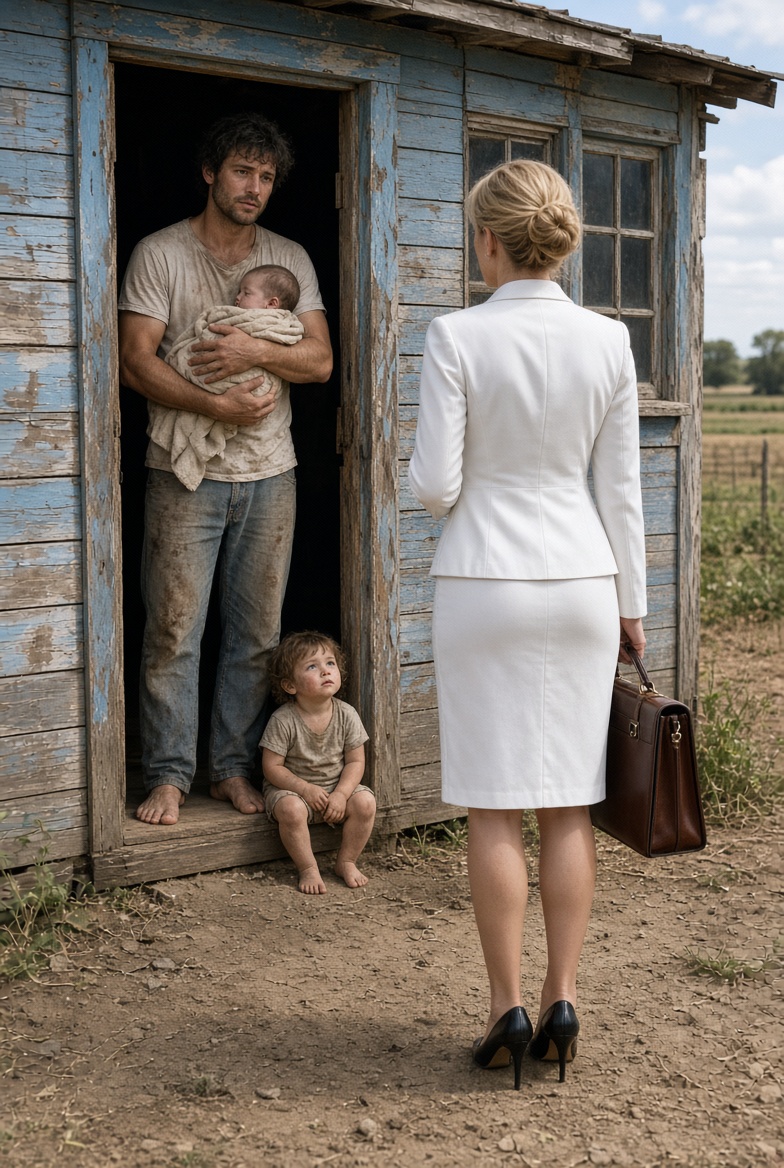
And now he was cleaning her floors.
Laura sat in silence for a long time. The penthouse windows gave her the city the way a map gives a general a field: useful, distant, stripped of the people who would have to walk it. For the first time in her life, success did not feel like victory. It felt like damage with a letterhead.
She remembered the groundbreaking. She remembered the speech about revitalization. She did not remember a man named Daniel Carter, because she had not been required to. The files had called him a household. A unit. A line item under displacement.
The next morning she did not go to the office.
She went back to the blue house.
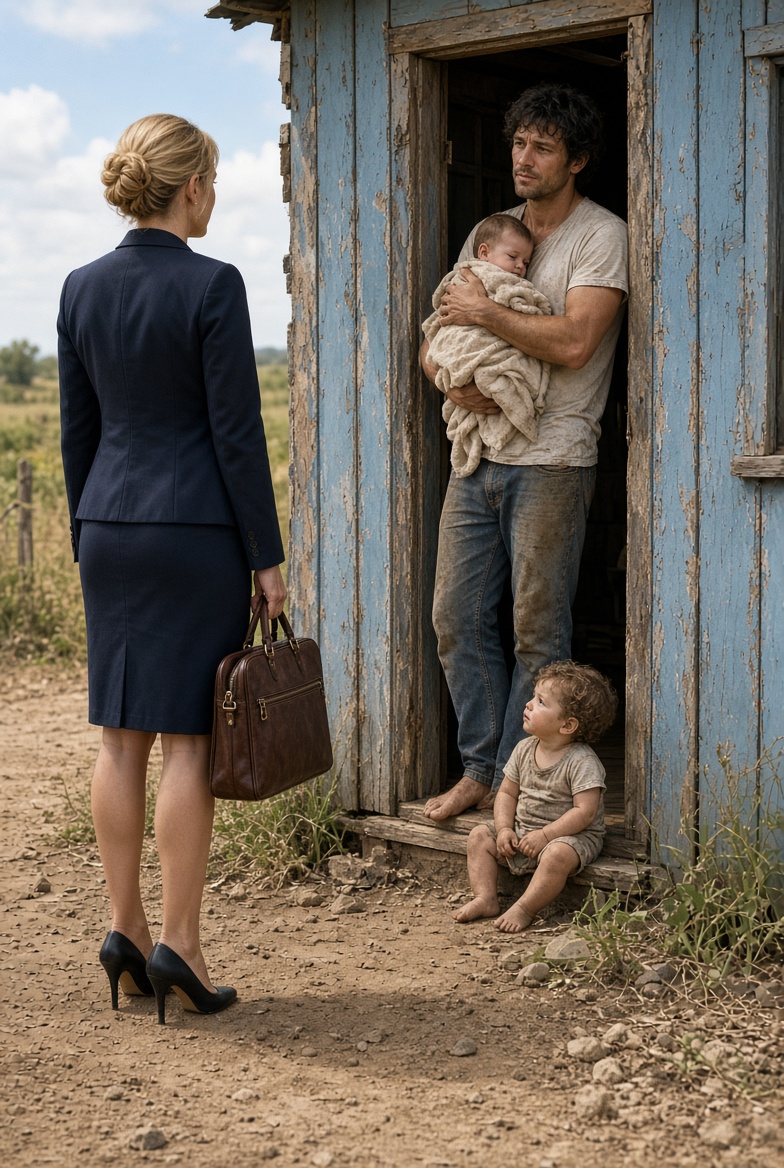
This time she did not knock like a boss. She knocked like a person who had no right to the answer she was about to ask for, and knew it.
Daniel opened the door with the baby asleep against him. The little boy was visible in the hall, holding a plastic cup with both hands. Behind them the woman on the mattress had been turned toward the window, as if someone had decided that light, at least, should not cost anything.
“I didn’t know,” Laura said.
He said nothing. The silence was not rude. It was the silence of a man who had learned that explanations from people like her rarely arrived without a second purpose.
“I should have,” she added.
And for once there was no defense in her voice. No clause. No mitigation. Only the plain sentence she had never practiced, because her life had not required it.
Over the next weeks, everything changed — not with a press release, which she refused, and not with a visit from the firm’s communications staff, which she barred from the file.
Laura arranged medical care for Daniel’s wife. Quietly. Without cameras in the corridor, without a plaque, without the kind of generosity that needs to be witnessed in order to count. Specialists who had no idea whose name was on the account. A bed that was not a mattress on a floor. Treatment that did not end when a billing office decided the story was over.
She set up a trust fund for his children — not a gesture large enough to be a spectacle, but large enough that a fever in the night would never again be a choice between medicine and rent.
More important than either of those things, she began reviewing every project her company had ever completed.
Every displacement.
Every phrase in an old prospectus that had called a loss necessary.
Every family whose address had been a problem to be solved rather than a life to be accounted for.
The work was ugly in the way honest ledgers are ugly. Some of the people could not be found. Some did not want to be found by the firm that had moved them. Some took what was offered and closed the door. Laura did not demand gratitude. She had forfeited the right to it. She made the calls herself when the staff hesitated. She sat in rooms that smelled of cooking and damp and the particular patience of people who have already been promised something once.
One by one, she started making things right.
Not because a court required it.
Because she finally understood that the empire she had built had a cellar, and she had spent years refusing to go down the stairs.
Months later Laura stood on the rooftop of a new building. Not a luxury tower. No concierge. No skyline premium baked into the rent. Affordable housing, built on land her company once would have ignored or flipped or held until the neighborhood around it became convenient to harvest. The brick was plain. The windows were generous. On the sidewalk below, a woman waited for a bus that actually came.
Daniel stood beside her. Clean suit, steady posture, no longer arranged to occupy the edges of a room. Not as a janitor. As a building manager — someone the tenants knew by name, someone the contractors answered, someone seen.
The little boy, who had a name Laura had learned and then used until it became ordinary, was downstairs in the courtyard with a ball that still had its color. Daniel’s wife was home. Not well in the cheap, final sense of the word, but well enough to sit at a table and pour water and be, for hours at a time, a person instead of a crisis.
“You didn’t have to do any of this,” Daniel said quietly.
Laura looked out over the city. From here the glass towers were still visible. They had not become smaller. She had. Or rather, the story she had told about them had.
“Yes,” she replied. “I did. I just didn’t know it yet.”
That night, alone in her penthouse, she looked around at the glass, the steel, the perfection she had once worshipped because it asked nothing of her except that she keep winning. The city glittered the way it always had. The difference was that she could no longer pretend the glitter was the whole of the map.
For the first time she understood something no business school had ever put on a slide.
Success is not measured by what you build above the ground —
but by how many lives you do not destroy beneath it.
And sometimes the people you overlook the most are the ones carrying the weight of everything you have ever taken.
Laura turned off the last lamp and stood a moment longer at the window. Somewhere south of the river a faded blue house still sat on a cracked street. It was empty now. The family who had lived there slept under a roof her company had finally learned how to build. She did not congratulate herself. She had arrived too late for that. She had arrived, at last, which was a different and harder thing.
In the morning she would go back to work. The cranes would still be there. The difference, if she kept her word, would be what they were lifting, and whom they were lifting it for.
