

A crystal jewelry display trembled violently.
Customers screamed.
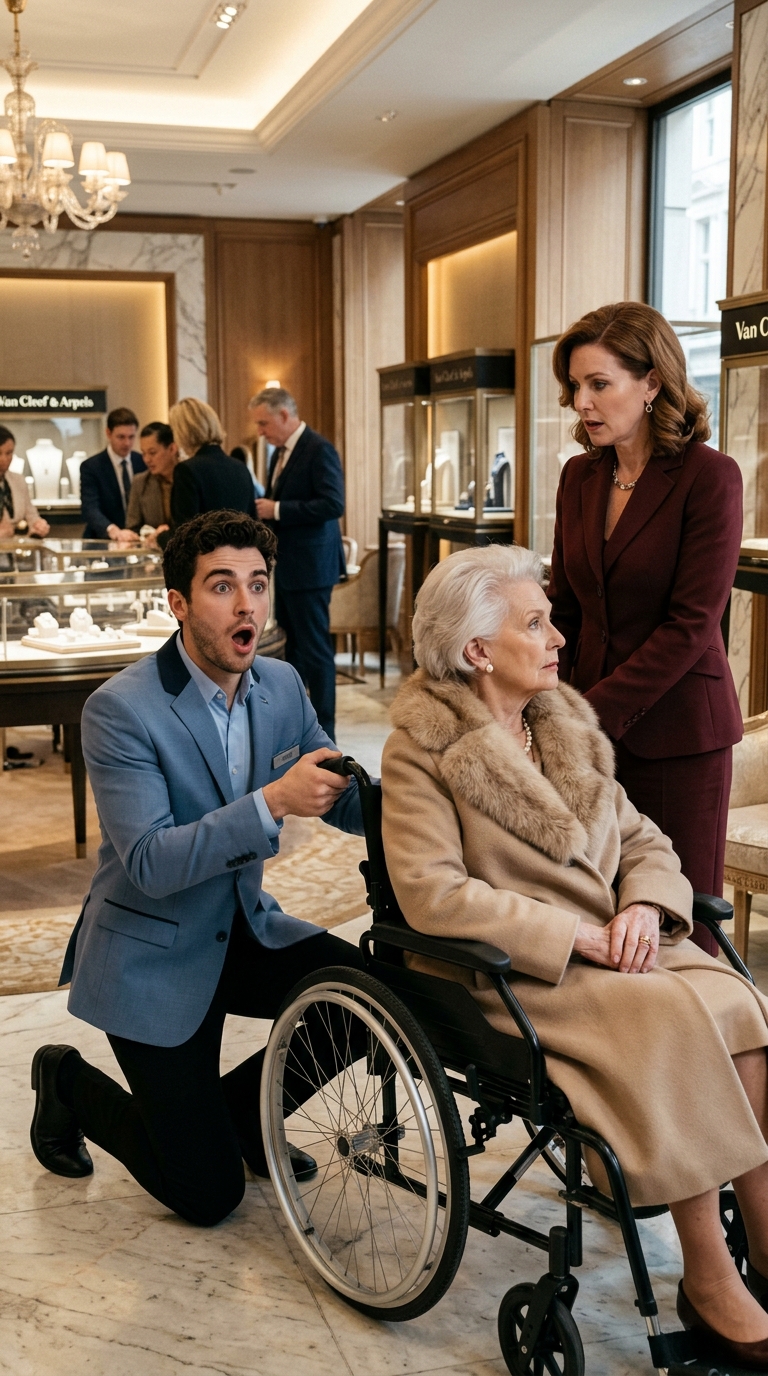
The handheld camera swerved across glittering diamond cases as the elderly woman tipped forward, her frail body slipping from the wheelchair beneath the chandelier’s cold glow.
A young employee in a blue uniform sprinted across the floor.
He caught the wheelchair just inches before it hit the ground.
The boutique fell into total silence.
Only uneven breathing remained.
The manager stepped forward at once, anger tightening her otherwise composed face.
“Do not touch her.”
But the employee ignored her completely.
Still breathless, he dropped to one knee beside the elderly woman.
“Are you okay?”
The woman tried to speak.
SNAP.
Her pearl necklace broke apart.
Pearls scattered across the marble like fragments of white light, rolling in every direction.
The wealthy customers instinctively stepped back.
No one moved to help.
Only the young employee did.
One by one, he knelt and gathered the pearls with shaking hands as the soft piano music faded into uneasy silence.
The camera tracked a single pearl rolling across the floor, reflecting fractured chandeliers above.
The elderly woman watched him closely.
Her voice was barely audible.
“No one else bent down.”
The manager reached for the wheelchair again.
“We’re removing her now.”
But the old woman slowly raised a trembling hand.
“Stop.”
The room froze.
A final pearl rolled gently against the employee’s shoe.
He picked it up.
EXTREME CLOSE-UP.
CRACK.
The pearl split open in his palm.
A small gold key dropped into his hand.
CLICK.
The metallic sound echoed unnaturally through the boutique.
The manager’s face drained of color.
“The vault key…” she whispered.
The camera snapped toward a massive locked private showroom door hidden at the back of the boutique.
Heartbeat.
Slow.
Heavy.
The employee stared at the key.
Then slowly turned back to the elderly woman.
“Who are you?”
Tears shimmered in her eyes under the chandelier light.
But her voice was no longer fragile.
It was controlled.
Certain.
“I came to choose the next owner.”
HARD CUT TO BLACK.
DEEP CINEMATIC BASS HIT.
The silence that followed was heavier than sound.
For a moment, no one inside the boutique moved. Even the customers who had seconds ago been recording, whispering, judging, now stood frozen as if the air itself had changed pressure.
The manager finally forced a nervous laugh, stepping between the employee and the elderly woman.
“This is inappropriate. She’s confused. Someone get security—”
“Stop,” the elderly woman said again.
Not louder.
Just final.
The security guard hesitated mid-step.
The young employee still held the gold key in his palm. It felt heavier than metal, like it carried something unseen, something that did not belong in a jewelry store where everything had a price.
The elderly woman slowly straightened in the wheelchair, her trembling replaced by a controlled stillness that unsettled everyone watching.
“You think this store sells jewelry,” she said softly.
No one answered.
She looked toward the glass cases, the diamonds, the velvet trays, the careful lighting designed to create desire.
“It doesn’t.”
The manager’s expression tightened.
“Ma’am, I think you should leave.”
The elderly woman let out a quiet breath, almost amused.
“I built this place.”
That sentence changed nothing and everything at once.
The employee blinked.
“You… built it?”
She nodded once.
“Forty-three years ago.”
A low murmur spread through the room. The manager’s confidence flickered, just for a second.
“That’s impossible,” she said, but her voice had lost its certainty.
The elderly woman raised her hand slightly.
“Open the door.”
The employee looked at the locked showroom entrance. Heavy, reinforced, designed not to be questioned. He glanced at the manager.
She shook her head quickly.
“No. That room is restricted.”
The elderly woman turned her gaze to her.
“And yet you don’t have the key.”
The manager froze.
The employee looked down at the small gold object again.
Then back at the door.
Something in him shifted—not authority, not confidence, but recognition that whatever this moment was, it was already beyond permission.
He stepped forward.
The key slid into the lock.
For a brief second, nothing happened.
Then—
CLICK.
The sound was soft, but it traveled through the entire boutique like a shockwave.
The locked door unlocked.
A breath caught in the room.
The employee slowly pushed it open.
Inside was not a showroom.
It was an archive.
Rows of sealed display cases. Old design sketches framed on the walls. Photographs of the boutique in its earliest years. And at the center—a single empty pedestal waiting beneath a spotlight that had not been turned on in years.
The elderly woman wheeled forward slowly.
Her voice softened.
“They forgot what this place was meant to be.”
The manager stepped forward, panicked now.
“You can’t just—this is corporate property—”
The elderly woman interrupted without looking at her.
“It was never theirs.”
The employee stood still, staring at the archive. For the first time, he understood that what he had saved on the floor earlier had not been a person, or a moment of kindness.
It had been a test.
The elderly woman turned slightly toward him.
“You didn’t hesitate.”
He didn’t answer.
“You saw someone fall, and you chose to act before you understood the consequence.”
A pause.
“That is rare.”
The manager’s voice cracked slightly.
“What is this about?”
The elderly woman finally looked at her directly.
“It’s about ownership.”
Not of the boutique.
Of what it means to inherit it.
She reached into her coat and pulled out a folded document, placing it gently onto the nearest counter.
The employee looked at it, but did not touch it.
The elderly woman’s eyes stayed on him.
“Everything I built will be transferred. Not to blood. Not to titles. To character.”
The room remained silent.
Outside, the city continued moving as if nothing had changed. But inside the boutique, something irreversible had already shifted.
The manager took a step back, realizing too late that authority built on position meant nothing in a room where legacy was being rewritten.
The elderly woman leaned back in her wheelchair, her strength fading now that her purpose had been delivered.
But her voice remained steady.
“Choose carefully,” she said to the employee. “Because once you open that door… you cannot pretend you didn’t see what’s inside.”
The employee looked once more at the archive.
Then at the gold key in his hand.
And finally, at the woman who had dropped it into his life like fate disguised as accident.
He exhaled slowly.
And stepped inside
