

PART 1
In the freezing mountains of Chihuahua, during the brutal winter of 1987, Soledad Martínez’s world shattered completely. At 38, she became a widow when the apple-picking truck carrying her beloved husband Ramiro plunged off the dreaded Devil’s Curve.
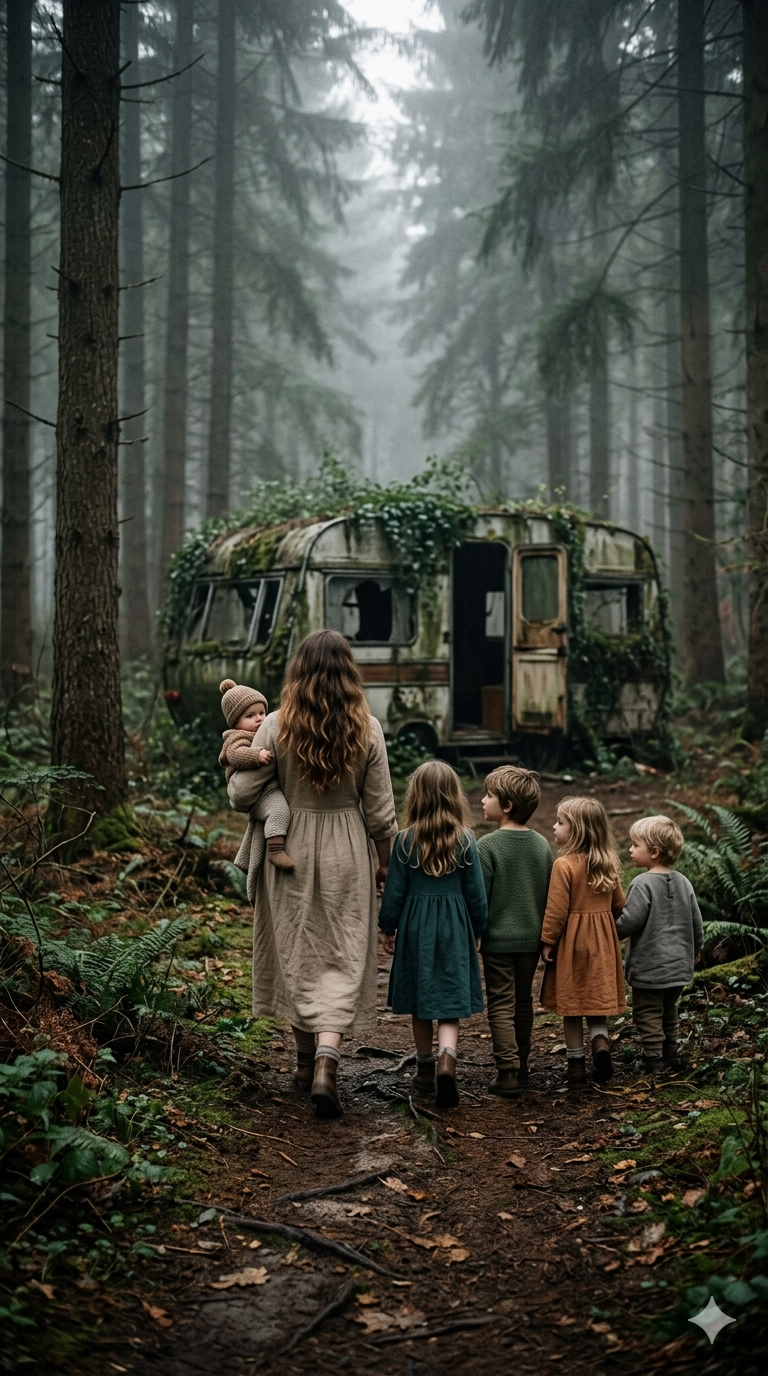
The agricultural company, cold and indifferent, handed her a stained envelope with 150,000 pesos as the only compensation for the life of a good, hardworking man. With five mouths to feed—12-year-old Mateo, 8-year-old twins Luna and Estrella, little Tadeo, 5, and baby Luz just months old—that pitiful amount meant a sentence of absolute poverty.
Without Ramiro’s income, the cruel landlord of the small adobe room they rented threw them out in less than two weeks. After spending three nights under a stone bridge, enduring the freezing winds of the harsh mountains that threatened to kill her children, Soledad made a desperate choice.
With the last 80,000 pesos tied tightly around her waist, she went to the village store. There, she overheard rough men talking about an abandoned aluminum trailer five kilometers off the main road, hidden deep in the forest. Rumors claimed it was cursed, that its former owner had vanished without a trace, but Soledad didn’t care about legends; she feared far more that her children would freeze to death in the streets.
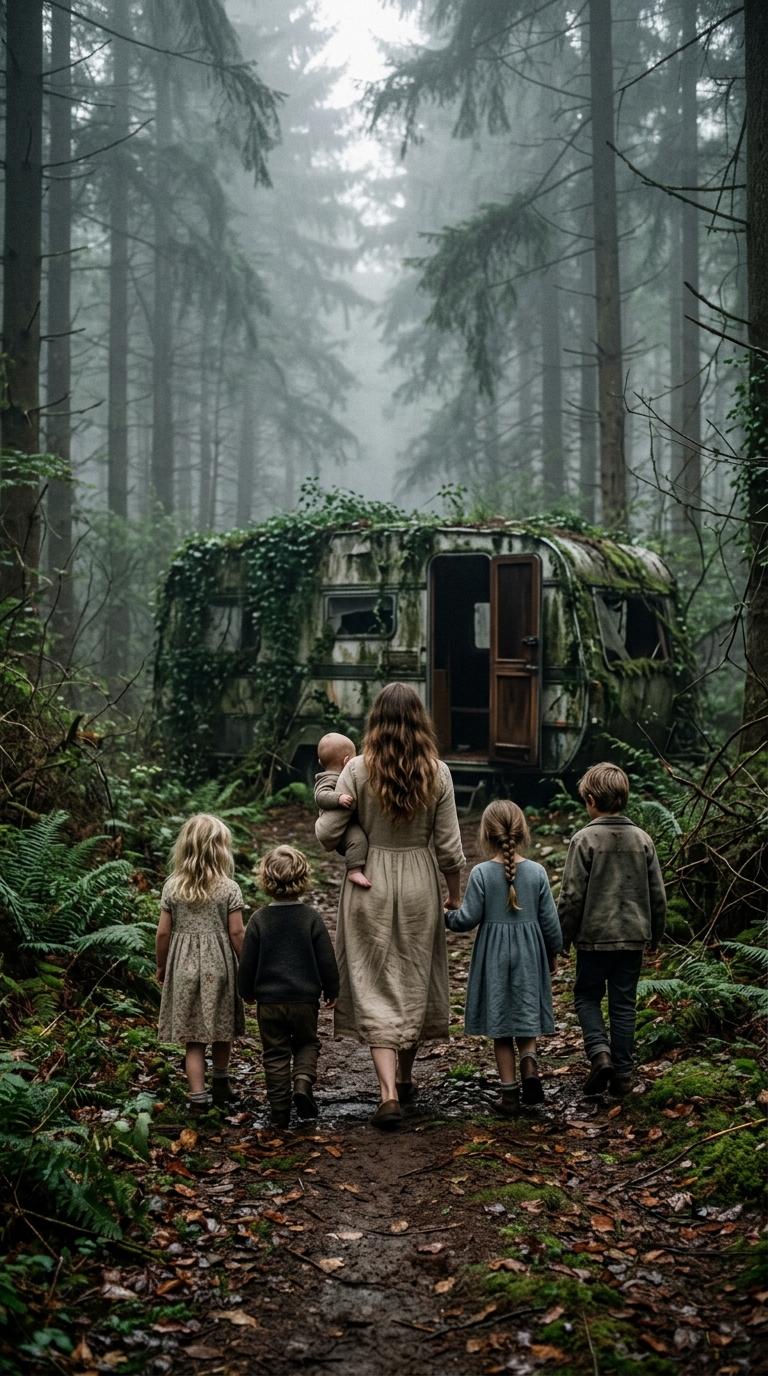
The trailer was a terrifying sight of total abandonment. Rust covered every surface, tall weeds surrounded it, and a strong stench of rot, dead animals, and dampness filled the air.
The windows were empty holes, and the linoleum floor sank dangerously under her bare feet. For six exhausting days, Soledad and her eldest son worked tirelessly, clearing rat nests and scrubbing the metal walls with icy water from a nearby stream. One afternoon, exhausted, they decided to tear out the most rotten section of the floor in the center of the trailer to prevent the younger children from falling through.
That was when Soledad’s splintered hands struck something solid—something that wasn’t soil or rusted metal. It was thick pine boards, perfectly aligned, forming a precise one-meter square. Her heart pounded wildly.
Using a long rusted iron pipe, she pried it open with all her strength. The wood gave way with a long, hollow crack, revealing a deep, pitch-black hole descending into the cold earth below.
Soledad leaned in carefully, and the stench rising from below was not natural forest dampness, but something far worse—confinement, sickness, sweat, and dried blood. She was about to scream for her children to run when a faint sound came from the darkness: fabric scraping against dirt, followed by a terrified, uneven breath. Something—or someone—was alive beneath them.
Mateo clung to her arm, pale and shaking. The twins stepped back in fear. Soledad gripped the metal pipe tightly, lifted her only candle, and brought the trembling flame closer to the opening. The dim light flickered, revealing a curled figure in the corner of the pit—an image so shocking it froze her blood.
What was hidden at the bottom of that hole would unleash a storm of deadly danger upon her family. No one could have imagined what was about to happen…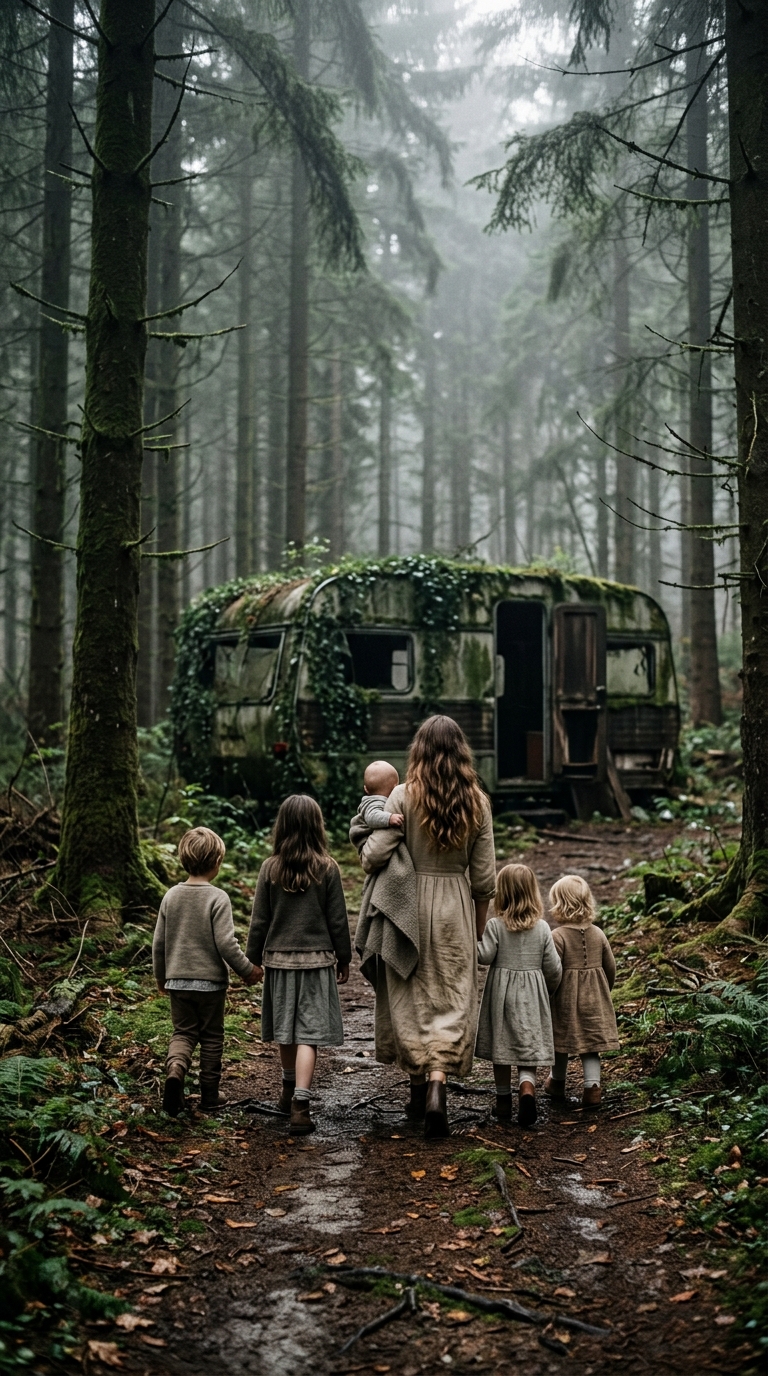
PART 2
At the damp bottom of the pit lay a young man barely twenty years old. He was covered in thick mud and dried blood. One leg was broken and swollen at a horrifying angle, tied tightly to two dirty wooden boards. His hands were torn from desperate digging, and his face was bruised beyond recognition. When the light reached him, his one open eye reflected pure animal terror.
—“Please… don’t turn me in,” the young man begged hoarsely, with a strong foreign accent. “They will kill me.”
His name was Alex, an American biology student. Through feverish delirium and tears, he revealed he had been hiding there for over two agonizing weeks. He had come to the mountains to investigate illegal logging. But one night, at Don Artemio’s sawmill—the most feared and ruthless man in the region—he discovered a massive hidden airstrip where armed men loaded hollow logs filled with weapons and drugs. Even the rural police commander, Valles, was there, taking bribes. They discovered him. They beat him brutally, breaking his leg, and left him in the forest to die.
Miraculously, he crawled to the trailer and hid.
Soledad felt a deadly chill. Artemio and Valles controlled everything. Word had already spread: 50,000 pesos for the “gringo.” That money could save her children—food, shelter, a future. The temptation tore her apart. Should she sacrifice one innocent life to save her own children?
She looked at her terrified children. Then at the wounded young man, bleeding for telling the truth. She remembered her promise to Ramiro: “Take care of our children and raise them to be good people.” Betraying Alex would destroy that forever.
With immense effort, Soledad and Mateo hid Alex beneath the trailer sink, covering him with dirty rags and heavy pots. They sealed the hole and placed a rotten mattress over it. Soledad walked miles to the village and bought penicillin and strong mezcal with her last coins. The old shopkeeper, who hated Artemio, gave her the medicine without asking questions.
For ten days, she treated Alex’s wounds, pouring mezcal directly onto the flesh as he bit down on wood to suppress his screams. But peace didn’t last. On the tenth day, two trucks arrived. Armed men stepped out—led by Valles.
—“We’re looking for a fugitive,” he growled. “And it smells like medicine here.”
Soledad stood firm, claiming her son Tadeo was injured. The men searched. One kicked the pile hiding Alex. The impact echoed against his body. Soledad’s heart stopped. If he made a sound, they would all die.
Three endless seconds passed.
Silence.
The man stepped away. They left.
That night, Soledad made a decision. —“We leave tonight. Valles will return.”
They fled under darkness. She carried baby Luz and supported Alex. Mateo carried Tadeo. At dawn, gunshots echoed behind them. The hunt had begun.
By midday, they reached the edge of a massive canyon: the Copper Canyon. Behind them, dogs were closing in.
—“You must go down there,” Soledad ordered, pointing to a narrow crack.
They descended. Bullets rained down. A shot shattered rock near her face.
—“Keep moving!” she shouted, shielding Alex.
After four hours, they reached the bottom. They crossed the desert for three more days. Water ran out. Just as Soledad collapsed, they saw smoke—a hidden camp.
There, a healer saved Alex’s leg. They hid for seven months. When he recovered, he was guided safely to the United States.
Years passed.
In 1990, the government intervened. Valles was killed. Artemio was arrested. The criminal network was destroyed.
Denver, Colorado. January 2011. Snow falls gently.
Soledad, now 62, looks out from a warm apartment. Her children are successful. A knock sounds.
It’s Alex, now a professor, carrying an apple pie.
—“You saved my life, Mama Sole,” he says, voice breaking.
Soledad smiles with quiet strength.
—“I didn’t waste my 80,000 pesos. I bought the chance to teach my children that courage is worth more than fear.”
This story proves that compassion is the greatest act of courage. What would you have done in Soledad’s place?
