

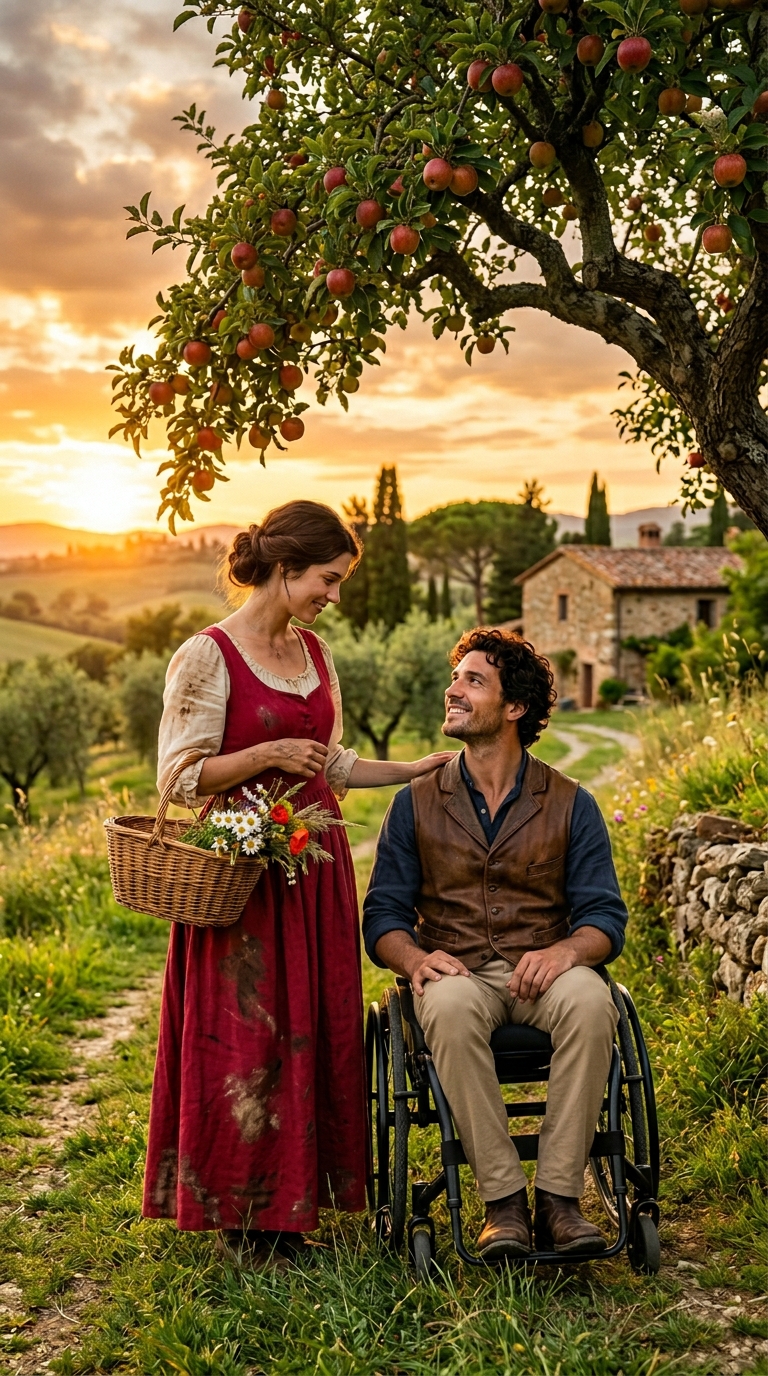
The people of Zacatlán said that Finca Santa Lucía had begun to die on the night of the fire.
They repeated it in the town square, at the grocery store, outside the church, and even at the market, where boxes of Santa Lucía apples used to sell out before noon. They said that since that fire, nothing smelled the same anymore: not the cider, not the apple bread, not even the damp earth after the rain.
But it wasn’t true.
The fire had only burned a warehouse.
The estate began to die later, when Don Alonso Valderrama stopped believing it was worth saving.
He was only thirty-five years old, but from his wheelchair he looked like a much older man. Not because of the wrinkles, but because of the way he looked at the orchard from the window: as if it all already belonged to the past.
Before the fire, Alonso was the first to rise. He pruned trees, carried sacks, checked cider barrels, and knew every worker by name. No one worked harder than he did. No one loved those lands more.
But a beam fell during the fire and crushed his back. The doctors told him he might never walk again. Then came the debts, the laid-off workers, the closed winery, and the abandoned apple trees.
The fruit fell to the ground and rotted in the mud.
The kitchen was cold.
The fireplace was almost never lit.
And in town, Esteban Rojas, an elegant and ambitious merchant, began circling like a vulture.
“Don Alonso, you need to rest,” he would say in a gentle voice. “I can buy the estate, pay your debts, and give you a peaceful life.”
Alonso always gave the same answer:
“Santa Lucía is not for sale.”
But each time he said it with less strength.
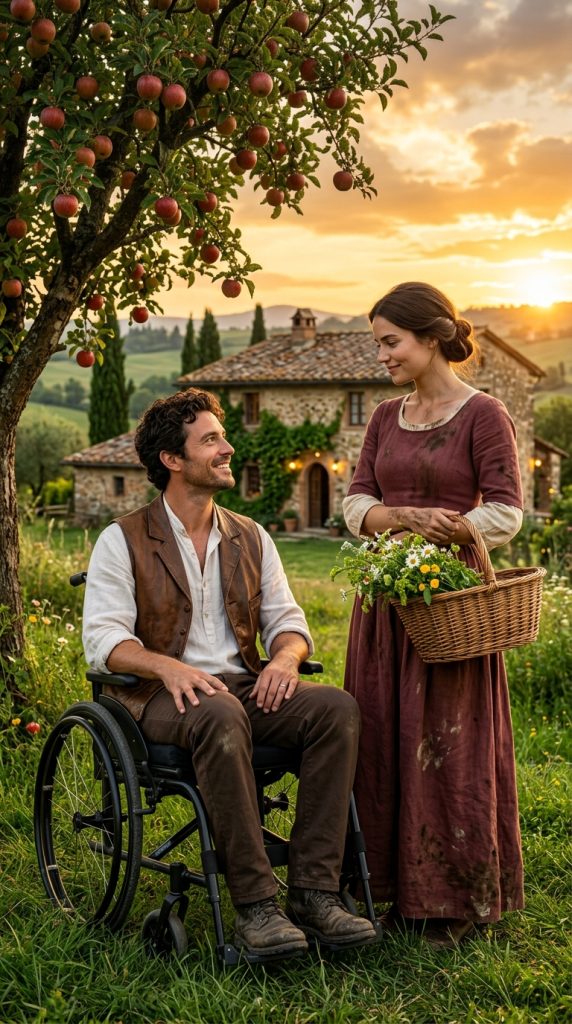
One cold afternoon, as the mist descended from the mountains, a woman appeared walking along the dirt road. She carried a cloth bag over her shoulder, worn shoes, and a dress stained with mud. She was young, about twenty-five, dark-skinned, with steady eyes and an ancient weariness.
Mateo, the fifteen-year-old boy who helped on the estate for food and a few coins, ran to tell them.
“Doña Mercedes, there’s a woman coming.”
Doña Mercedes, the old housekeeper, looked up.
“A woman or a debt?”
“A woman who looks like she’s walked a long way.”
When the stranger reached the threshold, she didn’t lower her gaze.
“Good afternoon. I’m looking for work.”
“There’s no work here,” Alonso said from his chair, not giving her a chance.
She looked toward the patio, the fallen gate, and the apples rotting under the trees.
“With respect, sir, there is work. What there isn’t is people doing it.”
Mateo coughed to hide a laugh. Doña Mercedes gave him a light smack on the back of the head.
“What’s your name?” the old woman asked.
“Isabel Moreno.”
“Where are you from?”
“From several places. The last one isn’t worth naming.”
Alonso observed her. There was no pity in her eyes when she saw the wheelchair. That annoyed him and, at the same time, caught his attention.
“I don’t have money to pay you,” he said.
“Then don’t pay me for the first month.”
“I don’t accept charity.”
“Neither do I. I ask for food, a corner to sleep in, and permission to work. If I’m no use after a month, I’ll leave.”
Alonso tightened his fingers on the wheelchair wheels.
“This estate is not a shelter for anyone.”
Isabel looked at the cold walls, the unlit stove, the silent patio.
“It doesn’t look like a shelter for you either.”
The sentence landed like a stone.
Doña Mercedes lowered her face to hide a smile.
Alonso wanted to throw her out right then. But something in him—an old part that still knew how to calculate harvests—understood that willing hands could do more than a thousand complaints.
“One month,” he said at last.
Isabel nodded.
“One month.”
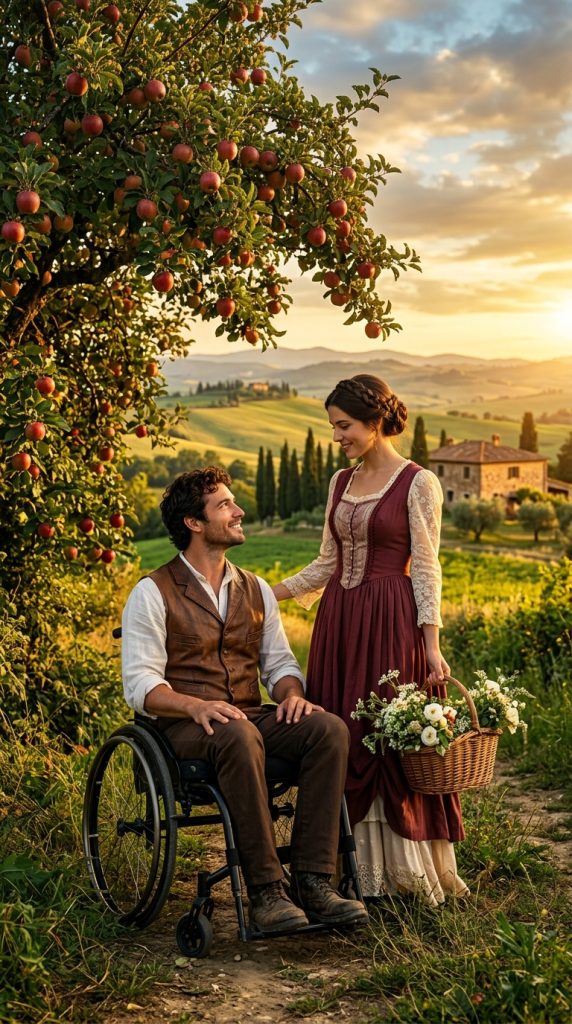
The next morning, before Alonso had finished his bitter coffee, the kitchen smelled of warm apples, cinnamon, and sugar.
He pushed his chair to the door and found a scene he hadn’t seen in months. Doña Mercedes was peeling fruit with a stern expression, though her hands moved with enthusiasm. Mateo was hiding a spoon behind his back. Isabel was stirring a large pot over the fire.
On the table were three piles of apples: the good ones, the bruised ones, and the rotten ones.
“What is this?” Alonso asked.
“Jam,” Isabel answered without stopping stirring.
“I can see it’s jam. I’m asking why.”
“Because there were apples that were still good.”
“They were fallen apples.”
Isabel looked at him for a second.
“Fallen doesn’t mean useless.”
Alonso felt that phrase hit him somewhere very deep.
“A few apples won’t save Santa Lucía.”
“I didn’t say they would save it. I said they could save this pot. And maybe tomorrow’s breakfast.”
Mateo peeked with the spoon.
“I think they can also save my mood.”
“Your mood is already too well fed,” said Doña Mercedes.
For the first time in a long while, Alonso almost smiled.
Isabel didn’t try to save the estate with speeches. She didn’t talk about miracles or hope. She just worked.
She gathered fallen fruit. She separated what was useful from what was lost. She made jam, apple vinegar, fresh cheese with the milk from the few remaining sheep. She cleaned the pantry. She opened a notebook and recorded every jar sold, every coin received, every outstanding debt.
Mateo accompanied her to town with baskets. At first they sold little: two jars of jam, a small cheese, some simple tarts. But people began to remember.
“It tastes like before,” said one woman at the market.
That phrase reached the kitchen like a spark.
Doña Mercedes taught Isabel old recipes. Mateo made absurd mistakes, like trading a jar of jam for a hen that, according to him, “seemed to have a future.” Doña Mercedes declared that the hen had more sense than he did.
And Alonso listened from the hallway.
He didn’t want to get involved. But one night he found the notebook open on the table. He read: “Five jars sold. Four traded for flour. Two cheeses ordered for Sunday. Ask Julián about urgent pruning.”
The next day, he entered the kitchen.
“Julián still knows how to prune the apple trees on the north path,” he said.
Isabel looked up.
“Would you like me to find him?”
“Ask how much he charges for half a day. We can pay part with product.”
Mateo’s eyes widened.
“Don Alonso just suggested paying with jam.”
“And you just suggested shutting up,” said Doña Mercedes.
The estate began to breathe again.
But Esteban Rojas noticed it too.
He arrived one afternoon with clean boots, a fine hat, and the smile of a patient man.
“Don Alonso,” he said. “I see movement. I’m glad, but you shouldn’t fool yourself. An estate this size doesn’t sustain itself with jars of jam.”
“It sustains itself with work,” Isabel answered from the hallway.
Esteban looked at her as one looks at a pebble in a shoe.
“I didn’t know the servants now had opinions on business.”
Alonso felt anger, but before he could speak, Isabel replied:
“I’m not giving opinions on business. I only recognize someone who wants to buy cheap what another cannot defend.”
Esteban’s smile hardened.
“Interesting girl.”
“Just a worker, nothing more.”
When Esteban left, Alonso looked at Isabel with something different. She hadn’t defended him out of pity. She had defended the estate as if it mattered to her too.
That night the first small miracle happened.
Isabel was bringing him warm cloths to ease his back. When she placed one near his right ankle, Alonso frowned.
“Did you feel that?” she asked.
“No.”
“Your face said something else.”
“My face doesn’t always ask permission.”
Isabel didn’t insist, but she observed. Days later, when the chair jolted over a stone in the hallway, Alonso’s left leg twitched slightly.
“I saw it,” she said.
“You’re not a doctor.”
“No. But I know when something isn’t completely dead.”
Alonso became furious.
“There were already doctors. They already said what had to be said.”
“Maybe they said what they could see at the time.”
He forbade her from talking about the subject.
She didn’t promise to obey.
She went to town and looked for Don Eusebio, an old doctor. He listened to her, later examined Alonso, and gave a cautious verdict: there were signs, but not enough to promise anything. Perhaps with therapy in a big city something could be attempted. But that cost money.
Alonso shut himself away for three days.
“Hope only lifts you up so the fall hurts more,” he told Isabel when she managed to get in.
Isabel didn’t cry.
“It wasn’t hope that hurt you. It was staying alone after the fall.”
He looked at her for the first time without defenses.
“I can’t give you what you want.”
“I didn’t come asking for your legs, Don Alonso.”
“Then what do you want?”
“That you don’t treat yourself as if there’s no one left inside you.”
The next day, Isabel found a note in the notebook, written in Alonso’s firm handwriting:
“Ask about another doctor. Don’t sell the large jars cheap. Try small-batch cider with the firm apples.”
The answer came unexpectedly.
One morning, an elegant car stopped in front of Santa Lucía. An older woman with a warm gaze stepped out, accompanied by a tall man carrying a leather briefcase.
The woman took Isabel’s hands.
“You don’t remember me, but years ago you found me unconscious on a road near Chignahuapan. You gave me water, looked for help, and didn’t accept money. I am Beatriz Herrera. I never forgot your name.”
Isabel was speechless.
The man introduced himself:
“Rafael Herrera. I am a specialist in neurological rehabilitation.”
Alonso, from the doorway, hardened his face.
“The miracles arrived late here, doctor.”
Rafael held his gaze.
“I don’t believe in miracles. I work with muscles, nerves, patience, and pain. They’re less brilliant, but more useful.”
At first, Alonso refused. Then he agreed to an examination. Rafael was clear: he didn’t promise he would walk as before, but there was partial sensitivity and a possibility of improvement.
“One month of treatment,” he proposed. “Then we’ll see.”
Alonso looked at Isabel.
She didn’t beg.
“The decision is yours,” she said.
And that was what convinced him.
The treatment was hard. Alonso sweated, got angry, shouted that it was useless. Rafael remained unmoved. Isabel prepared cloths, broths, and hearty meals. Doña Mercedes grumbled to keep from crying. Mateo made terrible jokes that sometimes saved the day.
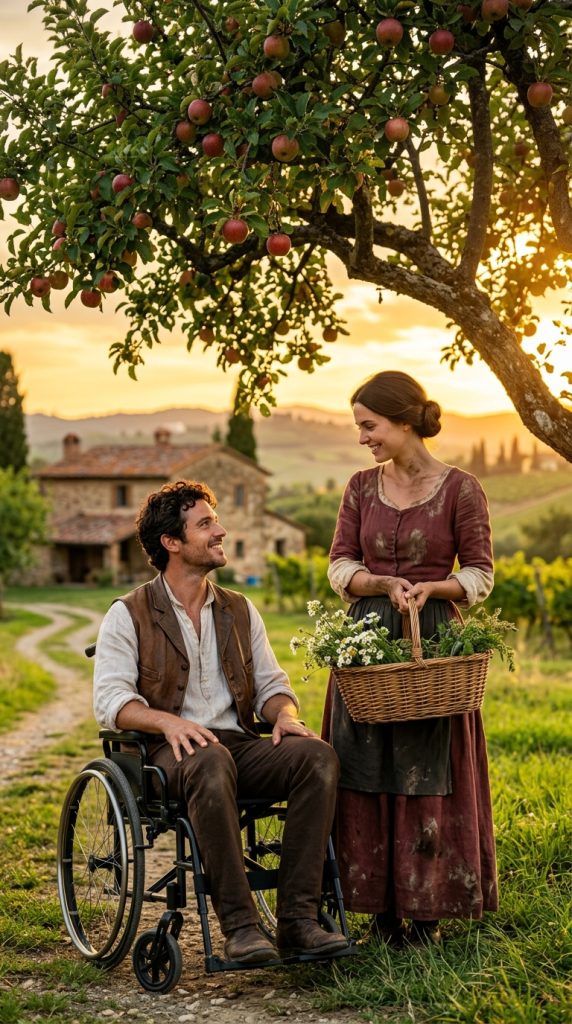
One afternoon under the old apple tree, Alonso managed to stand with support bars.
Just a few seconds.
Then he fell back into the chair, pale and trembling.
“It wasn’t much,” he murmured.
Isabel offered him water.
“It was more than yesterday.”
Weeks later he took three clumsy steps with crutches.
Doña Mercedes cried and blamed the wind. Mateo said the wind in Santa Lucía was very sentimental.
Then Esteban Rojas returned.
He arrived expecting to find the same ruin. But he saw baskets of apples, neatly lined jars, workers repairing fences, and Alonso standing with crutches under the apple tree.
“My offer is still open,” Esteban said. “Don’t confuse movement with stability.”
Alonso asked for the notebook. Isabel handed it to him and stood beside him, not in front.
“These are the accounts,” he said. “Production, orders, payments, repairs. It’s little, yes. But it’s real. And there are no new debts.”
“A wounded estate can swallow a man,” Esteban warned.
Alonso gripped the crutches firmly.
“Santa Lucía is not for sale. Not because it’s easy to keep it, but because there are still people willing to do so.”
Esteban looked around. He was no longer speaking to an isolated man, but to a living house.
He left without saying goodbye.
Time passed. Rafael finished the initial treatment and left instructions. Before leaving, he spoke with Isabel.
“He loves you,” he said, looking toward Alonso.
“And I love him,” she replied honestly.
Rafael smiled with noble sadness.
“Then you chose well. But don’t let anyone love you only for how useful you are.”
“I won’t.”
That night, Alonso waited for Isabel under the apple tree.
“I love you,” he said, his voice trembling. “Not because you saved my estate or because you helped me stand. I love you because when you look at me, you don’t see only what I lost, and you don’t pretend I didn’t lose it. You see me whole.”
Isabel took his hand.
“I spent years being useful so they would let me stay. Here, for the first time, I felt I could be tired and still be loved.”
“Then stay because you want to, not because I need you.”
She smiled.
“I’m staying because I choose to, Alonso.”
Months later, they got married under the old apple tree. There was no luxury, but there was warm bread, fresh cheese, light cider, apple tarts, and jars of jam with clean cloths on the lids.
Alonso walked a few steps with crutches beside Isabel after the blessing. It was slow. Painful. Imperfect.
But he walked.
And Santa Lucía, which everyone had once given up for dead, once again filled with smoke from the chimney, laughter in the kitchen, and flowers on the apple trees.
Because not everything that falls is lost.
There are fallen apples that still nourish.
There are cold houses that once again smell of bread.
And there are lives that don’t return to what they were before, but can become something humbler, stronger, and more true.
Sometimes, starting over doesn’t mean running.
Sometimes it means moving forward slowly, with pain, with fear, but accompanied by someone who doesn’t walk for you.
They walk with you.
