

By the time the first police cruiser turned onto Briarstone Lane, Leon Walker had already finished cutting the front lawn.
The grass lay neat and even beneath the morning sun, except for one narrow section near the driveway where he had stopped to move the rake. His gray T-shirt was soaked with sweat, his work pants were stained green around the knees, and fresh clippings clung to his old brown boots. The mower rested beside the garage, cooling with a soft metallic ticking in the quiet.
Leon was fifty-eight, Black, tall, and carried the weathered strength of a man who had spent more years carrying burdens than talking about them.
Silver had begun appearing at his temples.
Most mornings, his back hurt.
Rain made one knee ache.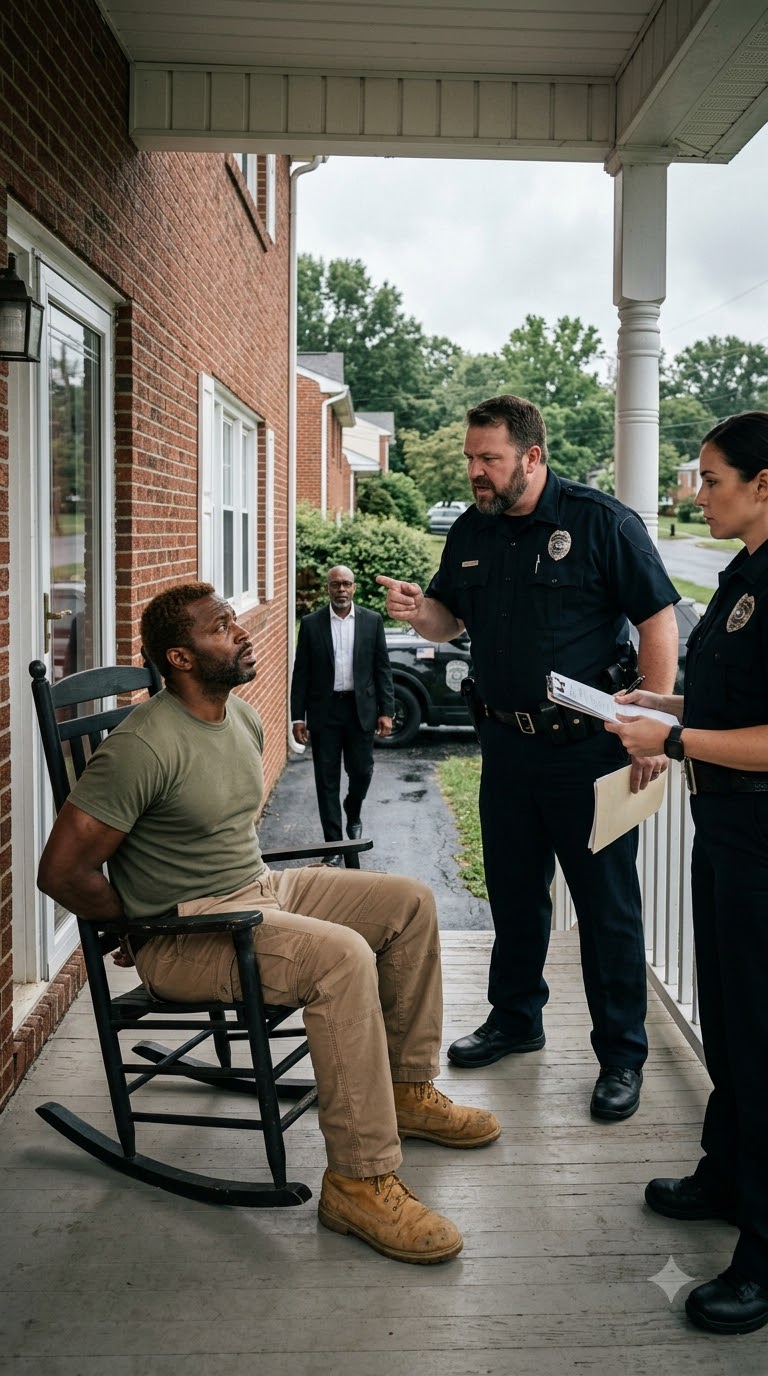
Still, every Saturday he cut his own grass because the simple routine kept him grounded. The smell of freshly cut lawn, the steady rhythm of the mower, and the satisfaction of creating clean lines across his property brought him peace.
After a lifetime spent in places where peace had to be protected, ordinary work felt almost sacred.
Then three police cars came down the street with their lights flashing.
The noise shattered the quiet neighborhood.
Birds scattered from the maple trees.
A dog began barking behind a white fence.
Curtains moved in houses across the street.
Leon lifted his eyes from the rake and watched the cruisers stop outside his home, the largest brick colonial on the block. Red and blue lights reflected across the porch columns, polished windows, and garage door he had opened only ten minutes earlier with the remote attached to his belt.
He did not run.
He did not shout.
He did not look frightened.
A man who had spent twenty-six years wearing a uniform learned early that fear traveled faster when you gave it space.
Leon carefully set the rake down, wiped his forehead, and raised both hands where the officers could see them.
“Officers,” he said, calm and clear, “this is my home.”
The first officer stepped from the lead cruiser with one hand close to his belt.
Sergeant Evan Harrow was a broad white man in his late forties, with a square jaw and a voice that seemed built for giving orders. His eyes moved over Leon’s grass-stained clothes, then the brick house, the mower, the rake, and the open garage.
“Keep your hands up.”
Leon kept them raised.
“My identification is in my wallet,” he said. “My keys are in my pocket. I also have a copy of the property deed on my phone if you want to verify it.”
Officer Blake Ford, younger and noticeably more aggressive, exited the second cruiser and gave a short laugh.
“You expect us to believe you own this place?”
Leon looked directly at him.
“Yes,” he said. “Because I do.”
Ford looked him up and down.
“Then why are you dressed like the landscaper?”
Leon glanced at his stained shirt before looking back at the officer.
“Because I was landscaping.”
Across the street, several neighbors had already gathered.
Phones appeared in their hands.
Marjorie Bellamy stood on her porch with her arms folded tightly across her chest. She had moved into the neighborhood less than a month earlier, buying the white house with black shutters and a polished brass mailbox.
She knew the HOA president.
She knew the trash collection schedule.
She knew which houses had sprinkler systems.
But she had never bothered to ask who lived next door.
That morning, she had watched Leon through her kitchen window. She saw him unlock the side gate, move around the garage, carry tools across the yard, and climb the porch steps as though he belonged there.
Instead of wondering whether he might actually be the homeowner, she decided he was a worker who had crossed some invisible boundary.
So she called the police.
She told dispatch there was “a suspicious man” around the large brick house.
She said he had tools.
She said he was attempting to enter the garage.
She never mentioned a broken lock because there was no broken lock.
She never mentioned a shattered window because there was no shattered window.
She never mentioned anything being stolen because nothing was missing.
What she reported was a feeling.
And that feeling had brought three police cars to Leon’s home.
Officer Sofia Ramirez was the last to exit the third cruiser. At twenty-eight, she was still new enough to look at evidence before allowing senior officers to tell her what it meant.
Her eyes quickly moved from Leon’s raised hands to the mower, garage, house number, mailbox, and remote clipped to his belt.
Something about the scene bothered her.
“Sergeant,” she said quietly, “we should confirm the address.”
Harrow ignored her.
He moved closer to Leon.
“Slowly reach for your wallet.”
Leon deliberately moved his right hand toward his back pocket.
Ford shifted his stance.
Leon immediately stopped.
Harrow nodded.
Only then did Leon take out his wallet, open it, and extend his driver’s license between two fingers.
Harrow took it.
The printed address matched the house behind him.
Briarstone Lane.
Number eighteen.
Leon Walker.
Ramirez saw the address.
Ford saw it too.
But Harrow did not announce it over the radio.
Leon carefully reached toward another pocket.
“I also keep a folded copy of the closing papers in my truck. The deed is on my phone, and the property tax record is public.”
Ford smirked.
“That’s a lot of paperwork for a guy cutting grass.”
Leon remained calm.
“A homeowner can cut grass.”
The sentence was simple.
That made it difficult to dismiss.
From across the street, Marjorie called out.
“I saw him going around the side of the house with tools.”
Leon turned his head slightly.
“Mrs. Bellamy, I introduced myself two weeks ago.”
Her face reddened.
“I met a man named Leon. I didn’t know you lived there.”
An uncomfortable silence settled over the street.
It was not an innocent statement, no matter how innocent she wanted it to sound.
Leon turned back toward Harrow.
“May I show you the garage remote?”
“Don’t touch anything.”
“The remote is clipped to my belt.”
“I said don’t touch anything.”
Leon lowered his hand again.
The garage remained open behind him.
Inside were storage shelves, a workbench, a gray pickup truck, gardening tools, and a folded American flag displayed in a wooden case on the back shelf.
The flag had once flown over a forward base where Leon had led men and women through nights that still sometimes returned to him in dreams.
Nobody asked about the flag.
Nobody asked about the truck.
Nobody asked why the garage looked exactly like the garage of a homeowner on a Saturday morning.
Ramirez spoke again.
“Sergeant, his license shows this address.”
Harrow’s jaw tightened.
“I can read.”
“Then maybe we should verify before—”
“Officer Ramirez,” Harrow said sharply, “watch his hands.”
She went quiet.
But her body camera continued recording.
Leon noticed.
He said nothing.
Ford stepped closer.
“What do you do for work?”
“I’m retired.”
“Retired from what?”
“The Army.”
Ford gave another short laugh.
“Everybody was in the Army when they need a story.”
Something changed in Leon’s eyes.
Not anger.
Something older.
He could have recited the years.
He could have named the units.
He could have described deserts, mountains, dangerous roads, men carried under fire, letters written to families, and decisions that remained with him long after retirement.
He did not.
He simply stood in his own driveway with his hands raised.
Harrow looked at the neighbors watching from their porches and windows.
His authority had become public.
And authority becomes dangerous when the person holding it becomes more concerned about looking right than discovering the truth.
“Turn around,” Harrow said.
Leon looked at him.
“For what?”
“Turn around. Hands behind your back.”
Ramirez stepped forward.
“Sergeant, wait.”
“Stand down.”
Leon held Harrow’s gaze for a long moment.
He was not defiant.
He was not pleading.
He simply looked disappointed.
Then he slowly turned around.
The first cuff snapped around his right wrist.
Cold metal pressed against warm skin.
The second cuff clicked shut.
For the first time that morning, Leon’s calm expression broke.
Only slightly.
Only for half a second.
But those watching closely could see the wound before discipline covered it again.
He did not resist.
He did not pull away.
He knew exactly how quickly resistance could be written into a report by people who had already refused to acknowledge the truth standing directly in front of them.
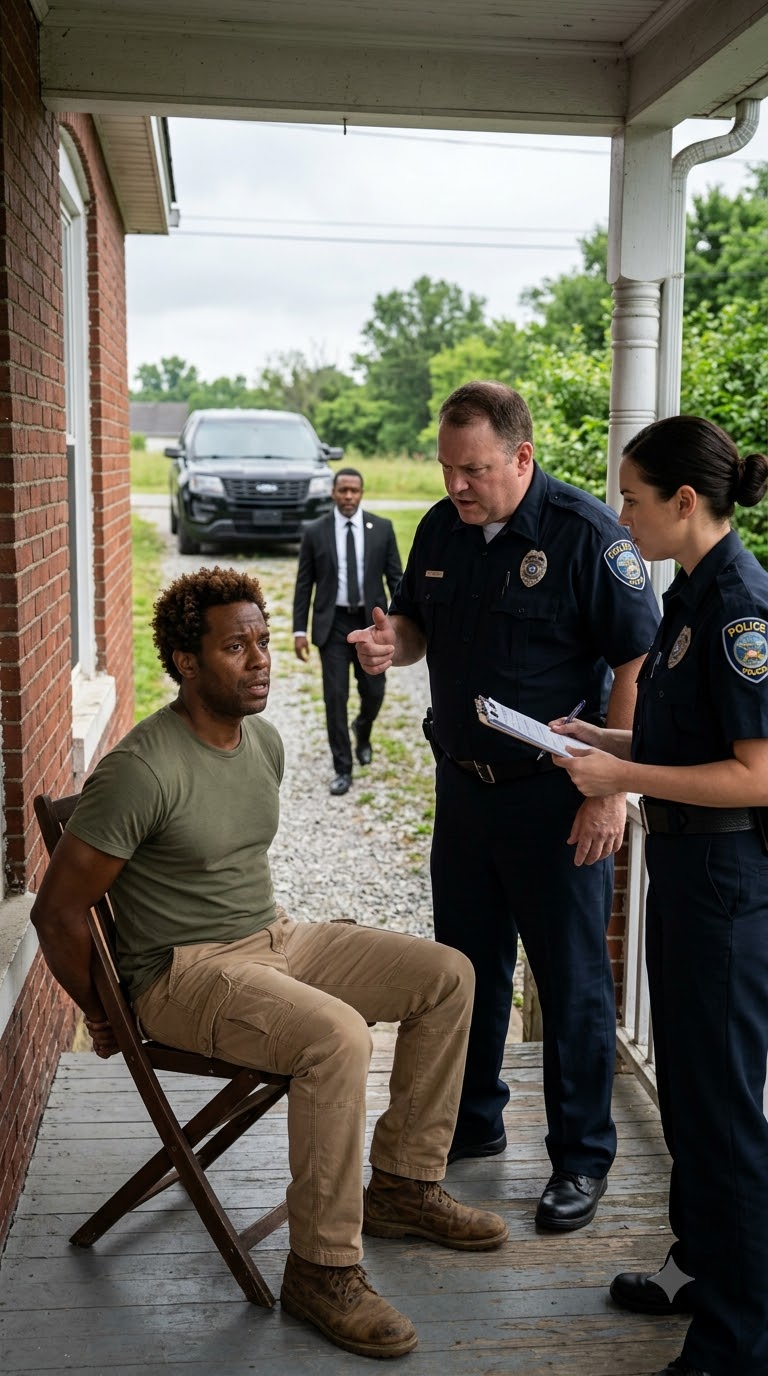
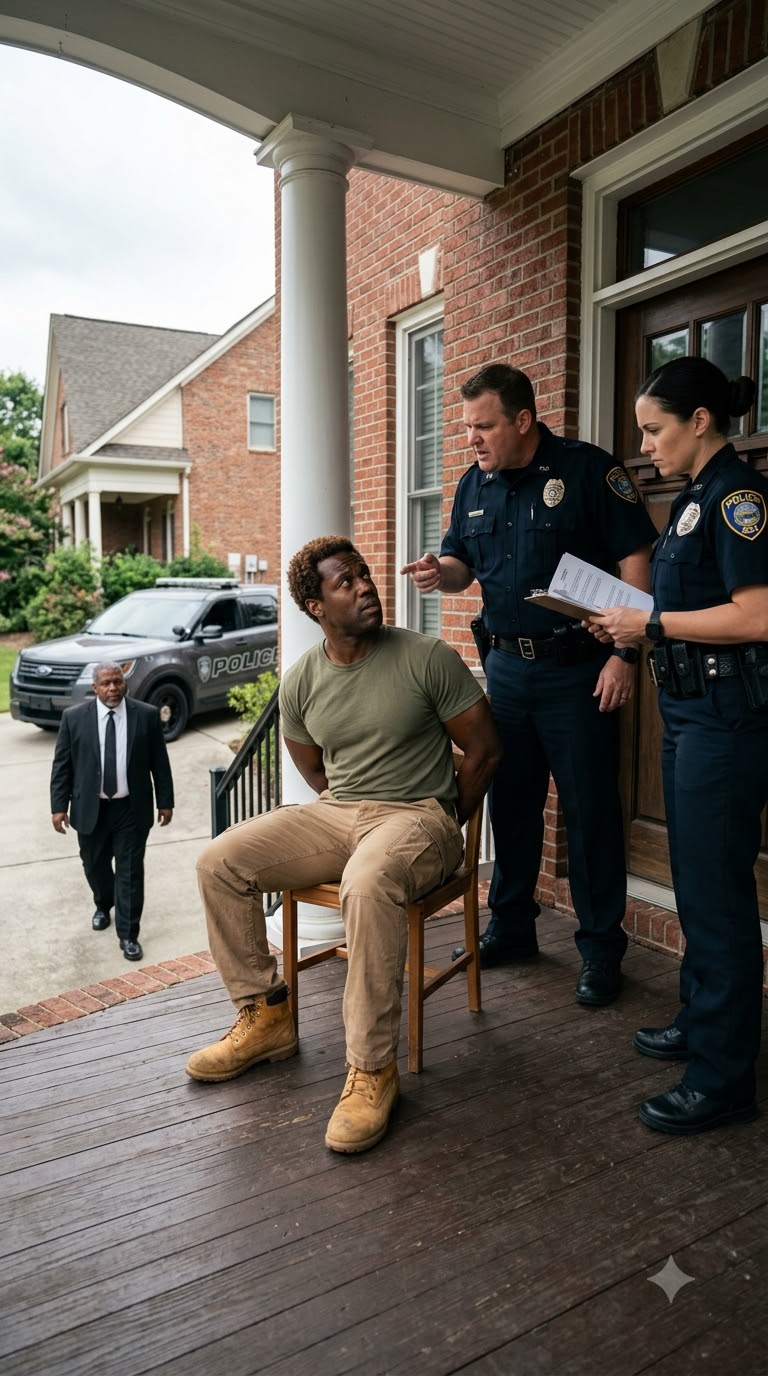
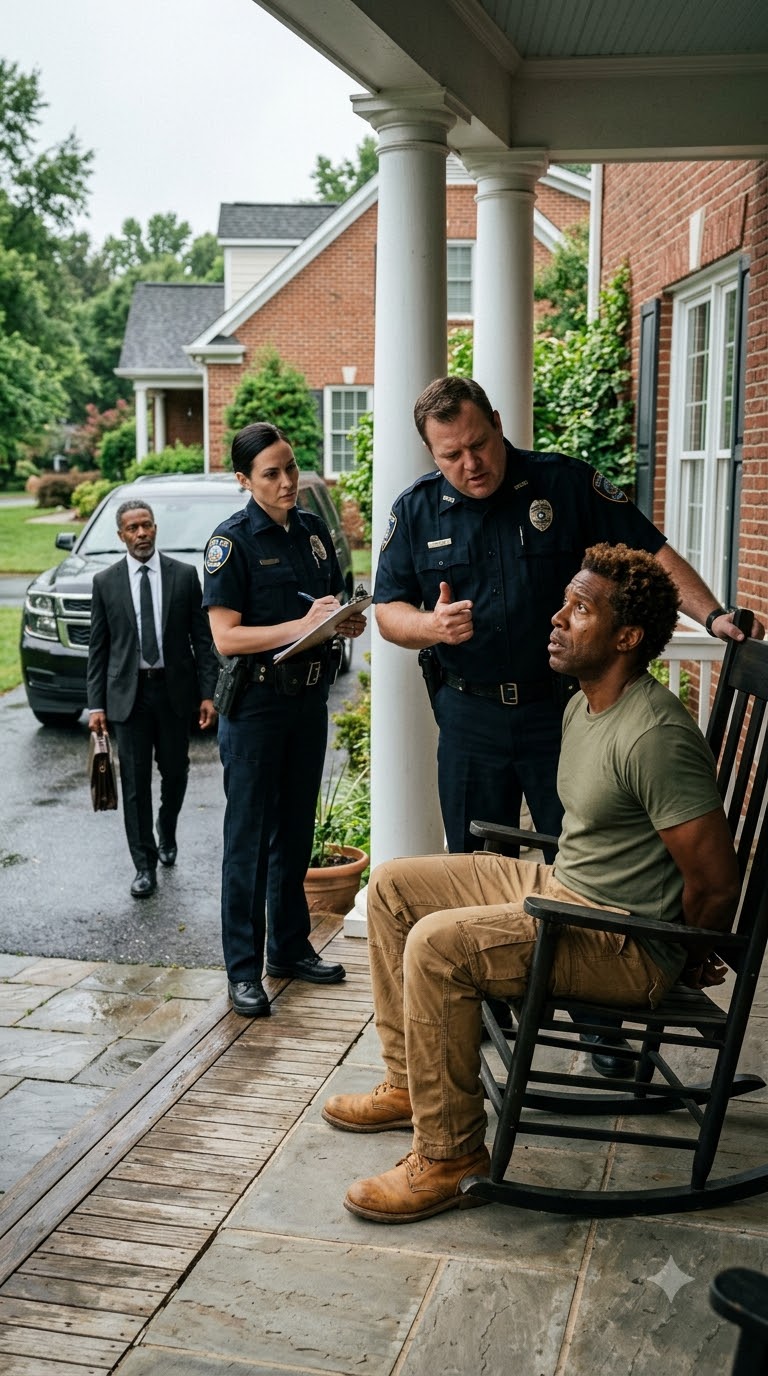
Harrow escorted him to the porch and forced him to sit.
Leon sat upright, his hands cuffed behind him, grass clinging to his boots, the mower silent beside the driveway, the garage still open, and his own driver’s license still in the sergeant’s hand.
Across the street, someone muttered, “Some people really will try anything.”
A few uneasy laughs followed.
Leon lowered his eyes once.
Not in shame.
In control.
He had taught younger soldiers that dignity was not the absence of humiliation.
Sometimes dignity was what remained when humiliation failed to change your posture.
That lesson belonged to him again now.
Six months earlier, most people on Briarstone Lane knew very little about Leon Walker.
He had lived at number eighteen for almost three years, buying the large brick colonial after retiring from active duty. He had paid cash for part of it, financed the rest, and never once wondered whether a man should have to explain why he owned what he owned.
He kept to himself.
He woke before dawn.
He drank coffee on the back porch while the street remained dark.
He trimmed hedges with the patience of a man who had once inspected equipment before convoys departed.
He shoveled snow for Mrs. Evelyn Price two doors down before she woke.
He repaired a teenager’s bicycle chain near the corner and refused payment.
He moved a fallen branch from Marjorie Bellamy’s driveway the week after she arrived, then went home before she saw him.
He was polite.
Quiet.
Useful.
And now he sat handcuffed on his own porch.
Ford walked toward him.
“Stand up.”
Leon looked at him.
“I’m already sitting down.”
Ford frowned.
“You heard me.”
Leon slowly rose.
Ramirez stepped between them.
“Sergeant, we have confirmed the address.”
Harrow looked at her.
“And?”
“He owns the property.”
Ford scoffed.
“That doesn’t prove he wasn’t trespassing inside the garage.”
Ramirez pointed toward the open garage.
“The garage is open. The truck is registered to him. His license matches the address. His property records match. There isn’t a reported burglary.”
Harrow stared at her.
“Are you questioning my judgment?”
“I’m asking what crime we’re investigating.”
Silence.
That question changed the atmosphere.
Harrow opened his mouth.
Nothing came out.
Leon remained still.
Then the distant sound of another engine approached.
It was deeper than the police cruisers.
Slow.
Heavy.
Deliberate.
Everyone on the street turned.
A large black government SUV appeared at the end of Briarstone Lane.
Behind it came another vehicle.
Then another.
The first SUV stopped directly in front of Leon’s house.
Its rear door opened.
A man stepped out.
He was tall.
Older.
Straight-backed.
His silver hair was cut close to his head, and he wore a dark military uniform decorated with four stars.
The street went silent.
Even Harrow seemed frozen.
The man walked toward the porch.
Ramirez’s eyes widened.
Ford stared.
Leon lifted his head.
For the first time since the police arrived, a faint smile appeared on his face.
The general stopped a few feet away.
“Leon.”
Leon looked at him.
“General.”
The four-star general glanced at the handcuffs.
Then at Harrow.
Then at Ford.
Finally, his eyes settled on Ramirez.
“What exactly is happening here?”
Nobody answered immediately.
Harrow recovered first.
“Sir, this is a police matter.”
The general looked at the badge on Harrow’s chest.
Then at Leon.
Then back at Harrow.
“No.”
His voice was quiet.
“This is a very serious matter.”
Ford shifted uncomfortably.
The general stepped onto the porch.
He stopped beside Leon.
“Remove the cuffs.”
Harrow shook his head.
“Sir, with respect, I can’t do that.”
The general’s expression hardened.
“Then I suggest you explain why you have a retired Army officer handcuffed on his own property after his identification confirmed his address.”
Harrow tried to regain control.
“We received a suspicious-person complaint.”
The general looked toward Marjorie.
Then back to Harrow.
“Was anything stolen?”
“No.”
“Was there forced entry?”
“No.”
“Did he attempt to flee?”
“No.”
“Did he threaten anyone?”
“No.”
The general paused.
“Then why is he handcuffed?”
Harrow swallowed.
“He was acting suspiciously.”
The general’s eyes narrowed.
“What did he do?”
Harrow said nothing.
The general turned toward Ramirez.
“Officer?”
Ramirez answered honestly.
“He was cutting his lawn.”
A few neighbors lowered their phones.
The general looked at Leon.
Then at the mower.
Then at the cuffs.
His expression changed.
Not into anger.
Into something colder.
Recognition.
The general crouched slightly so he could speak privately with Leon.
“Are you all right?”
Leon nodded.
“I’ve been through worse.”
The general smiled faintly.
“I know.”
He stood again.
Then he turned toward the officers.
“My name is General Marcus Whitaker.”
Ford’s face changed.
Everyone knew that name.
Whitaker had spent decades in the military and currently served in one of the highest-ranking positions in the armed forces.
But that was not why he had come.
He reached into his jacket and removed a folded document.
“I received a call from Leon early this morning.”
Harrow frowned.
“He called you?”
“No.”
The general looked toward Leon.
“He called someone else.”
He held up the document.
“And that person called me.”
Harrow’s face tightened.
“Who?”
Leon finally answered.
“My attorney.”
Harrow looked at him.
Leon continued.
“She saw the live footage from my neighbor.”
Marjorie’s face turned pale.
The general looked toward her.
“Ma’am, did you record the police encounter?”
She hesitated.
“Yes.”
“Did you provide the footage to anyone?”
Marjorie lowered her phone.
“No.”
Leon looked at her.
“You uploaded it.”
Her eyes widened.
She had forgotten that the neighborhood security group automatically shared certain videos.
Ramirez looked at her.
“So the footage was already online?”
Marjorie nodded reluctantly.
The general turned back toward Harrow.
“And that footage shows my friend standing peacefully on his own property with his hands raised while your officers approached him.”
Harrow tried to interrupt.
“We had reason to believe—”
The general raised one hand.
Harrow stopped.
“You had a complaint.”
“Yes.”
“A complaint that described a suspicious Black man working around a house.”
Harrow said nothing.
“And after you discovered the man was the homeowner, you still arrested him.”
Harrow’s face hardened.
“We were still investigating.”
The general looked at Leon.
Then at the officers.
“Then investigate the facts.”
He pointed toward Leon’s cuffs.
“Not the man.”
Ramirez stepped forward.
“Sergeant.”
Harrow looked at her.
“We should remove the cuffs.”
For several seconds, Harrow did not move.
Then he reached for the key.
The cuffs opened.
Leon slowly brought his hands forward and rubbed his wrists.
General Whitaker watched him.
“I’m sorry.”
Leon looked at him.
“You didn’t put them on me.”
“No.”
The general’s voice became softer.
“But I know what they represent.”
Leon nodded.
He understood.
Whitaker had not come because Leon needed rescuing.
He had come because Leon’s past mattered.
The man sitting on that porch was not merely a retired soldier.
He had been Whitaker’s commander during one of the most difficult periods of both their careers.
Years earlier, Leon had commanded a specialized unit during a deployment that had earned him several commendations and left him with memories he rarely discussed.
He had saved lives.
He had carried wounded soldiers.
He had made decisions under pressure that nobody should have been forced to make.
And when he finally retired, he had chosen the quietest life he could build.
A house.
A lawn.
A garden.
A Saturday morning.
The general looked at the officers.
“Do you know who he is?”
Ford shook his head.
“No, sir.”
Whitaker nodded.
“That is precisely the problem.”
Harrow frowned.
“What does that mean?”
“It means you should never need someone’s résumé to know how to treat them.”
Nobody spoke.
Leon looked toward the street.
Neighbors who had gathered earlier now stood silently.
Some looked embarrassed.
Some looked away.
Marjorie remained on her porch.
Her arms were no longer folded.
The general turned toward her.
“Ma’am.”
She looked up.
“Yes?”
“You made a report because you saw a Black man with tools outside a house.”
Her lips parted.
“I thought he was trespassing.”
“You didn’t ask him.”
She lowered her eyes.
“No.”
“You didn’t check the address.”
“No.”
“You didn’t speak to the homeowner.”
“No.”
Whitaker nodded.
“Then perhaps what you saw wasn’t suspicious.”
Marjorie swallowed.
“Perhaps I was wrong.”
Leon looked at her.
For a moment, everyone expected anger.
Instead, he said quietly:
“You were.”
The words landed harder than shouting would have.
Marjorie’s eyes filled.
“I’m sorry.”
Leon studied her.
Then he nodded once.
“Thank you.”
Harrow looked increasingly uncomfortable.
His body camera was still running.
So was Ramirez’s.
So were several phones across the street.
There was no way to erase what had happened.
And then Ramirez noticed something on the pavement near the cruiser.
A folded sheet of paper.
She picked it up.
It was a printed property record.
Leon’s name appeared at the top.
Underneath was the address.
At the bottom was a handwritten note.
Ramirez looked at Leon.
“Sir, is this yours?”
Leon nodded.
“Yes.”
She read the note.
It was a simple list.
Mrs. Price — check porch rail.
Evelyn — snow shovel.
Marjorie — trim hedge if needed.
Ramirez looked toward Marjorie.
“You had him on your list.”
Marjorie stared at the paper.
Leon nodded.
“She mentioned her hedge needed trimming.”
Marjorie’s face crumpled.
She remembered.
He had offered to help when she first moved in.
She had barely looked at him.
And now she had called the police on him.
The silence became unbearable.
Then General Whitaker spoke.
“Leon, come inside.”
Leon looked at the lawn.
“I still need to finish that section.”
The general laughed quietly.
“Of course you do.”
For the first time that morning, Leon smiled.
He picked up his rake.
The officers stepped aside.
The neighbors watched as the man they had just seen handcuffed on his porch walked calmly back toward his lawn.
But before Leon started working again, he turned toward the officers.
“I don’t want revenge.”
Harrow looked at him.
Leon continued.
“I want the report to be accurate.”
Ramirez nodded.
“It will be.”
Harrow looked away.
Leon returned to his yard.
The general remained beside him for another minute.
Then he said quietly, “You know this isn’t going to end here.”
Leon kept his eyes on the grass.
“I know.”
“Are you prepared?”
Leon leaned on the rake.
“I spent twenty-six years preparing for things I didn’t want to happen.”
Whitaker smiled.
“That sounds like you.”
Leon looked toward him.
“What are you doing here anyway?”
The general’s expression softened.
“I heard you were cutting grass.”
Leon laughed.
“That’s all it took?”
“For me?”
Whitaker glanced at the police cruisers.
“Yes.”
Leon shook his head.
“You’re still dramatic.”
“And you’re still impossible.”
The two men smiled.
Then Whitaker returned to his SUV.
Before leaving, he turned around.
“Leon.”
“Yes?”
“You don’t have to explain who you are.”
Leon looked at him.
“I know.”
The general nodded.
“Good.”
Then he left.
The police remained for another twenty minutes.
Ramirez completed her report.
Ford was noticeably quieter.
Harrow eventually approached Leon.
For the first time since arriving, his voice lacked its earlier confidence.
“Mr. Walker.”
Leon looked at him.
“Yes?”
“I owe you an apology.”
Leon waited.
Harrow struggled to continue.
“I handled this badly.”
Leon nodded.
“Yes.”
Harrow looked surprised that Leon had not softened the answer.
Leon continued.
“You did.”
Harrow looked down.
“I understand.”
“Do you?”
Harrow lifted his eyes.
Leon pointed toward the street.
“Because tomorrow you may stop someone else.”
Harrow said nothing.
“Maybe they’ll be older than me.”
Leon paused.
“Maybe they’ll be poorer.”
Another pause.
“Maybe they won’t know their rights.”
Harrow swallowed.
“And if you decide they’re suspicious because they don’t look like they belong, you can do this all over again.”
The sergeant stood silently.
Leon looked directly at him.
“That’s the part you need to understand.”
Harrow nodded.
“I do.”
Leon turned back toward his lawn.
Harrow walked away.
Ramirez stayed behind.
“Mr. Walker.”
Leon looked at her.
“I’m sorry too.”
“You didn’t cuff me.”
“No.”
She looked toward Harrow.
“But I didn’t stop him.”
Leon nodded.
“That matters.”
Ramirez took a breath.
“I’ll remember that.”
“I hope you do.”
She walked away.
The cruisers eventually disappeared down Briarstone Lane.
The neighborhood slowly returned to normal.
Dogs stopped barking.
Doors closed.
Phones lowered.
People went inside.
But the story did not disappear.
The footage spread through the community.
Then beyond it.
Not because Leon had demanded attention.
Because someone had recorded an ordinary man being treated as suspicious in his own home.
The video showed the mower.
The rake.
The house.
The driver’s license.
The cuffs.
And finally, the four-star general stepping onto the porch.
Within days, the police department opened an internal review.
The department’s leadership examined the dispatch recording, body-camera footage, property records, and witness statements.
The original complaint was reviewed line by line.
No burglary.
No forced entry.
No stolen property.
No threat.
No attempted escape.
The investigation eventually concluded that the officers had lacked sufficient justification for escalating the encounter in the manner they had.
Harrow faced disciplinary proceedings.
Ford was required to undergo additional training.
Ramirez remained with the department and later became one of the officers who helped revise its response procedures for suspicious-person complaints.
And Marjorie Bellamy?
She did something Leon never expected.
One Saturday morning, she knocked on his door.
Leon opened it.
She held a small basket.
“I brought you breakfast.”
Leon looked at the basket.
Then at her.
“Why?”
She smiled sadly.
“Because I owe you more than an apology.”
Leon accepted the basket.
“You don’t.”
“I do.”
She looked toward the lawn.
“Your grass is uneven.”
Leon smiled.
“That’s because I stopped halfway through.”
“I know.”
She hesitated.
“Can I help?”
Leon looked at her for a moment.
Then handed her the rake.
“Start over there.”
Marjorie laughed through tears.
“Yes, sir.”
Leon walked toward the mower.
For the first time since moving onto Briarstone Lane, the two neighbors worked side by side.
No police cars.
No accusations.
No assumptions.
Just two people taking care of a lawn.
And sometimes that was where healing began.
Not with speeches.
Not with cameras.
Not with someone important arriving to announce who deserved respect.
It began when people finally looked at one another and saw human beings before labels.
Leon Walker had spent most of his life serving his country.
He had commanded soldiers.
He had carried responsibility.
He had protected people who might never know his name.
But on that Saturday morning, none of those accomplishments mattered as much as the simplest truth.
He was home.
It was his porch.
His lawn.
His life.
And he should never have needed a four-star general to prove it.
