

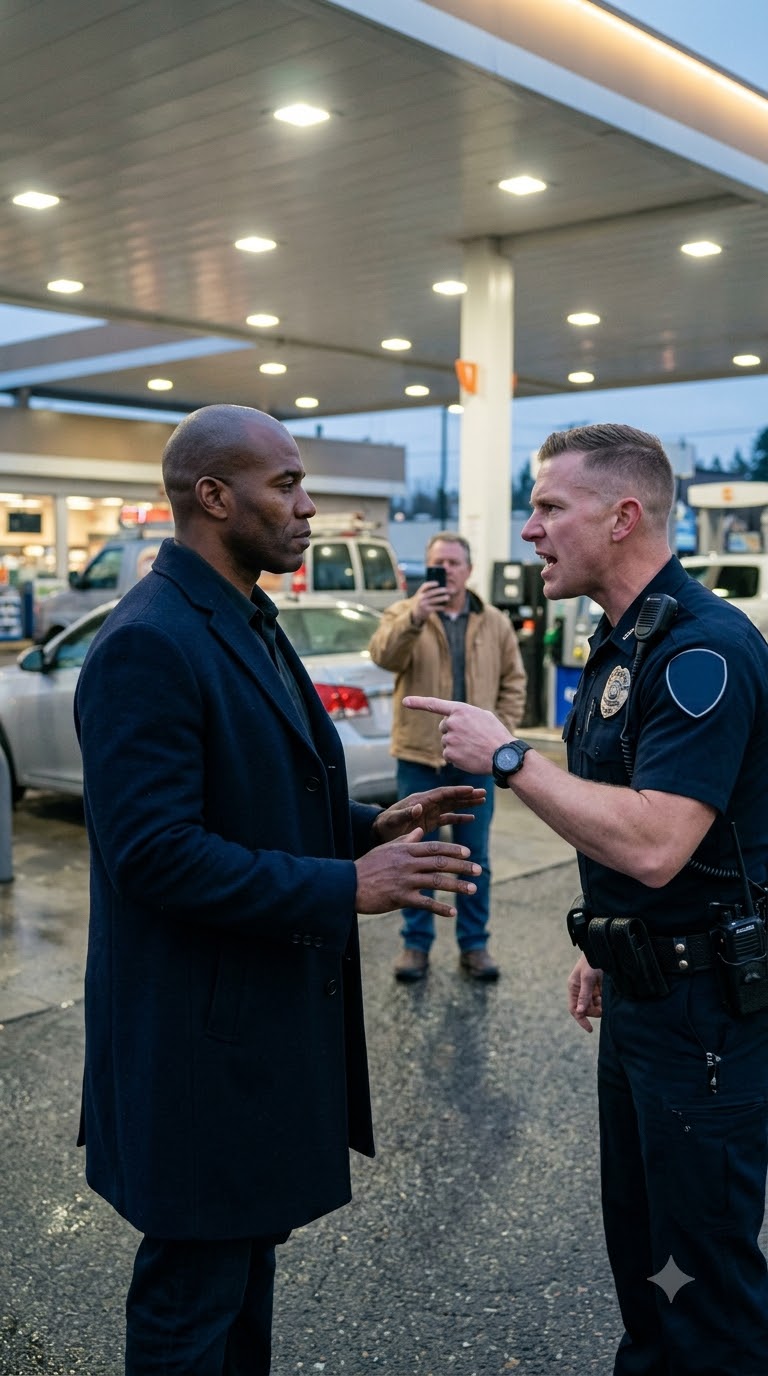
PART 2
Marcus continued, “You also have a use-of-force incident now.”
Alvarez took control of the situation.
“Sir, I need to separate everyone.”
Marcus nodded. “Good.”
She turned toward Porter. “Go to your unit.”
He stared at her. “Nina—”
“Go.”
Porter looked around at the phones, the faces, and the rain.
Then he walked toward his patrol car.
Marcus remained beside his sedan.
The man in the baseball cap, whose name was Harold Pike, suddenly seemed far less confident.
Alvarez approached him.
“You said you saw this man pulling your truck handle?”
Harold gestured vaguely. “Yeah.”
“When?”
“Like five minutes before you got here.”
“Which truck?”
“The blue Ford.”
Alvarez looked across the parking lot.
The blue Ford was parked three rows away.
“Did you see his face?”
Harold hesitated. “He had a dark coat.”
“Did you see his face?”
“Not really.”
“Height?”
“I don’t know.”
“Anything else?”
Harold glanced at Marcus before quickly looking away.
“He was Black.”
Alvarez’s jaw tightened.
She turned toward the restaurant entrance.
A security camera was mounted above the door.
The complaint was already falling apart.
But the slap remained.
Marcus called his office.
“Evelyn, it’s Marcus.”
His wife answered immediately.
“I’m fine.”
He paused.
“No, listen.”
He explained only what was necessary.
Then he called the duty attorney at the U.S. Attorney’s Office and requested that local command be contacted.
“No press from us,” he said.
After ending the call, he turned as Alvarez approached.
“Mr. Reed, I need to ask whether you want medical attention.”
“No.”
“Can I photograph the injury?”
“Yes.”
She documented the redness on his cheek and the marks around his wrist.
Marcus asked, “Body cameras?”
“Yes.”
“Both running?”
Alvarez checked. “Yes.”
“Good.”
He glanced toward Porter’s patrol vehicle.
“Do not let anyone turn them off.”
“I won’t.”
That was where trust began.
Not friendship.
Not yet.
Twelve minutes later, a lieutenant arrived.
Daniel Ross was fifty-two, Black, and composed, with the weary posture of a supervisor who had watched too many incidents become exercises in reputation management before anyone had finished collecting the facts.
He stepped out of his SUV and looked first at Marcus, then at Porter, and finally at Alvarez.
“Everyone separate?”
“Yes.”
“Body cams secured?”
“Yes.”
Ross nodded, then approached Marcus.
“Sir, I’m Lieutenant Daniel Ross. I understand there’s been an incident.”
Marcus looked at him steadily. “There has.”
Ross glanced at the redness on his face.
“I apologize for what happened.”
Marcus did not immediately respond.
“I appreciate the acknowledgment,” he said finally. “But an apology is not an investigation.”
Ross’s expression tightened slightly.
“No, sir. It isn’t.”
“Then I expect an independent review of the footage, the witness statements, and the original complaint. I also expect the records to be preserved.”
“You have my word.”
Marcus held his gaze.
“Please understand, Lieutenant. I am not asking for special treatment because of my position. I am asking for the same protections any citizen should receive.”
Ross nodded slowly.
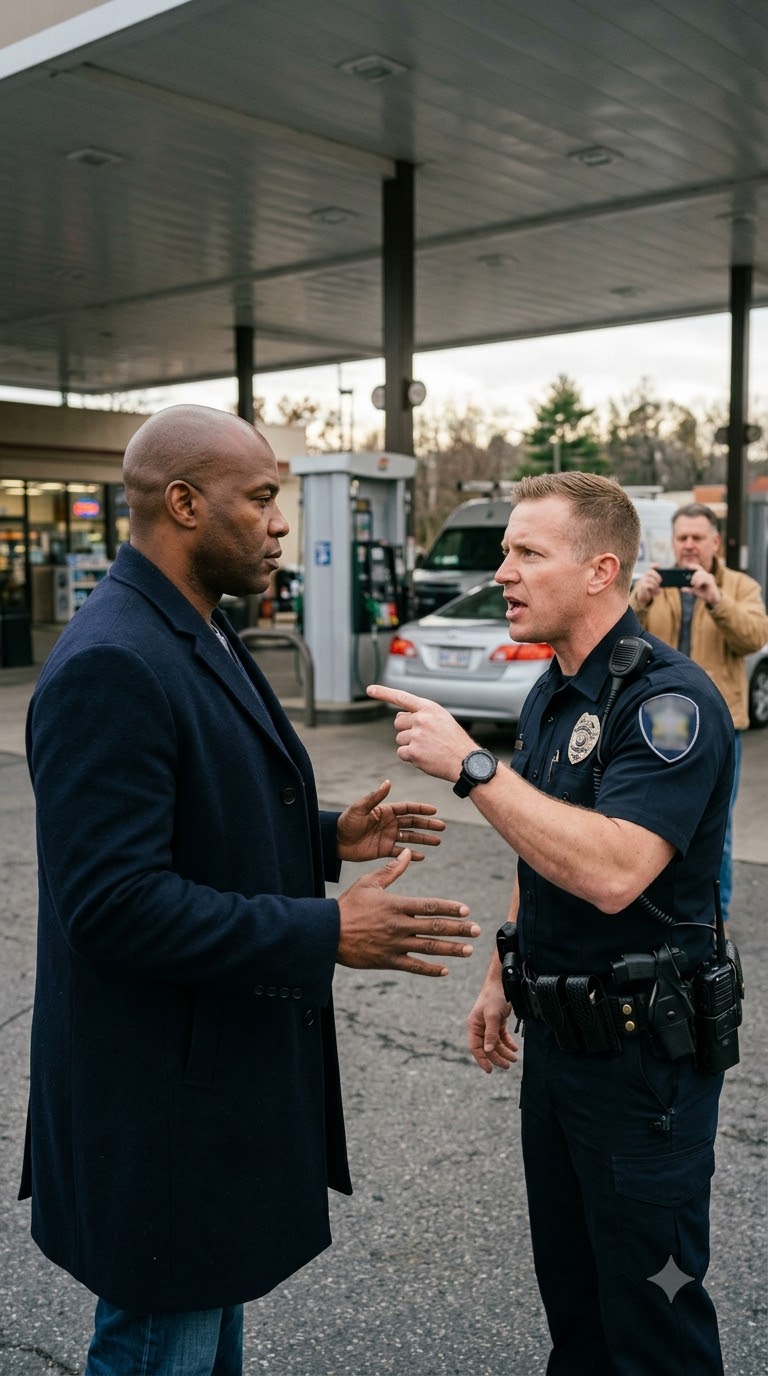
“That is fair.”
He turned to Alvarez.
“Secure the recordings. Document every witness. Nobody deletes or edits anything. I want the original dispatch information and the restaurant’s security footage preserved.”
“Yes, sir.”
Then Ross looked toward Porter.
“Officer Porter, hand over your badge and service weapon pending an administrative review.”
Porter stiffened.
“Lieutenant, I made a mistake.”
Ross’s voice remained controlled.
“You struck a man who was not threatening you, and now we need to establish exactly what happened. This is not the time for explanations.”
Porter glanced at Marcus.
“I didn’t know who he was.”
Marcus answered before Ross could.
“That has nothing to do with it.”
Porter looked away.
Marcus continued, “If I had been a delivery driver, a construction worker, or a man who had never owned a suit in his life, would that slap have been acceptable?”
No one answered.
“Would it have become less serious because I couldn’t show you a federal credential?”
Ross lowered his eyes for a moment.
“No,” he said. “It would not.”
Porter removed his equipment with shaking hands.
The crowd had heard every word.
Harold Pike remained near the awning, his cap pulled low over his forehead. When Alvarez asked him to provide a formal statement, he initially insisted that he had been mistaken about the timing.
Then the restaurant manager brought out a copy of the exterior camera footage.
It showed Marcus standing beside his silver sedan, trying his key fob and opening his own car door.
The blue Ford remained untouched.
Harold watched the screen in silence.
Finally, he admitted that he had seen a different man near his truck earlier and had assumed Marcus was the same person.
He had noticed the dark coat and the fact that Marcus was Black. That was all.
His careless assumption had become a police complaint.
The complaint had become a confrontation.
And the confrontation had ended with an officer striking an innocent man.
Harold looked at Marcus.
“I’m sorry. I thought I saw you.”
Marcus studied him.
“You thought you saw someone who fit a description. You told an officer you were certain.”
Harold lowered his head.
“I was wrong.”
“Yes,” Marcus said. “You were.”
He did not offer Harold easy forgiveness, nor did he demand a public apology. He simply refused to let the man turn uncertainty into an excuse.
By the time the scene was cleared, the rain had stopped.
Marcus retrieved his keys from the sedan and sat behind the wheel for several seconds without starting the engine.
His cheek hurt.
His wrist ached.
But what bothered him most was the familiar question that had followed him throughout his life: how much evidence of his own innocence would he need to produce before someone believed him?
His federal credentials had changed the way Porter looked at him.
They had not changed what Porter had done.
That distinction mattered.
