

The hallway of St. Mary’s Children’s Hospital smelled of bleach and stale coffee — like fear trying to pass for cleanliness.
It was New York City, one of those winter nights when the air felt thin and fluorescent lights turned everyone pale. Nurses rushed past. Machines beeped with merciless rhythm. Screens blinked, quietly reminding everyone that time refused to stop.
Daniel Herrera couldn’t stop trembling.
Not from the cold — from the kind of fear that sinks into your bones when reality becomes unbearable.
For three weeks, he had practically lived outside Room 512. His tailored suit was wrinkled beyond recognition, his beard overgrown, his phone always in his hand as if wealth, influence, and connections could somehow be exchanged for a miracle.
Inside, his three-year-old son, Tommy, lay surrounded by tubes and monitors that looked too large for his tiny body. Each day he seemed smaller. Paler. Quieter. As if something invisible was slowly dimming him.
Daniel had built his fortune believing one thing: every problem has a solution.
Now he was facing the first one money couldn’t fix.
Dr. Michael Bennett, head of pediatrics, asked him to “sit down for a moment.” The tone alone told Daniel everything.
He knew that look — calm voice, measured breath, eyes that never quite hold yours.
“Mr. Herrera,” the doctor began carefully, “we need to be honest.”
Daniel’s throat went dry.
“We’ve tried everything. Multiple treatment protocols. International consultations. Tests we rarely perform. Your son’s condition is extraordinarily rare. In the few documented cases…”
He stopped.
The silence said the rest.
The hallway seemed to tilt.
“How long?” Daniel managed.
Dr. Bennett lowered his eyes. “Five days. Maybe a week… if we’re fortunate. At this point, our focus is keeping him comfortable.”
Five days.
That was a deadline for a contract.
Not for a child.
“There has to be something,” Daniel said, gripping the doctor’s sleeve. “Money isn’t a problem. I’ll fly in anyone. Name your price.”
“We’ve already consulted the best,” Dr. Bennett replied gently. “Sometimes medicine reaches its limits.”
Sometimes.
It sounded like surrender.
When the doctor left, Daniel stood frozen before finally walking back into the room.
Tommy lay under a white blanket, breathing with effort. His skin looked almost translucent. Daniel took his son’s cold hand and pressed it against his forehead like a prayer.
Tears came without permission.
How am I going to tell Elena?
His wife was in Miami at a conference. Just two days away. And their son had five.
The door opened.
Daniel wiped his face, expecting a nurse.
Instead, a little girl stepped in.
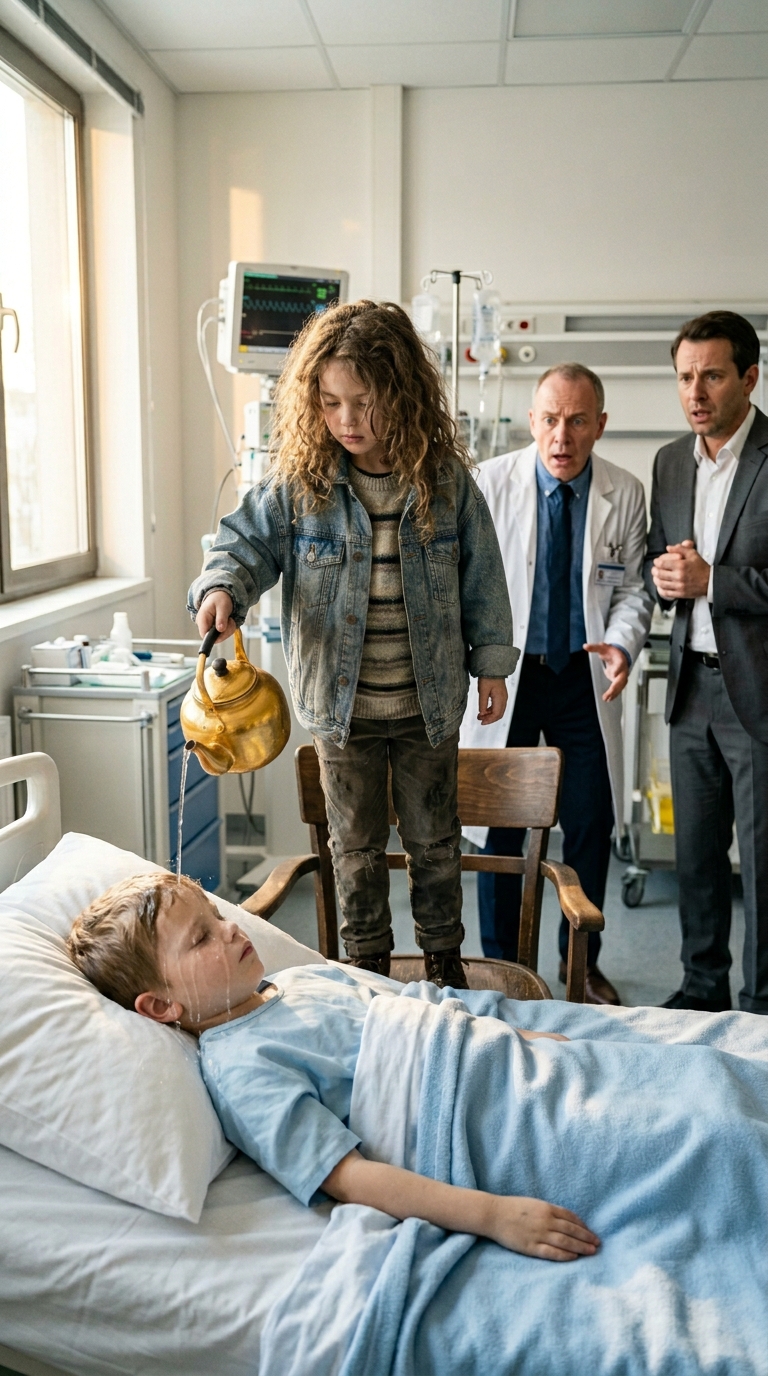
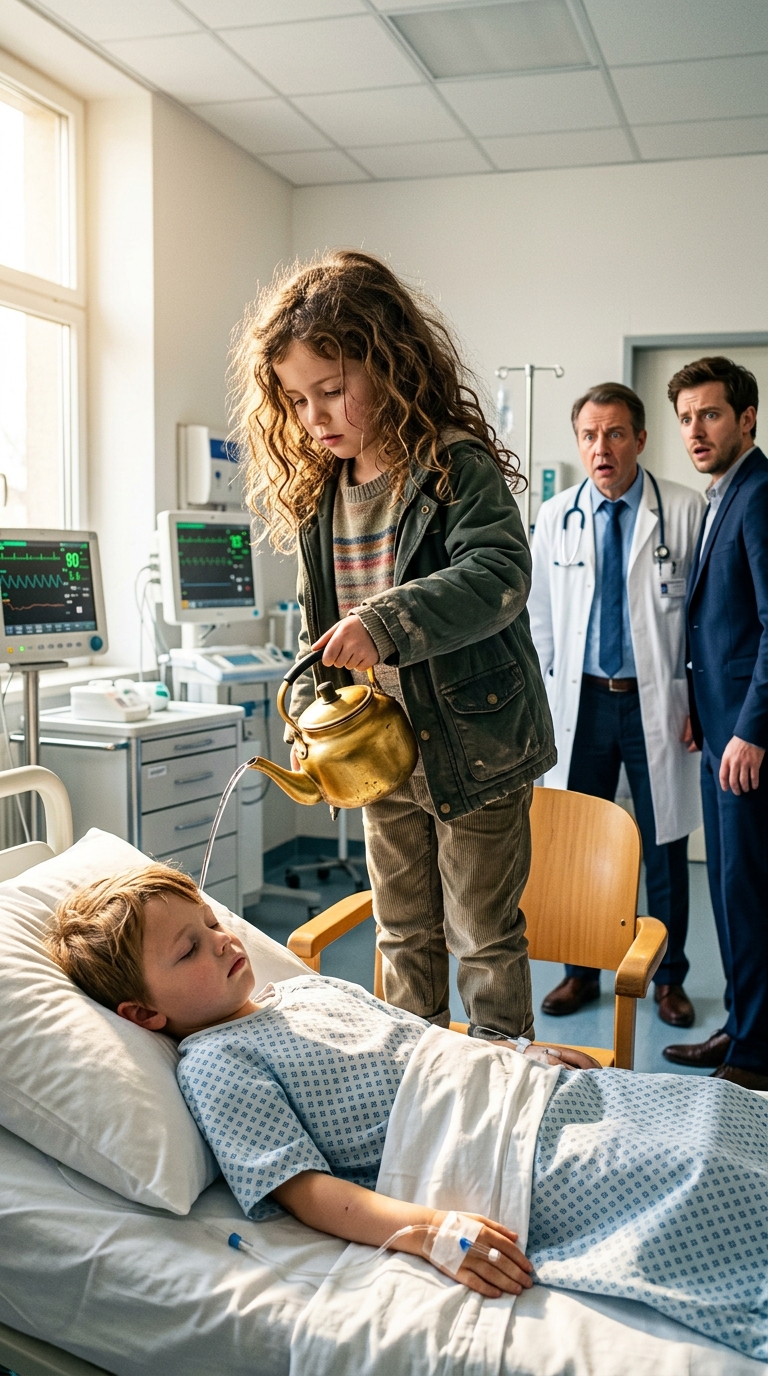
She was about six, wearing a faded school uniform and an oversized gray sweater. Her dark hair was messy, as if she’d been running. In her hand was a cheap gold-colored plastic bottle.
“Who are you?” Daniel asked sharply. “How did you get in here?”
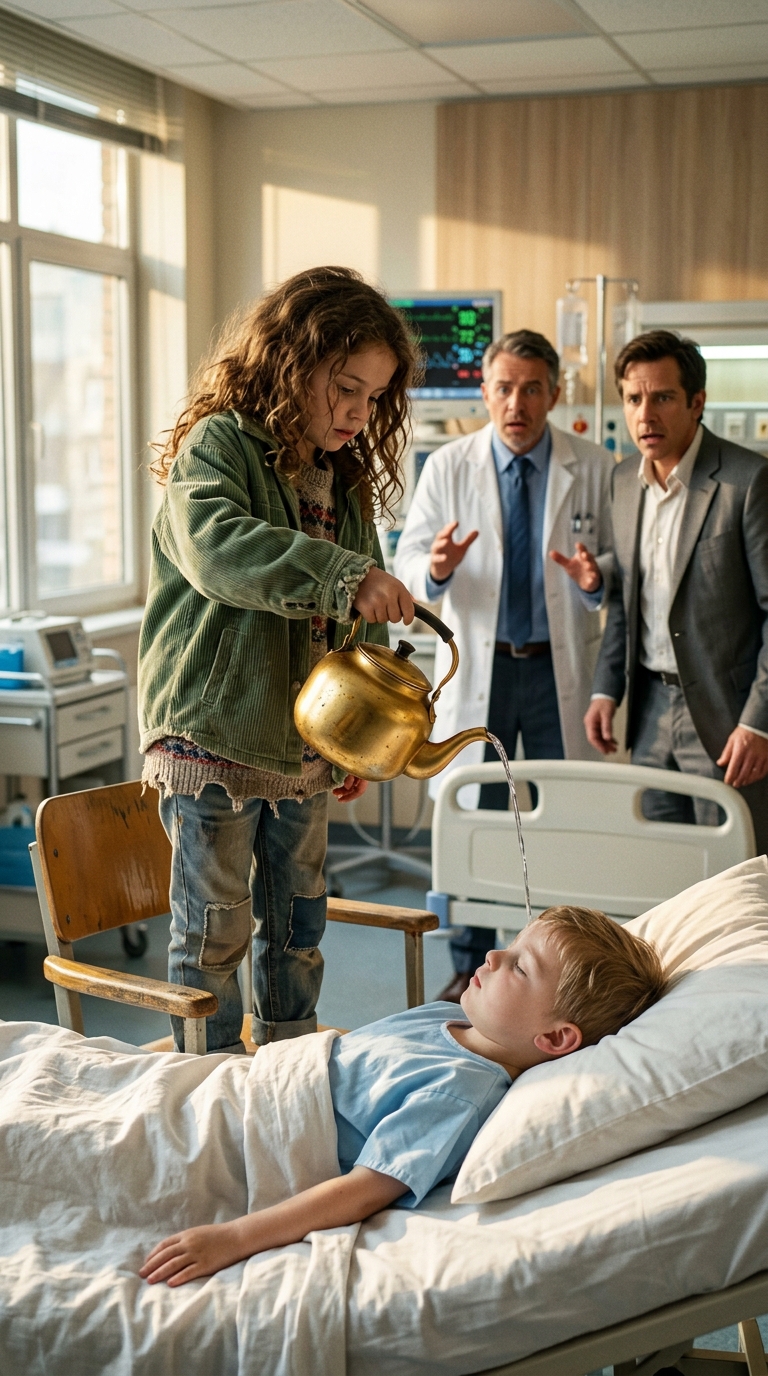
She didn’t answer. She walked to Tommy’s bed with startling determination, climbed onto a step stool, and studied him like she saw something no one else could.
“I’m going to save him,” she said.
Before Daniel could react, she unscrewed the cap.
“Wait—”
Too late.
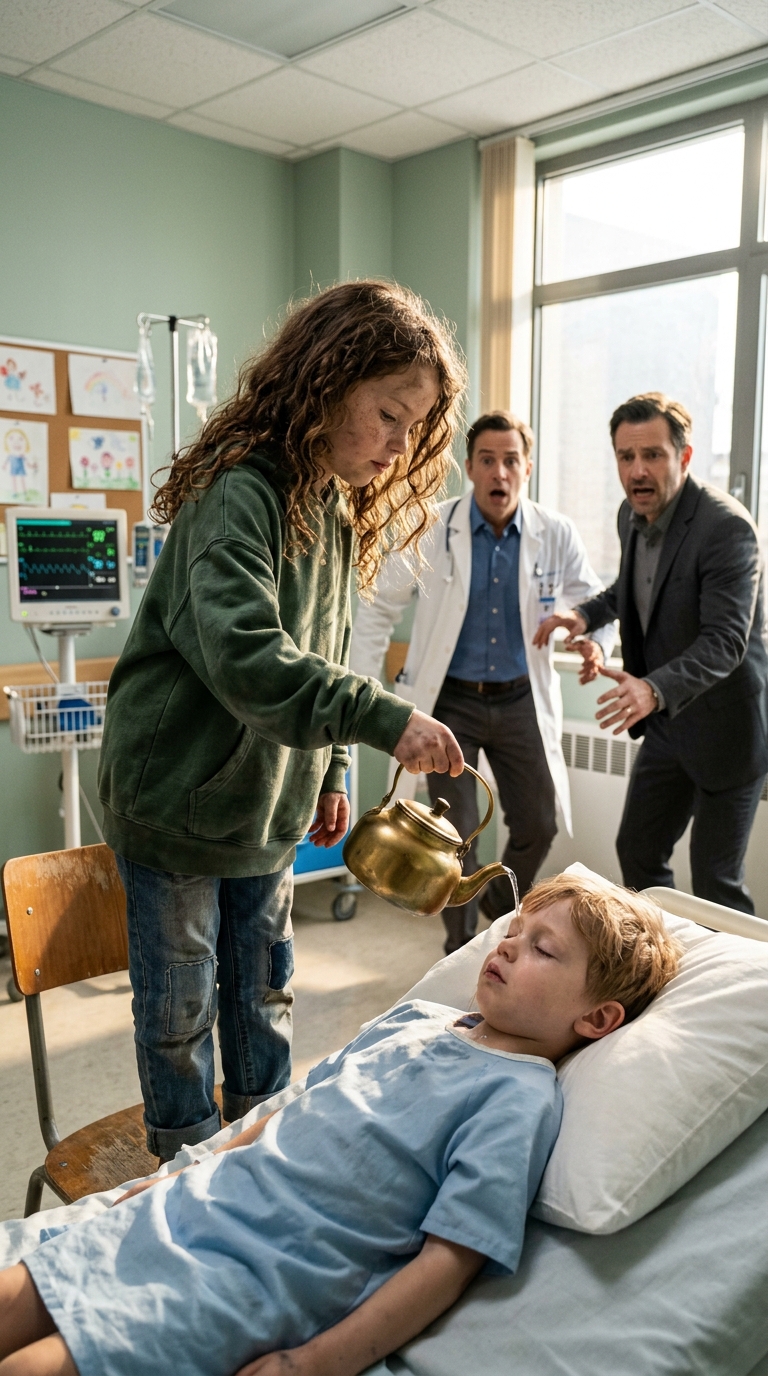
She poured water gently over Tommy’s face.
Daniel lunged forward, pulling the bottle away.
“What are you doing?” he shouted. “Get out!”
Tommy coughed once. Then silence again.
The girl clutched the bottle. “He needs it. It’s special water. He’ll get better.”
Two nurses rushed in.
From the hallway, a woman’s voice cried out, “Sophie! What did you do?”
A hospital janitor hurried in — a tired-looking woman in her thirties. “I’m so sorry,” she said breathlessly. “I’m Lisa. She’s my daughter. We’re leaving.”
“I was helping Tommy!” the girl protested through tears.
Daniel stiffened. “How does she know his name?”
Lisa hesitated. “I work here. Maybe she saw it on the door—”
“No,” Sophie interrupted. “We used to play at Miss Rose’s daycare.”
Daniel’s chest tightened. “My son has never been to daycare.”
“Yes, he did,” Sophie insisted. “Twice a week. He liked hide-and-seek.”
Daniel slowly turned to Lisa.
“We’re leaving,” she repeated, pulling her daughter away.
They disappeared down the hall, leaving Daniel holding the cheap bottle — and a new, unsettling doubt.
That afternoon he called the nanny, Grace.
“I want the truth. Did you take Tommy to daycare?”
A long silence.
“…Yes,” she admitted finally. “Only twice a week. He was lonely, sir. It was a small place in Eastbrook. He seemed happy there.”
Eastbrook was one of the city’s poorest neighborhoods.
Daniel hung up, anger rising — at the lie, at himself, at the realization he’d been too absent to notice.
He looked through the glass at Tommy.
Five days.
If his son had found joy in a modest daycare, who was he to judge?
“I don’t care where you were happy,” he whispered, holding Tommy’s hand. “I just want you here.”
That night, Daniel fell asleep in the chair.
He woke to whispering.
Sophie was back.
This time she was simply holding Tommy’s hand, murmuring something that sounded like a prayer mixed with a story.
“How did you get in here?” Daniel asked, exhausted.
“Through the back door,” she said simply. “I know where Mom keeps the key.”
“You can’t be here.”
“Tommy needs me.”
Daniel was about to call security when she whispered, “Look.”
Tommy’s color was different.
Not healed. Not strong.
But slightly less gray.
Daniel felt something he hadn’t allowed himself to feel in days:
Hope.
“What is this water?” he asked quietly.
Sophie’s eyes brightened. “From the courtyard fountain. My grandma says there used to be a well there a long time ago. People said it helped the sick.”
Daniel let out a soft, skeptical breath. “It’s just a story.”
“Maybe,” she replied. “But he smiles when I talk to him.”
Daniel looked down.
Tommy’s fingers had curled faintly around hers.
For the first time in weeks, Daniel didn’t think about money, specialists, or statistics.
He thought about friendship. About laughter in a small daycare he had never visited. About a little girl who believed more fiercely than any adult in the building.
Maybe the water wasn’t a miracle.
Maybe hope was.
And for the first time since hearing “five days,” Daniel allowed himself to believe that sometimes, what medicine cannot measure still matters.
