

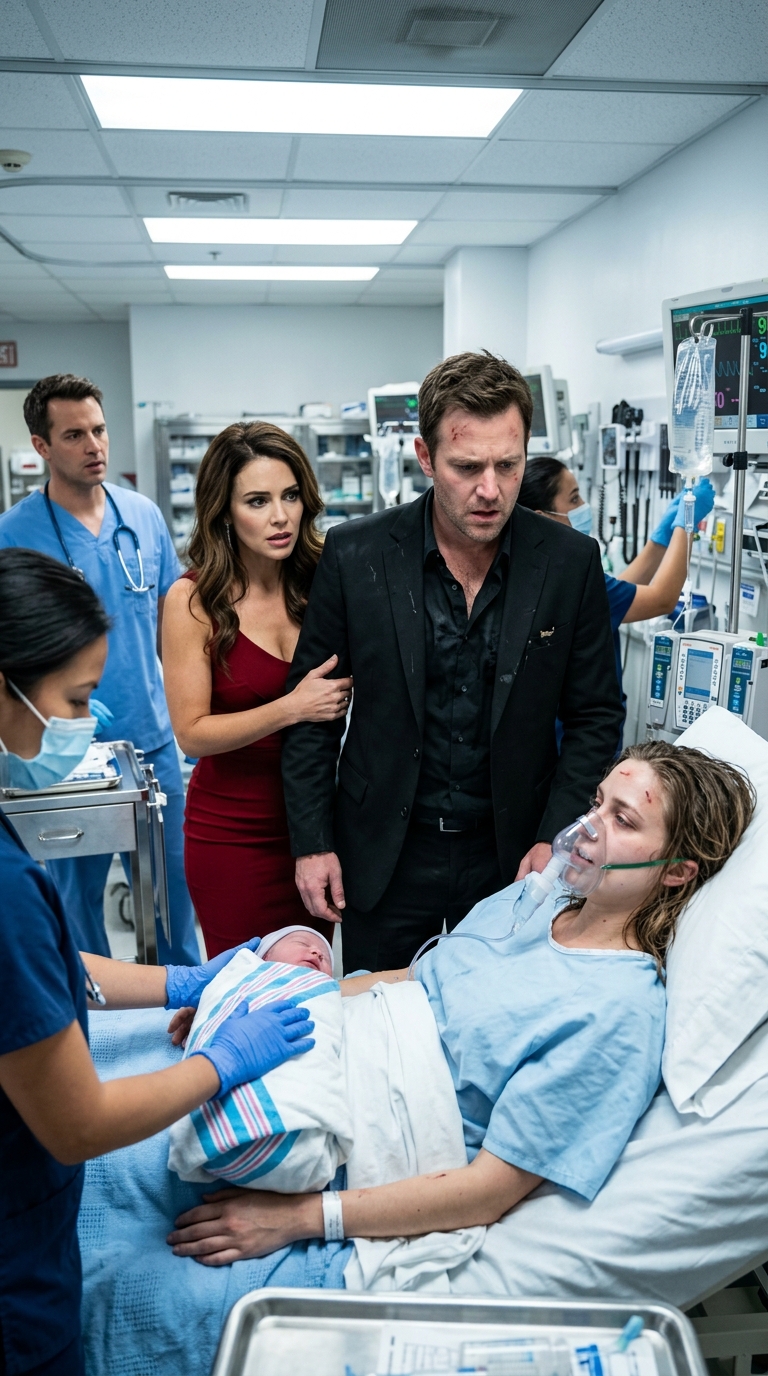
By the time Cormack Hale realized the woman on the emergency gurney was Brin Holloway, his phone had already slipped from his hand and hit the carpeted floor of Northwestern Memorial Hospital with a dull thud. He barely heard it.
One second earlier, he had been sitting in the VIP waiting lounge with one ankle resting over his knee, answering encrypted messages on a titanium-cased phone while his girlfriend complained about stomach pain beside him. The room smelled faintly of antiseptic and expensive lilies. A television mounted in the corner played a home renovation show with the sound off. Two of his men stood outside the glass doors, dressed in dark suits, scanning the corridor with the quiet vigilance of trained predators.
To everyone else on that floor, Cormack looked like a wealthy businessman waiting for a routine appointment to end. No one looking at him would have guessed that at thirty-seven years old, he controlled half the criminal infrastructure running through Chicago’s lakefront shadow economy.
Money laundering through gaming companies. Night shipments through private docks. Protection chains disguised as “security consulting.” Men who obeyed him faster than they obeyed the law.
Across from him, Yara Salcedo shifted in her chair and pressed a manicured hand to her stomach. “This pain is not normal,” she said, her voice tight. “Cormack, I’m serious.”
Cormack murmured something that wasn’t quite a response.
He had a meeting downtown at two. Three division heads were waiting on revised numbers. One of his attorneys needed approval on a land transfer in Hammond. The hospital visit was an inconvenience. Necessary, yes. Important politically, certainly. But still an inconvenience. Yara was the daughter of Aurelio Salcedo, and men in Cormack’s world did not ignore the daughter of Aurelio Salcedo.
Then the double doors at the far end of the hall burst open.
A gurney came tearing through the corridor so fast one of the wheels rattled over the tile seam. Two nurses ran alongside it. Another person in blue scrubs shouted into a radio.
“Blood pressure dropping.” “Thirty-eight weeks.” “Move, move.” “Possible PPCM—get OB and cardio in place now.”
Cormack looked up, irritated first. Then frozen.
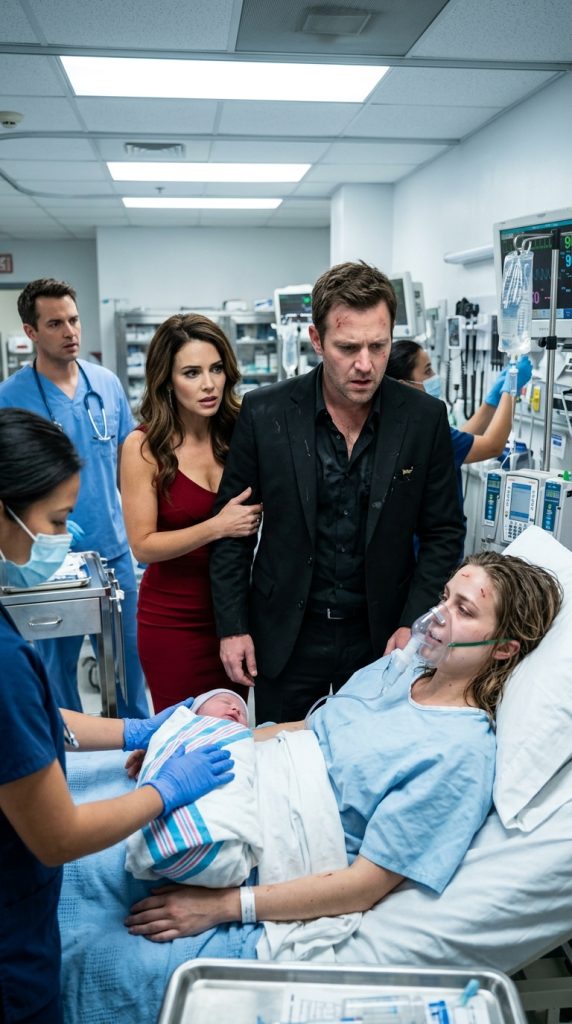
The woman on the gurney was drenched in sweat, face white as paper, black hair tangled against the pillow. Her fingers were clamped around the side rail. A clear oxygen mask fogged and cleared, fogged and cleared with every shallow breath. Beneath the blanket, the hard curve of a full-term pregnancy strained upward like a cruel miracle.
Brin. Brin Holloway. The bartender from his club. The woman who had once slept with her hand open over his heart as if she trusted it. The woman he had looked in the eye nine months earlier and told, “You don’t belong in this world.” Then he had put on his suit jacket and walked out.
He had called it protection. She had called it abandonment.
And now she was here. Pregnant. Dying.
His mind did what men like him trained their minds to do under pressure: it calculated. Nine months. The apartment behind the club. The whiskey. The silence. The last night. The way she had cried and turned away so he wouldn’t see. The way he had pretended not to hear because if he let himself hear it, he might stay.
Nine months. Every number led to the same answer.
The blood drained from his face.
Royce, the closest of his bodyguards, stepped through the doorway and leaned in. “Boss,” he said quietly, “that’s the old bartender from Vesper Row, right? You want me to find out where they’re taking her?”
Cormack stared at the closing doors behind the gurney. “No,” he said.
Royce blinked. “No?” “No one touches her. No one pressures anyone. No one says her name. Stay back.”
Yara turned in her chair, sharp and annoyed. “Cormack, what is wrong with you?”
He didn’t answer.
The hydraulic doors sealed shut with a soft hiss, but in his chest it sounded like a prison gate slamming.
For the first time in twenty-two years, Cormack Hale felt helpless in a way guns, lawyers, cash, and violence could not solve.
He was on his feet before he realized he had stood. He moved fast, crossing the polished floor, turning down the maternity corridor, ignoring Yara calling his name behind him. At the central nurses’ station, a middle-aged nurse with silver threaded through her dark hair looked up from a chart.
“How can I help you, sir?”
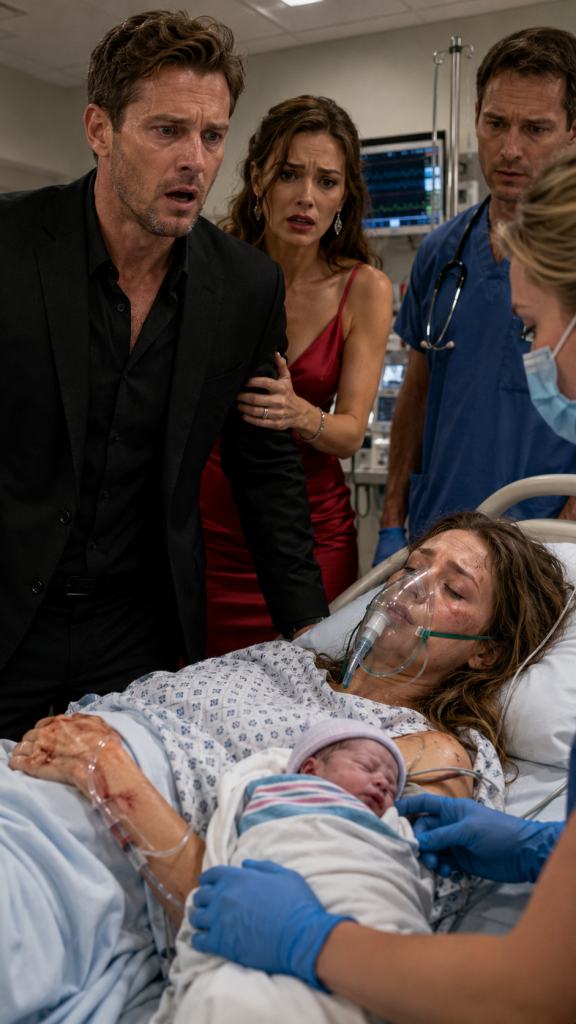
PART 2:
Cormack Hale stopped hard enough that the soles of his shoes whispered against the floor.
For one dangerous second, he forgot how to speak.
Beyond the nurses’ station, somewhere behind swinging doors and coded hallways, Brin Holloway was being swallowed by a system he could not intimidate. A world of monitors, surgeons, oxygen lines, medical terms barked too fast to understand. In his city, his name could open locked doors and close mouths. Here, the woman behind the desk looked at him as if he were just another anxious man in an expensive coat.
“I need to see the woman who was just brought in,” he said.
The nurse’s expression did not change. “Name?”
Cormack’s jaw tightened.
He knew better than to answer too quickly. Names were currency. Names created trails. Names created danger.
But Brin was dying somewhere behind that wall.
“Brin Holloway.”
The nurse glanced down at her screen. “Are you family?”
The question struck him with humiliating precision.
Family. He had made sure he was not.
Cormack opened his mouth, but no answer came. Husband? No. Fiancé? No. Emergency contact? He had once been the number Brin called when a drunk customer grabbed her wrist too hard. He had once been the man she trusted to walk her home after closing. But on paper, in the clean, merciless world of forms and signatures, he was nothing.
“I’m the father,” he said finally.
The nurse looked up. Something flickered across her face, not surprise exactly. More like caution.
“Do you have identification?”
Cormack took out his wallet and placed his driver’s license on the counter. The nurse read it, typed something, then paused.
“She did not list you,” she said. “I know.” “She listed a Mrs. Althea March as her emergency contact.”
His throat tightened.
Althea. Brin’s former landlady. A retired piano teacher with a spine made of iron and a mouth sharp enough to draw blood. Cormack had met her once, briefly, when he sent someone to deliver boxes Brin had left at the apartment behind Vesper Row. The old woman had opened the door, looked at the Hale crest stamped on the delivery invoice, and spat on the ground near his driver’s shoes.
He had almost admired her for it.
“Has she been called?” Cormack asked. “Yes.” “How long?” “Sir, I can’t release medical information unless—”
Cormack leaned in slightly. Not enough to threaten. Enough to remind the world that he had spent decades turning rooms cold.
The nurse did not move. Her eyes hardened.
And, to his surprise, Cormack looked away first.
“I’m not here to cause trouble,” he said, voice lower. “I just need to know if she’s alive.”
The nurse studied him.
Behind him, footsteps approached. Royce stopped a few paces away but said nothing. A moment later, Yara’s heels clicked against the floor like small gunshots.
“There you are,” she snapped. “Do you know how humiliating it is to be left sitting alone while you chase after some—” “Not now,” Cormack said.
Yara froze.
People did not speak to Yara Salcedo that way. Not waiters. Not drivers. Not men who wanted to live comfortably. Her father had taught her early that beauty was useful, but fear lasted longer.
Her eyes moved from Cormack to the nurse, then to the maternity ward sign above the corridor. A slow understanding began to gather behind her expression.
“Who is she?” Yara asked.
Cormack did not answer.
The nurse closed the chart in front of her. “Sir, you’ll need to wait in the family area until someone can speak with you.” “I’m not leaving this floor.” “That’s your choice,” she said. “But you’re not going beyond those doors.”
Cormack stared at her.
Royce shifted his weight, already sensing the old instinct in his boss — the instinct to press until something broke. But Cormack only nodded once.
“Tell the doctor the father is here,” he said. “I’ll pass it along.”
Yara laughed once, a brittle sound. “The father?”
Cormack turned.
Her face had changed. The annoyance was gone. In its place came something colder, thinner, more dangerous.
“You’re joking,” she said. “No.”
Her lips parted. Then she smiled, but it was not a smile anyone would mistake for happiness.
“You got some club girl pregnant?”
Cormack’s voice dropped. “Watch your mouth.”
Yara stepped closer. “My mouth? You dragged me here because my father told you to look after me, and now I find out you have a secret pregnant mistress dying in a hospital?” “She is not your concern.” “The hell she isn’t.”
Royce glanced down the corridor. Cormack saw the warning in his eyes. Too public. Too exposed.
“Take her back to the lounge,” Cormack ordered.
Royce hesitated. “Boss—” “Now.”
Yara’s eyes flashed. “Touch me and my father will hang your skin from the marina gates.”
Royce did not touch her. He did not need to. He merely stood beside her, silent and immovable, while two other men appeared at the corridor’s edge like shadows that had learned to breathe.
Yara looked from one to the other and realized, perhaps for the first time, that Cormack’s empire was not merely borrowed strength from old men and treaties. It was his own.
She stepped close enough for only him to hear. “You just ruined everything,” she whispered. “No,” Cormack said. “I ruined it nine months ago.”
Her expression sharpened, but before she could answer, the maternity doors opened.
A doctor stepped out, pulling off gloves. He was in his late forties, hair flattened from a surgical cap, eyes tired in a way that made Cormack’s stomach turn.
“Mr. Hale?”
Cormack moved toward him. “Yes.” “I’m Dr. Venn. I’m overseeing Ms. Holloway’s case with obstetrics and cardiology.” “Is she alive?” “Yes.”
The word almost broke his knees.
The doctor continued before relief could take root. “But she’s critical. She has severe peripartum cardiomyopathy. Her heart is failing under the strain of late pregnancy. We’re stabilizing her, but the baby is showing signs of distress.”
Cormack heard every word and understood only the shape of disaster.
“What do you need?”
The doctor frowned. “Excuse me?” “Equipment. Specialists. A helicopter. Blood. Tell me what you need.” “We have what we need.” “You have the best?” “We have the team available.” “That wasn’t my question.”
Dr. Venn’s face cooled. “Mr. Hale, this is not a negotiation.”
Cormack stepped closer. “Everything is.” “No. Not this.” The doctor held his gaze. “Ms. Holloway needs an emergency delivery. After that, we’ll attempt to stabilize her heart. There are risks to both patients.”
Both patients.
Cormack closed his eyes briefly.
“Can I see her?” “She’s conscious intermittently. She’s frightened. She specifically told us no visitors.”
The sentence went through him cleanly.
No visitors. Not no strangers. No him.
“She knows I’m here?” he asked. “Yes.”
Cormack looked past the doctor toward the sealed doors.
For nine months, he had imagined Brin somewhere else. Safe because he was gone. Angry perhaps. Hurt, certainly. But safe. He had not imagined her alone in a hospital, heart failing, carrying a child with his blood in its veins.
“Tell her,” he said slowly, “tell her I won’t come in unless she asks. Tell her I’ll sign anything. Pay for anything. Protect anything. But I won’t force my way in.”
Dr. Venn examined him for a moment, as if searching for the trick. Then he nodded.
When the doors closed again, Cormack remained standing in the corridor.
Yara had not left. Her eyes were glossy now, not with tears, but with fury restrained so tightly it had become elegant.
“You think this is romantic?” she asked. “You think you can play tragic father in a hallway and everyone forgets what this means?”
Cormack did not look at her. “What does it mean, Yara?” “It means my father will see this as an insult.” “Your father sees breathing as an insult when it suits him.” “It means our arrangement is dead.” “There was no arrangement.”
Her laugh was soft. “Don’t be stupid. Men like you don’t date women like me because of feelings.”
At that, Cormack looked at her.
Yara was beautiful in a hard, polished way. She had been raised among glass tables, armed drivers, and conversations where every compliment concealed a blade. He had never loved her. She had never expected love. That had been their strength.
Until Brin. Until the woman he had tried to bury inside his past came through a hospital corridor carrying the one thing he had never planned for.
“Go home,” he said.
Yara’s face went still. “You’ll regret choosing her.” “I already regret not choosing her.”
The words hung between them.
Then Yara turned and walked away.
Royce watched her go. “Boss.”
Cormack did not answer. “She’ll call Aurelio.” “I know.” “That creates a problem.”
Cormack stared at the doors. “Aurelio can wait his turn.”
Hours twisted.
Cormack Hale had waited out police raids in windowless rooms. He had waited for verdicts from judges he owned and a few he did not. He had waited in parked cars while men walked into warehouses and did not come out again.
None of it compared to sitting beneath fluorescent hospital lights while the woman he had abandoned fought to live.
Althea March arrived forty minutes later wearing a gray wool coat over a nightgown, her white hair pinned badly at the back of her head. She was seventy if she was a day, short and narrow, but she carried herself like a queen forced to visit a lesser kingdom.
The moment she saw Cormack, her face twisted. “You.”
Cormack stood. “Mrs. March.”
Her palm cracked across his face before Royce could move. The sound snapped down the hallway.
Royce took one step forward. Cormack lifted a hand without looking at him.
Althea’s eyes burned. “That was for Brin. I’d give you another for the baby, but I don’t want security dragging me out before I see my girl.”
Cormack accepted the sting. “How long have you known?” he asked. “That she was pregnant?” Althea’s mouth hardened. “Since the beginning.” “She never told me.” “She tried.”
Cormack went still.
Althea reached into her handbag and pulled out a folded envelope, creased and worn from being handled too many times.
“She wrote this after her first appointment. She mailed it to that club of yours. It came back unopened.”
Cormack stared at the envelope. His name was written across it in Brin’s hand. Strong letters. No decoration. No pleading.
He reached for it.
Althea pulled it back. “No,” she said. “You don’t get to read it like a man entitled to forgiveness.” “I need to know what it says.” “You needed to answer the phone when she called. You needed to listen when she said she was scared. You needed to be a man before a hospital made you one.”
Cormack’s control cracked at the edges. “I never got it.”
Althea’s eyes narrowed.
“I swear to you,” he said. “I never got that letter.”
She looked at him for a long time. Then, reluctantly, she handed it over.
Cormack opened it with fingers that had broken men and suddenly could not handle paper.
Cormack, I told myself I wouldn’t write. Then I told myself I would write only one page. Now I don’t know what I’m doing except that I am tired of talking to walls. I’m pregnant. I don’t know if you’ll believe it. I don’t know if you’ll think I did it on purpose. I didn’t. I’m terrified. I’m angry. I hate you most days before breakfast and miss you by lunch. I won’t ask you to love me. I won’t ask you to come back. You made your choice clearly enough. But this child deserves to be more than a secret I carry alone. I have an appointment next Thursday. I wish I didn’t still know your number by heart. Brin.
Cormack read it once. Then again. The paper blurred.
He folded the letter carefully and put it inside his coat, over his heart, where her hand had once rested.
“Who handles mail at Vesper Row?” he asked Royce quietly.
Royce’s face darkened. “Nolan.”
Cormack looked at him.
Royce understood immediately.
“Find him,” Cormack said. “Now?” “Now.”
Royce left without another word.
Althea watched the exchange with open suspicion. “What are you going to do?” “What I should have done the first time,” Cormack said. “Find out who wanted me not to know.”
Before Althea could respond, the doors opened again.
Dr. Venn appeared with a neonatal specialist beside him. Both looked grim, but not defeated.
“The baby is delivered,” Dr. Venn said.
Cormack stopped breathing.
“A girl,” the neonatal doctor added. “She’s small, and she needed help breathing, but she’s responding. We’re moving her to the NICU.”
A girl.
Cormack’s hand closed around the back of the chair.
Althea made a broken sound and covered her mouth.
“And Brin?” Cormack asked.
Dr. Venn’s pause lasted only a second. It was enough.
“She survived the delivery,” he said. “But her cardiac function is severely compromised. She’s sedated and intubated. The next several hours are critical.”
Cormack nodded because if he did not, something inside him might tear loose.
“Can we see the baby?” Althea asked. “Yes. One at a time.”
Cormack stepped back. “Take Mrs. March first.”
Althea looked startled. He did not meet her eyes. “I’ll wait,” he said.
And he did.
He waited while Althea disappeared into the NICU. He waited while nurses passed carrying charts and warm blankets. He waited while his phone vibrated again and again with calls from men who did not yet know that the architecture of his life had shifted beneath them.
When Althea returned, her eyes were wet. “She has Brin’s mouth,” she said.
Cormack looked at her. “And your eyes,” she added, almost accusingly.
Something painful moved through him.
A nurse guided him down a quiet corridor into the NICU, where the air hummed with machines and fragile life. He washed his hands as instructed. He removed his coat. He let a nurse teach him how to stand, where to place his hands, how not to bring the violence of the outside world into that room.
Then he saw her.
His daughter lay beneath soft light, impossibly small, wrapped in tubes thinner than thread. Her skin was flushed. One tiny hand rested beside her cheek, fingers curled as if guarding a secret.
Cormack Hale, who had ordered deaths without blinking, gripped the edge of the incubator and nearly fell apart.
“What’s her name?” the nurse asked gently.
He could not answer. Because he did not know. Because Brin had named her alone, or perhaps had not had time. Because he had forfeited the right to every first thing.
He bent slightly, close enough that his breath trembled against the clear wall between them. “I’m here,” he whispered.
The baby’s fingers moved. It was nothing. Reflex, perhaps. A meaningless twitch. To Cormack, it felt like judgment.
His phone buzzed again. This time, the screen showed Royce.
Cormack stepped outside before answering. “Talk,” he said.
Royce’s voice was low. “Nolan’s gone.”
Cormack’s eyes cooled. “Gone where?” “Apartment cleared. Car missing. His girlfriend says he left yesterday. Also, boss… we found payments.” “From who?”
A pause. “Shell account tied to Salcedo Logistics.”
Cormack looked down the corridor. At the far end, through a narrow pane of glass, he could see Yara standing near the elevators. She had not gone home. She was on the phone, one hand folded over her stomach, expression calm now. Too calm.
Cormack ended the call.
Yara saw him watching. Slowly, she lowered her phone.
Neither moved.
Then his phone vibrated again. An unknown number.
Cormack answered without speaking.
A man’s voice came through, smooth and old, accented by Havana smoke and Chicago winter. “A daughter,” Aurelio Salcedo said. “Congratulations.”
Cormack’s blood went cold. “What do you want?”
Aurelio chuckled softly. “Always direct. That is why I liked you.” “Liked?” “You embarrassed my child. You complicated our agreement. And now you have a newborn girl in a hospital full of doors.”
Cormack turned away from the windows. Every instinct in him sharpened.
“If you threaten my daughter again,” he said, “I will burn everything you own while you watch.”
Aurelio sighed. “You still think fire solves everything. Listen carefully. I did not call to threaten the baby. I called to warn you.”
Cormack froze. “Warn me about what?” “About the woman you abandoned.”
Cormack said nothing.
Aurelio’s voice lowered. “Brin Holloway was never just a bartender.”
The line clicked dead.
For a moment, the hospital sounds disappeared. No monitors. No footsteps. No nurses calling names. Only the echo of Aurelio’s words moving through Cormack’s mind like a knife turning in the dark.
Behind the glass, Yara smiled.
And somewhere beyond the sealed doors, Brin Holloway lay unconscious, carrying a secret Cormack had not even begun to understand.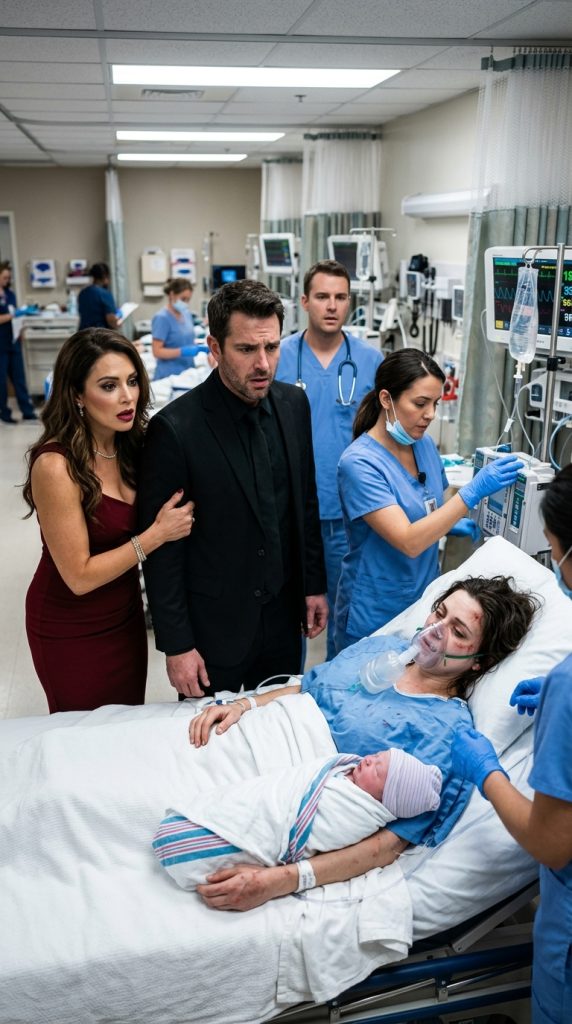
PART 3 — The Name He Wasn’t Allowed to Say
“How can I help you, sir?”
The nurse’s voice was professional, gentle, and absolutely immovable.
Cormack Hale stood before her in his charcoal suit, with blood roaring in his ears and the taste of fear dry on his tongue. He had intimidated judges with less effort than a glance. He had made aldermen change their votes with a single phone call. He had once stared down a man holding a gun and calmly told him where to aim.
But now, under the fluorescent lights of Northwestern Memorial, he could not force open one set of hospital doors.
“I need to know where they took the woman who just came in,” he said.
The nurse’s eyes narrowed slightly. “Are you family?”
The question struck him with such precision that for one second he forgot how to breathe.
Family.
He had been many things to Brin Holloway. A temptation. A danger. A secret. A warm body in a cold bed. A man who kissed her like surrender and left like a sentence.
But family?
He had thrown that away before it could exist.
Before he could answer, Yara Salcedo’s heels snapped against the polished floor behind him.
“Cormack,” she said, voice sharp enough to cut glass. “What is this?”
He didn’t turn around.
The nurse glanced from him to Yara. “Sir?”
Cormack lowered his voice. “Her name is Brin Holloway.”
Yara went still.
There it was. The name. A ghost called into a room full of witnesses.
The nurse’s face changed, not with recognition, but caution. “I can’t release patient information unless you’re listed as her emergency contact or immediate family.”
“I may be the father of her child.”
The words left his mouth before pride could stop them.
Yara inhaled behind him like she had been slapped.
The nurse blinked once. Her professionalism held, but barely. “Then you need to wait here until a doctor or social worker can speak with you.”
“I need to see her.”
“I understand.”
“No,” Cormack said, and something raw entered his voice. “You don’t.”
The nurse leaned forward, her expression softening by one painful inch. “Sir, she is in critical care. The team is working on her. If you care about this woman, let them do their job.”
If you care about this woman.
Yara laughed once, cold and disbelieving. “Care? Cormack, are you serious? A bartender? You dragged me here while your pregnant ex-mistress is dying down the hall?”
Cormack turned then.
The look on his face silenced even her.
Not because it was angry.
Because it wasn’t.
It was devastated.
Yara’s fury wavered, replaced by something uglier—fear. Not fear of Brin. Fear of losing.
“You told me there was no one,” she whispered.
Cormack’s jaw tightened. “There wasn’t supposed to be.”
“That’s not an answer.”
“No,” he said. “It’s a confession.”
Yara’s manicured hand drifted over her abdomen, the gesture suddenly theatrical. “I came here because I’m in pain.”
“And you’ll be treated,” he said.
“You’re choosing her.”
Cormack looked toward the sealed doors. Through the glass, figures blurred past in blue and white, moving fast.
“I chose wrong once,” he said quietly. “I won’t do it twice.”
Yara’s face hardened. “You have no idea what my father will do if you humiliate me.”
Cormack finally looked back at her, and the old danger returned—not loud, not wild, but controlled.
“Then call him,” he said. “Tell Aurelio Salcedo I’m busy waiting to find out whether my child lives.”
The words landed like a gunshot.
Yara’s eyes shone with rage. “You’ll regret this.”
“I already do.”
She turned and stormed toward the VIP corridor, phone already in hand.
Royce moved as if to follow, but Cormack lifted two fingers.
“Let her go.”
Royce stopped. “Boss, Salcedo won’t take this well.”
Cormack stared at the maternity doors. “Nobody takes anything well in our world.”
“And the woman?”
Cormack’s voice broke so quietly only Royce heard it.
“Her name is Brin.”
A doctor emerged ten minutes later, mask hanging under his chin, exhaustion and urgency written across his face.
“Mr. Hale?”
Cormack stepped forward so fast the nurse rose from her chair.
“I’m Dr. Amani Reyes, maternal-fetal medicine. Brin Holloway is in severe cardiac distress. We believe she has peripartum cardiomyopathy. Her heart is struggling to pump effectively, and the baby is showing signs of distress.”
Cormack felt the hall tilt.
“What does that mean?”
“It means we need to deliver the baby now. Emergency C-section. Then we stabilize her heart.”
“Will she survive?”
Dr. Reyes did not answer fast enough.
That delay became the cruelest sound Cormack had ever heard.
“We’re doing everything possible.”
Cormack grabbed the edge of the counter. “Does she know I’m here?”
The doctor hesitated. “She was conscious for a moment.”
“And?”
“She asked us not to let you in.”
Cormack closed his eyes.
Of all the punishments waiting for him, that one was deserved.
“What else did she say?”
Dr. Reyes looked at him carefully.
“She said, ‘Tell him the baby isn’t a bargaining chip.’”
Cormack opened his eyes.
Something inside him folded, then shattered.
“She thought I’d use the child.”
“She was afraid,” the doctor said.
Cormack nodded slowly. “She had reason to be.”
Dr. Reyes softened. “There is one more thing. She has no listed family in Chicago. No emergency contact. If complications arise after delivery, decisions may need to be made quickly.”
“I’ll sign whatever you need.”
“That may not be legally simple.”
Cormack laughed once, without humor. “Nothing about me is simple, Doctor.”
“No,” Reyes said, studying him. “But in that room, none of your power matters. Only what’s best for Brin and the baby.”
Cormack swallowed.
“Then make that the law.”
Behind the doors, alarms began to sound.
A nurse shouted.
Dr. Reyes turned instantly.
Cormack took one step forward.
The nurse at the station blocked him with a raised hand.
“No farther.”
Through the glass, he saw only motion—someone running, a curtain pulled, a red light flashing over a door.
Then, faintly, impossibly, he heard Brin scream.
Not in anger.
Not in accusation.
In terror.
Cormack Hale, king of Chicago’s shadows, stood helpless in the corridor while the woman he abandoned fought death for the child he never knew existed.
And for the first time in his life, he prayed without knowing who he was praying to.
PART 4 — The Baby Who Had His Eyes
The waiting lasted forty-three minutes.
Cormack knew because he counted every second.
He did not sit. He did not speak. He did not answer the twelve calls from Aurelio Salcedo, the six from his attorney, or the one from a number he recognized as Yara’s private line.
His phone remained in Royce’s hand.
At minute twenty-seven, Royce said, “Boss, we’ve got movement downstairs.”
Cormack didn’t look away from the doors. “What kind?”
“Salcedo men. Three cars. Maybe more coming.”
“Keep them off this floor.”
“Quiet or loud?”
Cormack turned his head slowly.
Royce understood before the answer came.
“Quiet,” Royce said. “Right.”
At minute thirty-nine, an infant cried.
The sound cut through the corridor like a blade wrapped in silk.
Small. Furious. Alive.
Cormack’s breath stopped.
He looked at the doors.
The cry came again, stronger this time.
A nurse pushed through moments later, carrying a bundled newborn in a warmed blanket, moving quickly toward the neonatal team.
Cormack stepped into her path before he knew he was moving.
The nurse almost snapped at him, but then she saw his face.
“Is that—”
“Baby boy,” she said. “Breathing on his own. We’re checking him now.”
Cormack looked down.
The newborn’s face was flushed and wrinkled, mouth open in offended protest at the entire world. One tiny fist had escaped the blanket and punched the air.
Then the baby’s eyes opened.
Gray.
Storm-gray.
Hale eyes.
Cormack felt something in his chest tear loose.
He had held weapons, contracts, fortunes, secrets. He had held men’s lives in his hands and treated the weight as ordinary.
But seeing that tiny furious fist, he understood he had never held anything that mattered.
“Can I—” His voice failed.
The nurse softened. “Not yet. We need to examine him.”
“Is he safe?”
“He’s alive,” she said. “That is the first miracle. Let us work on the second.”
“Brin,” he whispered.
The nurse’s expression dimmed.
“She’s still in surgery.”
Still.
That word became a cliff.
The baby was carried away, crying as if he had inherited his mother’s stubborn heart.
Cormack watched until the nursery doors closed.
Then Yara returned.
She was no longer alone.
Two men stood behind her, both Salcedo soldiers, their jackets too tight over shoulder holsters. Yara’s face was pale, her eyes fever-bright with humiliation.
“My father says you are to come downstairs,” she said.
Cormack did not move. “Your father can wait.”
“He says you embarrassed our family.”
“Then your family is fragile.”
One of the Salcedo men shifted.
Royce appeared at Cormack’s left shoulder like a shadow remembering it had teeth.
“Hospital floor,” Royce murmured. “Think hard.”
Yara stepped closer. “You think because she had your baby, this changes everything?”
Cormack looked at her.
“It changes what everything was.”
“She kept it from you.”
“I gave her every reason to.”
“She trapped you.”
“No,” he said. “I walked away and called it mercy.”
Yara’s mouth trembled, but her cruelty returned fast. “You don’t even know whether she wants you.”
Cormack’s eyes flicked toward the surgical doors.
“I know she doesn’t.”
That answer stunned her.
He continued, quieter. “Wanting me was never the issue. Surviving me was.”
Yara stared as if seeing him for the first time—not the man her father wanted beside her, not the empire in a tailored suit, but the ruined creature beneath it.
“You’re going to throw away an alliance for a woman who hates you?”
Cormack smiled faintly.
“Yara, I have thrown away better things for worse reasons.”
Her voice dropped. “My father will make her disappear.”
The temperature around them changed.
Royce’s hand moved beneath his jacket.
Cormack didn’t blink.
“If anyone from your family goes near Brin Holloway or my son,” he said, every word clean and quiet, “there will be no alliance to break because there will be no Salcedo table left in Chicago to sit at.”
Yara’s eyes widened.
For the first time, she looked afraid of what she had invited.
Then a voice came from behind them.
“Mr. Hale?”
Dr. Reyes stood in the doorway, cap removed, face drawn with fatigue.
Cormack turned.
“The baby is stable.”
Cormack closed his eyes for half a second.
“And Brin?”
The doctor’s expression did not brighten.
“She survived the surgery.”
Cormack exhaled.
“But she’s not out of danger. Her heart function is extremely weak. We’re moving her to cardiac ICU. The next twenty-four hours are critical.”
Cormack nodded, absorbing every word like impact.
“Can I see her?”
Dr. Reyes hesitated.
“She was very clear.”
“She doesn’t want me there.”
“No.”
He looked down.
“Then I won’t go in.”
Yara made a soft sound of disbelief.
Cormack ignored her.
“But the baby,” he said. “Who stays with him?”
Dr. Reyes glanced toward the nursery. “For now, staff.”
“No,” Cormack said. “A guard outside the nursery. Not mine inside. Outside. No weapons visible. No intimidation. No one interferes with medical staff.”
“Mr. Hale—”
“My world followed me here,” he said. “Let me keep it outside the glass.”
The doctor studied him, then nodded once.
Cormack turned to Royce. “You heard me.”
Royce nodded. “Done.”
Then Dr. Reyes added something that changed the air.
“When Brin was coming out of anesthesia, she said a name.”
Cormack looked up.
“Not yours,” the doctor said.
He flinched.
“She said, ‘Mara has the envelope.’”
Cormack frowned. “Who’s Mara?”
The doctor shook her head. “I was hoping you knew.”
Yara’s face flickered.
A tiny movement.
Almost nothing.
But Cormack saw it.
He had built an empire by noticing almost nothing.
His eyes locked on Yara.
“You know that name.”
Yara’s lips parted. “No.”
Cormack stepped toward her.
“Yara.”
She lifted her chin. “I know many names.”
“What envelope?”
“I have no idea.”
But the lie was too quick.
Cormack looked at Royce.
“Find Mara.”
Yara’s expression shifted from anger to panic for one brief, fatal second.
That was enough.
Because somewhere in Chicago, a woman named Mara had an envelope Brin had protected while dying.
And Cormack knew then that Brin’s pregnancy was not the only secret that had been hidden from him.
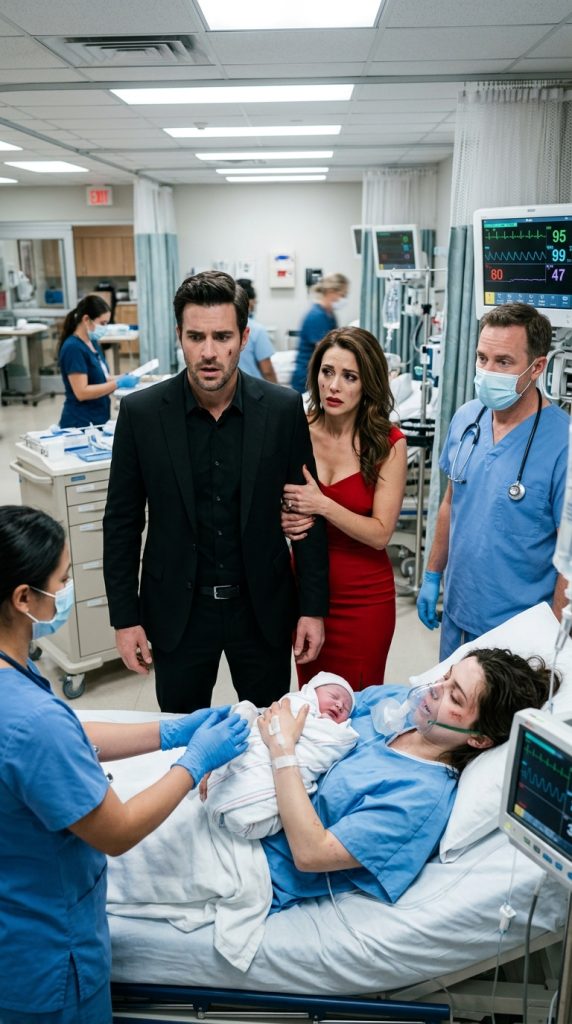
PART 5 — The Envelope Brin Wouldn’t Burn
Mara Vale was found in a laundromat on West Belmont just after midnight.
She was twenty-six, thin as a matchstick, with a split lip, a swollen cheek, and a duffel bag hugged to her chest like it contained her soul.
Royce called Cormack from the sidewalk.
“She says she’ll only speak to you.”
Cormack stood outside the cardiac ICU, staring through the glass at Brin.
She lay beneath a tangle of wires and tubes, her face turned slightly toward the window, dark lashes resting against skin too pale to look alive. Machines breathed rhythm around her. Numbers glowed beside her bed, each one a language Cormack suddenly wished he understood.
He had not entered.
He had honored her one request, though it punished him.
Now he looked at her through glass like a man staring into the life he had ruined.
“Bring Mara here,” he said.
Twenty minutes later, Mara arrived wrapped in Royce’s coat, eyes darting at every corner.
The moment she saw Cormack, she recoiled.
“Don’t come near me.”
Cormack stopped. “You know who I am.”
“Everyone knows who you are.”
“Brin said you had an envelope.”
Mara’s eyes filled instantly.
“She told me if anything happened, I had to give it to Dr. Reyes. Not you.”
Cormack nodded. “Then give it to Dr. Reyes.”
Mara blinked.
“You’re not going to take it?”
“No.”
“You’re not going to threaten me?”
“I’m trying to stop being the reason people need threatening.”
Mara laughed bitterly, then wiped her eyes.
Dr. Reyes came from ICU at Cormack’s request, and Mara handed her a thick manila envelope sealed with black tape.
Written across the front in Brin’s handwriting were five words:
IF I DIE, TELL THE TRUTH.
Cormack’s throat closed.
Dr. Reyes opened it carefully.
Inside were medical records. Printed emails. Photographs. A sonogram dated months earlier. A letter. And a small flash drive taped to the inside flap.
Dr. Reyes read first, her face tightening.
“What is it?” Cormack asked.
Mara looked at the floor.
Dr. Reyes handed him one page.
It was a letter from Brin.
His hands, which had never trembled at gunpoint, trembled now.
Cormack,
If you are reading this, I either died or came close enough that lying stopped mattering.
I did not tell you about the baby because two weeks after you left, a woman came to my apartment. She had red nails, a white coat, and two men with her.
Yara.
She knew I was pregnant before I fully believed it myself. She told me if I contacted you, the child would never be born. She showed me photos of my building, my shifts, Mara’s younger brother leaving school. She said you would deny me anyway.
I wanted to hate you enough to believe her.
Some days I did.
But I knew if I came to you, blood would follow. So I stayed quiet.
I named him in my head. Rowan.
If he lives, do not raise him to become you.
If I live, stay away unless I ask you not to.
—Brin
Cormack read it once.
Then again.
Then a third time, because his mind refused to accept that a single piece of paper could contain so much pain.
Yara had known.
Yara had threatened Brin.
Yara had let him sit beside her in the VIP lounge while Brin arrived dying down the hall.
Something old and monstrous rose in him.
Royce saw it and moved closer. “Boss.”
Cormack’s voice came out flat. “Where is Yara?”
“Gone from the hospital.”
“Find her.”
Dr. Reyes stepped between them. “No.”
Cormack looked at her.
The doctor did not move.
“You bring violence into this hospital and Brin wakes up to exactly what she feared,” Reyes said. “You want justice? Start by not becoming the proof that she was right.”
Silence stretched.
Cormack looked through the glass at Brin.
Her hand lay open on the blanket.
He remembered that hand over his heart.
Open, trusting, warm.
Then he looked back at Royce.
“Find her,” he said. “Do not touch her.”
Royce nodded.
Cormack faced Mara. “Why did Brin trust you?”
Mara swallowed. “Because when she found out she was pregnant, everyone else told her what to do. I asked her what she wanted.”
“What did she want?”
Mara looked toward ICU.
“To live long enough to hold him.”
The words broke something quiet in the hallway.
Dr. Reyes excused herself to review the flash drive. Mara sat in a plastic chair, shivering beneath Royce’s coat.
Cormack remained standing.
After a long while, Mara said, “She waited for you.”
Cormack didn’t answer.
“Not at first,” Mara continued. “At first she cursed you so much I thought the walls would catch fire. But later, when the baby started kicking, she’d sit by the window and go quiet. She’d say, ‘He would have loved this part.’ Then she’d hate herself for saying it.”
Cormack closed his eyes.
“I did love her,” he said.
Mara’s voice sharpened. “Then why leave?”
Because men were hunting him. Because his enemies had begun circling anyone he touched. Because love had made Brin visible. Because he thought distance was a shield.
Because he was a coward who knew how to survive war but not tenderness.
“I thought absence would protect her.”
Mara looked at him with exhausted contempt.
“It didn’t.”
“No,” Cormack said. “It didn’t.”
Dr. Reyes returned with the flash drive in a plastic evidence sleeve.
“This contains recordings,” she said. “Yara threatening Brin. Also someone else.”
Cormack’s head lifted.
“Who?”
Dr. Reyes looked grim.
“A man named Aurelio Salcedo.”
Cormack’s expression went utterly still.
“He ordered it?”
“From what I heard,” Reyes said, “he ordered more than threats. Brin believed someone had been tampering with her medication.”
Mara stood abruptly. “What?”
Cormack’s blood turned cold.
Dr. Reyes continued. “I can’t prove that medically yet. But the recordings are serious.”
Cormack looked through the glass again.
Brin’s machines beeped steadily.
His son slept somewhere down the hall.
And outside the hospital, an alliance was becoming a war.
But this time, Cormack understood something he had not understood nine months ago.
If he answered darkness with darkness, Brin and Rowan would inherit only ashes.
So he did the most shocking thing a man like him could do.
He took out his phone.
And called the FBI.
PART 6 — The King Who Put Down His Crown
Special Agent Lena Voss arrived at dawn with two federal agents, a sealed warrant request in progress, and the expression of a woman who had waited years to see Cormack Hale bleed himself open.
“You must be desperate,” she said.
Cormack stood in a quiet consultation room, sleeves rolled to his elbows, face carved from sleepless stone.
“I am.”
Voss studied him. “You understand what you’re offering?”
“Yes.”
“Evidence against Salcedo?”
“And myself.”
Royce, standing near the door, turned sharply. “Boss.”
Cormack did not look at him.
Agent Voss’s eyes narrowed. “Say that again.”
Cormack placed his titanium phone on the table. Then a second phone. Then a slim black drive from his inner pocket.
“Shipping routes. Payment ledgers. Shell companies. Police contacts. Judges on payroll. Salcedo’s docks. My docks. Everything.”
Royce stepped forward. “Cormack.”
“Enough,” Cormack said.
The single word stopped him.
Voss looked from the drives to Cormack. “Why?”
He laughed softly.
It was not amusement.
It was grief.
“Because my son was born last night, and the first inheritance I gave him was a war.”
Agent Voss leaned back. “Men like you don’t confess because babies are born.”
“No,” he said. “They confess because women almost die carrying them.”
For the first time, Voss’s expression shifted.
Cormack continued. “Aurelio Salcedo threatened Brin Holloway. His daughter participated. Brin recorded them. She believed they tampered with her medication or prenatal care. I want protection for her, the baby, Mara Vale, and Dr. Reyes.”
“And in exchange?”
“No exchange.”
Voss blinked.
Cormack pushed the drives toward her.
“I’ll testify.”
Royce looked as if he had been shot.
“Boss, this burns everything.”
Cormack finally turned to him. “Good.”
The word hung in the room like smoke.
Royce’s jaw worked. “Men will die over this.”
“Men are already dying for less.”
“You’ll go to prison.”
Cormack’s gaze drifted to the frosted glass window facing ICU.
“Maybe.”
“And the organization?”
Cormack looked back at him. “Was never a family.”
Royce flinched.
That one landed.
Agent Voss gathered the devices carefully. “You’ll be placed under federal supervision.”
“I’m not leaving the hospital.”
“You may not have a choice.”
Cormack leaned forward. “Then arrest me in the hallway. But until Brin wakes up or dies, I’m not walking out voluntarily.”
Voss held his stare.
Then, unexpectedly, she nodded.
“I’ll station agents outside the unit.”
Cormack sat back.
“Thank you.”
“Don’t thank me,” Voss said. “I’ve wanted handcuffs on you for eight years.”
“You may get them.”
“I know.”
She paused at the door.
“Mr. Hale?”
He looked up.
“If this is a trick, I’ll bury you.”
Cormack’s eyes were tired.
“If this is a trick, I deserve it.”
By midmorning, the hospital had changed shape.
Plainclothes federal agents replaced Cormack’s men near the elevators. Salcedo’s soldiers were turned away downstairs. Dr. Reyes gave statements. Mara was moved to protective custody after refusing three times and then finally agreeing when Royce promised to personally escort her younger brother.
At noon, Rowan Hale was brought to the observation nursery.
Cormack stood outside the glass.
A nurse held the baby up for him to see.
Rowan was wrapped in a striped hospital blanket, cheeks calmer now, tiny mouth pursed as if unimpressed by birth, crime, and federal collapse alike.
Cormack lifted one hand to the glass.
Rowan yawned.
The nurse smiled.
Cormack didn’t.
He was too close to weeping.
Behind him, Agent Voss said, “Paternity test will take time.”
Cormack didn’t turn. “He’s mine.”
“You don’t know that legally.”
“I know it in every place law can’t reach.”
Voss said nothing.
Then his phone rang.
Not the clean one.
The old one.
Royce held it out reluctantly. “Aurelio.”
Cormack took it.
He answered without greeting.
Aurelio Salcedo’s voice came through soft and oily. “You made a mistake, my boy.”
Cormack stared at his son through glass. “I’ve made many.”
“This one costs you.”
“No,” Cormack said. “This one pays my debt.”
Aurelio chuckled. “You think the government saves you? You think a hospital protects her? I have men in places even God forgets to check.”
Cormack’s eyes hardened.
“You threatened a pregnant woman.”
“I managed a complication.”
“You threatened my son.”
“No,” Aurelio said. “I threatened a problem before it became an heir.”
Cormack’s hand tightened around the phone.
Agent Voss stepped closer, listening.
Aurelio continued, unaware. “Walk away from the Holloway woman. Marry Yara. Claim the boy privately if you must. Do that, and I let her breathe.”
Cormack looked at Rowan.
Then toward ICU, where Brin remained suspended between life and death.
When he spoke, his voice was quiet enough to be mistaken for peace.
“You should have killed the man I was,” he said. “This one has nothing left to protect except the truth.”
Aurelio’s silence crackled.
Cormack ended the call.
Agent Voss stared at him. “We got it.”
Cormack handed the phone over.
“Use it.”
At three in the afternoon, Brin’s heart failed again.
The alarm screamed through ICU.
Doctors ran.
Cormack stood outside the glass, hands flat against it, watching them compress oxygen into the woman he had once kissed beneath a flickering club sign in the rain.
Dr. Reyes shouted orders.
A nurse pulled the curtain halfway, but not before Cormack saw Brin’s body arch under the effort to keep her alive.
Royce gripped his shoulder.
Cormack did not move.
He whispered one sentence over and over, not as command, but confession.
“Come back and hate me.”
The machines screamed.
“Come back and hate me.”
The hall blurred.
“Come back and hate me.”
Then, after endless minutes, the alarm changed.
A rhythm returned.
Weak.
Uneven.
There.
Dr. Reyes emerged, sweat at her temples.
“She’s alive,” she said.
Cormack covered his mouth with one hand.
The doctor’s eyes were red.
“She needs a reason to keep fighting.”
Cormack looked toward the nursery.
Then back at Brin.
“Bring him to her.”
“She’s unconscious.”
“Then let him be there anyway.”
Dr. Reyes hesitated.
Then she nodded.
Because sometimes medicine was science.
And sometimes it was a newborn’s breath against his mother’s skin, reminding a failing heart what it had crossed death to meet.
PART 7 — When Brin Opened Her Eyes
They placed Rowan against Brin’s chest just before sunset.
The baby was wrapped carefully, monitored closely, his tiny face turned toward the hollow beneath his mother’s collarbone. Brin did not wake. Her hands did not move. The machines continued their fragile counting.
But after several minutes, her heart rate steadied.
Dr. Reyes watched the monitor.
Cormack watched Brin.
Mara cried silently in the corner.
Royce stood outside the door, looking at the floor like a man reconsidering every oath he had ever taken.
Cormack remained beyond the threshold.
He had permission to enter now, technically. Brin was unconscious. The doctors allowed it.
He still did not cross.
He had spent years entering rooms because no one could stop him.
Now he stayed out because one woman had asked him to.
Night fell against the hospital windows, turning Chicago into a field of scattered lights. News began breaking across phones and televisions. Federal raids. Dock closures. Arrests connected to the Salcedo organization. Anonymous sources. Prominent businessman cooperating. Rumors moving faster than facts.
At 9:17 p.m., Aurelio Salcedo was arrested at a private airfield outside Joliet.
At 9:43, Yara was taken into custody in a hotel suite under a false name, carrying two passports and a diamond necklace Brin had once seen around her throat during the apartment threat.
At 10:06, Cormack Hale sat alone in the chapel.
He did not kneel.
He did not know how.
He sat in the last pew with his elbows on his knees and stared at a small stained-glass window where blue light touched the floor.
Royce found him there.
“They got Salcedo,” Royce said.
Cormack nodded.
“Yara too.”
Cormack nodded again.
Royce waited. “What happens now?”
“Now everyone decides whether they want prison, witness protection, or blood.”
“And us?”
Cormack looked at him. “There is no us.”
Royce’s face tightened.
“I’m dissolving it,” Cormack said. “Whatever can become legitimate will. Whatever can’t, I hand over.”
“You think they’ll let you live?”
“No.”
Royce swallowed. “You think she’ll forgive you?”
Cormack’s laugh was almost soundless. “No.”
“Then why?”
Cormack looked toward the chapel doors, beyond them toward ICU, toward Brin and Rowan.
“Because forgiveness isn’t the price of doing what I should have done.”
Royce sat beside him.
For a while, neither man spoke.
Then Royce said, “You saved me once.”
Cormack glanced over.
“Back when Foley’s crew was going to dump me in the river. You gave me a job instead.”
“I gave you chains with a better suit.”
Royce shook his head. “Maybe. But I chose them.”
Cormack looked back at the stained glass. “Choose different now.”
Royce’s voice was rough. “And you?”
“I’m trying.”
Near midnight, Dr. Reyes appeared in the chapel doorway.
Cormack stood so quickly the pew creaked.
“She’s awake,” the doctor said.
The world narrowed to those words.
Brin was awake.
Cormack followed Dr. Reyes back to ICU, each step heavier than the last.
At the door, he stopped.
Inside, Brin lay propped slightly against pillows. Rowan was no longer on her chest but sleeping in a bassinet beside her bed. Her face was ghost-pale, her lips dry, her eyes half-lidded with exhaustion.
But open.
Alive.
When she saw Cormack through the glass, her expression changed.
Not joy.
Not relief.
Pain.
Old, deep, immediate.
Dr. Reyes entered first, spoke softly, then turned.
“She’ll see you for two minutes.”
Cormack’s throat worked.
He stepped inside.
The room smelled of antiseptic, warm blankets, and something faintly sweet from the newborn bassinet.
For a moment, he could only look at her.
Brin’s voice came out fragile but sharp.
“Don’t look at me like that.”
He lowered his gaze. “How?”
“Like you’re sorry enough to undo it.”
He absorbed the blow.
“I’m not.”
Her eyes flashed.
“I’m sorry,” he said. “But sorry doesn’t undo anything.”
That seemed to take the anger from her for half a second, leaving only exhaustion.
“Did he live?”
Cormack looked toward the bassinet.
“Yes.”
Her eyes filled.
“The baby?”
“Rowan,” he said.
A tear slipped down her temple. “You read the letter.”
“Yes.”
“I didn’t want you to name him.”
“I didn’t,” Cormack said. “You did.”
Brin turned her face away.
He took one step closer, then stopped himself.
“Yara was arrested. Aurelio too.”
Brin’s eyes shut. “You killed them?”
“No.”
She opened them again, wary.
“I called the FBI.”
For the first time since he entered, Brin looked genuinely stunned.
“What?”
“I gave them everything.”
“You what?”
“My ledgers. Salcedo’s routes. My own.”
Brin stared at him as if the heart monitor had started speaking Latin.
“Why?”
Cormack looked at Rowan.
“Because I heard our son cry, and for one second I saw the whole road ahead. Men teaching him fear and calling it respect. Blood dressed as loyalty. Women threatened because men like me confuse possession with love.”
His voice roughened.
“I won’t hand him that kingdom.”
Brin’s expression trembled, caught between disbelief and something too wounded to name.
“You think that fixes it?”
“No.”
“You left.”
“Yes.”
“You let me think I meant nothing.”
His face twisted.
“Yes.”
“I was so scared,” she whispered.
Cormack closed his eyes.
There were accusations he could bear.
That one nearly put him on his knees.
“I know.”
“You don’t.”
“No,” he said. “I don’t. But I will spend whatever time I’m allowed making sure you never have to be scared of me again.”
Brin looked at him for a long time.
Then Rowan stirred.
A small whimper rose from the bassinet.
Brin tried to move, pain crossing her face instantly.
Cormack stepped forward on instinct.
She flinched.
He stopped.
That flinch destroyed him more than any sentence could have.
A nurse entered and lifted Rowan gently, placing him near Brin’s side. Brin touched his cheek with one shaking finger.
Her face broke open.
Not into a smile.
Into wonder.
“Hi,” she whispered. “Hi, my boy.”
Rowan quieted at her voice.
Cormack turned away, unable to watch without feeling he had stolen the right to be present.
Then Brin spoke.
“Cormack.”
He looked back.
She didn’t look at him. She looked at Rowan.
“If you ever lie to me again, I’ll disappear so completely not even your ghosts will find me.”
“I know.”
“If you ever use him—”
“I won’t.”
“If prison comes for you, I won’t promise to wait.”
“I wouldn’t ask.”
She swallowed.
“But when he asks who his father is…”
Cormack stood still.
Brin’s eyes lifted to his.
“I won’t tell him you were only a monster.”
The words hit him harder than mercy.
His voice failed.
Brin looked back at Rowan.
“Two minutes are over.”
Cormack nodded.
At the door, he paused.
“I loved you badly,” he said.
Brin closed her eyes.
“Yes,” she whispered. “You did.”
He left before he asked for more than she could give.
Behind him, Rowan began to cry again.
And Brin, weak as candlelight but alive, began to hum.
PART 8 — The Ending No One Saw Coming
Six months later, Cormack Hale vanished.
Not escaped.
Not murdered.
Vanished by court order.
The news called it a historic cooperation agreement. The streets called it betrayal. The families called it suicide. Federal prosecutors called it the largest organized crime dismantling in Chicago in twenty years.
Brin called it none of those things.
She called it Thursday.
By then, she could walk around her apartment without gripping the walls. Her heart was healing slowly, stubbornly, exactly like the rest of her. Rowan slept in a crib beside her bed, round-cheeked and fierce-eyed, already capable of making grown adults rearrange their lives with one indignant squeak.
Mara lived two floors below under a new lease paid anonymously through a victim assistance fund that Brin pretended not to know Cormack had created before surrendering his assets.
Royce, to everyone’s astonishment, opened a boxing gym for teenagers and named it Second Bell.
Yara testified against her father after realizing Aurelio had planned to trade her immunity for his own. Aurelio never saw daylight again outside a courtroom.
And Cormack?
For months, he existed only in letters.
Not love letters.
Never that.
Brin would have burned those.
They were short, careful updates written from federal custody before his sentencing.
Rowan should know I had gray eyes before he did.
I signed over the Vesper Row property. Sell it or burn it.
I am learning that silence is not the same as control.
I have no right to ask for photographs, but thank you for sending the one of his hand.
Brin read them all.
She answered almost none.
Then came the shock.
Cormack Hale did not receive the life sentence everyone expected.
His testimony cracked open networks far beyond Chicago: judges, shipping executives, interstate trafficking routes, laundering operations linked through six states. Because his cooperation prevented retaliatory killings and led to convictions at the federal level, the court handed down a reduced sentence with heavy restrictions, asset forfeiture, and long-term supervised protection.
The newspapers raged.
The streets whispered.
Brin changed Rowan’s diaper and said, “Your father remains dramatic.”
At nine months old, Rowan laughed for the first time while chewing on a rubber giraffe.
At eleven months, Brin received one final letter before Cormack entered protected relocation.
Brin,
This is the last letter unless you allow another.
I have been offered a name that is not mine, in a town I have never heard of, doing work no one will fear. For the first time in my life, I own nothing that can hurt anyone.
I do not ask to return.
I ask only this: when Rowan is old enough to wonder, tell him I once built a kingdom out of fear, and his mother was brave enough not to enter it.
Tell him he was the reason I put it down.
If you never want me near him, I will obey.
If someday you do, I will arrive as no one important.
Cormack
Brin read it at the kitchen table while Rowan slept against her shoulder.
She did not cry.
She had done enough crying for one lifetime.
Instead, she placed the letter in the drawer with all the others.
Then she whispered to her son, “No one important, huh?”
Three years passed.
The final twist arrived on a rainy afternoon in a little lakeside town in Michigan, where Brin had moved after deciding Chicago held too many shadows with familiar footsteps.
She owned a bakery now.
Not because she had dreamed of flour and frosting, but because recovery had taught her that ordinary mornings were sacred. Bread rising. Coffee brewing. A toddler pressing his face to the display case and demanding “the moon cookie.” Mara running the register badly but charming every customer anyway.
Brin was kneading dough when the bell over the door rang.
Rowan, now four, looked up from his coloring book.
A man stood in the doorway wearing faded jeans, a dark wool coat, and no visible armor of wealth. His hair was shorter. His face leaner. There was a small scar near his brow that had not been there before.
But his eyes were the same.
Storm-gray.
Rowan stared.
The man stared back.
Brin’s hands went still in the dough.
Mara emerged from the back, saw him, and nearly dropped a tray of muffins.
No one spoke.
Then Rowan climbed down from his chair and marched over with the absolute authority of a child who feared nothing.
“Are you the man in the letters?” he asked.
Cormack Hale—though that was no longer his legal name—looked at Brin first.
Asking permission without words.
Brin’s heart moved painfully.
Not like fear.
Not like love exactly.
Like an old locked door discovering the key no longer fit because the house behind it had changed.
She wiped her hands on a towel.
“He is,” she said.
Rowan inspected him. “Mama says you were in time-out for grown-ups.”
Mara made a strangled sound.
Cormack’s mouth trembled.
“That is accurate.”
“Did you learn?”
Cormack crouched slowly, keeping distance.
“I am still learning.”
Rowan considered this.
Then he held out a blue crayon. “You can color the dragon. But not the fire. I’m doing the fire.”
Cormack looked at the crayon as if being handed a crown he no longer deserved.
He took it carefully.
“Thank you.”
Brin watched them sit at the little table near the window—Rowan bossing him around, Cormack obeying every instruction with grave seriousness.
Outside, rain slid down the glass.
Inside, the bakery smelled of cinnamon, coffee, and bread.
Mara came to stand beside Brin.
“Well,” Mara murmured, “that was unexpected.”
Brin folded her arms.
“That he came?”
“That you let him sit.”
Brin watched Cormack color inside the lines like his life depended on it.
“I didn’t let the man he was sit,” she said. “I let Rowan meet the man who survived him.”
Mara smiled faintly. “And you?”
Brin did not answer quickly.
Cormack looked up then, as if feeling her gaze. There was no demand in his expression. No claim. No old arrogance dressed as devotion.
Only patience.
Only remorse that had learned to stand quietly.
Rowan lifted his drawing.
“Look! Papa made the dragon blue!”
The word struck the room silent.
Papa.
Cormack froze.
Brin stopped breathing.
Rowan looked between them, confused. “What?”
Cormack’s eyes filled, but he did not reach for the child. He looked at Brin again, asking without asking.
And Brin, who had once believed the only endings available to women like her were grief or escape, did something no one in Cormack Hale’s old world could have predicted.
She smiled.
Not fully.
Not easily.
But truly.
“It’s okay,” she told Rowan.
The boy grinned and returned to his dragon.
Cormack bowed his head over the table.
His shoulders shook once.
Brin turned back to her dough, blinking at the blur in her eyes.
There would be no fairy-tale forgiveness. No erased wounds. No pretending love alone could repair what fear had built.
But there would be mornings.
There would be careful visits.
There would be Rowan’s laughter, Mara’s terrible coffee, rain on the windows, bread in the oven, and a former king of shadows learning how to be ordinary at a child’s table.
And years later, when Rowan asked the real story, Brin would tell him the truth.
His father had once walked into a hospital with the wrong woman on his arm and found the right one dying behind sealed doors.
He had lost his empire there.
He had found his son there.
And somewhere between the sound of a newborn cry and the steadying beat of a wounded heart, Cormack Hale had become the one thing no enemy, no lover, no judge, and no ghost had ever expected him to be.
Free.
The End
