

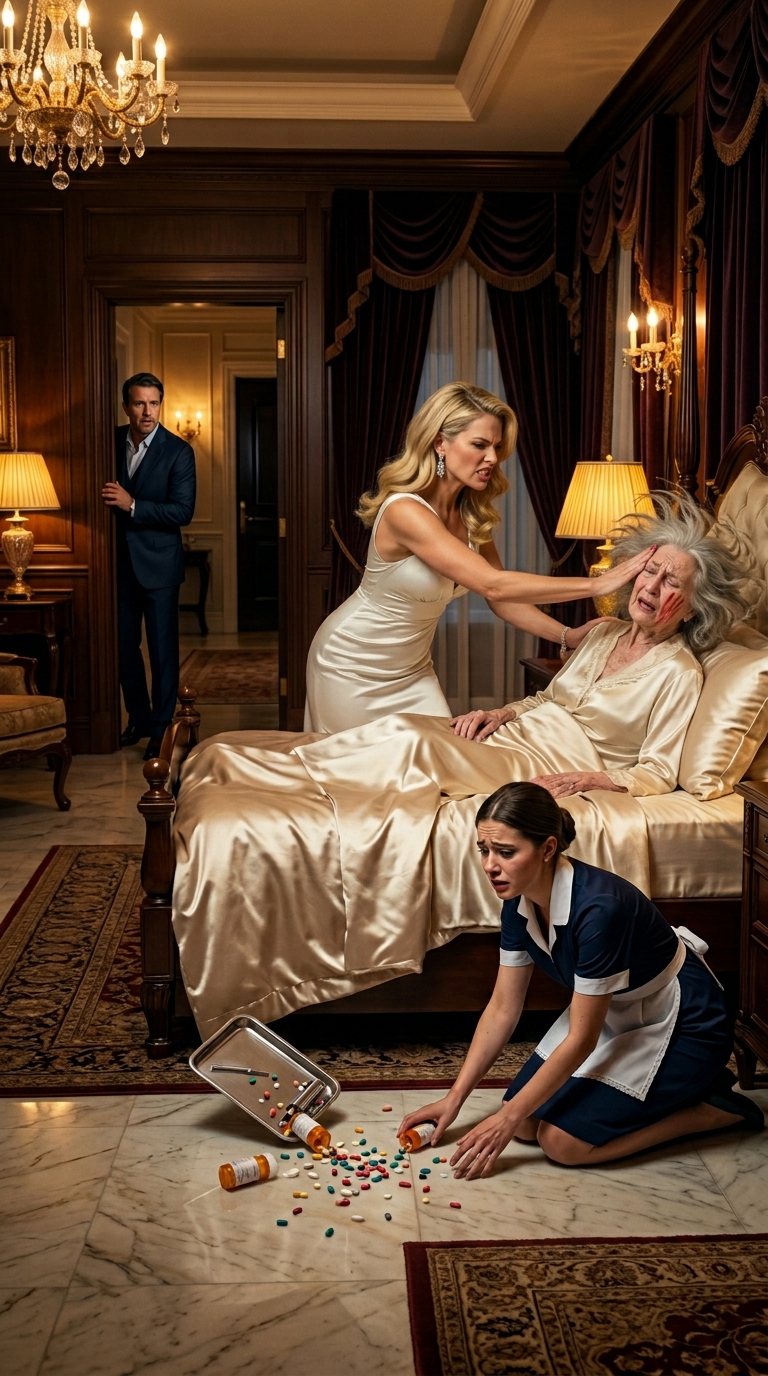
Damián Santoro did not leave the hidden room right away.
He sat in the darkness, black ink drying across his fingers, watching Clara kneel beside his mother as if she were holding together the only honest thing left in the house. Renata’s perfume still lingered on the hallway screen — sweet, expensive, like a lie sprayed over rot.
For years, men had feared his silence. Tonight, his own silence felt like punishment.
He watched Clara help his mother lean back against the pillows. She wiped the red mark on Mercedes’s cheek with a damp cloth, her hands trembling, her face full of guilt that did not belong to her.
“Did she hurt you anywhere else?” Clara asked softly.
His mother closed her eyes.
“No, hija,” she whispered. “Not more than usual.”
Damián’s body went still.
Not more than usual.
Those four words cut deeper than the slap.
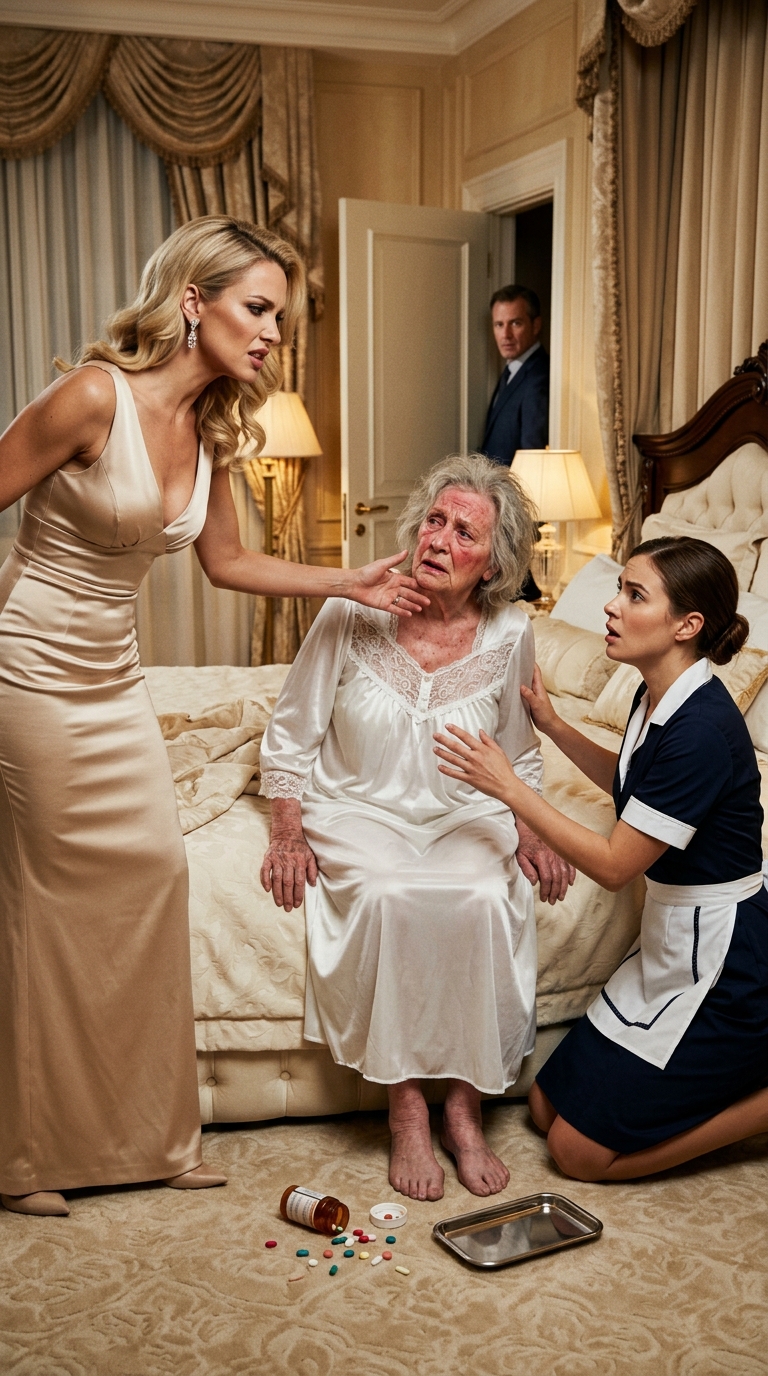
He leaned closer to the screen. Clara glanced toward the door, then toward the small camera hidden above the curtain rod. She knew it was there.
Then she said something that made the blood drain from Damián’s face.
“Doña Meche, we cannot keep waiting. He has to know tonight.”
His mother gripped her wrist.
“No. If Damián comes out angry, they will twist everything. They will make him look like the monster they already tell everyone he is.”
Clara swallowed hard.
“Then let me tell him.”
Damián stopped breathing.
His mother shook her head.
“You already risked too much.”
Clara reached under the mattress and pulled out a small cloth pouch. From inside, she removed an old phone, a key, and a folded envelope sealed with tape.
“I have the recordings,” Clara said. “I have the pills. I have the papers Tomás hid in the laundry room.”
Damián’s hand tightened on the armrest.
Tomás. His accountant of seven years. The man who knew where the money slept and where the secrets were buried.
On the screen, Clara looked terrified but not weak. She looked like someone who had been standing alone in a storm and had decided the lightning could take her if it wanted.
Damián stood.
Ramiro, his right hand, stepped out from the corner of the hidden room.
“Boss,” he said carefully, “give the order.”
Damián looked at the screen. Renata was laughing in the living room with Tomás, drinking his wine under his roof while his mother sat in pain just twenty steps away.
The old Damián would have opened the door with rage. The old Damián would have made the whole mansion shake.
But his mother’s warning echoed in his head.
They will make him look like the monster.
So he wiped the ink from his hand with a white cloth and spoke in a voice so calm that even Ramiro looked uneasy.
“No one touches them.”
Ramiro blinked.
Damián turned to him. “Lock the gates. Quietly. Cut off the outside security feed, but keep the inside cameras running. Call our lawyer, call Dr. Valdés, and bring me Clara through the service hallway.”
Ramiro nodded.
“And Ramiro?”
He stopped.
“If Renata or Tomás try to leave, they do not get hurt. They get recorded.”
For a second, Ramiro almost smiled. Tonight was not about revenge. Tonight was about evidence.
Damián stepped into the narrow passage behind the library, moving through the bones of the mansion like a ghost. He knew every wall, every hidden door.
He paused behind the panel near his mother’s room. Clara was still inside, helping Mercedes drink water. His mother’s hands shook badly, but her eyes were clear. She saw the wall move before Clara did.
“Damián,” she whispered.
Clara turned so fast she nearly dropped the glass.
Damián stepped into the room.
For one moment, nobody spoke. He was supposed to be in Italy. Supposed to be gone. Supposed to be blind.
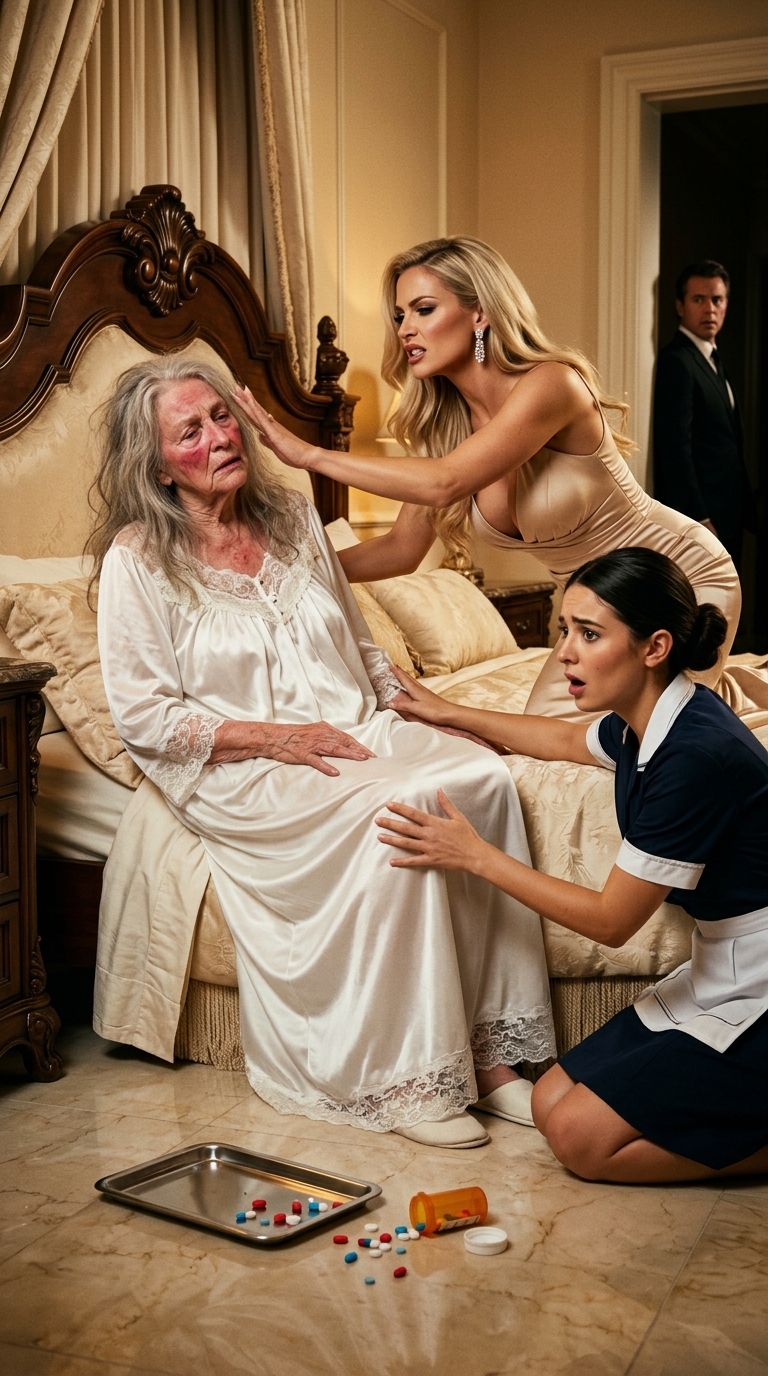
Instead, he stood in his mother’s bedroom with ink on his hand and murder in his heart, trying very hard to be the son she had raised before the world made him dangerous.
His mother reached for him. He went to her immediately. When he saw the red mark on her cheek up close, something ancient and violent rose inside him. It took everything he had not to storm down the hall.
Mercedes read his face.
“No,” she said.
He lowered his head. “Madre, she put her hand on you.”
“And if you become what they expect, she wins.”
That hurt because it was true.
Clara stood near the bed, eyes lowered. Damián turned to her.
“Look at me, Clara.”
She hesitated, then did.
“What did you find?”
Clara took the old phone from the pouch.
“I started recording three months ago,” she said. “At first, only because Doña Meche asked me to. Some days she was too dizzy. Other days she shook worse than usual.”
She had checked the pills. Some were switched. Not every day — just enough to make Mercedes seem confused and unstable.
“I saw Renata in the room twice,” Clara continued, her voice trembling. “But Tomás brought the envelopes.”
She handed Damián the folded envelope. Inside were medical forms, draft legal papers, and a private clinic admission request for Mercedes Santoro — citing cognitive decline and aggression. The authorization after marriage was listed under “spouse of Damián Santoro” — Renata.
After the wedding, Renata had planned to send his mother away to a facility where no one would hear her cry.
Damián folded the papers slowly.
Clara stepped back. “Please… I didn’t know who to trust.”
“You trusted my mother,” he said. “That was enough.”
Clara began crying silently. Mercedes squeezed her hand.
Damián looked at his mother. “Why didn’t you tell me sooner?”
“Because you loved Renata’s mask,” she replied softly.
The truth landed hard.
He stepped away from the bed. “I will fix this.”
Mercedes watched him carefully. “You will fix it like my son, not like Santoro.”
That sentence stopped him.
Ramiro appeared. “The gates are closed. The lawyer is on his way. Dr. Valdés is twenty minutes out. Internal cameras are running.”
Damián handed him the envelope. “Make copies. Keep the originals with me.”
He looked at Clara. “You will come with me.”
Fear flashed across her face, but she followed.
In the living room, Renata sat on the sofa with one leg crossed, Tomás too close beside her, his hand behind her back. A half-empty bottle of Damián’s wine stood on the table.
They both froze when he entered with Clara at his side.
Renata’s face shifted from shock to fear to calculation in seconds.
“Damián,” she breathed. “You’re here?”
“I live here,” he replied.
Tomás stood so quickly his glass spilled red wine across the rug.
Renata tried to spin the story. “Something terrible happened. Your mother became confused and aggressive. I was only trying to calm her.”
Clara’s face tightened.
Damián said nothing. He picked up the remote and turned on the large television.
The hallway camera. The bedroom camera. Renata’s own voice filled the room:
“After the wedding, the old woman goes. I’ll put her in a cheap nursing home far away.”
The video showed Renata throwing the medication tray and slapping Mercedes.
When it ended, the room was deathly silent.
Renata laughed — a sharp, broken sound. “So what? Everyone already knows who you are, Damián. You’re Santoro. Show this video and people will ask why you have secret cameras in your own house. They will dig into everything.”
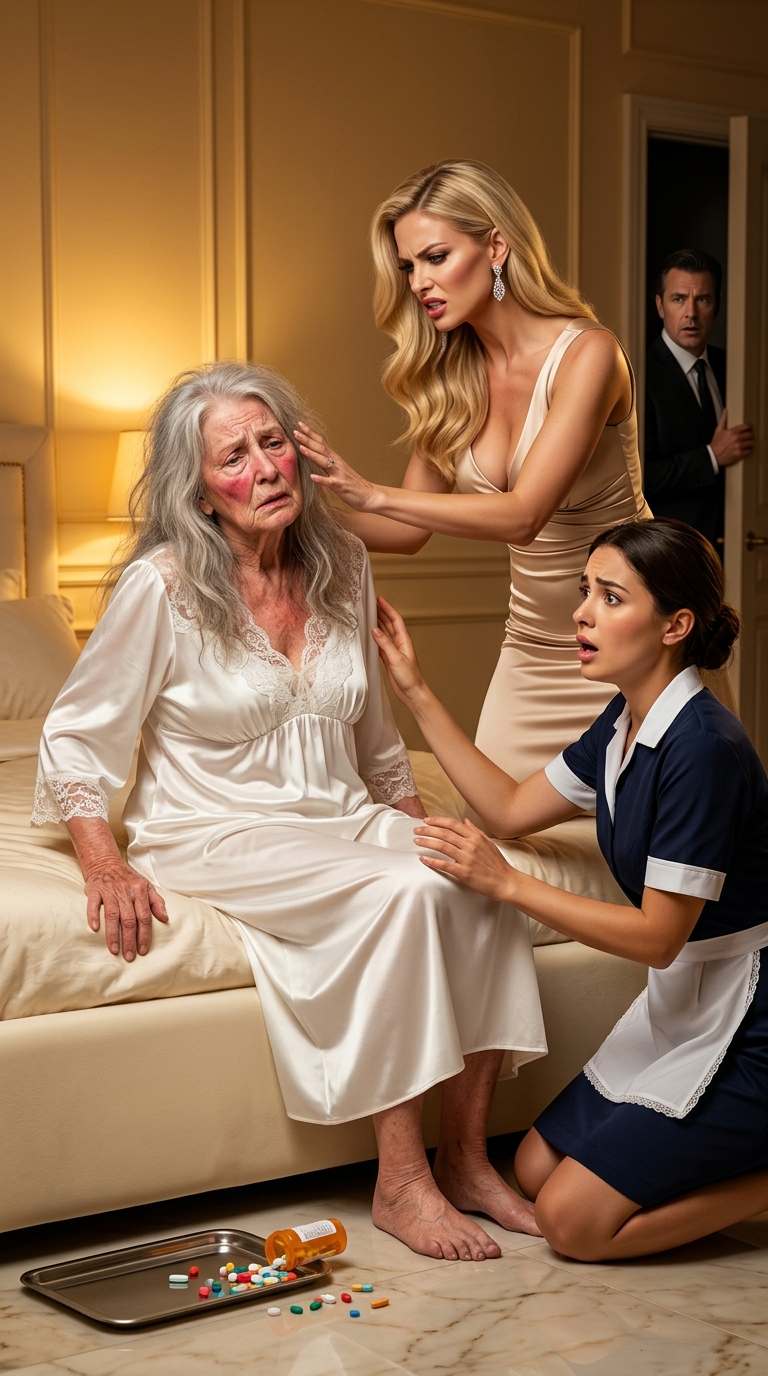
She stepped closer, growing bolder. “You want to ruin me? You open the door to everything.”
Damián looked at her. “You’re right. I am Santoro. People expect me to bury things.” He placed Clara’s old phone on the table. “That is why I am not burying anything tonight.”
The recordings played — Renata and Tomás discussing the medication, the clinic, the fake transfers.
Tomás collapsed into a chair. Renata whispered, “You stupid girl.”
When the lawyer Javier Cárdenas and Dr. Valdés arrived, the confrontation continued. Javier explained the marriage contract’s morality and fraud clause. Renata’s face drained of color.
She removed the engagement ring — Damián’s grandmother’s diamond — and threw it onto the table. It skidded near Clara’s hand. Clara did not touch it.
Renata tried to leave, but the evidence kept mounting. The police were called. Statements were taken for hours. Renata denied, blamed Tomás, then claimed she was emotionally pressured. Tomás betrayed her completely to save himself.
At one point, Renata sneered at Clara, “Don’t tell me the great Damián Santoro is falling for the help.”
Damián replied calmly, “No. I am learning the difference between value and price.”
When his mother insisted on coming downstairs, Mercedes descended the staircase with quiet dignity. She stood before Renata and Tomás and spoke with calm strength, then publicly praised Clara in front of the officers: “If not for Clara Solís, I might not be alive to speak.”
Renata was escorted out at three in the morning. As she reached the door, she looked back. “You’ll regret humiliating me.”
Damián answered, “No. I regret almost marrying you.”
In the days and weeks that followed, the scandal broke. Renata’s family tried to negotiate and threaten. Damián refused. He paid for Clara’s brother’s surgery through a proper trust, respecting her pride and conditions. Clara started nursing school at night. The mansion slowly changed — fewer secrets, warmer dinners, real conversations.
Months later, at the final hearing, Renata looked smaller. After the trial, she asked to speak to Damián one last time.
“You’ll get bored of the saint,” she said, referring to Clara.
Damián looked at her. “You still think wanting more is the sin. That was never your problem. You wanted what wasn’t yours, and you were willing to throw away anyone who stood near it.”
A year after the canceled wedding, during a lively family dinner filled with neighbors, nurses, and Clara’s family, Doña Mercedes placed the old diamond ring on the table.
“Keep it,” she told her son. “But do not give it to a mask again.”
Damián looked at Clara. She met his eyes with a soft smile that said: Not yet. Earn the man first.
He put the ring in his pocket — not as a promise, but as a reminder.
The Santoro mansion no longer ran on fear. It now ran on truth, quiet courage, and the love of a young woman who had once been invisible to everyone — except when it mattered most.
And Damián Santoro finally understood: the most powerful weapon was never violence or money.
It was the proof that came from the person no one had thought to fear — a maid who chose to stand up when everyone else looked away.
