

PART 1
María de la Luz was thrown out of her house with an old suitcase and a child who had not yet been born.
There were no shouts. There were no tears. Only two men in black hats, sealed papers, and a phrase that split her life in half:
“You have 15 days to vacate. Your husband’s debts will be collected with the property.”
Her husband, Rogelio Salvatierra, had been buried for barely three weeks in the San Gabriel cemetery in Jalisco. He had died of a sudden fever, leaving behind a mortgaged house, debts in cantinas, lost bets, and a stained name. María did not mourn him as women in love mourn. She mourned him as one mourns a wasted life: with exhaustion, with shame, and with one hand over her belly.
Because she was pregnant.
She was 27 years old, but her eyes seemed to have lived much longer. During her marriage she had learned to walk without making noise, to cook without complaining, to stay silent when Rogelio came home drunk, to hide the blows to her soul where no one could see them. And now, when the man who had extinguished her was finally gone, the world came to collect what he had broken.
On the last day, María folded two dresses, kept a photo of her mother, a medal of the Virgin of Guadalupe, and a black shawl. She did not take Rogelio’s cracked cup or his dusty boots. She had already carried too much of him.
She left at dawn. The town was barely waking up. Some women watched her from their windows. None opened their doors. In Mexico, María thought, sometimes people pity you with their eyes, but not with their hands.
She walked until the sun burned the back of her neck. At a crossroads, a boy herding goats told her that on the lands of Hacienda El Naranjo there was an old abandoned house, empty for years, next to a twisted mesquite tree.
“They say it’s haunted,” the boy warned her.
María looked at her belly.
“Sleeping in the street is scarier.”
The house appeared at dusk: cracked adobe walls, broken tiles, a door swollen by rain, and a patio overgrown with dry grass. It was not a home, but it had a roof. And that night, for a woman without a world, a roof was almost a miracle.
She entered, swept with branches, shook out an old cot, and lit a small fire in the stove. When the smoke rose through the chimney, María knelt on the dirt floor.
“Little Virgin… I don’t ask for wealth. Just give me strength until my son is born.”
What she did not know was that, on the other side of the hacienda, a farmhand had already seen the smoke.
The next morning, the news reached Don Aurelio Beltrán, owner of El Naranjo.
Don Aurelio was 43 years old, known as a hard man, with a sadness no one dared to name. He had lost his wife, Inés, seven years earlier during childbirth. Since then he lived among horses, books, harvest accounts, and silences. He never raised his voice because he didn’t need to. His mere presence was enough for the men to straighten up.
When his administrator told him that an unknown woman was occupying the old house, Don Aurelio set his coffee cup down on the table.
“I will go.”
The administrator blinked in surprise.
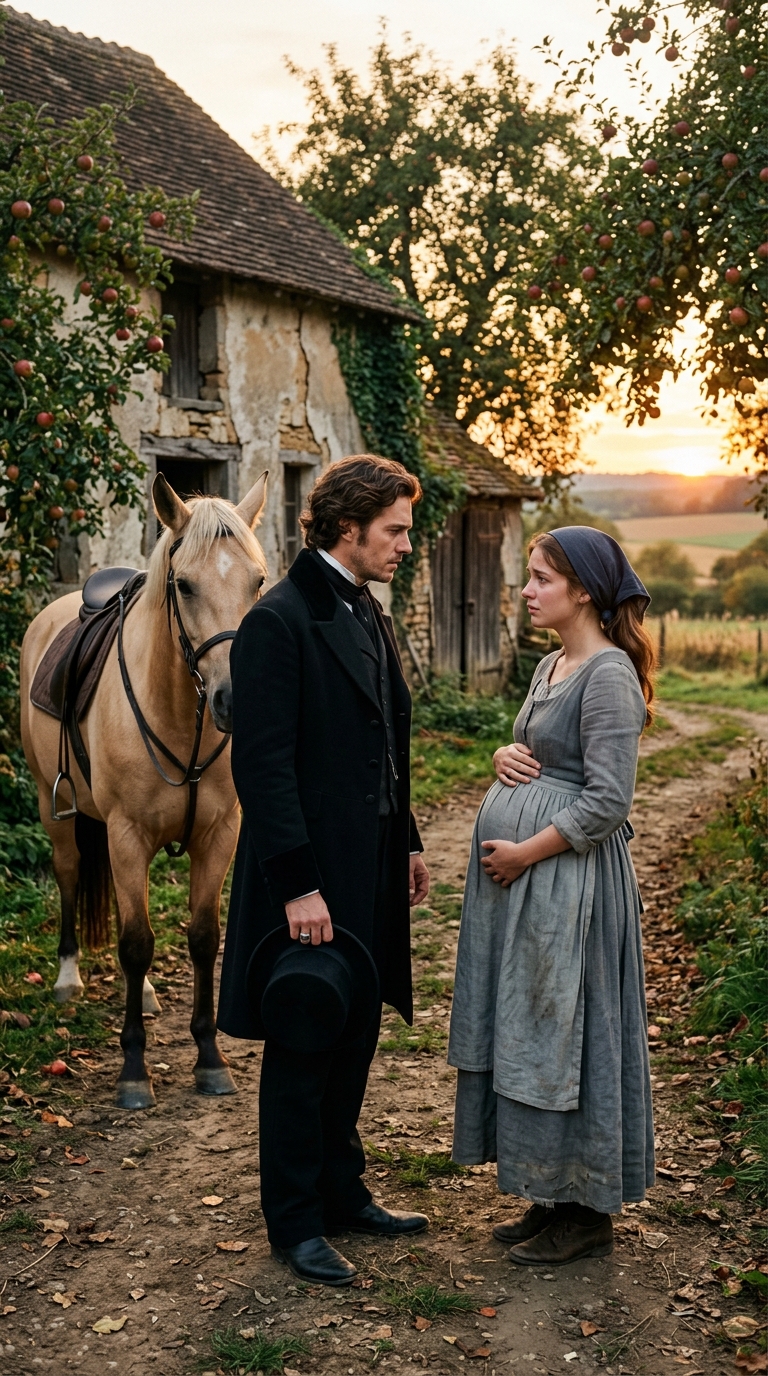
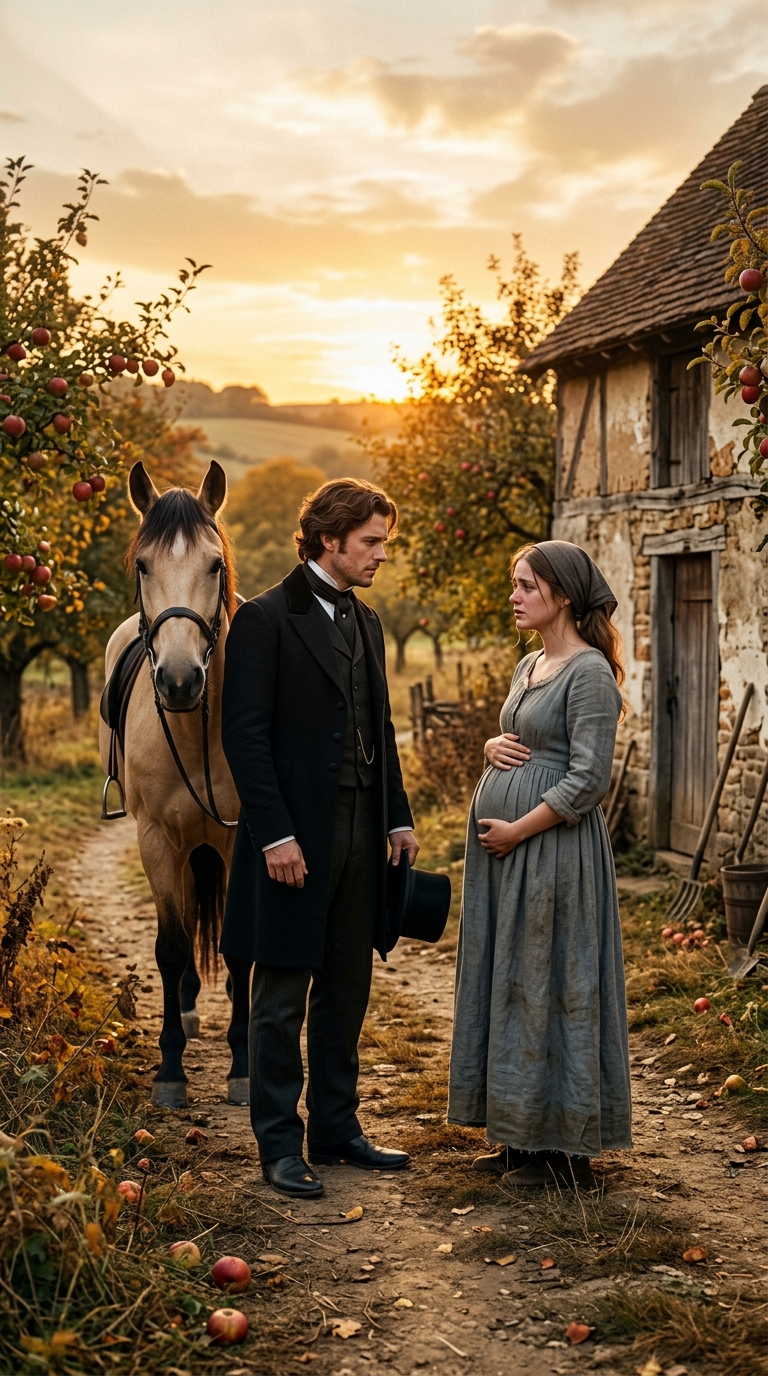
Don Aurelio mounted his sorrel horse and rode through the agaves until he reached the little house. María was outside gathering firewood, with the shawl covering her shoulders. When she saw him, she did not run. She did not hide. She simply lifted her face.
That was the first thing he noticed: that woman was terrified, but she did not humble herself.
“This land belongs to Hacienda El Naranjo,” he said. “Who are you?”
María tightened her fingers around the firewood.
“My name is María de la Luz Salvatierra. I am a widow. My husband left debts and they took my house. They told me this place was abandoned. I didn’t come to steal. I just need a roof until I find work.”
Don Aurelio looked at her belly.
“Are you expecting a child?”
“Yes. And for him I cannot afford to fall.”
The hacendado remained silent. He had come prepared to politely evict her and perhaps give her a few coins to go to town. But something in that woman reminded him of a truth he had avoided for years: there are pains that do not ask permission to enter a life.
He looked at the old house, then at the vast fields behind him.
“You may stay.”
María did not understand at first.
“Pardon?”
“You may stay. I will have the roof repaired. Food, firewood, and blankets will also be brought to you.”
María’s eyes shone, but she did not cry.
“I have no way to repay you.”
Don Aurelio took the reins of his horse.
“Then don’t repay me. Just live.”
And as he left, for the first time in seven years, he felt something inside his chest breathe again.
PART 2
The news spread faster than water in the rainy season. “The boss let a pregnant widow onto his lands.” “Surely the child isn’t the dead man’s.” “Rich people don’t get charitable for no reason.” In the plaza, the women lowered their voices when María passed, but not enough for her not to hear. She continued buying thread, corn, and soap with her head held high, even though inside every word hurt like a stone in her shoe.
Don Aurelio, on the other hand, seemed to hear nothing. He had the house repaired, sent a new mattress, chickens, seeds for the patio, and even three books from his library. María received those books as if they had returned a part of herself. As a girl she used to read while her blacksmith father worked late; when married, Rogelio mocked her whenever he saw her with a paper in her hand.
“What do you read for?” he would say. “Poor women don’t need ideas.”
Now, by the light of a candle, María read again. And while her belly grew, so did something she could not name: calm.
Don Aurelio visited her every so often with simple excuses. To check the roof. To ask about the chickens. To see if she needed medicine. One stormy afternoon, the rain forced him to take shelter in the little house. María offered him coffee with piloncillo. He sat by the stove, soaked and less imposing than usual. For the first time they spoke without haste.
He told her about Inés, about that room in the main house he had never entered again, about the son who never got to cry. María listened without interrupting.
“The pain doesn’t go away,” she said. “You just learn to carry it differently.”
Don Aurelio looked at her as if those words had opened a door closed for years.
But the peace did not last long.
In August, Doña Remedios Beltrán arrived at the hacienda, Don Aurelio’s cousin, a rich and venomous widow, always dressed in black although no one quite remembered who she was still mourning. She arrived with two trunks and a sharp tongue.
“Aurelio, the whole town is talking about you,” she said during dinner. “A pregnant widow on your lands. Do you realize the damage this does to the family name?”
“The name is not stained by helping a woman alone,” he replied.
Doña Remedios smiled with contempt.
“Don’t be naïve. Women like that know how to climb.”
The next day, without warning, she went to the old house. María was hanging baby clothes she had sewn herself from scraps.
“So you are the famous widow,” said Remedios, looking around as if everything smelled bad. “Congratulations. Not just anyone manages to get a roof, food, and protection using only a belly.”
María felt the blood rise to her face, but she did not lower her head.
“I asked for nothing more than permission not to sleep in the street.”
“And now the boss comes to see you as if you were family. Listen well: when that child is born, you will leave. If not, I will make sure everyone knows exactly what you are.”
That afternoon, María packed. She put the same two dresses, the medal, and the books in the suitcase. She did not want to drag Don Aurelio into the mud of rumors. She preferred to leave before becoming a shame for the only man who had treated her with respect.
But when she reached the hacienda gate, it began to rain. A brutal rain, the kind that turns roads into rivers. María took three steps and a pain doubled her over.
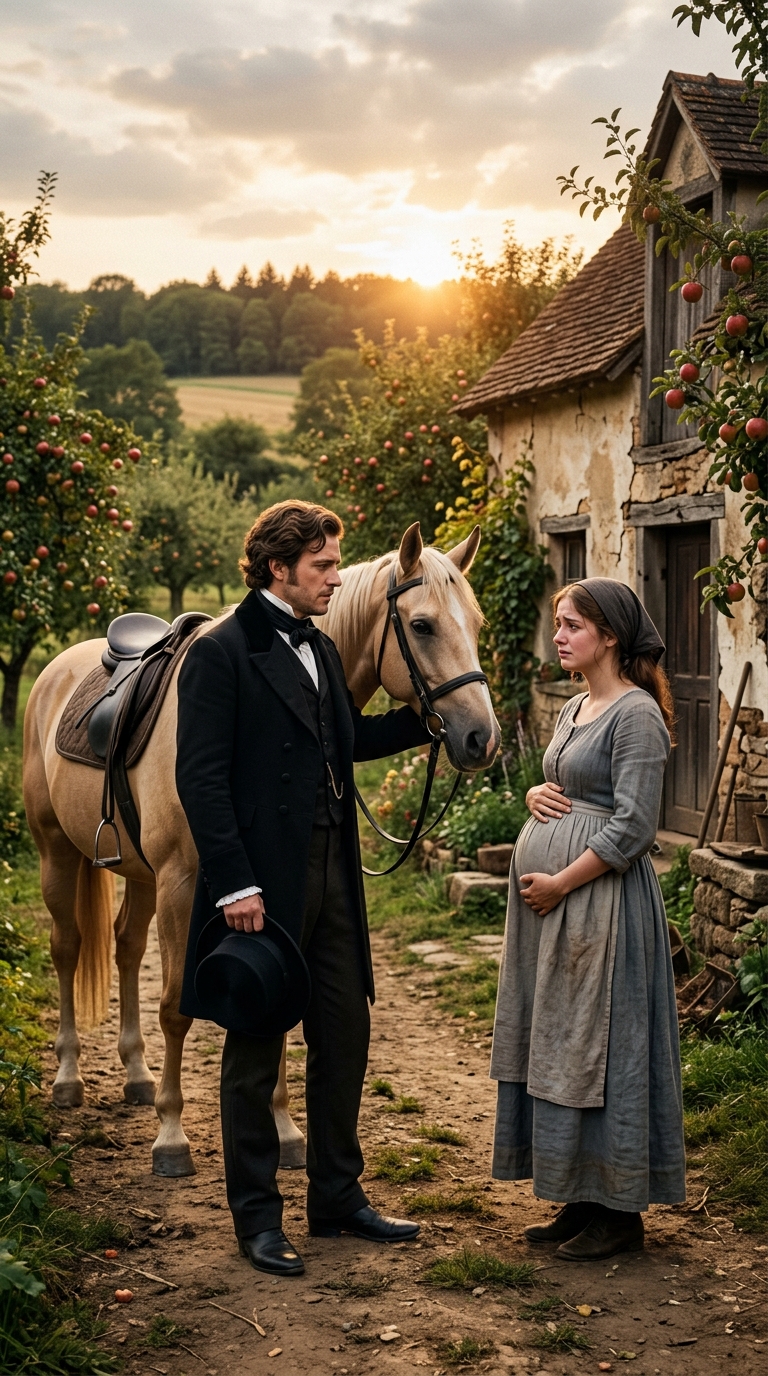
The child was coming early.
She fell to her knees in the mud, clutching the suitcase with one hand and her belly with the other. A farmhand saw her and ran toward the main house.
When Don Aurelio arrived, María was pale, soaked, trembling.
“Who told you to leave?” he asked, with quiet fury.
María could barely speak.
“I didn’t want… to cause you problems…”
Don Aurelio lifted her in his arms as if she weighed nothing.
“You were never the problem, María.”
In the corridor, Doña Remedios watched the scene with a hardened face.
And then, in front of everyone, Don Aurelio said the phrase that shook the entire hacienda:
“Let no one touch her things again. Mrs. María de la Luz and her son are under my protection. And anyone who cannot respect that will leave my house tonight.”
PART 3
The birth lasted until dawn. Outside, lightning split the sky over the agaves. Inside, María bit a handkerchief so as not to scream too much, while the ranch midwife kept telling her to breathe. Don Aurelio paced the hallway, his hands stained with mud and his face whiter than the lime on the walls.
Every cry from María took him back to the night he lost Inés. But this time he did not run. This time he stayed. And when the baby’s cry filled the house, Don Aurelio closed his eyes, as if the sound had broken a curse.
It was a small, strong boy with dark hair and closed fists.
María received him on her chest with silent tears.
“His name will be Miguel,” she whispered. “Like my father. The only good man I knew before coming here.”
Don Aurelio approached slowly. The midwife placed the child in his arms. He held Miguel with careful clumsiness, as if carrying a lit candle in the wind.
“He is beautiful,” he said.
María looked at him and understood something that needed no words: that child did not replace the son Don Aurelio had lost, but was teaching him that love could return through another door.
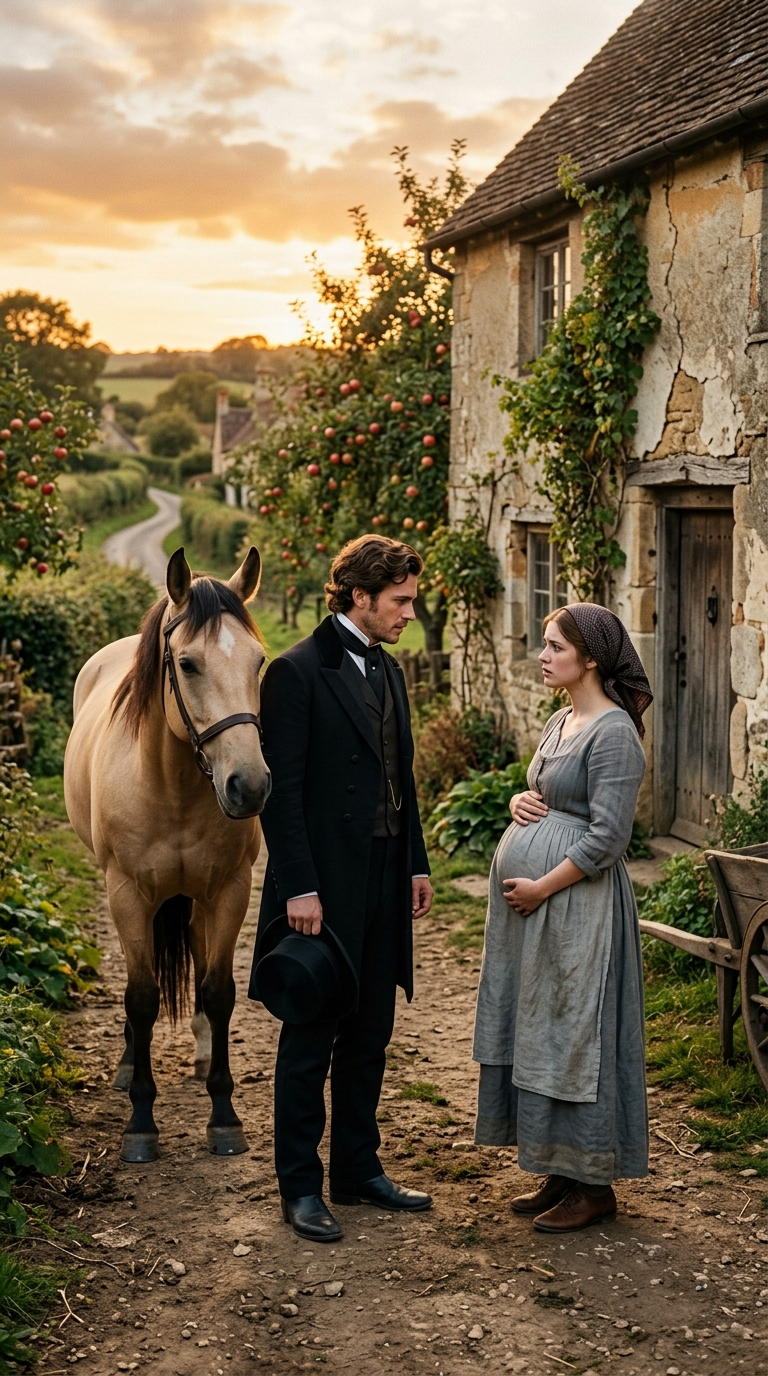
Doña Remedios did not give up. Three days later, she summoned the town lawyer and demanded that María be expelled to “protect the inheritance.” But the surprise came before her poison could finish falling.
The lawyer brought other papers: debt documents signed by Rogelio. Among them was a hidden letter, written months before his death. In it, Rogelio confessed that he had wanted to sell the house and abandon María before knowing about the pregnancy. He also admitted that the debts were his alone, and that María had never participated in any deal.
The town was left speechless for a whole day.
The same people who had looked at her with contempt began to greet her with shame. Some women brought broth, diapers, sweet bread. María accepted without humbling herself, but she did not pretend to forget.
“Charity that comes after gossip weighs differently,” she told one of them. “But if it comes from the heart, I won’t reject it.”
Months passed. Miguel grew pink and smiling. The old house no longer looked abandoned: it had bougainvillea at the entrance, chickens in the patio, the smell of freshly made tortillas, and a wooden cradle that Don Aurelio had carved with the child’s name.
He came every afternoon. Sometimes he brought books. Sometimes he carried Miguel while María watered the plants. Sometimes he said nothing, and yet the house filled with a new peace.
One December afternoon, Don Aurelio arrived with a notebook with green covers.
“This is for you,” he said.
María opened it. On the first page, in firm handwriting, it said: “For the story that is still left to write.”
She lifted her gaze.
“And who is going to write it?”
Don Aurelio took a deep breath. His eyes, once so hard, were full of a tenderness he found difficult to show.
“If you allow me… the three of us.”
María remained still.
“Don Aurelio…”
“I don’t want to save you, María. You already saved yourself. I don’t want to buy your gratitude. I don’t want to take anyone’s place out of pity. I just want to ask you if someday, when your heart is ready, you would let me walk by your side. With you… and with Miguel.”
María cried then, but not from fear. She cried because for the first time no one was demanding anything from her. They were offering her a future without chains.
They did not marry immediately. María was not a woman who ran toward another life just because it looked beautiful. She waited. She observed. She healed. And Don Aurelio waited with her, without pressuring her, the way one waits for good rain after a long drought.
One year later, in the small chapel of the hacienda, María walked dressed in simple white, with Miguel in her arms. The entire town attended. Doña Remedios was not invited.
When the priest asked if she accepted Don Aurelio as her husband, María looked at the man who one day could have thrown her out of an abandoned house and instead chose to give her a home.
“Yes, I accept,” she said. “But not because he rescued me. I accept because he taught me that I could still be looked at with love.”
Don Aurelio took Miguel’s hand and then hers.
And from that day on, in San Gabriel a different story was told: the story of a widow who arrived with a broken suitcase, a child in her belly, and a tired soul… and ended up turning the most forgotten house on the hacienda into the place where a powerful man learned to live again.
