

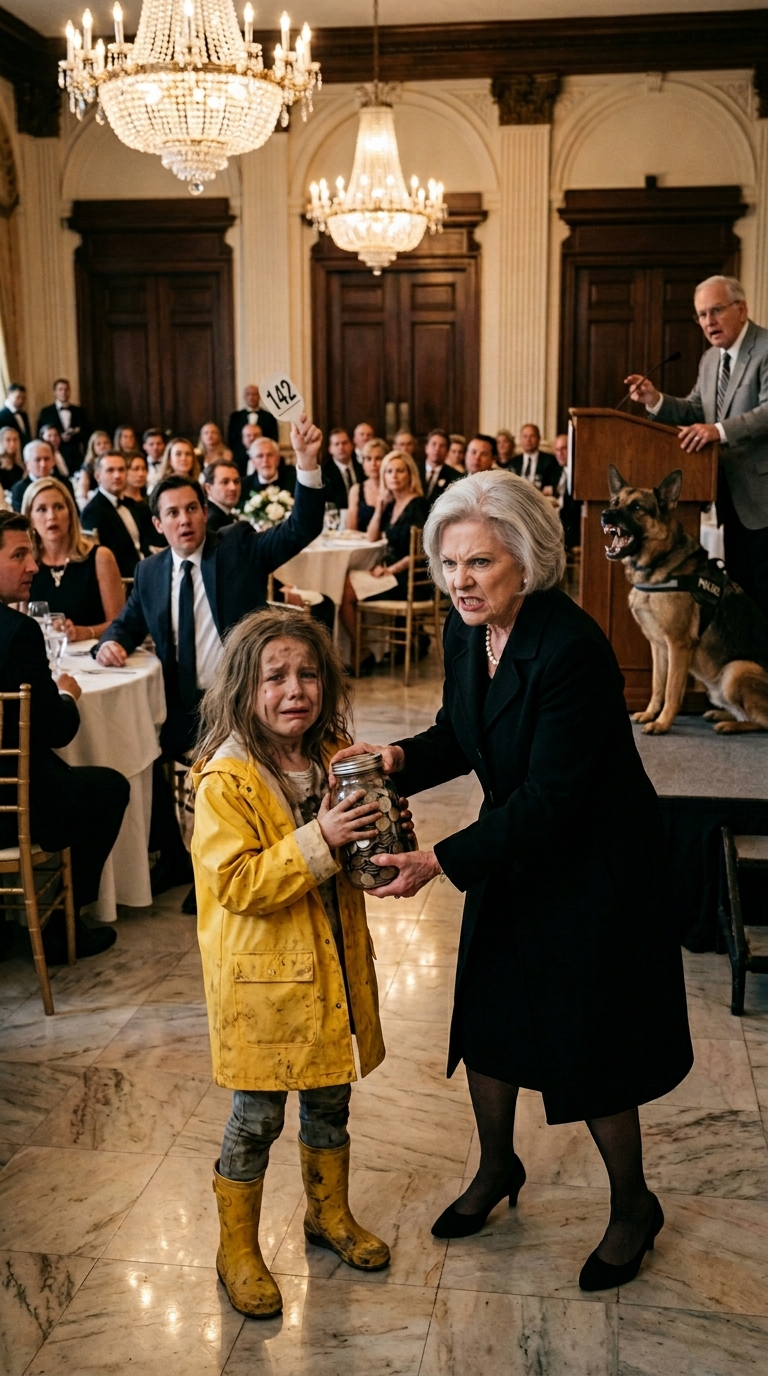
The bark rang out through the auction hall like a gunshot.
For one frozen moment, nobody stirred.
Not the wealthy bidders seated in rows of red velvet chairs. Not the auctioneer positioned behind the polished wooden podium. Not Mr. Dubois, whose numbered paddle stayed raised in the air as his smug smile faded from his face.
And certainly not eight-year-old Léa Laurent, who stood shaking in her soaked yellow boots, gripping a glass jar of coins as if it were the final piece of her heart.
On the stage, Tango, the aging Belgian Malinois, stood stiffly with his ears pricked forward. His amber eyes were not locked on the businessman who had just bid six hundred euros.
They were locked on Aunt Béatrice.
The woman who had burst into the auction hall.
The woman who had seized Léa’s arm.
The woman who had labeled Tango a coward.
Béatrice’s fingers tightened around Léa’s sleeve.
“Control that animal,” she snapped, but her voice cracked just enough for Léa to hear it.
Tango barked again.
This time, deeper.
The sound rolled through the hall, filled with something Léa could not name. Not anger exactly. Not fear.
Recognition.
The auctioneer cleared his throat. “Madame, please release the child.”
Béatrice turned sharply. “This is a family matter.”
“No,” a calm voice said from the back of the room. “It is now an official matter.”
Every head turned.
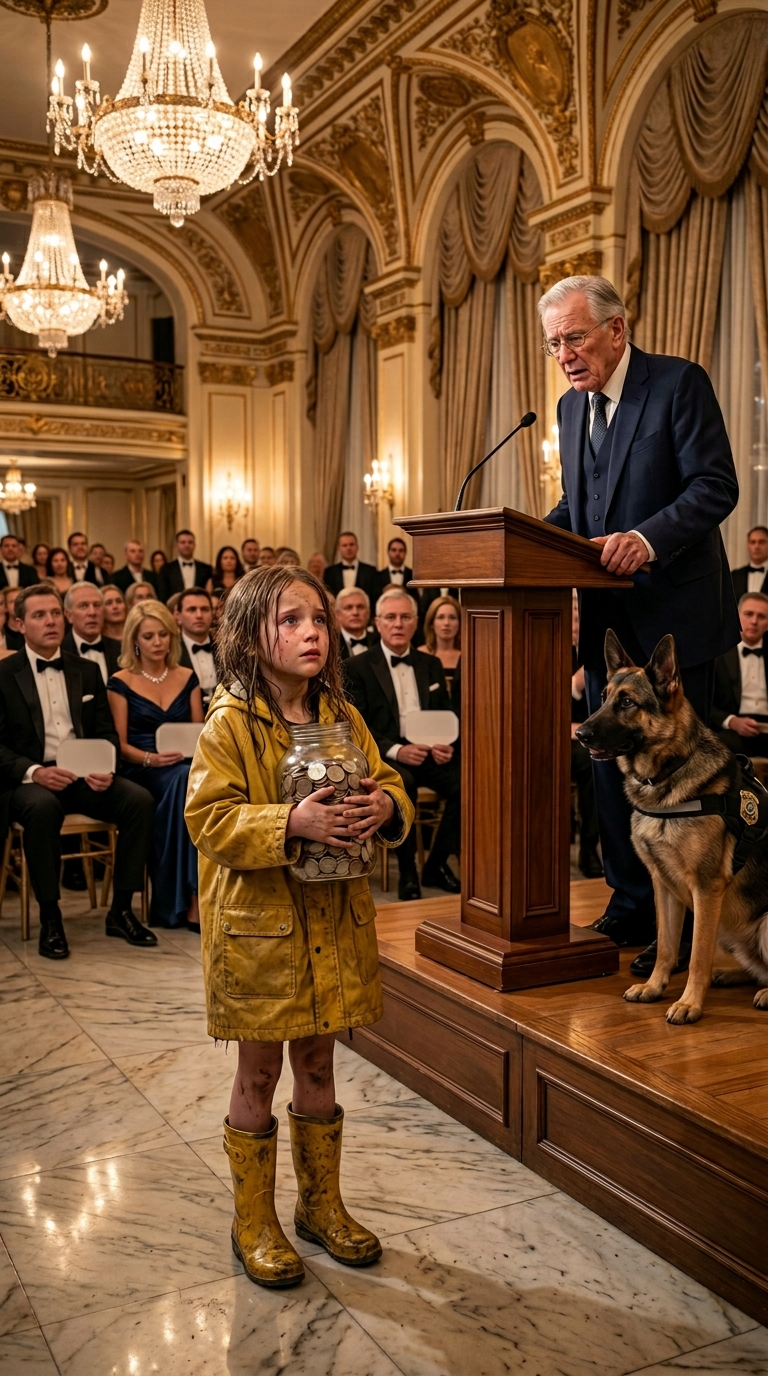
A tall man in a dark coat stepped through the open oak doors. Rain glittered on his shoulders. His hair was silver at the temples, and his eyes held the weary patience of someone who had spent too many years watching people lie.
Beside him stood two uniformed officers.
Béatrice went pale.
Léa did not recognize the man, but Tango did.
The dog’s barking stopped.
His tail lowered. His ears softened. Then, slowly, Tango sat.
The man walked down the aisle, his shoes echoing across the marble.
“Commander Moreau,” the auctioneer whispered.
The name rippled through the room.
Léa had heard it before.
Her mother had spoken that name once, late at night, when she thought Léa was asleep.
“If anything ever happens to me, trust Moreau.”
Léa’s breath caught.
Commander Moreau stopped a few feet from her and crouched so his eyes were level with hers.
“You are Léa Laurent,” he said gently.
Léa nodded.
His expression changed. It was not pity. It was something heavier.
“I served with your mother.”
At those words, Léa’s chest squeezed so hard she almost dropped the jar.
Béatrice stepped forward quickly. “This is unnecessary. My niece is confused. She ran away from home and—”
Tango growled.
Not loudly.
But enough.
Béatrice stopped speaking.
Commander Moreau rose to his feet. “Strange,” he said, looking at her. “For seven months, you refused every request to bring Tango near the child. You claimed it would traumatize her.”
“It would,” Béatrice snapped. “That dog abandoned Élise.”
“No,” Moreau said.
One word.
Quiet.
Heavy.
The entire room seemed to lean toward him.
Léa looked from Moreau to Tango, then to her aunt. “What does he mean?”
Béatrice yanked Léa closer. “Do not listen to him.”
But Léa pulled her arm free.
For the first time in seven months, she did not obey.
Moreau reached into his coat and removed a small sealed evidence bag. Inside was a scratched metal object no bigger than a child’s thumb.
A dog collar tag.
Léa recognized it instantly.
It was Tango’s old service tag.
Her mother had shown it to her many times, laughing as Tango sat proudly beside them in the kitchen.
Moreau held it up.
“Your mother trusted Tango with her life,” he said. “And on the night she died, he did not run away.”
Béatrice’s lips parted.
Moreau continued, “He was found two streets away from the scene, injured, guarding this tag. At first, we thought it was damaged by accident. But last week, our forensic technician discovered something hidden inside.”
A murmur spread through the auction hall.
Léa’s heart pounded.
Inside the evidence bag, the tag looked ordinary. Scratched. Old. Silent.
But Tango stared at it as if he had waited seven months for someone to listen.
Moreau turned toward the auctioneer. “This sale is suspended.”
Mr. Dubois slammed his paddle down. “You cannot do that. I made a legal bid.”
Moreau looked at him. “Mr. Dubois, you may want to sit quietly.”
Dubois’s face tightened.
Béatrice’s eyes flicked toward him.
It was fast.
Almost invisible.
But Léa saw it.
So did Tango.
The dog stood again.
Moreau nodded to one of the officers, who opened a small device and connected it to the tag. The hall fell silent as the officer pressed a button.
At first, there was only static.
Then a woman’s voice filled the room.
Soft.
Breathless.
But unmistakable.
Léa’s knees nearly gave way.
“This is Captain Élise Laurent.”
The jar slipped from Léa’s hands.
It hit the marble floor but did not break.
Coins scattered everywhere, spinning and ringing like tiny bells.
“Mama,” Léa whispered.
The recording continued.
“If this is found, it means I was right. The raid was compromised before we arrived. Someone warned the target.”
Béatrice made a small choking sound.
Moreau’s eyes never left her.
Élise’s voice crackled through the hall.
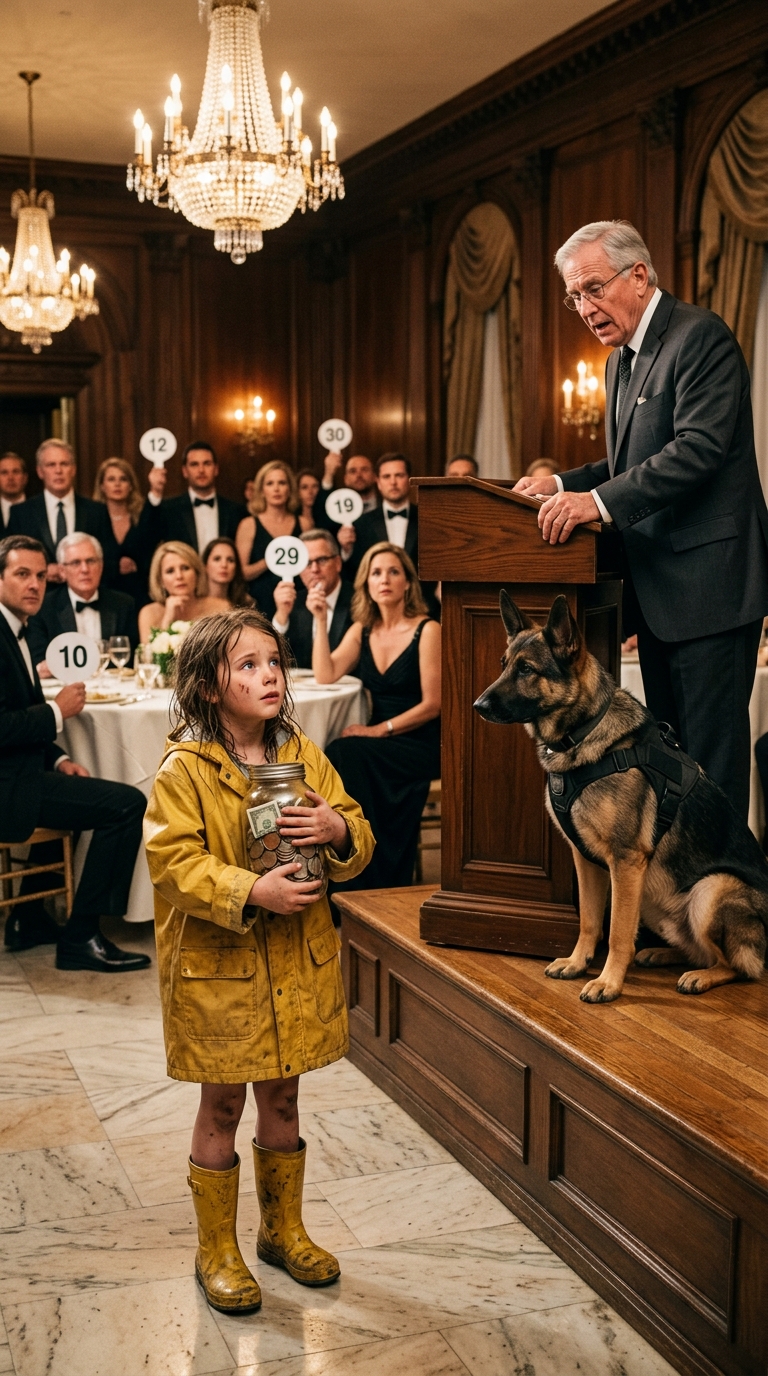
“I do not have much time. Tango is with me. He tried to pull me out, but I ordered him to run. I put this tag in his collar because he is the only one I trust to carry it home.”
Léa covered her mouth.
Tears spilled down her cheeks.
Tango let out a low whine and stepped to the edge of the stage, his eyes fixed on the child.
“He didn’t leave her,” Léa said, barely able to breathe. “She told him to go.”
Moreau’s voice softened. “Yes.”
The recording continued.
“I heard Béatrice speaking to Dubois three nights ago. She said if the operation failed, no one would look inside the family. She said a dead officer could not expose them.”
The auction hall erupted.
Chairs scraped backward. Voices rose. Someone gasped, “My God.”
Béatrice spun toward Moreau. “That is fake.”
Moreau did not blink.
Élise’s voice came again, weaker now but sharp with urgency.
“Béatrice is not protecting Léa. She wants my files. She wants the insurance money. She wants the house. And Dubois—”
Dubois stood suddenly.
Two officers moved toward him.
He tried to step into the aisle, but the buyers beside him recoiled, trapping him between chairs.
Élise’s voice broke through the chaos.
“Dubois paid for the leak.”
Dubois shouted, “This is absurd!”
Tango barked once.
The hall fell silent again.
The officer pressed pause.
Moreau turned to Béatrice. “Captain Laurent had been investigating a private security company using retired police dogs for illegal work. Your friend Mr. Dubois owned one of the front companies.”
Béatrice’s face had turned gray.
Léa stared at her aunt as if seeing a stranger wearing a familiar coat.
“You knew?” Léa whispered. “You knew Mama was in danger?”
Béatrice’s jaw trembled, but her eyes hardened.
“She was going to ruin everything,” she hissed. “She always had to be noble. Always had to be better than everyone.”
The words were so ugly, so naked, that even Dubois looked away.
Léa stepped back.
For seven months, she had lived in Béatrice’s house. She had eaten at her table. She had slept in a cold room while her aunt told her, again and again, that Tango had betrayed her mother.
But the betrayal had never belonged to Tango.
It had been standing beside her all along.
Moreau nodded to the officers.
They moved in.
Béatrice did not run.
Instead, she lunged toward Léa.
Not to hurt her. Not exactly.
To grab the jar.
“The key,” she snapped. “Where is the key?”
Léa stumbled backward.
Tango moved faster than anyone expected.
The old Malinois leapt down from the stage, landing between Léa and Béatrice with a force that made the marble floor echo. He did not bite. He did not attack.
He simply stood there.
A wall of fur, muscle, loyalty, and memory.
Béatrice froze inches away from him.
Moreau seized her wrist. “That is enough.”
As the officers handcuffed Béatrice and Dubois, Léa sank to her knees among the scattered coins. Her body shook, but she did not cry loudly. She only pressed her hands to her face, as if trying to hold herself together.
Tango approached slowly.
He lowered his head.
Léa looked up.
For a moment, the auction hall disappeared.
There were no buyers. No officials. No whispers. No betrayal.
There was only a little girl and the dog her mother had trusted with her final secret.
Léa wrapped both arms around Tango’s neck.
“I’m sorry,” she sobbed into his fur. “I believed them.”
Tango pressed his head against her shoulder.
Commander Moreau looked away, blinking hard.
Then he bent down and picked up the glass jar.
Only then did he notice something unusual.
The jar had not broken, but the wooden base beneath it had loosened when it hit the floor. Inside the base was a small folded paper, hidden under a thin circle of cork.
Moreau frowned. “Léa… where did you get this jar?”
Léa wiped her eyes. “It was Mama’s. She kept buttons in it when I was little. I used it for the coins.”
Moreau carefully removed the paper.
Béatrice, already being led toward the doors, suddenly twisted around.
“No,” she whispered.
Everyone heard it.
Moreau unfolded the paper.
Inside was a short handwritten note.
Léa recognized her mother’s writing before she even read the words.
Moreau handed it to her.
Her hands trembled as she read.
My brave little Léa, If you are reading this, then Tango found his way back to you. I knew he would. People may lie, but loyalty leaves a trail. Look beneath what everyone thinks is worthless. That is where truth hides. I love you more than every star over Lyon. Mama.
Léa pressed the note to her chest.
But Moreau was staring at the back of the paper.
There was a second message.
Not to Léa.
To him.
He turned it over.
The handwriting became smaller, rushed, secretive.
Moreau, if Béatrice gets custody, do not trust the paperwork. Léa is not her ward by blood. Her real guardian is named in the sealed file. The child was never supposed to go to my sister.
The commander’s face changed.
Léa looked up. “What does that mean?”
Moreau did not answer immediately.
He pulled out his phone, spoke quietly to someone, then waited while the whole room watched. Minutes seemed to stretch forever.
Finally, his phone buzzed.
He read the message.
Then he looked at Léa with a mixture of shock and wonder.
“Your mother changed her will two weeks before she died,” he said. “Béatrice hid the update before it could be processed.”
Léa’s voice was small. “Who was supposed to take care of me?”
Moreau swallowed.
Then he said the words no one expected.
“Me.”
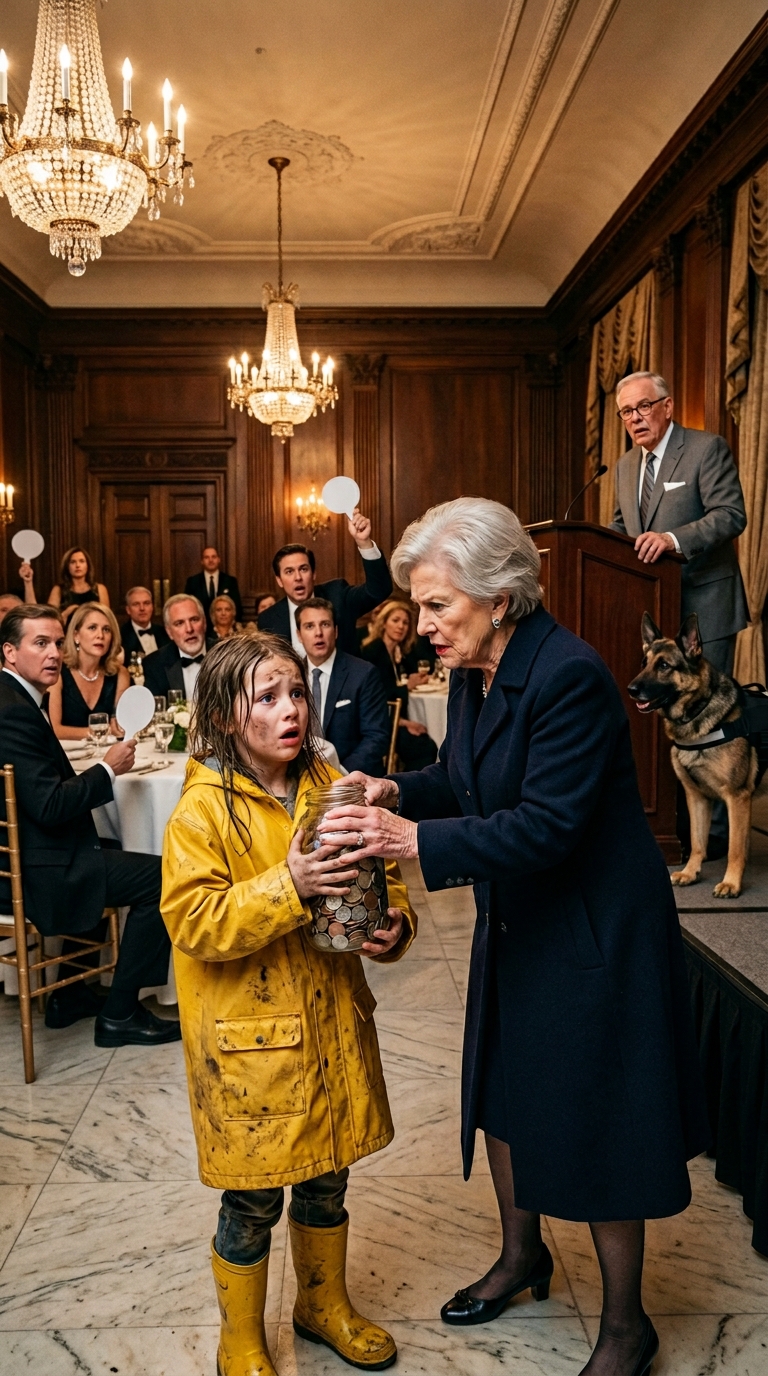
The room went silent.
Even Tango seemed to understand.
Moreau looked shaken, almost afraid. “Your mother asked me after your father died. I said yes. I thought the documents had never been finished.”
Léa stared at him.
This serious man. This stranger with tired eyes. This person her mother had told her to trust.
“You were supposed to be my guardian?”
“Yes,” he said softly. “If you will allow it.”
Léa looked at Tango.
The dog gave one gentle wag of his tail.
Then Léa did something that made half the room wipe their eyes.
She picked up one coin from the floor, placed it back into the jar, and held it out to Moreau.
“I still want to buy Tango,” she said. “I saved everything.”
Moreau looked at the auctioneer.
The auctioneer removed his glasses, cleared his throat, and spoke in a voice rough with emotion.
“Lot number 12 is withdrawn from sale. By authority of the state and in recognition of service rendered, Tango is hereby retired into the care of Léa Laurent.”
The hall erupted—not with murmurs this time, but applause.
Léa hugged Tango tighter.
But the final twist came three days later.
When investigators searched Béatrice’s house, they found Élise’s missing files locked behind a false wall. Inside was evidence against Dubois, Béatrice, and several others.
But hidden at the bottom was one last envelope.
It was addressed to Léa.
Inside was a photograph.
A much younger Élise stood in a hospital room, smiling through tears. In her arms was a newborn baby.
Beside her stood Commander Moreau.
On the back, in Élise’s handwriting, were six words:
He is not only your guardian.
Léa stared at the photo.
Then she looked up at Moreau, who had gone completely still.
His face drained of color.
With shaking hands, he took the photograph and turned it over.
There, beneath the first sentence, was one final line.
He is your father.
For a long moment, no one spoke.
Then Moreau dropped to his knees in front of Léa, tears finally breaking through the hard mask he had worn for years.
“I didn’t know,” he whispered. “Léa, I swear to you, I didn’t know.”
Léa looked at him, then at Tango.
The old dog moved between them, gently pressing his body against both.
And somehow, that was the answer.
The dog everyone called a coward had carried a dead woman’s truth across seven months of silence.
He had exposed a betrayal.
He had saved a child.
And, in the end, he had brought Léa back to the family she never knew she still had.
Because Tango had not abandoned Élise Laurent.
He had obeyed her final command.
Find my daughter.
