

PART 3 — What My Mother Passed On
The following Friday, I rode with Dad.
My alarm rang at 3:45 in the morning.
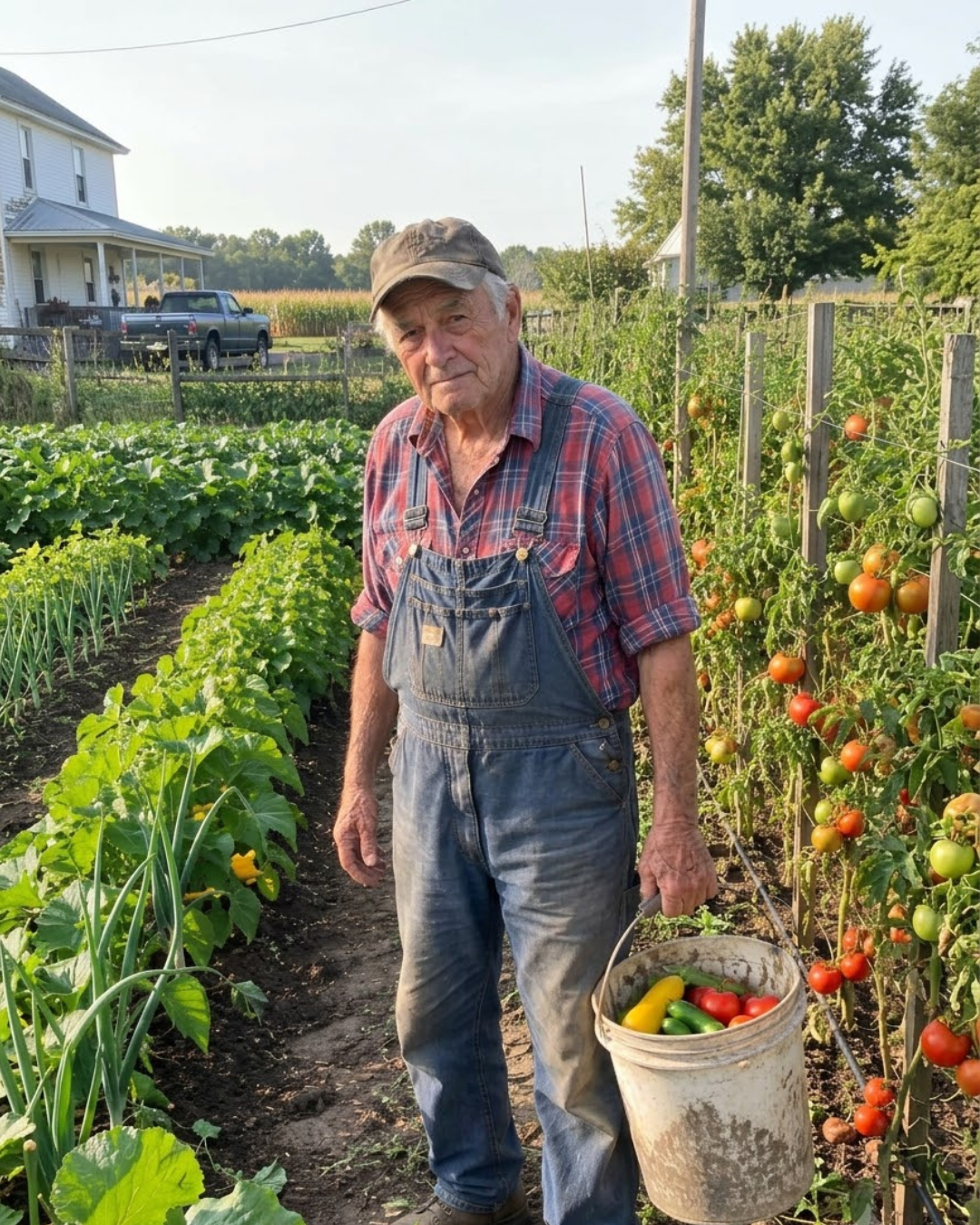
When I came downstairs, he was already packing vegetables into banana boxes.
Eleven boxes.
“You coming?” he asked casually.
Like he’d been expecting me all along.
“I’m coming.”
He showed me how to arrange everything.
Potatoes at the bottom.
Squash above them.
Then beans.
Tomatoes on top, cushioned with newspaper so they wouldn’t bruise.
We loaded the pickup together.
The sky was still dark when we pulled away.
Dad waited until we reached the main road before switching on the headlights.
“Don’t want to wake the neighbors,” he explained.
Our first stop was a little blue house on Elm Street.
A ninety-one-year-old man named Walt lived there.
He couldn’t drive anymore and needed a walker to move around.
Dad carried a box to the porch and set it beside the door.
He didn’t knock.
He tapped twice on the window.
A light came on inside.
An elderly hand appeared behind the glass and waved.
“Walt’s been getting vegetables for nine years,” Dad told me. “Since his wife passed. Marta brought him a pie after the funeral, and he cried so hard she kept coming back.”
We continued to a trailer park.
A young woman named Dee lived there with three children while her husband was hospitalized.
Then an apartment building where four elderly residents shared the same floor.
Dad climbed three flights of stairs carrying a box.
He was breathing hard when he came down.
“I’m carrying the next one,” I told him.
He didn’t argue.
Our next stop was a small house with a wheelchair ramp.
A man named Curtis waited on the porch.
He’d lost both legs in Afghanistan.
He was holding a thermos of coffee.
“Arne,” he called. “Who’s this?”
“My daughter. Kristin.”
Curtis looked at me.
“Your mother used to bring me peach pie every August. When the peaches were good.”
His expression softened.
“I miss her.”
“So do I,” I whispered.
We visited seven more houses before stopping at St. Luke’s.
Sister Rosemary met us at the church kitchen and embraced Dad.
“You’re a saint, Arne.”
“Oh, hush,” he said.
We unloaded the remaining boxes.
By then, sunrise was turning the hills pink and gold.
I thought we were going home.
But Dad took another road.
He drove up the hill behind the church and turned into the cemetery.
He parked beneath a large oak tree.
Then he reached behind the seat and retrieved a small paper bag.
I followed him through the wet grass.
We stopped at my mother’s grave.
The headstone read:
MARTA ELISE LINDQVIST
1949–2023
SHE PASSED IT ON.
I’d visited that grave many times.
Somehow, I’d never really noticed the final words.
Dad opened the bag.
Inside was a single tomato.
Large.
Red.
Perfect.
The finest one from the garden.
He placed it carefully on top of the headstone.
“Eleven houses this week, Marta,” he said.
He stood quietly for a moment.
“And St. Luke’s. Forty-two families on Saturday. That’s a record.”
My eyes filled again.
“The neighbor’s going to be all right,” Dad continued. “June’s boy. He’s coming around.”
He rested his palm against the stone.
“You’d like him, I think. Once he lets you.”
Then his voice dropped.
“I haven’t missed a Friday.”
He swallowed.
“Not one.”
He stood there a little longer.
Then he turned and walked back toward the truck.
I remained beside Mom’s grave.
I touched the tomato once.
And followed him home.
That was a year ago.
Since then, almost everything has changed.
Tyler Ostrowski helped Dad secure the community garden permit in six weeks instead of six months.
He personally guided the paperwork through the county offices.
The garden now has an official name.
The Marta Lindqvist Community Garden.
Tyler made the wooden sign himself in his garage.
It stands beside the driveway.
He visits most Saturdays with his girlfriend, and they pick tomatoes for her grandmother.
Brent withdrew his complaint the following Monday.
But he didn’t stop there.
In October, construction workers arrived at his gray house.
At first, I worried he was building a taller fence.
Instead, they tore up half of his immaculate lawn.
Brent came to Dad’s back door.
“I want to make the garden bigger,” he said. “On my side of the property. If that’s okay.”
Dad stared at him.
“My mother thinks we could plant pole beans along the fence,” Brent continued. “She says we’d double the yield. And she’s got some pretty strong opinions about squash.”
Dad looked toward the torn-up grass.
“Your mother’s right about squash,” he said.
They built a gate between the properties that autumn.
Brent insisted on doing the work himself.
He wasn’t particularly good with tools.
It took three weekends, and he hit his thumb with the hammer more times than I could count.
But eventually, there was a wooden gate with an iron latch.
It hung a little crooked.
Dad loved it.
“That’s how you know somebody made it by hand,” he said.
June moved into Brent’s house in November.
She resisted at first.
She didn’t want to be a burden.
She said she liked her apartment near the Dollar General.
Brent kept asking.
“Mom, I’ve got four empty bedrooms. And a garden that needs somebody who knows what they’re doing.”
She finally agreed.
By Thanksgiving, she was living in a bedroom overlooking the vegetables.
Every morning now, Brent and June stand together on the deck.
He drinks coffee.
She drinks tea.
They point at the garden and debate where the tomatoes should go next spring.
Neither of them frowns at it anymore.
Brent also began joining Dad on the Friday deliveries.
Not every week.
He still had his business and sometimes traveled.
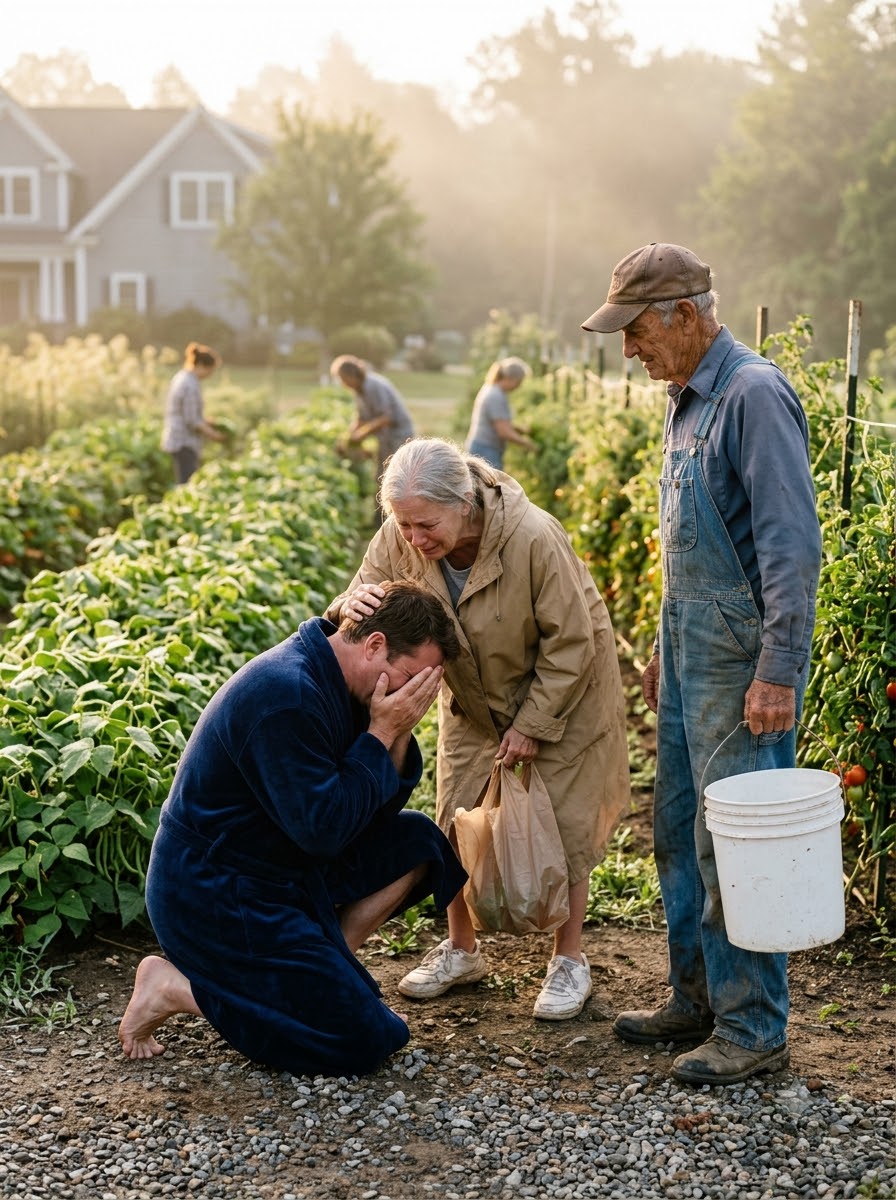
But most Fridays, around 3:45 in the morning, he’d arrive in jeans and a sweatshirt.
He drove the truck.
Dad sat beside him and gave directions.
Brent carried the heavy boxes.
All three flights of stairs when necessary.
Dad finally let someone else do the lifting.
They talked during those drives.
About gardening.
About the old paper mill.
About County Road 9.
About Brent’s father and the injury that had changed their family’s life.
And about Marta.
“He’s a good boy,” Dad told me one afternoon.
“Just took him a while to stop running.”
In May, my father turned eighty.
A couple of months earlier, he’d suffered a heart problem.
Doctors placed a stent, and he spent four days in the hospital.
He complained about only one thing.
Nobody was home to plant his peas.
But he was wrong.
Brent planted them.
So did June.
And Tyler.
And the teenage brothers, Marcus and Devon.
And Ashley, the young mother who came on Saturdays with her children.
Even Curtis helped from his wheelchair, giving instructions from the end of the rows.
They planted peas, beans, onions, and potatoes.
They prepared the tomato cages.
They tied the climbing strings.
They worked until every row was ready.
When I brought Dad home from the hospital, he stepped onto the back porch and stopped.
The garden lay before him.
Freshly turned soil.
Straight rows.
Small green shoots.
Everything cared for.
He stood there for a long time.
“Well,” he whispered. “Would you look at that.”
I put my hand on his arm.
“You’ve got help now, Dad.”
He nodded slowly.
“I see that.”
He lowered himself into his old metal lawn chair.
I sat beside him.
“Your mother worried about this,” he said after a while.
“About what?”
“Who’d keep it going after we were gone.”
He looked across the garden.
“I told her I’d figure something out.”
Then he chuckled.
“Never figured it’d be the fellow who tried to tear it out.”
This morning was another Saturday.
I arrived at five-thirty.
I come every Saturday now.
Every single one.
I bring a second coffee urn because Mother’s old thirty-cup pot isn’t enough anymore.
The valley was covered in the same soft fog as that first Saturday.
At six, headlights appeared along Ridge Road.
One vehicle.
Then another.
Then another.
I counted.
Twenty-three cars.
A new record.
People emerged carrying bags, boxes, buckets, and baskets.
They walked into the garden as the sun began to rise.
June was gathering yellow squash.
Naturally.
She still preferred the little red potatoes to the big ones.
Tyler was helping his girlfriend pick tomatoes.
Ashley was in the strawberry patch with her little girl, who seemed determined to eat more berries than she collected.
At the far end of the beans stood my father.
Eighty years old now.
His old dented bucket in one hand.
He moved more slowly than before.
Sometimes he needed to stop and rest.
But he was still there.
Still tending the rows.
Still making sure everyone had enough.
And in the next row, kneeling beside him, was Brent.
He wore faded jeans with holes at the knees.
His fingernails were permanently stained with dirt.
He didn’t bother trying to scrub them spotless anymore.
Then a car I didn’t recognize pulled into the driveway.
It had Texas plates and a cracked windshield.
A young couple climbed out with a little boy, perhaps seven years old.
They stood beside the car, uncertain.
The father looked exhausted.
The mother held the child’s hand tightly.
They watched the people moving through the garden but didn’t approach.
I recognized that hesitation.
I’d seen it in June.
In people who needed help but wished they didn’t.
Brent noticed them too.
He stood, brushed dirt from his knees, and walked toward the driveway.
“Morning,” he said. “First time?”
The father nodded.
“Somebody at the gas station told us about this place,” he said. “Said people could come here and…”
His voice faded.
Brent smiled.
“They can. Come on.”
He led them toward the shed and picked up an empty bucket.
The little boy stared at the vegetables.
Then he looked up at Brent.
“Mister, whose garden is this?”
Brent considered the question.
He glanced toward my father, who was slowly straightening at the end of the bean rows.
“It’s Mr. Lindqvist’s garden,” Brent answered. “And his wife’s. She started it a long time ago.”
The boy looked toward the beans.
“Who are all the beans for?”
Brent smiled.
Not the tight, uncomfortable smile I’d seen when he first moved next door.
A real one.
He knelt until he was level with the child.
“People,” he said.
The boy thought about that.
“Like us?”
“Exactly like you.”
Brent handed him the bucket.
“Beans are on the left. Nine rows. Pick from the bottom up. The ones near the ground are ready first.”
The boy nodded solemnly.
Then he walked into the garden, knelt at the first row, and began picking beans.
Across the rows, Dad caught my eye.
He didn’t say anything.
He simply raised one hand in a small wave.
Then he bent back toward his work.
I stood on the porch with my coffee, watching twenty-three carloads of people move quietly through the morning fog.
They gathered what they needed.
They left enough for whoever came next.
And somewhere on the hill behind St. Luke’s, a headstone stood beneath an oak tree.
Sometimes there was a tomato resting on it.
The words carved into the stone were simple.
SHE PASSED IT ON.
My mother had spent forty years feeding people without asking for recognition.
My father had kept her promise after she died.
And the man who once wanted to destroy their garden was now helping it grow.
For years, I thought the garden was simply where my parents raised vegetables.
I know better now.
It was where my mother turned a stranger’s kindness into a promise.
Where my father kept that promise alive.
Where a frightened man finally stopped running from his childhood.
And where people who arrived with empty bags could leave with food, dignity, and the knowledge that somebody cared.
My mother passed it on.
My father passed it on.
Brent passed it on.
And now, so do we.
