

PART 2 — The People Who Came at Six
I set my alarm for five Saturday morning.
I was awake at four-thirty.
When I entered the kitchen, Dad had already prepared coffee.
Not his usual little pot.
He’d brought out Mother’s enormous thirty-cup urn, the one she used for church suppers and community dinners.
It sat on the counter, steaming.
“Expecting company?” I asked.
“People,” Dad replied.
That word again.
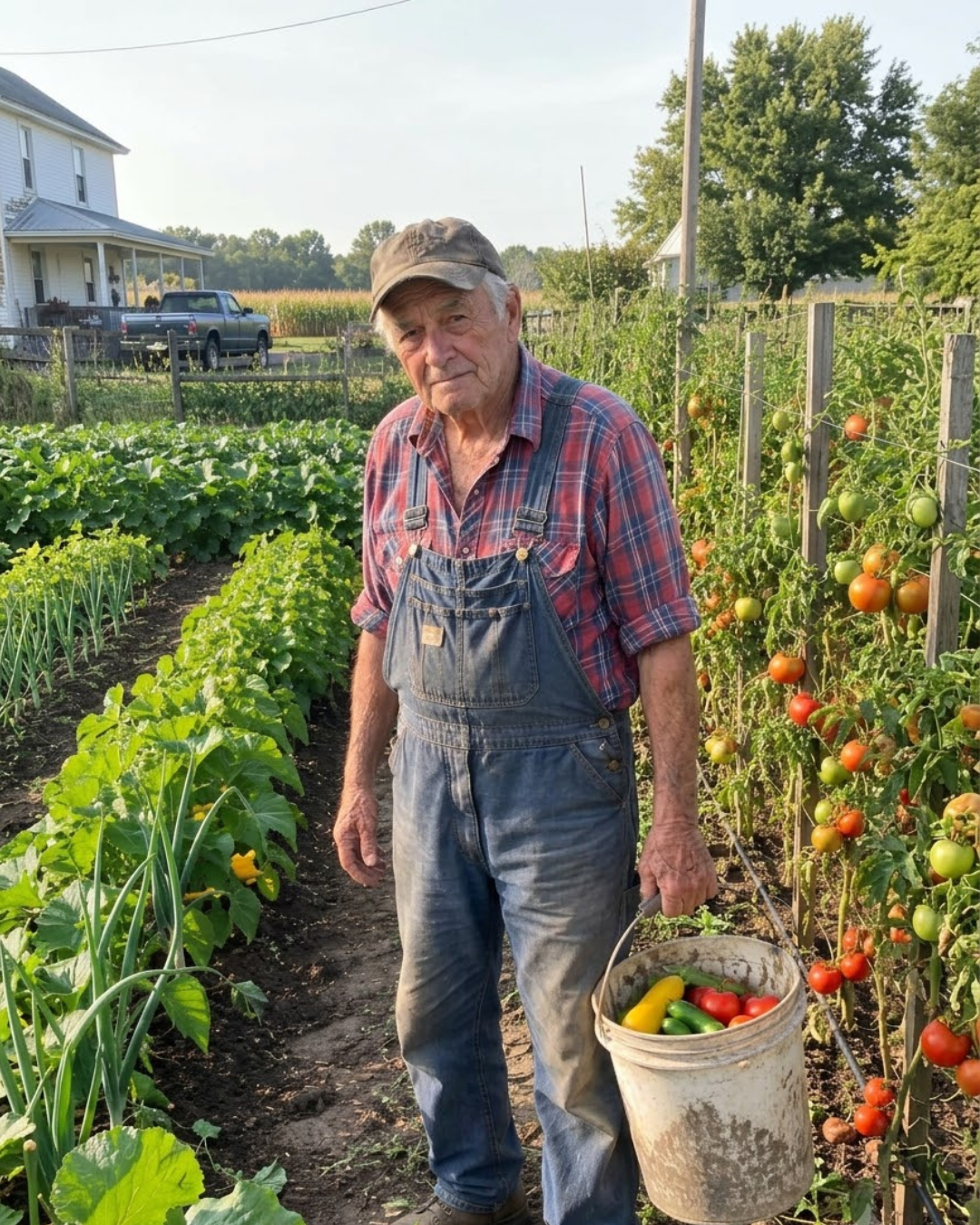
He took his bucket and went outside.
The morning was wrapped in thick fog.
I could barely see the corn beyond the porch. Everything farther away dissolved into white.
Dad was a faint shape among the bean rows, already working.
At 5:55, Tyler’s county car appeared through the mist.
He parked near the driveway and walked toward the porch wearing a jacket over his sweatshirt.
“Morning,” he said. “I’m here.”
I offered him coffee.
This time, he accepted.
“Where’s your father?”
I pointed toward the garden.
“And what exactly am I supposed to see?”
“I wish I knew.”
Across the fence, Brent was already on his deck.
He wore a dark blue bathrobe and held his usual coffee mug.
When he spotted Tyler, he lifted the mug slightly, almost like a toast.
Tyler ignored him.
Then, precisely at six, headlights appeared down Ridge Road.
An old red Ford pickup pulled onto the shoulder.
A white Chevrolet followed.
Then a blue Dodge with a cracked windshield.
A brown Corolla.
A station wagon.
A minivan.
More vehicles kept coming, their headlights emerging one after another from the fog.
I began counting.
Eleven.
Fourteen.
Seventeen.
They parked in a long line beside the road.
Doors opened.
People climbed out.
An elderly man in suspenders and a feed-store cap.
A young mother with a baby strapped against her chest and a toddler holding her hand.
A man wearing a Walmart vest.
Two teenage boys carrying a laundry basket.
A woman in medical scrubs.
An elderly lady leaning on a cane.
A man with a prosthetic leg.
Families with children still wearing pajamas beneath their jackets.
Every person carried something.
An empty grocery bag.
A bucket.
A cardboard box.
A basket.
A little red wagon.
They greeted one another softly and walked up the driveway.
Then they entered my father’s garden.
Without instructions.
Without confusion.
As though they’d done it a hundred times before.
The elderly man went to the potatoes.
The teenage boys headed straight for the corn.
The woman in scrubs began picking tomatoes.
The young mother settled near the strawberry patch while her toddler gathered berries and ate half of them.
The woman with the cane walked toward Dad.
He straightened, greeted her warmly, and handed her his already-full bucket of beans.
He’d been picking them for her.
Tyler stood motionless beside me.
His pen hovered above the clipboard.
“What is this?” he whispered.
I couldn’t speak.
The answer was unfolding right in front of me.
All those vegetables.
All those early mornings.
All those hours Dad spent on his knees.
Who are all those beans for?
People.
My eyes filled with tears.
Nobody was taking too much.
Each person gathered what they needed and left the rest.
There were no prices.
No cash register.
No signs asking for payment.
Just people helping themselves to food my father had grown.
I looked up at Brent.
His coffee mug was no longer raised.
He gripped the railing and stared at the garden below.
Then one final vehicle appeared.
A silver minivan.
It drove slowly to the end of the line and stopped.
For a moment, nobody emerged.
Then the driver’s door opened.
A small elderly woman stepped out.
She was about seventy, with gray hair clipped back, a loose tan raincoat, and worn white sneakers.
She carried two faded cloth grocery bags.
She walked slowly up the driveway, keeping her eyes lowered.
There was something hesitant about every step.
Halfway up, she looked toward the garden.
Then beyond it.
Toward Brent’s deck.
She stopped.
One grocery bag slipped from her arm and fell onto the gravel.
She didn’t reach for it.
She simply stared.
On the deck, Brent slowly lowered his coffee mug.
His face changed.
He disappeared into the house.
Moments later, he came hurrying around the side, barefoot in his bathrobe.
He crossed his immaculate lawn, stepped over the low corner of the fence, and pushed through the corn.
He stopped several feet from the woman.
“Mom?”
Her face crumpled.
“Brent,” she whispered. “What are you doing here?”
“I live here.”
He pointed toward the gray house.
“That’s my house.”
She looked up at it.
“I didn’t know,” she said. “You never told me exactly where. You never invited me.”
Brent stared at her.
“What are you doing here?”
She looked down at the empty grocery bags.
She couldn’t answer.
She didn’t have to.
Brent glanced toward the people harvesting vegetables.
Then back at his mother.
“No,” he whispered.
“Brent—”
“You’re here for food?”
She lifted her chin.
“Every Saturday,” she answered. “For a year and a half.”
He stepped backward.
“Why? Mom, I send you money.”
“You send me two hundred dollars a month,” she said. “And I’m grateful, honey. I truly am.”
“Then why are you here?”
“Because my pension is eleven hundred dollars. My rent is eight hundred. My heart medicine costs three hundred and forty after insurance.”
Her voice trembled.
“Then there’s electricity, the phone, and car insurance. It doesn’t add up, Brent. It hasn’t added up since your father died.”
“You should’ve told me.”
“How could I?”
Tears began rolling down her cheeks.
“You worked so hard to escape the life we had. You went to college, worked two jobs, built your company. You were so proud of that new house and your new car.”
She pressed the grocery bags against her chest.
“I didn’t want to drag you back into the old days.”
“Mom, you’re my mother.”
“I know. But I didn’t want you remembering our empty cupboards every time you looked at me.”
Brent stood barefoot on the gravel.
His mouth opened, but no words came.
By then, Dad had approached from the garden.
The woman noticed him.
“Arne,” she said tearfully. “I’m sorry. I didn’t know he was your neighbor.”
“Morning, June,” Dad replied. “Nothing to apologize for.”
Brent turned sharply.
“You know my mother?”
“She’s been coming every Saturday for a year and a half,” Dad said. “Likes yellow squash and the little red potatoes. Says they remind her of what her mother used to grow.”
June laughed weakly through her tears.
Brent stared between them.
“I reported this garden,” he said.
“I know,” Dad answered.
“I tried to get the county to make you tear it out.”
“I know that too.”
“And you knew my mother came here?”
“Didn’t know she was your mother. I just knew she was June, a widow living near the Dollar General who liked yellow squash.”
Dad lowered his bucket.
“People don’t have to explain who they are to get a bag of beans.”
Brent looked around at the garden.
At the people picking food.
At his mother’s empty bags.
He seemed to shrink.
Then he sat down on the driveway.
Right there in his expensive bathrobe.
He buried his face in his hands.
June approached him and gently touched his hair.
“Honey,” she whispered. “It’s okay.”
“No,” he said. “It isn’t.”
The garden had grown quiet.
People stopped working and watched from between the rows.
Brent lifted his head.
“When I was a kid,” he began, “we lived in a trailer on County Road 9.”
His voice was rough.
“My father drove a delivery truck until he injured his back. After that, he couldn’t work. My mother grew vegetables because we couldn’t afford enough food.”
June closed her eyes.
“She made me pick beans every summer. Hours in the heat. I went to school with dirt under my fingernails, and the other kids called me Bean Boy.”
He gave a bitter laugh.
“Six years. Bean Boy. Because we ate beans all the time. Green beans, beans and rice, even bean sandwiches.”
He looked at his house.
“I promised myself I’d never be poor again. Never have dirt under my nails again. Never let anyone look at me and see that trailer.”
His eyes returned to Dad.
“So I built that house. And every morning, I’d stand on the deck and look down at your garden.”
He swallowed.
“All I saw was County Road 9. My mother’s garden. The empty cupboards. Everything I spent my life trying to escape.”
His shoulders shook.
“And she was here the whole time. Getting food from the very garden I wanted destroyed.”
Nobody moved.
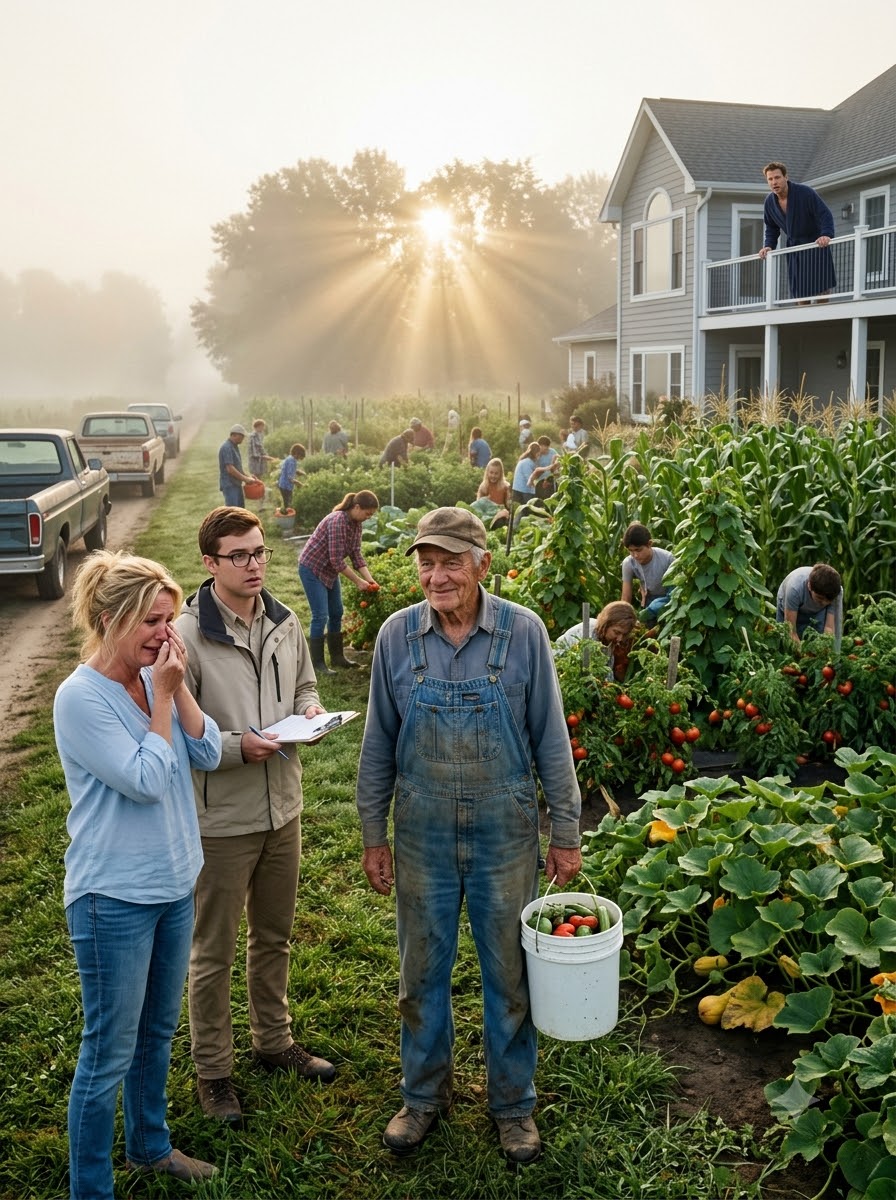
Then Dad slowly lowered himself onto the gravel beside Brent.
His knees cracked loudly.
For a while, they sat together without speaking.
Finally, Dad said, “In 1982, the paper mill laid off two hundred workers.”
Brent looked at him.
“I was one of them.”
Dad nodded toward me.
“I had a wife and a five-year-old daughter. A mortgage. No job. Every mill in the valley was cutting workers.”
He rubbed his dirt-stained hands.
“That winter was terrible. One week, all we had left was crackers and peanut butter.”
I felt my throat tighten.
“Marta would give Kristin part of her own food and pretend she’d already eaten.”
I didn’t remember.
I had been too young.
“One morning,” Dad continued, “I opened the front door and found a box on the porch.”
He looked down.
“Potatoes. Onions. Canned beans. Tomatoes. Flour. A whole ham.”
There had been a note.
From the neighbors. Pass it on.
“Another box came the next Friday,” Dad said. “And the next. Every week until I found work again in May.”
“Who brought them?” Brent asked.
“Never found out. Marta thought it was the Swensons.”
He pointed toward Brent’s property.
“They lived where your house stands now. Good people. Quiet people. Old Mr. Swenson would’ve denied it if we’d asked.”
Dad smiled faintly.
“But Marta made me promise something when I found work again.”
He paused.
“She said, ‘Arne, we’re going to pass it on. As long as we live. We’re never letting anybody on this road open their cupboards and find nothing.’”
He gestured toward the garden.
“So she made it bigger.”
Every year, they planted more.
Every Saturday, anyone who needed food could come and take vegetables.
No forms.
No questions.
No judgment.
Every Friday before sunrise, Marta delivered boxes to people who couldn’t come.
The elderly.
The disabled.
The sick.
And those who were too embarrassed to ask.
“For forty years,” Dad said. “She kept it going.”
His voice grew unsteady.
“Then she got sick.”
He stared at his hands.
“The last thing she ever said to me was, ‘Arne. The Fridays. Don’t you dare stop the Fridays.’”
A long silence followed.
“So I didn’t,” he whispered.
I was crying openly.
Forty years.
My mother had spent forty years feeding people in secret.
And I had never known.
I’d left home for college, built my own life, and returned for holidays and occasional visits.
I’d seen the garden.
I’d eaten its vegetables.
But I’d never truly asked what it meant.
Tyler placed his clipboard on the porch railing.
“How many families?” he asked.
Dad thought for a moment.
“About forty on Saturdays. Sometimes more. Eleven houses on Fridays. Anything left goes to the food pantry at St. Luke’s.”
“Forty families?”
“Give or take.”
Tyler looked across the garden.
Then he picked up his clipboard.
He stared at the violation notice for several seconds.
Carefully, he tore the half-completed sheet from the pad.
He folded it and placed it in his pocket.
“Mr. Lindqvist,” he said, “the complaint describes unmaintained agricultural use.”
Dad nodded.
“That’s what it said.”
“Well, in my professional opinion, this is the most carefully maintained property I’ve ever inspected.”
Tyler swallowed.
“I don’t see an unmaintained-property violation here. I’ll document that finding. And I’ll help you apply for the proper community garden exemption.”
Dad looked up.
“Thank you, son.”
Tyler shook his head.
“My grandmother used to receive vegetables from somebody like you. I never knew who brought them.”
His eyes shone.
“I’ll find out what paperwork you need. I’ll walk it through the county myself.”
Brent stood.
He wiped his face with his sleeve and turned toward Tyler.
“I want to withdraw my complaint,” he said. “Officially. Whatever I need to sign.”
“I’ll bring the form Monday,” Tyler replied.
Brent faced my father.
“Mr. Lindqvist, I’m sorry. I don’t know what else to say.”
Dad looked up from the gravel.
“Help me stand. My knees aren’t what they used to be.”
Brent immediately reached down.
He helped Dad to his feet and steadied him until he could stand on his own.
“Thank you,” Dad said.
Brent’s voice broke.
“Is there anything I can do?”
Dad studied him for a moment.
Then he bent, picked up his dented metal bucket, and held it out.
“Beans are on the left. Nine rows. Your mother likes squash, but she could use beans too.”
Brent stared at the bucket.
“Pick from the bottom up,” Dad added. “The ones near the ground are ready first.”
For a moment, Brent didn’t move.
I could almost see the memories passing through him.
The trailer.
The schoolyard.
The cruel nickname.
The dirt he had scrubbed from his hands as a boy.
Then he reached out.
He took the bucket.
“Bottom up,” he repeated quietly.
“Bottom up,” Dad said.
And Brent Hollis walked into my father’s garden.
Barefoot.
Still wearing his expensive blue bathrobe.
He knelt beside the first row of beans.
And for the first time in thirty years, he began picking them.
His mother stood nearby, crying silently.
Around them, the others returned to their work.
The fog slowly lifted.
Sunlight spread across the corn and tomatoes, turning the entire garden gold.
I walked down from the porch and put my arm around Dad.
“You could’ve told me,” I whispered.
“About your deliveries. About Mom. About all of this.”
“You never asked.”
“I did ask once. I asked who all the beans were for.”
Dad glanced at me.
“And what did I say?”
“People.”
“Well,” he replied, “that was the answer.”
I laughed through my tears.
Then I told him about the lawyer.
“I was going to fight the county. I was ready to take Brent to court.”
“I know.”
“Why didn’t you let me?”
Dad watched Brent picking beans.
“Lawyer might’ve found a way to win,” he said. “But Brent would’ve spent the rest of his life standing on that deck hating this garden.”
He shook his head.
“A lawyer can stop a man from complaining. Can’t make him stop hurting.”
He nodded toward the bean rows.
“Sometimes you’ve got to let people see the whole thing. Then they decide what kind of person they want to be.”
“What if he still wanted the garden gone?”
Dad shrugged.
“Then we’d have called your lawyer.”
I laughed again.
He smiled.
“But your mother always said most people aren’t mean. Most are just afraid of something they haven’t really looked at.”
That morning, I finally understood.
Dad hadn’t invited Tyler back to win an argument.
He’d invited him to see what the garden was really growing.
And it wasn’t just vegetables.
