

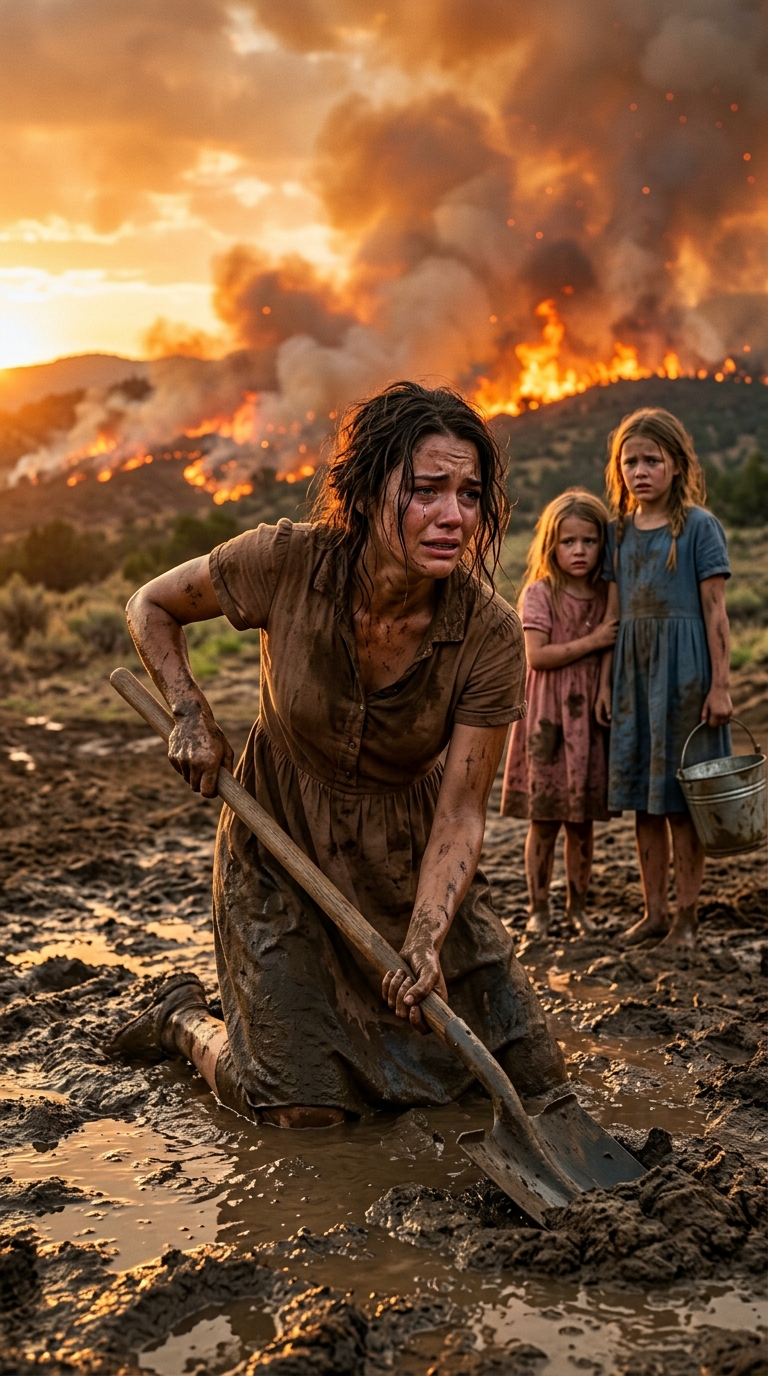
PART 1
The southern Mexican sun showed no mercy. It beat down like divine punishment on the rusted tin roofs of the village of San Juan de las Piedras, on the twisted mesquite trees, and on the streams that had long since become deep scars of dust. In that arid region, water was worth far more than gold, and people’s very lives were measured by the bottom of their buckets. Whoever owned a deep well was considered the master of the village; whoever did not, learned to survive by walking 15 kilometers every day with heavy cans on their shoulders, praying for a storm that never came.
Teresa was barely 32 years old, but tragedy had carved many more decades into her gaze. Exactly four months earlier, a sudden fever had taken her husband in just three days. There had been no time for goodbyes or for expensive doctors. Overnight, she became a widow, clutching her two young daughters with only 300 pesos saved in a glass jar.
But her husband’s death was not the worst of her troubles. As soon as the nine-day prayers ended, her brother-in-law Ramiro — an ambitious man with a rotten heart — burst into her house. Without any pity, he threw her out onto the street, claiming that the property belonged to the men of the family. “You’re nothing here anymore. Go make a life for yourself,” Ramiro spat, throwing her few clothes into the dust. Returning to her parents’ house meant accepting eternal misery and condemning her daughters to a life as servants. Staying alone and fighting back was to bet her life on madness.
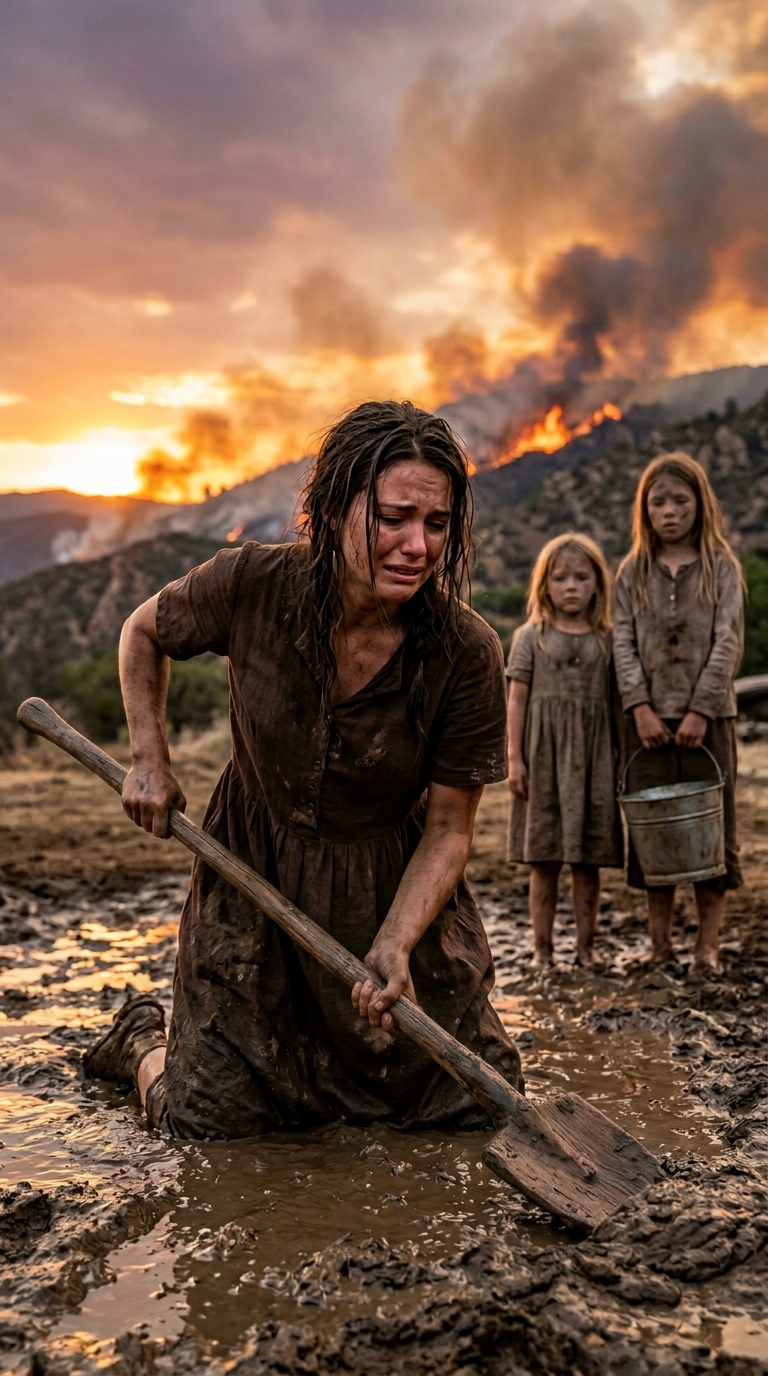
With her 300 pesos, Teresa made a decision that made the entire village laugh. She bought “The Devil’s Plot,” a piece of land abandoned for 40 years, located in the deadest part of the valley. It was a slice of hell with a shack on the verge of collapse and soil so hard and cracked that not even weeds dared to grow. The notary charged her 250 pesos and mocked her to her face.
The first night, they slept on two threadbare blankets. Ana, four years old, shivered with cold and stared at the stars through the many holes in the roof. Rosa, the eight-month-old baby, cried from hunger. At dawn, Teresa tied the baby to her back with a faded rebozo, picked up a heavy hoe, and went out to face hell.
She worked 14 hours a day under the blazing sky. She cleared the land, removed enormous stones, and began digging in an attempt to plant something. The neighboring women, led by Doña Petra, leaned against the wire fence just to mock her. “There you are, digging your own grave, you stubborn widow,” they shouted while chewing pumpkin seeds. No one offered her a glass of water.
When the seeds she had planted died after five days, Teresa realized the surface was cursed. If the soil above would not give life, she would have to look for it below. She began digging a colossal hole. Twelve days of agony passed, her hands destroyed and bleeding.
On the afternoon of the thirteenth day, at nearly three meters deep, Teresa’s hoe struck something different. It was not soil. It was not solid rock. It was a hollow sound, followed by a spine-chilling crack. Moisture began to soak her huaraches. Her heart pounded furiously. She had found something! But just as she looked up to shout to her daughter, the sunlight was blocked. A huge, menacing shadow fell over the hole. Someone was watching her from the edge of the pit, gripping a sharp machete that gleamed in the afternoon light. She could not believe what was about to happen…
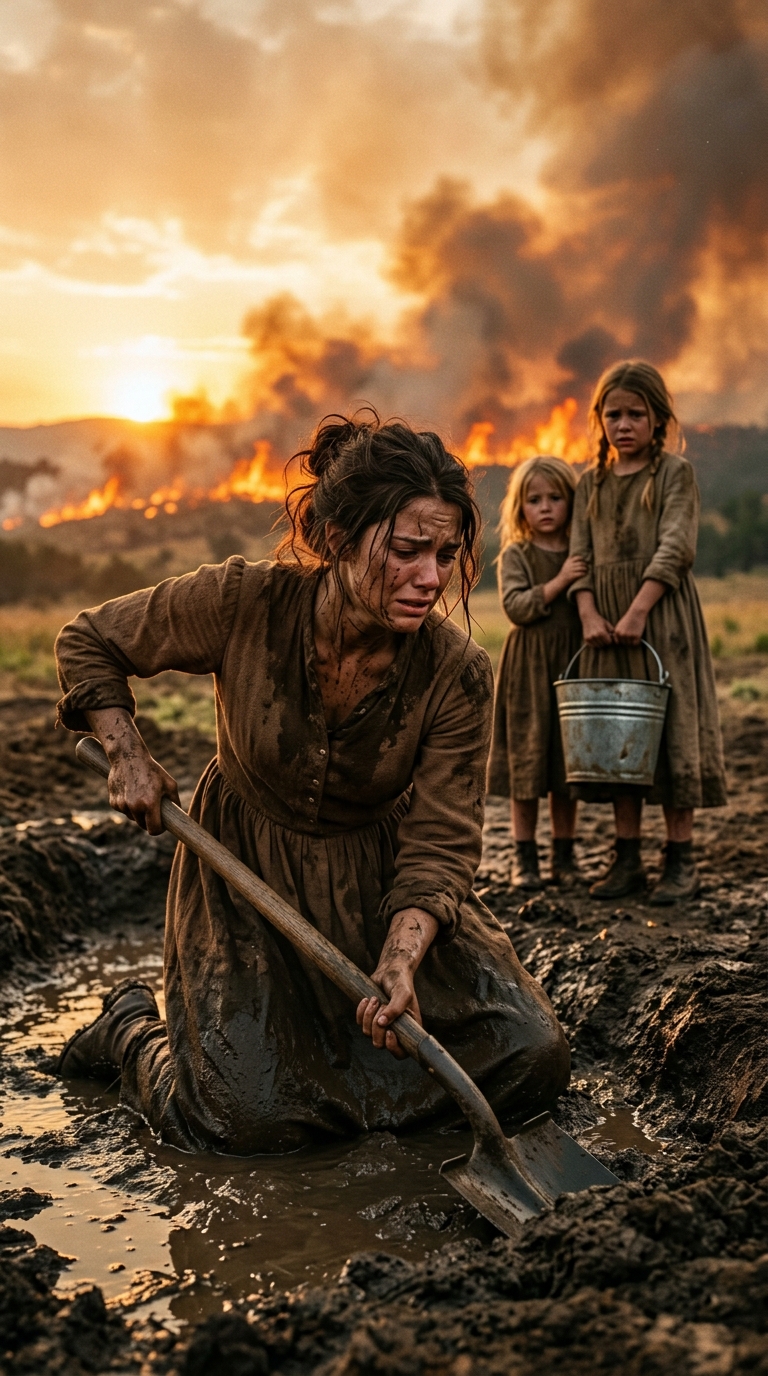
PART 2
Teresa gripped the handle of her hoe tightly, her knuckles white and her heart hammering in her throat. Squinting against the blinding sun, she recognized the face twisted by greed. It was Ramiro, her brother-in-law. The man had heard the rumors in the cantina about the crazy widow who was digging a giant crater. Believing she had found the revolutionary gold that legends said was buried in that area, he had come to claim it.
“Get out of there, you thief,” Ramiro growled, descending into the pit with the machete pointed forward. “Everything you find in this village belongs to my family. Your husband owed me money.”
Driven by that primitive strength that only mothers possess when they see their young threatened, Teresa did not back down. She raised the heavy hoe stained with her own blood.
“Take one more step and I swear to God I will bury you right here, Ramiro,” she declared in a voice so dark and guttural that it made the coward hesitate.
At that exact moment of tension, a deafening explosion came from the bottom of the pit. The crust of rock that Teresa had fractured finally gave way under the immense underground pressure. It was not gold. It was not ancient coins. A furious torrent of crystal-clear, ice-cold water shot upward like an enraged geyser, striking Ramiro in the chest and hurling him backward into the mud. The water rose with colossal force, flooding the pit in seconds. Teresa had to desperately climb the earthen walls to avoid drowning, laughing and crying hysterically as the water overflowed onto the parched plot.
Ramiro fled in terror, spitting mud and cursing, while Teresa fell to her knees, embracing her four-year-old daughter Ana. Both were soaked by the greatest miracle San Juan de las Piedras had seen in fifty years.
In less than two hours, the news spread like wildfire. The crater was not a simple well; Teresa had uncovered a main vein, a massive underground river. The water kept gushing out, forming a clean stream that began to moisten the dead cracks in the land. The villagers — the same ones who had laughed at her — gathered at the fence, speechless with amazement. Doña Petra was the first to approach, with an empty bucket in her trembling hands and shame written across her face.
“Teresa… my grandchildren have had fever for two days from drinking from the dirty puddle in the dry river,” the old woman murmured, humiliated.
Teresa looked at her. Resentment screamed at her to throw the woman out, to let them dry up just as they had let her dry up. But then she looked at her two daughters and realized that hatred is a poison that is passed down.
“Come in, Doña Petra. Take what you need. It is God’s water,” said the widow.
That act of mercy unleashed a pilgrimage. Hundreds of people arrived with clay pots. And among the crowd appeared Antonio. He was a 35-year-old farmer with calloused hands, broad shoulders, and honest eyes, who had lost his own wife years earlier. Antonio did not come to ask; he came with two shovels and a sack of seeds.
“You gave us life today, ma’am,” he said, removing his straw hat. “Let me help you channel this water so it doesn’t go to waste, and I promise you this land will become the most beautiful garden in Guerrero.”
Over the next three weeks, Antonio and Teresa worked side by side. They built channels and planted corn, beans, and chili peppers. The abandoned plot burst into vibrant green — an oasis in the middle of hell. Little Ana and baby Rosa soon grew used to Antonio’s warm presence; he treated them with a tenderness Teresa thought she had forgotten.
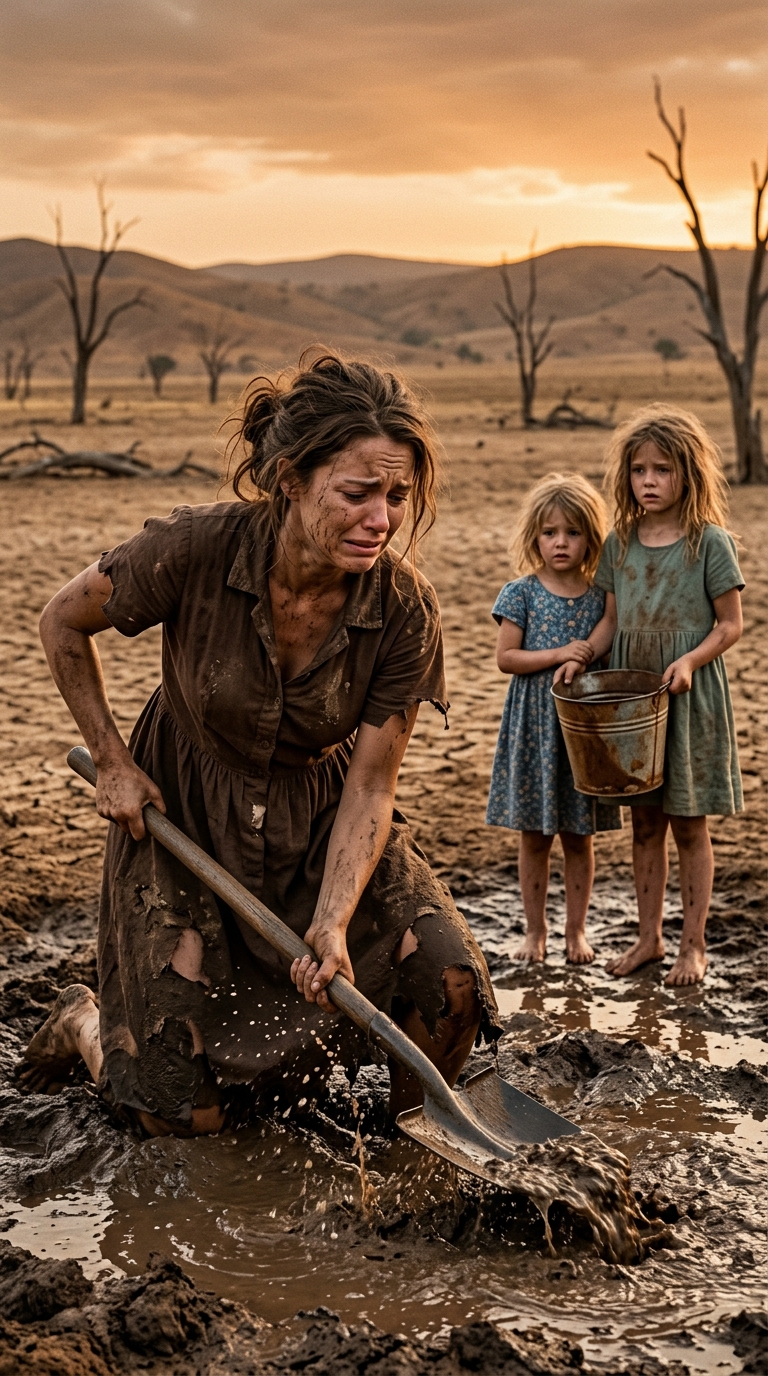
But the miracle carried with it a much darker and more dangerous secret.
One afternoon, while the village’s old healer was tasting the water from Teresa’s new stream, his face turned pale. The water had a slight but distinctive sweet mineral taste. It was exactly the same flavor as the water that flowed exclusively in the luxurious hacienda of the region’s cacique, Don Eusebio Barragán. The old man immediately connected the dots. Forty years earlier, Don Eusebio’s father had dynamited the caves in the mountain, blocking the natural channel that fed the village in order to divert the entire underground river to his private properties. They had killed the whole village with thirst to control their lives and buy their lands for pennies. Teresa had not discovered a new spring; by digging so deep, she had broken the stone plug that the Barragáns had placed four decades ago. She had freed the stolen river!
When Don Eusebio learned that his secret had been exposed and that the pressure in his own wells was decreasing, he flew into a rage. He sent five of his armed thugs with rifles to Teresa’s plot. They arrived, raising dust with their trucks, and threw a fake document at the widow’s feet.
“You have 24 hours to get out. This land has a ten-year tax debt and now belongs to Don Eusebio,” barked the leader of the hitmen, spitting on the newly sprouted corn.
Terror paralyzed Teresa. All her effort, her daughters’ future, was about to be crushed under the boot of power. That same night she packed her things, crying in silence. She could not fight against bullets.
But when she stepped out into the courtyard at dawn, ready to flee, she was left breathless.
She was not alone. Antonio stood in front of the fence, holding a heavy machete. And behind him were more than 150 people — men, women, and elders. There was Doña Petra with a pitchfork made of straw. There was the healer. The entire village of San Juan de las Piedras was there, armed with sticks, torches, and farming tools. They had lived on their knees for forty years, dying of thirst because of one rich family’s greed, and this widow had given them back not only water, but their dignity. They were not going to let it be stolen again.
At noon, when the hitmen and Don Eusebio himself arrived in their trucks to take the land by force, they faced an impenetrable human wall. The tension was suffocating. Don Eusebio stepped down from the vehicle, his face red with rage, demanding they move aside.
“That land is mine, you starving wretches!” the cacique shouted, drawing his pistol.
From the crowd, a miserable figure crawled forward, almost dragging himself through the dust. It was Ramiro. His own land had completely dried up since the water course had changed, and in his desperation, he had tried to sell Don Eusebio false information about Teresa in exchange for favors. But Eusebio had kicked him like a mangy dog. Now Ramiro fell to his knees in front of Teresa, humiliated before the entire village.
“Teresa… my crops are dead. My family has nothing to drink. I beg you… give me a little water,” sobbed the man who, months earlier, had left her on the street.
A sepulchral silence fell over the place. Everyone expected Teresa to spit on him, to deny him life as he had denied it to her. It was the perfect moment for revenge. Teresa looked at Don Eusebio, then at Ramiro crawling in the mud. She walked to the stream, filled a wooden bucket to the brim, and handed it directly to Ramiro.
“Drink, Ramiro. And may God forgive you, because I no longer have time to hate you,” she said in a voice that resounded with the force of thunder.
That act of moral superiority broke the spirit of the armed men. They saw in Teresa an absolute leader. Several of the hitmen lowered their rifles, refusing to shoot their own people to defend a thieving boss. Antonio stepped forward and handed Don Eusebio a legal document, certified by three lawyers from the capital whom the community had paid for by pooling their last savings.
“The old maps confirm that the river is national property, Don Eusebio. You and your father stole it. The federal authorities will arrive in two hours to inspect your dynamited tunnels. If I were you, I would run,” Antonio declared.
Cornered and betrayed by the fear of his own men, the cacique turned around and fled, leaving behind his empire of tyranny and thirst.
The village erupted in a cry of joy that made the earth tremble. The nightmare was over. Teresa’s plot officially became a community reserve, ensuring that water would never again have an owner. Ramiro had to leave the village weeks later, unable to bear the shame of knowing that his family’s life depended on the charity of the woman he had tried to destroy.
Time was generous. One year after the discovery, under the shade of a huge mesquite tree that now grew lush beside the water, Antonio took Teresa’s weathered hands. There were no diamond rings or great luxuries. There was only truth.
“I’m not asking you to marry me because you need me, Teresa. You’ve already proven you can conquer the world alone with a hoe,” he whispered, looking into her eyes. “I’m asking because I am the one who needs to walk by your side.”
Teresa smiled, and for the first time in a long time, she knew that the winter in her heart had ended. They were married at a celebration with tamales, ranchera music, and fresh fruit water for the more than 300 people who attended.
Today, when people pass by the green and lush garden that was once the worst plot of land in San Juan, they hear Ana and Rosa laughing as they play with their two new little brothers. And the widow’s story continues to be told from generation to generation throughout the state, reminding everyone of an unbreakable lesson:
Sometimes they bury you to destroy you, without knowing that you were a seed. And if you have the courage to keep digging through your pain while everyone laughs at you, you will end up discovering a hidden strength so powerful that it will not only heal your life, but will also cleanse the evil of those around you. Because the true treasure is never on the surface; it is down there, waiting for the brave ones who are not afraid to get their hands dirty.
