

The doorknob is ripped from your hand before you can turn it.
The bedroom door slams inward so violently it hits the wall, and three camera flashes erupt at once, flooding the sunrise-white room like a staged crime scene.
You stand there barefoot, shoes clutched in one hand, hair tangled from sleeping on a velvet sofa you never should have touched, and for a stunned second your mind refuses to accept what you’re seeing.
Then you recognize them. Arthur Varela enters first—expensive gray suit, silver hair, a smile like a blade. Beside him is Valeria Kent, Mateo’s ex-fiancée, beautiful in that cold, polished way of someone who has learned how to be watched more than loved.
Behind them come three men in dark suits, one holding a leather folder, two already filming on their phones, and just beyond the doorway paparazzi angle for shots like they’ve smelled blood.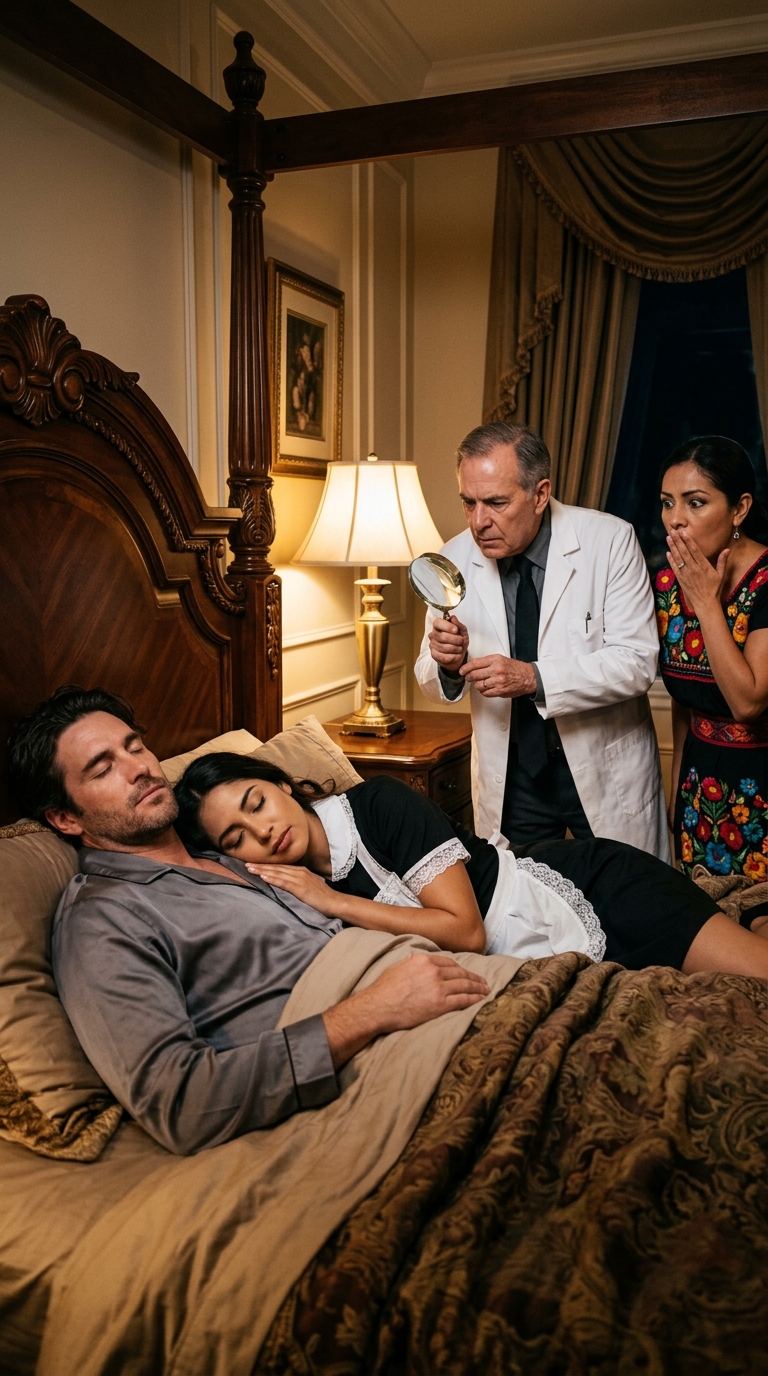
A sharp, panicked thought hits you: I am so fired.
Then Mateo sits up in bed. Not in panic. Not in confusion. Not in the fractured, restless way you were warned about. He blinks once, slowly, eyes clear, and runs a hand through his hair like a man waking from real sleep.
Arthur notices immediately, and something in his expression shifts.
That is the first sign this morning was not supposed to go like this.
“Good,” Arthur says, stepping further in. “You’re awake for this.”
His tone carries the satisfied calm of someone who rehearsed this moment. Valeria lifts the folder with manicured fingers and glances at you with quick, dismissive precision, as though categorizing you in a single look. Her eyes land on the sofa, the blankets, the untouched tray from last night, and her smile sharpens. “This is almost too easy,” she says.
You tighten your grip on your shoes.
Last night you were only supposed to bring dinner, set the tray down, apologize for existing, and leave. Instead, shaken by the silence of that massive Bel Air mansion and the even more unsettling man sitting on the edge of the bed staring into nothing, you made the worst professional decision of your life. You sat on the sofa without permission and started talking about a runaway turkey back home in New Mexico that ruined a wedding, a veil, and eventually a police car. You did the voices.
You even acted out the turkey.
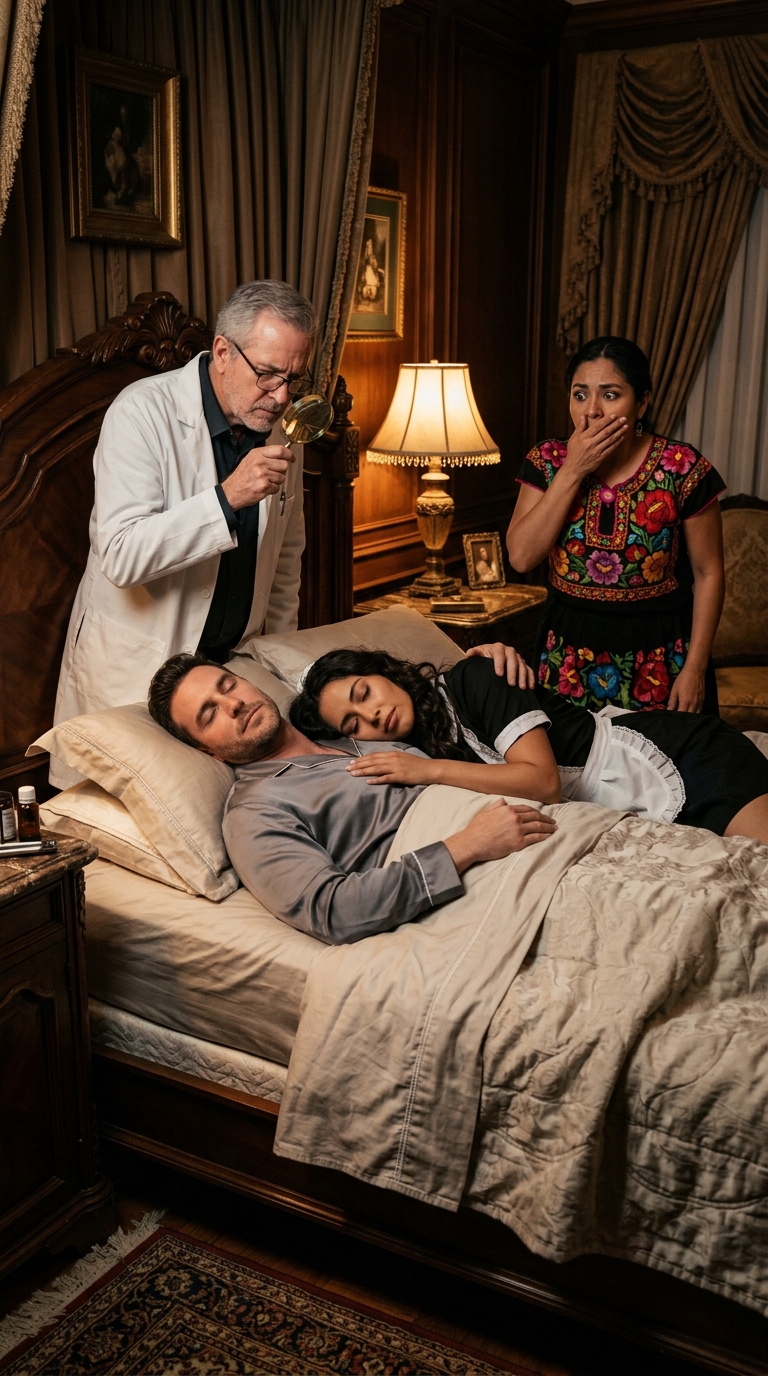
At some point Mateo laughed—a real laugh, sudden and deep, like it surprised him as much as anyone else—and then something impossible happened. His eyes closed. His shoulders dropped. Five years of tension left his face in one quiet surrender, and the man the headlines called untouchable fell asleep while you were still describing the groom’s aunt throwing deviled eggs like grenades.
You meant to leave.
Instead, you checked if he was breathing, because men carved out of wealth and silence are not supposed to soften that quickly. Then the warmth of the room and exhaustion caught up with you, and somewhere between promising yourself “just one second” and hugging a throw pillow like it owed you money, you fell asleep too.
Now the disaster stands in the doorway with cameras.
“What is this?” Mateo asks. His voice is low, steady, and rested in a way that makes Arthur’s jaw tighten.
Valeria moves first, because she always does when there is attention to be seized. She lifts the folder, steps in, and says, “It’s called consequences, Mateo. There’s an emergency petition before the board and an injunction hearing at ten. You were documented overnight with an employee in your private bedroom, in violation of the conduct provisions your father wrote himself.”
You understand enough to feel your stomach drop.
Documented. Employee. Overnight. Conduct provisions.
This isn’t scandal in the way people gossip about it. It’s structured damage—paperwork, leverage, and reputational warfare dressed up as morality.
Arthur clasps his hands behind his back and walks in like he already owns the room.
“For five years,” he says quietly, “we’ve watched you unravel. The insomnia. The instability. The isolation. The staff turnover. The missed meetings. The rumors.” His gaze lands on you with clinical precision. “And now this.”
You try to speak.
Nothing comes out.
Because how do you explain to people here for scandal that nothing scandalous happened? That the most intimate thing in that room was laughter?
Mateo swings his legs off the bed and stands.
At full height he looks dangerous even in sleep clothes, but the danger is different now. Not chaotic. Not brittle. Focused. As if sleep has removed something corrosive rather than added weakness. He holds out a hand.
“Let me see the papers.”
Valeria hesitates—just long enough to reveal she didn’t expect him this clear. Then she passes the folder over, still confident. Arthur watches the cameras outside like he’s already won.
Mateo reads.
His eyes move down the pages, and something shifts in the room. Arthur straightens slightly. Valeria’s arms fold tighter.
Then Mateo looks up. “You filed ex parte removal proceedings based on alleged moral misconduct and executive incapacity,” he says. “And you timed service for market open.”
Arthur’s smile doesn’t fade. “Still sharp when you want to be.”
“You brought paparazzi to a sealed family matter.”
“That helps the board understand urgency.”
“Or it helps you position yourself to acquire what you couldn’t take from me after my parents died.”
The air tightens.
One of the men in suits shifts uncomfortably. Valeria’s smile flickers. Arthur’s expression holds, but the room has changed—this is no longer control. It’s collision.
Mateo turns to you.
“What time did you come in last night?”
Of all things, that is what he asks.
“Uh… around nine-thirty,” you say. “Doña Carmen said you needed dinner.”
“And what happened?”
“I panicked,” you admit. “I started talking.”
Arthur snaps, “This is absurd.”
Mateo ignores him. “And then?”
“You laughed,” you say.
The room shifts at that, like even the air doesn’t know what to do with it.
“And after that?”
“You fell asleep.”
A faint, disbelieving sound comes from the hallway.
Valeria smiles again. “I’m sure the board will find that compelling.”
Something in you hardens—not dramatic, not cinematic, just final.
“I’m not a story,” you say. “And I’m not his mistress.”
Arthur lets out a short laugh. “Of course not.”
You look at him. “Then why bring cameras?”
Silence.
Because that question is too direct. Too clean. It doesn’t leave space for performance.
Arthur’s jaw tightens. “Because the company requires documentation.”
“Of me asleep on a couch?”
“Of an employee spending the night in the principal’s bedroom.”
You almost correct principal into something worse, but Mateo speaks before you can. The doorknob is ripped from your grip before you even manage to turn it.
The bedroom door crashes inward so violently it slams against the wall, and three camera flashes erupt at once, bleaching the sunrise-lit room into something that feels like a crime scene. You stand barefoot, shoes clutched in one hand, hair tangled from sleeping on a velvet sofa you were never supposed to touch, and for a stunned second your mind refuses to process what is happening. Then recognition hits.
Arthur Varela enters first—expensive gray suit, silver hair, a smile sharpened into something dangerous. Beside him glides Valeria Kent, Mateo’s former fiancée, beautiful in that icy, controlled way that comes from being admired more than loved. Behind them follow three men in dark suits—one holding a leather folder, two already recording on their phones—and just beyond the doorway, paparazzi angle for shots like they’ve already smelled profit.
A panicked thought flashes through your mind: I am so fired.
Then Mateo sits up.
Not violently. Not with the fractured, unstable panic you were warned about. Not with rage. Just a slow blink, like someone surfacing from real sleep for the first time in years. His dark eyes are clear. His shoulders loosen slightly. He runs a hand through his hair as though waking is something unfamiliar but not unwelcome.
Arthur notices immediately.
And his expression changes.
That is the first sign this morning was never meant to unfold like this.
“Good,” Arthur says, stepping further inside. “You’re awake for this.”
His voice carries rehearsed certainty, the tone of someone who has already decided he has won. Valeria lifts a folder and lets her eyes drag over you with open contempt, taking in the sofa, the blankets, the remnants of last night’s untouched dinner. “This is almost too easy,” she says.
You tighten your grip on your shoes.
Last night you were only supposed to bring dinner to the boss’s room, set it down, apologize for existing, and leave. Instead, unnerved by the silence of the Bel Air mansion and even more unnerved by the man sitting on the bed staring into nothing, you made the worst professional decision of your life. You stayed. You sat on the sofa. You talked. About a runaway turkey back home in New Mexico that ruined a wedding, a veil, and eventually a police cruiser. You even did the voices.
You acted out the turkey.
At some point Mateo laughed—a real, unexpected sound that seemed to surprise even him. And then it happened. His eyes closed. His shoulders dropped. Five years of tension drained from his face in one quiet surrender, and the man the news called untouchable fell asleep while you were still describing a groom’s aunt throwing deviled eggs like grenades.
You meant to leave.
Instead you checked his breathing, because men carved like marble aren’t supposed to soften that quickly. Then the warmth of the room, the exhaustion in your bones, and the absurd safety of it all caught up to you. You told yourself you’d rest “for one second.” You fell asleep anyway.
Now the consequences are standing in the doorway with cameras.
“What is this?” Mateo asks.
His voice is steady. Rested. And that alone makes Arthur’s jaw tighten.
Valeria moves first, as if she has been waiting for her cue. “It’s called consequences, Mateo.” She steps forward, holding up the folder. “There’s an emergency petition before the board and an injunction hearing at ten. You were documented overnight with an employee in your private bedroom, in violation of conduct provisions your father himself established.”
The meaning lands slowly, then all at once.
Documented. Employee. Overnight. Conduct provisions.
Not scandal in the simple sense. Something more precise. More surgical. A legal weapon designed to turn perception into removal.
Arthur strolls further into the room, hands clasped behind his back like he already owns it.
“For five years,” he says, almost regretfully, “we’ve watched you unravel. The insomnia. The volatility. The isolation. The staff turnover. The rumors.” His gaze flicks to you. “And now this.”
You try to speak.
Nothing comes out that helps.
Because how do you explain that nothing happened the way they are implying? That there was no affair, no violation, no calculated impropriety—only laughter and exhaustion and a moment where a man stopped suffering long enough to sleep?
Mateo stands.
Even in sleep clothes, he carries a controlled danger. But today it is different. Less fractured. More focused. Like something inside him has finally aligned. “Let me see the papers,” he says.
Valeria hesitates just long enough to betray herself, then hands them over.
Arthur smiles at the cameras still hovering in the hallway.
Mateo reads.
And the room shifts.
You watch his eyes move line by line, and realize something unsettling: rest has made him sharper, not weaker. Arthur stiffens slightly. Valeria folds her arms.
Then Mateo looks up. “Ex parte removal based on alleged moral impropriety and incapacity,” he says evenly. “Timed for market open.”
Arthur’s smile holds. “Still quick.”
“You brought paparazzi into a sealed family proceeding.”
“To show severity.”
“Or to trigger panic before acquisition.”
That last word lands harder than the rest.
A pause follows. One of the men in suits shifts uncomfortably.
Mateo turns to you. “What time did you arrive last night?”
The question catches you off guard.
“Uh… nine-thirty? Doña Carmen said you needed dinner.”
“And then?”
“I sat down. You looked like you hadn’t slept in years. I started talking.”
Arthur cuts in sharply. “This is irrelevant.”
Mateo doesn’t look away from you. “Then what happened?”
“You laughed,” you say.
A small silence follows that sentence—because no one in this room seems used to hearing it attached to him.
“And then?”
“You fell asleep.”
Valeria smiles sharply. “I’m sure the board will be fascinated by storytelling.”
Something in you straightens.
“I’m not his mistress,” you say. “And I’m not part of whatever story you’re trying to build.”
Arthur gives a short laugh. “Of course not.”
“Then why bring cameras?” you ask.
Silence again.
Because the question is too direct. Too simple. And simple questions are dangerous when everything else depends on interpretation.
Arthur’s jaw tightens. “Documentation.”
“Of me sleeping on a couch?”
“Of an employee in the principal’s bedroom overnight.”
You almost correct him on “principal,” but Mateo speaks first.
“Everyone out.”
Arthur blinks. “Excuse me?”
Mateo closes the folder. “Rebecca arrives in fifteen minutes. Legal will handle you downstairs. Everyone except Ms. Serrano leaves this room.”
Arthur laughs.
“You think you’re in control of anything right now?”
Mateo looks at one of the men with a phone. “You’re the process server. Serve and leave. The rest of you go downstairs or get removed.”
Arthur interjects immediately. “He has no authority pending the hearing.”
Mateo smiles faintly. “My uncle has confused ambition with ownership for five years. Don’t join him.”
That smile changes the temperature of the room.
Not warmth. Clarity.
The paparazzi are escorted out. The process server leaves the papers. Valeria lingers a moment longer than necessary, her expression sharp with something personal now.
When the room finally empties, Mateo picks up his phone. “Eli. Upstairs.”
Arthur crosses his arms. “This doesn’t stop the hearing.”
“I know.”
“You won’t survive it.”
Mateo looks at him. “That depends on what I decide to reveal.”
For the first time, Arthur looks uncertain.
Valeria tries one last angle. “This maid won’t save you.”
You should feel insulted.
Instead you say, “He finally slept last night. If you came here expecting weakness, that’s your mistake.”
Valeria stares at you like you’ve spoken a language she doesn’t recognize.
Arthur snaps, “Enough,” and they leave.
The room falls quiet.
Not peaceful quiet. Aftermath quiet. The kind that arrives after something almost detonates but doesn’t.
Mateo sets the papers down and closes his eyes briefly.
When he opens them, he looks at you. “Did I really laugh at a turkey?”
A startled sound escapes you. “That’s what you took from this?”
“It feels important.”
“In my defense, the turkey was committed to chaos.”
A faint twitch appears at the corner of his mouth.
Then it fades, replaced by something quieter. “I slept,” he says, almost testing the word.
“You did.”
“For how long?”
“Seven hours.”
He goes still.
Seven hours, for him, is not rest. It is rupture. A recalibration of something that has been broken for too long to trust easily.
Then he nods once, small and private.
A moment later, Rebecca enters—general counsel energy sharp enough to cut glass. She assesses the room in seconds.
“Are you the employee?” she asks you.
“Yes.”
“Good. Stay honest.”
Then to Mateo: “How bad?”
“Board emergency. Arthur pushing incapacity. Camera setup at dawn.”
“Lovely,” she says, already reading.
Within minutes, the strategy forms. No sexual contact. No misconduct. No coercion. Only evidence. Only timing. Only manipulation.
Then you remember your phone.
“It might still be in the sofa,” you say. “I was recording a voice memo last night. I didn’t stop it.”
Rebecca’s eyes sharpen instantly.
“Get it.”
You find it. The recording is still running.
8 hours. 17 minutes.
Rebecca exhales, almost smiling. “That’s either incompetence or fate.”
“Same thing,” you mutter.
She connects it to the speaker.
And the room begins to hear everything.
Your voice. The turkey story. Mateo’s laughter. The long silence of sleep.
Then Arthur outside the door.
Get the girl first.
Valeria: If he looks groggy, mention pills.
Arthur: Use whatever you get.
Silence follows when the recording ends.
Then a lawyer on the video call says softly, “He’s dead.”
Mateo doesn’t react theatrically. He just leans back slightly, like a man who has been handed proof instead of accusation.
“Get me the board,” he says.
Everything after that moves quickly.
Arthur’s network collapses under documentation, logs, footage, and financial tracing that Rebecca has been quietly assembling for months. Valeria disappears from the process the moment the room turns. The vote takes minutes.
Arthur is removed.
When it ends, silence returns again—heavier this time.
Mateo stands at the table for a long moment.
Then he looks at you. “Come with us.”
“To court?”
“To the board.”
“I clean windows,” you say.
“Today,” he replies, “you’re the only witness with clean audio in the city.”
Rebecca adds, “And unexpectedly competent under pressure.”
On the drive downtown, the skyline blurs past like something indifferent to human collapse. Mateo sits across from you.
“You’re doing the rich-man staring thing,” you say.
“What thing?”
“The one where I can’t tell if I’m being evaluated or adopted.”
He actually laughs.
“I’m trying to understand how your voice did what a team of specialists couldn’t.”
“Maybe you were just tired of being treated like a problem.”
That lands differently.
Later, he tells you about the night his parents died. About 12:30 a.m. and a phone call at 12:29 that never left him.
He doesn’t say it for pity.
He says it because something in him has finally loosened enough to speak in full sentences.
By the time the boardroom arrives, everything has already begun to shift.
Arthur tries to control the narrative.
But then Mateo places the speaker on the table.
And the room hears everything.
By the end, no one argues anymore.
Only the truth remains.
Arthur is removed.
Afterward, when the room empties, Mateo exhales like someone who has been holding breath for years.
Rebecca leaves you with a warning about contracts and charging your phone.
Then it is just you and him.
“I owe you,” he says.
“You owe me nothing,” you reply. “Your uncle owes everyone therapy.”
That earns a faint smile.
“I slept,” he says again.
“I know.”
“I don’t think you understand what that means.”
You think about that carefully.
“I think it means your body finally stopped thinking it was alone.”
He goes still.
Then: “Would you stay?”
The question is not an order. Not a trap. Just uncertainty given voice.
So you answer honestly.
“I won’t disappear into your house.”
“I didn’t ask you to.”
“I’ll stay until this settles. I’ll help. But I’m not becoming invisible.”
He nods. “Fair.”
“Also,” you add, “I want health insurance that doesn’t feel like a myth.”
That gets a real laugh.
“Done.”
Months pass.
Arthur is indicted. Valeria vanishes into a different city and a different identity. Mateo keeps sleeping more often than not. And when he doesn’t, you sit nearby and talk until the silence stops feeling sharp.
The mansion changes.
Not because it becomes richer—but because it becomes quieter in the right way.
You stop carrying trays.
You start carrying responsibility.
And one night, almost a year later, he stands on the terrace at 12:34 a.m.
“I wanted to see if I’d still feel hunted,” he says.
“And?”
“I don’t.”
You smile. “Nervous system doing overtime work.”
He laughs softly.
Then, more seriously: “I’m in love with you.”
No performance. No pressure. Just truth.
You look at him for a long moment.
“Good,” you say.
“Good?”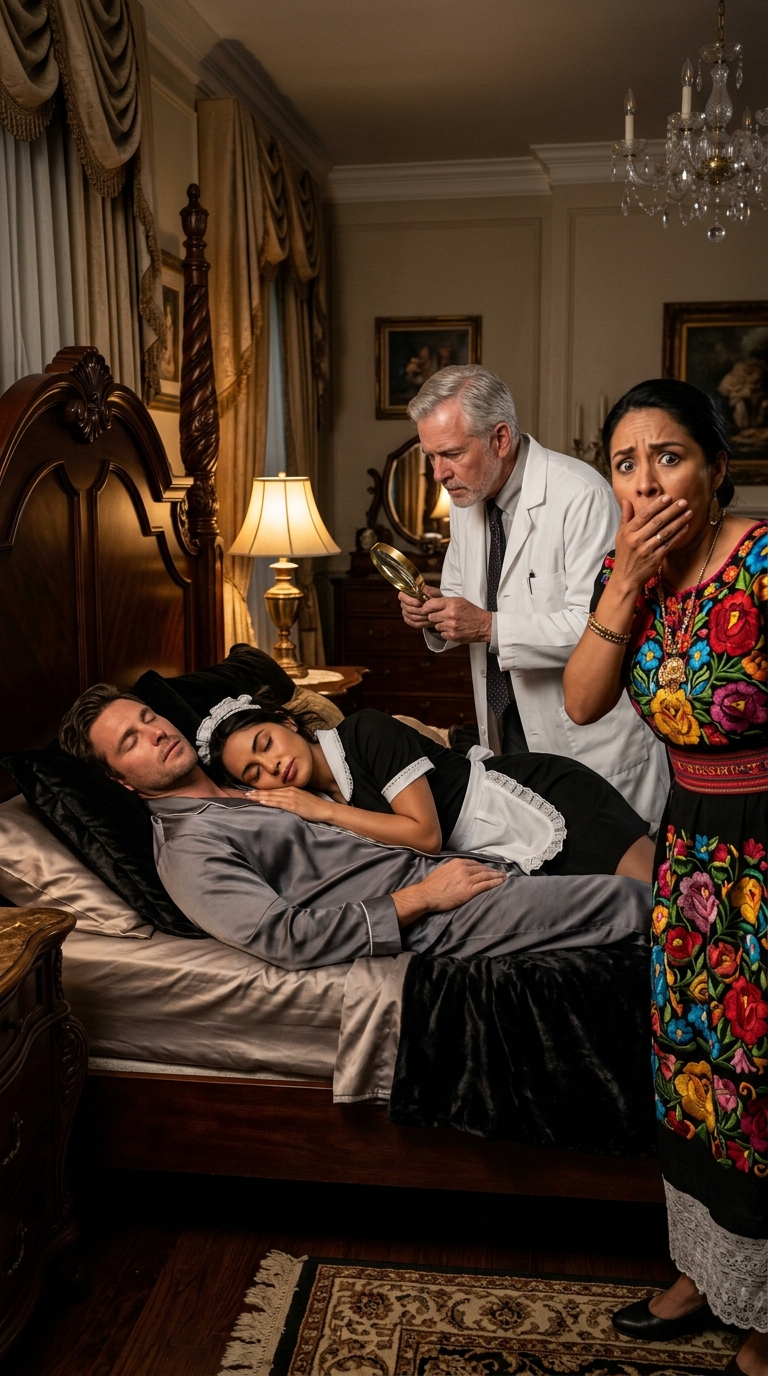
“I’ve been in love with you since the turkey story.”
He exhales a laugh that sounds like relief and disbelief at once.
When he kisses you, it is not possession. Not escape. Just choice.
And later, when people try to explain the billionaire who stopped being broken, they get it wrong in every expensive way possible.
They say leadership. Strategy. Transformation.
But the truth is simpler.
A tired man finally slept.
And a woman who was never supposed to matter talked long enough for his body to believe it was safe.
