

PART 1: The Boy Nobody Wanted at Graduation
My daughter brought a life-size cardboard boy to her high school graduation, and her classmates laughed at her.
Some students called him her imaginary boyfriend. Others pulled out their phones and started recording.
Even the principal threatened to prevent her from graduating unless she removed him.
But when Emma stepped toward the microphone and handed Principal William a folded letter, his expression changed completely.
The laughter stopped.
And within minutes, everyone in that gymnasium would understand why my daughter had refused to leave the cardboard boy behind.
That morning, I found Emma standing in front of the hallway mirror.
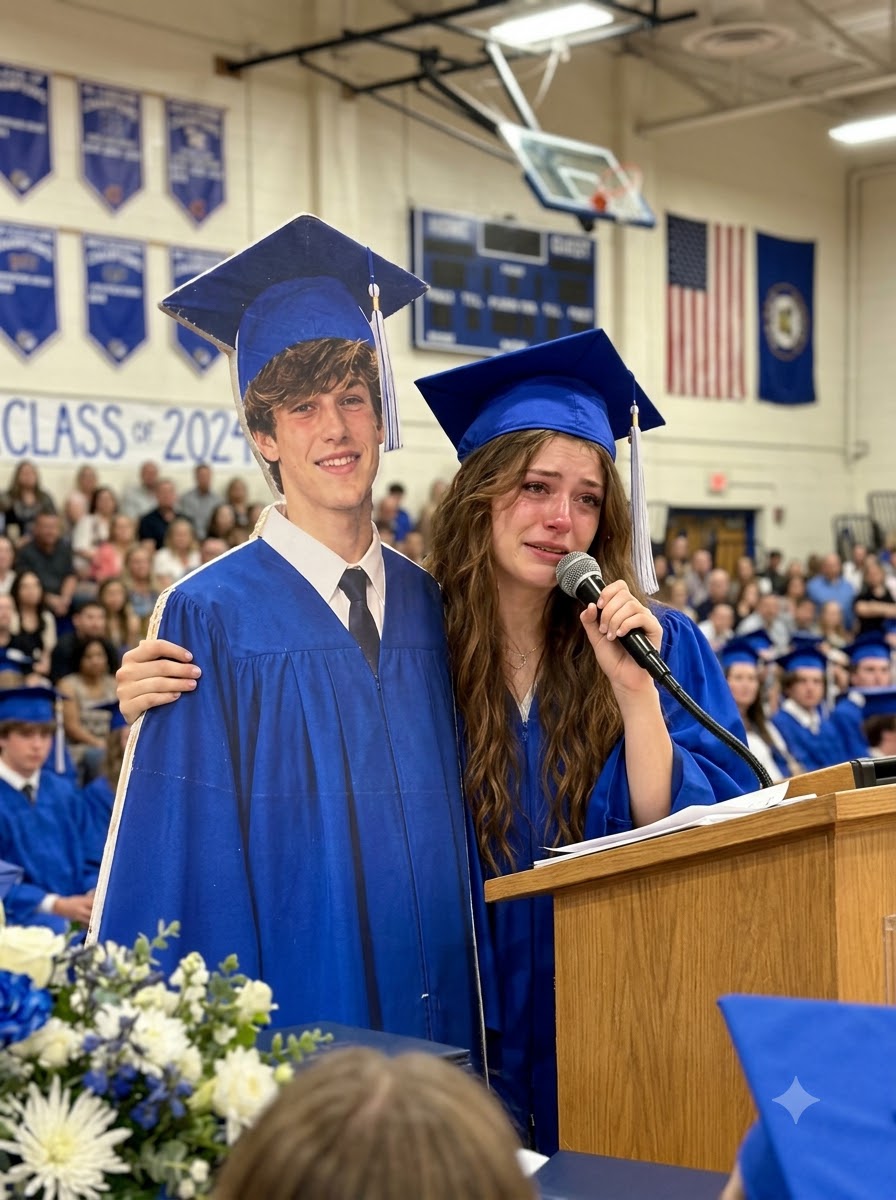
She was carefully straightening a blue graduation cap on a life-size cardboard cutout of a teenage boy.
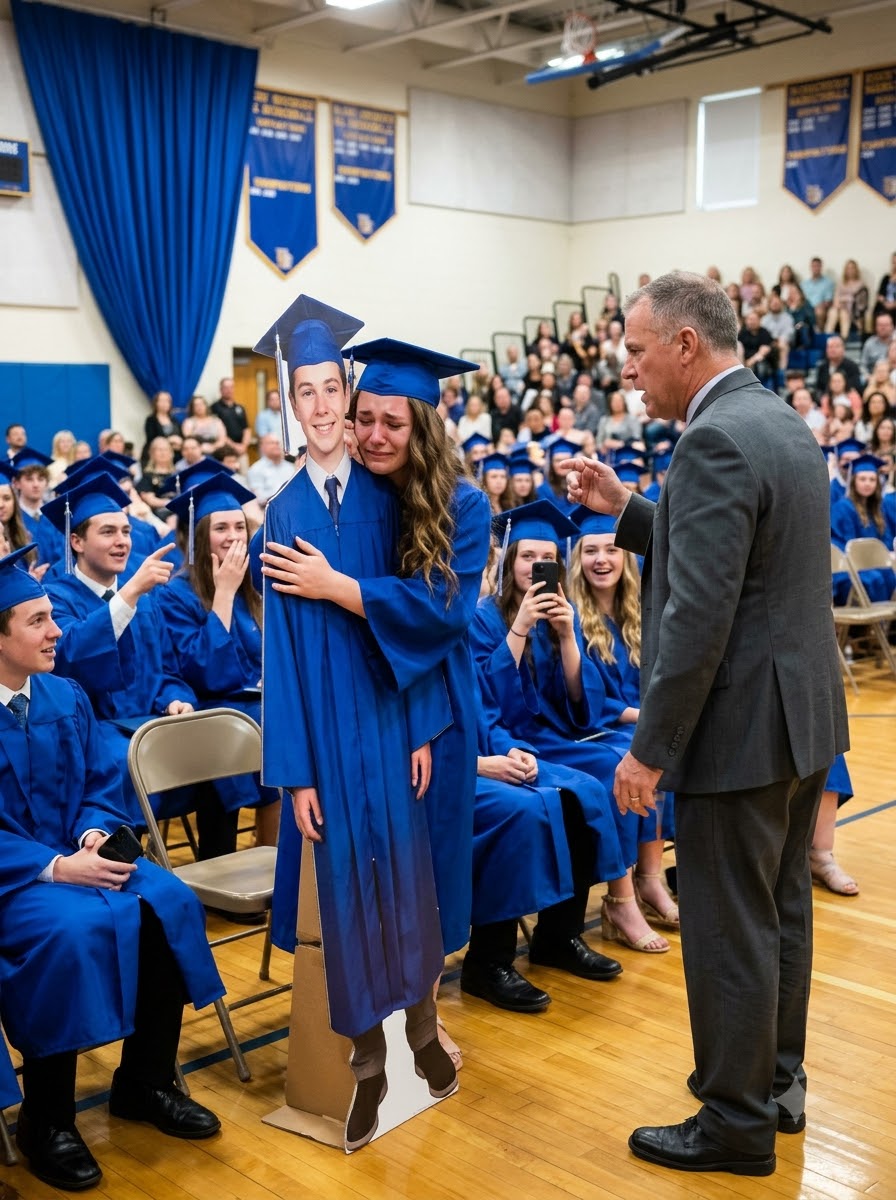
The cardboard figure wore a matching blue graduation gown.
Its smiling face was familiar enough to make my heart ache.
“Emma, please tell me you’re not taking that thing to graduation.”
She didn’t turn around.
Instead, she reached up and adjusted the cap again.
“His cap is crooked, Mom.”
I took a step closer.
“Emma, I’m serious.”
“So am I.”
She straightened the gown, examined the cardboard figure, and stepped back.
For a brief moment, she smiled.
Then she turned toward me.
Her eyes were shining.
“Mom, promise me you won’t tell anyone,” she whispered. “I need to do this myself.”
I looked at the cardboard boy.
I knew exactly why she had made him.
I was the only person who understood what his presence meant.
And that knowledge made it almost impossible to answer her.
I wanted to argue.
I wanted to explain that graduation was already an emotional day and that carrying a life-size cardboard figure into a crowded gymnasium would attract attention.
I knew how cruel teenagers could be when someone did something they didn’t understand.
I knew how quickly a joke could spread through a crowd.
Most of all, I was afraid that Emma would be hurt.
But I also recognized the determination in her expression.
She had made this decision carefully.
And she was asking me to trust her.
“I promise,” I said.
I had no idea how difficult keeping that promise would become.
The moment we entered the school gymnasium, people began staring.
Emma carried the cardboard cutout with great care, one arm wrapped around its shoulders to keep it upright.
The figure wore the same blue cap and gown as the graduating students.
For a moment, I hoped people would simply let her pass.
Then someone laughed.
“Is that her cardboard boyfriend?”
Another girl pulled out her phone.
“That’s so creepy!”
Several students turned toward us.
Someone began recording.
A few others whispered and pointed.
Emma heard every word.
I could tell by the way her shoulders stiffened.
But she didn’t argue.
She didn’t cry.
She simply adjusted the cardboard boy’s graduation cap and continued walking.
I followed a few steps behind her, trying to ignore the growing attention.
Then Principal William noticed us.
He approached quickly, his expression already disapproving.
“Emma, absolutely not. This is a graduation ceremony, not a joke.”
Emma stopped.
“It’s not a joke, sir.”
“Then remove it. You’re embarrassing yourself and disrupting the ceremony.”
My daughter shook her head.
“Please. I just want him to walk across the stage with me.”
William’s expression hardened.
“Put that thing away, or you won’t be walking across that stage at all.”
A few students laughed again.
I stood up, ready to intervene.
I wanted to tell William everything.
I wanted to explain why that cardboard boy mattered more to Emma than he could possibly understand.
But before I could speak, Emma turned toward me.
She gave a tiny shake of her head.
Our promise.
I stopped.
Every instinct told me to protect her.
Yet she had asked for the chance to explain this herself.
So I sat back down.
And I watched her carefully lean the cardboard boy against the wall near the gym doors.
The ceremony continued.
One by one, students crossed the stage to receive their diplomas.
Parents applauded.
Teachers smiled.
Names echoed through the gymnasium.
But I barely heard the speeches.
My attention kept returning to the cardboard figure standing beside the entrance.
Two years earlier, I could never have imagined seeing that familiar face printed on cardboard.
I had expected to see him sitting among the graduates.
Wearing a real cap and gown.
Laughing with his classmates.
Waiting impatiently for his name to be called.
Instead, there was a cardboard photograph.
And my daughter was sitting alone.
I tried to concentrate on the ceremony.
Then Principal William called her name.
“Emma.”
She stood.
My heart tightened.
Instead of walking directly toward the stage, she went back to the gym doors and retrieved the cardboard cutout.
A ripple of whispers moved through the audience.
William saw her immediately.
“Emma!” William snapped. “I told you to leave that thing!”
Emma stopped beside the microphone near the stage steps.
“Please, sir. Just give me thirty seconds.”
William reached for the microphone.
But Emma spoke first.
“Before you laugh at him again, there’s something I need to tell you about the boy in this picture.”
The gymnasium grew quieter.
She reached inside the cardboard boy’s graduation gown and removed a folded piece of paper.
Then she handed it to Principal William.
He glanced at the top.
His eyes moved across the page.
Then he looked at the cardboard boy.
His expression changed.
“Where did you get this?”
“It belonged to him,” Emma answered.
William examined the paper again.
From my seat, I recognized the handwriting.
My breath caught.
Suddenly, I understood why Emma had been searching through her brother’s belongings three nights earlier.
“That’s a private letter,” William said quietly.
“It was written to him. I think that makes it his.”
The gymnasium fell silent.
William looked toward me.
“Melinda, did you know about this?”
I rose from my seat.
But Emma answered before I could speak.
“Mom knew I was bringing him. She didn’t know about the letter.”
William lowered the paper.
“Emma, perhaps we should discuss this privately.”
“I tried discussing it privately.”
He said nothing.
Emma turned toward the microphone.
“His name was Felix. And he wasn’t my boyfriend.”
She paused.
“He was my twin brother.”
A murmur passed through the audience.
“Wait, Felix?” someone whispered.
Emma continued.
“He was supposed to graduate with us today. But he died two years ago.”
The girl who had been recording lowered her phone.
My daughter rested one hand on the cardboard shoulder.
“Some of you remember him. Some probably don’t. But he went here. He sat in these classrooms. He did the same homework we did.”
I stared at Felix’s smiling face.
The photograph had been taken shortly before his final hospitalization.
His hair was thinner then.
His cheeks were pale.
But he was grinning because Emma had said something ridiculous just before the picture was taken.
I remembered that afternoon perfectly.
Felix had been born with a heart condition.
For years, our family managed medication, medical appointments, and hospital stays while trying to give both children an ordinary childhood.
There were days when Felix felt strong enough to run around with his sister.
Other days, he was exhausted after the smallest activity.
But he hated being treated differently.
He wanted to attend school.
He wanted to do homework.
He wanted to argue with Emma about whose grades were better.
And he wanted to graduate beside her.
During sophomore year, his health deteriorated.
He began missing weeks of school.
Sometimes he was absent for months.
His teachers sent assignments home.
Emma carried his completed work back to school.
Even when he was exhausted, Felix insisted on keeping up.
“I can’t let Emma beat me at everything,” he’d joke.
She usually answered, “Too late.”
They had competed since kindergarten.
Who could run faster.
Who could finish a book first.
Who earned better grades.
Eventually, their competition became a running argument about who would cross the graduation stage first.
Felix insisted that being born seven minutes earlier gave him the right to go first.
Emma argued that alphabetical order would decide it.
Neither admitted that what they really wanted was to walk together.
After one particularly difficult hospital appointment, Felix asked Emma to bring him the school’s graduation information.
She arrived with the pages, and he spread them across his hospital blanket.
“Think they’ll let me walk with a chair if I’m too tired?”
“Obviously,” Emma answered.
“And if they don’t?”
“I’ll push you across myself.”
Felix laughed.
“Then make sure you don’t crash me into the principal.”
I laughed with them.
At the time, it seemed like another ordinary conversation between my children.
I had no idea how desperately I would someday wish that moment had become reality.
Felix died six months later.
He was sixteen.
For weeks afterward, Emma barely spoke.
She still attended school.
She completed her assignments.
She helped around the house.
But the girl who had once argued endlessly with her twin brother became painfully quiet.
I often found her sitting on Felix’s bedroom floor.
His belongings surrounded her.
Sometimes she searched through his notebooks.
Sometimes she held one of his school folders.
Sometimes she simply sat there, staring at nothing.
I tried not to rush her grief.
I was struggling with my own.
Losing Felix had changed everything.
The house seemed too quiet.
Every ordinary moment reminded me that one of my children was missing.
I would set the table and remember that Felix wasn’t coming downstairs.
I would hear Emma laugh at something and instinctively expect her brother to answer.
Sometimes I walked past his bedroom and almost called his name.
What frightened me most was that Emma stopped discussing her future.
Before Felix died, she had dreamed about college.
She wanted to travel.
She talked about becoming a teacher.
Afterward, whenever I mentioned graduation, she changed the subject.
I assumed time would help.
I hoped that eventually she would find a way to imagine her future again.
Then, in January, she came home carrying a folder.
“Mom, do you think the school would mention Felix at graduation?”
“Maybe. Have you asked?”
She nodded.
“I emailed Principal William.”
She had requested a brief acknowledgment of students who had died before graduation, including her brother.
But William replied that the ceremony was reserved for students receiving diplomas.
Emma was disappointed.
Still, she tried again.
She suggested including Felix’s photograph in a display near the entrance.
That request was declined too.
The school was preparing a display of current graduates.
William said he didn’t want confusion about which students had completed the graduation requirements.
Emma then asked whether she could carry Felix’s photograph while accepting her diploma.
William insisted the ceremony needed to remain consistent for everyone.
“Did you explain why it matters?” I asked.
“Three times, Mom.”
I offered to arrange a meeting with him.
She refused.
“I can talk to him myself.”
At first, I thought she was being stubborn.
But standing in the gymnasium that afternoon, watching her hold Felix’s cardboard shoulder, I began to understand how much those refusals had hurt her.
She hadn’t been asking for a diploma he hadn’t earned.
She hadn’t been trying to disrupt the ceremony.
She had been asking the school to acknowledge that her brother had once belonged there.
And now she was standing before hundreds of people, trying to explain something the principal had repeatedly refused to hear.
PART 2: The Letter That Changed Everything
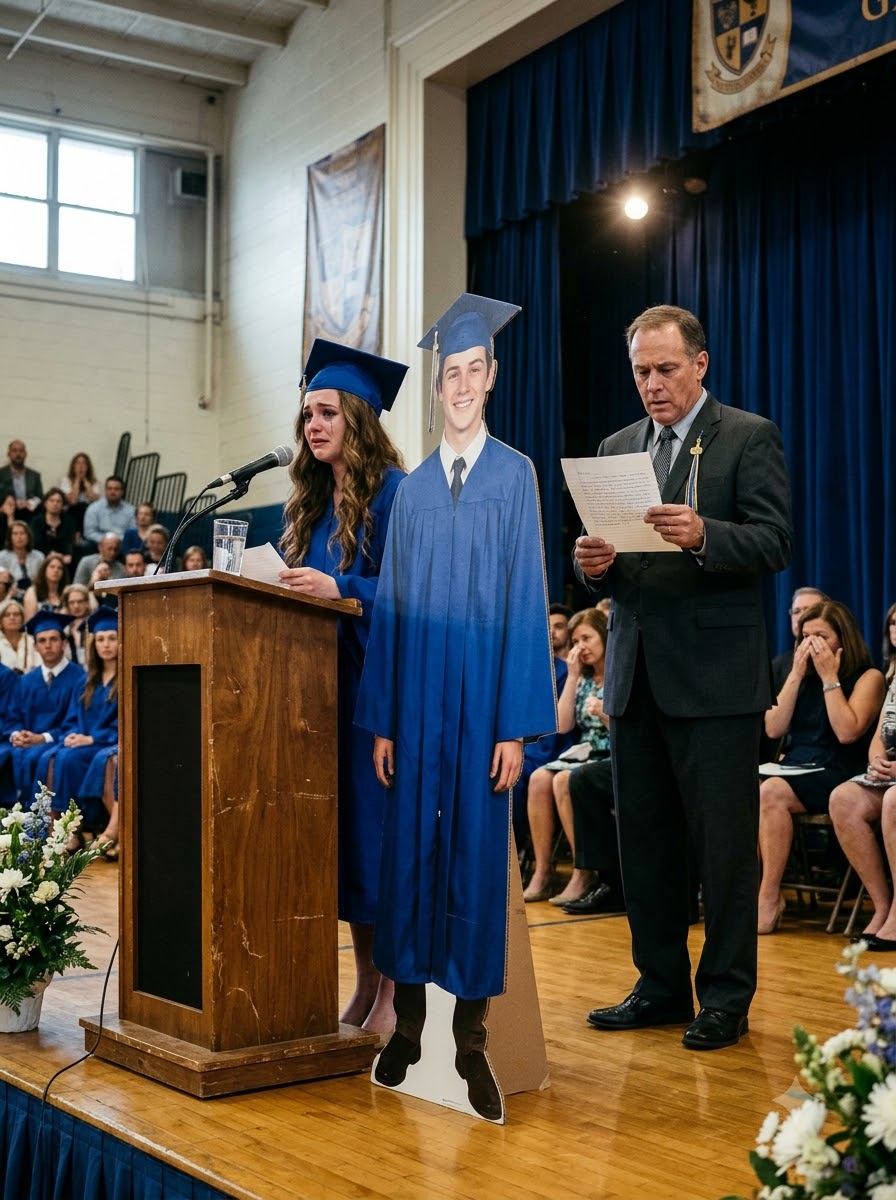
Emma stood beside the microphone, one hand resting on Felix’s cardboard shoulder.
The gymnasium was silent.
Students who had laughed only minutes earlier were now watching her carefully.
Principal William stood beside her, holding the folded letter.
I sat among the parents, barely breathing.
My daughter looked toward the audience.
“I didn’t want a special graduation for Felix,” she told the audience. “I know he didn’t finish school. I know he can’t receive a diploma.”
Her voice trembled.
“I just wanted someone to remember he was supposed to be here.”
William looked down at the letter.
Emma turned toward him.
“And you did remember him once.”
She reached for the paper.
William hesitated.
Then he returned it.
Emma unfolded the letter carefully.
“This letter was written to Felix when he was hospitalized during sophomore year. He kept it.”
She lowered her eyes to the page.
Then she began reading.
“Dear Felix, your teachers have told me how hard you’re working despite everything you’re facing. Your determination and dedication make you a valued member of our school community.”
She paused.
“Whatever the future holds, I hope you remember that you will always have a place among your classmates.”
Emma raised her head.
“It was signed by Principal William.”
Nobody laughed.
William stared at the floor.
I remembered that letter.
He had sent it during one of Felix’s longest hospital stays.
Felix had been delighted when it arrived.
“See, Mom? The principal knows I’m still part of the class.”
He placed it inside his school folder beside assignments he intended to finish.
After his death, I had packed the folder away.
Until that moment, I hadn’t known Emma had found it.
“Mr. William,” she said, “you told my brother he would always have a place here.”
William slowly raised his eyes.
“I remember writing it.”
“Then why was it so hard to let me remember him today?”
He didn’t answer.
Emma looked at the letter again.
“I asked for his name to be mentioned. I asked about a photograph. I even asked if I could carry a picture.”
Her voice became steadier.
“Every time, I was told no.”
William pressed a hand against his forehead.
“Emma, I was trying to keep the ceremony fair.”
She looked directly at him.
“Fair to who?”
The question hung in the silence.
I watched William struggle for an answer.
Emma continued.
“I’m not asking you to pretend Felix graduated. I’m asking you to remember he was here.”
Several parents wiped their eyes.
A teacher near the stage lowered her head.
But Emma wasn’t finished.
“There’s something else I need to explain.”
She turned toward Felix’s photograph.
“My brother hated when people felt sorry for him.”
A faint smile appeared on her face.
“He got so annoyed when people talked to me instead of him, like being sick meant he couldn’t answer questions.”
A few students smiled.
“He wanted people to remember he was funny. That he loved school. That he was terrible at basketball but kept playing anyway.”
Her smile faded.
“Before he died, he asked me not to put his picture somewhere just to make people feel sorry for him.”
I remembered that conversation too.
Felix had been sitting in bed after an exhausting afternoon.
Emma was beside him, helping with an assignment.
He suddenly asked what she would do if he didn’t make it to graduation.
She immediately told him to stop talking like that.
But he insisted.
“Just don’t turn me into some sad picture everybody stares at. Make sure they remember I was actually part of the class.”
Emma promised him.
At the time, I hadn’t understood how heavily that promise would weigh on her.
Now she was standing before her graduating class, trying to keep it.
“I thought about what he said for a long time,” Emma continued.
“And I know this looks ridiculous.”
She glanced at the cardboard figure.
“Honestly, Felix probably would’ve made fun of it himself.”
Gentle laughter moved through the gym.
This time, it wasn’t cruel.
It was the kind of laughter Felix would have loved.
“But when the school wouldn’t let me include even a small picture, I didn’t know what else to do.”
She reached up and straightened his graduation gown.
“So I made him big enough that nobody could overlook him.”
I covered my mouth.
For months, I had watched Emma struggle with her grief.
I knew she missed Felix.
I knew graduation would be painful.
But I hadn’t fully understood why she had insisted on creating a life-size cardboard figure.
She wasn’t trying to pretend that her brother was alive.
She wasn’t trying to attract attention.
She wanted the people who had forgotten him to remember that he had been a real student.
A real classmate.
A boy who loved school, joked with his sister, and dreamed about graduating.
Emma turned toward me.
“Mom, I’m sorry I didn’t tell you about the letter.”
I shook my head.
She looked back at William.
“I wasn’t planning a speech. I hoped you’d let me carry him across the stage.”
“Then why bring the letter?” he asked.
“Because I wanted to be ready if you stopped me again.”
She swallowed.
“And because I needed to know whether your promise still meant anything.”
For a long moment, nobody moved.
The gymnasium was completely quiet.
William looked at the letter in Emma’s hand.
Then he looked at Felix’s photograph.
I wondered whether he remembered the boy who had worked so hard to complete assignments from a hospital bed.
Whether he remembered the teachers who had praised Felix’s determination.
Whether he remembered writing that letter and imagining how much it would mean to a sick student.
Finally, William approached the microphone.
“Emma, I owe you an apology.”
His voice carried throughout the gymnasium.
“I remember Felix. I remember his teachers speaking highly of him. And I remember writing that letter.”
He glanced at the cardboard figure.
“When you contacted me about graduation, I treated your requests like scheduling problems. I didn’t consider what I’d promised your brother.”
Emma listened without interrupting.
“I was wrong to dismiss you. And especially wrong to embarrass you today.”
He took a breath.
“I’m sorry.”
Emma lowered her eyes toward Felix’s photograph.
William stepped aside.
“If you’d still like to walk with your brother, you may.”
For a moment, my daughter couldn’t move.
She stood beside the microphone, holding the letter.
Then she nodded.
“Thank you.”
She carefully folded the paper and returned it to Felix’s gown.
Then she adjusted his graduation cap.
She lifted the cardboard figure and began moving toward the stage.
A boy sitting in the second row stood.
I vaguely recognized him from Felix’s school years.
Another student rose.
Then another.
Soon, much of the graduating class was standing.
Applause began.
It wasn’t coordinated.
Some students clapped immediately.
Others stood gradually as they understood what was happening.
But nobody laughed at Emma.
Nobody mocked the cardboard figure.
The same classmates who had watched her enter the gymnasium under a cloud of embarrassment were now applauding as she approached the stage with her twin brother’s photograph beside her.
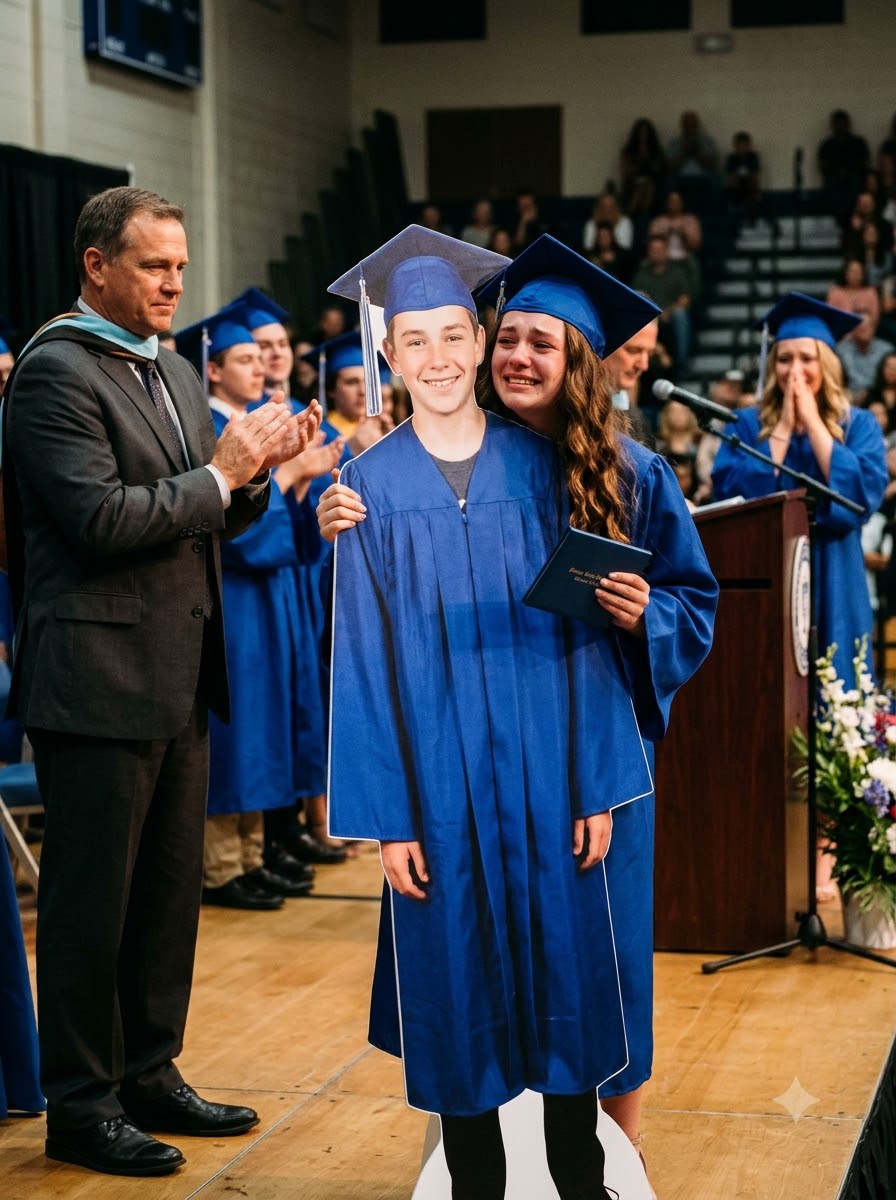
William waited until she reached him.
Then he handed her diploma to her.
“Congratulations, Emma.”
She accepted it with one hand while using the other to steady Felix’s cutout.
I raised my phone.
My hands trembled so badly that I struggled to hold it still.
Through tears, I took the photograph I had imagined taking years earlier.
My daughter stood onstage wearing her blue cap and gown.
Beside her smiled her twin brother.
It wasn’t the graduation picture we had planned.
Felix wasn’t standing there in person.
He couldn’t laugh with Emma or tease her about their grades.
He couldn’t argue that being born seven minutes earlier meant he should have crossed the stage first.
But his face was there.
His sister had made sure of it.
And for one unforgettable moment, the entire gymnasium remembered that he had belonged to their class.
After Emma received her diploma, she carried the cutout back down from the stage.
I watched her carefully guide it through the crowd.
Several students smiled at her.
A few reached out to touch her shoulder.
The girl who had been recording earlier no longer held her phone up.
Instead, she watched Emma pass with tears in her eyes.
The ceremony continued.
Other graduates received their diplomas.
Families applauded.
But something had changed.
The cardboard boy was no longer a joke.
He was Felix.
A student who had once sat in those classrooms.
A boy who had worked through illness because he wanted to graduate with his sister.
A brother who had asked not to be remembered only as someone people felt sorry for.
When the ceremony finally ended, students and families began gathering near the gym entrance.
Emma leaned Felix against the wall while classmates approached her.
Several apologized for laughing.
One girl admitted that she had mistaken the cardboard figure for a joke because she hadn’t attended the school when Felix was alive.
Emma listened quietly.
She accepted their apologies.
I could see that she was exhausted.
The speech had required enormous courage.
But there was something different in her expression.
For the first time that day, she no longer looked as though she needed to defend her brother’s presence.
People were coming to her because they wanted to remember him.
Then Principal William approached us.
He waited until the other students had moved away.
“Melinda, I’m deeply sorry about today.”
I looked at him.
“I nearly broke my promise to Emma when you threatened to stop her graduation.”
He gave a small nod.
I glanced toward Felix’s photograph.
“Felix loved this school,” I said. “Even when he couldn’t attend, he asked about his teachers and classmates every day.”
William lowered his eyes.
“I should have remembered that.”
He explained that he wanted to discuss a permanent remembrance display with the school staff.
Emma studied him carefully.
“Please don’t do it just because everyone heard what happened today.”
William looked at her.
“I won’t. I’d like you and your mother to help decide what’s appropriate.”
She nodded.
“Felix would’ve liked that.”
Then she added something that made the principal fall silent.
“I wish you’d listened before today.”
William didn’t argue.
“So do I.”
I looked at my daughter.
She had stood before an entire gymnasium and defended the memory of her brother.
She had faced ridicule.
She had faced the threat of losing her place in the graduation ceremony.
And she had done it without asking me to speak for her.
I had promised to let her handle it herself.
Keeping that promise had been one of the hardest things I’d ever done.
But now I understood why it mattered.
Emma hadn’t simply wanted me to protect Felix’s memory.
She needed to know that she could protect it herself.
And she had.
Yet the most important moment of that day was still waiting for us.
It happened hours later, when the applause had ended, the guests had gone home, and Emma finally sat alone with her diploma and the cardboard figure of her brother.
PART 3: The Promise Felix Wanted Her to Keep
That evening, messages began arriving on Emma’s phone.
Some came from classmates she had known for years.
Others were from students she barely remembered.
They were all about Felix.
One classmate recalled the ridiculous cartoons he used to draw in the margins of his worksheets.
Another remembered him helping with math homework.
Someone else mentioned how determined he had been to keep attending school even when his health made it difficult.
Emma showed me every message.
Sometimes she laughed.
Sometimes her eyes filled with tears.
But for the first time in two years, talking about Felix seemed to make her smile more often than cry.
I watched her read the messages again and again.
She had spent so long worrying that people would forget her brother.
Now memories of him were arriving from people she hadn’t expected to hear from.
The boy who had been so much more than his illness was being remembered for the things he loved.
His humor.
His kindness.
His determination.
His terrible basketball skills.
The silly drawings he left on worksheets.
The help he offered classmates even when he was struggling himself.
These were the memories Emma had wanted people to share.
Not pity.
Not a sad photograph displayed simply to make people feel sorry for him.
She wanted Felix to be remembered as a person.
As someone who had belonged.
I thought about the cardboard cutout standing near our hallway mirror that morning.
At the time, I had worried that Emma was setting herself up for humiliation.
I had been afraid that her classmates would mock her.
And they had.
I had been afraid that the principal would refuse to let her participate.
And he nearly did.
But Emma had known something I hadn’t fully understood.
She wasn’t bringing Felix to graduation because she couldn’t accept his death.
She was bringing him because she refused to let his life be erased from a day they had spent years imagining together.
I remembered the arguments they used to have about graduation.
Felix insisting he deserved to cross the stage first because he was seven minutes older.
Emma insisting alphabetical order would settle the matter.
Their teasing.
Their laughter.
Their certainty that they would somehow find a way to share that moment.
When Felix became seriously ill, those conversations grew more important.
They talked about whether he might need a chair.
Whether Emma would have to push him across the stage.
Whether she might accidentally crash him into the principal.
At the time, I laughed with them.
I wanted so badly to believe that everything would work out.
I wanted to imagine both my children graduating together.
But Felix died before that day arrived.
And Emma was left carrying a promise she had made to him.
“Just don’t turn me into some sad picture everybody stares at. Make sure they remember I was actually part of the class.”
For two years, she had been trying to figure out how to honor those words.
She asked the school to mention his name.
She asked whether his photograph could be displayed.
She asked whether she could carry his picture across the stage.
Each request was denied.
The principal believed he was protecting the consistency of the ceremony.
But to Emma, those refusals meant that Felix was being excluded from the class he had worked so hard to remain part of.
Finally, she made him impossible to overlook.
A life-size cardboard figure.
A blue cap.
A matching gown.
And a letter proving that the principal had once promised Felix he would always have a place among his classmates.
I understood now why she had asked me not to tell anyone.
She wanted to speak for herself.
She wanted to keep the promise in her own way.
And she wanted the people who had dismissed her requests to hear directly from her.
Later that evening, the house grew quiet.
I noticed that Emma hadn’t come downstairs for a while.
I walked toward her bedroom.
The door was partly open.
I found her sitting on the floor beside Felix’s cardboard cutout.
She had removed his graduation cap and placed it next to her own.
Her diploma lay across her knees.
For a moment, I simply watched her.
The cardboard figure stood beside the wall.
Felix’s familiar smile looked back at us.
I remembered the afternoon the photograph had been taken.
His thinner hair.
His pale cheeks.
The grin that appeared because Emma had said something ridiculous.
I remembered thinking that even after everything his body had endured, his sense of humor remained untouched.
Now his sister sat beside that same smile, holding the diploma he had once hoped to receive alongside her.
“Are you okay?” I asked.
Emma looked up.
She nodded.
Then she shook her head.
“I don’t know.”
I entered the room and sat beside her.
“Did today turn out how you hoped?”
“Mostly.”
She touched the edge of her diploma.
“I thought walking across that stage without Felix would mean leaving him behind.”
I waited.
She looked down.
“But when I got my diploma, I was happy.”
“Of course you were.”
Her expression changed.
“Then I felt guilty.”
I reached for her hand.
For two years, I had watched my daughter struggle to imagine a future without her brother.
She had continued attending school.
She had completed her assignments.
She had helped around the house.
But whenever the conversation turned toward college or graduation, she became quiet.
I had worried that she believed moving forward meant abandoning Felix.
Now I knew that was exactly what she had feared.
She had wanted to celebrate her achievement.
But the happiness made her feel as though she were leaving her brother behind.
I held her hand.
“Remember what Felix told you the last time you discussed graduation?”
Emma stared at me.
I remembered his words clearly.
He had been ill.
They were talking about all the things they had planned to do together.
Then Felix made her promise something.
“Promise me something, Em. If I don’t get to do all the things we planned, don’t spend your life feeling bad because you still can.”
Emma closed her eyes.
“He made me promise.”
“I know.”
She looked toward his cardboard photograph.
“I’ve been trying so hard to remember him that I forgot that part.”
I squeezed her hand.
“You can miss him and still have a wonderful life.”
She was quiet for a long time.
Then she looked at Felix’s smiling face.
“I wish he’d been there for real.”
My eyes filled.
“Me too, sweetheart.”
We sat together on the floor.
There was nothing I could say that would make his absence disappear.
Nothing that could give Emma back the brother she had lost.
Nothing that could replace the graduation day we had imagined when both children were younger.
But I could sit beside her.
I could remember him with her.
And I could remind her that loving Felix did not mean she had to stop living.
After a while, Emma picked up her diploma.
She examined it carefully.
Then she turned toward me.
“Mom? Do you think Felix would’ve been proud of me?”
I looked at my son’s smiling photograph.
“He would’ve bragged about you to everyone.”
Emma laughed softly.
“He would’ve said he could’ve gotten better grades.”
“Absolutely.”
She leaned against my shoulder.
For a few minutes, we remained there, surrounded by the graduation caps, the diploma, and the cardboard figure.
Then Emma began talking.
At first, it was something small about the ceremony.
Then she mentioned a class she wanted to take in college.
She talked about subjects she was interested in studying.
She mentioned places she hoped to visit.
And before long, she was discussing the future in a way I hadn’t heard since Felix died.
I listened.
I didn’t interrupt.
I didn’t rush to tell her how happy I was.
I simply let her talk.
For two years, I had feared that moving forward meant losing what remained of Felix.
I worried that if we packed away his belongings, stopped talking about him every day, or allowed ourselves to feel happy, we would somehow be leaving him behind.
Emma had been struggling with the same fear.
But watching her sit beside her brother’s photograph while imagining her future, I finally understood something important.
Felix hadn’t wanted his sister to spend the rest of her life standing still.
He hadn’t wanted her to feel guilty for accomplishing things he never had the chance to do.
He had wanted her to keep going.
To graduate.
To attend college.
To travel.
To become a teacher if that was still her dream.
To laugh without feeling ashamed.
To build a life filled with experiences he would have celebrated with her.
And Emma was beginning to understand that too.
The cardboard figure had helped her honor one promise.
But the conversation in her bedroom reminded her of another.
The promise to keep living.
I thought about Principal William.
He had apologized in front of the entire school.
He had admitted that he treated Emma’s requests like scheduling problems instead of recognizing the grief behind them.
He had offered to let her walk across the stage with Felix.
And afterward, he had suggested a permanent remembrance display.
Emma hadn’t accepted the suggestion blindly.
“Please don’t do it just because everyone heard what happened today.”
She wanted the remembrance to be sincere.
Not a reaction to public embarrassment.
Not an attempt to make the school look compassionate after the ceremony.
She wanted Felix to be remembered because he had mattered.
William promised that she and I could help decide what would be appropriate.
And although she appreciated his apology, she had still told him the truth.
“I wish you’d listened before today.”
“So do I.”
I respected her for saying it.
The apology mattered.
But it didn’t erase how difficult the day had been.
It didn’t change the fact that Emma had asked repeatedly for something meaningful and had been dismissed.
It didn’t undo the laughter she endured when she entered the gymnasium.
Still, the day had ended differently from how it began.
The same students who mocked the cardboard boy had stood and applauded.
The principal who threatened to stop her graduation had handed her diploma to her while Felix’s photograph stood beside her.
And the classmates who had nearly forgotten Felix were now sharing memories of him.
Emma had given them a chance to remember the boy he had been.
And they had responded.
Later that night, I looked again at the photograph I had taken during the ceremony.
Emma stood onstage in her blue cap and gown.
Her diploma was in one hand.
Her other hand steadied the cardboard cutout of her twin brother.
Felix smiled beside her.
It wasn’t the photograph I had dreamed of taking.
I had imagined two teenagers standing together.
Two real graduation gowns.
Two diplomas.
Felix teasing Emma about being seven minutes older.
Emma arguing that her grades were better.
I had imagined taking picture after picture while they complained that I was embarrassing them.
Instead, I had taken one photograph through tears.
A daughter.
A cardboard image of her brother.
And a moment that would never happen the way we had planned.
But it was still theirs.
Emma had found a way to make room for Felix without pretending he had completed the graduation requirements.
She had acknowledged the truth of his death while refusing to let his memory disappear.
She had spoken for herself.
And she had reminded everyone that a student’s place in a school community isn’t measured only by whether that student lives long enough to receive a diploma.
Felix had belonged there.
He had attended those classrooms.
Completed assignments.
Made friends.
Helped classmates.
Drawn ridiculous cartoons.
Played basketball badly.
And worked through illness because he wanted to remain part of his class.
His life mattered long before graduation day.
And it still mattered afterward.
As I prepared for bed, I passed Emma’s room one more time.
She was putting away her diploma.
Felix’s cardboard figure remained beside the wall.
His graduation cap rested nearby.
Emma looked tired.
But there was a softness in her expression I hadn’t seen for a long time.
She had cried that day.
She had faced humiliation.
She had stood before hundreds of people and spoken about the most painful loss of her life.
Yet she had also laughed.
She had celebrated.
She had received her diploma.
And she had begun talking about college again.
For the first time, I understood that grief and happiness did not have to cancel each other out.
We could miss Felix and still celebrate Emma.
We could remember the future he never had without asking his sister to give up her own.
We could keep his photograph, his notebooks, and his memories without allowing sorrow to define every day that followed.
Felix had wanted to be remembered as part of the class.
Emma had made sure that happened.
But he had also wanted her to live.
And now she was finally ready to begin doing that.
I thought back to the morning when she stood before the hallway mirror, adjusting his graduation cap.
“Mom, promise me you won’t tell anyone,” she whispered. “I need to do this myself.”
At the time, I had been terrified of what would happen if I kept that promise.
I wanted to protect her from ridicule.
I wanted to spare her the pain of explaining her brother’s death to strangers.
I wanted to step forward whenever someone laughed or criticized her.
But Emma had needed the opportunity to speak.
She needed to tell the school why Felix mattered.
And she needed to discover that she was strong enough to honor him without hiding behind me.
Keeping my promise had been painful.
Watching her stand at the microphone had been terrifying.
But hearing her speak about her brother made me realize how much she had grown.
She wasn’t the same girl who had sat silently on Felix’s bedroom floor after his death.
She was still grieving.
She would always miss him.
But she was finding her voice again.
And that voice had filled an entire gymnasium.
I looked at the graduation photograph one last time.
My daughter stood proudly beside the smiling image of her twin brother.
It wasn’t the future we’d imagined.
But it was a beginning.
Felix hadn’t needed Emma to stop living in order to remember him.
He had wanted her to carry his memory while continuing her own journey.
And she had finally found a way to do both.
If you were Melinda, would you have broken your promise to protect Emma from public humiliation, or trusted her to speak for herself?
THE END.
